

The Stimulating Effect of Anthroposophy
on the Sciences
GA 76
5 April 1921, Dornach
Translated by Steiner Online Library
3. Mathematics and Inorganic Sciences
[ 1 ] When I attempt today to make the transition from the realm of philosophy proper to that of the specific sciences, this transition, in our present era, must quite naturally be accomplished through an understanding of mathematics and physics and chemistry—that is, the inorganic realm of nature: because the vast majority of contemporary philosophical concepts are structured in such a way that philosophers base them on the concepts and ideas they have derived from the field of science considered the most reliable today—namely, mathematics and the inorganic natural sciences.
[ 2 ] If one wishes to discuss the mathematical treatment of the field of inorganic natural sciences, which is so popular today, one must always return to something that was already mentioned in the opening address: the connection that contemporary thought believes it can establish with Kant precisely through the introduction of mathematics into the inorganic natural sciences—indeed, into science in general.
[ 3 ] This is a point that will need to be emphasized—from the negative side, I say explicitly from the negative side—both in this context and in a later one; it has already been noted by certain thinkers who are very far removed from the use of supersensible knowledge. Thus, one will find the negative aspect—that is, the rejection of a purely mathematical approach to the natural sciences—exemplified quite admirably even in a thinker like Fritz Mauthner, who, out of a certain acumen, is by no means misguided in his negative stance, that is, in his rejection of what appears as the false claims of a false scientific approach. And with regard to the question: What is contemporary science incapable of? — one can learn a great deal precisely from a thinker like Fritz Mauthner, learning through the negative arguments he puts forward, and learning from the fact that he remains with this negative stance and has no desire whatsoever to advance toward a positive understanding.
[ 4 ] Why shouldn’t you also learn from such a negative thinker? If yesterday I was able to quote Ludwig Haller’s statement that, in his opinion, Kant had taken weapons from the arsenal of light to use them in the service of darkness, why shouldn’t you, too, borrow weapons from the arsenal of darkness—even the deliberate darkness of knowledge, as found in Fritz Mauthner—to use them in the service of light?
[ 5 ] As mentioned, it is worth noting Kant’s statement that in every single discipline, there is only as much true science as there is mathematics.
[ 6 ] If one studies the history of how this Kantian saying has been used right up to the present day, one finds an interesting example that helps answer the question of what it actually means to be a Kantian in modern times. For the people who invoke this statement believe that as much true scientific rigor is brought into each individual science as there is mathematics in it. Kant, however, means something entirely different. Kant means: to the extent that he introduces mathematics into science, that is precisely how much mathematics—that is, true science—is present in it, and the rest is, in fact, not science at all in the individual sciences.
[ 7 ] You see, one becomes a Kantian when one thoroughly misunderstands a Kantian statement. For the “Kantianism” in this area follows roughly this logic: If I say that in a gathering of a thousand people, there is as much genius as three brilliant people have brought to it, I certainly do not mean that the thousand people have now been endowed with the genius of those three. Nor does Kant mean that the rest of science has acquired the scientific character of mathematics; rather, he means precisely that only the small part that has remained mathematical within the sciences is true science, while the rest is not science at all.
[ 8 ] One must study such matters seriously—and in an empirical age, one should do so empirically, not a priori—so that such questions are not answered as they often are today, but so that one may uncover the truth.
[ 9 ] But there is something else worth pointing out: The most outstanding mathematical thinkers of modern times define mathematics something like this: it is the “science of quantities.” Well, today it is indeed the science of quantities. But let us go back just a few centuries to the time when Descartes and Spinoza took great pleasure in presenting their philosophy “according to the mathematical method,” as they put it, and one will find that what Descartes and Spinoza sought to incorporate into their philosophy as a “mathematical method” was something entirely different from what, in modern times, is supposed to be brought into the natural sciences as mathematics.
[ 10 ] If we go back to Descartes and Spinoza, we find that these two philosophers sought to construct their philosophical systems in such a way that the transition from one proposition to another would be as certain as it is in mathematics. That is to say, they want to construct their philosophy according to the model of these mathematical methods; but they do not intend to incorporate into their philosophy what is understood today as mathematics. Thus, by going back to Descartes and Spinoza in this way, we have already ascribed an entirely different meaning to the word “mathematics.” We have—setting aside what relates merely to quantities—associated the meaning of the internal, certain transition from judgment to judgment, from conclusion to conclusion. We have focused on the nature of mathematical thinking, not on what we might call a science of quantities.
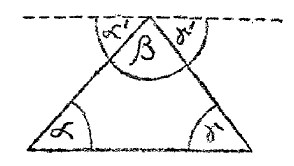
[ 11 ] And let’s go back even further. In earlier times, the word “mathematics” took on an entirely different meaning. It was then synonymous with the word “science.” That is to say, when one meant “science,” one spoke of “mathesis” or “mathematics,” because in the practice of mathematics one found the certainty of an inner insight into a “state of affairs” present in consciousness. This word was associated with the meanings “knowledge” and “science.” And so a much more general concept was applied to the narrow field of the theory of quantities. Today we have every reason to recall such things, because we are compelled to look once again at what actually lies at the heart of mathematical thinking. What is the essence of mathematical thinking? The essence of mathematical thinking is precisely the transparency of the contents of mathematical consciousness. If I draw a triangle, consider its three angles—alpha, beta, and gamma—and wish to prove that the sum of these three angles is 180 degrees, then I do the following (see Figure 1): I draw a line parallel to the base through the apex of the triangle, examine the relationship between angles Alpha and Gamma and the alternate angles formed at the parallel line, and then—by observing how the three angles formed at the parallel line—Gamma’, Alpha’, and Beta—relate to one another and how they form an angle of 180 degrees, I have the proof that the three angles of the triangle also total 180 degrees. In other words, what exists as a state of consciousness in mathematics, right down to the proofs themselves, is comprehensible; it is accompanied by inner experience from beginning to end. And this is the basis for the certainty one feels when engaging in mathematical reasoning: that everything present as a content of consciousness is accompanied by inner experience all the way to the judgment and the proof.
[ 12 ] And when one then considers external nature—whose material foundations cannot be penetrated with such clarity—one nevertheless feels satisfied in observing external nature if one can at least follow its phenomena through the experience that first presented itself to one in that clarity.
[ 13 ] The sense of certainty one feels in the clarity of mathematical concepts becomes particularly evident when one considers what is widely regarded as a major advance in mathematics during the 19th century: what emerged as “non-Euclidean geometry,” as “metageometry” in Lobachevsky, Bolyai, Legendre, and so on.
[ 14 ] Here we see how—essentially building upon the inner certainty of perception—one first modifies the Euclidean axioms and, by modifying them, constructs geometries other than Euclidean geometry, and how one then attempts to cope with an inscrutable reality using what has been constructed as an extension of visual intuition. All the ideas that have entered modern thought through this “metageometry” are, in essence, empirical proof of the security one feels in the comprehensibility of mathematical reasoning.
[ 15 ] And no one, with regard to Euclidean space—since the spaces of other geometries are, after all, different spaces—which is characterized by the fact that three mutually perpendicular coordinate axes must be conceived as extending to infinity in directions perpendicular to one another, will doubt that what has been presented here as proof of the 180-degree sum of the three angles of a triangle applies to this Euclidean space. And everyone will realize that, if one modifies the Euclidean axioms, this might have implications for the space in which we exist—which would then no longer be Euclidean space, but perhaps an intrinsically curved space—but that, for the Euclidean space that is clearly comprehensible, the Euclidean results must be accepted as certain because of their transparency. No one will doubt this.
[ 16 ] And precisely when one sees through these facts, one will find that the application of mathematics to the field of natural science is based on the fact that what has first been discovered internally is then rediscovered in the external world—that, in a sense, the facts of the external world behave in a way that corresponds to the mathematical results we first discovered through inner intuition, independently of this external world.
[ 17 ] But one thing can certainly be stated: The—I would say—prerequisite for this inner perception of the mathematical is that the mathematical first presents itself to us as an image. That inner, free activity of constructing that we experience in mathematical thinking is such an inner, free activity only insofar as nothing prevails within it that otherwise prevails within our human nature—for example, when we will something by following an instinct, or the like. From this, what appears as a component of consciousness in mathematical thinking is, so to speak, elevated to the level of imagery. Mathematics is, in relation to what constitutes “external natural reality,” unreality. And we derive satisfaction from applying mathematics to the understanding of nature precisely because we can recognize within the realm of being that which has been freely grasped in imagery.
[ 18 ] But precisely because of this, one must admit that, on the one hand, it is justified for such minds—who do not wish to limit themselves merely to what natural reality as such presents as real in human perception, but who seek to grasp the fullness, totality of reality—such as Goethe—and if such minds—as Goethe clearly demonstrated, particularly in his treatment of the “Theory of Colors”—do not seek a total application of mathematics to the entire external reality. Goethe’s rejection of mathematics stemmed precisely from the realization that, while one can indeed find in external nature through mathematics that which corresponds to the pictorial clarity of the mathematical, one thereby simultaneously distances oneself from everything qualitative. In his treatment of external nature, Goethe did not want to include merely the quantitative; he also wanted to include the qualitative.
[ 19 ] On the other hand, however, it must be said that the entire inner greatness of mathematics rests on its pictorial nature, and that it is precisely in this pictorial nature that we must seek what gives it the character of an a priori science—a science that can be discovered purely through inner intuition.
[ 20 ] But at the same time, by mathematizing, one is actually outside of nature itself—the very thing in which mathematics is particularly interested. One does not grasp anything that acts within itself, but only the relationships of this activity that can be expressed through mathematical formulas. When you calculate a future lunar eclipse using mathematical formulas—or, by substituting the appropriate quantities in negative form, a lunar eclipse that occurred in the past—you must be aware that you never penetrate the inner essence of what is happening there, but merely grasp the quantities of relationships from a certain perspective using mathematical formulas. This means one must be clear that one can never penetrate the intrinsically differentiated essence through mathematics if one understands mathematics in the narrow sense in which it is still often understood today.
[ 21 ] But already we see, even within mathematics itself, a kind of path that leads out of mathematics itself. From what I have just said, you can infer that this path, which leads out of mathematics, must be similar to the path we traverse when we, with the purely pictorial mathematics—the unempowered, ineffective pictorial mathematics—now immerse ourselves in nature, which is empowered and empowering. There we immerse ourselves in something that, in a sense, intercepts us with our free mathematical activity and forces the mathematical formulas into a process that is active in itself, that is something in itself, about which we must say: we cannot fully approach it with mathematics; the thing asserts its essential independence and its essential inner being in the face of the inner transparency of mathematics.
[ 22 ] This path—which is taken when one simply seeks the transition from the unreal mathematical mode of thinking to the real scientific mode of thinking—can, in a certain sense, already be found today within mathematics itself, in a certain respect. And we see how it can be found if we consider—not externally, but internally—the attempts that thought has made in the transition from purely analytical geometry to projective or synthetic geometry, as presented by modern science. I would like to explain what I mean by the statement I just made using a very elementary—indeed, the most elementary and best-known—example of synthetic geometry.
[ 23 ] When one engages in synthetic, modern projective geometry, one differs from the analytical geometer in that the analytical geometer performs calculations using mathematical formulas—that is, he calculates, counts, and so on. As a synthetic geometer, one uses—I mean this, of course, in an ideal sense—only the straightedge, the compass, and whatever can arise in consciousness as a fact through the straightedge and compass, whatever emerges initially from intuition. But let us ask ourselves whether it also remains purely within intuition.
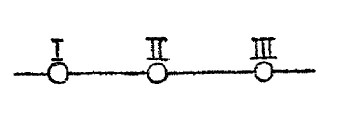
[ 24 ] Let’s imagine a line—what is called a line in ordinary geometry—and three points on that line. Then we have the following mathematical object (see Figure 2): a line on which the three points I, II, and III lie.
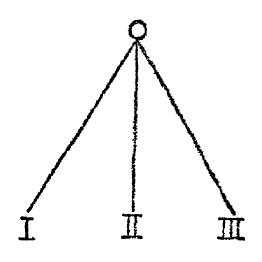
[ 25 ] There is now—I can, of course, only outline what I have to say here in broad strokes, drawing, so to speak, on what you already know about the matter — another figure which, in a certain way, corresponds in its entire configuration to the mathematical figure just drawn. And this other figure arises when I treat three lines in a similar way to how I treated these three points here, and when I treat a point in a similar way to how I treated the line here. So imagine that, instead of the three points ], II, III, I draw three lines on the board, and instead of the line passing through the three points, I draw a point (see Figure 3); and to create a correspondence, I take the point where the three lines intersect: I have drawn another figure here (Fig. 3). The point that I have marked above with a small circle corresponds to the line on the left—the three so-called rays that intersect at a point, which I label I, II, III—and these correspond to the three points I, II, III that lie on the line on the left (Fig. 2).
[ 26 ] If you want to grasp the full weight of this judgment I have just pronounced, you must take the exact wording as I have just stated it. You must say: the point on the right (Figure 3), which I have marked above with a small circle, corresponds to the line on the left (Figure 2) on which the three points lie; and the rays I, II, III on the right correspond to the points I, II, III on the left. And since the three rays I, II, III on the right intersect at the single point at the top, this intersection corresponds to the three points I, II, III on the left lying on the straight line drawn there.
[ 27 ] When expressed in this way, a very specific state of consciousness is present, and a corresponding structure is located to the left of the structure on the right.
[ 28 ] One can now—by remaining, for the time being, strictly within the realm of what is intuitively clear, that is, what can be constructed with a compass and a ruler and requires no calculation—proceed to the following state of consciousness: I will draw another line on the left, and once again mark three points on this line (the bottom line in Figure 4).
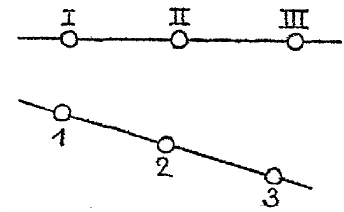
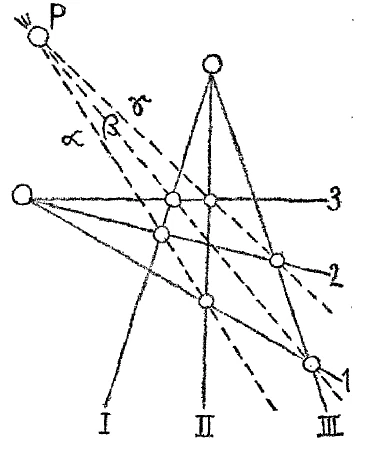
[ 29 ] I have now—and I ask that you consider the exact wording I am about to use as authoritative for the facts of the case—I have now drawn a line on the left along which the three points 1, 2, and 3 lie. I will continue and assume—please pay close attention to the words I am using: “and assume”—I will proceed as follows and then make an assumption. I will, in a certain way, connect the points to the left of one line with the points on the other line, thereby obtaining connecting lines that will intersect (see Figure 5). I will connect, on the left side of my figure, point I with point 3, point III with point i, point I with point 2, point II with point 1, point III with point 2, point II with point 3, and through these lines I will obtain points of intersection, which I can then—I am now assuming—connect with a straight line. So let my construction be carried out with such clarity that I can actually accomplish what I have just described. For this construction can indeed be carried out as shown (dotted line in Figure 5): As you can see, I have obtained the three points of intersection—which I derived in the manner described earlier—in such a way that I can draw the dashed line through them.
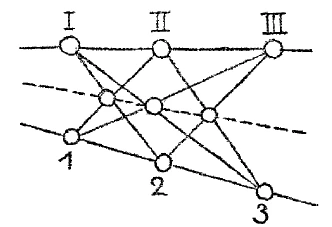
[ 30 ] I now assume that, by adding another beam to the right-hand beam (Figure 3)—as it is called—I have the same ratio of radiation within it as I do in the distance between the points lying on the left-hand line. I will therefore draw a second bundle of rays on the right (Figure 6), which, in terms of its radiation ratios, corresponds to the positional ratios of the points on the lines on the left. So here (Figure 6) I have drawn in another bundle of rays and label it 1, 2, 3, assuming that 1, 2, 3 with respect to the rays on the right correspond to 1, 2, 3 with respect to the points on the left.
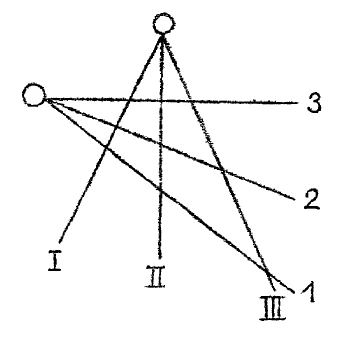
[ 31 ] And I will now perform the corresponding procedure on my two ray figures on the right, which I performed on the left (Figure 5) for my line and point figures; however, I must take into account that a line on the left corresponds to a point on the right: while on the left I looked for a line connecting two points, on the right I must look for a point that is formed where two rays intersect. The intersection on the right should correspond to the connection on the left (the points of intersection in Figure 6 are marked by small circles; see Figure 7). You can see what I’ve done: while on the left I connected III with i and 3 with I as points, here on the right I’ve drawn lines connecting I with 3 and i with III so that they intersect.
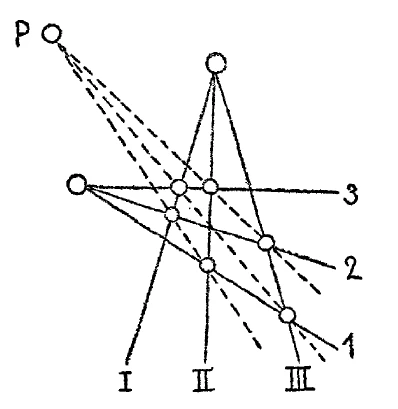
[ 32 ] And if I have drawn two lines on the left starting from points and brought them to intersect at a single point, I will now draw a line on the right through the two points I have obtained (dashed in Figure 7), and I will now perform the same procedure with respect to the other rays. That is to say [the lecturer once again illustrates the correspondence between the circled points of intersection in Figure 7 and the connecting lines in Figure 5], I will intersect II with i, I with 2, III with 2, and II with 3; so on the right I will find the points of intersection, just as I found the connecting lines on the left; and, as you can see, on the right I have found these points of intersection by bringing the rays to intersection in order to draw lines through these points of intersection (dashed in Figure 7), just as on the left I found lines by connecting the points in order to obtain the points of intersection of these intersecting lines (shaded in Figure 5).
[ 33 ] The connecting lines—but the points of intersection that I obtained on the right—intersect at a point at the top (P in Figure 7), marked here by a small circle, just as the three points I obtained on the left lie on a straight line (dashed in Figure 5). This means that in the figure on the right—where lines replace the points and intersection points replace the connecting lines—just as I obtained a line on the left that passes through the three points, I obtain a point where the three lines intersect. On the right, I again obtain a point corresponding to the line on the left.
[ 34 ] Here, by proceeding purely from the realm of the perceptible, I remain within the realm of what arises from perception, yet this leads to something else. And I ask you to consider the following. Suppose you are looking along the line in the direction indicated by the (dashed) line on the left, which passes through the three intersection points—Alpha, Beta, Gamma; then you will be looking at an intersection point that obscures the others, with the others located behind it (Figure 8). Here, laid out in the line, you do not have merely “three points.” Rather, as soon as one moves to a relationship in reality, something quite vividly apparent emerges in relation to these three points: point Gamma is the one in front, and behind it are points Beta and Alpha. You have clearly laid this out in the visual representation in the figure on the left.
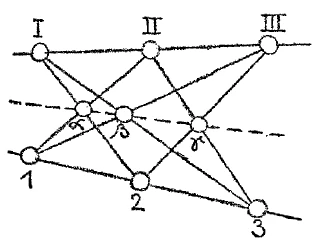
[ 35 ] If we now proceed through a completely legitimate procedure—which I have described—to the corresponding figure on the right, we must consider a point (P in Figure 9) instead of a line. When we consider this point, we must note that, just as on the left the intersection of III with 2 and the intersection of 3 with II creates a point, Gamma, which covers the other points of intersection, resulting in the relationship: Gamma is in front, Alpha is behind; thus, on the right, it becomes necessary to conceive of the following and, through the law of connection, to move from the concrete to the abstract: On the right (Figure 9), the necessity arises to conceive of the circled point (P) in such a way that the ray (Gamma), which arises from the connection of the points of intersection of lines III and 2, II and 3, first intersects at the circled point with the ray (Beta) that arises from the preceding relationship (III with 1, I with 3); and we must imagine that within this dotted point, the intersections formed by the three dashed rays 76 lie as three internally differentiated entities, just as the three points Gamma, Beta, and Alpha do on the dotted line on the left. That is to say, I must find the intersections on the right arranged within the single point in such a way that they coincide with one another.
[ 36 ] In other words, this means nothing less than the following: Just as I must conceive of the dotted line on the left—for an observing eye—in such a way that a front and a back emerge for the points Gamma, Beta, and Alpha, so must I conceive of a differentiation in all three dimensions within the point—that is, within a spatial extension of zero. At this point—viewed from the nature of how it arose from this structure—I must conceive not something undifferentiated, but a front and a back. Here I am faced with the necessity of conceiving a point not neutrally in all directions, but as having a front and a back.
[ 37 ] Here I am charting a path through which I am compelled, from the free creation of the mathematical, into something where the objective transitions into self-determination, into an inner being. You see, this path is similar to the one through which I transition from free mathematical formation to the reception of this formation from the inner determinacy within the order of nature. And as I transition from analytical to synthetic geometry, I find the beginning of the path that is shown to me from mathematics to inorganic natural science.
[ 38 ] From there, it is really only a short step to something else. By continuing the line of thought I have just outlined, one can arrive at an inner understanding of the following state of consciousness: If one uses purely projective, synthetic geometry to trace how a hyperbola relates to an asymptote, one can see quite clearly that on one side—let’s say the upper right—the asymptote approaches the hyperbola, but never reaches it; yet one still gets the impression that the hyperbola returns from the lower left with its other branch, and the asymptote likewise returns from the lower left with its other side. In other words: through this relationship between the asymptote and the hyperbola, I gain something that I could draw for you on the board in roughly the following manner (Figure 10): In the upper right, the asymptote—the straight line—comes ever closer to the hyperbola. I have added some shading there to express the nature of the relationship the asymptote actually has to the hyperbola. It comes ever closer to it; it seeks to approach it; it enters ever more deeply into the essence of its relationship with it. If one now traces this relationship upward to the right, one ultimately arrives—through purely projective thinking—at the direction of the line extending upward and to the right, whether it be the hyperbola or the asymptote, coming back from the lower left, finding the hyperbolic load and the asymptote, and doing so in such a way that, with its existence as indicated by the hatched area, it departs more and more from the hyperbolic load.
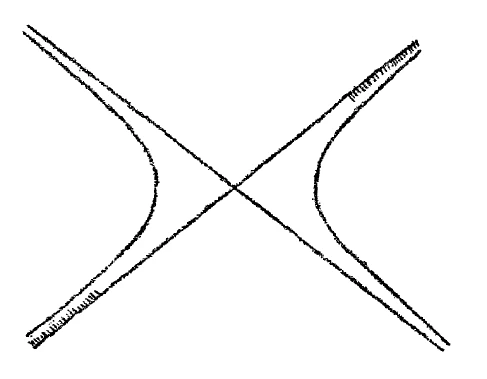
[ 39 ] So we can say: this asymptote has a curious property. As it rises toward the upper right, its relationship to the hyperbola turns toward the hyperbola; as it rises again from the lower left, its relationship to the hyperbola turns away from the hyperbola. This line, the asymptote, when I consider it in its completeness, its totality, has, in turn, a front and a back. That is why I was able to draw the hatching on one side one time and on the other side another time. I enter once again into an internal differentiation of the linear, just as I enter into an internal differentiation when I push the purely mathematical, pictorial into the realm of natural phenomena. That is to say, I approach what appears as differentiation in natural phenomena when I seek to grasp the mathematical structures themselves in the correct manner with the aid of projective geometry.
[ 40 ] What is achieved through projective geometry can never be accomplished in the same way by mere analytic geometry. For mere analytical geometry—by constructing in coordinates and then, in its calculational form, determining the endpoints of the abscissas and ordinates—remains, in its form, entirely outside the curve or outside the figure itself. Projective geometry does not remain outside the curve and the figure, but rather penetrates into the figure’s internal differentiation: down to the point at which one must distinguish between front and back—down to the line, at which one must likewise distinguish between front and back. I have mentioned only these properties due to time constraints; I could mention other properties as well, such as a certain curvature ratio inherent in the point extended across the three spatial dimensions, and so on.
[ 41 ] If one truly follows, with a part of one’s inner soul, the path that leads from analytical geometry into synthetic geometry, if one sees how, I would say, one is caught up by something that already approaches reality, as this reality exists in the external natural world, then one has the same inner experience, exactly the same inner experience, that one has when one rises from the ordinary conceptual mind, from ordinary logic, to the imaginative. One must simply go further in imaginative cognition. But the first step has been taken when one begins to move from analytical geometry to synthetic geometry. There one notices being caught up by what arises from the definiteness imparted by external reality, according to which one has grasped the result, and one notices this just as much in imaginative cognition.
[ 42 ] And now, what is the opposite path within spiritual science to the one that leads from ordinary concrete cognition into imaginative cognition? It would be the one that leads down from intuition above toward inspired knowledge. But here we already find that we are standing within the Real. For with intuition, we stand within the Real. And we are moving away from the Real. As we descend from intuition to inspiration, we are once again moving away from the Real. And when we descend to the level of imagination, we have only the image of the inner Real.
[ 43 ] This path is, at the same time, the one that reality undergoes in order to become the object of our cognition. Of course, in intuition, we are immersed in reality. We move away from reality—toward inspiration, toward imagination—and arrive at our concrete insights. These are what we then have in our present-day cognition. We trace the path from reality into our cognition. In a sense, we first stand within reality and depart from this reality toward unreal cognition. On the path we take from analytical geometry into projective or synthetic geometry, we attempt to move once again in the opposite direction—from purely rational analytical geometry into that realm where we can begin to think in real terms, if we wish to arrive at anything at all. We counter the “de-realization” of nature—which it undergoes in its striving to become knowledge—by realizing this unreal knowledge.
[ 44 ] As you can see, there is no need to assume that our modern humanities, as they appear here, would seek to apply mathematics differently than mathematicians do when they apply it strictly in their own way. There is not even much else to do—apart from seeking out specific experimental setups that lead from the quantitative into the qualitative—in the fields that quantitative natural science has already entered today. And when this external, quantitative natural science today holds up its “sound results” in opposition to modern anthroposophy, it is roughly as if someone had read aloud a poem that ventures into entirely different realms, and another person were to say: “Yes, I cannot decide, based on my state of mind, whether one can live within a poem, but I know one thing for certain: that two times two is four!” — No one doubts that two times two is four; nor does anyone who wishes to advance toward spiritual science doubt the findings of modern inorganic natural science. But there is simply no particular objection to the content of a poem, for example, when one counters it by saying: two times two is four.
[ 45 ] The point, however, is that what the individual sciences are already tending toward in particular—where they are headed—should be seriously and courageously undertaken by anthroposophy as a path to a true understanding of reality. And while some people today, in fruitless skepticism, seek to cast a shadow over what they perceive—often rightly—as the limits of scientific knowledge, anthroposophy seeks to kindle the light of spiritual knowledge precisely where the natural sciences grow dark.
[ 46 ] And so, with regard to the sciences mentioned today, it may not exactly adopt significantly different methods; but it will present to humanity the significance—the intrinsic value—of the sciences discussed today, thereby ensuring that people understand why mathematics is used to penetrate the essence of existence, not merely why it leads to a certain degree of certainty. For, in the end, the point is not simply to develop products of certainty. We could shut ourselves off in the narrowest of circles and go round and round in that circle over and over again if we merely wanted to hold fast to “the most certain things.” Rather, it is a matter of expanding our understanding. But this cannot be found if one shies away from the path leading from inner experience to outer, internally differentiated existence. This path is even hinted at in many ways in contemporary mathematics and mathematical natural science. One need only recognize it and then act scientifically in accordance with this recognition.
[ 47 ] Closing Remarks on the Debate
[ 48 ] Ladies and gentlemen! Partly because it is getting late and partly for other reasons, I do not wish to make more than a few remarks related to what has been said and discussed this evening.
[ 49 ] I would like to briefly return to the question regarding Professor Rein, because there is one aspect of this matter in particular that should be strongly emphasized.
[ 50 ] I am well aware that a Herbartian—especially one who has been trained in the historical school—cannot say very much in favor of my Philosophy of Freedom. This became apparent immediately after the publication of the Philosophy of Freedom in 1894. For one of the first reviews to appear on the Philosophy of Freedom was that of the Herbartian Robert Zimmermann. But I must say that, even though this review was extraordinarily critical, it pleased me because, in contrast, some truly significant points of view were raised at the time. As for how necessary the relationship must be between a Herbartian assessment and the content of my Philosophy of Freedom, I have not the slightest doubt about it. However, it is a pity that I do not currently have Professor Rein’s review of the Philosophy of Freedom here and cannot thus cite it as I would like to. — It has just been brought to me, and I can therefore, on the basis of the review, elaborate on certain points even more precisely than would otherwise be possible. This review begins, then, with the following words: “In times of moral decline such as the German people have likely never before experienced, it is doubly urgent to defend the great moral landmarks established by Kant and Herbart and not to allow them to be shifted in favor of relativistic tendencies. Baron von Stein’s statement that a people can remain strong only by keeping alive the virtues through which it became great must be counted today among the foremost tasks amid the dissolution of all moral concepts.
[ 51 ] It is particularly regrettable that a text by the leader of the anthroposophists in Germany, Dr. R. Steiner, is involved in this dissolution, since one cannot deny the idealistic character of this movement—which aims at a strong inner development of the individual—and can find in his plan for the threefold social order sound ideas that promote the welfare of the people. However, in his work The Philosophy of Freedom (Berlin, 1918), he takes his individualistic stance to extremes in a way that leads to the dissolution of the social community and must therefore be opposed.
[ 52 ] As you can clearly see here, the “Philosophy of Freedom” emerged from the dissolution of all moral concepts and so on—and one can certainly believe that this is one man’s opinion.
[ 53 ] Well, a large number of those present here are familiar with my views regarding scientific accuracy, scientific diligence, and, above all, the fact that one should first thoroughly inform oneself about the subject one is writing about. To associate The Philosophy of Freedom, published in 1894, even merely stylistically, with what is alluded to here in the opening sentences is reckless. And such recklessness must not be excused on the grounds that the person in question, who serves as a professor of education at a university, has—as I believe was stated—“not gone beyond the bounds of a truly objective assessment.” The point is that we can bring about a recovery of precisely those conditions that have been discussed here this evening in a rather candid manner only if we do not make ourselves guilty of the same recklessness, but rather if we rigorously exercise scholarly diligence precisely toward those whose official duty it is to influence young people through education. Those in this profession must not be allowed to overlook the circumstances and the era in which a text under evaluation was written. That is the first thing I have to say.
[ 54 ] Then there is the manner of citation. In this article, you will find an unbelievable way of taking sentences out of context and then, rather than linking those isolated sentences to what is written in my Philosophy of Freedom, linking them to what the author of the article believes, based on his own opinion, should be linked to—conclusions that, in his view, can be drawn from the interpretation of the sentences he has taken out of context. in his opinion.
[ 55 ] Anyone who takes the trouble to truly work through the Philosophy of Freedom will see that throughout this work, it is explained with complete clarity how to avoid what Professor Rein, out of misunderstanding, criticizes based on sentences arbitrarily taken out of context.
[ 56 ] What he writes about removing the Philosophy of Freedom from its historical context corresponds to placing it within impossible contexts: “When we hear Dr. Steiner speak in this way, one might be tempted to address him as an apostle of ethical libertinism.” He has also sensed this and has encountered the objection that goes something like this: If every person strives only to live out their desires and do whatever they please, then there is no difference between a good deed and a crime. Every mischievous impulse within me has the same right to be acted upon as the intention to serve the common good. Dr. Steiner seeks to refute this objection by pointing out that a person may lay claim to the freedom demanded only after acquiring the ability to rise to the intuitive content of the world’s ideas. Acquiring this ability is the task of the anthroposophist, who is to rise to the standpoint of ethical individualism.”
[ 57 ] Well, please ask yourself whether anyone is justified in writing such statements as a critique of The Philosophy of Freedom. The Philosophy of Freedom was published in 1894, at a time when there were no “anthroposophists” yet. Thus, Professor Rein places The Philosophy of Freedom within a context that was entirely impossible for the book at the time of its publication—not to mention the trivialities that follow when he speaks of it as an ethics for anthroposophists, angels, and the like, and so on.
[ 58 ] This is really not a matter of wanting to cast a negative light in any way on, shall we say, an “opposing point of view,” but rather that this way of judging spiritual matters is entirely part of the whole world of what must be eliminated from our culture if the conditions we are discussing here today are to improve. I think I can safely say that I gave it careful thought as to whether or not I should ultimately speak these words here. But the matter does seem important enough to me, and I believe that I have not overstepped the bounds of objectivity; that I have, in essence, limited myself to characterizing the manner of judgment and not the “point of view” before you here. I know that one is always, in a sense, treading on thin ice when all sorts of family connections are brought up. However, I cannot let that guide me—even though I am not otherwise bound by such considerations—because I have no father-in-law among the professors!
[ 59 ] Now I would like to make a few more remarks and follow up on a statement that was also discussed here today. Really, just to speak symbolically, I would like to share a small experience, which is meant only to illustrate my point.
[ 60 ] It has been said that it is true that not all students who enter a university or college are actually ready for that institution; however, the professors at these institutions are not to blame for this—rather, these students are simply sent to them by the secondary schools. Yes, but I really couldn’t help but recall a conversation that had once taken place in my presence with one of the most famous literary historians at German universities. This literary historian was also on the examination board for high school teaching certification. — I actually do this reluctantly; but times are so serious today that one must bring up such matters as well. — He said: “Yes, as for these high school teachers—we know them, of course, and we have to examine them—but we sometimes have quite strange thoughts when we have to send these camels out into the high schools as teachers!”
[ 61 ] Well, as I said, it is merely an illustration I would like to offer through this experience. I don’t know if it reflects very well on university professors when an examiner and renowned university professor deigns to call those teachers of young people who are sent out to the high schools “camels.” I’m not saying it, but the man in question did. I’m merely quoting. — Well, every thought must be thought through to its conclusion. And I believe that, when the thought is thought through to its conclusion, university professors have no right to complain when incompetent high school graduates enter the university gates; for it was the university professors themselves who sent out the high school teachers who produced these graduates. So ultimately, as I said, it is necessary to think the idea through to its conclusion. And that shows us that, albeit with some leniency, we may already apply the concept of guilt in a certain respect.
[ 62 ] But some rather strange things have been said today, you see. And I must say, one of the strangest remarks—almost one of those little tidbits—was the claim that a university professor had said: “We expect salvation from the student body!” — I’m just surprised he didn’t go on to say: “From the moment we take our seats in the lecture halls and promote the students to the lectern.” — You see, it is indeed necessary to examine the increasingly trite judgments that are so prevalent today—judgments that are nevertheless the cause of our current circumstances—and to investigate the triteness of these judgments. Of course, when one does so, one does not fail to recognize that exceptional circumstances and exceptions exist everywhere, and one can, for example, agree with much—very much—of what has been said regarding art education at the academies. But on the whole, one must say: There really isn’t all that much reason to to harbor high hopes for the future unless one is willing—not merely on the surface, through some association or the like—to band together to work toward some undefined goal, but unless one is willing—and only if one is willing—to truly engage in a thorough renewal and revitalization of our spiritual life itself. The very nature of the harm is already encroaching upon our spiritual life itself. And anyone familiar with the entire structure of anthroposophical life—as it has led, for example, to this School of Spiritual Science—certainly does not need to be told that “everyone must be free to express their worldview and speak from their own free convictions!” The many malicious individuals who are around today, ready to say all sorts of inaccurate things about the anthroposophical movement and everything connected with it, will immediately capitalize on this and say: These anthroposophists want their worldview to be represented everywhere.
[ 63 ] Well, the Waldorf School was founded from within our own ranks, without this in any way constituting the establishment of an ideologically driven school. The very opposite of an ideologically driven school was intended to be established. This has been emphasized time and time again. And anyone who believes that the Waldorf School is “an anthroposophical school” simply does not know it at all. Nor can it be said here at the Goetheanum that, in anything that takes place here, anyone is in any way hindered in the free expression of their own deepest convictions.
[ 64 ] But the one thing I will always fight for—despite all the freedom, individuality, and intellectualism—is: scientific rigor, thoroughness, and being well-informed about the very subject one is writing about—not merely stating one’s own opinion, because one believes that harm could potentially result from something one has not actually made an effort to understand, and from which one pulls out a few sentences to write an article.
[ 65 ] I say this without any emotion whatsoever. As you know, I usually use the so-called “discussions” about anthroposophy merely as a convenient opportunity to characterize general conditions. Personal attacks do not interest me at all, really, except insofar as they point to what must be eliminated from our circumstances. And in this regard, I do believe that the fellow student from Bonn, in his hearty manner, struck the right note—a note that is true insofar as the students he was referring to are indeed unable to find what they are looking for at universities or colleges today.
[ 66 ] But not “because of the curriculum,” not “because the selection process is flawed,” but because today’s youth—quite instinctively, though not fully aware of it—yearn from the depths of their being for something that does not yet exist within the framework of general scholarship, but which must be created within that framework. This is what the youth expect. These young people will certainly not hesitate to seize the opportunity with both hands when they are truly offered—what they actually want—a truly new spirit. For the present age needs just such a new spirit.
[ 67 ] That is, in essence, also the reason for the aversion to what emanates from anthroposophical spiritual science, even if people pay lip service to the idea that “one wants to be open to everything new.” When it comes down to it, they don’t actually do it. Because, deep down, they are simply unable to. It would be of no use to conceal these things in any way; rather, they must be pointed out sharply, plainly, and clearly.
[ 68 ] Then the question of the World School Association was raised here. I believe I expressed quite clearly what I have to say about this World School Association—in terms of its intentions—at the end of our last university courses here in the fall. I then went on to emphasize, in much the same way, the necessity of establishing such a general World School Association in The Hague, Amsterdam, Utrecht, Rotterdam, and Hilversum: that the possibility of working within a World School Association depends on the conviction—that a new spirit must take hold in the general school system—spreading among as many people as possible. I pointed out that today it is by no means a matter of establishing schools here and there that would stand in isolation and in which one applies a method prevalent in this or that respect, but rather that the school system of modern civilization—the school system of all categories and all subjects—must be taken in hand based on the idea of a self-sustaining, internally liberated spiritual life.
[ 69 ] As far as I am aware, the words and appeals I have spoken so far are, in essence, the only thing I have to report. These words were intended to find an echo among the civilized population of today. I have no such response to report. And I believe the fellow student from Bonn spoke the truth when he pointed out that, after all, the student body from whose hearts he spoke here is in the minority. I believe it is very, very much in the minority, especially in Germany. But also elsewhere—I don’t want to say anything unkind to anyone—elsewhere, not far from where we are. This is evident from the attendance at this university course. He said: “The majority of the student body is asleep!” Yes, it rages at times, too. But one can also sleep while raging when it comes to the issues at hand.
[ 70 ] And as for the matters in connection with which this demand for the World School Association has been raised, everything remains in a state of slumber, even in the broadest circles. And it must be said: People have not yet fully come to terms with just how necessary it is to bring anthroposophical work into modern civilization. — We should get used to this, and I long for the day when I can report more substantively on the question of the World School Association. Today I still cannot say much more than what I said here at the end of the University Courses last fall, even though what I said was intended to make it possible to report something entirely different on the subject today.
[ 71 ] But the same is true of other things, and it is very difficult to raise awareness of precisely those issues that really matter in today’s world.
[ 72 ] In a lecture I gave in Berlin—after Lloyd George had patched things up following a strike in England that had already broken out—I pointed out that such measures accomplish nothing, that they are merely a postponement. It seems people took it as mere rhetoric at the time. Well, please see for yourselves today—you’ve been able to do so for several days now—whether what I said back then was mere rhetoric, or whether it might not, after all, have stemmed from a deeper understanding of social interrelationships and the necessity of such interrelationships.
[ 73 ] That is the difficulty: today, one finds so few people with the kind of enthusiasm that brings about a genuine, inner engagement with what they, after all, are happy to hear. And that is why I am always delighted when I encounter young people who have something to say about how they still find this or that—whatever they are seeking—here or there. For I believe that from such impulses will emerge what we need for all insight, for all understanding: inner involvement, inner involvement that knows how profound the metamorphosis must be—the one that leads us from the forces of decline in an old civilization to the impulses of the new civilization. Indeed, we need conscientious understanding; we need profound insight. But above all, we also need what young people could bring forth from their natural dispositions. We need—not only among the young, but in the broadest circles of present-day civilized humanity—not only insight, not only a profound understanding of the truth, but we need enthusiasm for the truth!
