

The Stimulating Effect of Anthroposophy
on the Sciences
GA 76
6 April 1921, Dornach
Translated by Steiner Online Library
4. Organic Natural Sciences and Medicine
[ 1 ] The subject I will be addressing today is so vast—even if it is to be examined from a single perspective—that what I will be able to offer today can only be a few brief insights, and I ask you to bear this in mind. The point is that, as we progress from the inorganic natural sciences to the organic natural sciences—and then on to psychological and spiritual considerations — on the one hand, the necessity for spiritual-scientific, anthroposophical consideration becomes ever more apparent; yet on the other hand, this progression also increasingly reveals how what is called spiritual science here can have a fertilizing effect on the individual specialized sciences.
[ 2 ] With regard to what could be said about the nature of mathematics and the nature of the inorganic natural sciences, the point was not so much that a humanities-based approach would somehow bring about, in a thoroughly radical way, a different method of treatment—and, in particular, a different content—than what already exists in our current scientific mindset. You have therefore been able to discern a certain underlying tone in the lectures so far on mathematics and the inorganic natural sciences, one that aimed to suggest how, everywhere—in mathematics as well as in the inorganic natural sciences—the beginnings of that approach to these sciences, which is recognized by the humanities as the correct one, are present, even if they go unnoticed by most. You have seen how one must point to the transition from the analytical treatment of geometry to the synthetic treatment, and how one finds there that continuing along this path leads to imaginative contemplation—provided one does not remain stuck at the formal level but moves on to a living grasp of what is actually present there. And you have then seen, when a more purely mathematical consideration was presented, how a certain more lively treatment of the problems is to give rise to what, in mathematics and the inorganic natural sciences, is to be regarded as correct in the anthroposophical sense. In a sense, we have delved into these sciences and sought within them the focal points in the directions of which we are to proceed. The only point is that, in these sciences, one remains strictly within the objective mode of observation—which is the characteristic of present-day human consciousness—and that there is no need to arrive at anything other than a certain “how” in the approach to this observation.
[ 3 ] The situation is different in the organic natural sciences, although there is something similar here as well, albeit in a different context. When we speak today of mathematics, the inorganic natural sciences, phoronomy, mechanics, and so on, we must point to the way of thinking that needs to be reformed, as was done yesterday. In the organic natural sciences, however, the starting point is that one must point not to what must be rejected, but to what must be embraced. This begins already within the world of facts itself. There, nothing substantial can actually be achieved through a mere reform of the way of thinking.
[ 4 ] I would like to begin with a brief historical overview intended to clarify how we should proceed in this area in order to arrive at a fruitful perspective. We have pointed out elsewhere in our discussion that, in the ongoing course of human development, what we call the distinctive nature of our present-day consciousness has actually only emerged since the 15th century A.D. All earlier modes of perception were, in essence, quite different. It was only from the aforementioned point in time that humanity truly embraced that form of consciousness which, on the one hand, leads to the exercise of freedom, but on the other hand, by turning the individual back upon himself, casts him into an abstraction through which he becomes, in a certain sense, detached from reality in relation to the world of being. It is the approach that relies solely on external observations and their description, on the design of experiments and the observation of their results—that is, the answers that nature provides when questions are posed to her not merely theoretically, but practically, through experimentation.
[ 5 ] The faculty of the soul that is applied in this way to bring about science is the combinatory power of the intellect. This combinatory power of the intellect is, first and foremost—I would say—the great practical-scientific problem. It becomes such when one raises the question of its proper application. And this question of the proper application of the power of understanding—or ordinary reason—in observation, in the synthesis of observations, and in experimentation—this question arose particularly for Goethe. And anyone who—as you can read in my “Introductions to Goethe’s Scientific Writings,” which is now nearly forty years old — into what actually became a problem for Goethe—will find that Goethe did not want the power of the intellect or reason to be applied in such a way that it provides science with actual content, that one, so to speak, uses the power of the intellect or reason to say something about being as such, but rather in such a way that this power of the intellect or reason is used only to to conceive of phenomena in such a way that one phenomenon explains another. Thus, by making use of one’s intellect or reason, one has added nothing to what the phenomena themselves express.
[ 6 ] The point is that, if one wishes to apply reason alone, one must then proceed unreservedly toward a pure phenomenology—that is, use reason solely to contemplate a phenomenon purely, doing nothing other than bringing it to pure contemplation, and then placing the other related phenomenon alongside it; so that through this arrangement of phenomena—which is then also put into practice in the experiment—the phenomena themselves are led to explain one another. The intellect thus has merely an organizing, a—so to speak—truly methodological significance, not a qualitative one. In the Goethean sense, nothing may emerge from it that in any way says anything about Being itself.
[ 7 ] This, I believe, sharply clarifies what Goethe regarded as the use of the power of reason, and it is also what the general consciousness of humanity has been striving toward since the first third of the 15th century. One could say that not everyone has yet learned to resign themselves in a certain way when it comes to the intellect, as Goethe sought to do in his own research, even if he did not fully succeed in this in every instance. But this kind of intellectual life lives on unconsciously in the scientific endeavor from which spiritual science seeks to emerge—albeit in a different way than through the intellect—as an unconscious ideal.
[ 8 ] And what I am saying now is plain as day when one looks at the developments that have taken place in scientific thought, let’s say, from the beginning of the 19th century—and I’m not referring here to the natural philosophers, but to the empirical natural scientists, from the likes of Johannes Müller up to Mach, or even Poincaré and the others, or to Fritz Mauthner, who, admittedly, is not a natural scientist.
[ 9 ] Anyone who truly wishes to gain an understanding of what is at stake here must familiarize themselves with something that still played a certain role in the first half of the 19th century, but which was then completely abandoned toward the middle of the 19th century, and which is now reappearing here and there in scientific discourse in a curious form. This is the idea of vital force—what is known in scientific circles as vitalism.
[ 10 ] If we return to the concept of vital force as it was understood in earlier times, we see that those who believed in the existence of this vital force said to themselves: When we consider an object of inorganic nature, we find within it all manner of forces—thermal force, light force, electrical force, and so on; but when we consider a being of the organic world, we find, in addition to these forces that constitute inorganic nature, the vital force, the life force. This life force is present in every living being, just as magnetic force is present in a magnet. It takes control, as it were, of the inorganic forces in order to synthesize them and produce effects that they, acting on their own, cannot achieve.
[ 11 ] The final blow to this concept of vital force came with Wöhler and Liebig’s synthetic synthesis of an organic compound, and it was abandoned as such in the second half of the 19th century. But in so-called neovitalism, it has recently reemerged from obscurity, because certain thinkers have come to realize: If we apply the methods we have developed to explain the inorganic using inorganic forces to the organic, we simply cannot make sense of it; we must look for something else within the organic. — And, I would say, with a clear echo of the old life force, something like this is once again emerging in Neovitalism as an explanation in the organic sciences.
[ 12 ] But anyone who really engages critically with what remains of the concept of “vital force” even in Johannes Müller’s analysis will find that there is something in this vital force that, as a concept, cannot actually be fully grasped. And I would say that it was precisely because of the impossibility of grasping the life force as a concept that it died out in scientific thought over the course of the 19th century. It could not be grasped. And why could it not be grasped? To begin with, if one proceeds very cautiously in examining the organic-scientific methodology of the 19th century, one will see how those who wrestle with the idea of this life force find that they cannot make sense of it. What they seek to grasp vanishes immediately when they approach the phenomenon with their idea. They simply do not get to the heart of the matter. They fail to do so fundamentally because they do not clearly grasp the actual function of intellectual activity.
[ 13 ] In our age, intellectual activity tends to focus solely on the phenomenon and to juxtapose it with another, so that one phenomenon explains the other. But this cannot be done with the life force. When it comes to the life force, if one wishes to do anything at all, one must always introduce something into the phenomenon from the activity of the intellect. One must, so to speak, attribute something to the phenomenon. And therein lies what has gradually become a cause for concern in the use of the concept of vital force. This was then the reason why it was abandoned entirely and why, in the broadest circles, a certain ideal emerged: to view living beings now as a convergence, a combination of those forces that also prevail in inorganic nature.
[ 14 ] In other words: the idea of vital force has actually become a kind of changeling. People have come to seek the constitutive element in the sciences solely in the phenomenon. The life force did not present itself as a phenomenon. One had to—which was actually impermissible in this era of human development—construct the vital force from the intellect. That was the negative aspect of the development in which we find ourselves today. For in neovitalism, nothing concrete appears. What Neovitalism substitutes for an explanation of life phenomena that merely combines inorganic elements is nothing other than a sort of rehash of the old Vitalism. And one could say that there is clearly, in the outward activity of scientific life, a kind of reflection of what is actually taking place in the inner spiritual life. Today I can only point to this reflection in individual phenomena. But anyone who can view these related phenomena in such a way that they shed light on one another will already recognize the truth of what I now mean. What has been preserved from an older way of thinking—the concepts and ideas retained from it—still figured, until quite recently, that is, until the middle of the 19th century, as a rather unsightly form of philosophy. And in my first lecture in this series, I attempted—at least in outline—to analyze what transpired with this philosophy. Yet already in the second half of the 19th century, certain remarkable phenomena were taking place in the realm of philosophical life.
[ 15 ] We can see how a quite conscientious thinker—who was simply unable to think through the problems he raised to their logical conclusion—I have mentioned him here recently—how Franz Brentano calls for the scientific method in philosophy. He knew of no other scientific method than the one that is currently in common use. In a sense, this provided the guiding principle for all those who no longer wished to reflect on a particular intellectual method, but instead submitted to the general authority of conventional scientific thinking. But then other developments arose. In certain faculties, where, let us say, old Herbartians were active, it came to pass that they left their chairs, and there were then faculties which, when filling these vacant chairs in philosophy, no longer appointed philosophers in the old sense, but rather those who thought in the manner of the natural sciences. This was the case, for example, in Vienna, where Mach, the natural scientist, was to take up the chair of philosophy that had become vacant. People still found this somewhat unsettling, and so they called the subject he was to teach “inductive philosophy,” and so they had assigned him the chair of Inductive Philosophy, though they placed alongside him a man—I hold this man in high regard, but I am now objectively characterizing cultural phenomena, and personal esteem plays no role here—who had previously been a professor of Christian philosophy in the theological faculty of the new university. This served to demonstrate that what was to be considered philosophy was not derived from some new method of research, but from the old tradition. And what took place there—I would say in a rather conspicuous manner—is, in fact, a recurring phenomenon. Apart from the fact that those who think entirely in scientific terms are being brought into the chairs of psychology and are introducing a purely scientific way of thinking into a field that was formerly regarded as philosophical, we also see in other contexts how those who think scientifically now function quite officially as the bearers of philosophy. In such phenomena, what I am trying to suggest here is also expressed outwardly: with what has emerged in recent times as the “combining intellect”—which, in its purity, can only be applied as Goethe intended it to be applied—it is impossible to make any sense of the phenomena of life.
[ 16 ] Here, once again, is the point where honesty and impartiality in scientific thinking must be strictly demanded. And the methods that conduct research with the aid of external observation, external experimentation, and this combinatory intellect—if they apply a truly critical approach to themselves, if, based on their own observations, they gain—if I may put it this way—a full awareness of their own scope—cannot help but conclude: As methods, we are applicable only to the realm of inorganic natural sciences; that is where we belong, and that is where we can fully develop this approach; but we must not venture into the realm of organic natural sciences without altering the very essence—and thus the content—of this approach. That must remain untouched by this method.
[ 17 ] Spiritual science must now speak from the other side. Spiritual science must say: There is also the possibility of a development of consciousness corresponding to the course taken by those forms of consciousness that were still in their final bloom before the 14th century. Just as progress was made from these forms of consciousness toward purely objective consciousness—which should not remain stuck in the realm of phenomena—so too must we today, for the sake of a scientific approach to the organic, ascend through the inner development of the soul to the other forms of consciousness: to imaginative consciousness, inspired consciousness, and intuitive consciousness.
[ 18 ] For if the intellect is to make sense of the phenomena of life, then what takes place within the realm of these phenomena must become, for the intellect, observation—a phenomenon. This cannot happen within the realm of sensory observation. Reason cannot be constitutive of the content of the organic natural sciences. Here, too, reason must act in a combinatory manner. But intuition must be provided to it. This intuition is provided to it through imaginative cognition. In the training of imaginative cognition, as I have described it in my book How Does One Attain Knowledge of the Higher Worlds?, one achieves—apart from everything else that can be said about it—the possibility of breaking with the old vitalism, which has produced a changeling of conceptuality, and of substituting the imaginative perception of life in its place.
[ 19 ] Of course, here comes the incredibly cheap objection that can now be raised. One might say: Well, yes, but we normal people simply have only this combinatory intellect. There may be such oddballs who go on to experience imagination, inspiration, and so on. We do not wish to doubt that any further, but we simply do not possess these qualities. Therefore, a philosophy applies to us that rejects these elements of imagination and so on, one that does not concern itself with incorporating these elements of imagination, inspiration, and so on into itself as philosophy. This flimsy objection must be refuted in the following manner. I will illustrate this with an example I have mentioned before. If spiritual research simply takes the facts that are already available to empirical organic science today, then—for example, in the study of the human heart—one arrives at views entirely different from those that still prevail in mainstream science due to a flawed, traditional way of thinking handed down from ancient times. There, the heart is viewed as a kind of improved pump that drives blood through the organism. This view can only be considered “correct” for human beings if one applies to the human organism—as a living being—a mode of thinking that is not applicable to it. As soon as one rises to the level of imaginative observation, one comes to realize: It is not the heart that drives the blood through the veins of the organism, but rather the heart’s movement is the result of the inner life of the blood. It is the blood itself that, through its own intense life—which is centered in the heart—causes this movement, so that the heart’s movement is the consequence of the blood’s movement, and not the other way around. This follows directly from an imaginative observation of the human organism and, by extension, the animal organism. Now, anyone who formulates a theory of the heart or a theory of heart movement without this imaginative observation must, if they are honest, come to recognize that this approach contains shortcomings that must be addressed. And if they then set aside what they themselves have recognized as inadequate in their explanation, but retain the empirical knowledge of the facts—the entire factual world of the human and animal organisms—insofar as this factual world relates to the movement of blood and the movement of the heart, and if they summarize it all — spiritual science never shrinks from a truly thorough and conscientious examination by others —, what can be gleaned from the scope of current anatomy, physiology, biology, and so on, and specifically what can be gleaned from embryology in elucidating this problem, then he will say to himself: Well, the one who stands on the ground of imaginative knowledge offers this explanation. I know the facts; if I honestly take the result of imaginative knowledge as a given and test against it the facts I know well, then it agrees completely, and this provides every desirable basis for accepting what is gained through imaginative knowledge.
[ 20 ] As long as we make conscientious and honest progress in this field toward the scientific development of consciousness, the excuse that “those who do not possess imaginative insight themselves need not acknowledge this imaginative insight” can no longer hold. Instead, it must be replaced by the following statement: I am well acquainted with the facts that present themselves to sensory observation, but an explanation comes to me only through imaginative perception. I am satisfied with this explanation. The facts can be understood on the basis of this explanation; thus, all the prerequisites for accepting it are met. — And, fundamentally speaking, anyone who rejects supersensible knowledge in this field for the reason just described does not demonstrate that he lacks mastery of supersensible knowledge. After all, such knowledge has not yet reached a stage where it can be easily mastered. Rather, he proves that he cannot correctly assess the facts before him. He demonstrates his own lack of insight into the world of facts derived from sensory-empirical observation. And this is most often the case in today’s approach to the organic natural sciences. The approach required for the organic natural sciences is one that rises from mere objective cognition to imaginative cognition. For it is only in imaginative cognition that the mystery of life is revealed.
[ 21 ] Starting from pure phenomenology—which he sought to apply, for example, in his theory of colors and his theory of sound—Goethe strove toward what he called his “morphology,” that is, the comprehension of what takes shape. He reached only a certain degree of insight. What he initiated must be continued. One can see how he only got so far: although his approach had sufficed to a high degree—if not entirely—for the unconscious plant kingdom, he had to stop when he wanted to move from the plant kingdom to the study of metamorphosis in the animal kingdom. Take a look at the treatises he wrote regarding the metamorphosis of the animal kingdom. You will see everywhere how, as a conscientious person, he breaks off because he simply cannot go any further; because, from a certain point in Goethe’s morphology, if one wishes to proceed, one must arrive at something even more spiritual than mere form: at that which consciousness can grasp inwardly through the world of sensation and will—now in inspired knowledge.
[ 22 ] If one looks at the matter this way, one will see that what is essential lies primarily in the perspective, in the way of looking at things, and in the way the methodology is developed. And—as I said, I can only hint at this today—if we take a look from this perspective at what the theory of evolution became in the course of the 19th century and at the beginning of the 20th century, we will find the following: First, the series of living beings is traced outwardly and empirically, from the imperfect, so-called imperfect monera all the way up to human beings, and the approach taken is such that one always conceives of the more perfect emerging from the less perfect. If one proceeds in a somewhat different manner, as Haeckel did to a certain extent, one constructs—at least in the ancestral lineage of present-day organisms—organisms that are, in turn, fairly exact replicas of present-day living beings. The reconstructed prehistoric organisms in Haeckel’s old phylogenetic tree certainly bear the characteristics of those that live today.
[ 23 ] But what presents itself to the imagination leads to an entirely different way of looking at things. And I will—because time is short—outline this way of looking at things only schematically: If one proceeds from the standpoint of the imaginative mode of perception, the human head, for example, can—in comparison with the spinal column—properly be regarded only in such a way that one says: This human head form, however dissimilar it may be in its external shape to the spinal column in its present-day metamorphosis, can be conceived only metamorphically as a transformation of the spinal column. One must imagine that the nervous organization of the spinal cord transforms, metamorphosing into what appears to us as the brain, and that the surrounding bones—the vertebral bones of the spinal column—also transform into what becomes the skull.
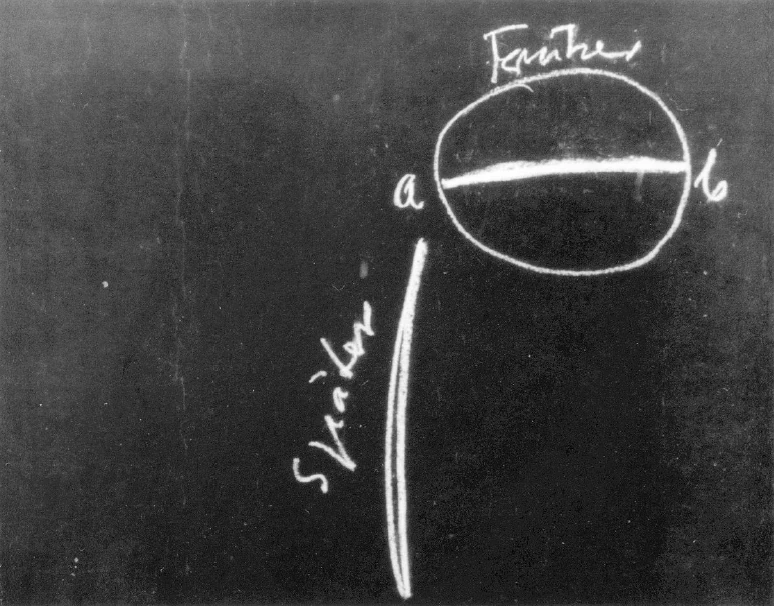
[ 24 ] But now it is important to consider the following. One must imagine that, in a certain sense, what I have drawn here as a circle in contrast to the line a–b is, so to speak, a puffed-up spinal column and points to what it once was in an earlier metamorphosis: itself something like a spinal column, but under different external conditions. What I have drawn as a circle has thus, in a certain sense, developed out of a–b. But what today constitutes the vertebral column in the human organism was only later attached to what had already developed in this way. In humans, this is the later formation. After the skull had transformed from an arrangement of forces that appears today in a somewhat different form in the spine, this present-day spine became attached to it. What is “less perfect” in human beings is thus the later development, and what is “more perfect” is the earlier one. And if we proceed logically, we are led back to an age in which, in a different metamorphosis, the forces that form the human head were already present, but not the forces that form the modern human spinal column.
[ 25 ] But when we consider these latter forces, they are the same forces we encounter, for example, in the animal kingdom, where the structure of the skull shows only a slight modification from the spinal column compared to that in humans. So we must say: What is present in the human head points us back, as the earliest formation, to times earlier than what appeared in humans with the vertebral column, and also earlier than what is found in the animal kingdom. In evolution, we must not derive humans from the animal kingdom; rather, we must say that a reasonable interpretation of the facts themselves shows us that human beings are older beings than animals, that animals arose later and, in their evolution, have only reached the stage that is evident today in human beings in their later form as the spinal column; but because they had less time at their disposal, they did not manage to develop the metamorphosis of the skull in the human sense.
[ 26 ] If you think this idea through—which I can only sketch out here—you will arrive at a truly meaningful understanding of the theory of evolution. The magnificent facts that are before us—which one need only come to know in their full scope—become understandable when one takes as a basis this perspective drawn from imaginative cognition. And from these premises, one then arrives at very definite connections and relationships regarding what is presented in external science concerning our earthly conditions.
[ 27 ] Do you think that by pursuing this line of thought, one can come to understand the relationship between humans and animals? But one can also proceed further in this way and come to understand how humans relate to the plant kingdom and, ultimately, to the mineral kingdom, which can be grasped in its context of phenomena through observation, experimentation, and the synthesizing mind.
[ 28 ] With this way of thinking, one comes to truly understand humanity’s relationship to its environment, just as one understands, in a certain sense, the relationships between the domains that lead us to mathematical judgments in the mathematical sciences. One comes to develop more and more what Goethe envisioned as an ideal when he said that his “primordial plant” must become, in the realm of ideas, something through which one can cognitively present every single plant in its corresponding character before the soul. Just as, when one has the general concept of a triangle, one also knows what occurs in any particular triangle. This transformation of human cognition toward organic cognition—that is what Goethe envisioned as an ideal.
[ 29 ] But now I would like to illustrate this point once again with an example. If we start from this perspective, we are able to take a truly closer look at what functions, for example, are at work in the human head. We come to recognize how the functions of the human head—which, as I have described here, are subject to evolution—are already in the process of regression today; how they originated from other states and developed into the human head; and how, however, a process of mineralization is currently taking place in the human head due to external influences. And this process of mineralization is the parallel phenomenon to our intellectual cognition, which, too, is capable of grasping only the mineral-physical, because it is bound to a process of mineralization within the human nervous-sensory apparatus. One is just beginning to understand how what one accomplishes in intellectual cognition is accompanied, as its physical vehicle, by a process of mineralization that builds itself into the organic structure of the human being—a precipitation of the purely mineral within the organic. By precipitating this mineral element within the organic, one comes to carry out, for the soul, that which constitutes the intellectual activity of this human being. One comes to truly grasp, inwardly, the connection between the spiritual-soul and the physical-bodily, rather than merely talking about it abstractly, as the “psychophysical parallelists” and similar phrase-mongers in the field of psychology do.
[ 30 ] This is how, based on the current state of organic natural science, we can point the way forward that it must take. One cannot stop at demanding a particular way of thinking; one can only seek what the empirical facts themselves drive forward; one must truly replace the existing way of thinking with another, namely that of imaginative cognition.
[ 31 ] But this also leads to a truly fruitful application of this insight. If one searches in the external world for anything that—when placed in the external world—corresponds to what takes place in the human head as a process of mineralization parallel to intellectual cognition, then one finds in nature what occurs between the forces in the earth and what takes place in the root of the plant, and one finds the inner connection between what constitutes the formation of the plant’s root and what constitutes the processes taking place in the human head.
[ 32 ] In a similar way, one will then find connections between what takes place, for example, in the herbaceous and leafy parts of the plant, and what takes place in the human rhythmic system, within the human organism. And one finds connections between the functions in the plant’s flowering and fruiting stages and what takes place in the human metabolic system, the reproductive system, and so on. From this perspective, one can gain an overview of plant life.
[ 33 ] When one understands how what I have called the mineralization process works in the human organism—namely, that this mineralization process takes place internally, in contrast to the external mineralization process that also occurs in the upper parts of the plant—one then recognizes the connection between what is happening internally in the main organism, and what takes place in the root-formation process—namely, in what appears as the mineralizing factor in that process. One then also realizes that, in a certain sense, there is a contrast—a contrast despite the similarity—as is expressed, for example, when I have three and three, one positive, the other negative. Then I have two times three, but there is still a contrast within it. Thus, there is something that is, in a certain sense, the same and yet oppositional: in the inner process of mineralization within the human head and in the outer process of plant root formation, as well as in the outer process of mineralization of the Earth itself. From this point, one can then rationally establish the therapeutic connection between what is external and what is internal to the human being. And the transition can be found from pathology to rational therapy.
[ 34 ] I can only refer to this latter point here. Those concerned will, of course, be given further insights specifically regarding this chapter, as was already the case in a spring course last year for physicians and medical students. What will be significant, however, is that true scientific rigor—which is not merely theory but also a guide to fruitful action, to deeds—will be able to emerge from the spiritual sciences.
[ 35 ] Humanity today, particularly in the realm of science, faces the necessity of making not a small but a great decision: the decision to enter into organic life, not merely by slightly modifying the content of the old way of thinking, but by introducing into this old way of thinking itself a new element—the element of supersensory knowledge. What still stands in the way of this decision today for the majority of those who should be making it is not some deficiency in human cognitive ability; it is a deficiency—an understandable deficiency—of courage for this strong, radical transformation. People would much rather suffer than move forward toward something new. They would prefer to stick with the old and merely reshape it somewhat, whether critically or in some other way.
[ 36 ] But light will not be shed on what lies before our present civilization in the realm of knowledge until we muster the courage to move beyond the customary way of thinking and adopt a different one. Nothing fruitful will come of it as long as people console themselves with the excuse that “one cannot, after all, attain the imaginative mode of thinking”—which is not true. Rather, a turning point will occur only when people come to realize that they must not remain inwardly sluggish if science is to make fruitful progress in its approach. One must become inwardly active and diligent. What is needed here is a resolute decision of the will, not merely a theoretical consideration. And since—as every psychologist knows—it is harder to lead humanity to resolute decisions of the will than to theoretical considerations, during which one can remain quite calm inwardly, modern humanity has a unique opportunity to demonstrate how it can rise from necessity to greatness by resolving, first and foremost in the realm just mentioned—the realm of knowledge, the realm of the spirit—to muster the courage for a great transformation, rather than indulging in petty deliberations.