

The Stimulating Effect of Anthroposophy
on the Sciences
GA 76
7 April 1921, Dornach
Translated by Steiner Online Library
5. Linguistics
[ 1 ] It strikes me today as something quite natural that what has been discussed here, from this vantage point, in recent days—the harmony between the subjective and the objective—should now, in a sense also arising from a feeling, serve as the introduction to my lecture. Yesterday morning, the series of lectures here concluded with Professor Römer’s address, which gave me great satisfaction—that is the subjective aspect—because it demonstrated how, for a specialist who is thoroughly and fully immersed in his field, the need can arise to shed light on such a specific discipline using the tools of spiritual science. It will also have become clear to you from what Professor Römer was already able to cite today from his field of expertise that, above all, strong, vigorous work must be developed on the part of the relevant spiritual science itself to facilitate this interplay. For what has been provided so far—and this should be fully acknowledged—consists primarily of individual guidelines that require verification in relation to external science.
[ 2 ] Among all the things in this lecture that gave me a certain subjective satisfaction was a reflection on teeth. So yesterday’s discussion concluded with teeth—now I’ll turn to the objective. And allow me to begin again today with teeth—though not, at first, with something I wish to tell you about teeth on my own initiative, but rather with a saying that emerged from 11th-century scholarship as it existed in Central Europe at the time. This saying is:
When your tongue meets the wind
and draws it into your mouth,
it forms against your teeth
the words you speak.
[ 3 ] In other words: Just as the tongue catches the wind from its surroundings and draws it into the mouth, so it draws the word it speaks from the teeth.
[ 4 ] Well, this is a product of 11th-century Central European scholarship. It holds that the tongue draws the word out from the teeth just as it draws air from the outside world into the mouth.
[ 5 ] Now, a sample of 19th-century scholarship from its final third: a statement made by the philologist Wilhelm Scherer—who was revered as a modern idol by a large following of students—and which you will find recorded in his Deutsche Sprachgeschichte, where he also cites the very word I just read to you. The word he contrasts with it is this: “We laugh at such a word today.”
[ 6 ] This is the 19th-century scholarly assessment of this 11th-century term; it reflects the scholarly mindset that still prevails today in the broadest sense and is likely still expressed by scholars in the relevant field in further references.
[ 7 ] If one first considers this entire contrast from the perspective that has often been taken here—namely, that a complete reversal has taken place with regard to the state of people’s minds since the first third of the 15th century— then the period between the first quotation cited and Wilhelm Scherer’s statement corresponds roughly to the time that has elapsed since the decline of that state of mind that existed until the beginning of the 15th century, and the direction that has emerged since then and has undergone a certain development to date.
[ 8 ] Wilhelm Scherer now continues the sentences he began by saying that he had to laugh at such a word from the 1st century with a reflection that includes the following. He says that all current efforts in linguistics must be directed toward reconciling what physiologists have to say about speech and word formation—based on the physiological organization of human beings—with what philologists have to say about the development of language from ancient times to the present. In other words: physiology and philology must join forces in this field of science. And Wilhelm Scherer adds that he must, unfortunately, admit that philologists have fallen very, very far behind, and that there is little hope, for the time being, that they will meet the physiologists halfway with regard to what the latter have to say about the formation of speech based on the physical organization of the human body. Thus, physiology and philology are two branches of science whose failure to understand one another is sharply acknowledged by a man regarded by his contemporaries as an authority.
[ 9 ] This points to a phenomenon that is particularly prevalent in our time: that the individual sciences, with their respective methods, do not understand one another at all; that they speak past one another, so that anyone who is now placed within this scientific enterprise and hears what the physiologists have to say on one side and the philologists on the other— — forgive me for this perhaps somewhat bold comparison — can do anything other than feel impaled from both sides, with regard to his soul, by these conceptual frameworks.
[ 10 ] In a certain sense—though I do not mean to say much more than this as an analogy—the term itself, which, I would say, is unconsciously taken seriously by recent scientific trends, already expresses a certain contrast. The term “physiology” implies that it aims to be a logos concerning the physical aspect of the human being—that is, in a sense, that which grasps the physical in a logical, intellectual way; the term “philology” implies: love of wisdom, love of the logos, love of the word; it is thus a term derived from an emotional experience. In one case, the term is derived from an intellectual experience; in the other, from an emotional experience. And what the physiologist seeks to create as a kind of intellectual Logos concerning human physiology—namely, the Logos itself—is what the philologist actually seeks to love. As I said, I am merely pointing this out analogically at first, but it nevertheless has a certain significance if it is pursued further, particularly from a historical perspective; and I recommend examining the matter more closely from a historical standpoint.
[ 11 ] But we can also point to something else here that emerges from the prehistory—from the precursors of what has been present in human consciousness since the beginning of the 15th century. It is well known that what is called logic—and which, in a certain sense, finds its reflection in language—is, at least in essence, a creation of Aristotle. And if one were to argue that, of course—just as logic lives in the mental activity of a person today who has not studied logic—logic must also have lived in the mental activity of people before Aristotle, one overlooks the fact that the transformation of the unconscious into the conscious nevertheless has a deeper significance in the course of human development. The fact that the logical has been raised into consciousness also signifies a real process—albeit an inwardly real one—in the development of the human soul: in earlier times, there was an intimate relationship between the concept and the word. Just as such an intimate relationship existed between the concept or idea and perception—as you will find explained in my Riddles of Philosophy—so too did an intimate connection, an, I might say, interpenetration of words and ideas, exist.
[ 12 ] The distinction that we must make today, from a psychological standpoint, between the word and the content of the concept—which becomes particularly clear when considering the process of mathematization—was not made in earlier times. And it was Aristotle who first arrived at this very distinction. Within the life of the soul, he extracted that which is concept or representation from the fabric of language, making it something distinct and separate for the purposes of cognition. In doing so, however, he in turn pushed that which lives in language further down into the unconscious than it had been before. In a sense, an abyss was created for cognition between the concept or representation and the word.
[ 13 ] For the further back we go in our examination of human language, the more we find that, in human perception, word and concept or idea are experienced as one; that humans, so to speak, hear inwardly what they think; that they have a word image rather than a thought image. The thought is linked externally to sensory perceptions and internally to the word. Consequently, even in those earlier times, a certain sensation existed that can be characterized roughly as follows: As people expressed themselves in their words, they felt as if what resonated in their words had entered their language directly from the things themselves, in a subconscious way hidden within the instinctive realm. They felt, as it were, that a real process was taking place between what lives in things—and especially in facts—and what inwardly forms the impulse for the word to resound. They felt such a real connection, just as people today still feel a real connection between the substances that are outside—let’s say an egg, veal, or lettuce—and what then takes place inside them with the contents of these substances when they are digested. In this process—which extends from the external existence of the foods to what happens internally during digestion—they would see a real process. They experienced this real process subconsciously. Just as subconsciously—though much more clearly, already permeated by a certain twilight consciousness—was what they experienced in language. One had the sensation that something living within things was related to sounds and words. Just as the substances in the food one eats are connected to what happens internally in a person’s metabolism, so one sensed an inner connection between what takes place in things and events—which is word-like—and what resounds internally as a word. And by bringing what was perceived as a real process into consciousness—where concepts operate—Aristotle accomplished for language the same thing that a person accomplishes when reflecting on what the substances of the foods do within their organism. Thinking about digestion, however, is somewhat more distant from the actual digestive process itself than thinking about language is. But one can gain an idea of the corresponding relationship by clarifying this concept through a transition from something more immediate to something more distant—which becomes clearer precisely because of that distance.
[ 14 ] Well, for us, when we replace today’s abstract view of history with a more concrete one, the point is this: events that took place in Greece in pre-Christian times—and even in pre-Aristotelian times—were perceived by the Central European population—who still regarded the Greeks as barbaric, that is, as belonging to a lower cultural level—as having occurred at a later time. And we will arrive at the correct understanding—and the science of the spirit provides the guidance for this—to elevate this feeling to certainty if we imagine that the mental state from which one speaks is expressed emotionally: “The tongue draws the outside air into the mouth, just as it draws the word from between the teeth,” that this way of viewing things—this remarkably vivid, pictorial way of expressing itself—was roughly the same one that prevailed in Greece during the pre-Aristotelian era, and which was supplanted by what was bound to take its place through the separation of logic, of the Logos, through the separation of the conceptual from what is expressed in language.
[ 15 ] As you know, in that scholarship which first developed in the 15th century and from which the various branches of the individual academic disciplines emerged, late Greek culture played a significant role as a formative influence. Philologists in particular—that is, those who are supposed to love the Logos—were thoroughly influenced by what emerged from late Greek culture. And just imagine for a moment a scholar of Late Greek, such as the Germanist Wilhelm Scherer, confronted with Early Greek, and the Early Greek saying to him: “The tongue draws the language from between the teeth”—he would, of course, reject this; from his point of view, he would want nothing to do with it. One must view such facts in a light that strives to shed a deeper glow on the historical context than is often the case in conventional, popular historical scholarship today—both in the field of external political or cultural history and in the field of linguistic history.
[ 16 ] The question now is what paths we must seek in order to gain scientific access to the structure of the linguistic organism—if I may put it that way—itself.
[ 17 ] Even in outward appearances, it is evident how the perspective that has gradually elevated the soul into the realm of abstract concepts has distanced itself from what was perceived regarding language in the pre-Aristotelian era. What, for example, did this research—which bears the stamp of Aristotelianism—produce as a theory regarding the origin of language? Well, by elevating the soul into the abstract, it became alienated from its immediate connection to the external world—a connection through which one could experience what in things corresponds to the formed word. It became estranged from this connection, yet still sought to understand what such a connection might look like, and it then translated this connection into all manner of abstractions. What had been felt inwardly, it transferred to the realm where concepts are formed externally, based on sensory or other external observations. Because it was impossible to delve into things to investigate the process by which the word acts from within things into the human organism, an abstract concept was substituted for such an understanding—for example, in the so-called “Wauwau” theory or the “Bimbam” theory. Ultimately, the “Wauwau” theory states nothing more than that what manifests externally in the organic realm as a tone or sound is imitated. It is a completely external examination of an external phenomenon with the aid of abstract concepts. The Bimbam Theory differs from the Wauwau Theory only in that it takes into account the inorganic realm, insofar as it, so to speak, gives birth to the sound from within itself. This sound is then, in turn, imitated in an external manner by the human being who faces external nature and allows himself to be influenced by it. And the transformation of that which—admittedly not everywhere, but only in a narrowly defined region of the earth—children call out when they hear a dog bark: “wau-wau,” or of that which enters their linguistic sensibility when they hear a bell ring: “bim-bam-bum”—this transformation is then pursued through a peculiar method. Thus, what has subsequently developed into the organism of language can be seen in the theories mentioned above, which, incidentally, have not been replaced by anything much better to this day.
[ 18 ] We are thus dealing with a process by which the study of language becomes an inner process. Above all, the aim of spiritual science, as understood here, is for the contemplation of language to become an inner one once again; so that through what can be attained in the ascent from sensory to supersensory knowledge, that which was once thought of language on the basis of feeling and instinct—albeit now in a form appropriate to an advanced humanity—may once again be discovered independently. And here I must—since, due to time constraints, I can only point out the directions in which the empirical facts are to be pursued—draw attention to how spiritual science takes a strictly concrete path when it seeks to understand how the human being develops from childhood to a certain age. You will find what I am trying to hint at here described, for example, in my little book The Education of the Child from the Perspective of Spiritual Science.
[ 19 ] First, it must be pointed out that the entire psychological and physical constitution of a human being in the period before the change of teeth is fundamentally different from what it becomes after the change of teeth. Anyone who has gained insight into this fact through observation knows how much of a metamorphosis takes place in the psychophysical life during the period when the second set of teeth replaces the first. And anyone who does not seek the relationships between body, soul, and spirit through abstractions—as, for example, the adherents of psychophysical parallelism do—but who seeks them in concrete phenomena; who seeks them using a truly advanced scientific method; and who is able to grasp the inner structure of soul life in concrete terms—will indeed find that what later manifests more as a mental process in the distinctive configuration of conceptual life—in the assertion of what is experienced conceptually, through impulses of will that then lead to the formation of judgment—is in fact something that has been at work in the physical organization right up until the change of teeth. And he will not speculate about what can “work psychically” in the physical organization from birth until the change of teeth. Rather, he will say to himself that what is then set free during the change of teeth—set free from a body in which it was previously latent—is that which had previously worked in a latent and bound state within the human physical organization. And this particular type of physical organization, within which what is later to be observed as a soul process is at work, comes to an end with the eruption of the second set of teeth—a process to which your attention was also drawn yesterday.
[ 20 ] Now, one must not view the facts presented here from a one-sidedly physiological perspective, but rather in such a way that—just as the physiologist penetrates the physical processes of the human organism with his senses and the intellect bound to them—one likewise penetrates the psychological processes with what constitutes imagination and inspiration, so that one truly recognizes them, rather than merely describing them with words, as contemporary psychology does. If one truly penetrates these processes, then one must perceive, in the reality that is initially latent from birth until the change of teeth—and which is then released—a reality that is also grasped through imagination and insight. That is why my treatise The Education of the Child from the Standpoint of Spiritual Science, in summarizing this process in a formulaic way, states that with the change of teeth, the human etheric body—which previously operated within the physical body—is first born into free activity within the life of the soul. This “birth of the etheric body” is expressed in the change of teeth.
[ 21 ] It is necessary, so to speak, that at the starting point of anthroposophical-spiritual-scientific consideration there be such formulaic expressions as, for example, “the birth of the etheric body from the physical body,” which does, after all, correspond to an actual event. But when one seeks to make the transition from this spiritual science in the narrower sense—which focuses specifically on the observation of the human’s immediate daily experience—to the approach taken in individual specialized sciences, then what is initially expressed in such a formulaic manner becomes something akin to a mathematical formula: it becomes a method, a method for dealing with the facts. And that is why this spiritual science can have a fruitful effect on the individual sciences, without merely carrying over into them what must certainly be clearly grasped from the outset: that the human being is composed of a physical body, an etheric body, and so on. One can certainly know such things at the outset, and must know them; but if spiritual science is to have a fruitful impact, it must become action, it must become a method, a way of dealing even with the facts given through the senses and empirical experience. And in this regard, spiritual science—because it ascends from the inorganic, where it can do little, through the organic into the spiritual realm— I would say, not only in terms of how the individual sciences can be enriched, but it will have to provide them, based directly on its own findings, with factual confirmations that shed light on what is gained from the other side through sensory-physical observation and is then understood by the intellect. Spiritual and sensory-physical research must come together. And one of the most important tasks for the future is for this spiritual research and this sensory-physical research to come together.
[ 22 ] In the process that manifests itself most outwardly in the change of teeth, it becomes evident that what is called the “etheric body”—when one grasps a concrete image, rather than a verbal concept, with the eye of the soul—begins to act freely throughout the entire human organism, after having previously worked in an organizing capacity within the physical body. Now it ascends into the soul, becomes free, and then acts back upon the whole human being to a certain degree consciously.
[ 23 ] Something similar occurs, in turn, with what manifests outwardly as sexual maturity. Here we see how, once again in human experience, there is something that expresses itself, on the one hand, in a certain metamorphosis of the physical organism and, on the other hand, in a metamorphosis of the spiritual. And an essential aspect of the spiritual researcher is that he acquires a concrete perception of what occurs in the spiritual-soul realm, just as one who seeks to educate himself solely through external observation acquires a concrete perception of what he can see with his eyes and comprehend with his intellect. Psychic phenomena cannot be perceived in this way, but can only be perceived in their reality through imaginative perception. There is no true psychology that does not begin with imaginative perception, and there is no way to discover the interrelationship between body and soul—or physical body and spiritual soul—other than by building a bridge between what is given to external physical-sensory perception as the physical-bodily realm, and what falls outside this perception—that which can only be given as reality in the ascent to supersensible knowledge: the spiritual-soul realm.
[ 24 ] If we now consider what occurs during the stage of sexual maturity, we must conclude that, in a certain sense, we are witnessing the reverse process of what took place during the change of teeth. We see how what functions as the capacity for desire in human beings—the instinctive character of their will—seizes the organism in a way it did not before. When we summarize the entire broad complex of facts involved in this process in a formulaic way, we arrive at the following statement: that which contains, in particular, the nature of desire—the human astral body—becomes free when sexual maturity sets in. It is this astral body that now—if I may put it this way—sinks into the physical organism as a free entity, takes hold of it, permeates it, and thus gives physical form to desire, a process that finds its expression in the attainment of sexual maturity.
[ 25 ] Well, what does a proper comparison of these two processes reveal? In a sense, when the change of teeth occurs, we see a liberation of the human etheric body. How is what is happening there actually expressed? It manifests in such a way that the human being thereby becomes capable of further developing concept formation—and, in general, the activity of the imaginative life—which was previously more closely bound to the whole organism, specifically to the organization of the head. In a sense, we see—and spiritual science sees this not merely in a sense, but in its reality —that the etheric, which we attribute to the human being as the etheric body, withdraws with the change of teeth into that which now lives only in the rhythmic processes of the human organism and in the metabolism and limb system, and that it develops a free activity in the formation of the head, in the plastic shaping of the head, in which the human being’s conscious life of imagination participates. In a sense, the organization of the head is laid bare during this period. And if I may speak figuratively about a reality that certainly exists, I must say that what rises to the surface in the permanent teeth from the entire human organism is the soul-spiritual activity that previously permeated the entire physical organism and then becomes free. Previously, it permeated the entire human being all the way into the head. It gradually withdraws from the head; and it reveals how it withdraws by making manifest that it no longer acts all the way to the head—namely, by coming to a halt and bringing forth the permanent teeth. You can visualize this quite schematically. If I were to schematically indicate the human physical constitution with white chalk and the etheric constitution with red chalk, the following diagram would result (see illustration):

[ 26 ] In the figure on the left, you see the human being in his spiritual, soul, and physical activity, standing before you up until the time of tooth replacement. In the second figure, to your right, you see how the etheric has withdrawn from its immediate activity within the head organization, how it has become free in a certain sense, so that from there it acts freely upon the human head organism. And what ultimately results from this activity of the soul-spiritual within the physical organism is the eruption of the second set of teeth. You can observe—I would say, in a mirror image—what is being conveyed to you here as a spiritual insight by examining the skulls that Professor Römer showed you yesterday, comparing the emergence of the first teeth with that of the second teeth. If you wish to follow this line of reasoning, you must take as your foundation what has been gained here through spiritual science. Then you must tell yourselves that the first teeth, with all that they express, have been drawn out of the entire human organism, including the head organism. What is expressed in the second teeth has been drawn out after the inner soul organization—insofar as it concerns the etheric body—has slowly withdrawn into the rhythmic and metabolic organism and has thus become free for the head organism. In a similar way, we can say to ourselves—as I mentioned, I can only provide general guidelines—that something occurs with sexual maturity. There, what we conventionally call the astral body is immersed into the physical body, so that it ultimately takes hold of it and brings about precisely what constitutes sexual maturity.
[ 27 ] But what happens to human beings takes place through the most diverse metamorphoses. Anyone who has truly understood a process such as that which manifests itself in sexual maturity—a process that brings about a certain new relationship in human development, in the development of the human being toward the external world—anyone who truly understands such a process from within will also recognize it when it occurs in a certain form of metamorphosis. What occurs with sexual maturity—in that it encompasses the whole human being, in that it, so to speak, shapes a relationship between the whole human being and their surroundings—is, I would say, foreshadowed in a different metamorphosis at the very moment when language develops in the child. However, what takes place with sexual maturity occurs in the child, in the development of language, as a different kind of metamorphosis. There, what seizes the whole human being at sexual maturity and pours itself into their relationship to the outside world takes place between the rhythmic and limb-oriented human being and the human being’s head organization. In a sense, the same forces that take hold of the whole human being at puberty and exert a guiding influence on his relationship to the outside world assert themselves between the lower and upper human beings. And as the lower human being learns to perceive the upper human being in the same way that a person in later life learns to perceive the outside world, he learns to speak. A process that can be observed externally in a person at a later stage of life must be traceable in its metamorphosis back to the point where it appears as an inner metamorphosis taking place within the human organism—namely, in the learning of speech: the process that otherwise occurs in the whole person during puberty.
[ 28 ] And once one has grasped this, one is presented with the opportunity to understand how the interplay of the lower human being—the rhythmic human and the human of the limbs—in its mutual interaction gives rise to an inner experience of something that also exists externally in the nature that surrounds us. This inner experience of what exists externally leads to what remains externally silent in things—as their own language—beginning to resound as human language within the human being. Please, for my sake, take this statement as a guiding principle. Start from the premise that what falls silent in things as they become external and material becomes audible within the human being through dematerialization and comes to speech. Then you will find the path by which you do not develop a “woof-woof” or “bimbam” theory, but rather see what is external to things—and which, precisely because it cannot be perceived by external observation, since it falls silent and exists only in a supersensible way—unfold as language within the human being.
[ 29 ] What I am expressing here is like drawing a line to indicate a direction in which one would actually most like to paint a vast, expansive painting. I can only present to you this more abstract statement about the relationship between the things and facts of the external world and the emergence of human language within. And you will see everything you can sense about language cast in a new light if you find the path from this abstractly posited statement—which at first sounds formulaic—to that which meaningfully connects the facts for you. And if you then wish to relate what is gained in this way through philological analysis to physiology, you will be able to learn about the connection between external sexual metamorphosis and linguistic metamorphosis by studying facts that remain as a vestige: as the linguistic remnant of the metamorphosis of sexual maturity in the change of voice, that is, of the larynx in boys, and in certain other phenomena that occur in women. If you only have the will to engage with the facts and draw connections from one series of facts to another—not isolating yourself in sterile specialized disciplines, but truly seeking to illuminate what exists as a fact in one discipline through the facts revealed by other disciplines— then the individual specialized sciences will be able to become what human beings must seek in them if they wish to make progress both on the path of their cognition and on the path of their will.
[ 30 ] Tomorrow, in a context that might seem entirely unrelated, it will become very natural for us to see how we can now move from the process of losing baby teeth to the phenomenon of language, and then go back further to what is the third stage on this backward path: In a sense, we see in what is expressed in the change of teeth an interaction between the physical body and the etheric body. We see, in turn, in what is expressed in speech an interaction between the astral body and the etheric body. And we must seek, as the third element, an interrelationship between the “I” and what lives within the human being as the astral body, and we will be led thereby to what is the third element in this retrograde contemplation: to the embodiment of the spiritual-soul, to that which is born within the spiritual-soul. If one traces the path from the change of teeth through the development of speech, the third stage is the stage of the unification of the pre-existing human spiritual-soul element with the physical body.
[ 31 ] By using abstraction to block the path from the study of tooth replacement to the study of language, Aristotle was compelled to resort to the dogma that with every new human being a new spiritual-psychic entity is born. Due to a lack of will to continue along the path of knowledge, the understanding of human pre-existence has been lost, and with it, everything that truly leads to an understanding of the human soul.
[ 32 ] We see a historical connection that, however, plays out in the treatment of certain problems, and we can conclude by saying: Today, according to a philologist who is quite significant in the contemporary sense, philology and physiology stand in such opposition to one another that they cannot understand each other. Why is this so? Because physiology studies the human body and, in this study, does not proceed backward toward the spirit. If one pursues true physiology, then through the physical aspects of physiological observation one ultimately discovers the spiritual and psychological aspects of the human being. What, then, happens when one pursues true philology? When one pursues true philology, the Logos does not become an abstraction for which one then seeks to penetrate the afterimages—afterimages in the scientific method—but rather one seeks to penetrate that which one supposedly loves as “Philo”-logy through imaginative and other forms of contemplation. But then, when one penetrates into what has become a shadowy, nebulous concept for contemporary philology—namely, the linguistic genius, the creative linguistic genius—when one penetrates into it, one penetrates through the spirit to the outer physicality.
[ 33 ] Physiology finds the spirit through the inner nature. Philology, properly understood, finds—on the path outward through the genius of language—that which speaks from within things themselves and has fallen silent. It does not find “woof-woof” and “bimbam,” but rather finds in the physical things surrounding us the impetus for words—for language—to arise within us. Physiology has lost its way to its goal by stopping at the body and failing to penetrate inwardly through the body to the spirit. Philology has lost its way because it stops at the genius of language—which it then grasps only abstractly—and fails to penetrate into the inner essence of external things, from which resounds what lives in the word. If philology does not speak as if “Wauwau” and “Bimbam” were imitated by humans in an outwardly abstract manner, but rather speaks of outward physicality in such a way that it becomes clear to it, through imagination, how from this outward physicality the word springs forth—which resounds within like an echo—then, when physiology has found the spirit, and philology has found physicality, then they will find one another.
[ 34 ] I have thus outlined the path that spiritual science in the anthroposophical sense seeks to guide through conscientious work. I have offered only a few hints in this particular field of introductory linguistics.
[ 35 ] Well, these things are discussed among us; these are the things we strive for. While we strive for these things—so that they may bear witness to what is being sought through a path of knowledge that springs entirely from the spirit of our time—and while you can likely discern in what we are striving for a certain seriousness that can measure up to the seriousness that exists in other areas of life, yesterday in Stuttgart a gathering raged that largely trampled on our speakers, that had no intention whatsoever of listening to anything, that did not want to engage with what we have to say, but that, through trampling and similar actions, sought to crush what is being earnestly pursued. And, addressing my fellow students, I must say: last night in Stuttgart, your colleagues were missing—not those from the other faculty, but those of a different mindset—they were not absent; they were certainly present during the trampling.
[ 36 ] Ladies and gentlemen, my dear fellow students! It is becoming ever clearer how, from a certain quarter, that which cannot be refuted—because one does not want to refute it, because one, by stubbornly clinging to the old that has outlived its usefulness, does not want to engage with the new at all—will be trampled underfoot by external force. Well, I would simply like to appeal to you here in this way: I do, in fact, have faith in you—that perhaps deep down you are saying to yourselves: “We, too, have a say in this process of trampling!”—May this word, however, become action.
Third Debate Evening
[ 37 ] The questions did not relate to the topic of the day, “Linguistics,” but instead referred back to issues discussed earlier.
[ 38 ] Dr. Steiner. Here is the question:
[ 39 ] It has been said that the three dimensions of space are not identical in structure—what is the difference?
[ 40 ] In any case, the statement was never phrased this way: that the three dimensions of space are “not equal in their structure”; rather, what is likely being referred to here is the following. First, we have mathematical space—the space we imagine—if we form any precise conception of it at all—as consisting of three mutually perpendicular directions of dimension, which we thus define, for example, by the three mutually perpendicular coordinate axes.
[ 41 ] The way we usually view this space mathematically, the three dimensions are treated as absolutely equal. We make so little distinction between the dimensions up-down, right-left, and front-back that we might even think of these three dimensions as interchangeable. After all, in pure mathematical space, it does not matter at all whether—when we have the X-axis and the Z-axis perpendicular to each other, and the Y-axis perpendicular to both of them—we refer to the plane on which the Y-axis lies, or whether we call this axis itself “horizontal” or “vertical,” or the like. Likewise, in this space, we do not, so to speak, concern ourselves with its finiteness. Not that we imagine it to be boundless. One does not usually go so far as to imagine it that way, but rather one conceives of it in such a way that one does not concern oneself with its boundaries, tacitly assuming instead that one can start from any point—say, for example, in the X-direction—and add another segment to what has already been measured in the X-direction, then add another segment to that, and so on, and one would never be led to reach an end anywhere. In the course of the 19th century, metageometry had already put forward several arguments against this conception of space, which is rooted in Euclidean geometry. I would simply like to recall, for example, how Riemann distinguished between the “boundlessness” of space and the “infinity” of space. And to begin with, even in purely conceptual terms, there is no compulsion whatsoever to assume that the concept of “boundlessness” and that of “infinity” are identical. Take, for example, the surface of a sphere. If you draw on the surface of a sphere, you will find that nowhere do you encounter a boundary in space that could, so to speak, prevent you from continuing your drawing. Certainly, if you continue drawing, you will end up back where you started; but as long as you remain on the surface of the sphere, you will never be compelled to stop drawing because of a boundary. So you can say to yourself: The surface of the sphere is unbounded with respect to my ability to draw on it. — But no one would therefore claim that the surface of the sphere is infinite. Thus, one can distinguish, purely conceptually, between boundlessness and infinity.
[ 42 ] Under certain mathematical conditions, this can now be extended to three-dimensional space—it can be extended in such a way that one imagines: if I add a segment to the X- or Y-axis, and then another, and so on, and am never prevented from adding ever more segments, then this property of space might indeed suggest its boundlessness, but not the infinity of space. Despite the fact that I can keep adding new segments, space need not be infinite at all; it could simply be unbounded. So these two concepts must be distinguished from one another. One could therefore assume that if space were unbounded but not infinite, it would have an internal curvature in the same way that space does now—that is, it would in some way return upon itself, just as the surface of a sphere returns upon itself.
[ 43 ] Certain concepts in modern metageometry do indeed rely on such assumptions. No one can really say that there are particularly many objections to such assumptions; for, as has been said, there is absolutely no way to deduce its infinity in any way from what we experience of space. It could very well be curved in on itself and thus finite.
[ 44 ] Of course, I cannot elaborate on this line of thought, for it constitutes virtually the entire thread of modern metageometry. However, you will find sufficient guidance in the treatises by Riemann, Gauss, and others—which are readily available—to explore this topic further, should you find such mathematical concepts worthwhile.
[ 45 ] So, from a purely mathematical standpoint, this is what introduced objections into the—I would say rigid, in every respect neutral—space of Euclidean geometry, objections that were derived solely from “infinity.” But what the question alludes to is rooted in something else entirely. Namely, in the fact that the space we initially deal with—and which we encounter, for example, in analytic geometry when we work with the three mutually perpendicular coordinate axes—is, at first, an abstract concept, an abstraction. And an abstraction—of what? That is the question that must first be raised.
[ 46 ] The question is whether one must stop at “space” in this abstraction, or whether that is not the case. Must one stop at this abstraction of space? Is this the only space one can speak of? Or rather: If this abstract concept of space is the only one one can legitimately speak of, then one can really only raise the one objection—the very one that is sufficiently raised in Riemannian or other metageometry. The fact is that, for example, Kant’s definitions of space are based entirely on the very abstract concept of space, in which one initially pays no attention to boundlessness or infinity, and that then, in the course of the 19th century, this concept of space was also shaken from within—in terms of its conceptual content—by mathematics. There can be no question that Kant’s definitions, for instance, would still apply to a space that, while not infinite, is unbounded. In fact, many other aspects of the subsequent course of the Critique of Pure Reason—the doctrine of paralogisms, for example—would be called into question if one were compelled to adopt the concept of unbounded, self-curved space.
[ 47 ] I am well aware that this concept of curved space poses difficulties for the ordinary mind. However, from a purely mathematical-geometric standpoint, the only objection that can be raised against what is assumed here is that one is moving in a realm of pure abstraction that is, at first glance, quite far removed from reality. And anyone who looks more closely will find that, at its core, the derivations of modern metageometry involve a curious circular argument. It is this: one starts with the concept of Euclidean geometry, which, as we know, does not concern itself with the finiteness of space. From this, one then derives certain concepts—that is, concepts that relate to something like a spherical surface. And then, by applying certain reinterpretations or reclassifications to the forms that arise, one can proceed from there to formulate interpretations of space. Everything is actually stated on the basis of Euclidean coordinate geometry. Under this assumption, one derives a certain measure of curvature. One arrives at the derivations. All of this is entirely in line with the concepts of Euclidean geometry. But then, so to speak, one reverses the process: one now uses these concepts—which can only arise with the help of Euclidean geometry, such as the measure of curvature—to arrive at yet another concept, one that leads to a reinterpretation and can, in turn, provide an interpretation of what has been derived from the curved forms. Essentially, one is moving in a realm detached from reality by deriving abstractions from abstractions. This would only be justified if empirical facts made it necessary to align what one obtains through such a process with the concepts underlying those facts.
[ 48 ] The question, then, is this: Where does the empirical basis lie for what the abstraction “space” actually is? For space as such, as conceived by Euclid, is an abstraction. Where does that which can be experienced and perceived lie?
[ 49 ] First, we must say: We must start from the human experience of space. Placed within the world, human beings—through their own active experience—actually perceive only one spatial dimension, and that is the dimension of depth. This perception—this actively developed perception of the dimension of depth by human beings—is based on a process of consciousness that is very often overlooked. Yet this acquired perception is something entirely different from the concept of a flat plane, the concept of extension in two dimensions. When we look at the world with both our eyes—that is, with our total vision—we are never aware that these two dimensions come about through our own activity, through an engagement of the soul. They are, so to speak, simply there as two dimensions. Whereas the third dimension—even though this active process is usually not brought into consciousness—comes about through a certain kind of activity. We must actually first work out the knowledge, the insight into how deep within space, how far away from us, any given form lies. We do not actively perceive the extent of the surface; that is given through visual perception. But through our two eyes, we do in fact actively perceive the depth dimension. Thus, the way in which we experience the depth dimension lies, admittedly, right on the border between the conscious and the unconscious; but anyone who has learned to focus their attention on such matters knows that the process of estimating depth—which occurs half-unconsciously or one-third unconsciously, and never consciously—resembles an intellectual activity, indeed a psychological activity, an active psychological process, far more than anything that is merely perceived on a flat plane.
[ 50 ] Thus, one dimension of three-dimensional space has already been actively conquered by our concrete consciousness. And we cannot help but say: When we consider the posture of the upright human being, something is thereby given with regard to this dimension of depth—front to back—that cannot be interchanged with any other dimension. For simply by the fact that the human being stands in the world and, while acting in a certain way, experiences this dimension, what he experiences there cannot be interchanged with any other direction. For the individual human being, this depth dimension is something that cannot be interchanged with any other dimension. It is also certainly the case that the perception of two-dimensionality—that is, up-down, right-left, and of course what is in front of us—is linked to other parts of the brain, since it lies within the process of vision, that is, within the sensory process of perception; whereas, in terms of its localization in the brain, the emergence of the third dimension is certainly closely associated with those centers that are relevant to intellectual activity. So here we can already see that, even in terms of experience, there is a fundamental difference in the emergence of this third dimension compared to the other two dimensions.
[ 51 ] But when we ascend to the level of imagination, we step entirely outside of what we experience in the third dimension: in imagination, we actually transition to two-dimensional conception. And now we must—albeit just as subtly as we developed the third dimension in concrete visualization—also develop the other concept, that of right and left; so that there, too, lies a specific experience in right and left. And finally: when we ascend to inspiration, the same applies to up and down.
[ 52 ] For ordinary imagination, which is tied to our nervous-sensory system, we develop the third dimension. But when we turn directly to the rhythmic system, setting aside the ordinary activity of the nervous-sensory system—which, in a certain sense, occurs during the ascent to imagination (though this is not entirely accurate, but that does not matter for now)—then we have the experience of the second dimension. And we have the experience of the first dimension when we ascend to inspiration, that is, when we advance to the third level of the human organization.
[ 53 ] Thus, what we have before us in abstract space proves to be precise, because everything we discover in mathematics we draw from within ourselves. What emerges in mathematics as three-dimensional space is actually something we possess within ourselves. But if we descend within ourselves through the supersensible concepts, what emerges is not abstract space with its three equally valid dimensions, but rather three different values for the three different dimensions: front-back, right-left, up-down; they are not interchangeable. From this follows something else: If these three are not interchangeable, there is also no need to imagine them with the same intensity. This is the essence of Euclidean space—that we imagine the X, Y, and Z axes—which, after all, must be assumed for any geometric calculation—with equal intensity.
[ 54 ] If we consider the X, Y, and Z axes, then—if we wish to adhere to what our equations tell us in analytic geometry, but assume an intrinsic intensity for the three axes—we must conceive of this intensity as equivalent. If, for example, we were to elastically extend the X-axis with a certain intensity, the Y- and Z-axes would have to extend with the same intensity. That is to say, if I now conceive of that which I am expanding as having intensity, then the force of expansion—if I may put it that way—is the same for the X, Y, and Z axes, that is, for the three dimensions of Euclidean space. Therefore, applying the concept of “space” in this way, I would like to call this space “rigid space.”
[ 55 ] Well, that is no longer the case when we consider real space—of which this rigid space is an abstraction—when we consider the space that is derived in such a way that it is, in fact, extracted from the human being. Then we can no longer say that these three intensities of extension are equal. Rather, the intensity essentially depends on what is found in the human being: the human being’s proportions are entirely the result of the intensities of spatial extension. And we must, for example, if we call the up-down direction the Y-axis, imagine this with a greater intensity of extension than, for example, the X-axis, which would correspond to the right-left direction. If we were to seek a formulaic expression for this real space—that is, if we were to express in formulaic terms what is actually meant here (again, an abstraction; we must simply remain aware that this abstraction is, in fact, an abstraction)—we would then arrive at a triaxial ellipsoid.
[ 56 ] Now, however, there is also reason to conceive of this three-axis space—in which supersensible imagination must exist—in its three entirely different modes of extension, in such a way that, through the real X-, Y-, Z-axis experience—which is given to us through our physical body—we can also recognize this space as that which simultaneously expresses the relationship of action between the world bodies located within it.
[ 57 ] When we imagine this, we must bear in mind, in a certain sense, that everything we conceive of out there in this three-dimensional space does not simply extend in various directions with equal intensity along the X, Y, Z-axes—as is the case in Euclidean space—but rather that the universe itself has a configuration that could be visualized as a triaxial ellipsoid. And the arrangement of certain stars certainly supports this. Our Milky Way system is usually referred to as a lens and so on. It is by no means possible to conceive of it as a spherical surface; we must conceive of it in a different way if we are to stick to a purely physical fact.
[ 58 ] It is precisely in the treatment of space that you can see how unnatural modern thinking is. In earlier times, in older cultures, no one subscribed to a concept such as that of rigid space. One cannot even say that Euclidean geometry already possessed a clear conception of this rigid space with its three equal intensities of extension, nor of the three mutually perpendicular lines. Rather, it was only when people began to treat Euclid’s space mathematically—precisely because abstraction has become an essential feature of modern thought—that this abstract conception of space actually arose. In earlier times, people had insights quite similar to those I have just developed once again from the nature of supersensible cognition. You can see from this that things on which we rely so heavily today—things we take for granted—fundamentally have such significance only because they operate in a sphere alien to reality. The space with which we calculate today is an abstraction; it operates entirely in a sphere detached from reality. It is abstracted from experiences of which we can, however, know through actual lived experience. But today, people often content themselves with what are merely abstractions. In our time, when so much emphasis is placed on empiricism, people most often rely on abstractions. And they do not even realize it. They believe they are engaging with things in reality. But you can see how much our conceptions in this regard need to be corrected.
[ 59 ] The researcher of the mind does not merely ask, with regard to every idea, whether it is logical. Riemannian space is certainly logical as well, even though in a certain sense it is merely a branch of Euclidean space; but for that very reason, it cannot actually be fully grasped in the imagination, because one arrives at it through entirely abstract thinking, in which, on the basis of a conclusion one has reached, one’s entire way of thinking, so to speak, is turned on its head. When forming a concept, the spiritual researcher asks not merely whether it is logical, but also whether it corresponds to reality. For him, this is the decisive factor in whether or not to accept a concept. He accepts a concept only when it corresponds to reality.
[ 60 ] And this correspondence to reality will serve as the criterion, if such ideas are ever properly addressed—which justifies, for example, something like the theory of relativity. It is, I would say, logical in and of itself—because it is comprehensible only within the realm of logical abstraction—as logical as anything can possibly be. There can be nothing more logical than the theory of relativity! But the other question is whether its concepts are feasible. And there you need only look at the concepts listed there as analogies, and you will find: These are actually concepts completely detached from reality, which are simply thrown around. “This is just for illustration,” people say beforehand. But it is not merely there for illustration. Otherwise, the entire procedure would once again be left hanging in the air.
[ 61 ] That, then, is what I would like to say about the subject to which the question refers. As you can see, it is not possible to answer questions that touch on such areas all that easily. Now there is a question regarding the sentence:
[ 62 ] The physiology of an ancient Egyptian or Greek was quite different from that of modern humans.
[ 63 ] Ladies and gentlemen, of course I did not say that! And at this point I must certainly draw your attention to something that I often point out—and I assure you, not out of immodesty: I take great care to express myself as precisely as I possibly can. And it is actually an—not so much for me personally, since that is bearable, but from the standpoint of the anthroposophical spiritual movement—extremely painful fact that, in response to various matters for which I have taken every possible precaution in my phrasing to capture the actual facts as adequately as possible, all sorts of things are said, all sorts of things are said, and then these assertions are sent out into the world as “genuine anthroposophical teaching.” Among these assertions is the claim that I supposedly said, “The organism of an ancient Egyptian or Greek was quite different from that of modern humans.”
[ 64 ] It boils down to the following. I said: The modern way of thinking assumes too strongly that human beings, as complete beings—right down to their innermost core—have, in essence, always been the way they are today, going back even to a certain historical period. — I tend to speak of “completely different” and of metamorphoses of the human being as such only from that point onward, where there are major differences, where the human being becomes, in a certain respect, “completely different”: in prehistoric times. But, I said, anyone who is able to delve into the subtleties of structure down to its innermost fabric—as human beings can do in the spiritual sciences—will find that a continuous metamorphosis of humanity is taking place; that, for example, modern humans differ from the Egyptians or the Greeks. Of course, not in terms of outward, striking characteristics—such as physical appearance and the like. That is certainly what the question implies, but it is not my view, for in terms of these outward characteristics, modern human beings are naturally not “entirely different” from the Egyptians. But with regard to finer inner structural relationships, spiritual science, for example, arrives at the following conclusion. It must acknowledge that since the first third of the 15th century, humanity has come to think abstractly, increasingly turning to abstract lines of thought. This is also essentially based on a different structure of the brain’s organization. And through the methods of spiritual science, the spiritual researcher can recognize this fact. It then becomes clear that it is indeed true that the brain’s finest structures have indeed changed significantly since Egyptian times. The brain of the ancient Egyptian was such that—to take an example—he was among those of whom Dr. Husemann spoke, noting that even the ancient Egyptians had no sense of the nuances of the color blue, and so on. In general, one can see that the sense of abstraction emerges to the same extent that shades of blue emerge from sheer darkness. What occurs in the life of the soul corresponds quite precisely to a physical metamorphosis. It is extraordinarily important, as I said, not to limit one’s view of human beings to those coarse features that are typically presented when one goes back—for my sake—to long periods of time that lie before history. Rather, if one wishes to consider humanity as a whole, one must also take into account the finer structural changes occurring within human beings during their historical existence.
[ 65 ] Question: It would be interesting to hear, in a more personal way, how this situation plays out.
[ 66 ] Well, in fact, especially in recent days—let’s say, partly due to the points Dr. Husemann has raised—quite a lot has been said about the intimate nature of this reality. And of course, if other areas of fact were to be addressed, there would certainly be much more to say about these other, much finer, more intimate structural relationships within the human being.
[ 67 ] Question: How does one explain the phenomenon of the well-known horse that, to the astonishment of all scholars, solved all arithmetic and mathematical problems without difficulty, yet failed completely only when it was made to write the problems on slips of paper in front of the examiner? If, in the case of the horse, no one present in the room could see the problem, is this due to the animal’s strong suggestibility? And how does that come about?
[ 68 ] I would never want to speak about anything other than what I have investigated myself. And so, in answering this question, I would also like to share only what I have experienced myself. For example, I am not familiar with the famous Elberfeld horses. Nor am I familiar with the dog Rolf; I have never had the honor of meeting him. Well, with regard to such things, I have always found that the story is all the more wonderful the less one is put in the position of truly understanding it or really getting to know it. But I did once see Mr. von Osten’s horse in Berlin. I can’t exactly say that the arithmetic problems Mr. von Osten presented to the horse were all that extraordinarily complicated. But from what was going on there—which, admittedly, only required looking closely—I was able to form an immediate impression of what it was actually all about.
[ 69 ] I could only marvel, however, at the strange theories that have been put forward about these things. There was a lecturer—I think his name was Fox or something like that—who was supposed to investigate this whole business with the horse; and he put forward the theory that every time Mr. von Osten gave a command, there were incredibly slight movements in his eye or something of that sort. A different small movement would occur when Mr. von Osten says “three” like this, or when he says it that way; another movement would occur when he says “two.” So that a certain subtle sequence of movements would occur when Mr. von Osten said, “three times two”; then the same sign of this movement would appear again—six! And Mr. von Osten’s horse was now supposed to be particularly predisposed to guess these subtle movements—which the lecturer in question said he did not perceive in any way, but only assumed hypothetically. So, ultimately, the whole “theory” was based on the assumption that Mr. von Osten’s horse was much more perceptive—and, in reality, to a much greater degree—than the lecturer who had formulated this theory.
[ 70 ] If one adheres to the “lightning-blue” way of thinking when formulating hypotheses, one can formulate hypotheses in the most diverse ways. For those who can see a little into such matters, certain circumstances were of extraordinary value: namely, throughout the entire time that the gentleman from the East was demonstrating his experiments with his horse to the astonished audience, he—he had huge pockets in the back of his coat—kept feeding the horse nothing but sweets. And the horse just kept licking away, and that’s how it solved these problems.
[ 71 ] Now imagine that this creates an entirely different emotional bond between the horse and Mr. von Osten himself. When Mr. von Osten constantly gives the horse sugar, a very special bond of love and intimacy develops. Now, animal nature is such that it is extraordinarily variable depending on the intimacy of the relationship that develops, both from ‘animal to human’ and from ‘human to animal.’ And this gives rise to effects that are actually mislabeled when they are called “mind reading”—in the trivial sense in which the word is often understood—but which are in fact mediators for what are not the “subtle twitches” that a private lecturer hypothetically posits, even though he himself says he does not see them! No subtle twitches are needed to convey the solutions. It can be attributed to the following: imagine what was going on inside Mr. von Osten—he naturally had the vanity to believe that among the audience, a crowd of sensation-seekers, the tension in the room was reaching the most incredible peaks whenever he noticed this; and when he was then on the verge of solving the problem, he would give the horse a piece of sugar. And consider, too, the effect of the emotional bond on the horse. It was truly not a command conveyed through words or twitches, but rather an intimate command that always emanated from Mr. von Osten to the horse whenever he gave it the sweets to eat. “Suggestion” is probably not the right word. Relationships that exist between human beings cannot be transferred to every living creature.
[ 72 ] I once tried to illustrate these points concretely by highlighting a detail that many would consider trivial—the constant consumption of sugar—as something extraordinarily significant.
[ 73 ] Question: Is it possible to identify a perspective for the field of mineralogy and crystallography that would revitalize its taxonomy in the same way that the concept of the “primordial plant” has done for botany, or as a novel interpretation of the periodic table of elements has done for chemistry?
[ 74 ] However, when we speak of crystal forms, and I am not referring here to those created by human design, but to real crystal forms—we are dealing with forms that are fundamentally different in their entire relationship to the cosmos, in their entire position in the world, from the forms one can imagine in the archetypal plant and, in turn, in the plant forms derived from the archetypal plant—that is, forms that exist as possibilities for real existence. For example, the principle applied to the formation of the archetypal plant could by no means be applied to the field of mineralogy or crystallography. For there we are dealing with something that must be approached from an entirely different angle. Specifically, one must first approach it by actually moving toward the realm of polyhedral crystal forms. And this approach—I can only hint at it now. I once explained it in greater detail, with its individual aspects, in a lecture series I gave to a small group. This approach is encountered when one starts from an inner, dynamic consideration of the states of matter—let us say, initially from the gaseous state downward toward the solid state. I can only sketch the outlines here; it would take too long to go into detail, but I want to hint at it. As one descends—if I may put it that way—from the gaseous state of matter to the liquid state, one must say: the liquid state of matter is characterized by the fact that, as befits it within the overall coherence of nature, one encounters a level-limiting surface—which is a spherical surface—whose radius of curvature, measured from any point on the surface, is obtained by the transition to the tangent at that point. What one obtains, then, includes a form whose outer boundary lies on the spherical surface and a point at its center that is equidistant from this spherical surface in every direction.
[ 75 ] If we now imagine the drop enlarged in an unlimited manner—I do not say infinitely, but in an unlimited manner—we obtain a level surface approaching the horizontal, and we must evaluate certain ratios in terms of the perpendiculars to this level surface.
[ 76 ] However, one arrives at the same concept by considering the relationships that arise when one regards our Earth simply as a system of forces capable of attracting objects in its environment that are not firmly attached to it. If one regards the Earth not as a center of gravity but as a spherical surface of gravity, then the result for this—I would say—gravitational figure is exactly the same as what is required in another context for the material constitution of a drop. Thus, for a pure system of forces, one obtains something that corresponds to a material system. And in this way, one arrives at a means of studying form relationships in the inorganic realm.
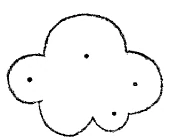
[ 77 ] So one can say that, in this interplay of forces—which is present throughout the entire Earth—one is always dealing with the horizontal level. If we now move from this state of forces to one in which—let’s say—there were not a single point at the center to which the level surface relates, as in the case of the “drop falling on a single center point,” but rather several points, we would find a curiously composite surface. I would have to depict these relationships of the line to these “center points” in the diagram roughly as follows: But if we now move on—and here I am taking a big leap, which is, admittedly, well-founded, though in this short time I can only hint at its true meaning—if we move on to assuming these points not inside, within the system we are dealing with, but outside it, then we might obtain a drawing that can be represented diagrammatically as follows: If one relocates the points into immeasurable expanses—not infinite expanses, but very large ones—then these curved surfaces, which are indicated here by the curved lines and curves, merge into planes, and we would obtain a polyhedral form that approximates what we see in the familiar crystal structures.
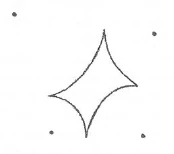
[ 78 ] And indeed, the spiritual-scientific perspective leads us to view the crystal in such a way that we do not merely derive it from certain inner, formative forces within some material substance, but rather relate it to the outer cosmos, and seek within the cosmos the directions which, through the distribution of their points of origin, yield precisely what the individual crystal form is. In fact, we find in the individual crystal form, so to speak, imprints of great cosmic relationships. All of this needs to be studied in detail. I fear that what I have just been able to hint at—albeit only in isolated, very sparse outlines—already seems to you to be something quite daring. But one must simply say that people today have confined their world of ideas to a very narrow realm, and that this is why they feel so uncomfortable when one does not adhere to the conceptual framework that is usually taken as a basis today—I would say, in all sciences. Spiritual science demands—as experience necessarily requires—an immeasurable expansion of concepts compared to the present state of affairs. And that is precisely what makes some people uncomfortable. They cannot, so to speak, see the shore and believe they are heading into the boundless. But they would realize that what is lost in the vastness is regained as a certain inner stability and security, so that one need not fear so greatly what appears to be an expansion into the boundless.
[ 79 ] It is, of course, much easier to come up with some sort of model—as was also mentioned today in connection with a specific question—than to move toward such concepts. It is easier to say: The truth must be simple! — The reason people say “the truth must be simple” is not, in fact, that the truth must actually be simple—for the human organism, for example, is immeasurably complex. Rather, the reason people say, “The truth must be simple!” is that simplicity is convenient for thinking. That is the whole point. And it is precisely necessary to move toward the more substantial above all else if one truly wants to gradually grasp reality.
[ 80 ] The question that has been raised here would require a three-hour lecture on the theory. One cannot speak about the sun by giving “a brief answer to the question,” because one would simply be completely misunderstood. And I would not want that. — So, for now, the questions that can be answered have been answered in a rudimentary way.
[ 81 ] Question: Does spiritual science perceive a transformation of the material Earth with the coming of the Christ Spirit into the Earth? Is the effect of the Christ force perhaps expressed particularly through one of the elements discovered in recent times?
[ 82 ] What is the point of this question? — After all, one need only consider from what perspective such a question might be asked. The question has been posed: Is the effect of the Christ force expressed in the material Earth? — You need only consider that spiritual science, based on its research, has a very specific conception of the Earth that does not coincide with what one imagines when speaking of the “material Earth” in the sense of the modern word “material.” So the question actually lacks any real substance. When one speaks of something like the “influence of the Christ force on the Earth,” one must—since this concept is, in a sense, borrowed from spiritual science—also hold the conception of the Earth that applies in anthroposophy and spiritual science. And just as the Christ force stands in a certain relationship to the entire metamorphosis of the Earth, this, too, can only be described within the overall context that I have outlined in An Outline of Esoteric Science. And there one will also find what is necessary to answer what is meant by this question when it is correctly formulated.
[ 83 ] At the request of many course participants, a gentleman from Stuttgart then gave a brief account of the lecture delivered the previous evening by the Pan-German General von Gleich at a mass rally in Stuttgart on “Rudolf Steiner as the Prophet of a Questionable Doctrine” (see Rudolf Steiner’s reference to this at the end of the morning lecture, pp. 139–140).
[ 84 ] I would just like to add that the aforementioned General von Quite a long time before—weeks before—he proceeded to give his lecture and write his pamphlet, he sent a letter to our friend Mr. Molt, as a concerned father, worried about the misfortune that, as the holder of a forty-year-old title of nobility, he had not only “given away” his son to anthroposophy, but also to a completely non-noble lady who is an anthroposophist! As a concerned father, he wrote to our friend Molt, asking him to visit him. Mr. Molt did so, but said that he didn’t know what to make of him. In particular, he deduced this from the fact that Mr. von Gleich had demanded that we “of the Threefold Social Order Movement” should, in the future, pay the General von Gleich’s son—who was employed by us—such a meager wage that the young man would be unable to marry; we were to protect General von Gleich from his son’s marriage at least by means of this meager pay. — After these events, it was understandable that one could not exactly expect the best from General von Gleich’s lecture. And indeed, our worst expectations were surpassed! The situation with this lecture was that von Gleich essentially presented the contents of a pamphlet—adorned, shall we say, with a bit more color—which was published at the same time in Ludwigsburg. It had already been agreed that this pamphlet was to be published simultaneously with the lecture. In this pamphlet, he presents various arguments against anthroposophy in the most disjointed manner, without providing any evidence for what he says—as anyone who reads this pamphlet can see for themselves—essentially relying only on the opponents of anthroposophy. This is already evident from the table of contents of the pamphlet: a few references to literature where one can learn about anthroposophy. One would think these would be anthroposophical books, first and foremost. But no—there are about twenty opponents listed, with the most notorious one right at the top: Max Seiling! Essentially, von Gleich offers nothing different from what can be found in all the opponents’ writings of the same sort as Seiling’s brochure—only presented in the manner in which General von Gleich himself used to deliver his lectures. And it so happened that this lecture was announced as being “without discussion.” Numerous supporters of the anthroposophical movement were in attendance. After he had finished speaking—the lecture, which was delivered in the harshest terms, at times including the crudest slanders—he simply left the hall without engaging in any discussion. And when people tried to speak up in response, and when Mr. Molt, who was present and had also been personally attacked several times during the lecture, shouted: “I hereby publicly declare”—he shouted this into the hall, which was filled with a raging crowd of Mr. von Gleich’s supporters—“I hereby publicly declare Mr. von Gleich a liar and publicly deny him his honor”—Mr. von Gleich did not deem it worth the effort to respond in any way. He had already left the hall. In contrast, the supporters—armed with whistles and other noisemakers—tried to shout down the anthroposophists who wanted to speak out against this. And it came quite close to a brawl. It was, after all, very difficult to protest even the most serious slanders with anything more than shouts from the gallery, since the entire gathering immediately took on a threatening character, and it was clear that a brawl was about to break out.
[ 85 ] This was followed by several reports on von Gleich’s previous lecture in Ludwigsburg. Finally, a letter from General von Gleich to his son was read aloud.
[ 86 ] I’d just like to say a few more words. Could I have that letter again? I’d just like to make a formal remark—one that doesn’t actually concern the matter at hand. So, in Mr. von Gleich’s letter to his son, it says: “... If only God had willed that you had fallen for your country as a decent Christian nobleman, then I could at least mourn you with pride... I pray to God to remove this delusion from you, so that you may awaken from it again...” (Gap in the postscript.)
[ 87 ] As you can see, much has been said about Mr. von Gleich’s own Christian character; I would like to emphasize this: his own Christian character, in contrast to the unreasonable demand placed on us to pay the son so little that he is now, in fact, unable to marry. That strikes me as a truly Christian act! And I do not wish to let these “little tidbits”—which are, after all, also part of this program—distract me from the seriousness of the situation. For I know very well that what happened yesterday in Stuttgart is not an end, but a beginning, and that there is a strong organization behind it. And it is precisely out of this feeling that I feel I must wholeheartedly thank a person such as the one who just spoke—out of a genuine inner feeling for what anthroposophy at least aspires to be. However, I would like to emphasize the gravity of the situation and the necessity of behaving in a manner befitting this serious situation.
[ 88 ] What I want to say must, of course, be distinguished from a certain understanding that one can, after all, also have toward Christians such as General von Gleich—who is, after all, a Christian! I do not wish to make a comparison—not a formal one—but I simply want to mention something that this kind of Christianity brought to mind for me. For there are, in fact, very different kinds of Christianity, even within Orthodox Christianity. When the criminal anthropologist Moritz Benedikt began working and writing in the field of criminal anthropology, he initially found little understanding in Vienna. He then found extraordinary understanding from the director of a facility for serious criminals in Hungary. He was given the opportunity to examine criminals’ skulls—including those of Hungary’s most notorious criminals. Among them were the strangest of people, including, among others, a very devout Orthodox Christian who, admittedly, could not behave toward Professor Benedikt in accordance with his Christian convictions. He was very angry with this man because he had been allowed to examine his skull. And he was particularly furious because he had heard that the prison warden had agreed that Professor Benedikt would be allowed to study particularly characteristic criminal skulls after death. And since he was not allowed to approach Professor Benedikt freely within the institution, he wanted at least to be brought before Benedikt in chains. During this presentation, he said he could by no means accept that, given his Christian beliefs, he should have to allow his skull to be sent to Professor Benedikt in Vienna after his death; he would, after all, be buried here, and his skull would be lying around in Vienna! And he wanted to know how his body and his skull were to be reunited at the Resurrection. That’s how strongly he believed in his physical resurrection—he was a genuine criminal, I even believe a murderer.