

Self-Knowledge and God-Knowledge I
Theosophy, Christology and Mythology
GA 90a
2 February 1904, Berlin
Translated by Steiner Online Library
14. The Second Logos
[ 1 ] [I am speaking to you today] to show how one can [understand] the difficult subject of the rounds as described in Annie Besant’s book Ancient Wisdom.
[ 2 ] First and foremost, I want to caution against speaking too abstractly about the Logos. It is so tempting to speak in general terms of a first, second, and third Logos. Beginners, in particular, are very quick to start talking about “Logos” and want to discuss the entire world by debating what roles the first, second, and third Logos play. That is not what we want to do.
[ 3 ] Let us clarify what role the individual beings that are developing play within the evolution of the [entire] world, through which they become a link in the Logos. For, of course, we must be clear that when, for example, one evolutionary epoch transitions into another—for example, [the] lunar epoch transitions into [the] terrestrial epoch—[that] everything that took place during the lunar development, for instance, passes through [a] Pralaya and reappears, [and] that [all] of this enters into an inverse Pralaya. What happened earlier returns to the Logos and becomes [gap in the transcript]. [It] thus rests, as it were, in the Logos; it does not sleep; [it is] ready to receive a new task.
[ 4 ] The best way to gain clarity on this is to ask oneself: What will become of everything that, for example, is gradually taking shape today in our current terrestrial evolution during the various cycles and races? What will become of all this? When [the] Earth’s evolution comes to an end, the sum total of all these beings—the sum total of these entities—will be a cohesive mass of new seeds, which are to develop further in the next epoch. They will return once more to [the] Logos. Everything that is developing today during our earthly epoch—what remains, what passes through [a] Pralaya—will be [a] second Logos for the next epoch. The result of a past epoch is the second Logos for the next epoch.
[ 5 ] Please keep in mind that it is better to ask oneself: What will the second Logos be like? Rather than simply saying: first, second, third Logos. One should stick to the concrete and realize that everything that carries over from one epoch to the next is the second Logos for the next epoch.
[ 6 ] And now let us divide the entire course of evolution during our earthly development into two parts. We are dealing with seven cycles. First, let us consider the first three cycles and the first half of the fourth cycle. That is one half. It is precisely up to this point—when only half of the fourth round has elapsed—that everything has developed and come to expression that, as the third Logos, has united with [the] second Logos. The third Logos is something that /gap in the transcript]. Logos [has] generally not yet been used; it is something that has been newly added.
[ 7 ] Take plant seeds placed in the earth. The seeds you sow are the second Logos. The garden bed—the substance from which new forms arise—is the third Logos. The third Logos is used to cause forms to swell during the first half of the round’s development. This is what Annie Besant calls the development of form, or involution. [It is] what I would call “world dust,” insofar as one might call it the substantial bed. [The second and third Logos build up the forms, from the outside in.]
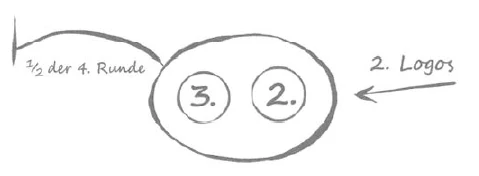
[ 8 ] Human beings are constructed from the outside in. The Pitris—the second Logos—have come over. They have fertilized the third Logos. The animal basis of human beings arises from the fertilization of the third Logos by the second Logos. [This is] the Lemurian/Lunar race up to the middle of the fourth round.
[ 9 ] And now the second fertilization takes place from what has arisen thus far. From the second and third Logos—as a result of the first Logos connecting directly with them here—the second part now comes into being. [Thus arises] the second half of the fourth round and the three following rounds.
[ 10 ] So we must imagine: [The] second Logos is that which comes from outside; [it] takes on form [with the help of the third Logos] and swells. All shells are formed.
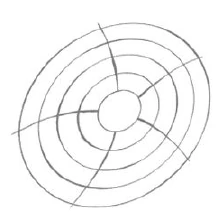
[ 11 ] And now comes [the] fertilization by the First Logos. It radiates from within. This is the fertilization by the First Logos. This is what can be seen in the aura.
[ 12 ] Up to the fourth round, the aura is formed in a cloud-like manner [from the outside], up to the Lemurian race. In the middle of the Lemurian race, the radiant image of the aura begins. And this is the inflow of the First Logos. And this is what Annie Besant calls the development of life, or evolution. Life—or evolution—begins from within. [Third Logos: Evolution of Life.]
[ 13 ] [The] human of the Lemurian race has formed [a] physical body, [an] astral body, [and a] Kama-Manas. All of this has developed. Now a black dot appears. In the center above the head, which, as it were, indicates the point from which the inflow of the First Logos radiates.
[ 14 ] Every epoch of evolution is intended to fulfill a very specific purpose of the Logos. Our current round—the terrestrial epoch—has intended humanity from the very beginning and is meant to bring humanity to perfection. The present [round] has the specific task of endowing humanity from the very beginning and guiding it toward development.
[ 15 ] To this end, a twofold fertilization always takes place. The first consists in [the fact that] the result of the preceding epoch fertilizes itself. What emerges from this fertilization are the facts of the first half of evolution. Then the second fertilization takes place [through] the First Logos. These are the facts of the second half of evolution. One half moves from the outside to the inside and forms the form. The other moves from the inside to the outside and forms life.
[ 16 ] I therefore refer to [the] third Logos as “world dust” because everything that has been cast off by the other worlds is absorbed into it. In order for [plant] seeds to grow and bloom, matter must first be drawn in. The [plant] seed must be planted in [the] soil, which is, as it were, prepared for it, [so that] it can draw out the power it needs. So it is with [the] third Logos as well. It consists of substance filled entirely with [source] power. The kamic beings attract the substance and form a cosmos.
[ 17 ] The eighth sphere releases its substance; it is incorporated into the new development when a new cosmos comes into being. [The eighth sphere, the corpse of every cosmos, provides the substance for the future.] At the end of its development, every world body turns light purple and disappears. All seeds are contained within it, and [gap in the transcript]
[ 18 ] We must free ourselves from the concept of space. It does not capture everything.
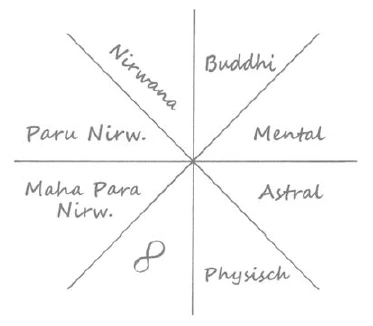
[ 19 ] No new forms will be created in the third cycle. Externally, human beings have attained the most perfect form. The next thing human beings will achieve is to perfect the other shells from within.
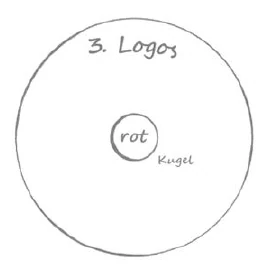
[ 20 ] The effect on the astral body has already begun. The fourth round will be completed, the fifth will follow, and then the astral body will be increasingly affected. And on the fifth sphere/round, the astral body will be like this.
[ 21 ] [From the middle of the fourth round onward, the forms are complete; now the influence on the astral body begins from within.] He will have numerous wheels in his astral body. The chakras move, just as they do [today] in those who can see with their souls. The chakras [rotate].
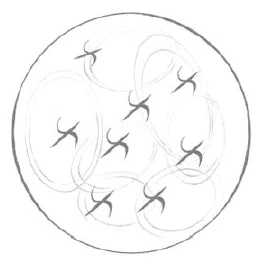
[ 22 ] During the sixth round, the mental body takes shape. Not only will the chakras move, but the mental body will shine more and more radiantly from within. Now it is the radiant mental body. This is perfected on the sixth sphere.
[ 23 ] In the seventh round, the causal body develops to its highest perfection. [It extends beyond the boundary of the astral body, until in the end nothing remains but the causal body.] Specifically, the rays will become the active causal body.
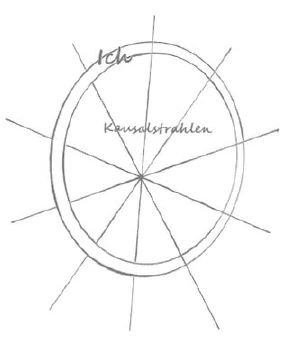
[ 24 ] She [gap in the transcript]
[ 25 ] At the end of the seventh round, there is nothing left but the causal body.
[ 26 ] The uppermost layer is formed in the fourth round. The upper brain provides the tool for independent action. Until then, the third Logos acts from the outside. From the brain, the forces can then radiate outward and set the chakras in motion again.
[ 27 ] We call that which comes from the previous stage of development Prakriti, that which comes from the second half Mahat, and that which comes from the third Purusha.
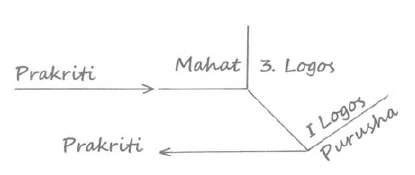
[ 28 ] The body is Mahat, the soul is Prakriti, and the mind is Purusha. [In the seed, Mahat and Purusha have disappeared; Prakriti is carried forward.]
[ 29 ] The body is made capable by the spirit dwelling within it. The body would not commit any errors if it were not [led astray] by the spirit. There is no such thing as physical sin. All sin is of a spiritual nature. Only a person who has given up restraining Kama can be cruel. It is only from the middle of the Lemurian race onward that there is “good and evil”; before that, there was none. Spirit and body are two perfect parts. In the middle of both lies Kama, the soul; it is the bearer of imperfection.
[ 30 ] [The body is the mind from the outside, Mahat. The soul is Prakriti.]
[ 31 ] There is nothing as perfect as your lungs, your stomach, your heart. If your mental faculties were as perfect [as these organs], you would have attained [mental] perfection. The physical realm does not err; the mineral realm does not err at all. It cannot err.