Human-Becoming, World-Soul and World-Spirit I
Human Beings as Physical and Spiritual Entities
in Their Relationship to the World
GA 205
24 June 1921, Dornach
Translated by Steiner Online Library
Third Lecture
[ 1 ] Following the historical reflections we have made, we will today consider some aspects of contemporary humanity, which will then give us the opportunity to examine more closely, over the next few days, how this contemporary human being is situated within the whole of time. We must be clear that human beings, as they stand before us as spiritual, soul, and physical beings, are situated in the world in three different ways. This becomes evident even when we consider human beings—I would say—purely from an external perspective. In terms of their spirit, they move through the world independently of external appearances; in terms of their soul, they are not quite so independent of external appearances. One need only observe certain connections that are visible throughout life to see how the life of the soul is actually connected to the external world. One can feel emotionally downcast; one can feel emotionally uplifted. Recall how often you have felt downcast in a dream, and how, upon waking, you must trace this feeling of downcastness back to an irregularity in your breathing rhythm. One might say this is a crude manifestation, and yet, all soul life is never entirely without a similar connection to the rhythmic life we experience in our breathing rhythm, in our blood circulation rhythm, and in the outer rhythmic life of the entire cosmos. Everything that takes place in the soul is connected to the rhythm of the world. So while, on the one hand, as spiritual beings we may feel to a high degree independent of our environment, we cannot say the same with regard to our soul life, for our soul life is embedded within the general rhythm of the world.
[ 2 ] We are even more present in the general phenomena of the world as physical beings. Again, one need only start with gross phenomena. As physical beings, we are heavy; we have weight. Other purely mineral entities also have weight. Mineral beings, plant beings, animal beings, and human beings as physical beings—they all form part of this general heaviness, and in a certain sense we must even rise above this general heaviness if we wish to make our body the physical instrument of spiritual life. As we have often mentioned, if it were merely a matter of the physical weight of our brain, it would be so great—one thousand three hundred to one thousand five hundred grams—that it would crush all the veins located beneath it. But the brain is subject to Archimedes’ principle, in that it floats in cerebrospinal fluid. It loses so much of its weight by floating in the cerebrospinal fluid that it actually weighs only twenty grams, meaning it exerts a pressure of only twenty grams on the veins at the base of the brain. You can see from this that the brain actually strives much more upward than downward. It resists gravity. It breaks free from the general pull of gravity. But in doing so, it does nothing different from any other object you place in water, which loses an amount of its weight equal to the weight of the displaced water.
[ 3 ] So you see an interplay between our entire physical being and the external world. And the fact is that here we are not merely integrated into a rhythm, as we are with the weaving of the soul, but that we are completely immersed in this external physical life. When we stand at a certain spot on the ground, we exert pressure on that spot; when we move to another spot, we exert pressure on a different spot on the ground. We are therefore physical beings as physical human beings, just like other physical beings in the other kingdoms of nature.
[ 4 ] We can therefore say: Through our spiritual being, we are, in a certain sense, independent of our environment; through our soul, we are integrated into the rhythm of the world; and through our physical body, we are integrated into the rest of the world as if we had no soul or spirit at all. We must certainly take this distinction into account. For we cannot arrive at an understanding of the higher nature of the human being unless we take into account this threefold relationship of the human being to its entire environment. Let us now take a look at the human being’s environment. In the human environment, we first have—I am now summarizing various things we have been considering for many months, albeit from different perspectives—everything that is governed by the laws of nature. Imagine the entire universe, governed by the laws of nature, with the entire visible world—or the world perceptible through the senses—bound by these laws of nature. Let us first consider this as humanity’s primary environment.
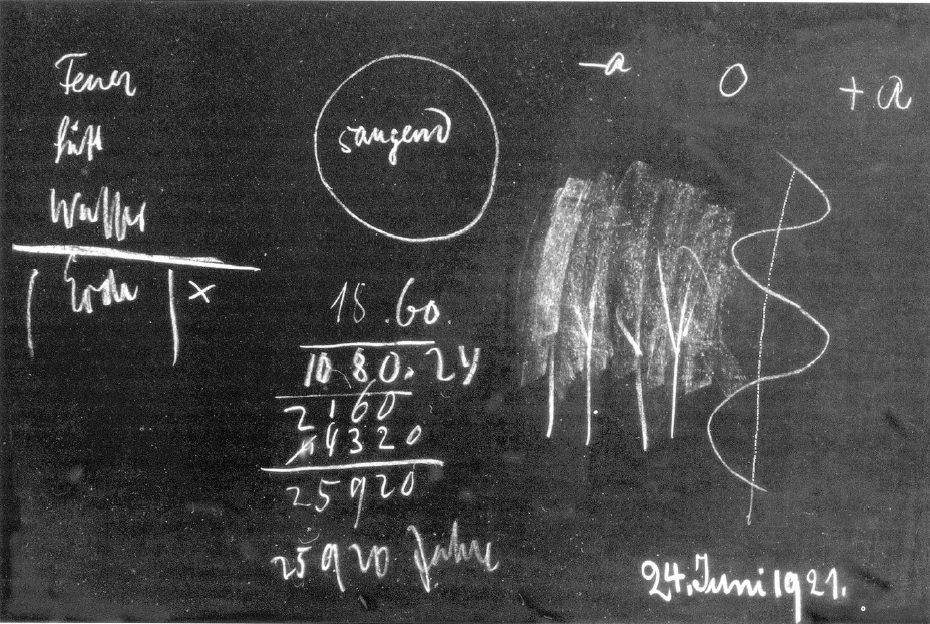
[ 5 ] If we consider this world—a simple reflection shows that we are, in fact, dealing only with the actual earthly world. Only reckless and unfounded hypotheses by physicists could suggest that the same laws of nature we observe all around us here on Earth also apply to the extraterrestrial cosmos. I have often pointed out to you how surprised physicists would be if they could ascend to the place where the Sun is. Physicists regard the Sun as something like a large gas furnace—albeit without walls—roughly like a burning gas. One would not find this burning gas if one were to reach the point in the cosmos where the Sun is. At that point in the cosmos where the Sun is, one would find something that is, however, very unlike the physicists’ conception. If this here (it is drawn) encloses the space we imagine the sun to occupy, then not only is there nothing present at this point of all the matter we find here on Earth, but there is not even present at this point what we call empty space. First, imagine filled space; after all, since you live here on Earth, you are always surrounded by filled space. If it is not filled with some solid or liquid substance, it is filled with air or at least with heat, light, and so on. In short, we are always dealing with filled space. But you know that it is also possible, at least approximately, to create a vacuum by pumping the air out of the air pump’s reservoir.
[ 6 ] Now imagine we have some filled space; let’s denote it by the letter A and put a plus sign in front of it, +A. Now we can make the space emptier and emptier, and the A will become smaller and smaller; but the space is filled, so we still denote it with a plus sign. We can—although we cannot actually do this under earthly conditions, since we can only make space approximately empty—but we can imagine that a completely vacuumed space could, after all, be created. Then, in the part of the space that has been emptied, there would be nothing but space. I will call it zero. It has zero content. Now, however, we can do with space what you can do with your wallet. When your wallet is full, you can keep taking more and more out of it; eventually, there will be nothing left inside. But if you now want to spend more money, you can’t take anything else out of the wallet—since there was already nothing left inside—but you can go into debt. There is then even less than zero inside the wallet when you are in debt. In the same way, you can conceive of space not merely as empty, but—I would say—as a “sucking” space, containing less than zero, -A. And this suction space—this space that is not only empty but has a content that is the opposite of material fullness—is the space that is occupied by what one must imagine as being filled by the sun. So the sun is internally suction-like, not oppressive like a gas. It is filled with negative materiality.

[ 7 ] I’m just citing this as an example so you can see that earthly laws cannot be applied so easily to the extraterrestrial cosmos. The conditions in the extraterrestrial cosmos are likely to be quite different from those we experience in our environment here on Earth. So when we first speak of a certain set of laws, we must say: We are surrounded by laws within earthly existence, and these laws encompass the material world, which is initially accessible to us. — Imagine this world of earthly existence: You need only bring to mind the processes that take place in the mineral world, bring them before your soul, and you will have what is, as far as you can see it, entirely encompassed within this lawfulness of earthly existence. So we can say: First, the mineral world is encompassed by it; second, however, something else is also encompassed. When we walk around, or even when we are carried around—in short, when we behave, so to speak, if I may put it crudely, as objects in this physical world—then we live within the same laws. For the laws of earthly existence, it makes no difference whether a paving stone is carried around or moved, or whether a human being is carried around or moves of their own accord; this is entirely irrelevant to the laws of earthly existence. You need only consider this. For the laws of earthly existence, nothing else comes into play except the change in a person’s location, which they can, of course, bring about themselves. This is then connected to other things; but if one studies only earthly laws, then it can be irrelevant what goes on inside a person’s skin or what goes on in a person’s soul. Only the change in position within earthly space is taken into account.
[ 8 ] We can therefore say: The second, apart from the mineral world, is the moving human being—specifically, the human being who moves externally (see list on page 62). — We find no other connection between the external world and human beings—insofar as it is earthly and appears to our senses—than the connection to the externally moved human being. If we wish to seek any other connection to human beings, then we must immediately turn to something else. And there we do indeed come to the extraterrestrial, to our extraterrestrial environment—insofar as we study, for example, the lunar environment, that which emanates from the Moon. After all, at least for the consciousness of many people, something of the Moon’s effect on Earth still becomes apparent. People in many parts of the world believe in such effects of the Moon on Earth—for example, the connection between the Moon’s movements and rainfall patterns. Contemporary scholars regard this as superstition. I have told you—at least some of you—that there was once a charming set of facts in Leipzig.
[ 9 ] The fascinating natural philosopher and aesthetician, Gustav Theodor Fechner, even wrote a book on the moon’s influence on weather conditions. He was a colleague at the university of the well-known botanist and naturalist Schleiden. Schleiden, of course, as a modern materialist, was deeply convinced that what his colleague Gustav Fechner claimed about the influence of the moon’s phases on the weather could only be based on superstition. However, in addition to the two scholars at the University of Leipzig, there were also their wives—Mrs. Schleiden and Mrs. Fechner—and living conditions in Leipzig at that time were still so modest that people collected rainwater for laundry. The women claimed that during certain phases of the moon, one could collect more rainwater and thus have more water for washing than during other phases. And Professor Fechner’s wife said she believed in what her husband had published about the influence of the moon’s phases on the weather; so she would like to come to an agreement with Professor Schleiden’s wife—who did not believe in it—that the latter would place her barrels in accordance with Professor Schleiden’s opinion; after all, according to his view, she would collect just as much rainwater as Professor Fechner’s wife did, following her husband’s sound advice. And lo and behold, even though Professor Schleiden considered Professor Fechner’s view to be extraordinarily superstitious, Professor Schleiden’s wife did not agree to this arrangement, but instead wanted to place her barrels during the other phases of the moon as well, in order to collect rainwater.
[ 10 ] Well, what is less apparent to our modern scientific understanding is the influence of the forces of other planetary bodies. But if one were to study more closely—as is now to be done at our scientific-physiological institute in Stuttgart—for example, the line along which plant leaves grow on the stem, one would find how every single line corresponds to the motion of the planets, how these lines, so to speak, represent miniature images of planetary movements. And one would discover that many things on the Earth’s surface can only be understood if one is familiar with the extraterrestrial realm and does not simply equate this extraterrestrial realm with the terrestrial one; if one assumes that there is a law at work that is cosmic rather than terrestrial.
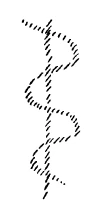
[ 11 ] So we can say that we have a second law within cosmic existence. Once we begin to study these cosmic influences—and we will be able to study them entirely empirically—only then will we have a true botany. For what grows as our plant world on Earth does not grow out of the earth in the way that materialistic botany imagines, but is drawn out of the earth by cosmic forces. And what is thus drawn out by the cosmic forces in the course of plant growth is permeated by the mineral forces, which, so to speak, permeate the cosmic plant skeleton, making it visibly perceptible to the senses. So we can say that this cosmic law encompasses, first, the plant world; secondly—though admittedly in a way that is not as easy to observe as in the plant world, because it attains a certain degree of autonomy and becomes independent of the rhythm of external processes, yet still imitates that rhythm internally—this cosmic law also encompasses everything that constitutes the inner movement of the human being, that is, a movement that is entirely physical yet internal to the human being. Thus, the earthly law of nature encompasses, first, the human being moved by external forces; but if you look at your digestion, at the movement of nutrients in the digestive organs, and if you further look not at the rhythm but at the movement of blood through the blood vessels—and there are many other things that move within the human being—then you have a picture of what moves within the human being, regardless of whether he is standing or walking. This cannot simply be incorporated into the first law, but must be incorporated into the cosmic law, just as the form and movements of plants are; only in the human being do these take place more slowly than the forms and movements of plants. So that we can say: Second, the inner movements of the human being are incorporated here (see table on page 62).
[ 12 ] You can now consider the cosmos—I would say to indefinite distances—and somehow everything in this way influences the life that develops on the Earth’s surface. But if only these two things existed—if only earthly laws and cosmic laws existed in the sense I have just presented them to you—then nothing else could exist on Earth except the mineral world and the plant world, for human beings, of course, could not exist there. They could move, if they were possible, and inner movements could exist, but that, of course, does not yet constitute a human being. Nor could animals exist on Earth; in reality, only minerals and plants could exist. That which is, first and foremost, cosmic law and the content of cosmic being must be permeated and interwoven with something that we can no longer even count as part of space—in contrast to which we can no longer speak of space.
[ 13 ] Of course, everything that falls under points one and two can be conceived of as existing in space, but we must speak of something that can no longer be conceived of as existing in space, yet which, for the time being, permeates all cosmic laws. You need only think of how, in human beings, their movements—their inner movements—are connected to their rhythm. To begin with, what constitutes the movement of our nutrients within us ultimately finds its way, so to speak, into the circulation. But the circulation does not simply consist of blood flowing through the veins as a nutrient-rich fluid. The blood moves rhythmically, and moreover, this rhythm stands in a specific relationship to the respiratory rhythm, in that oxygen is consumed in the process of blood formation. We have this dual rhythm. I once pointed out how this ratio of the blood rhythm to the respiratory rhythm—four to one—forms the basis of an inner psychological law, such that meter and verse form actually depend on it.
[ 1 ] We see, then, that what is taking place there as an inner movement is connected to rhythm, and we have said that this rhythm is related to the human soul life. Similarly, we must relate what we find in the movements of the stars to the world soul. Thus, thirdly, we can speak of the laws within the world soul (see table on page 62), and within this we have included, first, the animal world, and second, all that pertains to the rhythmic processes of the physical human being. These rhythmic processes within the human being stand, after all, in relation to the overall rhythm of the world. We have already spoken of this, but let us now bring it to mind again for the reflections we will be making over the next few days.
[ 15 ] As you know, a person takes about eighteen breaths per minute. Multiply that by sixty, and you get the number of breaths per hour. Multiply that by twenty-four, and you get the number of breaths per day: for a normal person, that comes to about 25,920 breaths over the course of a day. This number of breaths thus forms the day-and-night rhythm in human beings. We know that the spring equinox point of the sun shifts slightly further each year, so that, in a sense, the sun moves its spring equinox point forward across the celestial sphere. And the duration of time after which this spring equinox point returns to its former position is 25,920 years. This is, first and foremost, the rhythm of our universe, and our breathing rhythm over twenty-four hours is a miniature reflection of it. We are thus, through our rhythm, woven into the rhythm of the universe, and through our soul, into the laws of the world soul.
[ 16 ] The fourth principle we can consider is the law that underlies the entire universe—just as with the three previous principles—those laws within which we find ourselves when we become aware of ourselves as spiritual beings. When we become aware of ourselves as spiritual human beings, we must be clear about this: At first, we cannot comprehend this or that aspect of the world, for with today’s intellectualism—which is, after all, the general spiritual cultural force—very little is actually understood; thus, with our spirit at a certain stage of human development, we initially comprehend very little. But it lies in the spirit’s very self-conception that it tells itself: If it develops, no limits can be set for it. It must be able to develop into the universe through knowing, feeling, and willing. And so, as we carry our spirit within us, we must relate it to a fourth law within the world spirit (see table on page 62).
[ 17 ] And only now do we come to what is contained within it as a real being, for human beings could not possibly exist within the other laws of nature. Only then do we come to find the human being—but specifically, that aspect of the human being which is his nervous-sensory apparatus, everything that is, first and foremost, the physical vehicle of spiritual life, that is, the nervous-sensory processes. For with human beings, it is the case that first the whole human being comes into consideration—the one who bears his head, that is, the primary repository of the nervous-sensory organs—and then the head itself. Human beings are, so to speak, human precisely because they have a head, and the most human aspect of a human being is the head.
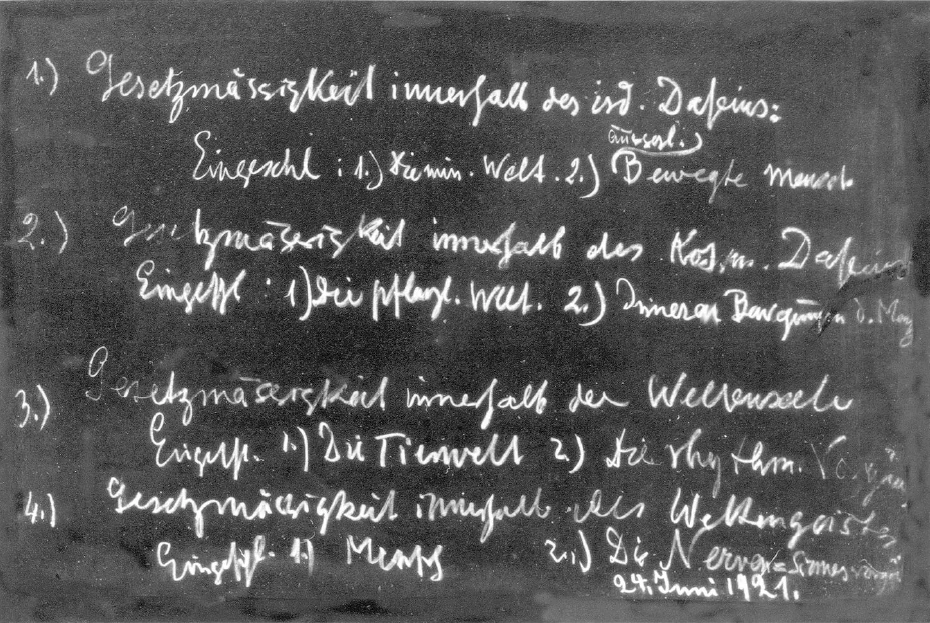
1.) Lawfulness within earthly existence
Included: 1) The mineral world 2) The human being subject to external forces2.) Rhythmic Patterns Within Cosmic Existence
Included: 1) The plant world 2) The inner movements of human beings3.) Lawfulness within the World Soul
Included: 1) The animal kingdom 2) Rhythmic processes4.) Lawfulness within the World Spirit
Included: 1) Human beings 2) Nervous and sensory processes
[ 8 ] So we already encounter the human being twice here. Now, if we consider this as a summary of what we have discussed in recent weeks, it first gives us a picture of the relationship between human beings and the environment—but not merely the spatial environment, since only points one and two refer to the spatial world—but also the non-spatial world. Points three and four then refer to this. It is particularly difficult for people today to conceive that anything could exist outside of space, or that it makes no sense to speak of space even when discussing realities. Without this, however, one cannot ascend to a spiritual science. Those who wish to remain within space cannot ascend to spiritual entities.
[ 19 ] The last time I spoke here, I talked to you about the Greeks’ worldview to show you how, in other eras, people viewed the world differently than we do today. This picture I have just described to you is revealed to people today; it is revealed to them when they simply observe the world without prejudice, unhindered by the debris that modern science throws up.
[ 20 ] Now I must add a few more things to what I have told you about the Greek worldview, so that we can connect it to what I have been trying to convey to you through this outline. If a person is truly intelligent, they will say: The physical world consists of some seventy elements, which have different atomic weights and so on, and these elements form compounds; one can perform analyses on them and so on. What takes place in the world with regard to these seventy or so elements is based on chemical combinations and chemical decompositions. We need not concern ourselves at this moment with the fact that they can be traced back to something more primordial. In general, these seventy or so elements are accepted by popular science today.
[ 21 ] A Greek—not in his present incarnation, since in that case he would naturally think just like people today if he were educated—but let’s say if he could suddenly appear in the present world as an ancient Greek, then he would say: “Yes, that’s all well and good, these seventy-odd elements, but they don’t get you very far; they don’t really tell us anything about the world. We used to think about the world quite differently. We thought the world consisted of fire, air, water, and earth.”
[ 22 ] A person today would say: That’s just characteristic of a childlike way of thinking. We’ve long since moved beyond that. After all, in the states of matter—in the gaseous states, we consider the airy; in the liquid state, the watery; and in the solid state, we consider the earthy. But heat no longer counts for us as anything that one would refer to as you do. We have simply moved beyond these childish notions. We have what constitutes the world for us in our seventy-odd elements.
[ 23 ] The Greek would say: “All right, but fire or heat, air, water, earth—these are something quite different to us than what you imagine them to be. And you don’t understand a thing about what we have imagined them to be.” — Now, today’s scholar would at first be somewhat taken aback by this, and he would think he was dealing with someone at a more childlike stage of cultural development. But the Greek might—since he would immediately grasp what the modern scholar actually has in mind—certainly not hold back, but would say: “Yes, you know, what you call your seventy-two elements—for us, all of that is part of the earth; it’s nice that you differentiate them, that you specify them further, but the properties you attribute to your seventy-two elements—for us, those are part of the earth. You don’t understand anything about water, air, and fire; you know nothing about them at all.”
[ 24 ] And the Greek would go on to say—you see, I’m not referring to some cultural epoch long past in the Orient, but simply to a knowledgeable Greek—he would say: What you’re saying there about your seventy-two elements with their syntheses and analyses is all well and good, but what do you think this refers to? It all refers merely to the physical human being once he has died and lies in the grave. There, his substances—there, his entire physical body—undergo the processes you learn about in your physics and chemistry. What you can learn within the structural relationships of your seventy-odd elements has absolutely nothing to do with the living human being. You know nothing at all about the living human being, because you know nothing about water, air, and fire. One must first know something about water, air, and fire; only then does one know anything about the living human being. Through what you cover in your chemistry, you know only what happens to a human being after they have died and lie in the grave—the processes the corpse undergoes. You know this only when you approach it with your seventy-odd elements.
[ 25 ] The Greek wouldn’t have much luck with the rest of his argument when dealing with the modern scholar, but he might try to clarify things a bit more in the following way. He would say to him: “Look, when you consider your seventy-two elements, to us that is all earth.” We are, of course, only considering the general; but even if you specify it further, it is merely a more precise understanding, and through that more precise understanding one does not penetrate to the depths. But if you knew what we call water, you would have an element in which, as soon as it begins to move and come to life, it is no longer governed solely by earthly conditions, but rather, water in all its activity is subject to cosmic conditions.
[ 26 ] By “water,” the Greeks did not mean physical water, but rather everything that flows from the cosmos onto the Earth in terms of natural laws, including the movement of water and matter. And within this movement of water and matter, the plant element, in turn, lives. By distinguishing within all earthly phenomena that which is contained in the living, weaving water element, the Greeks saw in this living, weaving element, at the same time, the entire order of plant life, which is embedded in this watery element. So that we can say: We can schematically place this watery element somewhere on Earth in some way, but we must place it in a way determined by the cosmos. And now we can conceive of the mineral element—the truly earthly element—as sprouting upward from below in all manner of ways, an element that then permeates the plants, infusing them, as it were, with the earthly element. But what the Greeks conceived of as the watery element was something essentially new, and for them it was a wholly positive conception. And they did not view it in terms of concepts; they viewed it in images, in imaginations. We must, however, go back to the Platonic era—for this way of viewing things was corrupted by Aristotle— we must go back to Plato, to the pre-Platonic era, and then we will find how the truly knowledgeable Greek, through imagination, perceived that which lived within the watery element and actually sustained vegetation, and how he related this entirely to the cosmos.
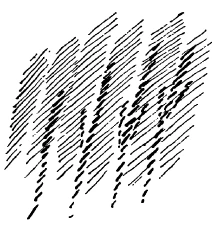
[ 27 ] Now he would go on to say: You see, what lies there in the grave when a human being has died—and what is lawfully permeated by the structural laws that operate within your seventy-odd elements—is bound, between birth—or let us say conception—and death, to the etheric life, to the etheric life that acts from the cosmos. You are permeated by this if you are a living human being, and you understand nothing of it unless you speak of water as a special element, and unless you look out into the plant world as embedded in the watery element, unless you see these images, these imaginations.
[ 28 ] We Greeks—he would say—certainly spoke of the human etheric body, but we did not invent anything about the etheric body; rather, we said: What may appear to the soul’s eye when, in spring, one sees the sprouting, greening plant world; when one sees the plant world gradually taking on different colors; when one sees this plant world bearing fruit in summer and the leaves withering toward fall—what may appear there, when one observes such a cycle of the year in the vegetation and has an inner understanding of it—this establishes a connection just as one establishes a connection to the mineral world through the bread and meat one eats; in the same way, one establishes a connection to what is visible in the plant world throughout the course of the year. And if we imbue ourselves with the insight that, in fact, everything within us unfolds in the twenty-four-hour cycle as in a miniature image—and then repeats itself throughout our entire life—then we have within us a miniature image of what out there, emerging from the watery, ethereal elements, from the cosmos, constitutes our environment. If we observe this outer world with understanding, we can say: What is out there lives within us. — Just as we say: “The spinach grows out there; I pick it, cook it, and eat it, and as a result I have it in my stomach—that is, in my physical body”—so we can say: “Out there, throughout the course of the year, an ethereal life weaves and lives, and I have that within me.”
[ 29 ] It was not physical water that the Greek had in mind, but rather what he grasped in these imaginings and brought into a living relationship with human beings—that was the foundation of his worldview. And so he would go on to say to his interlocutor: You study the corpse lying in the grave because you study only earth; for your seventy-odd elements are earth. We studied the living human being. During our time, we also studied the human being who has not yet died, who grows and moves out of inner vitality. One cannot do this unless one ascends to the other elements.
[ 30 ] This was the case with the Greeks, and if we were to go back even further, we would clearly encounter the element of air and the element of fire or heat. We will consider this later as well; but today I would first like to point out how the fact that human beings do not perceive the proper interrelationships of forces within themselves actually depends on their inability to find these interrelationships in the external world as well—that they have abandoned these interrelationships. And this is the defining feature of our cultural development since the first third of the 15th century: the understanding of these relationships among the elements has simply been lost, and with it has also been lost the understanding of the living human being. In official science, we study the corpse. We have often heard that this phase was bound to occur at some point in the history of human development—though for different reasons, namely so that humanity could pass through the phase of the development of freedom. But a certain understanding of nature and the human being has been lost since the first third of the 15th century. Understanding has so far been limited to this single element, the earth. And we must now set out on the return journey. We must find our way back, through imagination, to the element of water; through inspiration, to the element of air; and through intuition, to the element of fire. Essentially, what we have viewed and interpreted as an ascent into higher knowledge—the ascent from ordinary, concrete cognition through imagination and inspiration to intuition—is also an ascent to the elements. We will continue this discussion the day after tomorrow.