Human-Becoming, World-Soul and World-Spirit I
Human Beings as Physical and Spiritual Entities
in Their Relationship to the World
GA 205
26 June 1921, Dornach
Translated by Steiner Online Library
Fourth Lecture
[ 1 ] The day before yesterday, we discussed how a Greek from a time when a certain kind of inner knowledge still existed might have thought about the worldview—about the scientific worldview of the present day— and I then attempted to demonstrate how, from the standpoint of imaginative insight, such a Greek would have described what we are accustomed to calling the human etheric body in relation to the element of water. I said: Imaginative insight would reveal a certain connection between the overall effect of water—the undulation and weaving of the water element, its striving toward the expanse, its sinking toward the earth—and a connection between these, I might say, manifestations of force—toward the expanse and toward the center—and the shaping, the formation of the plant element in its individual forms. Here we arrive at a concrete shaping of the content of the imaginative world—at least of a part of the imaginative world. In practice, such insight can only be attained through human contemplation if one strives for the kind of development described in my book How Does One Attain Knowledge of the Higher Worlds?, with the goal of imaginative insight.
[ 2 ] However, even with such insight, one would still remain unfamiliar with what was called the air element in the earlier worldview. This air element—as the ancients, for example, conceived it—can only be penetrated through what is called inspired insight. You will come close to this inspired insight—this experience of the air element—if you try to grasp the following. I have often mentioned how, today, human beings are essentially viewed from a very external perspective. One need only recall how anatomical and physiological depictions of the human being are made today. They are created by drawing sharp contours around the internal organs—the heart, lungs, and liver. Certainly, these sharp contours, these boundary lines of the heart, lungs, liver, and so on, do have a certain validity. Yet by drawing them, we depict the human being as if he were a solid body through and through—but he is not. The human being consists of only a very small portion of solid mineral substances. If we were to take, so to speak, the maximum possible figure, we could assume at most eight percent of the human body to be solid; ninety-two percent of the human being is a column of fluid—it is not solid at all. The solid components are merely embedded within the human body. Very little awareness of this is awakened in today’s students of physiology, anatomy, and so on. But we do not come to know the watery human, the liquid human, when we draw him with the solid boundaries of his organs; rather, the liquid human is something that is in constant flux; his organism is one that is constantly in motion within itself. And it is into this fluid organism that the air organism is now first incorporated. The air flows in, combines with the substances within, and stirs them up, if I may put it that way.
[ 3 ] Because human beings contain this element of air within themselves, they actually form a complete unity with the external world. The air that I now have inside me—I didn’t have it inside me just a moment ago; it was outside. The air that I now have within me will later be outside again. One cannot say at all that human beings—when viewed in relation to this third element, the element of air—are enclosed within their skin, and certainly not in relation to the element of warmth or fire. One cannot say that human beings are self-contained beings.
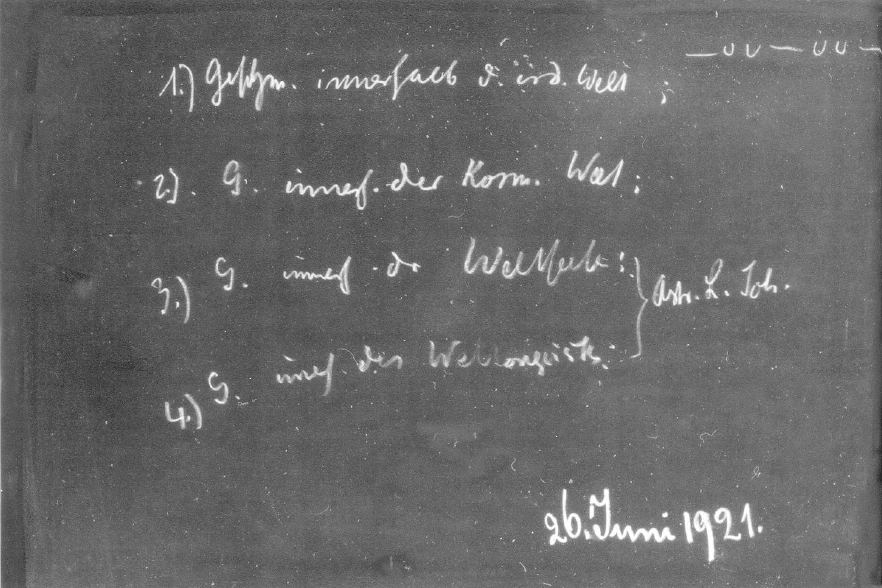
[ 4 ] Now let us contrast what we regard as the complete human being—that is, the human being who is organized not only in the solid, but also in the liquid, the gaseous, and the element of warmth, in the configured, intermoving warmth—with the human being as he is when he is asleep, with his soul and spirit outside the physical body and the etheric body. What animates and permeates the human being from waking until falling asleep is, of course, not present in the time between falling asleep and waking up. It is then in another world, which is also permeated by laws. And we must now ask ourselves: By what laws is the world permeated in which the human being finds himself between falling asleep and waking up? — Yesterday we identified four types of laws: first, the laws within the earthly world; second, the laws within the cosmic world; third, the laws within the World Soul; and fourth, the laws within the World Spirit. We ask ourselves: Where is the human being now—with his soul and his spirit, or with his soul-part and his “I”—between falling asleep and waking up? — Well, reflection and comparison with what we have discussed so far will show you that here, between falling asleep and waking up, the astral body and the “I” are in the realm of the World Soul and the World Spirit.
1. Laws within the earthly world
2. Laws within the cosmic world
3. Laws within the World Soul +
4. Laws within the World Spirit = Astral Body, I
[ 5 ] >And we must take very seriously what we mentioned the day before yesterday: that with the first two worlds—the earthly and the cosmic worlds—we have exhausted the entire realm of space. So, by entering these realms, we are already stepping outside the realms of spatiality. This is something we must bring ever more clearly before our souls: Every act of sleeping leads a person not only, as is often said, outside their physical body, but it also leads them outside ordinary space. It leads them into a world that must not be confused in any way with the world that can be perceived by the senses. Yet it is from this world that all the laws underlying the rhythmic human being—that human being who organizes both their fluid element and their air element through rhythm—originate. Rhythm appears in space, but the source of rhythm—the law that gives rise to it—flows forth at every point in space from depths beyond space itself. It is regulated everywhere by a real world that lies beyond the realm of the senses. And when we stand before that wondrous interplay that takes place in the inner human rhythm through the breaths and the pulse, we actually perceive in this rhythm something that is regulated from spiritual, extra-spatial depths into the world in which the human being also exists as a physical being. We cannot possibly understand the element of air unless we can arrive at such a concrete understanding of the human being’s rhythmic expression within this element of air.
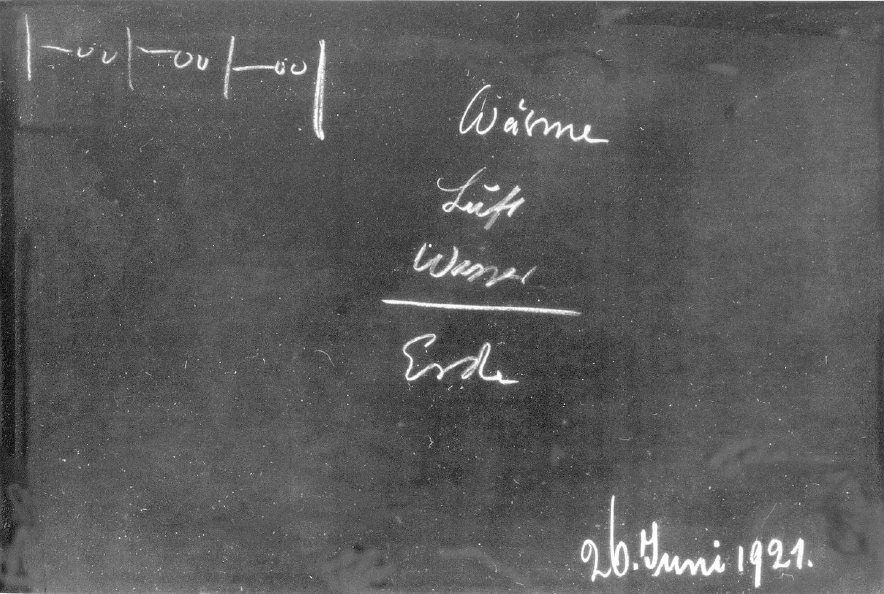
[ 6 ] If one uses one’s imagination to grasp what I described to you the day before yesterday—the interweaving and nature of the plant world and the parallel interweaving and nature of the human etheric body—then one is still in the world in which one normally finds oneself; one need only imagine oneself detached from the earth, as it were, poured out into the entire cosmos. But when one moves on to the element of air, one must remove oneself from space; one must be able to know oneself to be in a world that is no longer spatial but only temporal, in which only the temporal has any significance. In times when people viewed such things vividly, they perceived what belongs to such worlds in such a way that they truly saw the spiritual’s interplay in human activity, indirectly through rhythm. And I have drawn attention to how the ancient Greeks structured the hexameter: three heartbeats with a caesura, which constitutes one breath; another three heartbeats with a caesura or with the end of the verse make up the full hexameter: the corresponding eight heartbeats in two breaths. The interplay of the pulse beats with breathing was artfully shaped in the recitative of the Greek hexameter. It is as if, one might say, the spiritual-supernatural world trickles through the human being, as if it trickles into the blood circulation, into the rhythm of the blood, and synthesizes itself—four heartbeats, four rhythmic pulses—into a breathing rhythm; this was reflected in that form of speech known as the hexameter. All original endeavors to construct verses are drawn from this rhythmic organization of the human being.

[ 7 ] The world from which this rhythmic activity arises only becomes real for human beings when they become conscious while asleep. The activity in which a person then lives—asleep yet conscious—is precisely what shapes their rhythm. What underlies this remains unconscious to ordinary everyday consciousness and, even more so, to ordinary contemporary scientific consciousness. But when this becomes conscious, then not only does what I described yesterday—the undulating, weaving, billowing plant world—appear before the human being, but something else also appears: not images of the ordinary animal world—for those would be spatial—but rather a distinct consciousness — which, however, can arise only outside the body, not within it — whose content consists of the concrete images from which the forms of the animals then take shape in space. Just as our human rhythmic activity bubbles in from outside of space, so do the forms bubble in from outside of space, which then organize themselves into the various animals.
[ 8 ] The first thing one experiences when consciously going through that state—which is otherwise experienced unconsciously between falling asleep and waking up—is that, as one immerses oneself in this world, which is the source of our rhythm, the animal world becomes understandable in its forms. The animal world cannot be explained in terms of its forms by reference to external physical principles or forces. If zoologists or morphologists believe they can explain the form of the lion, the tiger, the butterfly, or the beetle based on something found here in physical space, they are greatly mistaken. It is from this that the forms of animals are to be explained, not from anything to be found here in physical space. One encounters it in the way I have just described when one enters into the third of the laws, the laws of the world soul.
[ 9 ] And now I would like to refer once again to the Greek whom I brought into a conversation the day before yesterday with the modern scholar who knows everything; that is to say, he does occasionally admit that he does not know everything, but he claims that, at least in his own way, everything must be explained. The Greek would say: Nothing at all can be explained in your way, for I have heard that you have something like a logic. In it, you list all sorts of abstract conceptual forms, categories—Being, Becoming, Having, and so on. This logic is something that is supposed to represent a regularity of concepts, of ideas. Yes, but this abstract logic—I’m thinking now of a Greek from the pre-Socratic period, a Greek from the time out of which the philosophies of Thales, Heraclitus, and Anaxagoras emerged, which, after all, have been preserved only in part—what you call logic—such a Greek would say— was actually created by a man who, in truth, no longer knew much about the mysteries of the world. It was Aristotle who first created it, after he had thoroughly applied his philistine intellect to Platonism. Certainly, Aristotle is a great man, but he is also a great philistine who completely corrupted true logic, who turned true logic into a web that relates to reality just as something very thinly spun and insubstantial relates to something densely real. And true logic—as a Greek of that time, who would have been a scientist in his own way, would say—encompasses those forms that become outwardly spatial in the animal world, and which one encounters when one becomes conscious between falling asleep and waking up. That is logic; that is the real content of logical consciousness.
[ 10 ] In the animal world, there is nothing other than what also exists in human beings, but in human beings it is spiritualized, and so they can think—they can conceive of the logical forms that shoot out into space in the external world and become animals. It is indeed true: When, between waking and falling asleep, we turn over our conceptual forms in ordinary consciousness—connecting one conceptual form with another—we are doing, in an ideal sense, the same thing that the external world does when it shapes the various forms of animals. Just as one contemplates one’s own etheric body when turning one’s gaze to the plants and imagining this plant world embedded in the element of water, so too does one comprehend one’s own soul world — for my part, it may be called the astral world — when one becomes imbued with this living weaving, which becomes conscious to the mind between falling asleep and waking up, and understands the outer shaping of the animal world. One must then imagine one’s own shaping of the ideal world woven into the rhythm of the airy element.
[ 11 ] You can form a very concrete picture based on the various things I have hinted at regarding human beings. Consider the process in very concrete terms: You inhale; the air travels through the lungs along the pathways you are familiar with. But because you have inhaled, the inhaled air surges into the space in which the spinal cord—and also the cerebrospinal fluid—is embedded; through the subarachnoid space, this fluid, which surrounds the spinal cord, is rhythmically propelled toward the brain. The cerebrospinal fluid becomes active. This activity in which the cerebrospinal fluid engages is the activity of thought. In reality, thought surges on the breath, which is transmitted to the cerebrospinal fluid, and this cerebrospinal fluid—in which the brain floats—now transmits its rhythmic pulsation to the brain itself. The impressions of the senses—the impressions from the eyes and ears—live in the brain through sensory-nervous activity. The rhythm of the breath synchronizes with what lives in the brain from the senses, and in this convergence, that interplay develops between sensory perception and that thought activity—that formal thought activity—which finds its life externally in animal forms, and which is brought about by the respiratory rhythm as it communicates itself to our cerebrospinal fluid in the arachnoid space and then surrounds what lives in the brain through the senses. Everything that now comes to life within us as an ideal activity arising from the rhythm lives there.
[ 12 ] That is the essential point: that you try to gradually gain insight into the way the spiritual interplays with the physical-sensory world. This is precisely the great cultural harm of our time: that we have a science which approaches the spiritual in abstract forms, in purely intellectual forms, whereas the spiritual must be understood in its creative element; otherwise, the material world remains like something hard and unconquered, standing outside the spiritual. We must look into how this element of the third and fourth laws plays a very concrete role in what we ourselves carry out.
[ 13 ] It is one of the most wondrous things we come to realize when we learn the true inner reason behind what can take place with every breath—not what actually takes place, but what can take place as the inhalation flows upward into the cerebrospinal fluid. Now comes the reverse movement: The cerebrospinal fluid is in turn pushed down through the arachnoid space, and then exhalation occurs. This is once again a surrender to the world; it is a merging with the world. But in this becoming-self—merging with the world—becoming-self—merging with the world—therein lies, in essence, that which is expressed in the rhythm of breathing.
[ 14 ] This is how one must speak when referring to the reality meant by the element of air, whereas earth encompasses everything contained in our seventy-odd chemical elements. As you can see, what becomes a physical body is subject to the laws governing the seventy-two elements. But that which initially brings this physical body to life, so that it grows and can digest, has flowed in from the cosmos. What permeates this organism, so that it not only grows and can digest, but also continually unfolds in rhythmic activity—in the rhythms of the pulse and respiration—comes from a world beyond space. And we study this extra-spatial world just as we study the cosmic—not the earthly—world in the element of air, for that is where it reveals itself, just as we study it in the element of water, for that is where it reveals itself. And what it reveals to today’s chemist and physicist comes solely from the internally differentiated element of earth.
[ 15 ] We can then also find the transition to the elements of warmth or fire; but this is actually only possible at a moment that arises practically for the human being when he has attained the ability not only to step out of his body consciously, but also to immerse himself in other beings with this consciousness. That is a difference. One may have had the ability to step out of one’s body for a long time; yet if even a trace of selfishness remains toward the world, one may indeed grasp everything I have spoken of so far, but one cannot truly immerse oneself in this outer world—one cannot surrender to it. When elements of true supersensible love are added—an immersion into that world in which one lives between falling asleep and waking up—only then does one actually come to know, in a practical sense, the element of warmth or fire. And only then does one truly come to know the true nature of the human being. For what is perceived externally through the senses is, after all, at first only a mere illusion of the human being; it is the human being from the other side, from the side of appearance.
[ 16 ] When one ascends to the element of water, the ethereal essence of the human being initially dissolves. It becomes, I might say, a miniature image of winter, summer, autumn, and so on. When one reaches the element of air, one perceives a rhythmic movement. The complete human being—the human being as an eternal being—can only be known within the element of warmth. There, everything comes together again: the movements and interweavings of the water element and the rhythms and rhythmic patterns of the air element merge. They balance each other out, they harmonize and become disharmonious within the element of warmth, within the element of fire, and there one can come to know the true nature of the human being. It is only there that one is truly within the fourth, within the laws of the World Spirit.
[ 17 ] So when we hear today about the ancient scientific concepts of earth, water, fire, and air, we should not think, “How wonderfully far we have come with our current science”—but rather we should realize that there was a completely different awareness of humanity’s roots in supersensible depths. That is why people also knew something about the distinct position of the earth element in relation to this supersensible realm. In a sense, the earth element lies entirely outside the sphere of the supersensible. The water element comes closer to it; in fact, this water element is much more closely related to the world of spheres spread out in cosmic space than to what the earth itself is. But we leave space entirely behind when we seek the source of what constitutes the air rhythm within us—that is, our air organization; for in relation to our air organization, we are rhythmizing, derhythmizing, and so on. And we finally arrive at the universal, non-spatial realm—that which even transcends time—when we enter the fire element, the element of warmth. But it is only there that we come to know the human being as a complete, self-contained whole. This can truly be found—once it has been rediscovered (and it is indeed necessary to rediscover it today)—in the literature dating back to before the 15th century, even though it has been corrupted.
[ 18 ] A few years ago, a Swedish scholar published a work on alchemy. This Swedish scholar reads a procedure described by an alchemist and says: If one examines this procedure today, it is pure nonsense; one cannot even begin to imagine what it entails. — It is quite understandable that today’s chemist—even a Swedish one, who is somewhat less prejudiced than his Central European counterpart—would take the terms used to describe what is found only in the corrupted literature of earlier times, imitate them, and then say that nothing comes of it! I looked up the process—which the good Swedish scholar cannot understand—in the literature available to him, and in that process, as described in the literature, there was indeed a fragment of the embryonic process, the embryonic development of the human being! This became apparent very quickly. But one had to be able to read the material! Today’s scholar reads something like this and applies the terms found in the chemistry textbooks he has studied. Now he sets up his retorts and tries to replicate the process: Nonsense! — What he has read is a fragment of a process that takes place in the mother’s womb during embryonic formation. You see, such is the gulf that has opened up between what today’s scholar can read and what was originally intended.
[ 19 ] But all the things described there are described under the influence of such concepts as we are now rediscovering through modern spiritual science. If we do not rediscover them, we cannot read these writings at all. They existed in a completely different way than we discover them today. They existed instinctively, atavistically, but they did exist, and humanity has, so to speak, elevated itself to an understanding of the mere earthly element. We must once again find our way back into the elements that now explain to us not merely the human corpse, but the whole human being, the living human being. To do this, however, it is necessary to learn to take the question of pre-existence very seriously within our civilization.
[ 20 ] When pre-existence was cast out of Western cultural development, selfless research was, in effect, cast out of that cultural development as well. When preachers today preach about immortality—please, take any sermon you like; as I have often pointed out—they are essentially appealing to human selfishness. We know that people feel uneasy; they fear the end of life. Certainly, life does not end. But when people speak of this, they do not appeal to one’s powers of cognition; rather, they appeal to one’s fear of death, to one’s will to continue living once the body is taken away; in other words, they appeal to one’s egoism. This is not possible when speaking of pre-existence. In fact, when people today look at their own self-interest, it is initially of the utmost indifference to them whether they lived before they were born or even conceived. They are alive now; of that they are certain. That is why they are not very concerned about pre-existence; they are concerned about post-existence. For even though they live now, they do not know whether they will live after death. This is connected to their self-interest. But since they are already living, they tell themselves—even if unconsciously or instinctively, if they have not engaged in reflection—“Well, I am alive, and even if I did not live before my birth or conception, it doesn’t matter to me, as long as I have begun to live now and do not cease again!” This is the mindset from which, fundamentally, the sentiments are drawn today that inspire people with enthusiasm for immortality. That is why, in the well-known languages, we have a word for immortality as a reference to eternity at the end of life, but—as I have often told you—we do not have a word for “unbornness” in the common cultural languages. Of course, we must gradually acquire that as well. This speaks more to knowledge; it speaks more to selflessness, to the ego-free understanding of the human being. We must once again appeal to this. And above all, this understanding must be interwoven with morality and ethics. Until the laboratory table becomes a kind of altar, until synthesizing and analyzing become a kind of spiritual art, and until we are conscious that we are intervening in the development of the world by doing this or that—until then, our cultural development cannot move forward. We are inevitably heading toward a terrible decline unless it is recognized in ever-wider circles: We must attain a non-egoistic understanding, a morally grounded understanding; we must overcome those analyses and syntheses—such as we have today—that take no account of the higher worlds. We must once again learn to understand such things as the rhythm that plays a role in our lives, just as that which plays a role in warmth. For it is precisely the moral that plays a role in warmth; and just as there are differences in warmth and variations in temperature, so in reality there is a morality that permeates the world, within which human beings develop. Humanity must gradually become aware of all this. And it is not merely, I would say, an idealistic quirk that calls on us to interpret the signs of the times in this era, but the signs of the times themselves speak to the effect that this deepening into the supersensible must be attempted.