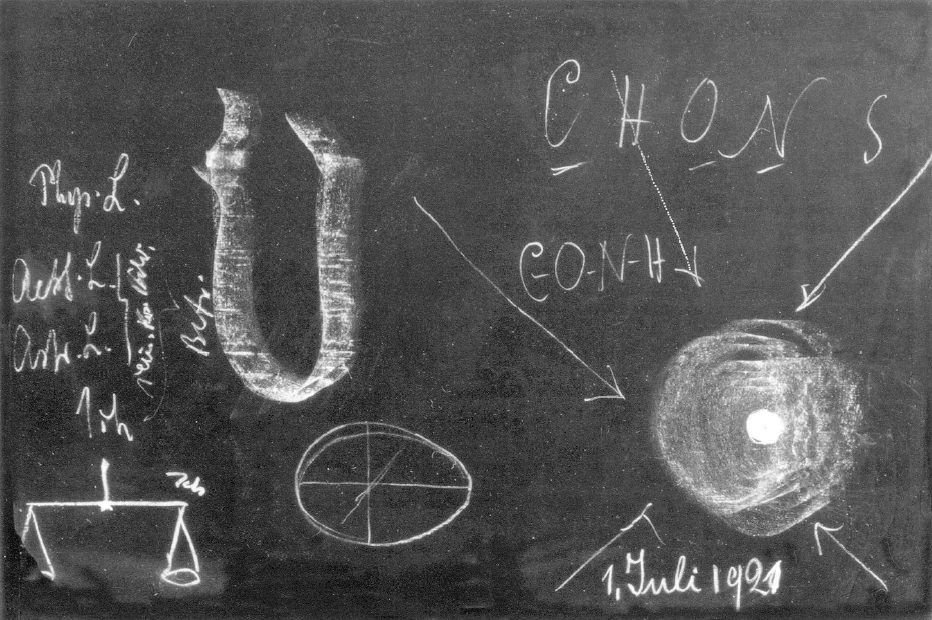
Human-Becoming, World-Soul and World-Spirit I
Human Beings as Physical and Spiritual Entities
in Their Relationship to the World
GA 205
1 July 1921, Dornach
Translated by Steiner Online Library
Fifth Lecture
[ 1 ] Today, in connection with the remarks I made eight days ago and earlier, I would like to discuss something—as a sort of anecdote—that can then lead us on to the continuation of our reflections. As we experience the world, we perceive many things in the world and in ourselves as abnormal, perhaps even pathological—and certainly, from one point of view, rightly so; but merely viewing something as abnormal or pathological in an absolute sense does not mean we have understood the world. Indeed, we often block our own path to understanding the world when we simply stop at such assessments of existence—such as healthy and sick, right and wrong, true and false, good and evil, and so on. For what appears pathological or abnormal from one perspective has its full justification from another perspective within the overall context of the world. I will cite a specific example in a moment, and you will see what I mean.
[ 2 ] The occurrence of so-called hallucinations or visions is rightly regarded as a pathological condition. Hallucinations—phenomena that arise in human consciousness and for which, upon closer critical examination, a person cannot find a corresponding reality—such hallucinations and visions are pathological when viewed from the perspective of human life as it presents itself to us between birth or conception and death. But by labeling hallucinations as something abnormal—as something that certainly does not belong in the normal course of life between birth and death—we have by no means grasped the essence of hallucinations.
[ 3 ] Let us now set aside any such judgment of hallucinations. Let us take them as they appear to the person experiencing them. They appear as an image that is connected in a more intense way to the person’s entire subjectivity—to their inner life—than ordinary external perception mediated by the senses. The hallucination is experienced more intensely on the inside than sensory perception. Furthermore, sensory perception can tolerate being interspersed with sharp, critical thoughts; in contrast, when it comes to hallucinations, the person experiencing them avoids interspersing them with sharp, critical thoughts. They live within the floating, weaving imagery.
[ 4 ] What, then, is this in which human beings live? Indeed, one cannot come to know it if one is familiar only with what enters ordinary human consciousness between birth and death. For in this consciousness, the content of the hallucination enters under all circumstances as something unwarranted. Hallucinations must be viewed from an entirely different perspective; only then can one approach their true nature. And this perspective arises when, in the course of developing higher insight, a person comes to know their own life and activity between death and a new birth—namely, the life and activity of their own being—when this life is already approaching birth, or conception, by decades. Thus, when one acquires the ability to immerse oneself in that which is, after all, the normal state of human existence as one approaches birth or conception, one then immerses oneself in the true form of that which appears as abnormal—as a hallucination—in the life between birth and death.
[ 5 ] Just as we here in life, between birth and death, are surrounded by the world of colors, by the world we sense in every breath of air and so on—in short, by the world we imagine ourselves to experience between birth and death—so our own soul-spiritual being lives between death and a new birth in an element that is entirely identical to what occurs within us during a hallucination. In a sense—and specifically in terms of our physicality—we are born out of the element of hallucination. What occurs in hallucination, I would say, floats through and blows through the world that underlies our own, and we emerge, through our birth, from this element, which can appear before our soul in an abnormal way in the hallucinatory world.
[ 6 ] What, then, is a hallucination in ordinary consciousness? Well, once a human being has lived through the period between death and a new birth, and has entered into physical-sensory existence through conception and birth, certain spiritual beings from those higher hierarchies we have come to know have had an intuition, and the result of this intuition is the physical body. So we can say: Certain beings have intuitions; the result of these intuitions is the human physical body, which can come into being only when the soul permeates it by emerging from the element of hallucinations. What happens, then, when hallucinations appear before ordinary consciousness in a pathological way? I can really only illustrate this to you figuratively, but it is only natural that I can only illustrate it to you figuratively, for hallucinations are, after all, images; so it goes without saying that one cannot make much sense of them with abstract concepts, that one must illustrate them figuratively.
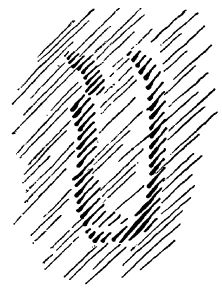
[ 7 ] Now consider the following: As I explained to you recently, this human physical body is, in reality, only to a very small extent defined by fixed contours; for the most part, it is watery, and it also consists of air, and so on. This human physical body has a certain consistency; it has a certain natural density. Now, if this natural density is transformed into an unnatural one, if it is disrupted—imagine, symbolically, that this physical body were somewhat constricted in its elasticity—then the original hallucinatory element from which it was born is squeezed out, just as water is squeezed out of a sponge. The emergence of the hallucinatory being is nothing other than the squeezing out of the physical body of its own element—the very element from which it arises, from which it is formed. And the onset of illness, which manifests itself in a hallucinatory state of consciousness, always points to an unhealthy condition of the physical body, which, in a sense, is forcing itself out spiritually.
[ 8 ] This fact does, in fact, point out to us that our thinking is, in a certain sense, precisely what materialism refers to. Our physical body is indeed, in a certain sense, a reflection of what preexists—before birth or before conception—in spiritual worlds. It is a reflection. And the thinking that occurs in ordinary consciousness—the very thinking of which the present age is most proud—is, not without reason, explained by materialists as something that is entirely bound to the physical body. It is simply this: this thinking, which modern man has made use of—particularly since the birth of the modern scientific way of thinking, since the 15th century—this thinking, as such, perishes with the physical body; it ceases with the physical body. What you often find in Catholic philosophy as it is practiced today—but which was common only in the present day, not in earlier centuries—namely, the notion that the abstract, intellectual workings of the soul survive death, is false; it is not correct. For this way of thinking, which precisely represents the characteristic life of the soul in the present, is thoroughly bound to the physical body. That which outlives the physical body only appears at the next higher level of cognition—in imagination, in pictorial conception, and so on.
[ 9 ] You will say: Yes, then the person who has no visual images has no immortality at all! — You cannot pose the question that way: “One has no visual images”—because that means nothing at all. You might say: I have no pictorial representations in my everyday consciousness; I do not bring them into my everyday consciousness. — But pictorial representations and imaginations are constantly forming within us; they are simply utilized in the organic process of life; they become the forces from which human beings continually rebuild their organism. Our materialistic philosophy and our materialistic natural science assume that when a person sleeps, they rebuild their exhausted organs from something; natural science doesn’t give much thought to what that “something” might be. But that is not the case; rather, it is precisely in our waking life that we continually form imaginations—even when we are merely engaging in everyday intellectual activity—and we digest these imaginations, so to speak, in our soul, and from them we build up our body. Because these imaginations build up the body, they are not perceived separately by ordinary consciousness. The development toward higher vision is based on our partially withdrawing—outwardly—from this work on the physical body, and on bringing up into consciousness that which otherwise simmers and bubbles beneath the surface of the physical body. Therefore, spiritual science is an essential part of higher vision, because this state cannot be sustained for long; otherwise, the organism’s health would be undermined. Thus, imagination is certainly present in ordinary soul life as well; it is simply digested into the body between birth and death. So we can say: Even there, during ordinary life, a subconscious activity takes place that is nothing other than something which, when it comes into consciousness, is a hallucination. — Hallucination is certainly a regular, elemental activity in our existence. It simply must not occur in our consciousness at the wrong time. Hallucination, as it usually occurs, must, so to speak, be more a part of the subconscious of our existence. And when the body expels—I would say—its primordial substance, it then proceeds to incorporate this expelled primordial substance into ordinary consciousness, and that is when hallucinations occur. Hallucinating means nothing other than that the body sends up into consciousness that which it should actually be using for digestion, growth, or some other internal process.
[ 10 ] This, in turn, relates to what I have often discussed regarding the illusions people harbor about certain mystics. It is as if, I would say, one were to wipe away the sacred from the mystics by drawing attention to what lies beneath. I said: Take such hallucinations that have a wonderfully poetic character, like those described by figures such as Mechthild of Magdeburg or Saint Teresa. Yes, these things are beautiful, but what are they in reality? — Anyone who sees through these things will find that they are hallucinations forced out of the body’s organs. They are the primordial substance. And anyone who wishes to describe the truth must sometimes describe processes in Mechthild of Magdeburg or Saint Teresa that are very much akin to digestion—when the most beautiful mystical poetry then wells up into consciousness.
[ 11 ] One shouldn’t really say that this takes away the charm of certain aspects of historical mysticism. The sensual pleasure that some people feel when they think of mysticism, or when they want to experience mysticism themselves—this sensual pleasure is, however, thereby brought back to its proper context. And much of the mystical experience is nothing other than inner sensual pleasure, which can emerge in a thoroughly poetic and beautiful way for the consciousness. But what is destroyed here is merely a shattered prejudice, a shattered illusion. Anyone who truly wishes to penetrate this human inner world must first come to terms with the fact that they will not find the beautiful descriptions of such mystics, but rather the manifestations of their organs—liver, lungs, and so on—arising from the cosmos, from the hallucinations of the cosmos. And fundamentally, the essence of mysticism is not taken away, but rather a higher understanding is revealed when we can describe how the liver emerges from the hallucinating cosmos, how it is, so to speak, composed of that which condenses within itself and appears as transformed spirit, as transformed hallucination. In this way, one looks into the physical realm and sees the connection between this physical realm and the entire cosmos.
[ 12 ] Yes, but now, of course, the very clever person will come along—and whenever one wants to explore the truth, one must always take into account the very clever people who raise their objections when one tries to explore the truth—and this very clever person will say: “What are you telling us—that the human form emerges from the cosmos! We know, after all, that a human being is born from the mother’s womb. We know what an embryo looks like, and so on!” — Yes, this is based on a thoroughly false notion, which we wish to examine once again, even though we have already considered something similar.
[ 13 ] When we survey the forms of the external natural world—let us focus first on the mineral world—we find there the most diverse forms. We refer to them as crystal forms. But we also find other forms in nature, and we find that a certain configuration—an internal configuration—emerges when, say, carbon, hydrogen, oxygen, nitrogen, and sulfur combine with one another. We know that when carbon and oxygen combine to form carbonic acid, a gas of a certain density is produced; when carbon combines with nitrogen, nitrogen gas is produced, and so on. But substances always form that chemists can investigate—substances that, in a sense, do not always exhibit external crystallization but do possess an internal configuration. In recent times, this internal configuration has even been indicated by the well-known structural formulas of chemistry.
[ 14 ] Now, a certain assumption has always been made. It is this: The assumption has been made that molecules, as they say, become more and more complex the further one moves from the mineral, inorganic realm toward the organic. And it is said: The organic molecule, the cellular molecule, consists of carbon, oxygen, nitrogen, hydrogen, and sulfur. These are bonded in some way. But they are bonded in a very complex manner—so it is said. And it is regarded as an ideal of natural science to discover how these individual atoms can be bonded within these complex organic molecules. People do say to themselves: It will take a long time yet before we discover how atom is arranged next to atom in organic matter, in the living molecule. — But the secret lies in this: The more organic a material structure becomes, the less the individual components are chemically bound to one another; the more chaotically the substances are jumbled together; and even ordinary protein molecules—say, in nervous tissue or blood—are, at their very core, essentially amorphous structures; they are not complex molecules, but rather internally fragmented inorganic matter, inorganic matter that has rid itself of the crystallizing forces—indeed, of all the forces that hold molecules together and link atoms to one another. This is already the case in ordinary organ molecules, and it is most evident in embryonic molecules, in the protein of the germ.
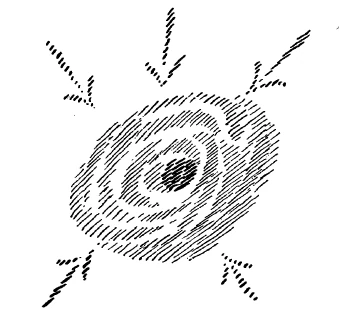
[ 15 ] If I were to sketch the organism here schematically and the germ—that is, the beginning of the embryo—here, the germ would be the most chaotic jumble of matter. This germ is something that has emancipated itself from all crystallizing forces, from all the chemical forces of the mineral kingdom, and so on. Chaos has arisen in one specific place, held together only by the rest of the organism. And because this chaotic protein appears here, we have created the possibility for the forces of the entire universe to act upon this protein, so that this protein in fact becomes an imprint of the forces of the entire universe. Specifically, the forces that subsequently give form to the etheric body and the astral body are already present in the female egg cell, even before fertilization has taken place. Through fertilization, this formation is further incorporated with what constitutes the physical body and the “I”—that is, the “I”-sheath, or the form of the “I.” So what is here before fertilization is a purely cosmic image, an image emerging from the cosmos, because the egg white has emancipated itself from all earthly forces and is thereby determinable by what is extraterrestrial. In the female egg cell, earthly substance is indeed surrendered to the cosmic forces. The cosmic forces create their image within the female egg cell. This goes so far that in certain forms of the egg—for example, in certain classes of animals, such as birds—something very important can be observed even in the structure of the egg itself. Of course, this cannot be perceived in higher animals or in humans, but in the structure of the egg in chickens, you can find the image of the cosmos. For the egg is nothing other than the true image of the cosmos. The cosmic forces act upon the predetermined egg white, which has emancipated itself from the earthly realm. The finished egg is indeed an imprint of the cosmos, and philosophers should not speculate on the nature of the three dimensions of space, for if one only knows correctly where to look, one can find the mysteries of the world vividly represented everywhere. The fact that one axis of the universe is longer than the other two is proven—and vividly so—by the chicken egg itself, and the boundaries of the chicken egg, the eggshells, are a true image of our space. It will certainly be necessary—and this is a side note for mathematicians—for our mathematicians to examine the relationships between, for example, Lobachevsky’s geometry or Riemann’s definition of space, and the chicken egg, the shape of the chicken egg. There is an extraordinary amount to be learned from this. The problems must actually be tackled in concrete terms.
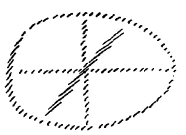
[ 16 ] You see, by focusing our attention on the determinable protein, we discover the influence of the cosmos, and we can describe in detail how the cosmos exerts this influence. It is certainly true, however, that one cannot go very far with this today, for if people were to grasp how these considerations could be taken further, the most appalling nonsense would still be perpetrated with such knowledge, especially given the extraordinary moral decline of the civilized population of the Earth.
[ 17 ] Now we have, so to speak, considered how our body arrives at perceptions: it pushes out from within itself the hallucinatory world from which it arose. In addition to the body, we carry our soul with us as part of our being. We will understand this better if we first set aside the soul and turn our attention to the other aspect—the spiritual. Just as we walk about here between birth and death, observing ourselves from the outside and saying, “We carry our body with us”—so, between death and a new birth, we have a spiritual existence. This corresponds, of course, to an inner contemplation, but—if I may put it this way—when we speak of our spiritual nature between death and a new birth, we do so no differently than we speak of our body here in physical life. Here, one becomes accustomed to speaking of the spiritual as the actual source of everything. But that is actually an illusory way of expressing it. One should speak of the spiritual as that which belongs to us between death and a new birth. Just as the body belongs to us here between birth and death—just as we are embodied here—so are we spiritualized between death and a new birth. And this spiritual aspect does not simply cease when we take on the body that emerges from the world hallucination; rather, it continues to exert its influence.
[ 18 ] Imagine the moment of conception—or a moment between conception and birth. It is not essential that we focus precisely on this particular moment, but if you imagine any moment that a human being passes through as they descend from the spiritual into physical existence, you will say to yourself: From this moment on, physical existence becomes interwoven with the human being’s spiritual-soul life. The spiritual-soul aspect, so to speak, undergoes a metamorphosis toward the physical. However, the force that was our own between death and a new birth does not cease at the moment we enter physical-sensory existence; rather, it continues to act, though in a very peculiar way. — I would like to illustrate this schematically.
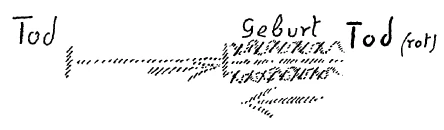
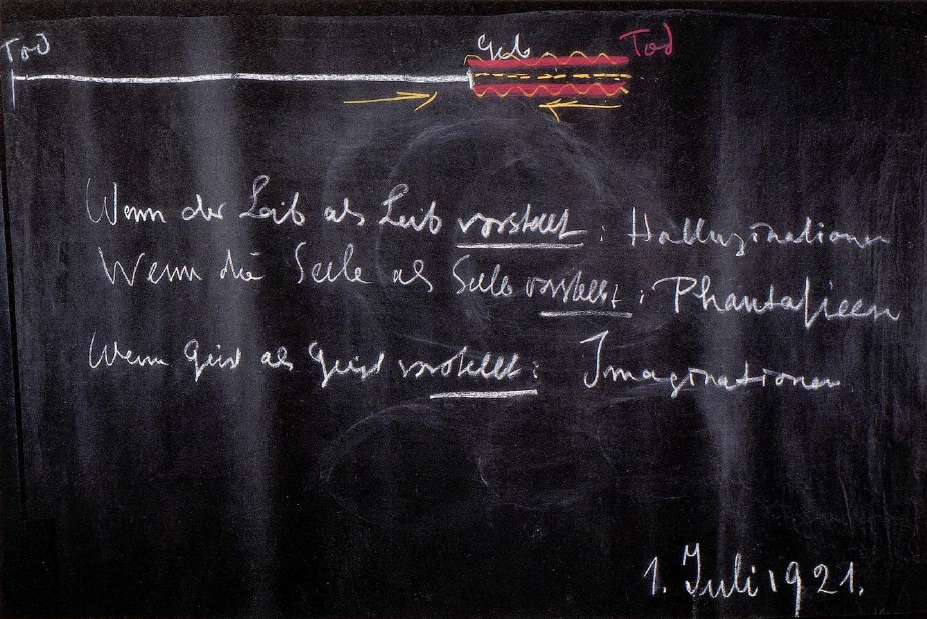
[ 19 ] So take the force from the last death—which is at work within you in the spiritual world—and bring it into your present birth—I will call it “birth.” There, the forces of the physical body, the etheric body, and so on continue to work. There would be a new death (red, darkly hatched). But this force, which was our own up to the birth, continues—and yet, one might say, does not continue; for it has poured out its true essence into the physical, which it spiritualizes. What endures here of this force, what proceeds, as it were, in the same direction, are only images; it is merely an existence of images. So that between birth and death we carry within us, as a living image, that which we possessed between death and a new birth. And this image is the power of our intellect. For our intellect is not at all a reality between birth and death, but rather it is the image of our being between death and a new birth.
[ 20 ] This insight not only solves epistemological puzzles, but also cultural ones. The entire structure of our modern culture—which, after all, depends on the intellect—becomes clear when one realizes that it is a culture of images, a culture created not by reality at all, but by the image—and indeed, now even by an image of spiritual reality. We have an abstract, spiritual culture. Materialism is, after all, an abstract, spiritual culture; one engages in the most subtle of thoughts when one denies thoughts and becomes a materialist. Materialist ideas were, in essence, quite astute, but they naturally led to error. It is indeed the image of a world that shapes our culture, not the world itself.
[ 21 ] This concept is difficult; but try to grasp it. You find it easy to visualize images in space. When you stand in front of a mirror, do not attribute reality to the image that appears to you; instead, attribute reality to yourself, not to the image. What takes place here spatially actually takes place here temporally. In what you experience as your intellect, you have the mirror image that is actually reflected back—reflected back to your earlier existence. Within you, in your physicality, you have a mirroring surface, except that it operates in time, and it reflects back the image of your prenatal life. But perceptions of being—sensory perceptions—are constantly being thrown into this intellectualized image. The sensory perceptions mix in there. That is why one does not perceive that it is actually being reflected back. One lives in the present. If, through exercises such as those I have described in How to Attain Knowledge of the Higher Worlds?, and are able to truly cast aside sensory perceptions and live vividly within this imagery, then one actually enters into prenatal, pre-existent life. Pre-existence then becomes a fact. The image of the pre-existent is, after all, within us; we need only see through it; then we are able to look into this pre-existent state.
[ 22 ] Essentially, every person has this ability, provided they do not fall into the other phenomenon—namely, that when they shut off their sensory perceptions, they sink into a sound sleep. This is, after all, the case for most people. They shut off their sensory perceptions, but then their thinking ceases as well. But if one can truly shut off sensory perceptions while thought remains active, then one does not look into the spatial world, but back into the time one most recently lived between one’s last death and this birth. At first, one sees it very indistinctly, but one knows: the world one is looking into is the world between death and this last birth. The truth—gaining a true overview of this—depends solely on not falling asleep when one suppresses sensory perceptions, so that one’s thinking remains as vivid as it is with the aid of sensory perceptions or while possessing them.
[ 23 ] But if one looks through oneself in this way toward one’s pre-existent life and then, naturally, continues to train oneself, then the concrete configurations also appear in this spiritual world, and a spiritual environment arises before us. Then the opposite occurs. We live here within the physical world. We do not force our hallucinations out of our bodies, but we draw ourselves out of our bodies and transport ourselves into our pre-existent life, filling ourselves there with spiritual reality. We immerse ourselves in the world flooded with hallucinations, and by perceiving its realities, we now perceive not hallucinations but imaginations. Thus, by rising to spiritual contemplation, we perceive imaginations.
[ 24 ] It is, of course, foolish—I would even say it is indecent—when someone today wants to be a scientist and keeps raising the same objection against anthroposophy over and over again: ‘Well, what is presented in anthroposophy could just as well be a hallucination; one cannot distinguish it from a hallucination.’ — If only those people would really engage with the entire method of research in spiritual science, they would find that it is precisely there that a very sharp and precise line is drawn between hallucinations and imagination.
[ 25 ] And what lies between the two? Well, I have now drawn your attention, on the one hand, to the physical state of being clothed in a body between birth and death, and, on the other hand, to the spiritual state of being clothed between death and a new birth. The soul acts as the mediator between the two. The spiritual is brought into physical existence through the life of the soul; what is experienced in the physical realm is, in turn, carried out through the soul and into the spiritual realm through death. The soul is the mediator between body and spirit.
[ 26 ] When the body imagines as a body, it produces hallucinations, or rather, it brings hallucinations into consciousness. When the mind imagines as a mind, it has imaginations. Now, when the soul—which acts as the mediator between the two—begins to imagine in its own right, that is, when the soul imagines as a soul, then neither do the unjustified hallucinations—extracted from the body—arise, nor does it penetrate to spiritual realities; rather, it occupies the undefined intermediate realm: these are the fantasies. So you can say: If the body imagines—it is not meant to imagine in the life between birth and death, but if it nevertheless imagines, that is, if it imagines unjustifiably and abnormally—then hallucinations arise. If the spirit imagines by truly distinguishing itself from the body and reaching realities, then it has imaginations. The soul acts as the mediator between hallucinations and imaginations within the ill-defined realm of fantasies.
When the body perceives itself as a body: hallucinations
When the soul perceives itself as a soul: fantasies
When the mind perceives itself as a mind: imaginations
[ 27 ] And by describing these processes here, we are describing real processes. In intellectualist thinking, after all, we have only the image of a pre-existing inner life—that is, the image of a life that is entirely imagined, emerging from the realm of hallucination. But our intellectual life is not real. We ourselves are not real in the act of thinking; rather, we develop into an image through the act of thinking. Otherwise, we could not be free. Human freedom rests on the fact that our thinking is not real when it becomes pure thought. A reflection cannot be a cause. If you have any reflection before you—something that is merely an image—and you act in accordance with it, then it does not determine your actions. If your thinking is a reality, there is no freedom. If your thinking is an image, then your life between birth and death is the school of freedom, because no cause lies in thinking. And life, to be a life of freedom, must be without cause.
[ 28 ] Life in the imagination, on the other hand, is not entirely free; yet it is real—real as a life of the imagination. The free life that is within us is, in terms of thought, not a real life; but by having pure thought and developing the will to free action out of pure thought, we grasp reality by the hem in pure thought. But where we ourselves, out of our own substance, confer reality upon the image, there free action is possible. I had already sought to present this in a purely philosophical manner in my Philosophy of Freedom (1893), precisely in order to lay a foundation for what was to come later. We will then base further reflections on this tomorrow.