

Human-Becoming, World-Soul and World-Spirit I
Human Beings as Physical and Spiritual Entities
in Their Relationship to the World
GA 206
6 August 1921, Dornach
Translated by Steiner Online Library
Eighteenth Lecture
[ 1 ] Yesterday I attempted to explain how, beginning in the mid-19th century, a certain peak in the sensualist or materialist worldview gradually took shape, and how, toward the end of the 19th century—at least from a certain point of view—this peak was reached. Let us first take a look at how the external facts of human development have unfolded under the influence of the materialist worldview. This materialist worldview cannot, of course, be spoken of as if it had merely arisen from the whims of a number of leading figures. For, even if this is denied on various sides, this materialistic worldview is based precisely on the very factors that gave rise to the scientific convictions and research findings of the 19th and early 20th centuries. Humanity was bound to arrive at these scientific findings. They were laid the groundwork for in the 15th century and reached a certain peak—at least insofar as they serve to educate humanity—precisely in the 19th century. In turn, nothing other than a certain materialistic worldview could have developed on the basis of this scientific mindset.
[ 2 ] Yesterday I left off by saying: What was actually at stake here—at least in terms of outward manifestations—came to the fore in a truly radical way in what can be characterized as Haeckel’s stance, for example, toward those who opposed him in the last decade of the 19th century and at the beginning of the 20th century. One can, in a sense, view what took place there—and what nevertheless had an extraordinarily profound impact on the general education of humanity—without taking into account the specific formulation Haeckel gave to his worldview, nor, ultimately, the specific formulation his opponents gave to their so-called refutations. One can simply observe that, on the one hand, there was what people believed they could derive from a careful examination of material phenomena all the way up to human beings. That alone was to form the basis of a worldview; only there did people believe they stood on solid ground. It was something entirely new compared to, for example, the medieval content of the worldview.
[ 3 ] With regard to the natural sciences, something decidedly new had been gained over the past three, four, or five centuries; with regard to the spiritual world, nothing. As for the spiritual world, people had finally arrived at a philosophy that, as I put it yesterday, saw its main task, so to speak, in at least justifying its existence in a certain way. Theories of knowledge were written with the intention of saying that, after all, one still had something philosophical to say regarding some remote point; that one might perhaps dare to say that a supersensible world exists, but that one could not know it—one could at most merely assume the existence of a supersensible world. Thus the sensualists—whose witty representative I cited to you yesterday in the person of Czolbe—spoke of something that was positive, something tangible to which one could point. And so the philosophers, and those who had become their disciples in popularizing their ideas, spoke of something that actually crumbled away the moment one tried to grasp it in any way.
[ 4 ] Now a peculiar cultural-historical phenomenon arose: Haeckel presented a purely naturalistic conception of the world, and the philosophical community felt compelled to take a stand against this—let us call it—“Haeckelism.” One could, I would say, consider the entire problem from an aesthetic perspective. One could look at the monumental aspect—whether true or false—that emerged in Haeckel’s synthesis of facts, which, precisely in its synthesis, already provided a worldview in and of itself. It seemed to me quite characteristic of the way Haeckel was situated in his era—all that took place during the celebration of, say, Haeckel’s sixtieth birthday in the 1890s in Jena, where I was present. At that time, of course, one could no longer expect anything new from Haeckel himself. He had essentially said everything he could say from his point of view and was, in fact, repeating himself.
[ 5 ] At this Haeckel celebration, a physiologist from the medical school then spoke. It was extremely interesting to listen to the man and to consider him a little from an intellectual perspective. There were quite a number of people at this Haeckel celebration who saw Haeckel as a significant figure—an outstanding individual, so to speak. But that physiologist was a thoroughly capable university professor, of the sort among the capable of whom one could say: Well, if you had put someone else of that caliber in his place, it would have been the same; you couldn’t really tell A from B or C. Haeckel could be distinguished from everyone else, but him—the university professor—could not be distinguished from the others. This is something I would ask you to view more as a characteristic of the age than as a matter specific to this particular instance.
[ 6 ] The point was that the person who was now standing there as A—who just as easily could have been B or C—was supposed to speak at a Haeckel celebration. I would say that in every single word, one could see what was actually going on! While some younger people spoke with a certain emphasis, aware that Haeckel was a prominent figure—they were, at most, private lecturers, though in Jena they had always been considered associate professors, since the latter positions were unpaid and they were granted only the title; but they were actually private lecturers—there was no such distinction for the physiologist in question; for if there were, one could not speak of A, B, and C in the manner in which I have just spoken; therefore, as he expressly emphasized, he was honoring his “colleague” Haeckel. After every third sentence, he spoke of his colleague Haeckel, thereby implying that it was simply the sixtieth birthday of some colleague or another, just like any other. But the point was to say something. Yes, didn’t he, as such a representative, belong to the ranks of those who merely collect scientific data—the very data from which Haeckel had constructed a worldview—but who were content with this data collection because they simply did not want to know anything at all about the possibility of a worldview. So this colleague did not speak about Haeckel’s worldview.
[ 7 ] In fact, he praised Haeckel in an extraordinary way from his own point of view, suggesting that, quite apart from what Haeckel had claimed about the world and life, one could certainly take note of what his colleague Haeckel had researched in this specific field. There are so many thousands of Haeckel’s microscopic specimens in the collection; there are so many thousands of specimens in this and that field, and so on; and one could even say that if one were to add up everything this Haeckel had collected, compiled, and processed in terms of individual, purely empirical data, it would amount to an entire academy. — So this colleague implicitly embodied a whole number of such “colleagues” for whom he had stood up. Well, he was, in a sense, a colleague from the medical school.
[ 8 ] Then, during the actual banquet, Eucken—the philosopher—spoke. Well, he had revealed—or one might say concealed—what he had to say, or rather what he did not have to say, by speaking of the ties, of the sloppily tied ties, and of the complaints that the Haeckel family in particular had to voice when they talked about Papa or about the husband in private circles. The philosopher spoke at considerable length about the carelessly tied ties—not without wit, mind you—but as I said, that was what philosophy had to say at the time. It was quite characteristic, for philosophy didn’t have much else to say anyway. Everything that was put forward was just abstract drivel. This says nothing at all about value judgments and the like; one can, after all, let the whole thing sink in aesthetically and discern from what is symptomatically on display how materialism—which offered something—has risen in recent times. Philosophy really had nothing more to say, since it was merely an offshoot of what had developed over time. Nor should one believe that philosophy has anything to say to the science of the spirit. Eucken proved this quite clearly recently in that discussion, which is recounted in a very stimulating manner in the latest or penultimate issue of the Dreigliederungszeitung, where the entirety of Eucken’s rhetoric revealed itself in its absolute lack of substance.
[ 9 ] But let us now consider the fact—which is the positive fact in all that I have said—and examine it from a cultural-historical perspective. On the one hand—as is clear from yesterday’s remarks—we have developed intellectualism within the human being, as Scholasticism brought it to its highest flowering as a technique of thought before the age of natural science. We then applied this intellectualism to external knowledge of nature. Through this, we have brought about what stands out in the 19th century—particularly toward the end—as a development of great historical significance: intellectualism and materialism belong together.
[ 10 ] When one considers this phenomenon in relation to the human being itself, one must say: Of all that constitutes the human being—the threefold human being, namely the nervous-sensory human being with its life of imagination, the rhythmic human being with its life of feeling, and the metabolic human being with its life of will—such a worldview primarily focuses on the head human being, the nervous-sensory human being. This nervous-sensory human being was therefore developed most strongly in the 19th century. I recently described to you, from a certain other perspective, how people who sensed that this head-human, this nervous-sensory human being, was in fact being particularly developed by the spiritual culture of the 19th century, became fearful and anxious about the future of humanity. I described this to you through a conversation I once had, decades ago, with the Austrian poet Hermann Rollett. Hermann Rollett was, in fact, according to his worldview—because someone who bases his views on science and for whom the old traditional ideas had faded could, in essence, do nothing else—thoroughly materialistic in his outlook. But at the same time—for he was a poet at heart, an artist at heart; after all, he had published the beautiful work Goethe-Bildnisse—he sensed how human beings grow only in terms of their nervous and sensory organization, in relation to their imaginative life. He wanted to depict this vividly. That is why he said: “Actually, it will gradually come to pass that a person’s arms, feet, and legs will become smaller and smaller, while the head will grow larger and larger.” — He wanted to visualize in spatial terms what was actually in the making. Then, if the Earth continues along this path of development for a while longer, human beings—as he vividly depicted—will be nothing more than a spherical head, rolling on and on across the Earth’s surface. One can sense the cultural upheaval hidden within such a notion. But those who do not approach these matters with the research methods of spiritual science see only the outer surface of the matter. If one wishes to penetrate the chaos of views that is leading to such calamity in the present, one must also look at the matter from the other side. For one might be tempted to say: What has emerged as a materialistic worldview encompasses only a small minority; the vast majority still lives, in terms of worldview sensibility, within the traditional creeds. — Yes, with regard to, I would say, a certain surface level, yes. But with regard to all forms of thought, with regard to what people think in their innermost being about their surroundings and about the world, that is certainly not the case. Our contemporary culture is such that what lives on in Haeckel’s The Riddle of the World by no means exists only among those—perhaps least of all among them—who have directly taken a liking to Haeckel’s The Riddle of the World. Haeckel’s “World Riddles” are, after all, merely a symptom of what, fundamentally speaking, constitutes the dominant emotional impulses throughout the entire civilized world today. One might say that these emotional impulses are most characteristic of outwardly devout Christians, especially outwardly devout Catholics. Certainly, on Sundays they profess what dogmatics has handed down; but the way in which they conceive of the afterlife and the rest of the week has found a kind of comprehensive expression in the materialistic worldview of the 19th century. Even in the most remote villages out in the countryside, this is indeed the prevailing worldview. Therefore, one cannot say that it is present only among a vanishingly small minority. Certainly, formulated concepts do exist among them, but these are merely the symptoms. What really matters—the reality—is indeed the defining characteristic of the present age. One can study things through their symptoms, but one must be aware that—just as when one speaks of Kant in relation to the second half of the 18th century, one is speaking only of a symptom of something that was present throughout that entire period—one is also speaking only of a symptom when discussing these matters that I touched upon yesterday and am continuing to explore in these reflections today. That is why what I am about to say is of such great significance. You see, a person can indeed be intellectually active and devoted to material things and phenomena—which are, in fact, the inner counterpart to intellectualism—but only during waking hours, from the moment of waking until falling asleep, and even then not entirely. We know, of course, that a person does not only have an imaginative life; a person also has an emotional life. The emotional life is, inwardly, equivalent to the dream life. The dream life unfolds in images; the emotional life unfolds in feelings. But the inner, substantial aspect is that which experiences the dream images within a person; it is that which undergoes the feelings in the human emotional life. So we can say that while awake—from the moment of waking until falling asleep—a person dreams while awake within their emotional life. What we experience in terms of emotions is permeated by exactly the same level of consciousness as our dream images, and what we experience in our volitional impulses is asleep—it sleeps, even when we are otherwise awake. In truth, we are awake only in our life of imagination. You fall asleep in the evening; you wake up in the morning. Unless what takes place from the moment you fall asleep until you wake up is illuminated by a certain spiritual-scientific insight, it eludes your consciousness; you are unaware of it in your consciousness. At most, dream images intrude upon it. But you will recognize these as no more significant for a worldview than you recognize feelings as significant for a worldview. In a sense, human life is always interspersed with the life of sleep.
[ 11 ] But just as time, after this life of sleep, becomes part of the full life of the human soul, so too does the world of feelings—and especially the world of volitional impulses—become part of this human life. We dream by feeling; we sleep by willing. Just as you do not know what is happening to you during sleep, so too do you not know what is happening when you raise your arm through your will. The actual inner forces at work there are just as much shrouded in the darkness of consciousness as the state of sleep is shrouded in the darkness of consciousness.
[ 12 ] So we can say: Of this threefold human being, modern culture—which began in the 15th century and reached its peak in the 19th century—made use of only one third: the human being of imagination, the human being of the head. And one must ask: What was actually going on within the dreaming, feeling human being, within the sleeping, willing human being, and what was happening between falling asleep and waking up?
[ 13 ] Yes, as human beings we can certainly be materialistic in our imaginative life. We certainly can; the 19th century has shown this. The 19th century also demonstrated the validity of this materialism; after all, it led to positive insights into the material world, which is a reflection of the spiritual world. We can be materialists with our minds, but we then have no control over our dreaming emotional life, nor over our sleeping life of the will. These—especially the life of the will—become spiritually oriented at the same time.
[ 14 ] It is interesting to examine what is actually going on there from a humanities perspective. Imagine a Moleschott or a Czolbe, whose minds recognize nothing but sensualism and materialism: down there they have their “human will,” which is entirely spiritual in disposition—though the mind knows nothing of it—and which reckon with the spiritual and spiritual worlds. They have their “human emotion,” which reckon with ghostly apparitions. And if we observe correctly, we witness the spectacle of the materialist writer sitting there and railing furiously against everything that constitutes the spiritual nature within his emotional and volitional selves; the latter now becomes enraged because he, too, is a spiritualist—the one rumbling within him, who is a complete opponent.
[ 15 ] That is how it was. Idealism, spiritualism, was there. It was present, in particular, in the subconscious will of human beings, and the strongest spiritualists were the materialists, the sensualists!
[ 16 ] But what is it that lives physically within the emotional human being? It is the rhythm, the blood circulation, the breathing rhythm, and so on. What lives within the volitional human being? Metabolism. Let us first consider this metabolism. While the head is occupied with the intellectual processing of material things and material phenomena into a materialistic science, the metabolic human being—who now also possesses the full human structure—develops the opposite worldview. He develops a thoroughly spiritualistic worldview, which the materialists themselves unconsciously carry within them. But in the metabolic human, this acts upon the instincts, upon the drives: there it produces the opposite of what it would bring about if it were to engage the whole human being. There it permeates the instincts; there it is seized by Ahrimanic forces; there it no longer acts in the divine-spiritual sense, but rather in the Ahrimanic-spiritual sense. There it drives the instincts to the highest degree of egoism. There it develops the instincts in such a way that the human being is led only to the demands of life, without being guided toward social impulses, social compassion, and the like. There, in particular, the individual aspect is brought to the fore to the point of egoistic instincts. And this took shape, if I may put it that way, beneath the surface of this materialistic civilization, and it appeared in world-historical events; it is appearing now. That which once took shape in its infancy beneath the surface, in the depths of the willful human beings, where the spirituality of the instincts had taken hold, is now appearing in world-historical events. And if this development were to continue producing these consequences, we would have arrived at the end of the 20th century in a war of all against all, precisely in that area of Earth’s development where so-called modern civilization has taken shape. And we see what has developed there already radiating from the East and asserting itself across a large part of the Earth. There is an inner connection. One need only see it.
[ 17 ] Externally, this is reflected in what I have already emphasized—and what others have also noted. I said that philosophers such as Avenarius and Mach—whose views, insofar as they prevail, are certainly rooted in the best liberal bourgeois views of the 19th century—are decent people against whom one can level no charges when considering the moral views of the 19th century; and yet, you can read in the works of Russian writers who understood how to depict their era how Avenarius’s and Mach’s philosophy became the Bolshevik philosophy of the state. This is not merely because outstanding Bolshevik agitators happened to have heard Avenarius speak in Zurich, for example, or to have heard Adler, a student of Mach, but because there are definitely internal impulses at work here. What Avenarius once expounded could, of course, intellectually be a perfectly sound bourgeois attitude, a commendable bourgeois attitude; in reality, it was the foundation for that which spiritually ignited the instincts in the depths of humanity, and which then bore the corresponding fruits in practice, because it does indeed bear such fruits. Here you see—and I must draw attention to this again and again—the difference between real logic, the logic of reality, and the merely abstract logic of the intellect. No one will be able to extract from Avenarius’s or Mach’s philosophy—not even with the best, or, I might also say, the very worst of intentions—the ethics of the Bolsheviks, if one can even call it ethics. It does not follow from abstract logic. Something entirely different follows. But living logic is quite different from abstract logic. What can be logically deduced from something does not necessarily follow in reality; the opposite may well result. That is why there is such a great difference between what we have come to rely on more and more in the materialistic age—abstract intellectual logic, which engages only the mind—and the sense of reality, which alone can lead to salvation in our time.
[ 18 ] In our time, people are satisfied if a worldview can be shown to have consistent logic. But in reality, that is of no consequence at all. It is not solely a matter of whether a worldview can be logically established, for, fundamentally speaking, radical materialism can be logically established just as well as radical spiritualism—and everything in between. What matters today is recognizing that something must not merely be logical, but must also be true to reality in addition to being logical—it must be true to reality. And this truth to reality is achieved only through living in harmony with reality. This living in harmony with reality is cultivated through spiritual science.
[ 19 ] What is this all about in relation to what I said today? Spiritual science encompasses many things, but with regard to what I have said today, what is it all about? Yes, it is about the fact that knowledge is now truly being drawn forth from those depths that do not come merely from the head, but from the whole human being. One could say: When a person who has educated themselves to self-awareness in the course of modern times looks at the world, they view it in such a way that they live within their own skin and observe what is outside their skin. Schematically, I would like to illustrate this as follows: Here is the human being. Outside the human being is everything the human being reflects upon (see drawing, red). And now he strives to know something about that which is outside of him, to know something within himself about what is out there. He, so to speak, reckons with the interrelationship between what is outside his skin. And quite characteristic of this reckoning with such an interrelationship are logical investigations such as those of John Stuart Mill; characteristic are philosophical constructs such as that of Herbert Spencer, and so on.
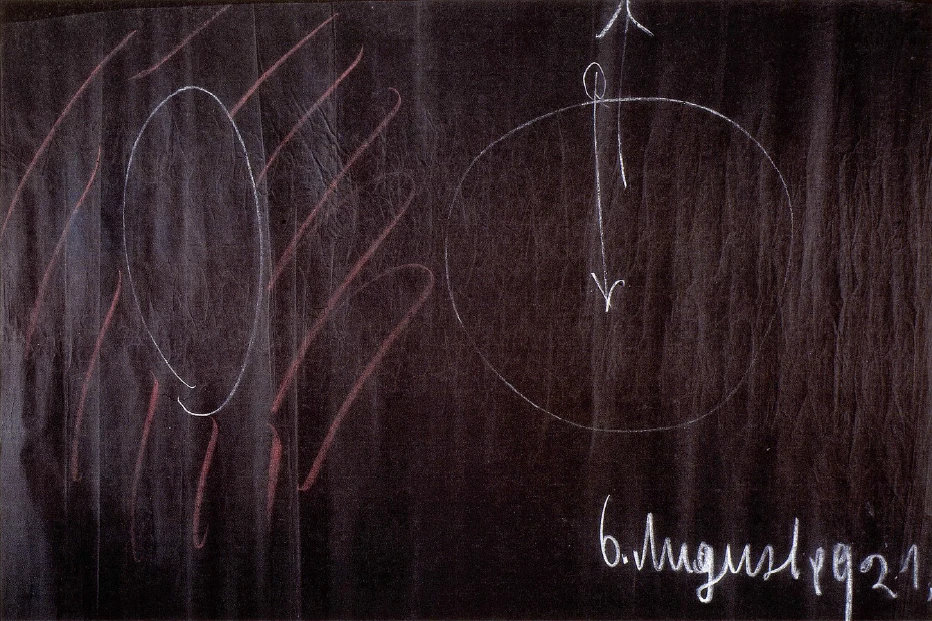
[ 20 ] When one ascends to higher knowledge, it is no longer the human being who lives within his own skin—for everything that lives within his skin is reflected in the mind; it is, after all, merely intellectual knowledge—but rather it is the whole human being. And the whole human being is connected to the whole Earth. Essentially, the insight known as supersensible insight is not a confrontation between what lies within the human skin and what lies outside the human skin, but rather a confrontation between what is within the Earth and what is outside the Earth. Human beings identify with the Earth. That is why they also shed everything that is bound to a particular spot on Earth—nationality and so on. Human beings adopt the perspective of an Earth being and speak about the universe from the perspective of an Earth being. Try to sense how one speaks from this standpoint—for example, in a series of lectures such as the one I gave in The Hague, where the connection between the individual members of the human being and the environment was discussed, but where what was actually meant was this intergrowth of the human being with his environment, where the human being was considered not merely as he is, let’s say, on May 13 at a single moment, but as he lives throughout the entire year through the seasons, lives in connection with the various localities, and so on. It is precisely through this, however, that human beings become earthly beings; through this, they also gain certain insights that arise from their engagement with what lies above the earthly realm and with what lies below it, through which earthly conditions first become clear.
[ 21 ] Spiritual science, then, does not arise from this narrowly defined human being—from whom the intellectualist, materialist science of the 19th century emerged, with its form of unleashing antisocial instincts—but rather, spiritual science arises from the whole human being, bringing to the forefront that which, in the first instance, only secondarily affects the individual human being. In this way, even though it appears to develop only intellectualistic concepts, it is able to embody real things within these concepts—things that, however, replace the antisocial with the social.
[ 22 ] One must view the world from perspectives quite different from those commonly adopted in the 19th century and at the beginning of the 20th century. It was, after all, considered commendable to speak so much about social demands and the social nature of things. For those who see through the world, this is merely a sign that one harbors so much that is unsocial within oneself. Just as the person who talks a great deal about love is, as a rule, a loveless being, and the person who has much love within speaks little of it, so too is the person who constantly talks about social matters—as was customary especially in the last third of the 19th century—as a rule actually completely riven by antisocial drives and instincts.
[ 23 ] The social system that is gaining ground in Eastern Europe is, after all, nothing other than the ultimate test of all that is anti-social and contrary to social life. Perhaps I may interject here that the accusation is repeatedly leveled against anthroposophical spiritual science—I heard it just the other day—that it speaks so little of God. In particular, those who speak constantly of God reproach anthroposophical spiritual science for speaking so little of God. I have often said that it seems to me those who are always speaking of God fail to take into account that one of the Ten Commandments states: “You shall not take the name of the Lord your God in vain”—and that upholding this commandment is far more important in the Christian sense than constantly speaking of God. At first glance, one might not even realize what the ideas presented by spiritual science—derived from spiritual observation—actually are. One might say: Well, it’s just another science that speaks only of worlds other than the materialistic ones. — But that is not the case. What is taken in through this concept—even without one having occult visions oneself—actually educates the human being. Above all, it does not educate the intellectual mind, but rather the whole human being, and it acts upon this whole human being in the truest sense. It corrects precisely what has been wrought by the spiritual adversary of the sensualist and materialist, who has always been present within them.
[ 23 ] The social system that is gaining ground in Eastern Europe is, after all, nothing other than the ultimate test of all that is anti-social and contrary to social life. Perhaps I may interject here that the accusation is repeatedly leveled against anthroposophical spiritual science—I heard it just the other day—that it speaks so little of God. In particular, those who speak constantly of God reproach anthroposophical spiritual science for speaking so little of God. I have often said that it seems to me those who are always speaking of God fail to take into account that one of the Ten Commandments states: “You shall not take the name of the Lord your God in vain”—and that upholding this commandment is far more important in the Christian sense than constantly speaking of God. At first glance, one might not even realize what the ideas presented by spiritual science—derived from spiritual observation—actually are. One might say: Well, it’s just another science that speaks only of worlds other than the materialistic ones. — But that is not the case. What is taken in through this concept—even without one having occult visions oneself—actually educates the human being. Above all, it does not educate the intellectual mind, but rather the whole human being, and it acts upon this whole human being in the truest sense. It corrects precisely what has been wrought by the spiritual adversary of the sensualist and materialist, who has always been present within them.
[ 23 ] The social system that is gaining ground in Eastern Europe is, after all, nothing other than the ultimate test of all that is anti-social and contrary to social life. Perhaps I may interject here that the accusation is repeatedly leveled against anthroposophical spiritual science—I heard it just the other day—that it speaks so little of God. In particular, those who speak constantly of God reproach anthroposophical spiritual science for speaking so little of God. I have often said that it seems to me those who are always speaking of God fail to take into account that one of the Ten Commandments states: “You shall not take the name of the Lord your God in vain”—and that upholding this commandment is far more important in the Christian sense than constantly speaking of God. At first glance, one might not even realize what the ideas presented by spiritual science—derived from spiritual observation—actually are. One might say: Well, it’s just another science that speaks only of worlds other than the materialistic ones. — But that is not the case. What is taken in through this concept—even without one having occult visions oneself—actually educates the human being. Above all, it does not educate the intellectual mind, but rather the whole human being, and it acts upon this whole human being in the truest sense. It corrects precisely what has been wrought by the spiritual adversary of the sensualist and materialist, who has always been present within them.
[ 23 ] The social system that is gaining ground in Eastern Europe is, after all, nothing other than the ultimate test of all that is anti-social and contrary to social life. Perhaps I may interject here that the accusation is repeatedly leveled against anthroposophical spiritual science—I heard it just the other day—that it speaks so little of God. In particular, those who speak constantly of God reproach anthroposophical spiritual science for speaking so little of God. I have often said that it seems to me those who are always speaking of God fail to take into account that one of the Ten Commandments states: “You shall not take the name of the Lord your God in vain”—and that upholding this commandment is far more important in the Christian sense than constantly speaking of God. At first glance, one might not even realize what the ideas presented by spiritual science—derived from spiritual observation—actually are. One might say: Well, it’s just another science that speaks only of worlds other than the materialistic ones. — But that is not the case. What is taken in through this concept—even without one having occult visions oneself—actually educates the human being. Above all, it does not educate the intellectual mind, but rather the whole human being, and it acts upon this whole human being in the truest sense. It corrects precisely what has been wrought by the spiritual adversary of the sensualist and materialist, who has always been present within them.
[ 27 ] After all, human beings actually know—don’t they?—the moment of death, that one moment when one truly sheds the physical body and when the spiritual self becomes connected—especially strongly connected—to the spiritual world. But that is, of course, only a single moment. I would like to say that there are an infinite number of integrals of differentials at the moment of death—differentials that are always contained within us throughout our entire lives. We are, after all, dying continuously. When we are born, we already begin to die, and in every moment there is a minute process of dying within us. And we could not conceive of—we could not even imagine—a large part of our soul life, and above all our spiritual life, if we did not continually have death within us. We do, after all, continually have death within us, and when we can no longer go on, we die in an instant. Yet we die continuously between birth and death.
[ 28 ] An ancient, instinctive wisdom has long sensed this: Human life is, in essence, a process of dying. Heraclitus, as a latecomer to this ancient wisdom, also expressed it: Human life is a process of dying. Human feeling is a state of perpetual illness. We have a tendency toward dying and toward illness. And what we learn—what purpose must it serve? It must be like a medicine. Learning must be a healing process. Having a worldview must be a healing process.
[ 29 ] The doctors certainly felt this way, since they provided physical healing only when necessary—that is, when the illness was acute. But they viewed human life solely as a chronic illness. And anyone who was a philosopher or a doctor—even as a healer—felt that, with regard to what humanity on Earth was, he was merely a healer for what is commonly regarded as normal, but which is in fact also sick—the predisposition toward death. We must regain these feelings regarding the worldview—that it is not merely a formal filling of the head or the mind with knowledge, but a real process in life; that the worldview serves to heal humanity.
[ 30 ] In terms of our cultural-historical development, we are not merely living with a chronic illness; rather, we are currently suffering from an acute cultural illness. What appears as a worldview must be a true remedy, must be a true medical science, a cure. One must be thoroughly imbued with the real significance of such a worldview—as it is meant here—for the current state of civilization and culture. We must be deeply convinced that a worldview actually refers to something real, not merely this formal notion: that one wants to know something, that one wants, so to speak, to possess within oneself the concepts for what exists as an external reality, that one wants to learn the laws of nature and apply them technically. — No, this inner aspect, this aspect connected to the human being, must be present wherever there is a true worldview, so that effective remedies for illnesses—indeed, for the process of dying—which must be constantly available, can be derived from this true worldview. As long as one does not speak in this way and as long as one does not understand this, one will always speak only superficially about the ills of our time and fail to address what is truly necessary.
We'll talk more about these things tomorrow.