

Human-Becoming, World-Soul and World-Spirit I
Human Beings as Physical and Spiritual Entities
in Their Relationship to the World
GA 206
7 August 1921, Dornach
Translated by Steiner Online Library
Nineteenth Lecture
[ 1 ] If one wishes to understand the significance of the materialistic age, one must examine human development, insofar as this development takes into account all the essential fundamental forces of the human being. Today, let us first consider this human development from a certain perspective. I will build on some of what I have already presented in recent times in order to arrive at a specific goal.
[ 2 ] I have often pointed out the great significance of that period in individual human development that coincides with the change of teeth, around the age of seven. This change of teeth signifies that certain forces, which were present in the human organism up to that point and were active within it, are in a certain sense set free and no longer perform the functions they had performed prior to this change of teeth. In fact, at the very moment this change of teeth begins, and during the time it takes place, the human being is essentially a transformed, metamorphosed being. What comes to light with the appearance of the second set of teeth—in this eruption of the second set of teeth—is what has been at work in the human organism up to that point. And then, when it comes to the fore—when it, so to speak, frees itself from the organism—it appears, in contrast to before, as a more soul-related force. By observing this, we come to the view that up until the age of seven, a soul-related force is at work within the human being, which, so to speak, brings its work on the organism to a close with the change of teeth. If we have acquired a certain inclination and ability to observe such things, we can see how the child’s entire soul constitution is transformed during this stage of life, how—particularly from this stage onward—the ability to form defined concepts emerges, and how other soul capacities arise. These soul capacities—where were they until the change of teeth? They were within the organism; they were working on the organism. That which later becomes a psychological faculty is first at work on the organism.
[ 3 ] We arrive at a completely different understanding of the interaction between the soul and the body than is described, for example, in all those abstract psychological accounts that speak of a psychophysical parallelism or of an abstract interaction between soul and body and the like. We arrive at a genuine understanding of what is at work in the human organism in a significant way during the first seven years of life. We see, as it were, what has been hidden until this point, and which is now free to emerge as a spiritual force. We need only cultivate the ability to observe such things; then, during this phase of human life—specifically the first seven years—we will see a certain system of forces at work, so to speak, in the physical body, and after this turning point in life, we will see it emerge as a soul force. We will then know, at least in part, what is actually at work in the human organism to bring about this substantiality; we will then know what is at work in the human organism during the first seven years of life.
[ 4 ] Now, when a person is in that state of life that lies between falling asleep and waking up, what I have just described plays a significant role in two successive states. One can also observe how a child sleeps in a certain way that is still different from the way a person sleeps—the person the child will become after losing their baby teeth. Admittedly, the difference is not so obvious, but it is there. For up until the age of seven, a child cannot yet send into its sleep state—that state peculiar to the soul between falling asleep and waking up—with the same intensity what it will later send in as soul forces; for these forces are still connected to the physical, specifically to the physical organism. Therefore, the child does not yet send sharply defined concepts into the state of sleep. It sends into the state of sleep concepts that are not yet sharply defined, as well as images that are not yet sharply defined; but these less sharply defined images have the peculiarity that they can encompass the soul-spiritual reality in a better way than the sharply defined images.
[ 5 ] This is an important point: the more sharply defined our concepts become for waking life, the less we project into the state of sleep in order to grasp realities there. That is why, in very many cases, a child actually brings a certain knowledge of spiritual reality with it from its state of sleep. This then ceases to the same extent that, with the change of teeth, the forces described become free, sharply defined concepts emerge, and these then influence the life of sleep. These sharply defined concepts, in a sense, dampen our perception of the spiritual realities within which we live between falling asleep and waking up.
[ 6 ] What I have just said can be verified through supersensible perception, provided that this supersensible perception develops the power I have often described—a power you will also find described in my Outline of Esoteric Science and in my treatise How Does One Attain Knowledge of the Higher Worlds?. When supersensible perception reaches the power of imagination—that is, when those images arise that we know are underpinned by spiritual realities—then we gradually come to perceive those very spiritual realities in the midst of which we find ourselves between falling asleep and waking up, and then we can also assess the difference between a sleeping child under the age of seven and a sleeping child over the age of seven. Then we can see how, in a sense, our perception of what becomes quite clear to us again to a certain degree in the imagination—our perception of these spiritual realities in whose midst we find ourselves between falling asleep and waking up—is somewhat muted.
[ 7 ] Once the change of teeth has begun, the soul develops in a way that can be grasped to a certain extent through imagination until sexual maturity is reached. One gains insight into what is developing in the human soul simply through imagination. The experience I have just described regarding the state between falling asleep and waking up is, after all, only one of the experiences one has through imaginative perception. In those interesting states that unfold in the child from the change of teeth until sexual maturity, we see how, in fact, a struggle is taking place to a great extent within the developing human being. In this phase of life, the etheric body—which, after all, undergoes its specific developmental stages up to sexual maturity—is, so to speak, struggling against the astral body. A genuine state of struggle is taking place within the child. And when we consider the physical counterpart that corresponds to this state of struggle, we can say: During this stage of the child’s life, there is a pronounced struggle between the forces of growth and those forces that act within us through physical inspiration—through breathing. — This is a very significant process within the human being, a process that will have to be studied more and more in order to understand the human being. For what is partly liberated into the soul through the change of teeth are, after all, the forces of growth. Naturally, a considerable portion of these forces of growth remains in the physical body, where they continue to ensure growth; a portion is liberated during the change of teeth and manifests as soul forces.
[ 8 ] But what continues to function as growth forces within the child is in conflict with something that now arises in the child essentially through the process of breathing. What arises through the process of breathing could not have arisen earlier. The respiratory process is certainly present in the child as well, but as long as the child, in its physical growth and physical organization, possesses the forces that then emerge during the change of teeth, nothing takes place in the child’s organism that corresponds to what the respiratory process later brings about so strikingly and significantly in the human body. For a large part of the development we undergo depends on this respiratory process. Hence those Eastern exercises that focus particularly on the respiratory process: by immersing oneself in the respiratory process—which these exercises facilitate—one actually comes into contact with something that permeates the entire human being, something that brings the human body into a state of inner mobility that has to do with penetrating the mysteries of the world.
[ 9 ] As I said, before the change of teeth has taken place, what breathing actually seeks to accomplish within us cannot become active in the human organism. But then a struggle ensues between the remaining growth forces and the intrusion of what enters the human being as a result of the breathing process. For the first major event that occurs physically as a consequence of the breathing process is sexual maturity.
[ 10 ] Science has not yet grasped this connection between breathing and sexual maturity. Yet it certainly exists. We actually breathe in that which makes us sexually mature, but which also, in a broader sense, gives us the ability to enter into a relationship of loving embrace with the world. That is what we actually breathe in. Every natural process also contains a spiritual element. The breathing process contains both a spiritual and a spiritual-soul aspect. This spiritual-soul aspect enters us through the breathing process. It can only enter once the forces that previously acted within the organism—and which cease to act there with the change of teeth—have become soul forces. Then what seeks to emerge from the breathing process flows into the human being.
[ 11 ] But this is counteracted—and this is where the struggle arises—by that which arises from the growth processes that have remained just that—growth processes—in other words, by the etheric forces. And this struggle exists between the etheric forces—the forces that rise from our etheric body and find their physical counterpart in the material system, in the metabolic system, in the blood circulation—and the astral forces. Here, metabolism interacts with the circulatory system and the rhythmic system. So that we can say schematically: We have our metabolic system, which, however, interacts with our blood rhythm, with the blood rhythm system; the metabolic system, which I am drawing here schematically, interacts with the circulatory system (see drawing, red). This is what, from the side of the etheric body, so to speak, surges upward within the human being during this period between the seventh and fourteenth years.
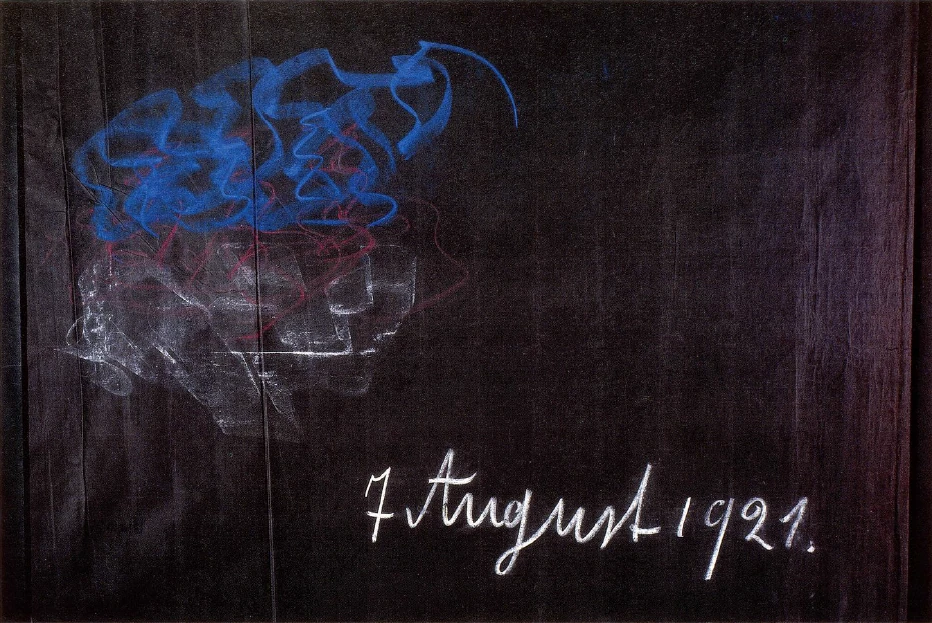
[ 12 ] The astral body works against this. We then have the rhythmic element flowing into the physical counterpart, which originates from breathing, and this struggle takes place between the rhythm of blood circulation and the rhythm of breathing (blue). This is what takes place internally within a person during this stage of life.
[ 13 ] And one could say—to put it somewhat figuratively, using an image that might seem radical—: It is roughly between the ages of nine and ten that, in every child, what previously took place—I would say—in the preliminary skirmishes, what occurred in the skirmishes before the actual main battle, is carried over into the main battle. The astral body and the etheric body carry out their most significant attack between the ages of nine and ten.
[ 14 ] That is why it is so important for educators to observe this period, this specific time. The fact is that as a teacher, educator, or instructor, one must pay close attention to something—though it plays out differently for almost every person—that takes place roughly between the ages of nine and ten. At this time, one observes something quite special in every child. Certain temperamental traits undergo a kind of metamorphosis. Certain ideas begin to emerge. But above all, it is at this point that one should begin—whereas previously it is best not to let the child become aware of the difference between the “I” and the outside world—to bring this difference between the “I” and the outside world into focus. While it is good beforehand to speak to the child through fairy tales and the like, as if natural processes were human processes—by personifying and explaining them—one can then begin to teach the child about nature in a more instructive manner.
[ 15 ] Natural history, even in its most basic form, should really only be introduced to the child from this point on. For it is at this point—when the child begins to clearly sense its “I” in the first stage of life—that the child is just beginning to sense that “I.” It is at this point that the child begins to associate a sharply defined concept—a concept that is more or less naturally sharply defined—with this “I.” It is only at this point that the child truly learns to distinguish itself from the outside world. And this corresponds to a very specific interplay between the respiratory rhythm and the circulatory rhythm, between the astral body and the etheric body.
[ 16 ] These things always have two sides in human beings. One side manifests itself in the state between waking and falling asleep. I have just described this state. In the state between falling asleep and waking up, the situation presents itself somewhat differently. Once we have progressed to imagination and then developed some capacity for inspiration, so that we can assess what happens through inspiration via the breathing process—which is the physical counterpart—we find that it is actually only at this point—which occurs somewhat earlier for one child and somewhat later for another, but on average between the ages of nine and ten—that a true detachment of the “I” and the astral body from the etheric body and the physical body actually takes place during sleep. The child is, particularly through its “I,” very intimately connected to its physical and etheric bodies, even while sleeping. But from this point on, the “I” begins to emerge as an independent entity whenever the “I” and the astral body do not participate in the functions of the etheric body and the physical body.
[ 17 ] This is why children who die before this point essentially have, in the life they experience up to the fifth, sixth, seventh, or even eighth or ninth year of life, something that has only slightly separated them from that spiritual-soul world experienced between death and a new birth; so that children are relatively easily drawn back into this spiritual-soul world, so that, in a sense, they merely append something to the life they completed at conception or birth; and so that, when we consider this death, a true severing of a new life actually occurs only when children die after this point. In a sense, the new life does not bind itself to the old life in such an intense way. It is only then that the states I described in my Theosophy are clearly experienced, whereas in the case of children who die earlier, they are, so to speak, thrown back again and append the life they have lived on Earth to the life they led up to conception or birth. One must simply say: What we see in the child up to this point—between the ages of nine and ten—actually contains the physical-soul and spiritual-soul aspects in a much more inseparable way than the adult does. The adult is a far more dualistic being than the child. The child has the spiritual-soul aspect embedded within its body, and the soul-spiritual aspect works upon the body. It is only after the period described above that the spiritual-soul aspect appears as a duality in relation to the physical-soul aspect. Thus, one must say: From this point on, the spiritual-soul aspect in the human being is less concerned with the physical than it was before. As a physical being, the child is a much more soulful being than the adult. The child’s body is, in its growth, still thoroughly permeated by soul forces, for soul forces still remain, even though a large part of them has just been transformed with the change of teeth.
[ 18 ] Then we can say: In a certain sense, the struggle I have described gradually subsides from the age of twelve onward, and with sexual maturity, the astral body comes into its own within the human constitution. But that which detaches itself from the human being—that which, in a sense, later pays less attention to the physical body—is also what carries the human being back through the gate of death into the spiritual-soul world when he dies. As I said, the child in his earlier years is drawn back more toward his previous life, whereas the human being after this period is separated from his previous life. And what detaches itself in this way contains within itself the seeds necessary to pass through the gate of death. Through imaginative insight, one can perceive these things very clearly, and one can point out the details with great precision. One can point out how the forces that arise there lead to sharply defined concepts—which, however, dampen the spiritual realities in the midst of which we live during sleep—and which are precisely what make a human being an independent being.
[ 19 ] By cutting himself off, by dampening spiritual realities, man once again becomes the spirit among spirits that he must be when he passes through the gate of death. The child, I might say, is always slipping into spiritual realities; the adult, however, detaches himself from these spiritual realities and becomes consistent within himself. Admittedly, what becomes consistent there can only be grasped through imaginative and inspired insight, but it is indeed present in the human being. The process I alluded to yesterday does indeed take place. If a person does not allow spiritual science to take effect within him, then it is indeed the case that: What detaches itself there—especially in an age when people receive only materialistic and intellectualistic concepts, when, in fact, what constitutes intellectualism and materialism is already being introduced into schools, and particularly into schools, since our individual school subjects are, after all, structured materialistically—what detaches itself there is organized along Ahrimanic lines. Because we are, as it were, asleep even during the day with regard to our will—and thus also with regard to our instincts—what is breaking free there captures the instincts. We educate ourselves to overcome this instinctive life precisely by taking in the concepts of spiritual science.
[ 20 ] Anyone who is a mere intellectualist, materialist, or sensualist will say of these concepts of the spiritual sciences: “Yes, these concepts of the spiritual sciences are fantasies; they do not describe anything that really exists!” — For he considers “real” only what the senses can perceive. But that is not at all what these concepts are intended to denote. All the concepts you will find presented in my Occult Science are not meant to describe the external sensory world at all; rather, they are intended to be a description of a supersensory world. When one takes these concepts on board, one is taking on concepts about this supersensory world, even if one cannot yet see into it. One adopts concepts that are suited to the supersensible world—concepts that are not applicable to the sensory, physical world—and one also breaks free from that which, in and of itself, lives within the human being in the physical-sensory world, that is, from the instincts.
[ 21 ] But the human race needs this kind of education; otherwise, humanity would slide further and further into social chaos. For the real consequence—as I said yesterday—the real consequence of intellectualism and materialism in science, the real consequence of our current scientific mindset in general, is a chaotic social state that is now unfolding in such a terrible way in Eastern Europe.
[ 22 ] As I said, logic alone cannot be used to deduce Bolshevism from the philosophies of Mach, Avenarius, or Bergson; but real logic—that is what leads one to that conclusion. This is something that humanity today must take into account: that the developments of the past few centuries have given rise to a dualism between humanity’s view of nature and its moral world of ideas. On the one hand, we have a view of nature that operates solely on the basis of natural necessity—as I have often explained—a view that seeks to be strict and precise, that seeks to reduce everything to certain causal relationships, or “causalities,” as they are called. This view of nature constructs a cosmic edifice and formulates hypotheses about the beginning and end of the Earth.
[ 23 ] Opposite this stands what human beings experience in terms of moral and religious ideals. But this is completely detached from what lives in our view of nature. That is why there is such a strong desire to justify this moral-religious content through mere certainty of faith. People have practically elevated it to a system: to let this moral-religious content stand on its own, so to speak, not allowing it to be touched by the content one has when describing external nature—for one senses how one destroys the other and does not allow it to coexist. And our current view of nature, as it stands in its latest phase—where it has united optics and electrodynamics—this view of nature, which exists in its latest phase, necessarily entails the concept of heat death. But then the Earth, with all its people, will die at the end of the Earth, and then no human soul will develop, despite all moral ideals. Beyond this end of the Earth, the law of the conservation of force—the conservation of energy—applies; then, by this law of the conservation of energy, the death of the Earth is determined, and the Earth dies along with all human souls, just as, according to the materialist’s view, the human soul must die with the human body. Only and exclusively if we are clear about the fact that that which lives within us morally—that which is imbued with religious ideals—lives within us like a seed that contains a reality within itself, just as the seed in a plant sprouts the following year into the plant’s next form; only if we are clear that what lives within us morally is the beginning and seed of a future natural existence, and that the Earth, with all that it contains—visible to our eyes, audible to our ears, and perceptible to our other senses—is not subject to the law of conservation of energy, but dies away, falling away from all human souls, who then carry the moral ideals forth as a new natural phenomenon, as the existence of Jupiter, Venus, and Vulcan; only if we are clear about this: Heaven and Earth will pass away, but my words—that is, the Logos that takes shape within human souls—will not pass away—if we are clear, literally clear, about this word, only then can we speak honestly of a moral and religious substance within our human soul. Otherwise, it is dishonest. Otherwise, we are, so to speak, imposing the moral onto the world and clinging to a certainty other than that which is the certainty of nature. But if we are clear that, if the words of Christ are true, the moral gives rise to a cosmos that will break free from its dead shells, and that when this cosmos crumbles to dust, then we have a worldview that reveals the moral and the natural in their metamorphoses.
[ 24 ] This is what humanity today must come to understand. For with that approach to thinking about nature that has developed over the last few centuries, it is impossible to arrive even at the simplest social concept that we use. For these social concepts must embody something of what morality simultaneously recognizes in its cosmic significance. Human beings must learn once again that they are cosmic beings. They will not be able to organize social affairs here on Earth until they have recognized how, as human beings, they are connected to cosmic purposes and cosmic entities.
[ 25 ] This is what is felt by those people of our age who can sense in their souls the full tragedy that has arisen from the chasm between our view of nature and our moral outlook. Perhaps only a few people yet feel the full significance of this gulf, but this gulf must be bridged. The possibility must once again arise to take such a saying literally: “Heaven and earth will pass away, but my words will not pass away.” This means: What takes root in the human soul will unfold, precisely when the earth has perished.
[ 26 ] However, one cannot be a sincere adherent to the law of conservation of energy and at the same time believe that the moral world has eternal significance. Only to the extent that we find the courage to perceive the essence of our view of nature from this very center will we find a way out of the chaos of the present. This way out can only be found if people resolve, once again—and now consciously—to return to that wisdom which humanity once possessed instinctively in those ancient mysteries. If humanity were to resolve to consciously penetrate the spiritual world, the objective possibility for this exists, my dear friends. Since the end of the 19th century, a wave from the spiritual world has been seeking to enter our physical world. I would say it is storming in; it is already here. People need only open their hearts and minds, and it will speak to human hearts and souls. The supersensible world means well, but humanity is still resisting it. And what the second decade of the 20th century experienced in such a terrible way is, ultimately, humanity’s resistance to the wave of the spiritual world that is seeking to break in. But one might say that the situation is worst precisely where the scientific spirit turns against this influx of the spiritual world. After all, now that materialistic and intellectualistic habits of thought have taken hold, people do not want to make use, in any form, of what can be gained from the spiritual world.
[ 27 ] In this regard, the intellectualist-materialist wave did indeed reach its peak, its high point, in the second half of the 19th century. Of course, materialism had been developing for a long time. I have always pointed to its actual beginning in world history; for what existed in ancient Greece as materialism was, after all, merely a prelude, as seen in Democritus and others. Materialism only gradually developed its significance in world history beginning in the mid-15th century. Certainly, it developed slowly, but even after both the dogmatic and the actual traditions had died out, there were still—I would say—sensations present that a spiritual world exists just as a physical world does, that this spiritual world can be grasped, but not through mere intellectualistic human behavior.
[ 28 ] Today, some people—who have not yet grasped the essence of this—look back with a certain wistfulness to a time not so long ago, when even thinkers of a positivist and materialist bent would still have been ashamed to view what it means to be human in such a completely inhuman way. It was not until the second half of the 19th century, in essence, that people began to strive for—and ultimately succumbed to—viewing human beings in a completely inhuman way, seeking to eradicate what is specifically human. This then backfired in that human beings gradually developed a relatively abstract mode of thinking, as has become evident, for example, in the more recent form of the theory of relativity. It is therefore interesting, at any rate—and one should bear this in mind—that there are still some minds that look back to the times when even materialistically oriented thinkers wanted what was to be undertaken with regard to human beings to be approached from a spiritual perspective.
[ 29 ] Certainly, Auguste Comte was a thoroughly intellectualist and positivist thinker, but he did not yet live in the era of the late 19th century, when humanity had already been completely cast out of human perception—an era in which, because intellectualism and materialism comprehend only external nature — only external nature was understood, where one no longer took one’s own humanity into account, or rather, did so only in such a way that one conceived of one’s own humanity through the images of purely non-human nature. And so it is interesting that we can now read that an English thinker, Frederick Harrison, recently made a statement about Auguste Comte. He says: I am thinking of a pithy remark Auguste Comte made more than seventy years ago. — Auguste Comte, the positivist, the intellectualist, who was, however, still somewhat touched by the spirituality of the old era, already sees the time approaching when the human being will be completely sidelined. But despite his positivism, despite his intellectualism, he was displeased by what was on the horizon—and which he had not yet even seen in the form it eventually took in the last third of the 19th century: “Our modern doctors,” said Comte, “seem to me, in essence, to be veterinarians.” — He meant — as Harrison goes on to say — that they too often treat people, and especially women, as if they were horses or cows.
[ 30 ] Comte emphasized that diseases must usually be considered from more than one perspective, that they contain a mental element—sometimes even a prominent mental element—so that a physician should be as much a philosopher of the soul as an anatomist of the body. He asserted that the true remedy has two aspects. For this reason—as Harrison now comments—he would reject Freudian one-sidedness. Harrison goes on to explain how this Comtean perspective has been developed in a certain way, but how we have nevertheless increasingly fallen into the very mindset that treats people like horses and cows and has gradually turned physicians of humanity into veterinarians. And he says that nowhere is Auguste Comte’s central doctrine to be found: “Everything is relative”—which already contained the legitimate core of the theory of relativity. This central doctrine of Auguste Comte has a better foundation and a more profound depth in philosophy and life than Einstein’s. — It is, after all, refreshing to hear such a statement even today, for we live in an age in which the spirit of science is rebelling against everything that comes from the spiritual realm, and especially against anything that seeks to bring the spirit into human life, into human action, and particularly into such important areas as medical practice.
[ 31 ] If we now ask ourselves: What is it, exactly, that makes materialism and intellectualism so appealing, particularly to contemporary science? Well, just look at how things are going there. Given the way our school system is currently structured, the expectation is that the teacher should engage as little as possible with the child’s overall development. Teachers are far too complacent—and they themselves have been raised to be far too complacent—to truly engage with the subtleties of a child’s development, as I have described once again today. No one wants to deal with such matters. For what do such matters demand? Such matters require that we not shy away from that transition from ordinary life—where we live in an illusion—to a completely different life, where we first come to know reality.
[ 32 ] This transformation of the human being, this becoming something else for the sake of knowledge—that is precisely what people shy away from today, what they do not want. They want to ascend as comfortably as possible to the highest truths, which, however, can then only be the highest abstractions, for one does indeed arrive at abstractions with a certain degree of ease. There is no need to transform oneself into something else. But one cannot attain a true substance of life—such as that which underlies our external sensory experience—unless one at least rises to concepts that make no sense to this ordinary sensory life, concepts whose meaning one must first penetrate through the power of one’s own inner being. Human beings are already placed within a life that extends up into this supersensible world, and in our age they are dependent on being guided in a healthy way into this supersensible world. And if I said yesterday that the materialistic-intellectualistic worldview does not merely encompass the few scientifically educated people who have undergone a scientific education, but that it is widespread—that it lives on in popular terms even among the simplest people who today believe they still belong to the old faiths—then it must be said: It is indeed urgently necessary that what conveys knowledge of the spiritual world also find its way back into our everyday lives in a popular form.
[ 33 ] But the characteristic features of the present age confront us wherever an attempt is made to bring into the various spheres of life what can come from anthroposophical spiritual science. In medicine, in religion, in social life—everywhere, we must bring in what is certainly not meant to be sectarian: anthroposophically oriented spiritual science, which is approached with the same scientific seriousness that has been cultivated in humanity since the mid-15th century through the natural sciences, which are, of course, fully recognized.
[ 34 ] And then, when the child has grown up, if he is fortunate enough to pursue some form of higher education—well, look at how things are today: these young people—doctors, theologians, philologists, lawyers—are not supposed to become anything else through this; they are not supposed to transform themselves; they are supposed to remain just as they are, and to absorb only in abstractions what their respective sciences entail. If an attempt is made to impart any understanding of the world, it is immediately rejected—especially by those who wish to continue living this life so comfortably in abstractions—which, however, would lead into chaos. And so we see an interesting symptom emerging, which I would like to cite as a single example. On the occasion of the now quite numerous lectures that Geyer, the chief preacher of Nuremberg, has given in various places, it became apparent: People sensed—and scientists in particular sensed—that an attempt was being made to introduce anthroposophically oriented spiritual science into their sphere of life. People do not want that. And even those with good intentions do not want this. They sense that they would have to rethink their entire scientific approach and reconsider their own fundamental concepts in a completely different way. Therefore, when something like this arises, they prefer to judge matters according to their own fundamental concepts—according to the comfortable abstractions they are accustomed to. And so, precisely in connection with Geyer’s lectures, we see an essay emerge by Senior Medical Councilor Kolb, director of the Erlangen Sanatorium and Nursing Home, a psychiatrist, in other words, a person who should actually welcome it with the deepest satisfaction and joy if those areas—into which only the spiritual sciences can shed fruitful light, namely the fields of psychiatry—were indeed illuminated in this way.
[ 35 ] Spiritual science follows in a healthy way the paths that the psychiatrist must traverse in a pathological manner, and psychiatry itself can only become healthy if it is illuminated in all its fields and in all its details by what is discovered in a healthy way through anthroposophical spiritual science. Therefore, a psychiatrist should strive to allow spiritual science to permeate his practice of psychiatry first and foremost; for this psychiatry has, after all, ultimately become nothing more than a psychopathography. This psychiatry is, indeed, a terrible thing in the present day. What does the psychiatrist do? He does not sense how the rays of light that can come to him from anthroposophical spiritual science shine into psychiatry; rather, he portrays spiritual science as it appears to him in light of conventional psychiatry—that is, he applies the psychiatric yardstick to spiritual science. And if, on top of that, he means well, then it becomes particularly interesting, for then we see what happens when, for example, you catch your reflection in a garden mirror and see your face: if it is a beautiful face, one will still see the beauty, but it is caricatured. So, of course, spiritual science must appear caricatured when it is portrayed by someone who opposes it with all his might yet is well-meaning. It is, after all, interesting to read some of the words spoken by this Dr. Kolb, Chief Medical Psychiatrist, who is, at least, well-intentioned:
[ 36 ] “I consider the well-known anthroposophist Rudolf Steiner to be a”—forgive me, I must read this aloud—“brilliant but extraordinarily unbalanced personality with many striking traits that can only be understood through psychiatric knowledge. Chief Preacher Geyer of Nuremberg seems to base his views on Steiner’s teachings. I have twice heard a public lecture by this clergyman, who is highly esteemed by many. The lecture was delightful as a work of art. I would consider it barbaric to pluck the blue flower of poetry that was so gracefully bestowed upon us, and to cloud the “blue fragrance”—so the “blue” does not seem to be the subject of criticism here—with which he painted for us the approach of the Steiner era, by tainting it with critical hues. There is only one thing I must say as a psychiatrist: Steiner’s “clairvoyance” is nothing other than ordinary thinking influenced by a kind of self-hypnosis; when a brilliant and—as I would like to assume at first”—though things will turn out differently later!—“morally upright personality with a brilliant education in the natural sciences and general knowledge, thoroughly versed in the religious and philosophical teachings to date, as Steiner is, looks into his own mind, so to speak, and presents the contents of his mind to us as “anthroposophy,” then, alongside numerous fantastical elements, one will also find many good, noble, and morally upright thoughts—and in isolated cases, perhaps even scientifically valuable ones.”
[ 37 ] So now I ask you to listen to this: Ordinary thinking, influenced by self-hypnosis, looks into the brain, and whatever one then sees in the brain is presented as anthroposophy! Please, just consider this brilliant statement by this psychiatrist: so everything one sees when looking into the brain is influenced a little by autosuggestion!
[ 38 ] “But if his teachings—which until now have been accessible only to the educated—were to be hurled from the pulpit down to the people, then even less gifted individuals, without any prior education, would proclaim the products of their ‘clairvoyance’ to an astonished public.”
[ 39 ] Those less educated people have already done enough! It really is as if this psychiatrist, who sees in anthroposophy a way of thinking influenced by self-hypnosis that peers into the brain, were living completely outside the real world.
[ 40 ] “Since occultism, much like communism, exerts a fatal attraction on the mentally weak, on immature youth, on the prematurely aged, on dreamers, on hysterical individuals, and above all on psychopaths, the unstable, pathological liars, and swindlers, we would see ‘prophets’ rise up among our people—a people worn down and made susceptible by war, death, hardship, and anxiety about the future—similar to those whose deeds we read about with horror in the history of the Münster Anabaptists. It is to the Catholic Church’s great credit that it has rejected Steiner with the utmost clarity and severity”—you can indeed observe this “clarity and severity” among those living quite close to us! “And as a Protestant, I would like to earnestly ask every single Protestant clergyman to examine very carefully that danger—and the danger of our church’s descent into a barren and dangerous sectarianism—before recommending Steiner’s doctrine, which is often dangerously alluring, especially to idealistic Christians, but is heavily laced with pathological traits.”
[ 41 ] This lesson was thus delivered by a psychiatrist, Senior Medical Officer Dr. Gustav Kolb, director of the Erlangen Sanatorium and Nursing Home, to Chief Preacher Geyer.
[ 42 ] You can see what the state of mind is like for a person who has completely internalized the habits of thought characteristic of the modern scientific spirit. And please, take a moment to consider—for my sake, even meditate on—what would result if, instead of directing one’s gaze toward the external world, instead of sharpening it mentally through imagination, inspiration, intuition, and then bring forth what is written, for example, in my Occult Science, were to turn that gaze inward and describe the human brain—perhaps under the influence of self-hypnosis. Isn’t it sheer madness what the psychiatrist describes there! The description that emerges here is indeed steeped in psychiatry! But one must say that a person like this Gustav Kolb is actually well-meaning, for he feels he shouldn’t pick apart the blue scent with other critical colors; he even considers it barbaric to oppose the blue flower that Pastor Geyer is bringing forward. So, in a way, he’s even good-natured; but he’s a truly typical representative of modern scientific thinking.
[ 43 ] This is precisely what we can hope for and expect from modern scientific rigor in the context of anthroposophically oriented spiritual science! That is why it must always be emphasized: This anthroposophically oriented spiritual science needed active collaborators who would track down, in every nook and cranny, what is put forward in this way, and who would then truly place it in the proper light—the light in which it is placed when one points out, first, that it cannot be otherwise from the perspective of contemporary scientific thought, and second, how it really is: the brain instead of anthroposophy.
[ 44 ] Truly, one must free oneself from the prejudice that it is possible today to convince anyone—here or there—among those who are thoroughly imbued with this modern, scientific way of thinking. The joy that some of our short-sighted followers repeatedly take in being able to win over this or that person—that joy is out of place. What is at stake is that open-minded humanity be imbued with what anthroposophically oriented spiritual science has to offer, and that this modern scientific mindset—precisely where it becomes nonsense, even if it is benign—be then characterized with relentless clarity. We face an immense gravity of situation today. That is why it must be emphasized again and again that as many among us as possible must stand up—those who sense this gravity, who do not merely want to sit back and listen a little in order to take pleasure in the anthroposophical truths, but who want to actively introduce into all of life that which anthroposophically oriented spiritual science seeks to be for life, and who also have the courage and strength to take a stand where necessary. Time and again I draw attention to this: The battle waged against spiritual science has taken on all manner of grotesque, ridiculous, mendacious, and well-meaning but impotent forms. The battle waged against this battle is still very meager. Yet it must be waged for the sake of humanity’s continued development. That which is being made sick precisely by the modern scientific spirit—which, as you know, is fully appreciated by spiritual science where it is justified—must be restored to health, because that spirit also seeks to assert itself in fields of which it understands nothing.