

Anthroposophy as Cosmosophy I
Human Traits in the Earthly and Cosmic Realms
GA 207
24 September 1921, Dornach
Translated by Steiner Online Library
Second Lecture
[ 1 ] Yesterday I spoke about how we find a kind of source of destruction within the human being. If we remain in ordinary consciousness, I said, we actually only manage, within that consciousness, to preserve memories of the impressions of the world. We have our experiences of the world; we perceive it through our senses, through our intellect, and through its effects on our soul life in general. Later, we can retrieve from our memory the afterimages of what we have experienced. We carry within us, as part of our inner life, the afterimages of our sensory experiences. And it is as if there were a mirror within us that functions differently from an ordinary physical mirror. An ordinary physical mirror reflects back what is in front of it. That living mirror we carry within us reflects things back differently. The sensory impressions we take in—prompted by this or that—are reflected back into our consciousness over time, and we have memories of our experiences. If we shatter a physical mirror, we see behind it. We then see an area that we do not see at all when the mirror is intact. If we practice inwardly in this way, then—as I have often mentioned—we arrive at something akin to shattering the inner mirror. The memories can, so to speak, cease for a short time—this must all be at our discretion—and we see deeper into our inner being. And then, precisely when we look deeper into our inner being, when we look behind the mirror of memory, we behold what I characterized yesterday as a kind of focus of destruction.
[ 2 ] Such a source of destruction must surely lie within us, for it is only within such a source that the human ego can truly solidify. That is, in fact, also the source of the ego’s consolidation and hardening. I said yesterday: When this hardening of the ego, this egotism, is carried outward into social life, it is precisely this that gives rise to evil—the evil in social life, in human activity.
[ 3 ] From this you can see just how complex the life into which human beings are placed actually is. What has its proper place within a person—without which we cannot develop our sense of self—must never be revealed to the outside world. The bad, the evil person reveals it to the outside world; the good person keeps it within. When it is brought out into the open, it becomes a crime; it becomes evil. When it is kept within, it is what we need so that the human “I” may gain the proper strength. There is simply nothing in the world that does not have its own beneficial significance in its proper place. We would be thoughtless, rash people if we did not have this inner hearth within us. For this inner hearth manifests itself in such a way that we experience within it something we can never experience in the outer world. In the outer world, we see things materially. Everything we see there, we see materially, and we then speak—in accordance with the conventions of modern science—of the conservation of matter and the indestructibility of the material itself.
[ 4 ] In this source of destruction, which I spoke of yesterday, matter is truly annihilated. It is cast back into nothingness. And then, within this nothingness that arises, we can bring about the good if, instead of our instincts and drives—which serve only to develop the ego—we channel into this focus of destruction, through a moral state of mind, all that constitutes moral and ethical ideals. Then something new comes into being. Then, precisely within this focus of destruction, the seeds for future worlds will emerge. Thus, as human beings, we participate in the emergence of new worlds. And when we speak—as can be seen in my *Outline of Esoteric Science*—of how our Earth will one day face destruction and, through various stages of transformation, develop into a Jupiter existence, we must say: In this Jupiter existence, there will be only that which is already taking shape today within human beings—within this very hotbed of destruction—as a new formation arising from moral ideals—though also from antimoral impulses, from that which acts precisely as evil arising from egoism. And so the Jupiter phase will be a struggle between what human beings on Earth are already bringing about by introducing their moral ideals into their inner chaos, and what they also introduce as that which arises with the development of egoity—namely, the immoral and the anti-moral. Thus, when we look into our deepest inner being, we are looking at a realm where matter is cast back into nothingness.
[ 5 ] I then pointed out how things are on the other side of human existence—the side where sensory phenomena are spread out around us. We look at these sensory phenomena: they are spread out like a carpet, and we then apply our reasoning mind to find laws within these sensory phenomena, which we call the laws of nature. But with ordinary consciousness, one cannot penetrate this carpet of sensory phenomena. Just as one cannot penetrate inward through the mirror of memory with ordinary consciousness, so too cannot one penetrate outward through the carpet of sensory impressions with ordinary consciousness. With developed consciousness, one can pass through, and with an instinctively perceptive consciousness, the people of ancient Eastern wisdom were able to pass through. And then they beheld that world in which, at first, the ego cannot assert itself in consciousness. We enter this world every time we fall asleep. There, the ego is subdued, because beyond the tapestry of the senses lies a world where, at first, the power of the “I”—which develops in human existence—has no place. Therefore, the worldview that, as the ancient Eastern tradition, developed a special longing to live beyond sensory phenomena spoke of Nirvana, of the dissolution of the ego.
[ 6 ] Yesterday we pointed out the great contrast that exists between the Orient and the Occident. The East once developed everything that human beings long to perceive beyond sensory phenomena, and it cultivated the ability to perceive a spiritual world—a world not composed of atoms and molecules, but rather of spiritual beings, and which, for the ancient Eastern worldview, simply existed as visible reality. Now the Orient, now Asia, and other parts of the world exist in the decadent stages of development of this yearning for the world beyond sensory phenomena, while the West has developed egoism—it has developed everything that hardens and solidifies within the human being at the very source of destruction that we have characterized.
[ 7 ] At the same time, however, this also points to everything that will necessarily have to enter people’s consciousness today and in the near future. For if what has developed since the middle of the 15th century as mere intellectualism were to continue, humanity would fall completely into decline; for with the help of intellectualism, one can never reach beyond the mirror of memory or beyond the tapestry of the senses spread out before our eyes. But human beings must regain an awareness of these worlds. They must regain an awareness of these worlds for the very reason that Christianity might once again become a truth for them; for Christianity is, in fact, no truth for them today. We see this most clearly in the modern development of the concept of Christ—if one can even speak of such a development at all. It is already the case for modern human beings at the present stage of development that they cannot arrive at a conception of Christ at all based on the concepts and ideas that have developed since the 15th century as those of the natural sciences. Nor were people capable of forming a conception of Christ in the 19th century or at the beginning of the 20th century.
[ 8 ] One must view these things in the following way. When a person, with the consciousness he possesses today, looks at the world around him, he forms laws of nature through his reasoning mind. In this way—which is entirely possible within the framework of present-day consciousness—he comes to say: This world is permeated by thoughts, for the laws of nature can be grasped in thought and are, in fact, the very thoughts of the world. — One then comes to the conclusion—especially when one traces the laws of nature back to the stage where they must be applied to the very origin of the human being as a physical being—that within the world we survey with our ordinary consciousness, from sensory perception to the mirror of memory, a spiritual reality lives. — One must actually be mentally ill, pathological, to refuse to acknowledge this spiritual reality, as the ordinary atheistic materialist does. After all, we stand within this world—which is given to ordinary consciousness—in such a way that we ourselves emerge from it as physical human beings through physical conception and physical birth. What is observable within the physical world must, in fact, necessarily be viewed as incomplete unless one takes a general spiritual essence as the foundation. We are born as physical beings in a physical manner. When we are born as small children, we are, in terms of external physical appearance, actually quite similar to a natural being. And from this natural being, which is essentially in a kind of dormant state, the inner spiritual faculties develop. These inner spiritual faculties, after all, only arise in the course of future development. One must quite necessarily resign oneself to tracing back what arises in the human being as spiritual faculties to a time before birth and conception, just as one traces the growth of the limbs. But then one comes to conceive of what one otherwise perceives in external nature only as abstract natural laws in a living, spiritual way. And then, in other words, one comes to recognize what one might call the Father God.
[ 9 ] It is indeed significant that medieval scholasticism held that among the insights one can gain from the ordinary observation of the world through ordinary human reason is the knowledge of God the Father. One can certainly say, as I have often expressed: Anyone who truly sets out to analyze this world, as it is given to ordinary consciousness, and then fails to ultimately synthesize the laws of nature into what is called God the Father must actually be sick in some way, pathological. To be an atheist is to be sick—that is how I once put it here.
[ 10 ] But with this ordinary consciousness, one simply cannot go any further than this God the Father. One can reach him with ordinary consciousness, but no further. And that is why it is significant that Adolf von Harnack, who is regarded as a very important theologian of recent times, has stated that Christ, the Son, does not actually belong in the Gospels at all; that the message of the Father belongs in the Gospels; and that Christ Jesus actually belongs in the Gospels only to the extent that he brought the message of the Father God. You can see quite clearly here that this modern way of thinking, even within modern theology, leads with a certain consistency to recognizing only God the Father and interpreting the Gospels themselves in such a way that they contain only the message about God the Father. According to this theology, therefore, Christ as a being was to be acknowledged only insofar as he once appeared in the world and taught people the correct doctrine of God the Father.
[ 11 ] This rests on two things: first, the belief that the message of God the Father cannot be found through ordinary observation of the world. Scholasticism still held this view; it did not assume that the Gospels were intended to speak of God the Father, but rather that they were intended to speak of God the Son. The fact that such an opinion could arise—namely, that one should really speak only of God the Father—testifies that theology, too, has fallen into the mode of thinking that has developed precisely as the Western way of thinking. For up until about the 3rd or 4th century A.D., when there was still much of Eastern wisdom present in Christianity, people were deeply preoccupied with the question of the difference between God the Father and God the Son. One might say: These subtle distinctions between God the Father and God the Son, which still occupied the early Christian centuries under the influence of Eastern wisdom, actually have no meaning left for modern people—for those modern people who, under influences such as those I described yesterday, have developed egoism.
[ 12 ] And so a certain untruth creeps into modern religious consciousness. What a person experiences inwardly—what he arrives at through his analysis and synthesis of the world—is God the Father. From tradition, from what has been handed down, he then has God the Son. The Gospels speak of this to him, tradition speaks of this to him: He has the Christ; he wants to profess his faith in the Christ—but based on his inner experience, he does not actually have the Christ. And so he transfers what he should really only apply to the Father God to the Christ-God. Modern theology does not actually have the Christ at all; it has only the Father, but it calls the Father “Christ” because it just so happens that the Christ-being has been handed down from history and people want to be Christians. If one were truthful, one should not even call oneself a Christian in modern times!
[ 13 ] However, things are different when we move further east. Even in Eastern Europe, things are different. If you take the Russian philosopher Soloviev, whom I have mentioned here many times, you have a state of mind—one that has become philosophy—which speaks with full authority, namely with an inner authority, of a difference between the Father and the Son, because for Soloviev, both the Father and Christ are experiences. Westerners do not distinguish between God the Father and Christ. If you are inwardly honest, you will feel for yourself how, the moment you try to make a distinction between God the Father and Christ, the two flow into one another. This is impossible for Soloviev. Soloviev experiences both separately, and he therefore still has a sense of the struggles—the spiritual struggles—that were waged in the early Christian centuries to bring home to human consciousness the difference between God the Father and God the Son.
[ 14 ] But that is precisely what modern people must come to understand once again. There must surely be some truth to it if one calls oneself a Christian. It cannot be that one purports to worship Christ while attributing to him only the characteristics of God the Father! But it is only by presenting such truths—such as those I drew attention to yesterday—that one will come to have both experiences: the experience of the Father and the experience of the Son.
[ 15 ] However, it will be necessary for the entire abstract form of consciousness in which modern human beings grow up—and which, in fact, allows for nothing other than the recognition of God the Father—to be replaced by a much more concrete life of consciousness. Of course, the way I presented these things to you yesterday cannot be presented in a completely general way in the world today, which is not sufficiently prepared by the other fields of spiritual science, of anthroposophy. But there are, after all, ways to point out to modern people as well that there is a source of destruction within them, and that in the outer world there is that in which the “I” is, so to speak, drowning—where it cannot hold its ground—just as people spoke in ancient times of the Fall of Man and similar concepts. One need only find the form in which these things can enter ordinary consciousness, just as the doctrine of the Fall of Man once provided a spiritual foundation for the world that operated differently from our doctrine of God the Father.
[ 16 ] Our science will simply have to come to terms with views such as those I put forward yesterday. Our science seeks only to recognize the laws of nature within the human being. But it is precisely in this focus of destruction—which I have already spoken of here on several occasions—that the laws of nature unite with the moral laws; there, the laws of nature and moral laws become one. Within us, matter—and with it all the laws of nature—is destroyed. Material life, with all its natural laws, is cast back into chaos, and from this chaos a new nature can arise, imbued with the moral impulses that we instill within it from within ourselves. And we have said: Everything that asserts itself there as a source of destruction lies below our mirror of memory. So when we look down beneath this mirror of memory, we perceive what is actually always present within the human being. This insight does not change the human being. He merely recognizes himself as he is, as he always is. The human being must come to realize what he is and how he is.
[ 17 ] But as we delve down into—we might say—the inner evil within the human being, and then also become aware of how moral impulses blow into this inner evil—where matter is destroyed, where matter is cast back into chaos—we find the beginning of spiritual being within ourselves. We then perceive the creative spirit within ourselves. For as the moral laws act upon matter—which has become one and been cast back into chaos—we have within us something spiritually active in a natural way. We become aware of the concrete spiritual activity that is within us and that is the seed for future worlds.
[ 18 ] To what can we compare what is stirring within us? We cannot compare it to what our senses initially convey to us from the external world. We can only compare it to what another person, for example, communicates to us when they speak to us. That is why it is more than a mere comparison when we say: What is taking place within us—as moral or even immoral impulses combine with the chaos within us—that speaks to us. It is indeed something that speaks within us. And we come to realize—in a way that is not merely allegory or symbol, but is thoroughly real—that what we can hear externally through our ears is a language attenuated for the earthly world, whereas within us a language is spoken that transcends the earth, because it speaks from that which contains the seeds of future worlds. We truly penetrate there to what must be called the “inner word.” However, in the attenuated language we speak or hear in our interactions with our fellow human beings, hearing and speaking are indeed separate; whereas within us, when we dive beneath the mirror of memory into the inner chaos, there is an essence where within ourselves speaking and hearing occur simultaneously. There, hearing and speaking are united once again. The inner word speaks within us; the inner word is heard within us.
[ 19 ] But at the same time, we have entered a realm where it no longer makes sense to speak of the subjective and the objective. When you hear another person—when they speak words to you that you perceive with your sense of hearing—you know that this essence of the other person is outside of you, but you must, in a sense, let go of yourself, surrender to it, so that you may perceive the essence of the other person in what you hear. And again, when you speak: you know that what truly becomes a word—an audible word—is not merely something subjective; it is something that is placed into the world. So even in the faintest sounds that we hear as words in our interactions with others, and that we speak to them as words, the distinction between subjectivity and objectivity makes no sense. We stand with our subjectivity within objectivity, and objectivity acts within us and with us as we perceive. This is also the case when we descend into the inner word. It is not merely an inner word; it is, at the same time, something objective. It is not our inner self that speaks; it is the world that speaks, merely on the stage of our inner self.
[ 20 ] Therefore, for the one who now has an insight into how there is a spiritual world behind the veil of the senses, and how the spiritual beings of the higher hierarchies reign and weave there, it is the case that he first perceives these beings through an imagination; but they become imbued with inner life for him, for his vision, as he now hears the Word—seemingly through himself, but in reality from the world.
[ 21 ] Through devotion and love, the human being thus penetrates into the world beyond the veil of the senses, and in doing so, strives to perceive the beings that reveal themselves there—through the full surrender of his own being—by means of what he must accept as the inner Word within himself. We grow together with the outer world. The outer world, so to speak, becomes a world of sound when the inner word is awakened.
[ 22 ] Well, what I am describing to you is, after all, present in every person today. They simply lack insight, and therefore lack prudence and awareness of it; and they must first grow into such insight, into such prudence. When we perceive the world with the ordinary consciousness that provides us with intellectual concepts, we actually perceive only what is passing away, only the past. And when we look closely at what our intellect can offer us, it is, in essence, a retrospective view of the passing world. But with what I have indicated, we can find the Father God. What kind of consciousness, then, do we develop toward the Father God? The consciousness that the Father God underlies a world whose passing is foreshadowed in our intellectuality.
[ 23 ] Yes, it is true: Since the mid-15th century, humankind has developed a special intellectual capacity to contemplate the world’s demise. We analyze and examine the corpse of the world with our intellectual scientific knowledge. And theologians such as Adolf Harnack, who cling only to God the Father, are in fact, for the world, chroniclers of what is perishing—that which will perish completely with the earth, that which will vanish completely with the earth. They are minds looking backward.
[ 24 ] But after all, what is it like for a person who has so completely internalized what has been instilled in him since childhood as modern scientific thinking? The fact is that he learns: While external phenomena arise and pass away in the world, matter remains; matter is indestructible, and even when the Earth has reached its end, matter will not be destroyed. Certainly, there will be a vast graveyard, but this vast graveyard will contain the same atoms and molecules—or at least the same atoms—that are already there today. — One merely turns one’s gaze toward what is perishing, and even in what is emerging, one essentially studies only what flows from the perishing into the emerging.
[ 25 ] It would never be possible for an Oriental to participate in this, and in Soloviev’s subdued philosophical sensibility, this is already evident in the “European Orient,” in Eastern Europe. Even if he does not state it explicitly—at least not as explicitly as it will need to be stated in the future in the collective consciousness—one must nevertheless say: A mind like Soloviev’s still retains so much of the Eastern mindset that he sees everywhere the world in decline—that which is crumbling, dissolving, and striving toward chaos—and yet he also sees the dawning, the future. But if one wishes to view this in terms of reality, one must recognize that everything we perceive with our senses—including what we initially perceive of other people through our senses—will one day cease to be. What appears to our eyes, what presents itself to our ears, and so on—all of that will one day cease to be. Heaven and earth will pass away—for even what we perceive of the stars through our senses belongs to this transitory realm—heaven and earth will pass away; but that which forms as the inner Word within the inner chaos of the human being, within the foci of destruction, will, after heaven and earth have passed away, continue to live on, just as the seed of this year’s plant will live on in next year’s plant. Within human beings lie the seeds of future worlds. And if human beings receive the Christ within these seeds, then heaven and earth may pass away, but the Logos, the Christ, cannot pass away. Human beings carry within themselves, as it were, what will one day be, when all that they see around them will no longer be.
[ 26 ] And he must be able to say to himself: I look to God the Father. God the Father is the foundation of the world that I can see through my senses. It is His revelation. But it is a world in decline, and it will drag humanity down with it in this decline if humanity were to become completely absorbed in it—if only the consciousness of God the Father could be developed. Humanity would return to God the Father; it would be unable to continue developing. Yet there is a world in the making, one that exists, for the time being, precisely through humanity. If humanity ennobles its moral ideals through Christ-consciousness, through the Christ impulse, and shapes its moral ideals so that they are as they ought to be because Christ came to Earth, then what is now germinating within its chaos and reaching into the future is not a world in decline, but a world in the making.
[ 27 ] One must have this intense sense of both the world that is passing away and the world that is coming into being. One must already sense in nature how there is an everlasting dying within it. And nature is, in a sense, tinged by this dying. Yet there is also a continuous blossoming in nature, a continuous coming into being. This does not tinge nature with what then becomes visible to our senses, but it can still be sensed in nature if we only surrender ourselves to it with an open heart.
[ 28 ] Out in nature, we see, for example, colors—colors in the sense of the color spectrum, from the deepest red to the deepest violet, with all the shades in between. If we were to blend these colors together in a certain way, they would come to life. Then they would become precisely what emerges from the human being as the so-called flesh color, the incarnate. When we look into nature, we see, as it were, the spread-out rainbow as the sign of God the Father. But when we look at the human being: the incarnate color speaks from within the human being, as all the colors interpenetrate one another, yet take on life, becoming alive in their interpenetration. That which takes on life is gone when we look merely at the corpse. What a human being is is then cast back into the rainbow, into the creation of God the Father. But a human being must also perceive within themselves the source of color—that which makes the rainbow into the incarnate, that which makes the rainbow a living unity—they must perceive this within themselves.
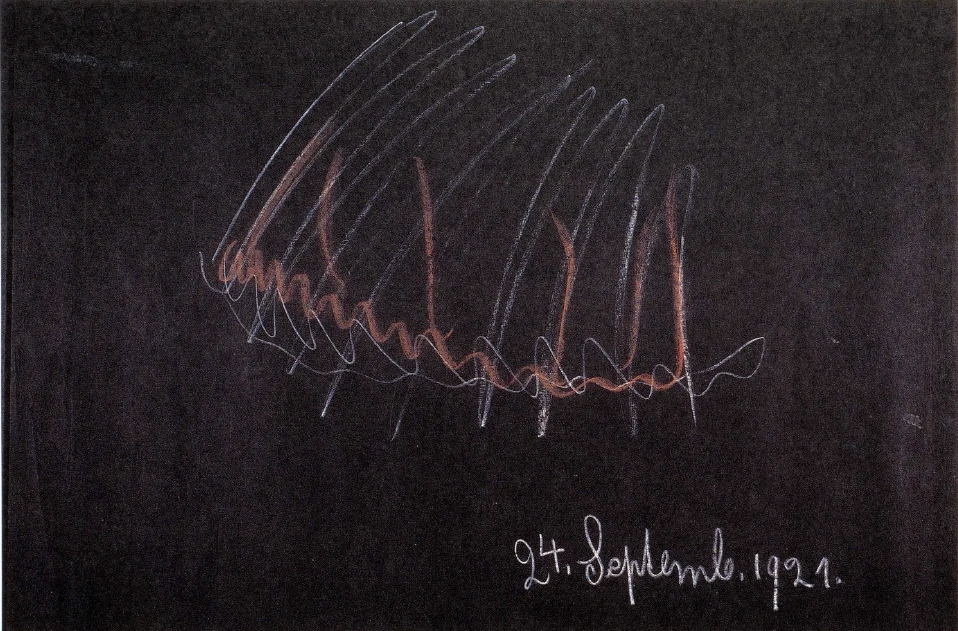
[ 29 ] Yesterday and today, I have guided you—perhaps in a somewhat complicated way—to this inner reality in its true meaning: how, through it, matter—that which is external—is cast back into nothingness, into chaos, so that the spirit may become creative anew. When one looks into this creative renewal, one says to oneself: God the Father acts down to matter in its perfection (see illustration, light). It appears to us in the outer world in the most varied ways, so that it is visible to us. But within our own inner being, this matter is cast back into its nothingness, permeated by the purely spiritual essence, by our moral ideals or even anti-moral ideals (red). There, new life then springs forth. The world must appear to us in this dual form: the Father God, as He creates what is outwardly visible, and how it has reached its end within the human being, where it is cast back into chaos. We must keenly feel the end of this world—which is the world of the Father God—and we will see how this leads us to an inner understanding of the Mystery of Golgotha, to that inner understanding through which it becomes clear to us how that which comes to an end in the sense of the Father God’s creation is revived through the Son God, and how a new beginning is made.
[ 30 ] Essentially, one can see everywhere in the Western world how, since the 15th century, there has been a tendency to penetrate only that which is decaying, only that which is corpse-like—the sole realm accessible to the intellect—and how all so-called education has been shaped solely under the influence of such a scientific approach directed toward the dead. This stands in opposition to true Christianity. True Christianity must have a sense for what is alive, but it must also be able to distinguish this sense of what is coming to life from what is decaying. Therefore, the most important concept—which must be linked to the Mystery of Golgotha—is that of the risen Christ, the Christ who has conquered death. What matters is to realize that the most important concept is that of the Christ who passed through death and rose again. Christianity is not merely a religion of salvation—the Eastern religions were that as well—but rather a religion of resurrection, a religion of reawakening for that which is otherwise simply crumbling matter.
[ 31 ] Cosmically speaking, we have the crumbling nature of matter in the Moon, and that which is constantly emerging anew and fresh in the solar realm. Spiritually speaking, as seen through spiritual vision, the Moon—as soon as one moves beyond ordinary sensory perception to the realm where the imagination operates—becomes something that is in a continuous process: it is constantly shattering (center of drawing a, p. 44). Where the Moon is situated, the Moon’s matter shatters and scatters out into the world, gathers again from the surroundings, and shatters once more (circular drawing a, p. 44). When one looks at the moon—even in the imagination—one sees a continuous gathering of matter that fragments where the moon is and scatters out into the world. The moon should actually be seen this way: a circle, a tighter circle—more concentrated, in other words, a tighter circle; but now it becomes the moon itself. There it dissolves, shatters. There it scatters out into the whole world. Within the moon, the matter cannot bear the midpoint, cannot bear the center. Matter concentrates toward the center of the moon, but cannot bear the center; it comes to a halt and shatters outward as cosmic dust. Only to ordinary sensory perception does the moon appear to be at rest. It is not at rest. Matter is constantly compressing and shattering outward (Drawing b, p. 44).
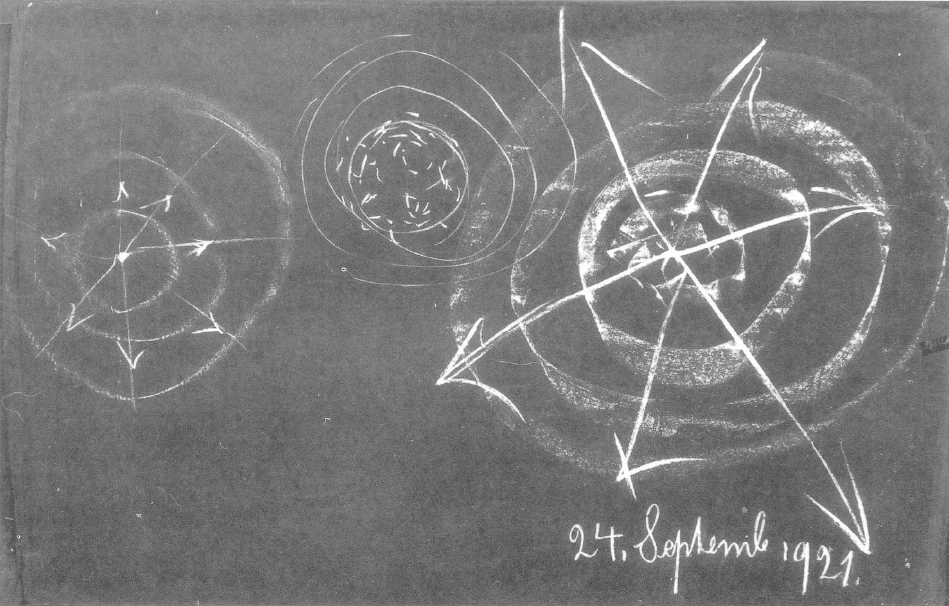
[ 32 ] The situation is different with the sun. Even in our imagination, we see that matter does not fragment in this way; rather, while matter does indeed approach the center, it now begins to take on vitality as it radiates outward. It does not fragment; it takes on vitality; it radiates life from the center in all directions. And with this life, astral nature develops. There, with the Moon, there is nothing; there, astral nature is destroyed. There, with the Sun, astral nature unites with the radiant. The Sun is, in truth, something permeated by inner life, where the center is not something that cannot be endured, but rather where it acts precisely as something life-giving. At the center of the Sun lives the cosmically fertilizing force. Indeed, cosmically speaking, the contrast between the Sun and the Moon also represents matter being cast into chaos, and the rising, sprouting, and budding of matter.
[ 33 ] When we dive deep into our inner being—we gaze into our inner chaos, into our lunar aspect. There is the inner moon. Matter is destroyed, just as it happens externally in the world only where the moon is present. But then the solar aspect penetrates us through our senses; then the solar aspect merges with the lunar aspect within us. The matter that disintegrates internally is replaced by the solar aspect. Here, within us, matter is constantly merging with the lunar aspect, and there, through our senses, we are constantly absorbing the solar aspect (see the illustration). This is how we relate to the cosmos, and this is why we must have the capacity to perceive the lunar aspect—that which fragments and dissolves into the dust of the worlds—and the life-giving force within the solar aspect.
[ 34 ] Through these two experiences, one glimpses, within that which is shattering and dispersing, the world of the Father-God, which had to exist until the world was transformed into the world of the Son-God—a world that is, in essence, physically manifested through the solar nature of the world. The lunar and the solar—they relate to one another as the Father-Godhead relates to the Son-Godhead.
[ 35 ] This was instinctively recognized in the early centuries of Christianity. It must be recognized once again with complete clarity if people are to be able to say honestly about themselves: “I am a Christian.”
[ 36 ] That is what I wanted to explain to you today.