

Anthroposophy as Cosmosophy I
Human Traits in the Earthly and Cosmic Realms
GA 207
30 September 1921, Dornach
Translated by Steiner Online Library
Third Lecture
[ 1 ] Let us continue the reflections we began here last Friday and Saturday, and today I would like to draw your attention in particular to a consideration of the soul life as it presents itself when viewed from the perspective of imaginative knowledge—a perspective you are familiar with from my book *How to Attain Knowledge of the Higher Worlds*. As you know, moving upward from our ordinary consciousness, we distinguish four levels of cognition: the level of cognition that characterizes our ordinary life today and modern science; the level of cognition that constitutes actual time-consciousness—which, in the context of the book *How to Attain Knowledge of the Higher Worlds*, is referred to as objective cognition; and then one enters the realm of the supersensible through the levels of cognition known as imagination, inspiration, and intuition. In ordinary objective cognition, it is impossible to contemplate the soul. The soul is experienced, and by experiencing it, one develops objective cognition. But true knowledge can only be gained when one can place what is to be known objectively before oneself. This is not possible in ordinary consciousness with regard to soul life. One must, so to speak, withdraw one step behind the life of the soul so that it comes to stand outside of us; only then can one observe it. But this is precisely what arises through imaginative cognition. And today I would simply like to describe to you what emerges for observation in this process.
[ 2 ] You know, when we consider the human being as a whole, we distinguish—at least initially—between the physical body, the etheric body (or body of formative forces), which is actually a sum of activities, the astral body, and the “I,” if we limit ourselves to what is present in the human being today. If we now bring the soul’s experience to the surface—not to knowledge, but to consciousness—we distinguish it, so to speak, by grasping it in the ebb and flow of life: in thinking, in feeling, and in willing. It is indeed the case that thinking, feeling, and willing interact with one another in ordinary soul life. You cannot imagine a train of thought without also imagining the interplay of the will within that train of thought. How we add one thought to another, how we separate one thought from another—this is entirely an activity of the will striving into the life of thought. And again, even if—as I have often explained—the process remains obscure at first: we do know that when we, as human beings, are willing, our thoughts flow into our willing as impulses, so that even in ordinary psychological life we do not have a will that is separate in and of itself, but rather a will interwoven with thought. And all the more so, thoughts, impulses of will, and the actual emotions flow into one another in feeling. We therefore experience the life of the soul as a continuous flow, yet in such a way that we are compelled—by factors we tend to disregard today—to distinguish between thinking, feeling, and willing within this flowing life of the soul. If you pick up my *Philosophy of Freedom*, you will see how one is compelled to clearly separate thinking from feeling and willing, for the reason that it is only through a consideration of thinking in isolation that one arrives at an understanding of human freedom.
[ 3 ] So by simply—I would say—vividly perceiving thinking, feeling, and willing, we simultaneously perceive the surging, weaving life of the soul. And when we then hold together what we perceive there in immediate liveliness with what anthroposophical spiritual science teaches us to recognize about the connection between the individual members of the human being—the physical body, the etheric body, the astral body, and the I—then the following emerges for imaginative cognition.
[ 4 ] We know, of course, that during our waking life—from the moment we wake up until we fall asleep—our physical body, etheric body, astral body, and “I” are in a certain intimate connection. We also know that in the sleeping state, the physical body and the etheric body are separated on one side, and the astral body and the “I” on the other. Even if the expression “the ‘I’ and the astral body separate from the physical body and the etheric body” is only approximately correct, one initially arrives at a perfectly valid conception when using precisely this expression. From the moment we fall asleep until we wake up, the “I” together with the astral body is outside the physical body and the etheric body.
[ 5 ] As soon as a person advances to imaginative cognition, they are increasingly able to grasp, right in the eye of the soul—through inner contemplation—what can be experienced, I would say, as fleeting, in a state of becoming. One has it and must grasp it quickly, but one can grasp it. One has before one what can be observed particularly clearly in the moments of waking up and falling asleep. These moments of falling asleep and waking up can be observed for the purpose of imaginative cognition. You know, of course, that among the preparations necessary to attain higher insights, I mentioned in the book cited earlier the cultivation of a certain presence of mind. In everyday life, people speak so little of the observations that can be made of the spiritual world precisely because they lack this presence of mind. If this presence of mind were cultivated more extensively in people, everyone would already be able to speak today of spiritual-supernatural impressions, for they actually present themselves to the highest degree when falling asleep and waking up, especially upon waking. It is only because so little attention is paid to cultivating this presence of mind that people do not notice it. At the moment of waking, a whole world appears before the soul. But as it arises, it vanishes again, and before people can bring themselves to grasp it, it is gone. That is why they can speak so little of this entire world that stands before the soul and which is truly of very special significance for the inner human being’s understanding.
[ 6 ] What presents itself to the soul when one truly manages, with presence of mind, to seize the moment of awakening is a whole world of surging thoughts. There need be nothing fantastical about it. Just as one observes phenomena in a chemistry lab, one can observe them with the same calmness and composure. And yet this world of surging thoughts—which must be very clearly distinguished from mere dreaming—is there. Mere dreaming unfolds in such a way that it is filled with memories of life. What takes place in the moment of waking, however, are not memories of life. These surging thoughts can be very clearly distinguished from memories of life. One can translate them into the language of ordinary consciousness, but they are, in essence, strange thoughts—thoughts that we cannot otherwise experience unless we grasp them either through spiritual training that has made this possible within us, or precisely in this moment of waking up.
[ 7 ] What are we actually perceiving here? Well, with our “I” and our astral body, we have entered the etheric body and the physical body. What is experienced in the etheric body, however, is experienced in such a way that it is dreamlike. And one learns—by learning to observe this, as I have indicated, subtly and with presence of mind—to distinguish clearly this passage through the etheric body, in which life’s reminiscences appear in a dreamlike manner, and then, before full awakening—before the impressions the senses now receive after awakening—one finds oneself placed in a world that is indeed a world of weaving thoughts, but one that is not experienced in the same way as dream thoughts, where one knows full well that they are one’s own subjective thoughts. The thoughts I am referring to now present themselves as entirely objective to the penetrating “I” and the astral human being, and one realizes quite clearly: one must pass through the etheric body; for as long as one is passing through the etheric body, everything remains dreamlike. But one must also pass through the abyss, the intermediate space—as I would say, if I may express myself somewhat inappropriately, but perhaps more clearly as a result—the intermediate space between the etheric body and the physical body, and then slip into the full etheric-physical realm by waking up, at which point the external physical sensory impressions are present. As soon as one has slipped into the physical body, these external physical sensory impressions are present. What we experience there in terms of objective thought-weaves thus takes place entirely between the etheric body and the physical body. We must therefore see in it an interaction between the etheric body and the physical body. So that we can say, if we draw a schematic diagram: If, for example, this represents the physical body (orange) and this the etheric body (green), then we have the living interplay of the physical body and the etheric body in the thoughts we perceive there, and through such observation we come to the realization that between our physical body and our etheric body, whether we are awake or asleep, there are processes constantly taking place that actually consist of an interwoven thought-life—that is, an interwoven thought-life between our physical body and our etheric body (yellow). Thus, we have now objectively grasped the first element of soul life. We see in it an interweaving between the etheric body and the physical body.
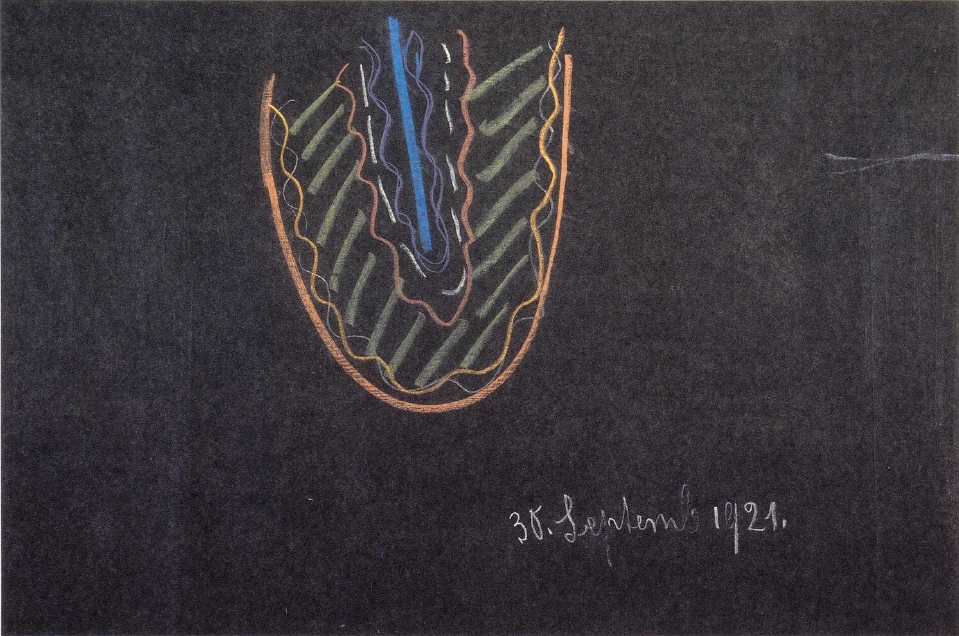
[ 8 ] This weaving life of thought does not actually come to our consciousness as it is during the waking state. It must be grasped in the way I have described. For when we wake up, we slip into our physical body with our “I” and our astral body. The “I” and the astral body, within our physical body—which is permeated by the etheric body—participate in the life of sensory perception. By having this life of sensory perception within themselves, they become permeated by the external world thoughts that they can form based on sensory perceptions, and thus have the strength to drown out this objective weaving of thoughts. Thus, in the place where objective thoughts would otherwise weave, we form—as it were—from the substance of this web of thought our everyday thoughts, which we develop in our interaction with the sensory world in the manner just described. And I can say: Into this objective weaving of thoughts comes what is now the subjective weaving of thoughts (light), which drowns out the other but also takes place between the etheric body and the physical body. We do indeed live in this—as I have already said: not strictly speaking, but nevertheless understandable, I must describe it as the space between the etheric body and the physical body— we live in this space between the etheric body and the physical body when we weave thoughts with the soul itself. We drown out the objective thoughts that are always present in both the sleeping and waking states with our subjective weaving of thoughts. But in a sense, both are present in the same region of our human being: the objective weaving of thoughts and the subjective weaving of thoughts.
[ 9 ] What is the significance of the objective weaving of thoughts? Objective thought-weaving—when it is perceived, when what I have described as the present-minded seizing of the moment of awakening actually occurs—this objective thought-weaving is not grasped as a mere mental process, but rather as that which lives within us as the forces of growth, as the forces of life itself. These forces of life are connected to the weaving of thought. They then permeate the etheric or life body from within; outwardly, they shape the physical body. We perceive what we experience as the objective weaving of thought—in that present-moment grasp of the moment of awakening—on the one hand as the weaving of thought, and on the other hand as an activity of growth and nourishment. What is within us in this way, we perceive as an inner weaving that nevertheless represents something living. Thinking, in a sense, loses its pictorial nature and abstractness. It also loses all sharp contours. It becomes fluctuating thinking, yet it is clearly recognizable as thinking. World-thinking weaves within us, and we experience how world-thinking weaves within us and how we, with our subjective thinking, immerse ourselves in this world-thinking. In this way, we have grasped the soul in a certain realm.
[ 10 ] If we now continue our mindful exploration of the moment of awakening, we find the following. If we are able to experience dream-like phenomena as we pass through the etheric body—that is, when we pass through the etheric body with the “I” and the astral body—we can then vividly bring these dream-like phenomena to mind. The images of the dream must cease the moment we wake up; otherwise, we would carry the dream into our ordinary conscious waking experience and become waking dreamers, thereby losing our presence of mind. Dreams as such must come to an end. But whoever experiences dreams consciously—that is, whoever possesses that presence of mind all the way back to the experience of the dreams—for the ordinary experience of dreams is a reminiscence, is actually a recollection of the dreams after the fact; this is, after all, the usual way of becoming aware of a dream—that one actually grasps it only as a reminiscence once it has ended— that is, when the dream is experienced as it flows through the etheric body, not only afterward in recollection, where it can be grasped briefly, as it is usually grasped—but when one grasps it while it is happening, that is, precisely as it permeates the etheric body—then it reveals itself as something alive, as something one experiences as an essential being within which one feels oneself. The imagery ceases to be merely imagery. One has the experience of being inside the image. But precisely because one has this experience—of being inside the image, of moving with one’s soul just as one otherwise moves with one’s body in waking life through the movement of the legs or hands—the dream becomes: it becomes active; it becomes something one experiences just as one experiences movements of the arms and legs or of the head and the like—when one experiences this, when one experiences this grasping of the dream as something substantial, then, precisely as the dream continues and one awakens, another experience follows this one: that this liveliness, which one experiences in the dream—and in which one now stands as if within something present—that this liveliness sinks into our physicality. Just as we feel when we think—we penetrate to the boundary of our physical body, where the sense organs are, and take in sensory impressions through thinking—so we feel ourselves sinking into our inner being with that which is experienced in the dream as inner activity. What one experiences there at the moment of waking—or rather, before the moment of waking, when one is still within the dream, when one is still entirely outside one’s physical body but already in the etheric body, or rather is just entering one’s etheric body—that sinks into our organism. And once we have reached the point where we experience this immersion, we also know what happens to what has been immersed: it radiates back into our waking consciousness, and it does so as a feeling, as emotion. Feelings are dreams that have been immersed in our being.
[ 11 ] When we perceive what is weaving in the external world in this dream-like state, they are dreams. When the dreams sink into our being and become conscious from within, we experience them as feelings. We experience these feelings, then, because that part of us which is in our astral body sinks into our etheric body and then further into our physical organism—not all the way to the senses, not to the periphery of the organism, but only into its inner structure. Then, once one has grasped this—having first perceived it particularly clearly through imaginative insight at the moment of waking—one also gains the inner strength to observe it continuously. For we are, in fact, dreaming continuously during our waking life. We merely overlook our dreaming with our thinking consciousness, with our life of imagination. Whoever can look beneath the surface of the life of imagination—and one trains oneself to see in this way by grasping the very moment of dreaming itself with presence of mind— who has trained themselves to grasp, upon waking, what I have described—can then also experience, beneath the surface of the luminous life of the imagination, the dreaming that continues throughout the entire day, which, however, is not experienced as dreaming, but always immediately sinks into our being and radiates back as a world of feelings. And they then know: What feeling is takes place between the astral body—which I have drawn here schematically (light-colored diagram on p. 51)—and the etheric body. It naturally expresses itself in the physical body (orange). Thus, the actual origin of feeling lies between the astral body and the etheric body (red). Just as the physical body and the etheric body must interact in a living interplay to give rise to the life of thought, so too must the etheric body and the astral body be in a living interplay to give rise to the life of feeling. When we are awake, we experience this living interplay of our intertwined etheric body and astral body as our feeling. When we sleep, we experience what the astral body—now living outside us—experiences in the outer etheric world as the images of the dream, which are present throughout the entire sleep but are not perceived in ordinary consciousness; rather, they are experienced only as fragments of memory that constitute ordinary dream life.
[ 12 ] You can see from this that if we want to understand the life of the soul, we must look even deeper into the components of the human organism. We conceive of the life of the soul as a flowing stream of thinking, feeling, and willing. We will speak of the latter in a moment. But we grasp it objectively by looking, as it were, into the spaces between these four members—between the physical body and the etheric body, and between the etheric body and the astral body.
[ 13 ] What is expressed in volition, as I have often explained here from other perspectives, is entirely beyond the scope of ordinary waking life and ordinary consciousness. In this ordinary consciousness, there are the ideas by which we orient our volition, and the feelings we develop based on these ideas as motives for our volition; but how what lies clearly in our consciousness as the content of our volition’s ideas plays out—when I merely move my arms to will—what is actually going on there is not revealed to us in ordinary consciousness. At the moment when the researcher of the spiritual world draws upon imagination within himself and comes to view the nature of thinking and feeling in the way I have described, he can then also come to experience, as something entering into consciousness, the human experiences that take place between falling asleep and waking up. For in the exercises of imagination, the “I” and the astral body are strengthened. They become stronger within themselves; they learn to experience one another. In ordinary consciousness, one simply does not have the true “I.” How does one have the “I” in ordinary consciousness? You see, I must make this comparison again and again: When one looks back on life in memory, it appears to be a continuous stream. But it is not; rather, as we live now, we should be able to survey the present day up to the moment of waking, then encounter a gap, followed by the contents of yesterday’s consciousness, and so on. What we observe in our recollection, however, also encompasses those states that we did not consciously experience—that is, those that are not present in the current content of our consciousness. But they are present in a different way. A person who never slept at all—if I may offer this as a hypothetical example—would have a completely fragmented recollection. His recollection would, in a sense, blind him. He would experience everything he brings before his consciousness in recollection as something entirely foreign to him, something dazzlingly bright. He would be overwhelmed by it and would have to shut himself off completely. He would not even be able to sense himself within himself. It is only through the interposition of states of sleep into the recollection that the recollection is dimmed. We are able to endure it. For this makes it possible for us to assert ourselves in the face of our memory. It is solely to the fact that we sleep that we owe our self-assertion in memory. What I am saying now could already be well established through empirical observation of human life courses in a comparative manner.
[ 14 ] But just as we sense that inner activity in the act of recollection, so too do we actually sense our “I” from within our entire organism. We sense it in the same way that we perceive states of sleep as—I would say—dark rooms in the flow of memory. We do not perceive the “I” directly in ordinary consciousness, but we perceive it only in the same way we perceive states of sleep. But as we acquire imaginative consciousness, this “I” truly emerges, and it is of a volitional nature. And we realize: What within us is a feeling that encompasses the capacity to feel sympathy or antipathy toward the world—what within us activates the will—takes place in a process similar to that which occurs between waking and falling asleep. One can observe this with full awareness if, just as for waking, one develops the same qualities I have spoken of for falling asleep. Then, as you fall asleep, you notice that you carry into the state of sleep what radiates outward—as activity—from your emotional life, and what radiates inward into the outer world; and you then learn to recognize how, every time you truly develop your will, you now submerge into a state similar to the one into which you submerge when falling asleep. One immerses oneself in an inner sleep. What occurs when falling asleep—when the “I,” together with the astral body, withdraws from the physical body and the etheric body—occurs internally every time one wills it.
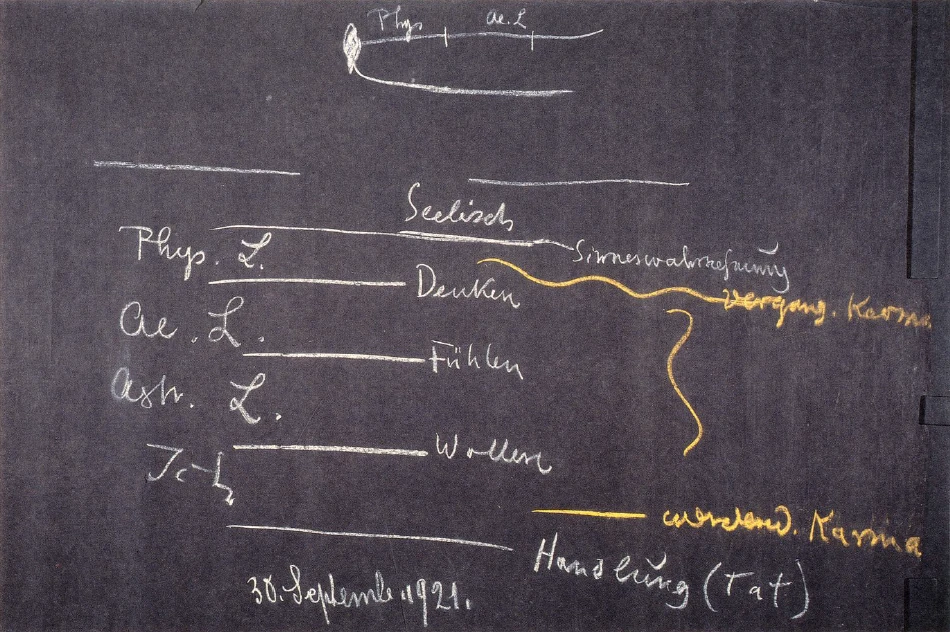
[ 15 ] Of course, you must realize that what I am describing to you here is much more difficult to grasp than what I described earlier, because the moment of falling asleep is, in most cases, even harder to grasp in the present moment than the moment of waking up. After waking up, we are awake; at least then we have the support of our memories. When falling asleep, we must carry the waking state into sleep if we want to be able to observe it. But people usually just fall asleep; they do not direct the activity of feeling into the process of falling asleep. If, however, they can carry it over into that process—which happens through training in imaginative insight—then they realize that in the act of willing there is indeed a plunging into the same element into which we plunge when we fall asleep. Through willing, we actually become free from our physical organization. We connect with real objectivity. Just as, upon waking, we draw in through our etheric body, through our physical body, and into the sensory region—that is, to the periphery of the body—taking possession, as it were, of the entire body and permeating it completely, so too do we send our dreams back into the body through feeling by immersing ourselves inwardly; they simply become feelings. But if we do not remain in the body now, but instead—without going to the periphery of the body—step out of the body inwardly and spiritually, then we arrive at volition. So that volition actually takes place independently of the body. I know that this says a great deal, but I must also describe it because it is a reality. And in grasping this, we come to realize that—if we now have the “I” here (see drawing on page 51, blue)—the will takes place between the astral body and the “I” (purple).
[ 16 ] We can therefore say: We divide the human being into the physical body, the etheric body (or body of formative forces), the astral body, and the I. Thinking takes place on the soul level between the physical body and the etheric body. Feeling takes place on the soul level between the etheric body and the astral body. On the soul level, willing takes place between the astral body and the “I.” As we move toward the periphery of the physical body, we experience sensory perception. As we step outside of ourselves through our “I,” projecting our entire being into the outer world, willing becomes action—the opposite pole of sensory perception (see diagram on page 62).
[ 17 ] In this way, one arrives at an objective grasp of what is subjectively experienced in the flow of thought, feeling, and will. Thus, experience is transformed into understanding. Any psychology that seeks to grasp the surging stream of thought, feeling, and will in any other way remains formal, because it does not penetrate to reality. Only imaginative insight can penetrate to reality for the experience of the soul.
[ 18 ] Let us now consider what has emerged, so to speak, as a byproduct of our entire line of thought. We said: Through mindful observation at the moment of waking—once one has slipped out of the etheric body—one can perceive a weaving of thoughts that is of an objective nature. One first perceives this objective weaving of thoughts. I said that one can quite easily distinguish it from dreams and also from everyday thought life, from subjective thought life, because it is connected with growth, with becoming. It is actually a real organization. But if one grasps what is weaving there—what, when one sees through it, one perceives as a weaving of thoughts; if one, I would say, senses it, feels it inwardly—then one perceives it as a force of growth, as a nourishing force, and so on, as the human being in the process of becoming. It is something that is initially foreign, yet it is a world of thought. If we can now study it more closely, we see that it is, in fact, the inner weaving of thoughts within ourselves. We perceive it at the periphery of our physical body; we perceive it before we reach the level of sensory perception. When we learn to understand it more closely, when we become accustomed to its strangeness in relation to our subjective thinking, then we recognize it; then we recognize it as that which we have brought with us through our birth from earlier experiences—from prenatal experiences or those preceding conception. And the spiritual—which brings our entire organism together—becomes for us something objectively concrete. The idea of pre-existence gains objectivity; it becomes objective contemplation. We can say, through inner comprehension: We are woven from the world of the spirit through thoughts. The subjective thoughts we add to this lie within the realm of our freedom. The thoughts we perceive there shape us; they build our body out of the fabric of thought. They are our past karma (see Chart 6, diagram on page 62). Thus: Before we even reach sensory perceptions, we perceive our past karma.
[ 19 ] And when we fall asleep, for those who live in objective awareness, this falling asleep is similar to the act of willing. When the act of willing is brought to full consciousness, one realizes quite clearly: one falls asleep into one’s own organism. Just as dreams otherwise descend, the motives of the will enter into our organism. One falls asleep into the organism. One learns to distinguish this falling asleep into the organism, which initially plays itself out in our ordinary actions—these take place externally; we perform them between waking and falling asleep—but not everything that lives within our emotional life finds expression in these actions. After all, we also live out our lives between falling asleep and waking up. And what we would otherwise channel into our actions, we push out of ourselves through the very same process of falling asleep. We push out a whole host of volitional impulses into the purely spiritual world in which we find ourselves between falling asleep and waking up. Impulses of will that pass into our spiritual being—which we nurture only between falling asleep and waking up—if we learn to observe them through imaginative insight, we perceive in them what remains of our orientation toward action beyond death, what goes with us beyond death.
[ 20 ] Will develops between the astral body and the “I.” Will becomes action by extending into the external world until it reaches the point from which sensory impressions otherwise arise. But when we fall asleep, a great deal goes out that seeks to become action but does not actually become action; rather, it remains connected to the “I” as the “I” passes into the spiritual world through death.
[ 21 ] As you can see, here on the other side we experience our karma in the making (see diagram on page 62). Between the will and the action, we experience our karma in the making. Both then merge in the imaginative consciousness: past karma and karma in the making—that which weaves and lives within us and manifests itself in such a way that it continues to weave beneath the threshold above which lie our free actions, which we can live out between birth and death. Between birth and death, we live in freedom. But beneath this realm of free will—of volition, which actually exists only between birth and death—there weaves and lives karma, whose effects from the past we perceive when we can remain with our “I” and our astral body in the etheric body just as it breaks through to the physical body. And conversely, on the other hand, we perceive our karma-in-the-making when we can remain in the region that lies precisely between willing and acting, and when we can develop enough self-discipline through practice that we can activate ourselves inwardly in a feeling just as we—I would say—activate ourselves in action by enlisting the body’s aid; if we can activate ourselves mentally through a feeling—that is, if we can hold an action within the “I.”
[ 22 ] Imagine this vividly: One can be so enthusiastic, so deeply captivated by something that springs from the heart—something that would otherwise translate into action—but one must hold it back; then it shines forth in the imagination as karma in the making.
[ 23 ] What I have described to you here is, of course, always present in human beings. Every time a person wakes up—every morning upon waking—they pass through the realm of their past karma; every evening upon falling asleep, they pass through the realm of their future karma. Through a certain degree of attentiveness, even without special training in mindfulness, a person can grasp the past objective reality—though, of course, not as clearly as I have just described. But they can perceive it; it is there. And it encompasses everything they carry within themselves in their moral impulses, both good and bad. Through this, a person actually comes to know themselves better than if they were to become aware, at the moment of waking, of this web of thoughts that constitutes their very being.
[ 24 ] But even more unsettling is the realization of what lies between intention and action—that which one can hold back. There, one comes to know oneself to the extent that one has shaped oneself during this life. There, one comes to know what one carries forward through death as an inner disposition—as karma in the making.
[ 25 ] Today I wanted to show you how to speak about these things with a vivid sense of their reality—how anthroposophy is by no means limited to a schematic framework, but how these things can be described in a living way—and tomorrow I will continue this reflection by moving on to an even deeper understanding of the human being based on what I have presented today.