

Anthroposophy as Cosmosophy I
Human Traits in the Earthly and Cosmic Realms
GA 207
1 October 1921, Dornach
Translated by Steiner Online Library
Fourth Lecture
[ 1 ] Yesterday we were able to point out how human beings, in their consciousness, approach the world in two ways, so to speak: when they turn inward and when they turn outward. For ordinary consciousness, however, what lives within the human being is not graspable, precisely because consciousness stumbles over it. But we have just seen how karma in the human being also lives in two ways between birth and death: on the one hand, when the human being, upon waking, sinks into their etheric body, where, while sinking in, they can also have reminiscences of dreams in ordinary consciousness. Then, in a sense, they pass through the space between the etheric body and the physical body—for they are not truly in the physical body until they have full sensory perception—and there they pass through the region of the thoughts that are alive and active within them. These are the very same thoughts that actually participated in the formation of his organism, that he brought into existence through birth, and which, in other words, constitute his past, his completed karma. But then, as the person falls asleep, they encounter that which cannot become action. What enters into our actions from our emotional and volitional impulses is, of course, lived out in life. But something always remains behind, and the person takes this with them into sleep. This is also present in other contexts. Everything from the soul life that does not enter into action—that, so to speak, stops short of action—is karma in the making, which takes shape and which we then carry on with us through death. In short, yesterday I wanted to point out how the forces of karma live within the human being.
[ 2 ] Today, so that we can bring this whole topic to a sort of conclusion tomorrow, we will take a look at the human environment to show how human beings actually relate to the world. Yesterday we endeavored to view the human soul life itself objectively, and thus found that thinking develops in that region which is precisely this objective region of thought between the physical body and the etheric body; that feeling then develops between the etheric body and the astral body; and that willing develops between the astral body and the “I.” So that—as I said yesterday, the expression is inappropriate, but it is nevertheless understandable—this actual soul activity develops, so to speak, in the interstices that we must assume exist between the four members of the human nature: the physical body, the etheric body, the astral body, and the “I.” If we view them objectively, they are reciprocal activities between the members of the human being.
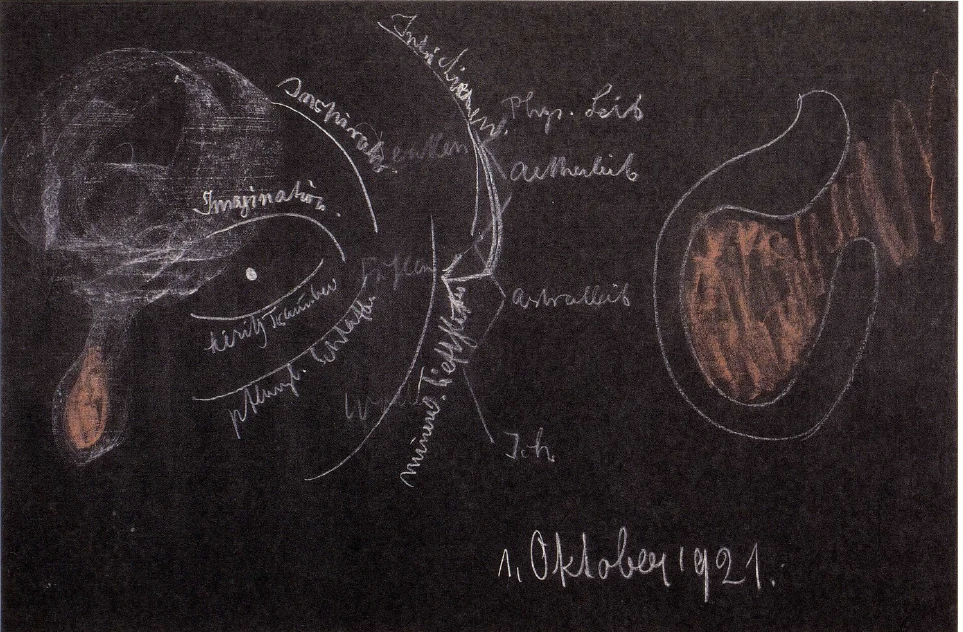
[ 3 ] Today, let’s take a closer look at the human environment. Let us really bring to mind how a person lives in a very vivid dream life, how a person has images that wander through this dream life. I said yesterday: The imaginative consciousness can perceive how these images descend into the organism and how what is at work in these images gives rise to our feelings. Our feelings, then, are what would actually be grasped if one were to look deeper into the innermost being of the human being, as perceived in dream images. Feelings are the waves that surge up into our consciousness from the life of daydreaming. We dream, as I said yesterday, continuously beneath the surface of our imaginative life, and this dream life plays itself out in our feelings.
[ 4 ] If we now look at the environment surrounding human beings—first at the animal world—we find that in the animal world there is a form of consciousness that does not rise to the level of thinking or a life of thought, but rather takes shape in a kind of living dream life. By studying our own dream life, we can form an idea of what the animal’s soul life is actually like. The animal’s soul life is, in fact, entirely a matter of dreaming. Therefore, the animal’s soul life is much more actively involved in the organism than the human soul life, which is much more emancipated from the organism through the clarity of the life of imagination. The animal actually dreams. And just as our dream images—the dream images we form during waking consciousness—well up as feelings, so too is such a feeling-like inner life what primarily underlies the animal’s existence. Animals do not actually possess a soul life permeated by the bright light of thought. What takes place in us between the etheric body and the astral body is, in essence, what takes place in animals; this constitutes the animal soul life. And we can understand animal life if we conceive of it as emerging from the soul life.
[ 5 ] It is important to form a certain idea of these conditions, for then one will understand what is actually happening, let us say, when the animal is digesting. One need only cast a glance at a herd lying in a pasture during digestion. The entire atmosphere within the animals foreshadows what spiritual research brings to light: that the active process—which essentially takes place between the animal’s etheric body and astral body—manifests as a living feeling, and that the animal lives within this feeling. An intensification or attenuation of this feeling—that is the essence of the animal’s experience—and participation in its dream images, when feeling is somewhat subdued and the image takes the place of feeling. We can therefore say: The animal lives in a state of consciousness similar to our dream consciousness.
[ 6 ] If we seek in him the consciousness that we ourselves possess as human beings—as human beings walking here on Earth—then we cannot look for it within the animal; rather, we must seek it in beings that do not have an immediate physical existence. We call them the animal group souls—souls that, as such, do not possess a physical body but express themselves through the animals. We can say that all lions together possess such a group soul, which has a spiritual existence. It is this group soul that possesses the kind of consciousness that we humans have, not the individual animal.
[ 7 ] If we now descend into the plant world, we do not find a consciousness like that of animals; rather, we find in the plant world itself a consciousness similar to the one we experience from the moment we fall asleep until we wake up. The plant is a sleeping being. But we also develop this consciousness between the astral body and the “I” in our volition. What is at work in the plant world is essentially of the same nature as what lives in our volition. In our volition, we are actually asleep even when we are awake. The same activity that reigns in our volition actually reigns over the entire plant world.
[ 8 ] The consciousness we develop as sleep consciousness is, in fact, something that constantly intrudes into our conscious mind as the unconscious, creating gaps—as I said yesterday—in our memory. But just as our consciousness is dull—and for most people, completely extinguished—during sleep, so too is plant consciousness.
[ 9 ] If we then seek to discover what in plant life is similar to animal life, we cannot look for it in the individual plant; rather, we must actually seek it in the entire soul of the Earth. The entire Earth soul possesses a dreamlike consciousness and slips into a state of sleep within the plant consciousness. And only to the extent that the Earth participates in cosmic becoming does it flicker to life in such a way that it can develop a consciousness as complete as the one we humans have between birth and death in our waking state. But this is primarily the case during the winter season: it is a kind of awakening of the Earth, whereas the dull dream-consciousness is present during the summer season, during the warm season. It is indeed a complete fallacy—as I have already explained in earlier lectures—to believe that the Earth is awake in summer and asleep in winter. The opposite is true. The intense vegetative activity that develops during the summer, during the warm season, is actually a state of sleep for the Earth—in fact, a “dream state” of the Earth—whereas a waking state of the Earth is present during the cold season. But when we now descend into the mineral kingdom, we are led to conclude that there exists a consciousness even deeper than that of our sleep—a consciousness that is already quite far removed from our ordinary human experience, one that would thus extend beyond the realm of volition. But in reality, what lives there in the minerals as a state of consciousness is only seemingly, only to ordinary consciousness, far removed from us humans. In reality, it is not so far removed from us at all. For when we pass from willing to actual action, when we carry out an action, our willing does indeed separate from us. And that in which we then—I might say—swim, in which we weave and live as we carry out the action that we merely imagine—for our consciousness is not actually inside the action, we merely imagine it—but what lies within the action itself, the content of the action, is ultimately the same thing that lies within the mineral realm beyond the surface of the minerals and constitutes mineral consciousness. In fact, if we could sink even deeper into the unconscious, we would arrive at the place where mineral consciousness weaves. But we would find ourselves in no other state than the one in which our own actions also take place. Therefore, mineral consciousness lies, so to speak, beyond what we as human beings can still experience. But our own actions, too, lie beyond what we as human beings can experience. Insofar as our actions do not depend on us—insofar as they do not lie within the realm of what is encompassed by our freedom—our actions are just as much a part of world events as what takes place within the minerals. We integrate our actions into this process, and in doing so we have in fact extended the relationship between human beings and their environment all the way to the point where human beings, through their actions, even transcend their waking consciousness. As human beings become aware of the mineral world around them—by observing the minerals from the outside—they come into contact with that which lies beyond their own experience. We can say: If this is the scope of what we see within the human kingdom, the animal kingdom, and the plant kingdom, and then as we approach the mineral kingdom here, the mineral kingdom—by acting upon our senses—presents its outer side to us; but beyond that, where we can no longer penetrate, the mineral kingdom then develops its consciousness, as it were, turned away from us (see drawing, red). And this consciousness that is developed there is the very one that also takes in the inner contents of our actions, which then continue to have an effect in the course of our karma.
[ 10 ] And now let us turn to beings who do not stand below human beings in the hierarchy of the natural kingdoms, but who stand above them. How can we form a certain conception of these beings? How, in general, does a conception of such higher beings arise even for the consciousness that we must establish through spiritual research, through anthroposophy? Well, you know from the exposition in my book *How Does One Attain Knowledge of the Higher Worlds?* and from what I have said on the same subject in lectures that we can ascend from everyday consciousness—which we call objective consciousness—to imaginative consciousness. When we ascend in a healthy way to imaginative consciousness, we are first freed from our physicality. We weave within the etheric life. As a result, our images will not be sharply defined; they will be flowing, intermingling imaginations, but they will be such that they resemble the life of thought I described yesterday—the one we experience upon waking, between the etheric body and the physical body. We are already immersing ourselves in such a life of thought. This life of thought, into which we immerse ourselves through imagination, is not one in which we arbitrarily link one thought to another; rather, the thoughts link themselves together. It is a thought organism, a pictorial thought organism, into which we immerse ourselves. But this pictorial organism of thought possesses a life force within itself. It presents itself to us as a being of thought, yet one that actually lives, that possesses a life of its own—not the kind of life that physical, earthly things possess, but a life that, in essence, interweaves with and permeates everything. We immerse ourselves in a world that lives through imagination, whose activity is imagination.
[ 11 ] This is the world we first experience as existing above the human being: this weaving, imagining world. And only as a fragment, as something cut out of this weaving, self-imagining world, do we find that which is woven within us between our etheric body and our physical body—that which we can find upon waking and which we know to be identical to that which enters through conception and birth from the spiritual world into this physical world when we first enter this physical world. That world, which is the world of imagination, releases us, so to speak, last of all, and it continues to work within our physical body even after our birth. A weaving of thought, independent of our own subjective weaving of thought, takes place there. This weaving of thought occurs as we grow. This weaving of thought is also at work in our nutrition. This weaving of thought is formed from the general weaving of thought of the cosmos.
[ 12 ] We cannot understand our etheric body unless we understand it in such a way that we perceive the general fabric of the world’s thoughts (see illustration, light), and our own etheric body is, so to speak, woven out of this fabric of the world’s thoughts through our birth. The world’s web of thought weaves itself into us, forming the forces that underlie our etheric body and that actually manifest in the space between the etheric body and the physical body. Through the physical body, they are, so to speak, carried in, separated from the outer world, and then work within us with the help of the etheric body—the body of formative forces (below).
[ 13 ] This allows us to form a conception of what lies beyond our world. Our next insight is the imaginative one, and the next essential aspect in our environment is that which imagines itself, that which lives itself out in living images. And our own organization is based on such a living-out in living images. In terms of our etheric body, we are entirely formed and shaped out of the cosmos. Just as, when we descend into the realm that lies beneath us, we must attribute to animals the kind of consciousness we experience in dreams, so too, when we ascend above ourselves, we experience what we then subjectively receive through imagination. What we develop internally as a web of imaginations is present externally; we observe it, so to speak, from the outside. We imagine inwardly. The beings next above us imagine outwardly, revealing themselves through imagination directed outward, and we ourselves are set apart from this world by such outwardly directed imagination. Thus, our world is in fact based on a weaving of thoughts, a weaving of image-thoughts, which we discover when we seek the spiritual world—a weaving of image-thoughts.
[ 14 ] You know that the next stage in the development of our cognitive faculties is the stage of inspiration. We can experience imagination from within as a cognitive process. But the world that follows the world of imagination is the one that, so to speak, weaves and lives within the same element that we enter upon inspiration. Only, for this world, it is an expiration, a kind of spreading out from within itself. We inhale as we recognize. But what the next world does is this: it exhales itself; it drives outward what we drive inward in inspired cognition.
[ 15 ] Thus, by viewing—as it were—what we experience from within during inspiration from the opposite perspective, we approach the objectivity of the next higher beings. And the same is true of intuition, of intuitive cognition. But I must first say: If we as human beings had, so to speak, been spun out merely from the world’s web of thought, then we would not bring into this life our soul life, which has lived through the period from our last death to this birth; for what is spun out of the world’s general web of thought is spun out of the cosmos itself—it has been bestowed upon us by the cosmos. It is into this that the soul must first enter. And this soul enters through a process of exhalation, through an activity that is the reverse of inhalation. We have thus, so to speak, been exhaled from the soul-spiritual universe. As the cosmos envelops us with its web of thought, the spiritual-soul world permeates us, exhaling the soul into us. But it must first take in this soul. And here we come to what, in turn, can only be properly understood by human beings.
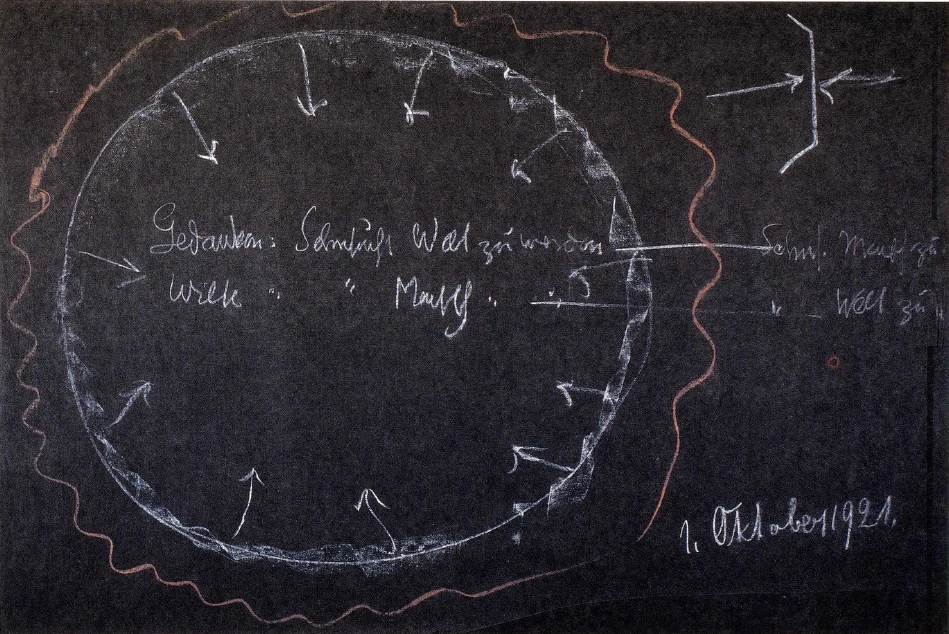
[ 16 ] You see, as human beings living in the world between birth and death, we are constantly taking in impressions of the external world through our sensory perceptions. We form ideas about them; we infuse these ideas with our feelings. We move on to our impulses of will. We permeate all of this. But this forms within us a kind of abstract life, a kind of life of images at first. And if you, I would say, look inward—toward that which is formed there from the sense organs inward as a soul experience of the external world—then that is, in fact, your soul content. It is the soul content of the human being that, in higher waking consciousness between birth and death, represents what the external world gives him. His inner being absorbs this, so to speak. If I were to sketch this inner being schematically: then, in perception, the world is, so to speak, sent in (drawing on p. 73, red) and becomes a world permeated internally by the forces of feeling and will, which presses its way into the human organism. We actually carry a vision of the world within us; but we carry a vision of the world within us because the effects—the impressions of the world—press their way into us. And in ordinary consciousness, we cannot fully comprehend what actually happens within us with these impressions of the world. What penetrates within us and lives within us in such a way that it is—within certain limits—an image of the cosmos is permeated not only by the feelings and inner impulses of will that enter our consciousness, but is pulsed through by everything that lives within the human being. This gives it a certain tendency. As long as we live, until death, it is held together by the body. As it passes through the gate of death, it takes with it from the body what might be called a desire to continue what it has become within the body: the desire to assume human existence. When we carry our inner soul life through death, it acquires the desire to assume human existence.
[ 17 ] This is what sustains our inner life through death: the longing for human existence. And this longing for human existence is particularly keenly felt in all that lies, as if dreaming and sleeping, in the depths of our inner life—in our will. Our will, as it integrates itself into the life of the soul that arises from impressions of the external world, carries within itself—as it passes through death—the deepest longing to become human in a spiritual world, in a spiritual fabric of the world.
[ 18 ] Our world of thoughts, on the other hand—the world that can be glimpsed, for example, in our memories, that is reflected back from within ourselves into our consciousness—carries within it the opposite longing. It has, after all, entered into a kinship with our human being. Our thoughts form a strong kinship with our human being. As they pass through death, they then carry within them the most profound longing to spread out into the world, to become the world (see drawing on page 68).
[ 19 ] We can therefore say: As we humans pass through death, our thoughts carry within them the longing to become the world. The will, on the other hand—which we develop in life—carries within it the longing to become human.
Thoughts: The Longing to Become the World
Will: The Longing to Become Human
[ 20 ] This is what we take with us through death. Everything that reigns in the depths of our being as will carries within its very core the longing to become human. One can observe this with imaginative consciousness when watching a sleeping person, whose will is indeed outside of them—in whom the “I” has the will outside of itself. There, in what lies outside the human body, the longing is already clearly expressed to return upon waking, in order to take on a human-like form within the expanse of the human physical body itself. But this longing persists beyond death. That which is of a volitional nature seeks to become human, whereas that which is of a thought-like nature—and which must connect precisely with the thoughts so close to physical life, with the thoughts that actually form our human fabric, that give us our human form between birth and death—takes on the longing to disperse once more, to dissolve once more, to become the world. And this then lasts until roughly the middle of the time we spend between death and a new birth.
[ 21 ] Here, the realm of thought, in its longing to become the world, has, in a sense, reached its end. It has integrated itself into the entire cosmos. The longing to become the world has been fulfilled, and a reversal takes place. Midway between death and a new birth, this longing of thought to become the world slowly transforms into the longing to become human once more, to interweave itself once more in the way it does when it becomes our very fabric of thought—which we can perceive against our body upon waking. So that we can say—I call what lies there in the middle between death and a new birth, as you know from my Mystery Dramas, the midnight hour of existence—that in this midnight hour of existence we experience a rhythmic reversal of our being’s mental longing to become the world, once it has been fulfilled, into the longing to become human again, to descend little by little in order to become human once more.
[ 22 ] At the very moment when thoughts begin to yearn to become human again, the opposite occurs in the will. For the will first develops the yearning to become human within the spiritual realm that we experience between death and a new birth. It is this longing that fulfills the will most of all. Out there, between death and a new birth, it has, so to speak, experienced a spiritual image of the human being; within this image, the most vivid longing to become the world again now arises. In a sense, the will expands; it becomes the world; it becomes cosmic. By expanding in this way, it also comes into proximity with that natural current which is then formed through the line of heredity as generations succeed one another. So that what acts as will in the spiritual-physical cosmos—what begins as will, at the midnight hour of existence, with the longing to become the world—actually already lives within the succession of generations. When we then incarnate into the other current—the one that yearns to become human—the will to become a world has already preceded us. It already lives in the succession of generations into which we then immerse ourselves. In what we receive from our ancestors, the will that sought to become the world from the midnight hour of existence already lives, and we unite with this will that seeks to become the world, as that which, since the midnight hour of existence, has sought to become human in our thoughts then integrates itself into it.
Thoughts: The Longing to Become the World — The Longing to Become Human
Will: The longing to become human — the longing to become the world
[ 23 ] So you see, when we observe with spiritual insight what lives in the physical realm on the one hand and what lives in the spiritual realm on the other, the image of becoming human truly unfolds before our soul. But we are also—as we pass through the web of thought that yearns to become human and to descend into our physical existence—connected to all the beings who live in the sphere immediately above humanity, those who imagine themselves. We pass, as it were, through the sphere of the imagining beings. And precisely at the moment when this reversal takes place, our soul—imbued with the “I”—also finds the possibility to continue living within the two currents, which do indeed diverge, but with which the soul lives—cosmically lives—until, upon the full fulfillment of the longing to become human, it incarnates once more and becomes a single human being. The soul’s life is, in essence, very complex, and here, at the midnight hour of existence, it crosses the abyss. It is, so to speak, inspired from within our own past—specifically, the past that lies between our last death and the midnight hour of existence. We pass through the midnight hour of existence through an activity that, when experienced inwardly, is similar to inhalation, and which outwardly is an exhalation, originating from a previous existence. Once the soul has passed through the midnight hour of existence, we come together with those beings who stand a second level above human beings and who live in exhalation, as I have said.
[ 24 ] But as a third stage in higher cognition, we have intuitive knowledge. If we experience it inwardly, then we have it, so to speak, from one side; if we experience it from the outside, then we have intuition, a surrender, a true surrender. This surrender, this pouring out into the outer world—that is the essence of the hierarchy that stands as the third level above the human being: intuition. And this intuition is the activity through which the content of our previous earthly lives is intuitively brought over into our present earthly life—it flows over, pours over into our present earthly life. We do, however, practice this activity continuously, both on the path leading up to the midnight hour of existence and beyond. This activity permeates everything else, and through it—that is, as we pass through our repeated earthly lives—we become participants in that world inhabited by beings who live in true intuition, the self-surrendering beings. For we, too, surrender ourselves to each successive earthly life from within our previous earthly life.
[ 25 ] In this way, we can also gain an understanding of how our life unfolds between death and a new birth within the realm of these three worlds.
[ 26 ] Just as we live here between birth and death in the midst of the animal, plant, and mineral worlds, so do we live between death and a new birth in that world where what we otherwise perceive in our imagination takes on form in images and lives outwardly. Therefore, what we carry from the spiritual cosmos into our physical form is something we can also grasp through imagination. That which we carry forward from our soul life through the midnight hour of existence—which then lives within us primarily as emotional activity but is dulled into the realm of dreams—we can grasp through inspiring insight; and even when it manifests as our emotional life, it is permeated by such beings.
[ 27 ] For as human beings, we actually live fully only within our external sensory perception. Even when we move on to thinking, this thinking is, objectively speaking, something that is given to the imagination—something that consists of the formation of images. We extract only the abstract thoughts from this formation of images into our consciousness. Behind our consciousness lies the very weaving of images that constitutes thought. It is precisely because we can extract these abstract thoughts from this weaving of images that we, as human beings between birth and death, attain freedom. The world of imaginative necessity lies beyond this. Yet there, too, we are no longer alone in the same way as we are here. There we are interwoven with the beings who reveal themselves through imagination, just as we are then interwoven in our feeling with the beings who reveal themselves outwardly through exhalation and inhalation. And as we pass from one earthly life to the next, we are interwoven with those beings who live in intuition.
[ 28 ] Our human life thus extends down into the three realms of nature and up into the three realms of divine, spiritual, and soul existence. This shows us that, when we look at a human being, we are seeing only the outer aspect of that person. The moment we look inward, the human being extends upward into the higher worlds; he reveals to us his connection to those higher worlds, and through imagination, inspiration, and intuition, we enter into these higher worlds.
[ 29 ] We have thus taken a look at the human environment. But in doing so, we have also discovered the world that, as a world of spiritual necessities, lies behind the world of physical necessities, and we come to appreciate all the more what lies in the middle: the world of our ordinary consciousness, which we experience in the waking state between birth and death. There we incorporate into our true human being that which can live in freedom. There is no freedom beneath us or above us. We carry freedom through the gate of death by taking with us the most essential content of consciousness that we possess between birth and death. It is precisely to earthly existence that the human being owes the attainment of that which constitutes the life of freedom within him. Then, however, it can no longer be taken from him; once he has attained it by living through the life between birth and death, it can no longer be taken from him as he carries this life forward into the world of spiritual necessities. This earthly life derives its profound meaning precisely from our ability to place it between what lies beneath us and what lies above us. And so we live our way upward toward an understanding of what can be grasped in the human being as the spiritual.
[ 30 ] If we want to recognize the soul, we must, so to speak, look into the spaces between the physical body, the etheric body, the astral body, and the I; then we must look into what weaves there between the members of our human being. If we wish to come to know the human being as a spiritual being, then we must ask what the human being experiences in relation to imaginative beings, to beings that reveal themselves externally through inspiration or, more precisely, expiration, and to beings that reveal themselves through intuition. Just as we must, so to speak, investigate the reciprocal interactions that develop among the members of our human being if we wish to examine the life of the soul, so too must we explore the interaction with the beings of the higher hierarchies if we wish to regard the human being as a spiritual being.
[ 31 ] If we look down into nature and wish to view the human being in its entirety, then this human being reveals itself to us for spiritual contemplation at the very moment when, out of inner knowledge, we can say: The human being, as it is today, carries within itself a physical body, an etheric body, an astral body, and an “I.” — Now we have come to recognize what the human being is within nature. Now we become aware—initially in a subjective way through inner experience—of the weaving of the soul. After all, we do not merely observe it; we stand within it. As we rise to the level of contemplation, we must seek it among the members that we have thus discovered as the essential members of the human being in natural existence. What these members do with one another inwardly is revealed to us as the objective contemplation of the life of the soul.
[ 32 ] But then we must go further and not only seek the interrelationships between the constituent elements of the human being and the effects of these elements on one another; rather, we must take the whole human being and view him in reciprocal interaction with that which lives in his worldly environment, understood in its broadest sense: below him and above him. There we discover how, beneath us, that which stands in contrast to what is above us—and which proves to be the true spirituality of the human being—spirituality as the experience of our interaction with the beings of the higher hierarchies—lies dormant. What is experienced as true spirituality up above and what is experienced down below in nature is perceived as an alternation, a rhythmic alternation between waking and sleeping. If we descend from human consciousness—which is waking consciousness—to animal consciousness, which is dreaming consciousness; if we go on to the plant kingdom—which is in a state of sleep; if we descend even deeper—deeper than sleep; and if we ascend again, we first find imagination fulfilled as reality. Thus, a further awakening arises in contrast to our ordinary consciousness; an even further awakening among the higher beings, through inspiration; a complete state of wakefulness in intuition—a state of wakefulness such that it is a surrender to the world.
[ 33 ] And now, please follow what I am about to sketch out here schematically, which is of the utmost importance for understanding the world and humanity. Take ordinary human consciousness, so to speak, as the central point here. It descends first, encountering the animalic dream consciousness; descends further, encountering the plant-like sleep consciousness; descends still further and encounters the mineral deep-sleep consciousness.
[ 34 ] But now the human being rises above himself, finds the beings that reveal themselves in imaginations; rises further, finds the beings that reveal themselves in inspirations—actually through an exhaling being; and finally finds the beings that reveal themselves through intuition, which pour themselves out. Where do they pour out? The highest consciousness pours out into the deep-sleep consciousness of the mineral kingdom. The mineral kingdom is spread out around us, showing us one side of itself. If, as you approach this one side of the mineral kingdom, you were to pass through it—not by crumbling down to the atoms, but by truly passing through—you would find, on the other side, that which flows from intuitive consciousness into the deep-sleep consciousness of the mineral kingdom. And this process, which we can find there in space, we ourselves as human beings undergo in the course of our development through our various earthly lives over time.
[ 35 ] Well, let's talk more about these circumstances tomorrow.