

Anthroposophy as Cosmosophy I
Human Traits in the Earthly and Cosmic Realms
GA 207
2 October 1921, Dornach
Translated by Steiner Online Library
Fifth Lecture
[ 1 ] To maintain the context, I would like to briefly recapitulate what has come to the fore in our souls over the past few days regarding our understanding of the soul and spiritual life of human beings. In particular, I would like to preface what follows—which will serve as a provisional conclusion to these reflections—with the necessary points from what has gone before. Today I want to speak more about the results; after all, I have already outlined the course of the observations over the past few days.
[ 2 ] We have seen that there exists, so to speak, in the space between the etheric body and the physical body, let us say, a web of living thoughts. What, then, is this web of living thoughts? It is that which we bring with us from the spiritual-soul world into the earthly world at birth. It is necessary to imagine that what we have only as an image within our thought activity—that is, what merely reflects something within our thought activity—has an independent life of its own, but that it does not consist of what we experience when we have thoughts; rather, the fabric of thought is permeated by objective essence, and is thus an active, weaving, dynamic fabric of thought. In the case of human beings, this fabric actively contributes to their formation and plays a role throughout their entire life between birth and death.
[ 3 ] I ask you to give full consideration to what I just said. One cannot simply say that this fabric of thought constitutes the whole of the human being, that is, that the human being is entirely woven from what might be called “world thoughts.” That is not the case, at least not with regard to this fabric of thought situated between the etheric and the physical body. Human beings are certainly also constituted by other elements that reach them from the general cosmos, and what I have described here as the fabric of thought is merely interwoven with them. But we find it, so to speak, at the very point where our subjective thinking is located, for we weave our subjective thoughts into this fabric of thought. The objective thoughts do not appear at all to ordinary consciousness, but as the subjective thoughts—sparked by the external world—become woven into this fabric, what constitutes the content of our thoughts comes into being for our consciousness.
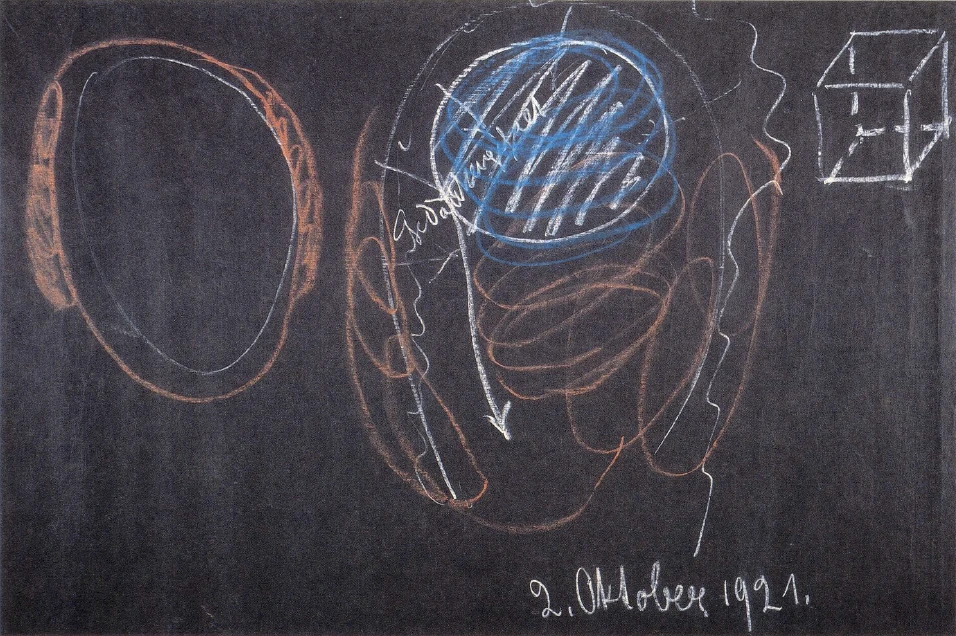
[ 4 ] So this is, in a sense, the human being as seen from one side. It is the human being as seen from the perspective of the skin, insofar as the skin is, after all, the sum of the senses. But as soon as we approach the sensory world itself today, the situation is such that, in a sense, we do not reach the senses by simply considering what the human being has been endowed with upon entering existence through birth. We must sketch this schematically by saying: If this is the thought-fabric between the etheric body and the physical body (see diagram, light-colored), then everything that constitutes the sensory life (red) incorporated into the skin wraps itself around this thought-fabric from the outside. This is thus, in a sense, formed from the cosmos and is attached to the human being. This, then, is what the human being receives, as it were, as a gift from the cosmos when, upon arriving through birth, he brings with him what is initially present in his thought fabric. And in fact, when we speak of the human being as developing through Saturn, Sun, Moon, and Earth, as I have described in my *Outline of Esoteric Science*, we find that this outer development—beginning with Saturn—is expressed primarily in the configuration of the sense organs. This then continues inward through processes into the glandular system, the nervous system, and so on; but it is from the senses that what the human being receives from the cosmos as part of their constitution emanates. But what I have depicted here as a “fabric of thought” is indeed something that belongs to the individual human being—something that is, however, separated from the etheric world when the human being enters existence through birth, yet which nonetheless belongs entirely to the individual human being; that is, it has to do with the individual earthly development of the human being. So one can say: This objective organization of thought works upon us during our embryonic life and throughout our entire subsequent life between birth and death, but it is by no means everything that the whole being of the human being brings forth from within itself.
[ 5 ] On the other hand, we have discovered what is of a volitional nature. And we can say: That which is of a volitional nature develops between the astral body and the “I.” The “I,” as it exists in a human being, is in fact entirely of a volitional nature. However, it develops in such a way that, as I have indicated, during the course of life between birth and death, the impulses of the will are initially transferred into a person’s actions, but not completely; certain elements remain behind. And what remains there of the volitional passes into the karma that is taking shape. So that when we consider the human being in terms of his physical body, we arrive at past karma in the fabric of thought; and when we consider the human being in terms of his “I”—for it is the “I” that actually lives in his actions— one must simply be fully aware that the “I” actually lives only fully in actions, actually awakens only through human action—what the “I” retains within itself, so to speak, is then carried through the gateway of death and passes into future karma, into karma-in-the-making.
[ 6 ] So there, viewed objectively, so to speak, we find what is otherwise subjectively the life of the soul within us. We find it objectified. We find it in such a way that we can view it objectively. But when we look at its relationship to the subjective, we find that on the one hand we have thought-forms, and on the other hand we have will-forms. In the middle, representing subjective experience, is feeling.
[ 7 ] One can only arrive at one’s true essence when one is clearly aware that, in fact, every feeling a person can harbor as an individual is interwoven with the entirety of human emotional life. And a person’s emotional life, in turn, can really only be understood if we conceive of it in this way: at any given moment in life, we are permeated and interwoven with the totality of our emotional life. We could also say: We are in a certain emotional mood; at every moment of our lives, we are in a certain emotional mood. Let us try—though at first, of course, each of us can only do this individually—to bring this emotional mood into our consciousness. Let us try to bring to consciousness the fact that, at any given moment of their earthly life, human beings are in a certain emotional mood. As you know, this emotional state is infinitely varied. It is such that in one person it can degenerate into what I would call excessive cheerfulness—so that one person is in an excessively cheerful mood, another suffers from depression, and a third is in a more balanced state of mind. If we wish to focus our attention solely on this emotional state at any given moment in life, we need not delve into the causes of these emotional states at all; rather, we need only take in the specific shade, the specific nuance of this emotional state: how it can reach the deepest depression in one person, remain balanced in another, and extend to cheerfulness, even to the utmost joy, in a third; how there can be a thousand different intermediate stages. In fact, this emotional state is different for every person. And now, when one investigates this emotional state through a kind of self-knowledge, one actually finds at first nothing other than subjective experience within this emotional state—subjective experience that is nuanced in all sorts of ways precisely by external experiences; but it is precisely subjective experience that one finds.
[ 8 ] If one remains within this subjective experience—that is, within the actual inner workings of the soul—without engaging in observation, that is, without allowing these things to become objective to oneself, one cannot gain any insight into the nature of, let us say, this emotional state of mind at any given moment. But even in everyday life, one can come to understand what this mood—this mood that lives entirely in feelings—actually is. To do so, however, one must possess the ability for psychological observation. One must be able to examine particularly striking personalities, perhaps, to assess their emotional content. And in doing so, you may have the following experience. Admittedly, external observation can only provide an approximation of the actual truth, but this very approximation is already extraordinarily valuable.
[ 9 ] We can, for example, set ourselves the task of studying Goethe, whom we can readily follow through his diaries, letters, and what has found its way into his most characteristic works—where, since we can trace his life biographically, sometimes from day to day, sometimes from morning to afternoon, we can clearly see, particularly in his case, what his moods are like. For example, one might set out to study, in a subtle psychological way, the state of mind that Goethe was in at a certain time—say, in 1790. One would first attempt to describe it as accurately as possible. One can do this; one can describe this state of mind as precisely as possible. And in doing so, however, one is inevitably directed in two directions—and it is extraordinarily important to pause and reflect on this—one is directed in two directions: one is directed toward Goethe’s life before 1790 and toward what Goethe experienced after 1790. And when one then, as it were, looks at all that penetrated Goethe’s soul before 1790 with a psychological eye, together with what then influenced his soul up until his death—that is, when one brings to mind both his earlier and later life— then the marvelous fact emerges that every moment of emotional state in a human being represents an interplay between what has gone before—what the person knows, what is already consciously present in their life—and what is yet to come, that is, what has not yet been given to their immediate conscious experience. Yet what is initially unknown to one’s own consciousness already lives within the general emotional atmosphere. One can already uncover this secret of a moment’s emotional mood in a biographical sense, I would say. And in doing so, one is already bordering on those realms of human contemplation that are often disregarded by people who live their lives thoughtlessly. What does the future matter to a person? After all, they do not yet know it—or so they believe. Yet in their emotional life, they do know it.
[ 10 ] And if one then goes further and examines more closely—for example, the state of mind of a person one knew well and about whom one has learned that he, let’s say, died a few years after you perceived that state of mind, then you can see quite clearly how the approaching death, with everything associated with it, had already cast its light back onto that state of mind. So that, when one delves into these things, one can truly see, first of all, the person’s past—from the life between birth and death—and the future up to death playing out in what coexists emotionally within the soul. That is why the life of the soul has something so inexplicable for the person themselves. That is why it enters into life as something elemental, because it is already tinged, as a feeling, by what we are yet to experience.
[ 11 ] This issue certainly had to be taken into account at the time I was writing my *Philosophy of Freedom*. Why, then, did I have to insist that free action can arise only from pure thought? Well, because if action is based on feeling—and the future already plays a role in it—then a truly free action could never arise from feeling! It can only arise from an impulse truly grasped in pure thought. And if you recall what I have presented over the past two days, you will be able to bring this matter even closer to your heart. I have said: Just as feeling appears to us, it is initially the case that what is actually happening within us—what is taking place in our human being—radiates back and up into our consciousness through feeling. If I were to draw a schematic diagram, I could say: In feeling, what actually flows upward into consciousness is the very experience of the feeling itself; but flowing downward is what can be experienced by the imaginative consciousness in a manner similar to dream images (see diagram on page 89)—that is, what takes place entirely within imaginations. Thus, the emotional life actually unfolds for the whole human being in such a way that what becomes conscious to us as feeling flows upward (blue), while what actually is an image—and which, when viewed through the imaginative consciousness, is indeed perceived as an image (red, inside)—flows downward and into the human organism. For ordinary consciousness, this flows down into the whole human being as something unconscious. Not in individual events, of course, for those must first come about—please understand this well—but in the overall mood of life, the result of a person’s future experiences lives within them, as it were, in a kind of underlying tone. Not as if the images of what is happening were alive there; but the impressions of it—those are what live in the images.
[ 12 ] So you shouldn’t imagine these images streaming down as something like a cinematic depiction of the future, but rather as the result of impressions. Only in certain people who possess atavistic clairvoyant abilities can these images—which then translate into images of certain facts—come to light, and then a certain glimpse into the near future can indeed take place. But what should interest us most today is that what plays out as a person’s emotional world is first sent down into them in pictorial form.
[ 13 ] As we now move from feeling to will, what enters the human being here—as I have described it to you—pushes outward and becomes his karma-in-the-making, his future karma (red, outside). Thus, what arises in a person through their feelings is, in a sense, connected to their karma up until their death; but what arises from the will is connected to their karma beyond death.
[ 14 ] It is therefore entirely possible to follow and study all these things in detail. As we continue to advance in the development of anthroposophical spiritual science, we do not speak in a schematic way about mere concepts, but rather about the concrete realities that live within the human being—realities that, when brought into consciousness, first provide the human being with insight into what he actually is. But you must develop a strong sense of how the will, which is rooted in the life of feeling, actually works into the future, beyond death, and how the will is the creator of future karma.
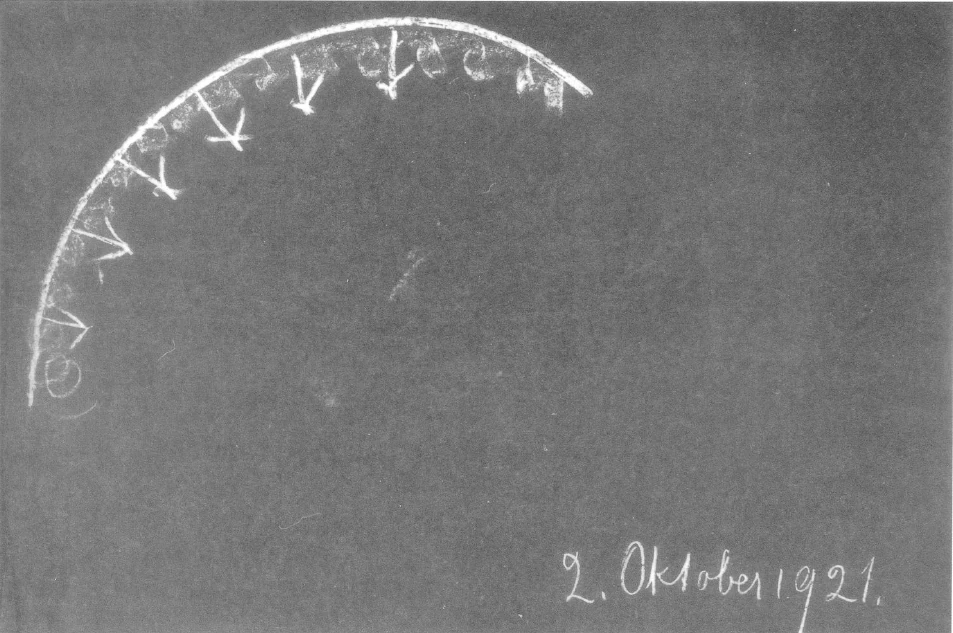
[ 15 ] If we turn our attention once more to the other side—to that web of thought that we have discovered and that truly exists between the etheric body and the physical body in human beings—then we must be clear that, as we experience something of the world through sensory impressions—and thus form a sensory worldview— we then process these sensory impressions mentally, and as we process them mentally, we are actually weaving our subjectivity into this fabric of thought. We connect what we experience in our soul as a result of sensory impressions, on the one hand, with what is incorporated into us as a web of thought from the moment of birth; but the one—the objective web of thought—remains unconscious, and only what we weave into it, what we, so to speak, push into it from our inner thought activity, comes into our consciousness. It is indeed as if the fabric of thought were there, and the subjective thoughts strike it—strike into this fabric of thought—and this fabric of thought then reflects back our subjective thoughts, though it does so by giving them all sorts of directions, thereby bringing our subjective thoughts to consciousness (see drawing on page 93). I say, by giving them all sorts of directions.
[ 16 ] You see, when we perceive, say, any external object—I want to describe the process to you in great detail—for example, a cube, a crystal cube: we see it first. We don’t stop at simply seeing it. We think about it. But this thought extends into the fabric of thought, and this fabric of thought—which is integrated into us from birth, which we thus acquired while we were in the cosmos, and which we indeed received through the cosmos—is such that we now begin, based on certain premises, to form crystallographic ideas that we generate from within. For example, as we form thoughts of the tesseral system, the tetragonal system, the rhombic system, the monoclinic system, the triclinic system, and the hexagonal system—that is, as we conceive of crystal systems in a mathematical-geometric way—we find that we can conceive of these crystal systems. This cube fits into the tesseral system that we have formed within ourselves. By incorporating something like the concept of the cube into what are, so to speak, a priori concepts that we draw from within ourselves, we are, at that very moment when subjective thoughts arise, directed toward the realm of objective thought. For what we develop as geometry, as purely geometric-mechanical physics, and so on, we draw from this fabric of thought that is ingrained in us from birth; and the individual, unique elements which we incorporate into these thoughts—the thoughts we develop through external sensory perceptions and impressions—are the very ones we clarify for ourselves by allowing them to be reflected back to us, but by interweaving them with the formative fabric of thought that lives, so to speak, eternally within us—eternal in process, at least, if not in its individual forms, for these change from incarnation to incarnation.
[ 17 ] We live, then, by thinking and by integrating the conceptual into our inner life of thought in such a way that we understand it; we live in such a way that we also draw upon what is contained within this web of thought for our subjective thinking.
[ 18 ] Well, what I have just said is something that is constantly happening within a person, something that is constantly unfolding within a person. But at the same time, you will see: On the one hand, by beginning with feeling, we take into account what enters the organism from feeling and passes into the will. That which, from the will, becomes—in a sense—karmic potential that remains at rest within the “I,” all of that leads us toward the future of humanity. When we look to the opposite side, toward the fabric of thought—toward which our subjective thoughts also flow—that certainly carries us into the current leading toward humanity’s past. Therefore, it is along this path that our past, our completed karma, is also to be sought. In feeling, the past and the future truly meet within the human being in the most eminent sense. The human being is thus, in a sense, born out of thought. He lives his life through feeling and weaves into his will that which passes with him through the gate of death.
[ 19 ] When we utter these words, we are actually pointing to what we subjectively experience in our inner life during the time between birth and death. But we can go even further. We can consider the following. We can ask ourselves: What is it actually like when these subjective thoughts, which we link to external impressions, merge with that which is most certainly only the past, just as I have just described? You see, the subjective thought first becomes conscious to us as a thought. As a thought, it has a certain content of representation. We think of a content when we think about the cube. But you will certainly come to realize what I already hinted at the day before yesterday: In our inner life, we cannot simply separate thinking, feeling, and willing.
[ 20 ] All the motives behind our moral thoughts reside in our will. But even in thinking—in subjective thinking—we are aware that we do not merely have the content of a thought. We link one thought to another, and we are aware of the activity that links one thought to the next. What, then, is alive in thinking? Well, the will itself is already alive in a subtle way in thinking—namely, in subjective thinking. We must therefore be clear about this: as we think, on the one hand the content of thought is alive, and on the other hand the activity of the will is alive within thinking. Now, when the thoughts collide here (see drawing)—they are, of course, reflected back to us as thoughts, but within the thoughts, within these subjective thoughts that we project into them, so to speak, and which collide with the fabric of thought—will also lives there. We actually have no use for this will in ordinary consciousness. Just consider: if this activity, which I have indicated to you here, were to be expressed quite clearly in memory—in memory, the will must already have faded! It must still be active; but once the memory is complete, once the remembered thought is there—the memory would not be pure; it would not clearly represent what it is supposed to represent as a past experience if it were permeated by the will! Of course, when you recall what you ate yesterday, you can no longer change the soup; the will is already out of the picture, isn’t it? The pure content of thought must come to light. The will must therefore be set aside during reflection. Where does it go, then?
[ 21 ] Well, when I draw the same diagram (p. 89)—when I have the fabric of thought here and it is reflected there—the content of thought simply enters consciousness. The volitional content of the thoughts descends and unites with the other volitional and emotional content, becoming part of the karma in the making—that is, it becomes a component of the karma in the making (see diagram on page 94, light hatching; dark-hatched downward arrow).
[ 22 ] On the other hand: Our impulses of will are, after all, like a sleeping part of us even while we are awake. We do not look down into those regions where the will actually resides. First, we have the thought of the impulse of will. This then, in a sense, transitions unconsciously into volition, and only when volition manifests outwardly do we again observe what happens through us—that which we experience in ordinary consciousness when we will. When we act, we actually experience everything in our imaginative life, dream about it in our emotional life, but remain asleep to it in relation to the actual life of the will.
[ 23 ] But these are precisely the thoughts that we direct into this life of the will. But when exactly? Only when we do not give in to our instincts, our drives—in other words, when we do not merely surrender to what is called “lower human nature,” for that is already down there, driving us to will and to act. But then we bring our will into that which constitutes our subjective experience when we govern it with our pure thoughts, which are directed toward willing—that is, when we govern it with our intuitively grasped moral ideals. We can send these intuitively grasped moral ideals along with the thinking will on its way down into the realm of the will. As a result, our will is permeated by our morality, and within the human being there is therefore a constant struggle between what the person sends down from their moral intuitions into the region of the will, and what stirs and seethes down there in their instinctive, dreamlike life. This is everything that goes on within the human being. But what is taking place down there within a person is, at the same time, the very process in which their human future beyond death is being prepared. It surges up into the realm of feeling. This future actually lives within the will. It surges up into the realm of feeling, and more is woven into feeling than just what I described earlier as the emotional mood that has significance for life between birth and death. In the ordinary emotional state I have described—which ranges from the deepest depression to complete exuberance, to excessive joy—all that in which a person’s future and past interact in the life between birth and death can play out. But even that which extends beyond death penetrates into what rises up from below. And what lives there? Something lives there—and because it rises from regions where consciousness no longer participates, we perceive it as something objective. It is indeed something objective, for it has to do with the laws by which we, as moral human beings, carry ourselves through death. What radiates back from there is then the conscience. And viewed psychologically, this is the true origin of conscience. If psychological science were truly to grapple with these matters, it would now have to examine the details of the life of the soul in light of these guidelines, and it would find confirmation everywhere—down to the minutest details of the life of the soul—of what is provided as such guidelines by anthroposophical spiritual science.
[ 24 ] So we see: Our feelings flow toward our thoughts. At first, they flow toward and enliven our subjective thoughts; but in a sense, they also reach out toward the objective network of thoughts, and within this network we experience ourselves as given—as a being who, through birth, has come to live within earthly existence. On the other hand, we can experience ourselves as the being that passes through death. One need only truly study the human inner life to arrive at what is already revealing itself within it as such—that it points beyond the human being, that is, beyond birth and death, and thus points toward that world which is not confined within the realm of the sensible. For this world, which is not confined within the realm of the sensible, provides us, first and foremost, with what is actually present within us. In particular, it would be of great importance for a genuine psychology—for what is considered psychology today is, after all, merely a collection of formalisms—to examine the human state of mind at a moment when past and future flow into one another. Through this, one would discover much that is mysterious in human life, and one would become convinced that an objection that seems extraordinarily obvious does not, in fact, hold true. The objection that seems so obvious is this: Yes, what would actually become of a person if they were to see through themselves in this way—if, so to speak, they were to constantly look into their inner being to examine their subjective state of mind in relation to what, so to speak, lies in their future? —This objection seems obvious, but it is merely the objection raised by the imagination. One imagines that the very way the future appears is exactly as it will then be experienced in perception and in experience. But that is not how the future is represented—as it will then be experienced! It is experienced in interaction with the external world, in collision with the external world. What goes on internally is that which manifests itself within a person as a radiating force, and this is something that, no matter how well a person knows it, cannot in any way lead them astray on their life’s path. In general, objections to the knowledge of human nature arise from a fear that is rooted entirely in illusions one creates for oneself—precisely because one judges solely on the basis of the life of ordinary consciousness, and because one does not wish to rise to the realization that, as soon as consciousness ascends to higher regions, it experiences something entirely new.
[ 25 ] But yesterday I showed you how, when a person passes through the gate of death, they develop with two longings—one arising from the life of thought and the other from the life of will: how the life of thought longs for worldhood, and the life of will, as it passes through death, longs for humanity; how this continues until what I have called the midnight hour of existence; how a rhythmic reversal then takes place: how the mental begins to yearn for the human, and the volitional begins to yearn for pouring out into the cosmos, so that the volitional then lives on in the inherited characteristics. The intellectual, however, lives in the individual who integrates into the new earthly life. The volitional, so to speak, surrounds us in what we have inherited from our ancestors—viewed from the outside: in our inherited traits and substances. The intellectual is what integrates itself into us, and throughout our lives we reconnect everything we draw up from the depths of our emotional and volitional lives with this intellectual life. At first, the life of thought is integrated into us as something that is not initially warm and alive like our inner life in general. If we were to remain with the life of thought as we are born, we would, in a sense, become thought machines full of inner coldness. But at the moment of birth, the individual inner self begins to stir from the will and the soul, infusing with warmth and life that which has initially grown cold on the journey from death to birth; and through this, we as human beings have the very possibility of imbuing with individual warmth that which, from the vast universe, must constitute us in coldness.
[ 26 ] This is how the human being is integrated into the spatial realm and into the unfolding of the world. This is how he stands within it. These things are completely obscured by contemporary scientific thinking. Contemporary scientific thinking does not seek to attain a true understanding of the human being. Consequently, human beings today experience themselves—and will experience themselves more and more in this way—in such a way that, while they recognize many things in their environment, they are unable to recognize their own true nature. Through contemporary academic and other forms of education, human beings today immerse themselves in the world to such an extent that, fundamentally, they grasp nothing of their own nature. And this will increase more and more. And if what is, in a sense, directly imposed on human beings through one-sided scientific knowledge could be fully realized, human beings would become completely alienated from themselves. Their inner individuality would seek to rise up, would seek to melt, through its warmth, the masses of ice that we have carried into earthly existence through birth. Human beings would perish spiritually in this process, which overwhelms them inwardly—a process that occurs even when they do not recognize it, but which, in the long run, they can endure only by recognizing it. All signs of the times point to the fact that human beings must truly arrive at the kind of self-knowledge characterized here. And it is simply the task of contemporary spiritual life, as it moves toward the near future, to truly incorporate these aspects of cultural development.
[ 27 ] But education to date has directed vast amounts of fear and vast amounts of antipathy against the assertion of what is so necessary for humanity if it does not wish to sink into ruin but rather to achieve a new dawn.