Anthroposophy as Cosmosophy I
GA 208
4 November 1921, Dornach
Translate the original German text into any language:
Versions Available:
Anthroposophy as Cosmosophy II, tr. SOL
Achtzehnter Vortrag
Eighteenth Lecture
[ 1 ] Wir haben den Menschen betrachtet in seinem Verhältnisse zum Kosmos in bezug auf die Form der menschlichen Organisation, in bezug auf die Lebensstufen, in bezug auf die Seeleninhalte, und wir wollen heute noch, um gewissermaßen ein anderes Kapitel für die beiden nächsten Tage vorzubereiten, auch die Geisteserlebnisse des Menschen ins Auge fassen.
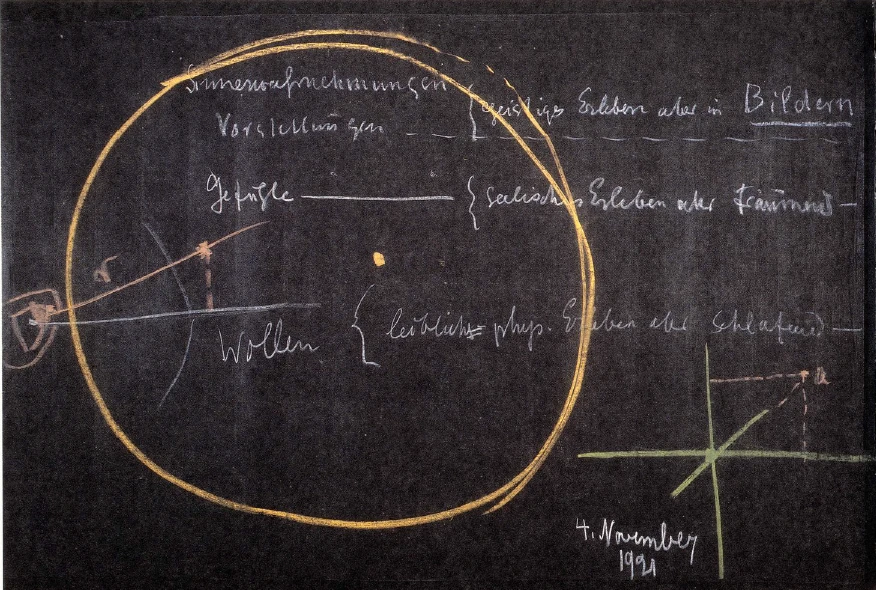
[ 1 ] We have considered human beings in their relationship to the cosmos—in terms of the form of human organization, the stages of life, and the contents of the soul—and today, in order to prepare, so to speak, for another chapter over the next two days, we also want to consider human spiritual experiences.
[ 2 ] Erinnern wir uns, wie wir darangegangen sind, den Menschen in bezug auf die Formung seines Organismus zu betrachten. Wir mußten ja die menschliche Organisation in ein Verhältnis bringen zum Kosmos bis an den Fixsternhimmel. Wir mußten dann, um die menschlichen Lebensstufen ins Auge zu fassen, das planetarische System, in dem der Mensch lebt, vor unsere Seele hinstellen. Und indem wir dann übergingen zu den Seelenerscheinungen, mußten wir gewissermaßen eine Schwenkung machen und den Menschen als seelisches Wesen in ein Verhältnis bringen zu seiner leiblichen Organisation, das heißt zu demjenigen, was er eben durch den Fixsternhimmel und durch das Planetensystem hat. Und wir haben ja durch die Formbetrachtung, durch die Lebensbetrachtung auch jene Gegensätzlichkeit vor unsere Seele hingestellt, welche in der Kopfesorganisation, in der Brustorganisation, in der Stoffwechsel-Gliedmaßenorganisation im Menschen vorhanden ist. Wir haben gesehen, wie das Seelische als Sinneswahrnehmung und Vorstellung gerade durch die Hauptesorganisation sich auslebt, durch die Sinnes-Nervenorganisation, und wir haben dann gesehen, wie das Gefühlsleben durch die Atmungs- und Zirkulationsorganisation zum Ausdrucke kommt, das Willensleben durch das Stoff‚ wechsel-Gliedmaßensystem. Wir mußten aber, um das Seelische zu betrachten, darauf Rücksicht nehmen, wie im Menschen das Ich, der astralische Leib, der Ätherleib und der physische Leib zusammenwirken.
[ 2 ] Let us recall how we set out to consider the human being in terms of the formation of his or her organism. After all, we had to relate the human organism to the cosmos, all the way up to the fixed stars. Then, in order to grasp the stages of human life, we had to place before our minds the planetary system in which human beings live. And as we then turned to the manifestations of the soul, we had to, so to speak, shift our focus and relate the human being, as a soul being, to his physical organization—that is, to what he derives precisely from the fixed-star sky and the planetary system. And through our consideration of form and of life, we have also placed before our soul that contrast which exists in the human head organization, the chest organization, and the metabolic-limb organization. We have seen how the soul, in the form of sensory perception and imagination, expresses itself precisely through the head organization—through the sensory-nervous system—and we have then seen how the life of feeling finds expression through the respiratory and circulatory systems, and the life of will through the metabolic-limb system. However, in order to consider the soul, we had to take into account how the ego, the astral body, the etheric body, and the physical body interact within the human being.
[ 3 ] So daß wir wirklich das letzte Mal einen Überblick bekommen haben von dem Ineinanderweben des Seelischen und des Leiblichen bis in die Drüsentätigkeit, bis in die Inanspruchnahme der Muskeltätigkeit durch den Willen.
[ 3 ] So that we have truly gained an overview—for the last time—of the interweaving of the psychological and the physical, extending all the way to glandular activity and the will’s control of muscular activity.
[ 4 ] Wenn man nun zum Geistigen im Menschen kommen will, so kann man nicht bloß den Menschen so betrachten, wie das letzte Mal für das Seelische, wo wir Rücksicht zu nehmen hatten auf das Ausleben, auf die Offenbarung dieses Seelischen im Leiblichen, sondern man muß, wenn man das Geistige ins Auge fassen will, auf die Wechselzustände des Menschen sehen, auf das Wachen und Schlafen.
[ 4 ] If one wishes to approach the spiritual aspect of the human being, one cannot simply view the human being as we did last time when discussing the soul—where we had to take into account the expression and manifestation of the soul in the physical body—but rather, if one wishes to consider the spiritual, one must look at the alternating states of the human being: waking and sleeping.
[ 5 ] Wachen und Schlafen, wir wissen es ja, sind uns zunächst als Menschen gegeben in dem Hinundherschwingen des menschlichen Lebens innerhalb von vierundzwanzig Stunden im Tageswachen und eben im Nachtschlafe. Das ist die eine Art, wie der Mensch lebt im Wachen und Schlafen. Wir wissen aber auch, daß der Mensch noch auf andere Art im Wachen und Schlafen vorhanden ist. Wenn der Mensch nämlich vorstellt und sich den Sinneswahrnehmungen hingibt, dann nur ist er ja eigentlich voll wach. Nur das Vorstellungs- und Sinneswahrnehmungsleben ist eigentlich das Wachsein. Dagegen ist das Willensleben und das Tatleben eigentlich ein Schlafensleben auch während des Wachens.
[ 5 ] Waking and sleeping, as we know, are initially given to us as human beings in the ebb and flow of human life within a twenty-four-hour cycle—in waking during the day and sleeping at night. This is one way in which human beings live through waking and sleeping. But we also know that human beings exist in other ways while awake and asleep. For when a person engages in imagination and surrenders to sensory perceptions, only then is he or she truly fully awake. Only the life of imagination and sensory perception is, in fact, wakefulness. In contrast, the life of the will and the life of action is, in fact, a life of sleep, even while awake.
[ 6 ] Das Gefühlsleben ist, wie wir wissen, ein Traumesleben auch während des Wachens. So daß also der Mensch auch in dieser Beziehung sein Leben gewissermaßen hin- und herschwingen läßt zwischen Wachen und Schlafen. Das Schlafen, ich möchte sagen, das wachende Schlafen spielt gewissermaßen in unser wirkliches Wachen, das heißt in das Vorstellungsleben herein, wenn wir einen Willensakt ausdrücken, wenn wir tätig sind, wach sind im Tätigsein dadurch, daß wir unsere eigene Tätigkeit vorstellen können. Was aber in dieser Tätigkeit vor sich geht, das bleibt so unbewußt wie die Zustände während des Schlafes.
[ 6 ] As we know, our emotional life is a dreamlike existence even while we are awake. Thus, in this respect as well, human beings allow their lives to oscillate, as it were, back and forth between waking and sleeping. Sleep—or, I would say, “waking sleep”—plays a role, so to speak, in our actual waking state, that is, in our life of imagination, when we express an act of will, when we are active, and are awake in our activity through our ability to imagine our own actions. But what takes place within this activity remains as unconscious as the states experienced during sleep.
[ 7 ] Aber daß der Mensch sich als ein individuelles Wesen fühlt, das verdankt er doch eigentlich dem Schlafe. Wenn der Mensch nur wachend dem Vorstellungsleben hingegeben wäre, so würde er die Welt gewissermaßen nur wie einen Ablauf von Bildern erleben. Er würde sich gewissermaßen ruhend fühlen, wie in einem Punkte des Weltenalls verharrend, und in Bildern würde das Weltenall vorhanden sein. Im Bildweben würde auch das Ich wie eine Art von Spiegelbild von etwas, aber doch eben nur wie ein Bild vorhanden sein. Nur dadurch, daß wir in dieses wache Vorstellungsleben gewissermaßen hineingießen erstens das fortwährende Erinnern daran, daß wir eigentlich Zustände haben, in denen wir nichts erleben, Schlafzustände, die Zeit vom Einschlafen bis zum Aufwachen, das führt uns auf uns selbst zurück. Und auch die unbestimmte Besinnung darauf, was wir wollen, also daß etwas Schlafartiges in unser bewußtes Dasein hineinspielt, das gibt uns unser Ich-Gefühl, unseren Ich-Impuls. Wir erleben ihn im gewöhnlichen Leben nicht vollbewußt, wir erleben ihn gewissermaßen als den aus unserer Organisation kommenden Stoß in das Bewußtsein hinein, diesen Ich-Impuls. Und wir erleben ihn auf der anderen Seite dadurch, daß wir vom Einschlafen bis zum Aufwachen eben mit unserem Ich, das aber sonst ja nicht in das gewöhnliche Bewußtsein hereintritt und mit unserem astralischen Leibe, der ebensowenig in das gewöhnliche Bewußtsein hereintritt, daß wir mit diesen uns in den Kosmos hinausbegeben und daß das gewissermaßen in unser Bewußtsein hereinschlägt, was wir als Verdunkelung dieses Bewußtseins erleben vom Einschlafen bis zum Aufwachen.
[ 7 ] But the fact that a person feels like an individual being is actually due to sleep. If a person were devoted solely to the life of the imagination while awake, he would, in a sense, experience the world only as a succession of images. He would feel, as it were, at rest, as if suspended at a single point in the universe, and the universe would be present to him in images. In this web of images, the “I” would also exist as a kind of mirror image of something—but still only as an image. It is only by infusing this waking life of imagination, so to speak, first with the constant reminder that we actually have states in which we experience nothing—states of sleep, the time from falling asleep to waking up—that we are led back to ourselves. And also the vague reflection on what we want—that is, the fact that something sleep-like plays into our conscious existence—gives us our sense of self, our “I” impulse. We do not experience it fully consciously in ordinary life; we experience it, so to speak, as a surge into consciousness arising from our inner organization—this “I” impulse. And we experience it, on the other hand, through the fact that from the moment we fall asleep until we wake up, we venture out into the cosmos with our “I”—which otherwise does not enter ordinary consciousness—and with our astral body, which likewise does not enter ordinary consciousness—that we venture out into the cosmos with these, and that what we experience as a darkening of this consciousness from the moment we fall asleep until we wake up, so to speak, strikes into our consciousness.
[ 8 ] Was ist es denn, was uns immer wiederum in den Schlaf versetzt, was unser Wollen und einen großen Teil unseres Fühlens in Unbewußtheit, gewissermaßen in die Nacht des Bewußtseins hinunterdrückt? Das ist es, daß wir im Wollen organische Tätigkeit entwickeln müssen. Wir haben ja das letzte Mal gesehen, wie der Mensch im Wollen sein Seelisches hineinwirken läßt bis in das Muskelleben. Es taucht gewissermaßen die Seele in das Muskelleben unter. Da wird sie unbewußt, geradeso wie sie unbewußt wird, wenn sie aus dem Leibe herausgeht und in dem Zustand zwischen dem Einschlafen und dem Aufwachen verharrt. Wir können also sagen: Es kommt von den Bedürfnissen, von den Bedingungen des Leiblichen, daß wir uns zunächst im gewöhnlichen Leben unseres Ich bewußt sind, es kommt davon, daß wir einen Leib an uns tragen, der, wenn Wollen ausgeführt werden soll, die Seele für sich in Anspruch nimmt, der, wenn er die Kräfte, die er im Wollen entwickelt, ausgleichen will, die Seele in die Unbewußtheit des Schlafes hinunterjagt, um eben immer voll das Bewußtsein des eigentlich unbewußt vorhandenen Ich vermitteln zu können. So also können wir sagen: Wir tauchen in das Leiblich-Physische unter, indem wir in dieses Leiblich-Physische hineingießen unseren Geist beziehungsweise zunächst unser Seelisches. Aber wir werden gleich sehen, daß wir mit diesem Seelischen eben unseren Geist in das Physisch-Leibliche hineinergießen. Da fühlen wir uns, möchte ich sagen, robust, wenn die Seele in den Leib hinuntergegossen ist. Wir fühlen uns nicht robust, aber wach, wenn wir Vorstellungen und Sinneswahrnehmungen haben.
[ 8 ] What is it, then, that lulls us back to sleep time and again, that pushes our will and a large part of our feelings into unconsciousness—into, so to speak, the night of consciousness? It is this: that we must develop organic activity in our will. We saw last time how, in our willing, human beings allow their soul life to work its way down into muscular life. The soul, so to speak, plunges into muscular life. There it becomes unconscious, just as it becomes unconscious when it leaves the body and remains in the state between falling asleep and waking up. We can therefore say: It stems from our needs, from the conditions of the physical body, that we are initially conscious of our “I” in ordinary life; it stems from the fact that we carry a body within us which, when a will act is to be carried out, claims the soul for itself; and which, when it seeks to balance the forces it develops in the act of willing, drives the soul down into the unconsciousness of sleep—precisely so that it can always fully convey the consciousness of the “I” that actually exists unconsciously. So we can say: We immerse ourselves in the physical-bodily realm by pouring our spirit—or, initially, our soul—into this physical-bodily realm. But we will soon see that with this soul we are in fact pouring our spirit into the physical-bodily realm. There, I would say, we feel robust when the soul has been poured down into the body. We do not feel robust, but rather alert, when we have ideas and sensory perceptions.
[ 9 ] Vorstellungen haben und Sinneswahrnehmungen haben, heißt nun aber, nicht im Leibe leben. Es ist durchaus ein Verkennen, wenn man glaubt, erst das imaginative, das inspirierte und das intuitive Erkennen führen den Menschen in die geistige Welt hinein. Nein, der Mensch lebt schon in der geistigen Welt, wenn er Sinneswahrnehmungen hat und wenn er Vorstellungen bildet. Denn wir haben ja gesehen, daß die Sinneswahrnehmungen daran geknüpft sind, daß überhaupt schon tote Materie, rein physische Apparate in unseren Organismus eingelagert sind, die nur vom Ätherleib durchzogen werden; aber sie sind eingelagert. Und indem wir in diesem physischen Apparat erleben, erleben wir die Sinneswahrnehmung. Der physische Apparat wird nicht erlebt; das Geistige, das darinnen vorgeht, wird erlebt. Seinem Wesen nach ist der Inhalt der Sinneswahrnehmung durchaus geistig. Nur, wie wir das letzte Mal gesehen haben, breiten wir im Vorstellen gewissermaßen die Sinnestätigkeit über die Nervenorganisation aus. Die Nerventätigkeit besteht eigentlich in einem Absterben. Es muß die organische Tätigkeit gerade ausgeschaltet werden, wenn wir vorstellen wollen. Daher leben wir, indem wir Sinneswahrnehmungen haben und Vorstellungen haben, durchaus im Geistigen. Aber wir leben als Menschen, die da leben zwischen Geburt und Tod, dieses Leben im Geistigen dadurch, daß wir von ihm, von diesem Leben, nur Bilder haben. Das ist das Eigentümliche, daß uns das Geistige zunächst in den Sinneswahrnehmungen und in den Vorstellungen bewußt wird, aber nur in Bildern. So daß wir sagen können (siehe Darstellung Seite 127): Sinneswahrnehmungen, Vorstellungen sind geistiges Erleben, aber in Bildern. Bei den Vorstellungen sind wir uns ja bewußt, sie tragen als solche einen abstrakten Charakter, sie sind nicht intensiv gesättigte Bilder. Es wird grau, möchte man sagen, wenn man von den Sinneswahrnehmungen zum Vorstellungsleben zurückgeht. Aber nur für unser Bewußtsein wird es grau. In Wirklichkeit enthalten alle Vorstellungen, die der Mensch entwickelt, Imaginationen.
[ 9 ] To have mental images and sensory perceptions, however, does not mean to live in the physical body. It is a complete misunderstanding to believe that only imaginative, inspired, and intuitive cognition lead a person into the spiritual world. No, a person already lives in the spiritual world when they have sensory perceptions and when they form ideas. For we have seen that sensory perceptions are linked to the fact that dead matter—purely physical apparatus—is already embedded in our organism, permeated only by the etheric body; but it is embedded. And as we experience life within this physical apparatus, we experience sensory perception. The physical apparatus itself is not experienced; what is experienced is the spiritual activity taking place within it. In its very nature, the content of sensory perception is entirely spiritual. However, as we saw last time, in the process of imagination we, so to speak, extend sensory activity across the nervous system. Nervous activity actually consists of a dying off. Organic activity must be precisely suspended if we are to form mental images. Therefore, by having sensory perceptions and mental images, we live entirely in the spiritual realm. But we, as human beings living between birth and death, live this life in the spiritual realm only insofar as we have images of it—of this life. This is what is peculiar about it: the spiritual world first becomes conscious to us through sensory perceptions and ideas, but only in images. So that we can say (see description on page 127): Sensory perceptions and ideas are spiritual experiences, but in images. In the case of ideas, we are, of course, aware that they have an abstract character as such; they are not intensely saturated images. One might say that things turn gray when we move from sensory perceptions back to the life of ideas. But it is only for our consciousness that things turn gray. In reality, all the ideas that human beings develop contain imaginations.
[ 10 ] So daß ich sagen kann: Die Vorstellungen, sie enthalten durchaus Imaginationen, nur kommen diese Imaginationen nicht zum Bewußtsein. Es ist gewissermaßen eine Art von Auszug aus diesen Imaginationen, die man im gewöhnlichen Leben als Vorstellungen hat. Das Imaginieren geht nach rückwärts in das Leibliche hinein, und das, was uns zum Bewußtsein kommt, ist das zurückgeworfene blasse Bild der Vorstellungen. Jedesmal, wenn Sie eine Vorstellung haben, und immerwährend, wenn Sie Vorstellungen haben, so haben Sie auch Imaginationen. Nur daß die Vorstellungen im Bewußtsein bleiben; die Imaginationen schlüpfen Ihnen hinunter und leben in der allgemeinen Vitalität Ihres Organismus, in der allgemeinen Lebenstätigkeit. Also die Imaginationen schlüpfen in die Vitalität, in die allgemeine Lebenstätigkeit hinein. Wenn ich das schematisch zeichnen sollte (siehe Zeichnung), so müßte ich so zeichnen (Kopf): Wir haben die Sinneswahrnehmung (rot), haben dann die Vorstellungstätigkeit, die wir uns bilden (blau, grün) aus der Sinneswahrnehmung und die eigentlich ein Janusgesicht hat. Nach vorn ist sie eben die blasse Vorstellung, die kommt in unser Bewußtsein; nach rückwärts ist sie Imagination, aber die Imagination kommt nicht ins Bewußtsein. Die Imagination geht in dem Organismus unter und bildet da die allgemeine Lebenstätigkeit. Sie geht in alle Organe hinein, diese Imagination, sie lebt im Gehirn, sie lebt im Herzen, sie lebt in der Lunge, sie lebt in den Nieren, sie lebt überall, sie geht in alle Organe hinein, diese Imagination. Sie vereinigt sich mit der allgemeinen Lebenskraft.
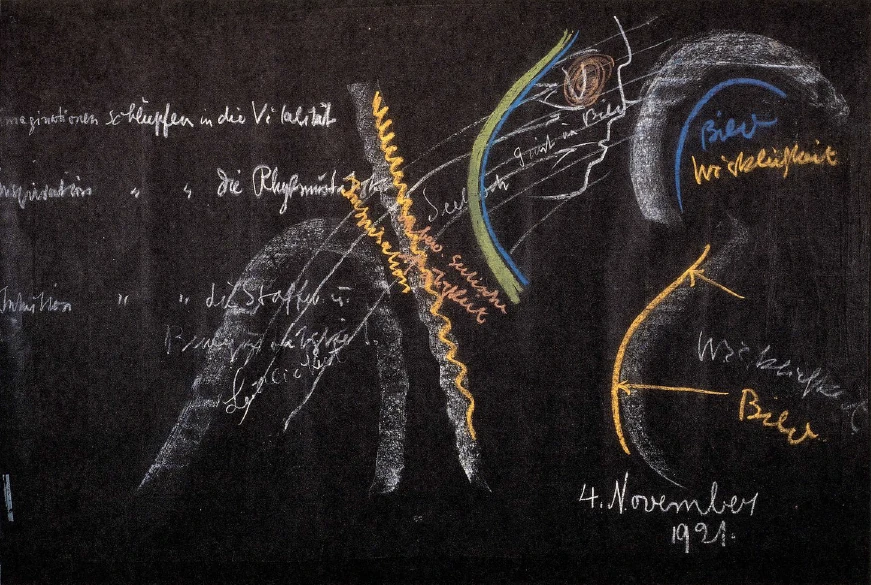
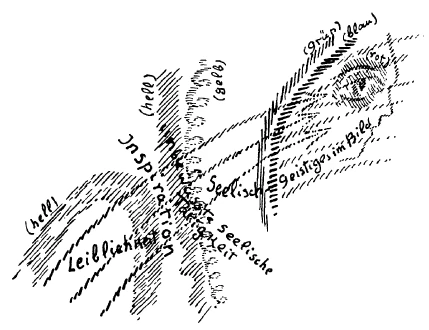
[ 10 ] So that I can say: These ideas certainly contain imaginations, but these imaginations do not enter into consciousness. In a sense, what we experience as concepts in everyday life is a kind of distillation of these imaginations. The act of imagining extends backward into the physical realm, and what comes to our consciousness is the pale, reflected image of the concepts. Every time you have a concept—and indeed, whenever you have concepts—you also have imaginations. The difference is that mental images remain in consciousness; imaginations slip down into you and live within the general vitality of your organism, within the general life activity. So imaginations slip into vitality, into the general life activity. If I were to draw this schematically (see drawing), I would have to draw it like this (head): We have sensory perception (red), then we have the process of formation of concepts, which we construct (blue, green) from sensory perception and which actually has a Janus-like nature. Facing forward, it is the pale concept that enters our consciousness; facing backward, it is imagination, but imagination does not enter consciousness. Imagination merges into the organism and forms the general life activity there. It enters all the organs—this imagination; it lives in the brain, it lives in the heart, it lives in the lungs, it lives in the kidneys, it lives everywhere; it enters all the organs, this imagination. It unites with the general life force.
[ 11 ] Dadurch tritt dieses Eigentümliche ein: Wir haben hier, soweit ich rot, blau gezeichnet habe, den Geist im Bild. Wir haben nichts im Bewußtsein von dem, was da hinunterragt in die Leiblichkeit, aber wir erleben es als seelisch. Der Geist ist also gewissermaßen nach vorn Geist; nach rückwärts, nach dem Organismus hinein (grün) ist er Seele. Aber im Seelischen beginnt er gleich unterzutauchen in das Halbbewußte und Unbewußte und vereinigt sich mit dem Leiblichen.
[ 11 ] This gives rise to something peculiar: Here, in the areas I have marked in red and blue, we have the spirit depicted in the image. We have no conscious awareness of what extends down into the physical realm, yet we experience it as spiritual. The spirit is thus, in a sense, spirit when directed forward; when directed backward, into the organism (green), it is soul. But within the soul, it immediately begins to submerge into the semi-conscious and unconscious and unites with the physical.
[ 12 ] Unterhalb dessen, was wir hier (siehe Zeichnung) haben, haben wir die unbewußte seelische Tätigkeit. Dahinein verschwindet also die Imagination. Und dann haben wir von der anderen Seite die Leiblichkeit. Aber diese Leiblichkeit ist in die Nacht des Bewußtseins, in den Schlaf hineingetaucht und äußert sich nur, indem sie den Willen heraufschickt bis in das Bewußtsein. Dieser Wille ist eben der Gegenstoß; der macht uns robust, der gibt uns Erleben der Wirklichkeit. Aber dieses Erleben der Wirklichkeit stößt höchstens noch als Gefühl herauf. Da träumen wir von dieser Wirklichkeit; aber im wesentlichen haben wir diese Wirklichkeit nicht im wachen Bewußtsein. So daß wir als Menschen zwischen Geburt und Tod unser Sein im Geistigen dadurch erkaufen, daß wir den Geist im Bilde erleben, im Bilde der Sinneswahrnehmungen, im Bilde der Vorstellungen; daß wir die Wirklichkeit zwar erleben, daß sie aber unbewußt hereinspielt in unser Bewußtsein, wie auch die äußere Wirklichkeit unbewußt hereinspielt.
[ 12 ] Below what we have here (see diagram), we have unconscious mental activity. Imagination thus disappears into this. And then, on the other side, we have physicality. But this physicality is immersed in the night of consciousness, in sleep, and expresses itself only by sending the will up into consciousness. This will is precisely the counterforce; it makes us resilient; it gives us an experience of reality. But this experience of reality surfaces, at most, only as a feeling. We dream of this reality; but essentially, we do not have this reality in our waking consciousness. Thus, as human beings between birth and death, we “purchase” our existence in the spiritual realm by experiencing the spirit through images—through the images of sensory perceptions and through the images of ideas; we do experience reality, but it flows unconsciously into our consciousness, just as external reality also flows in unconsciously.
[ 13 ] Wir tauchen unter in diese äußere Wirklichkeit, aber sie spielt im Grunde genommen — weil wir von den Schlafzuständen, wo wir draußen sind in der äußeren Wirklichkeit, nichts wissen —, sie spielt auch unbewußt herein. Wir werden gewissermaßen von dem Unbewußten umsponnen, von dem Unbewußten durchdrungen. Da leben wir in der Wirklichkeit. Aber wir leben im Leiblichen oder im Äußerlich-Physischen. Indem wir im Geistigen leben, erleben wir den Geist nur als Bild.
[ 13 ] We immerse ourselves in this external reality, but it actually—because we know nothing of the states of sleep in which we are out there in external reality—it also plays a role unconsciously. We are, so to speak, enveloped by the unconscious, permeated by the unconscious. That is where we live in reality. But we live in the bodily or in the outer-physical realm. When we live in the spiritual realm, we experience the spirit only as an image.
[ 14 ] Aber alles Leibliche ist vom Geistigen aufgebaut. Und wenn der Mensch nun seine Imagination ausbildet, so erlebt er schon das imaginative Leben, das da zurückliegt. Er erlebt auch weiter im Seelischen zurückliegend das, was im gewöhnlichen Bewußtsein als Gefühl vorhanden ist. Er erlebt das Gefühl zunächst bewußt. Aber hinter dem Gefühl, da ist die Inspiration.
[ 14 ] But everything physical is built up from the spiritual. And when a person develops their imagination, they already experience the imaginative life that lies behind it. They also experience, further back in the soul, what is present in ordinary consciousness as feeling. At first, they experience the feeling consciously. But behind the feeling lies inspiration.
[ 15 ] Jedesmal, wenn Sie ein Gefühl haben, haben Sie auch eine Inspiration. Aber geradeso wie beim Vorstellen einem die Imaginationen hinunterrutschen in die allgemeine Vitalität, so rutscht einem beim Fühlen die Inspiration hinunter in die Leiblichkeit, denn Sie brauchen sie dort unten. Sie brauchen sie zu der Atmungstätigkeit, zu der rhythmischen Tätigkeit. Da, mit der allgemeinen rhythmischen Tätigkeit verbindet sie sich. Also es rutscht in Ihre Atmungsvorgänge die Inspiration von Ihrem Gefühl ebenso hinein, wie von den Vorstellungen die Imagination in die allgemeine Vitalität hineinrutscht.
[ 15 ] Every time you have a feeling, you also have inspiration. But just as, when you imagine something, your imaginings slip down into your general vitality, so too, when you feel, inspiration slips down into your physicality, because you need it down there. You need it for the act of breathing, for rhythmic activity. There, it connects with general rhythmic activity. So the inspiration from your feeling slips into your breathing processes just as the imagination from your ideas slips into your general vitality.
[ 16 ] So daß ich sagen darf: Wir erleben weiter nach rückwärts in uns die Gefühle, und dadurch, daß wir in die Gefühle weiter eintauchen, haben wir das seelische Erleben, seelisches Erleben, aber träumend — aber wir haben darinnen eine verborgene Inspiration (siehe Zeichnung Seite 125). Eine verborgene Inspiration schlüpft in die Rhythmusbewegung, Rhythmustätigkeit. In Atmen und Blutzirkulation schlüpft das hinunter. Wenn man nachschauen würde, wenn man einen Menschen vor sich hätte, der denkt und fühlt, so könnte man so sagen: Du hast jetzt Vorstellungen, du denkst ja, das weißt du; aber aus deinem Vorstellen tropfen fortwährend durch deinen ganzen Leib die Imaginationen hinunter und erhalten deine Vitalität. Du fühlst; da tropfen fortwährend die Inspirationen in die Atmung und in die Blutzirkulation hinein.
[ 16 ] So that I may say: We continue to experience these feelings retroactively within ourselves, and by delving deeper into these feelings, we have a spiritual experience—a spiritual experience, but a dreamlike one—yet within it we have a hidden inspiration (see drawing on page 125). A hidden inspiration slips into the rhythmic movement, the rhythmic activity. It slips down into breathing and blood circulation. If one were to look closely, if one had a person before one who thinks and feels, one could say something like this: You now have ideas; you are thinking, as you know; but from your thinking, imaginations are constantly trickling down through your entire body, sustaining your vitality. You feel; there, inspirations are constantly trickling into your breathing and into your blood circulation.
[ 17 ] Und darunter liegt dann das Wollen. Das Wollen ist zunächst innerhalb der Lebensbetätigung des Menschen zwischen Geburt und Tod rein leiblich-physische Betätigung, ist leiblich-physisch zu erleben, denn der Geist wird in Anspruch genommen von der Muskeltätigkeit leiblich-physisches Erleben, aber schlafend, denn bewußt kann man nur den Geist erleben. Hier schläft er. Da drinnen ist aber Intuition. Es ist wirkliche Intuition, was ich das letzte Mal geschildert habe, wo der Mensch seine Seelentätigkeit und damit auch das Geistige, das er erlebt, in Bildern hinübersendet in seine Muskeltätigkeit, so daß er regsam wird, so daß er ein Handelnder, ein Wollender wird. Da intuitiert er wirklich. Da geht er aus seinem Ich-Leben heraus, läßt dieses Ich also in etwas ganz anderes, nämlich in die eigene Muskel-Knochenbewegung hinein. So daß wir sagen können: Die Intuition schlüpft in die Stoffwechsel- und Bewegungstätigkeit. Der Geist aber lebt eben in Imagination, Inspiration, Intuition.
[ 17 ] And beneath that lies volition. Will is, at first, a purely physical activity within a person’s life between birth and death; it is to be experienced physically, for the spirit is occupied by muscular activity—a physical experience—but it is dormant, since one can only experience the spirit consciously. Here it sleeps. But within it lies intuition. It is true intuition—what I described last time—when a person transmits their soul activity, and with it the spiritual aspect they experience, in images into their muscular activity, so that they become active, so that they become an agent, a being of will. There they truly intuit. There, they step out of their “I” life, allowing this “I” to enter into something entirely different—namely, their own muscle-and-bone movements. So that we can say: Intuition slips into metabolic and motor activity. The spirit, however, lives precisely in imagination, inspiration, and intuition.
Sinneswahrnehmungen,
Vorstellungen: Geistiges Erleben, aber in Bildern,
Imaginationen schlüpfen in die VitalitätGefühle: Seelisches Erleben, aber träumend,
Inspiration schlüpft in die RhythmustätigkeitWollen: Leiblich-physisches Erleben, aber schlafend,
Intuition schlüpft in die Stoffwechsel- und Bewegungstätigkeit
Sensory perceptions,
Concepts: Mental experiences, but in images,
Imaginations take root in vitalityEmotions: Emotional experiences, but dreamlike,
Inspiration slips into rhythmic activityDesire: A physical, bodily experience, but in a dormant state,
Intuition permeates metabolic and motor activity
[ 18 ] Sie sehen, jetzt haben wir den Geist ganz im Leibe drinnen. Die Intuition haben wir im Stoffwechsel und in der Bewegung der Gliedmaßen. Die Inspiration haben wir in der rhythmischen Tätigkeit. Die Imagination haben wir in der allgemeinen Vitalität. Und nur das gegenständliche Erkennen, das haben wir als Bildhaftigkeit, als geistige Wirksamkeit in Bildern. Weil es bloße Bilder sind, können sie sich auch vereinigen mit den Bildern der Außenwelt.
[ 18 ] You see, now we have the spirit fully within the body. We have intuition in our metabolism and in the movement of our limbs. We have inspiration in rhythmic activity. We have imagination in our general vitality. And only concrete cognition—that is what we have as pictorialness, as spiritual activity in images. Because they are mere images, they can also unite with the images of the external world.
[ 19 ] Wir haben das letzte Mal versucht, das Seelische mit dem Leiblichen zusammenzudenken. Wir haben gesehen, wie dieses Seelische im Kopfe, in der Nerven-Sinnesorganisation sich betätigt, indem dort ein fortwährendes Absterben ist, so daß das Seelische dort als solches sich ausleben kann, denn das Organische wird abgebaut.
[ 19 ] Last time, we tried to consider the spiritual and the physical together. We saw how this mental aspect is active in the head, in the nervous-sensory system, through a continuous process of decay there, so that the mental aspect can play out as such, because the organic is being broken down.
[ 20 ] Wir haben dann gesehen, wie in der Drüsentätigkeit das Seelische in Anspruch nimmt das Körperliche, aber eben nur in beschränktem Maße, indem die Drüse dann Stoffe absondert. Aber in der Muskel- und Knochentätigkeit, da wird das Seelische ganz in Anspruch genommen vom Leiblichen. Ich habe ausdrücklich gesagt: Wir schwafeln nicht herum von einer abstrakten Wechselbeziehung zwischen Körper und Leib, und Seele und Geist, reden nicht von irgendeiner Beziehung des Physischen zu einem Psychoid, sondern schauen hinein, indem wir konkret die Seele erfassen, wie dieses Leiblich-Physische mit dem Seelischen überall sich durchsetzt, durchdringt. Und umgekehrt: Jetzt erleben wir es, wie das Geistige, das zunächst im Menschen nur in Bildern vorhanden ist, doch aber in unserem Physisch-Leiblichen drinnen lebt.
[ 20 ] We have seen how, in glandular activity, the soul engages the body—but only to a limited extent, in that the gland then secretes substances. But in muscle and bone activity, the soul is fully engaged by the body. I have explicitly stated: We do not ramble on about an abstract interrelationship between body and physical form, and soul and spirit; we do not speak of some relationship between the physical and a “psychoid,” but rather look inward by concretely grasping the soul, seeing how this physical-bodily aspect prevails over and permeates the soulful everywhere. And conversely: Now we experience how the spiritual—which at first exists in human beings only in images—nevertheless lives within our physical body.
[ 21 ] Imagination, Inspiration, Intuition sind nicht irgend etwas, was man wie Wind, Wolken erfaßt, sondern sie sind das, was gerade in unserer Leibestätigkeit vorhanden ist, was da hinüberschlüpft, indem wir nur die Bilder vom Geistigen festhalten können.
[ 21 ] Imagination, inspiration, and intuition are not just something that can be grasped like the wind or clouds; rather, they are what is present right now in our bodily activity, what slips by as we can only hold on to the images of the spiritual.
[ 22 ] So kann man auch vordringen zu dem, was im Menschen das Geistige ist. Nach der Form, nach den Lebensstufen, nach dem Seeleninhalte, nach den geistigen Äußerungen oder geistigen Offenbarungen kann man den Menschen betrachten.
[ 22 ] In this way, one can also gain insight into the spiritual aspect of the human being. One can view human beings in terms of their form, their stages of life, the content of their souls, and their spiritual expressions or revelations.
[ 23 ] Die Form des Menschen, sie ist zwar abhängig von dem ganzen Fixsternhimmel, sie tritt uns aber äußerlich sichtbarlich entgegen. Die Lebensstufen sind abhängig von der Planetensphäre. Sie können wir nicht unmittelbar mit dem gewöhnlichen Bewußtsein erblicken. Diese Lebensstufen erblicken wir, indem sie in den Formverhältnissen sich ausdrücken. Tief im Inneren des Menschen ruht das Seelische. Wir entdecken es, wenn wir die geheimnisvollen Zusammenhänge zwischen des Menschen Nerven-Sinnestätigkeit und dem Seelischen ins Auge fassen, wenn wir die Drüsentätigkeit ins Auge fassen im Verhältnis zum Fühlen und zu alledem, was auf der rhythmischen Tätigkeit beruht. Wir sahen dann, wie zusammenhängt das Seelische mit dem Stoffwechsel-Gliedmaßensystem. Aber dieses Seelische wird durchdrungen an dem einen Pol des Lebens von dem Geistigen, kann aber von ihm nur Bildhaftes erfassen und drängt hinunter die Imagination, Inspiration und Intuition in das Leiblich-Physische. Dann, wenn so der Geist sich in die Seele ergießt, lebt er in der Seele als das Intimste, das der Mensch hat.
[ 23 ] The human form, while dependent on the entire fixed-star sky, appears to us outwardly and visibly. The stages of life depend on the planetary sphere. We cannot perceive them directly with ordinary consciousness. We perceive these stages of life through their expression in form. Deep within the human being lies the soul. We discover it when we consider the mysterious connections between a person’s nervous and sensory activity and the soul, when we consider glandular activity in relation to feeling and to everything based on rhythmic activity. We then saw how the soul is connected to the metabolic and limb systems. But this soul is permeated at one pole of life by the spiritual; yet it can grasp only images from the spiritual and channels imagination, inspiration, and intuition down into the physical body. Then, when the spirit pours itself into the soul in this way, it lives within the soul as the most intimate part of the human being.
[ 24 ] Der andere Pol zieht den Menschen nicht hinein in die Art und Weise, wie der Mensch von innen seine Sinnestätigkeit hat, wie der Mensch sein Vorstellen hat, sein Fühlen, wo der Mensch schon hinuntertaucht mit dem Geist in das Leibliche, in die Wirklichkeit zum Fühlen, wo tingiert ist mit den Inspirationen, die nun ihrerseits von oben wiederum die Imaginationen aufnehmen, das Leibliche mit dem Geistigen. Dieses kommt uns zum Ausdrucke, wenn wir sinnig den Menschen anschauen, der in voller Ruhe vor uns steht. Wenn wir studieren seine Physiognomie, wenn wir studieren, was aus ihm herausleuchtet, indem der Geist untertaucht in die Leiblichkeit, indem er die Inspiration in die Leiblichkeit hineinsendet, kommt dieser Geist wiederum an die Oberfläche, dringt durch die Lebensimpulse nach außen, gibt dem Menschen zunächst das Inkarnat, die Hautfleischfarbe, gibt dem Menschen, was er sonst als Physiognomie hat, erscheint uns in seiner edelgebauten Stirne, erscheint uns in seiner Mund- und Kinnbildung, in seiner Nasenbildung und so weiter. Dieser Geist, der als Inspiration untertaucht, erscheint uns, indem er durch die Lebensstufen wirkt, an dem ruhenden Menschen.
[ 24 ] The other pole does not draw the human being into the way in which the human being experiences sensory activity from within, into the way the human being conceives and feels—where the human being already plunges with the spirit into the physical, into reality in order to feel—where this is tinged with inspirations that, in turn, take up the imaginations from above, uniting the physical with the spiritual. This becomes evident to us when we look meaningfully at a person standing before us in complete stillness. When we study their physiognomy, when we study what shines forth from them as the spirit dives into the physical, as it sends inspiration into the physical, this spirit in turn rises to the surface, penetrates outward through the life impulses, first giving the human being their physical form—the color of their skin and flesh—giving them what we otherwise call their physiognomy; it appears to us in their nobly formed brow, in the shape of their mouth and chin, in the shape of their nose, and so on. This spirit, which descends as inspiration, appears to us as it works through the stages of life in the person at rest.
[ 25 ] Sobald der Mensch geht, sobald der Mensch tätig ist, ja wenn der Mensch nur mit den Augen zwinkert, dann ist es das, was der Mensch als Intuition hinübersendet vom Geist in das Leibliche; das ist das, was wir dann sehen. Bei einem Menschen, den wir im Gehen verfolgen, den wir im Gestikulieren verfolgen, bei dem verfolgen wir das Wirken seines Geistes, der aber intuitiv in dem Leib aufgeht, in dem er nicht als Geist anwesend ist, sondern als die Wärmebildungs-, als die chemischen Zersetzungsprozesse, die im Leibe vor sich gehen, wenn der Mensch tätig in der Welt wirksam ist.
[ 25 ] As soon as a person walks, as soon as a person is active—indeed, even when a person merely blinks—that is what the person transmits as intuition from the spirit to the physical body; that is what we then see. When we observe a person walking or gesturing, we are observing the workings of their spirit, which, however, intuitively merges into the body—not as a spirit, but as the heat-generating and chemical decomposition processes that take place within the body when the person is actively engaged in the world.
[ 26 ] Indem wir die Form betrachtet haben, mußten wir hinweisen auf das, was die Welt dem Menschen gibt. Indem wir jetzt den Geist ganz untertauchen gesehen haben in die Leiblichkeit, finden wir in der Betätigung des Menschen, was der Mensch wiederum an die Welt hinausgibt. Es ist ein vollständiger Kreislauf vorhanden.
[ 26 ] In examining form, we had to point out what the world gives to human beings. Now that we have seen the spirit completely immersed in physicality, we find in human activity what human beings, in turn, give back to the world. A complete cycle is at work.
[ 27 ] Der Mensch wacht, indem er im Wachen Bilder erlebt, das heißt, er ist des Geistes teilhaftig. Aber er erkauft für das Leben zwischen Geburt und Tod diese Teilhaftigkeit am Geist, indem er den Geist nicht als Wirklichkeit, sondern als Bildhaftigkeit in sich hat. Der Mensch hat aber den Geist auch zwischen Geburt und Tod als Wirklichkeit in sich; aber er erkauft diese Wirklichkeit dadurch, daß er diese Wirklichkeit nur schlafend, sei es wachend schlafend, sei es wirklich schlafend, erlebt. Und man müßte eigentlich sagen: Leben zwischen Geburt und Tod besteht darin, daß der Mensch den Geist in Bildesabglanz erlebt, die Wirklichkeit aber nicht bewußt erlebt; sondern diese Wirklichkeit erscheint ihm nur durch das Medium der Leiblichkeit. Zwischen Geburt und Tod sehen wir den Geist durch seine Leiblichkeit. Wir sehen eigentlich nicht in Wirklichkeit Materie. Die Materie ist der äußere Schein des Geistes. Wir sehen den Geist von außen, indem wir Materie sehen. So daß wir sagen können: Sehen wir Materie, sei es Materie draußen in der Welt, sei es Materie am Menschen, dann ist es eigentlich immer so, daß die Wirklichkeit sich uns verbirgt und die Oberfläche uns erscheint, wo der Geist aus der leiblichen Wirklichkeit, aus der materiellen Wirklichkeit heraus sich offenbart.
[ 27 ] Human beings are awake in that they experience images while awake; that is, they share in the Spirit. But for the life between birth and death, they pay the price for this participation in the spirit by having the spirit within them not as reality, but as imagery. Yet human beings also have the spirit within them as reality between birth and death; but they pay the price for this reality by experiencing it only in a state of sleep—whether it be waking sleep or actual sleep. And one would actually have to say: Life between birth and death consists in the fact that human beings experience the Spirit as a reflection in images, but do not consciously experience its reality; rather, this reality appears to them only through the medium of physicality. Between birth and death, we see the Spirit through its physicality. We do not actually see matter in reality. Matter is the outward appearance of the Spirit. We see the spirit from the outside by seeing matter. So that we can say: When we see matter—whether it is matter out in the world or matter in the human being—it is actually always the case that reality is hidden from us and the surface appears to us, where the spirit reveals itself from within bodily reality, from within material reality.
[ 28 ] Anders ist es, wenn der Mensch des Geistes teilhaftig wird. Da bleibt ihm sein Leibliches, wie zum Beispiel das Innere seines Hauptes, ja auch das Äußere seines Hauptes, wenn er sich nicht just im Spiegel sieht, aber dann hat er auch nur ein Bild, das bleibt im Hintergrunde. Dagegen erlebt er wirklich den Geist, aber er erlebt den Geist nur im Bild. Im Bewußtsein sehen wir den Geist innerlich, aber im Bilde. Schlafend, auch wachend schlafend, nehmen wir den Geist in seinem Schaffen wahr, aber wir können die Wahrnehmung nicht in ihrer Wesenheit ins Bewußtsein hineinbringen; sie bleibt draußen.
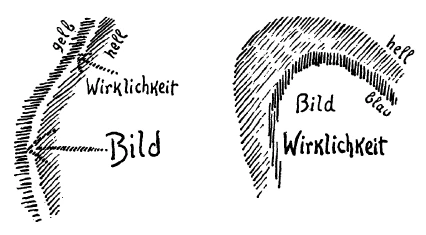
[ 28 ] It is different when a person partakes of the spirit. In that case, their physical aspects remain—such as the inside of their head, and even the outside of their head, unless they are looking at themselves in a mirror—but then they have only an image, which remains in the background. In contrast, they truly experience the spirit, but they experience it only as an image. In consciousness, we see the spirit inwardly, but as an image. While sleeping—or even while awake yet asleep—we perceive the spirit at work, but we cannot bring this perception into consciousness in its true essence; it remains outside.
[ 29 ] Deshalb müssen wir schon sagen, wenn wir irgendwo materielle Oberfläche wahrnehmen: dahinter ist der Geist. Wir können nur mit unserem Bewußtsein in diesen Geist nicht hinein. Wenn wir im gewöhnlichen Bewußtsein Geist erleben, müssen wir ihn innerlich erleben, aber wir erleben ihn eben nur im Bilde. Das ist eben der große Umschwung, der sich mit dem Menschen vollzieht: Mit dem Tode wird diese Wirklichkeit hier (auf die Zeichnung Seite 130, links, deutend) Bild, und die Bilder, die wir erleben (rechts, blau), die werden Wirklichkeit. Der Mensch beginnt, indem er durch die Pforte des Todes geht, das, was er vorher nur im Bilde wahrgenommen hat, als seine Wirklichkeit zu erleben, und was er vorher als Wirklichkeit verschlafen hat, das wird jetzt für ihn Bild — Bild, in dem sich allerdings vorbereitet das nächste Erdenleben, wo wiederum eine Umkehr stattfindet. Es ist also immer eine völlige Umkehr.
[ 29 ] That is why we must say, whenever we perceive a material surface: behind it lies the spirit. We cannot enter into this spirit with our consciousness alone. When we experience spirit in ordinary consciousness, we must experience it inwardly, but we experience it only as an image. This is precisely the great transformation that takes place within the human being: With death, this reality here (pointing to the drawing on page 130, left) becomes an image, and the images we experience (right, blue) become reality. By passing through the gate of death, a person begins to experience as their reality what they had previously perceived only as an image, and what they had previously slept through as reality now becomes an image for them—an image in which, however, the next earthly life is being prepared, where a reversal takes place once again. It is, therefore, always a complete reversal.
[ 30 ] Sehen Sie, wenn man des Menschen Formverhältnisse betrachtet, muß man weit hinausgehen, in die ganze Fixsternwelt muß man hinausgehen. Und wenn man in die ganze Fixsternwelt hinausgeht, dann liegen in der Fixsternwelt die Impulse, wie wir gesehen haben, die da bewirken, daß der Mensch gewisse Formen seines Hauptes, gewisse Formen seiner Brust, gewisse Formen seiner Gliedmaßen hat. Wir haben gesehen, wie diese zustande kommen. Wir gehen dann weiter an den Menschen heran: Wir finden das Planetensystem, die Planetensphäre. Und wiederum finden wir, daß diese Planetensphäre im Menschen seine Lebensstufen bildet. Jetzt müssen wir ganz in den Menschen hineingehen. Da finden wir sein Seelisches. Und wenn wir in dieses Seelische noch untertauchen, dann ergeben sich uns die Wechselzustände von Wachen und Schlafen, von Bild und Wirklichkeit. Dann kommen wir an den Geist des Menschen heran. Dann entdecken wir das Geistige des Menschen.
[ 30 ] You see, when one considers the proportions of the human form, one must look far out into the entire world of fixed stars. And when we venture out into the entire world of fixed stars, we find there—as we have seen—the impulses that cause human beings to have certain shapes of the head, certain shapes of the chest, and certain shapes of the limbs. We have seen how these come about. We then move closer to the human being: we find the planetary system, the planetary sphere. And once again we find that this planetary sphere forms the stages of human life. Now we must go deep into the human being. There we find the soul. And when we delve even deeper into this soul, the alternating states of waking and sleeping, of image and reality, reveal themselves to us. Then we approach the human spirit. Then we discover the spiritual aspect of the human being.
[ 31 ] Ich möchte Ihnen jetzt etwas vor die Seele hinstellen, was für viele von Ihnen vielleicht außerordentlich abstrakt und fremdartig erscheint. Aber ich bitte Sie, nehmen Sie es hin und betrachten Sie es als ein paar Nüsse, die Sie knacken müssen. Denn auch das, was ich heute in dieser rechts letzten Viertelstunde entwickeln will, kann Ihnen einmal wichtig sein für die Weltbetrachtung.
[ 31 ] I would now like to present something to you that may seem extremely abstract and strange to many of you. But I ask you to accept it and consider it a few nuts you need to crack. For what I intend to develop today in this final quarter-hour may one day be important to your view of the world.
[ 32 ] Wenn wir diesen Weg uns wirklich vorhalten, den man da geht von dem ganzen Weltensystem, von dem Fixsternhimmel herein durch die Planetensphäre in den Menschen, da wird man, wenn man dazu in der Lage ist, an etwas ganz Bestimmtes erinnert. Sehen Sie, die Mathematiker, die bestimmen die Lage eines Körpers oder die Lage eines Punktes — das spielt eine große Rolle heute gerade in der Relativitätstheorie —, indem sie sich drei aufeinander senkrecht stehende Linien denken, die sich in irgendeinem Punkte schneiden. Und wenn sie dann einen Punkt bestimmen wollen, sagen wir hier den Punkt A (siehe Zeichnung), dann messen sie die Entfernung zu den drei Ebenen, die durch die drei Linien bestimmt sind. Wenn sie also diese drei Linien haben, so können sie immer den Punkt bestimmen. Sie müssen nur annehmen diese drei aufeinander senkrecht stehenden Achsen, die man Koordinatenachsen nennt, und sie können ihnen dienen als Anhaltspunkt zur Ortsbestimmung jeglichen anderen Punktes, auch jeglicher Linie, denn die kann wenigstens nur durch ihre Punkte bestimmt werden, die sie enthält und so weiter.
[ 32 ] If we truly follow this path—the one that leads from the entire world system, from the fixed-star sky, through the planetary sphere, and into the human being—then, if we are capable of doing so, we are reminded of something very specific. You see, mathematicians determine the position of a body or the position of a point—which plays a major role today, especially in the theory of relativity—by imagining three lines perpendicular to one another that intersect at some point. And when they want to determine a point—let’s say point A here (see diagram)—they measure the distance to the three planes defined by the three lines. So if they have these three lines, they can always determine the point. They need only assume these three mutually perpendicular axes, which are called coordinate axes, and they can use them as a reference point to determine the location of any other point, including any line, since a line can be defined only by the points it contains, and so on.
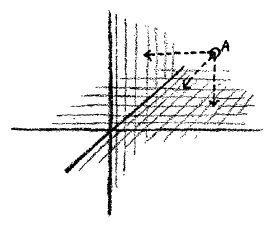
[ 33 ] Die Mathematiker sind nun außerordentlich stolz darauf, daß sie in einer solchen Weise die Ortsbestimmung mathematisch erfaßbar machen können. Sie reden von den drei Koordinaten, von der x-, y- und z-Koordinate. Nun entsteht aber für denjenigen, der nicht bloß Mathematiker, sondern der, indem er sich mit Mathematik beschäftigt hat, auch noch ein Mensch der Wirklichkeit ist, eine bestimmte Frage.
[ 33 ] Mathematicians are now extremely proud that they can make the determination of location mathematically graspable in this way. They speak of the three coordinates: the x, y, and z coordinates. But for those who are not merely mathematicians—but who, through their engagement with mathematics, are also people of the real world—a certain question arises.
[ 34 ] Er sagt sich: In dem Leben zwischen Geburt und Tod — und unsere jetzigen Mathematiker rechnen ja wahrhaftig nicht mit dem Leben zwischen dem Tod und neuer Geburt, sondern was sie berechnen, das liegt alles zwischen Geburt und Tod —, in dem Leben zwischen Geburt und Tod ist man ja immer eigentlich als Mensch in der äußeren Wirklichkeit mit drinnen, und man sieht als Mensch, oder man nimmt es wahr durch einen anderen Sinn, von irgendeinem Punkte aus das, was in der Außenwelt ist. Man muß also immer beim Menschen von einem Blickpunkte, von einem Augenpunkte sprechen. Nicht wahr, die Welt schaut ganz anders aus, je nachdem ob ich nun hier stehe, oder ob ich da drüben stehe. Wenn ich da drüben stehe — nun, schon dadurch wäre ein beträchtlicher Unterschied, daß ich Ihnen von hier in die Augen schaue; wenn ich da drüben stünde, würde ich Sie alle von der anderen Seite sehen. Also man kann, wenn man konkret, wirklichkeitsgemäß spricht, immer nur von einem bestimmten Blickpunkte aus die Wirklichkeit beurteilen, denn der Mensch kann sich ja nirgends ganz wegnehmen von der Wirklichkeit.
[ 34 ] He tells himself: In the life between birth and death—and our present-day mathematicians certainly do not take into account the life between death and rebirth; rather, everything they calculate lies between birth and death—in the life between birth and death, one is, as a human being, always actually part of external reality, and as a human being, one sees—or perceives through another sense—what is in the external world from some vantage point. So when it comes to human beings, one must always speak of a vantage point, a point of view. Isn’t it true that the world looks quite different depending on whether I’m standing here or over there? If I were standing over there—well, just that alone would make a considerable difference: from here, I’m looking you in the eye; if I were standing over there, I would see all of you from the other side. So, if one speaks concretely and in accordance with reality, one can always judge reality only from a specific vantage point, for a person cannot completely remove themselves from reality.
[ 35 ] Aber im modernen Denken, da hat man so etwas von einer Sehnsucht, sich wegzunehmen aus der Wirklichkeit. Die Physiker wollen alles Subjektive ausschließen. Ein neuerer Physiker hat gesagt: Was ist eigentlich? Was hat ein Sein? — Sogar in der Sprache kommt das Sein vom Sehen, so daß man, wenn man den Menschen einschließt, eigentlich ganz populär sagen müßte: Es ist das, was man sehen kann. Denn der Stamm des Wortes Sein hängt mit Sehen zusammen. — Aber das kann der Physiker nicht gelten lassen, und ein neuerer Physiker hat deshalb schon die Definition gegeben: Dasjenige ist, was sich messen läßt — wobei man es also nicht auf den Menschen bezieht, sondern auf einen objektiven Maßstab, und den Menschen schaltet man aus.
[ 35 ] But in modern thinking, there is a kind of longing to remove oneself from reality. Physicists want to exclude everything subjective. A recent physicist has said: What actually is? What constitutes “being”? — Even in language, “being” derives from “seeing,” so that if one includes human beings, one would actually have to say, in very simple terms: It is what one can see. For the root of the word “being” is connected to “seeing.” — But the physicist cannot accept that, and a more recent physicist has therefore already provided the definition: “That which is, is what can be measured”—whereby one does not refer to human beings, but to an objective standard, and human beings are excluded.
[ 36 ] Ein anderes Beispiel, wo der Mensch ausgeschaltet wird, habe ich ja schon öfter vor Ihre Seele hingestellt. Da wird die Kant-Laplacesche Theorie erklärt: Man nimmt ein Tröpfchen Ol, ein Kartenblatt auf einer Stecknadel, es kann auch eine Nähnadel sein, man dreht, und da sondern sich die Tropfen ab. Aber — es würde sich nichts absondern, und das ganze kleine Planetensystem würde nicht entstehen, wenn der Herr Lehrer nicht drehte! Aber wenn man das Weltsystem erklären will, läßt man wiederum den Herrn Lehrer aus. Sonst müßte der Lehrer sagen: Liebe Kinder, da entsteht ein Planetensystem, aber da bin ich, der da dreht; und da draußen entsteht das große Planetensystem, da ist der große Gott vorhanden, der dreht da die große Stecknadel. Sonst könnte die Welt nicht entstehen, wenn da draußen nicht ein im Verhältnis großer Gott wäre, wie ich der kleine Gott für euch alle hier bin. — So müßte der Lehrer eigentlich sagen, nicht wahr.
[ 36 ] I have already presented another example—one in which human beings are excluded—to your soul on several occasions. There, the Kant-Laplace theory is explained: Take a drop of oil, a sheet of paper on a pin—it could also be a sewing needle—and spin it, and the droplets separate. But—nothing would separate, and the entire little planetary system would not come into being if the teacher did not spin it! Yet when one wants to explain the solar system, the teacher is once again left out. Otherwise, the teacher would have to say: “Dear children, a planetary system is forming here, but it’s me who’s turning it; and out there, the great planetary system is forming—there is the great God, who is turning the big pin out there. Otherwise, the world couldn’t come into being if there weren’t a relatively great God out there, just as I am the little god for all of you here.”—That’s what the teacher would actually have to say, wouldn’t he?
[ 37 ] Nun, das sagt er nicht. Man ist gewohnt geworden im modernen Denken, den Blickpunkt gewissermaßen hinwegzudekretieren. Man dekretiert ihn sogar hier in der analytischen Geometrie weg. Aber es ist auch schwer, die Frage zu beantworten: Wo ist eigentlich derjenige, der das anschaut? Wo ist denn der, der das anschaut? Wo steckt denn der? Wer sieht denn wirklich das Ding hier so an, daß er nicht perspektivisch die x-, y-, z-Koordinate sieht? Wo steckt denn der Mensch, der das so sieht? — Ja, wissen Sie, da kann er nicht sein, da überall kann er nicht sein, denn da würde er immer perspektivisch sehen. Nun, wenn er gerade weit genug weg wäre, nämlich da im Unendlichen drüben, da würde er die vertikale Linie richtig sehen; wenn er da drüben im Unendlichen wäre; wenn er da droben im Unendlichen wäre, würde er die z-Linie sehen. Das muß nämlich ein ganz verflixter Kerl sein, der diese sogenannte Koordinatenachse sehen würde, die man für dieses hier (siehe Zeichnung Seite 132) in einem Punkt beschreibt; der muß nämlich in der Unendlichkeit sein, und zwar da, und da, und überall in der Unendlichkeit fort muß er sein. Das ist der Blickpunkt. Der muß überall sein, der da in diesem Raum alle richtigen drei Dimensionen betrachtet, die aufeinander senkrecht stehen. Wenn man vom Raume redet, ja, wenn man von analytischer Geometrie redet, so muß man den Blickpunkt überall ins Unendliche hin verlegen.
[ 37 ] Well, he doesn’t say that. In modern thinking, we’ve become accustomed to, so to speak, “declaring” the point of view away. We even disregard it here in analytical geometry. But it’s also difficult to answer the question: Where, exactly, is the person looking at this? Where is the one who’s looking at it? Where is he? Who is actually looking at this object in such a way that he doesn’t see the x, y, and z coordinates from a perspective? Where is the person who sees it that way? — Well, you see, he can’t be there; he can’t be everywhere, because then he would always be seeing it from a perspective. Now, if he were just far enough away—namely, over there at infinity—he would see the vertical line correctly; if he were over there at infinity; if he were up there at infinity, he would see the z-line. That would have to be one heck of a guy who could see this so-called coordinate axis, which is described as a point for this one here (see drawing on page 132); he’d have to be in infinity—right there, and there, and everywhere throughout infinity. That’s the viewpoint. It must be everywhere—the point from which one observes all three true dimensions in this space, which are perpendicular to one another. When one speaks of space—indeed, when one speaks of analytic geometry—one must shift the viewpoint everywhere into infinity.
[ 38 ] Und jetzt nehmen wir den Gegensatz. Jetzt nehmen wir einmal, wie der Mensch nun wirklich innerlich sich erlebt. Er erlebt sich ja im Mittelpunkt des Weltenalls. Er erlebt sich gewissermaßen als Punkt, und überall mit seinen Wahrnehmungen visiert er eigentlich. Er hat gewissermaßen vor sich oder um sich seinen Horizont. Und was auf dem Horizont oder über dem Horizont und unter dem Horizont ist, das erlebt der Mensch so; wenn ich es Ihnen andeuten will, könnte ich das so andeuten. Ich müßte sagen: Der Mensch erlebt erstens in seiner Visierlinie — es kann auch die Tastlinie sein — oder irgendwo oben, unten, natürlich auch hier herüben; kurz, er macht diesen Winkel größer oder kleiner, oder öffnet ihn nach oben oder nach unten. Das tun auch die Mathematiker; nur da, da gehen sie aus von einem ganz bestimmten Blickpunkte. Da nehmen sie Rücksicht auf den Menschen. Sie geben es aber auch nicht zu, weil das eine Schande wäre für den heutigen Denker, wenn er den Menschen einschließen würde in das Weltenbild. Sie reden daher nur von einem Punkt, bestimmen einen anderen Punkt irgendwo, indem sie die Abweichung von der Visierlinie bestimmen. Indem man also sagt: der Punkt hier, der ist so entfernt, daß hier eine Möglichkeit ist — nun, ich will nicht so weit gehen, das, was man den Kosinus nennt, einzuführen —, daß man eine Möglichkeit hat, den Punkt zu bestimmen. Der aber ist immer anders, also auch sein Kosinus ist immer anders, indem man weiter oben oder unten den Punkt ins Auge faßt. Da steht man eigentlich, wenn man die Sache wirklich betrachtet, in der vollen Wirklichkeit drinnen. Die Mathematiker haben das. Sie nennen das Polarkoordinaten.
[ 38 ] And now let’s consider the opposite. Let’s consider how a human being actually experiences themselves inwardly. They experience themselves, after all, at the center of the universe. They experience themselves, so to speak, as a point, and their perceptions are actually directed everywhere. They have, so to speak, their horizon in front of them or around them. And whatever lies on the horizon, above the horizon, or below the horizon, that is how a person experiences it; if I were to illustrate this to you, I could describe it this way. I would have to say: First, a person experiences things within their line of sight—it could also be their line of touch—or somewhere above, below, and of course over here as well; in short, they make this angle larger or smaller, or open it upward or downward. Mathematicians do this as well; only there, they start from a very specific vantage point. There, they take the human being into account. But they don’t admit it either, because it would be a disgrace for today’s thinker to include the human being in their worldview. Therefore, they speak only of one point and determine another point somewhere by calculating the deviation from the line of sight. So by saying: this point here is so far away that there is a possibility—well, I don’t want to go so far as to introduce what is called the cosine—that one has a possibility of determining the point. But that point is always different, so its cosine is also always different, depending on whether you focus on the point higher or lower. When you really look at it, that’s actually where you stand—right in the midst of full reality. Mathematicians have this. They call it polar coordinates.
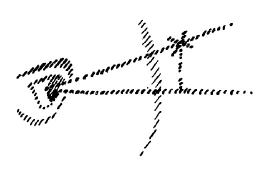
[ 39 ] Und jetzt, sehen Sie, jetzt haben wir einen merkwürdigen Satz. Wir können sagen: Da ist nun gar kein verflixter Kerl, denn das ist man selber fortwährend. Wenn man irgendwo ist, hat man den polaren Koordinatenmittelpunkt als Blickpunkt. Wenn man aber den Raum betrachtet, und eine Raumbetrachtung ist ja diese Betrachtung hier, dann ist man überall in der Unendlichkeit draußen. Da ist man der verflixte Kerl. Was ist denn aber, wenn Sie hier den Mittelpunkt betrachten, nun überall in der Unendlichkeit, was ist denn dazwischen drinnen? Was ist dazwischen drinnen? Zwischen dem Punkt und der Unendlichkeit ist nämlich zwischen drinnen der Kreis. Wenn Sie in die Unendlichkeit hinausgehen, also eigentlich den Raum durchmessen, Sie werden etwas darinnen finden. Aber wenn Sie sich den Blickpunkt in der Unendlichkeit überall denken, dann sind Sie in dem Gebiet, das die Fixsternbetrachtung ist. Wenn Sie hereingehen in den Mittelpunkt, da sind Sie in dem Gebiet, wo die menschliche Betrachtung ist. Zwischen drin ist der Kreis, oder kann wenigstens ein annähernder Kreis sein: die Planetenbewegungen. Es kann gar nicht anders sein. Wenn der Mensch durch seine Seele der Welt vermittelt wird, so muß diese Vermittelung durch eine Kreisbewegung, durch Sphären geschehen. Das ist einfach in der inneren Konstitution des Weltenalls begründet. Wir müssen also zwischen uns und der Unendlichkeit die kreisenden Sterne finden.
[ 39 ] And now, you see, now we have a strange sentence. We can say: There isn’t any “darn fellow” at all, because that is who you are all the time. When you are somewhere, you have the polar coordinate origin as your vantage point. But when you look at space—and this is, after all, a spatial consideration—then you’re everywhere out there in infinity. That’s where you’re the darn guy. But what if you look at the center here, now everywhere in infinity—what’s in between? What’s in between? Between the point and infinity, there’s the circle in between. If you go out into infinity—that is, if you actually traverse space—you will find something in there. But if you imagine the focal point as being everywhere in infinity, then you are in the realm of fixed-star observation. If you enter the center, you are in the realm of human observation. In between lies the circle—or at least what can be approximated as a circle: the movements of the planets. It cannot be any other way. If humanity is connected to the world through its soul, then this connection must occur through a circular motion, through spheres. This is simply rooted in the inner constitution of the universe. We must therefore find the circling stars between ourselves and infinity.
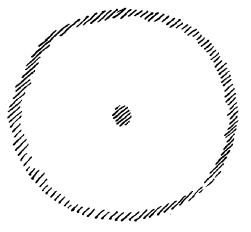
[ 40 ] Sehen Sie, in sehr alten Zeiten hat ein instinktives Hellsehen die Mathematik aus diesen Verhältnissen herausgeholt, aus den konkreten Verhältnissen heraus: den Weltenraum in drei Dimensionen mit dem Blickpunkte überall in der Unendlichkeit, die Sphäre und den eigenen Mittelpunkt. Davon ist man ausgegangen. Das war alte Mathematik. Heute ist die Mathematik auch abstrakt geworden und handelt eigentlich nur von Formeln, nicht von der Wirklichkeit. Aber wenn man sie innerlich betrachtet, so wie wir das jetzt getan haben, dann kann man noch eine Ahnung bekommen, wie das, was der Mathematiker heute vor sich hinzustellen gezwungen ist, das Koordinatenachsensystem oder die Polarkoordinaten, wie das durchaus in der inneren Struktur des Weltenalls begründet ist.
[ 40 ] You see, in very ancient times, an instinctive clairvoyance derived mathematics from these relationships—from concrete relationships: three-dimensional space with viewpoints everywhere in infinity, the sphere, and its own center. That was the starting point. That was ancient mathematics. Today, mathematics has also become abstract and is really only about formulas, not about reality. But if one looks at it from within, as we have just done, then one can still get a sense of how what mathematicians today are forced to set before them—the coordinate axis system or polar coordinates—is thoroughly grounded in the inner structure of the universe.
[ 41 ] Sehen Sie, Sie werden fast immer, wenn der Einstein oder ein Einsteinianer heute zu reden beginnt, finden: den Ausgangspunkt nehmen sie von irgendwelcher Koordinatenkonstruktion, und dann gehen sie über zu der Relativitätstheorie. Man braucht sich nicht darüber zu wundern, daß da alles relativ wird. Denn sobald man den ersten Ansatz macht — und den möchten nämlich die Leute machen —, zu der Wirklichkeit überzugehen, dann muß man sich verwandeln oder müßte sich verwandeln in den verflixten Kerl, der überall in der Unendlichkeit ist. Aber da kommt es schon nicht darauf an, ob es eine Meile oder mehr oder weniger, oder einen Erden- oder Sonnendurchmesser weit oder noch weiter voneinander ist. Daher werden alle Dinge relativ. Daher die Relativitätstheorie, weil der Blickpunkt im Unendlichen liegt, und es darauf nicht ankommt, ob weit oder weniger weit. Da wird dann, wenn man rein schaut auf die willkürlich angeführten Gründe, alles relativ. Das ist eigentlich der wahre Grund, der psychologische Grund. Man muß nur in diese Dinge hineinsehen.
[ 41 ] You see, almost every time Einstein or an Einsteinian begins to speak today, you’ll find that they start from some coordinate system and then move on to the theory of relativity. It’s no wonder that everything becomes relative there. Because as soon as you take the first step—and that’s exactly what people want to do—toward reality, you have to transform yourself, or would have to transform yourself, into that pesky fellow who is everywhere in infinity. But it doesn’t matter whether the distance is a mile or more or less, or the diameter of the Earth or the Sun, or even farther apart. That is why everything becomes relative. That is why we have the theory of relativity: because the vantage point lies in infinity, and it doesn’t matter whether the distance is great or small. When one looks purely at the arbitrarily cited reasons, everything becomes relative. That is actually the true reason, the psychological reason. One need only look into these things.
[ 42 ] Nun wollen wir morgen auf den Voraussetzungen, die wir heute gewonnen haben, einiges wiederum aufbauen.
[ 42 ] Now, building on the foundations we have laid today, let’s build on them further tomorrow.