Anthroposophy as Cosmosophy I
Human Traits in the Earthly and Cosmic Realms
GA 205
4 November 1921, Dornach
Translated by Steiner Online Library
Eighteenth Lecture
[ 1 ] We have considered human beings in their relationship to the cosmos—in terms of the form of human organization, the stages of life, and the contents of the soul—and today, in order to prepare, so to speak, for another chapter over the next two days, we also want to consider human spiritual experiences.
[ 2 ] Let us recall how we set out to consider the human being in terms of the formation of his or her organism. After all, we had to relate the human organism to the cosmos, all the way up to the fixed stars. Then, in order to grasp the stages of human life, we had to place before our minds the planetary system in which human beings live. And as we then turned to the manifestations of the soul, we had to, so to speak, shift our focus and relate the human being, as a soul being, to his physical organization—that is, to what he derives precisely from the fixed-star sky and the planetary system. And through our consideration of form and of life, we have also placed before our soul that contrast which exists in the human head organization, the chest organization, and the metabolic-limb organization. We have seen how the soul, in the form of sensory perception and imagination, expresses itself precisely through the head organization—through the sensory-nervous system—and we have then seen how the life of feeling finds expression through the respiratory and circulatory systems, and the life of will through the metabolic-limb system. However, in order to consider the soul, we had to take into account how the ego, the astral body, the etheric body, and the physical body interact within the human being.
[ 3 ] So that we have truly gained an overview—for the last time—of the interweaving of the psychological and the physical, extending all the way to glandular activity and the will’s control of muscular activity.
[ 4 ] If one wishes to approach the spiritual aspect of the human being, one cannot simply view the human being as we did last time when discussing the soul—where we had to take into account the expression and manifestation of the soul in the physical body—but rather, if one wishes to consider the spiritual, one must look at the alternating states of the human being: waking and sleeping.
[ 5 ] Waking and sleeping, as we know, are initially given to us as human beings in the ebb and flow of human life within a twenty-four-hour cycle—in waking during the day and sleeping at night. This is one way in which human beings live through waking and sleeping. But we also know that human beings exist in other ways while awake and asleep. For when a person engages in imagination and surrenders to sensory perceptions, only then is he or she truly fully awake. Only the life of imagination and sensory perception is, in fact, wakefulness. In contrast, the life of the will and the life of action is, in fact, a life of sleep, even while awake.
[ 6 ] As we know, our emotional life is a dreamlike existence even while we are awake. Thus, in this respect as well, human beings allow their lives to oscillate, as it were, back and forth between waking and sleeping. Sleep—or, I would say, “waking sleep”—plays a role, so to speak, in our actual waking state, that is, in our life of imagination, when we express an act of will, when we are active, and are awake in our activity through our ability to imagine our own actions. But what takes place within this activity remains as unconscious as the states experienced during sleep.
[ 7 ] But the fact that a person feels like an individual being is actually due to sleep. If a person were devoted solely to the life of the imagination while awake, he would, in a sense, experience the world only as a succession of images. He would feel, as it were, at rest, as if suspended at a single point in the universe, and the universe would be present to him in images. In this web of images, the “I” would also exist as a kind of mirror image of something—but still only as an image. It is only by infusing this waking life of imagination, so to speak, first with the constant reminder that we actually have states in which we experience nothing—states of sleep, the time from falling asleep to waking up—that we are led back to ourselves. And also the vague reflection on what we want—that is, the fact that something sleep-like plays into our conscious existence—gives us our sense of self, our “I” impulse. We do not experience it fully consciously in ordinary life; we experience it, so to speak, as a surge into consciousness arising from our inner organization—this “I” impulse. And we experience it, on the other hand, through the fact that from the moment we fall asleep until we wake up, we venture out into the cosmos with our “I”—which otherwise does not enter ordinary consciousness—and with our astral body, which likewise does not enter ordinary consciousness—that we venture out into the cosmos with these, and that what we experience as a darkening of this consciousness from the moment we fall asleep until we wake up, so to speak, strikes into our consciousness.
[ 8 ] What is it, then, that lulls us back to sleep time and again, that pushes our will and a large part of our feelings into unconsciousness—into, so to speak, the night of consciousness? It is this: that we must develop organic activity in our will. We saw last time how, in our willing, human beings allow their soul life to work its way down into muscular life. The soul, so to speak, plunges into muscular life. There it becomes unconscious, just as it becomes unconscious when it leaves the body and remains in the state between falling asleep and waking up. We can therefore say: It stems from our needs, from the conditions of the physical body, that we are initially conscious of our “I” in ordinary life; it stems from the fact that we carry a body within us which, when a will act is to be carried out, claims the soul for itself; and which, when it seeks to balance the forces it develops in the act of willing, drives the soul down into the unconsciousness of sleep—precisely so that it can always fully convey the consciousness of the “I” that actually exists unconsciously. So we can say: We immerse ourselves in the physical-bodily realm by pouring our spirit—or, initially, our soul—into this physical-bodily realm. But we will soon see that with this soul we are in fact pouring our spirit into the physical-bodily realm. There, I would say, we feel robust when the soul has been poured down into the body. We do not feel robust, but rather alert, when we have ideas and sensory perceptions.
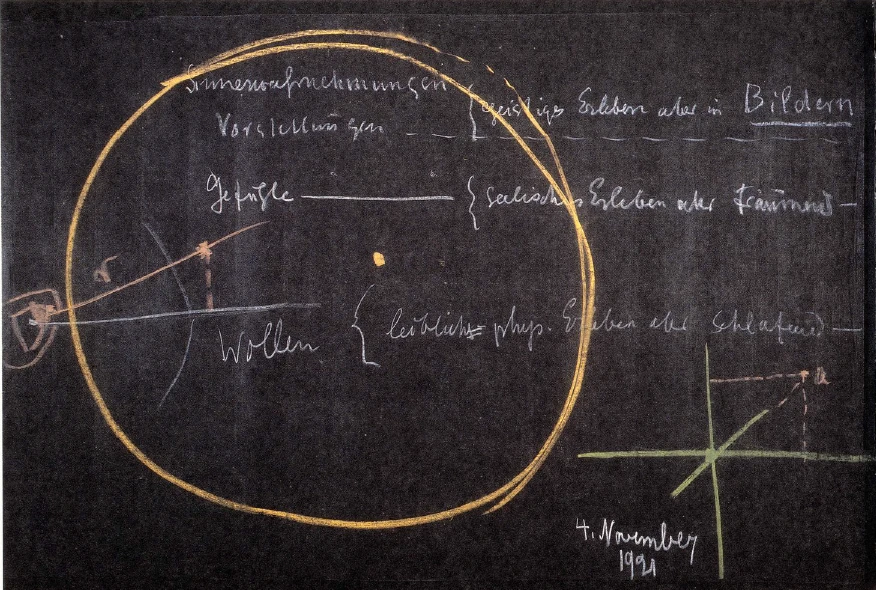
[ 9 ] To have mental images and sensory perceptions, however, does not mean to live in the physical body. It is a complete misunderstanding to believe that only imaginative, inspired, and intuitive cognition lead a person into the spiritual world. No, a person already lives in the spiritual world when they have sensory perceptions and when they form ideas. For we have seen that sensory perceptions are linked to the fact that dead matter—purely physical apparatus—is already embedded in our organism, permeated only by the etheric body; but it is embedded. And as we experience life within this physical apparatus, we experience sensory perception. The physical apparatus itself is not experienced; what is experienced is the spiritual activity taking place within it. In its very nature, the content of sensory perception is entirely spiritual. However, as we saw last time, in the process of imagination we, so to speak, extend sensory activity across the nervous system. Nervous activity actually consists of a dying off. Organic activity must be precisely suspended if we are to form mental images. Therefore, by having sensory perceptions and mental images, we live entirely in the spiritual realm. But we, as human beings living between birth and death, live this life in the spiritual realm only insofar as we have images of it—of this life. This is what is peculiar about it: the spiritual world first becomes conscious to us through sensory perceptions and ideas, but only in images. So that we can say (see description on page 127): Sensory perceptions and ideas are spiritual experiences, but in images. In the case of ideas, we are, of course, aware that they have an abstract character as such; they are not intensely saturated images. One might say that things turn gray when we move from sensory perceptions back to the life of ideas. But it is only for our consciousness that things turn gray. In reality, all the ideas that human beings develop contain imaginations.
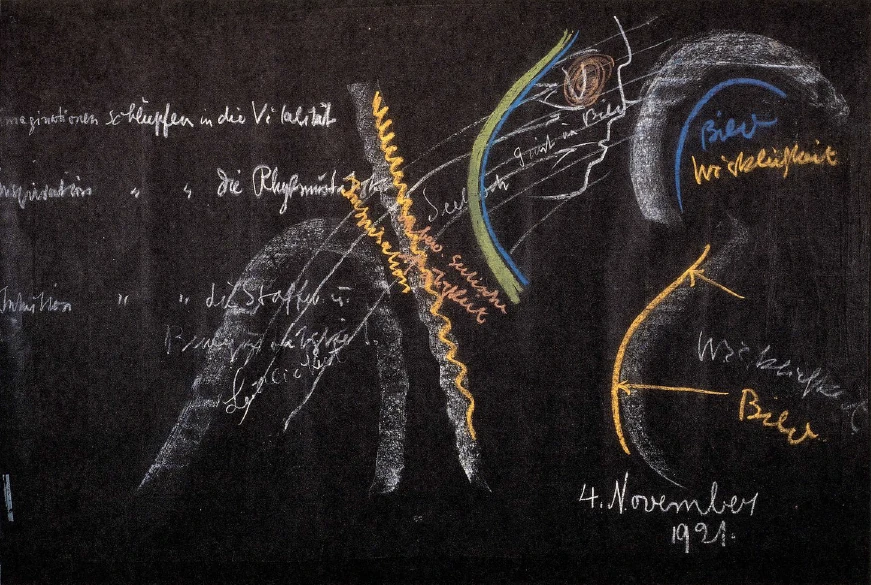
[ 10 ] So that I can say: These ideas certainly contain imaginations, but these imaginations do not enter into consciousness. In a sense, what we experience as concepts in everyday life is a kind of distillation of these imaginations. The act of imagining extends backward into the physical realm, and what comes to our consciousness is the pale, reflected image of the concepts. Every time you have a concept—and indeed, whenever you have concepts—you also have imaginations. The difference is that mental images remain in consciousness; imaginations slip down into you and live within the general vitality of your organism, within the general life activity. So imaginations slip into vitality, into the general life activity. If I were to draw this schematically (see drawing), I would have to draw it like this (head): We have sensory perception (red), then we have the process of formation of concepts, which we construct (blue, green) from sensory perception and which actually has a Janus-like nature. Facing forward, it is the pale concept that enters our consciousness; facing backward, it is imagination, but imagination does not enter consciousness. Imagination merges into the organism and forms the general life activity there. It enters all the organs—this imagination; it lives in the brain, it lives in the heart, it lives in the lungs, it lives in the kidneys, it lives everywhere; it enters all the organs, this imagination. It unites with the general life force.
[ 11 ] This gives rise to something peculiar: Here, in the areas I have marked in red and blue, we have the spirit depicted in the image. We have no conscious awareness of what extends down into the physical realm, yet we experience it as spiritual. The spirit is thus, in a sense, spirit when directed forward; when directed backward, into the organism (green), it is soul. But within the soul, it immediately begins to submerge into the semi-conscious and unconscious and unites with the physical.
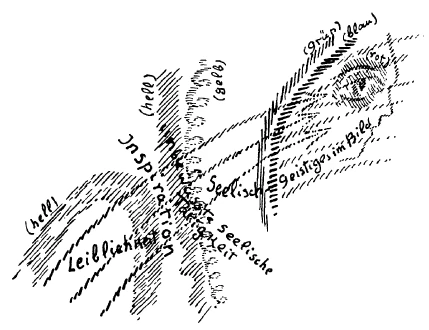
[ 12 ] Below what we have here (see diagram), we have unconscious mental activity. Imagination thus disappears into this. And then, on the other side, we have physicality. But this physicality is immersed in the night of consciousness, in sleep, and expresses itself only by sending the will up into consciousness. This will is precisely the counterforce; it makes us resilient; it gives us an experience of reality. But this experience of reality surfaces, at most, only as a feeling. We dream of this reality; but essentially, we do not have this reality in our waking consciousness. Thus, as human beings between birth and death, we “purchase” our existence in the spiritual realm by experiencing the spirit through images—through the images of sensory perceptions and through the images of ideas; we do experience reality, but it flows unconsciously into our consciousness, just as external reality also flows in unconsciously.
[ 13 ] We immerse ourselves in this external reality, but it actually—because we know nothing of the states of sleep in which we are out there in external reality—it also plays a role unconsciously. We are, so to speak, enveloped by the unconscious, permeated by the unconscious. That is where we live in reality. But we live in the bodily or in the outer-physical realm. When we live in the spiritual realm, we experience the spirit only as an image.
[ 14 ] But everything physical is built up from the spiritual. And when a person develops their imagination, they already experience the imaginative life that lies behind it. They also experience, further back in the soul, what is present in ordinary consciousness as feeling. At first, they experience the feeling consciously. But behind the feeling lies inspiration.
[ 15 ] Every time you have a feeling, you also have inspiration. But just as, when you imagine something, your imaginings slip down into your general vitality, so too, when you feel, inspiration slips down into your physicality, because you need it down there. You need it for the act of breathing, for rhythmic activity. There, it connects with general rhythmic activity. So the inspiration from your feeling slips into your breathing processes just as the imagination from your ideas slips into your general vitality.
[ 16 ] So that I may say: We continue to experience these feelings retroactively within ourselves, and by delving deeper into these feelings, we have a spiritual experience—a spiritual experience, but a dreamlike one—yet within it we have a hidden inspiration (see drawing on page 125). A hidden inspiration slips into the rhythmic movement, the rhythmic activity. It slips down into breathing and blood circulation. If one were to look closely, if one had a person before one who thinks and feels, one could say something like this: You now have ideas; you are thinking, as you know; but from your thinking, imaginations are constantly trickling down through your entire body, sustaining your vitality. You feel; there, inspirations are constantly trickling into your breathing and into your blood circulation.
[ 17 ] And beneath that lies volition. Will is, at first, a purely physical activity within a person’s life between birth and death; it is to be experienced physically, for the spirit is occupied by muscular activity—a physical experience—but it is dormant, since one can only experience the spirit consciously. Here it sleeps. But within it lies intuition. It is true intuition—what I described last time—when a person transmits their soul activity, and with it the spiritual aspect they experience, in images into their muscular activity, so that they become active, so that they become an agent, a being of will. There they truly intuit. There, they step out of their “I” life, allowing this “I” to enter into something entirely different—namely, their own muscle-and-bone movements. So that we can say: Intuition slips into metabolic and motor activity. The spirit, however, lives precisely in imagination, inspiration, and intuition.
Sensory perceptions,
Concepts: Mental experiences, but in images,
Imaginations take root in vitalityEmotions: Emotional experiences, but dreamlike,
Inspiration slips into rhythmic activityDesire: A physical, bodily experience, but in a dormant state,
Intuition permeates metabolic and motor activity
[ 18 ] You see, now we have the spirit fully within the body. We have intuition in our metabolism and in the movement of our limbs. We have inspiration in rhythmic activity. We have imagination in our general vitality. And only concrete cognition—that is what we have as pictorialness, as spiritual activity in images. Because they are mere images, they can also unite with the images of the external world.
[ 19 ] Last time, we tried to consider the spiritual and the physical together. We saw how this mental aspect is active in the head, in the nervous-sensory system, through a continuous process of decay there, so that the mental aspect can play out as such, because the organic is being broken down.
[ 20 ] We have seen how, in glandular activity, the soul engages the body—but only to a limited extent, in that the gland then secretes substances. But in muscle and bone activity, the soul is fully engaged by the body. I have explicitly stated: We do not ramble on about an abstract interrelationship between body and physical form, and soul and spirit; we do not speak of some relationship between the physical and a “psychoid,” but rather look inward by concretely grasping the soul, seeing how this physical-bodily aspect prevails over and permeates the soulful everywhere. And conversely: Now we experience how the spiritual—which at first exists in human beings only in images—nevertheless lives within our physical body.
[ 21 ] Imagination, inspiration, and intuition are not just something that can be grasped like the wind or clouds; rather, they are what is present right now in our bodily activity, what slips by as we can only hold on to the images of the spiritual.
[ 22 ] In this way, one can also gain insight into the spiritual aspect of the human being. One can view human beings in terms of their form, their stages of life, the content of their souls, and their spiritual expressions or revelations.
[ 23 ] The human form, while dependent on the entire fixed-star sky, appears to us outwardly and visibly. The stages of life depend on the planetary sphere. We cannot perceive them directly with ordinary consciousness. We perceive these stages of life through their expression in form. Deep within the human being lies the soul. We discover it when we consider the mysterious connections between a person’s nervous and sensory activity and the soul, when we consider glandular activity in relation to feeling and to everything based on rhythmic activity. We then saw how the soul is connected to the metabolic and limb systems. But this soul is permeated at one pole of life by the spiritual; yet it can grasp only images from the spiritual and channels imagination, inspiration, and intuition down into the physical body. Then, when the spirit pours itself into the soul in this way, it lives within the soul as the most intimate part of the human being.
[ 24 ] The other pole does not draw the human being into the way in which the human being experiences sensory activity from within, into the way the human being conceives and feels—where the human being already plunges with the spirit into the physical, into reality in order to feel—where this is tinged with inspirations that, in turn, take up the imaginations from above, uniting the physical with the spiritual. This becomes evident to us when we look meaningfully at a person standing before us in complete stillness. When we study their physiognomy, when we study what shines forth from them as the spirit dives into the physical, as it sends inspiration into the physical, this spirit in turn rises to the surface, penetrates outward through the life impulses, first giving the human being their physical form—the color of their skin and flesh—giving them what we otherwise call their physiognomy; it appears to us in their nobly formed brow, in the shape of their mouth and chin, in the shape of their nose, and so on. This spirit, which descends as inspiration, appears to us as it works through the stages of life in the person at rest.
[ 25 ] As soon as a person walks, as soon as a person is active—indeed, even when a person merely blinks—that is what the person transmits as intuition from the spirit to the physical body; that is what we then see. When we observe a person walking or gesturing, we are observing the workings of their spirit, which, however, intuitively merges into the body—not as a spirit, but as the heat-generating and chemical decomposition processes that take place within the body when the person is actively engaged in the world.
[ 26 ] In examining form, we had to point out what the world gives to human beings. Now that we have seen the spirit completely immersed in physicality, we find in human activity what human beings, in turn, give back to the world. A complete cycle is at work.
[ 27 ] Human beings are awake in that they experience images while awake; that is, they share in the Spirit. But for the life between birth and death, they pay the price for this participation in the spirit by having the spirit within them not as reality, but as imagery. Yet human beings also have the spirit within them as reality between birth and death; but they pay the price for this reality by experiencing it only in a state of sleep—whether it be waking sleep or actual sleep. And one would actually have to say: Life between birth and death consists in the fact that human beings experience the Spirit as a reflection in images, but do not consciously experience its reality; rather, this reality appears to them only through the medium of physicality. Between birth and death, we see the Spirit through its physicality. We do not actually see matter in reality. Matter is the outward appearance of the Spirit. We see the spirit from the outside by seeing matter. So that we can say: When we see matter—whether it is matter out in the world or matter in the human being—it is actually always the case that reality is hidden from us and the surface appears to us, where the spirit reveals itself from within bodily reality, from within material reality.
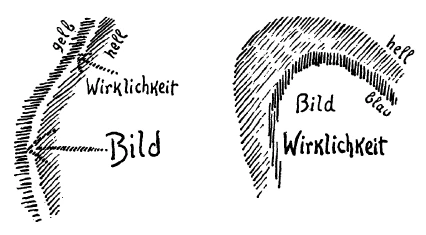
[ 28 ] It is different when a person partakes of the spirit. In that case, their physical aspects remain—such as the inside of their head, and even the outside of their head, unless they are looking at themselves in a mirror—but then they have only an image, which remains in the background. In contrast, they truly experience the spirit, but they experience it only as an image. In consciousness, we see the spirit inwardly, but as an image. While sleeping—or even while awake yet asleep—we perceive the spirit at work, but we cannot bring this perception into consciousness in its true essence; it remains outside.
[ 29 ] That is why we must say, whenever we perceive a material surface: behind it lies the spirit. We cannot enter into this spirit with our consciousness alone. When we experience spirit in ordinary consciousness, we must experience it inwardly, but we experience it only as an image. This is precisely the great transformation that takes place within the human being: With death, this reality here (pointing to the drawing on page 130, left) becomes an image, and the images we experience (right, blue) become reality. By passing through the gate of death, a person begins to experience as their reality what they had previously perceived only as an image, and what they had previously slept through as reality now becomes an image for them—an image in which, however, the next earthly life is being prepared, where a reversal takes place once again. It is, therefore, always a complete reversal.
[ 30 ] You see, when one considers the proportions of the human form, one must look far out into the entire world of fixed stars. And when we venture out into the entire world of fixed stars, we find there—as we have seen—the impulses that cause human beings to have certain shapes of the head, certain shapes of the chest, and certain shapes of the limbs. We have seen how these come about. We then move closer to the human being: we find the planetary system, the planetary sphere. And once again we find that this planetary sphere forms the stages of human life. Now we must go deep into the human being. There we find the soul. And when we delve even deeper into this soul, the alternating states of waking and sleeping, of image and reality, reveal themselves to us. Then we approach the human spirit. Then we discover the spiritual aspect of the human being.
[ 31 ] I would now like to present something to you that may seem extremely abstract and strange to many of you. But I ask you to accept it and consider it a few nuts you need to crack. For what I intend to develop today in this final quarter-hour may one day be important to your view of the world.
[ 32 ] If we truly follow this path—the one that leads from the entire world system, from the fixed-star sky, through the planetary sphere, and into the human being—then, if we are capable of doing so, we are reminded of something very specific. You see, mathematicians determine the position of a body or the position of a point—which plays a major role today, especially in the theory of relativity—by imagining three lines perpendicular to one another that intersect at some point. And when they want to determine a point—let’s say point A here (see diagram)—they measure the distance to the three planes defined by the three lines. So if they have these three lines, they can always determine the point. They need only assume these three mutually perpendicular axes, which are called coordinate axes, and they can use them as a reference point to determine the location of any other point, including any line, since a line can be defined only by the points it contains, and so on.
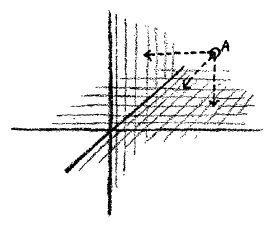
[ 33 ] Mathematicians are now extremely proud that they can make the determination of location mathematically graspable in this way. They speak of the three coordinates: the x, y, and z coordinates. But for those who are not merely mathematicians—but who, through their engagement with mathematics, are also people of the real world—a certain question arises.
[ 34 ] He tells himself: In the life between birth and death—and our present-day mathematicians certainly do not take into account the life between death and rebirth; rather, everything they calculate lies between birth and death—in the life between birth and death, one is, as a human being, always actually part of external reality, and as a human being, one sees—or perceives through another sense—what is in the external world from some vantage point. So when it comes to human beings, one must always speak of a vantage point, a point of view. Isn’t it true that the world looks quite different depending on whether I’m standing here or over there? If I were standing over there—well, just that alone would make a considerable difference: from here, I’m looking you in the eye; if I were standing over there, I would see all of you from the other side. So, if one speaks concretely and in accordance with reality, one can always judge reality only from a specific vantage point, for a person cannot completely remove themselves from reality.
[ 35 ] But in modern thinking, there is a kind of longing to remove oneself from reality. Physicists want to exclude everything subjective. A recent physicist has said: What actually is? What constitutes “being”? — Even in language, “being” derives from “seeing,” so that if one includes human beings, one would actually have to say, in very simple terms: It is what one can see. For the root of the word “being” is connected to “seeing.” — But the physicist cannot accept that, and a more recent physicist has therefore already provided the definition: “That which is, is what can be measured”—whereby one does not refer to human beings, but to an objective standard, and human beings are excluded.
[ 36 ] I have already presented another example—one in which human beings are excluded—to your soul on several occasions. There, the Kant-Laplace theory is explained: Take a drop of oil, a sheet of paper on a pin—it could also be a sewing needle—and spin it, and the droplets separate. But—nothing would separate, and the entire little planetary system would not come into being if the teacher did not spin it! Yet when one wants to explain the solar system, the teacher is once again left out. Otherwise, the teacher would have to say: “Dear children, a planetary system is forming here, but it’s me who’s turning it; and out there, the great planetary system is forming—there is the great God, who is turning the big pin out there. Otherwise, the world couldn’t come into being if there weren’t a relatively great God out there, just as I am the little god for all of you here.”—That’s what the teacher would actually have to say, wouldn’t he?
[ 37 ] Well, he doesn’t say that. In modern thinking, we’ve become accustomed to, so to speak, “declaring” the point of view away. We even disregard it here in analytical geometry. But it’s also difficult to answer the question: Where, exactly, is the person looking at this? Where is the one who’s looking at it? Where is he? Who is actually looking at this object in such a way that he doesn’t see the x, y, and z coordinates from a perspective? Where is the person who sees it that way? — Well, you see, he can’t be there; he can’t be everywhere, because then he would always be seeing it from a perspective. Now, if he were just far enough away—namely, over there at infinity—he would see the vertical line correctly; if he were over there at infinity; if he were up there at infinity, he would see the z-line. That would have to be one heck of a guy who could see this so-called coordinate axis, which is described as a point for this one here (see drawing on page 132); he’d have to be in infinity—right there, and there, and everywhere throughout infinity. That’s the viewpoint. It must be everywhere—the point from which one observes all three true dimensions in this space, which are perpendicular to one another. When one speaks of space—indeed, when one speaks of analytic geometry—one must shift the viewpoint everywhere into infinity.
[ 38 ] And now let’s consider the opposite. Let’s consider how a human being actually experiences themselves inwardly. They experience themselves, after all, at the center of the universe. They experience themselves, so to speak, as a point, and their perceptions are actually directed everywhere. They have, so to speak, their horizon in front of them or around them. And whatever lies on the horizon, above the horizon, or below the horizon, that is how a person experiences it; if I were to illustrate this to you, I could describe it this way. I would have to say: First, a person experiences things within their line of sight—it could also be their line of touch—or somewhere above, below, and of course over here as well; in short, they make this angle larger or smaller, or open it upward or downward. Mathematicians do this as well; only there, they start from a very specific vantage point. There, they take the human being into account. But they don’t admit it either, because it would be a disgrace for today’s thinker to include the human being in their worldview. Therefore, they speak only of one point and determine another point somewhere by calculating the deviation from the line of sight. So by saying: this point here is so far away that there is a possibility—well, I don’t want to go so far as to introduce what is called the cosine—that one has a possibility of determining the point. But that point is always different, so its cosine is also always different, depending on whether you focus on the point higher or lower. When you really look at it, that’s actually where you stand—right in the midst of full reality. Mathematicians have this. They call it polar coordinates.
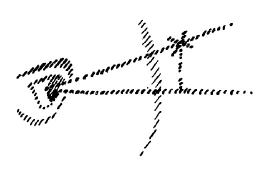
[ 39 ] And now, you see, now we have a strange sentence. We can say: There isn’t any “darn fellow” at all, because that is who you are all the time. When you are somewhere, you have the polar coordinate origin as your vantage point. But when you look at space—and this is, after all, a spatial consideration—then you’re everywhere out there in infinity. That’s where you’re the darn guy. But what if you look at the center here, now everywhere in infinity—what’s in between? What’s in between? Between the point and infinity, there’s the circle in between. If you go out into infinity—that is, if you actually traverse space—you will find something in there. But if you imagine the focal point as being everywhere in infinity, then you are in the realm of fixed-star observation. If you enter the center, you are in the realm of human observation. In between lies the circle—or at least what can be approximated as a circle: the movements of the planets. It cannot be any other way. If humanity is connected to the world through its soul, then this connection must occur through a circular motion, through spheres. This is simply rooted in the inner constitution of the universe. We must therefore find the circling stars between ourselves and infinity.
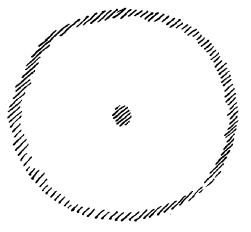
[ 40 ] You see, in very ancient times, an instinctive clairvoyance derived mathematics from these relationships—from concrete relationships: three-dimensional space with viewpoints everywhere in infinity, the sphere, and its own center. That was the starting point. That was ancient mathematics. Today, mathematics has also become abstract and is really only about formulas, not about reality. But if one looks at it from within, as we have just done, then one can still get a sense of how what mathematicians today are forced to set before them—the coordinate axis system or polar coordinates—is thoroughly grounded in the inner structure of the universe.
[ 41 ] You see, almost every time Einstein or an Einsteinian begins to speak today, you’ll find that they start from some coordinate system and then move on to the theory of relativity. It’s no wonder that everything becomes relative there. Because as soon as you take the first step—and that’s exactly what people want to do—toward reality, you have to transform yourself, or would have to transform yourself, into that pesky fellow who is everywhere in infinity. But it doesn’t matter whether the distance is a mile or more or less, or the diameter of the Earth or the Sun, or even farther apart. That is why everything becomes relative. That is why we have the theory of relativity: because the vantage point lies in infinity, and it doesn’t matter whether the distance is great or small. When one looks purely at the arbitrarily cited reasons, everything becomes relative. That is actually the true reason, the psychological reason. One need only look into these things.
[ 42 ] Now, building on the foundations we have laid today, let’s build on them further tomorrow.