Anthroposophy as Cosmosophy I
Human Traits in the Earthly and Cosmic Realms
GA 205
30 October 1921, Dornach
Translated by Steiner Online Library
Seventeenth Lecture
[ 1 ] We have attempted to view the human being in relation to the universe, in terms of both its form and its life. We have seen how the human being is, in a sense, related to the universe in various ways through the head and the extremities. All of these things, of course, apply essentially to the period of human development in which we find ourselves—the post-Atlantean era—and you must be clear that what can be said about world phenomena always applies only to certain epochs, because the world is in a state of development and undergoes radical changes in the successive stages of its evolution.
[ 2 ] We have seen how, in terms of form, the human being, as it were, breaks free from its affiliation with the zodiac; that is, it is set apart from the animal head, which lies within the zodiac, and is, as it were, rotated by a right angle. This part of the human being—the head—is, after all, filled with a life force that, in a sense, tends toward inorganic, lifeless nature. It is, more or less, a life that is fading and dying at this end of the human being. So we have this end of the human being before us in such a way that both the form and life itself break away from their connection with the cosmos on this side; that by breaking away, it brings itself, so to speak, into a kind of rigidity, into a kind of nascent lifelessness.
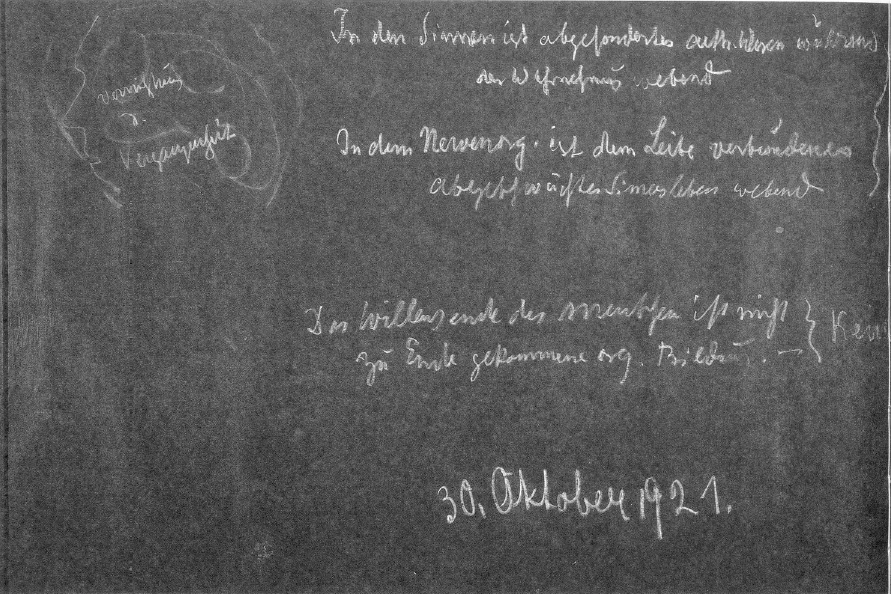
[ 3 ] Now, what we as human beings carry within us is, in essence, the result of past development. You need only think, for a moment, of the individual nature of the human being, and you will recall how I have repeatedly explained that the head of a human being is a metamorphosis of another human being from a previous life—that is, the head points to the past, whereas, as we have had to emphasize, the human being as a collection of limbs points to the future.
[ 4 ] In other respects, too, it is precisely this main purpose of the human head that points us back to the cosmic expanses of the past. We know, after all, that the head is the foremost bearer of the sense organs. But we also know that the sense organs first took shape during the ancient Saturn period. The most highly developed senses—though new sensory faculties did indeed emerge during the Sun and Moon periods—date back to the earliest times of Earth’s cosmic evolution. Thus, everything about the human head points back to the past, and in a certain sense one can say: As the mineral kingdom has developed during Earth’s existence, the human head—as the oldest formation—participates most strongly in this mineralization of the human being. And as the human being further detaches itself from the cosmos, it preserves, in a certain sense, during its life between birth and death, first, this form that is no longer connected to the cosmos, and second, the life that is dying off and becoming mineralized. So one can say: If human beings had retained their animal form—that is to say, if their head had remained within the zodiacal sphere—and if they possessed within themselves that more powerful life found in the animal head, then human beings would thereby be, in their head, entirely a product of their past. He would, so to speak, carry within his head something that one could immediately see as the result of the entire past cosmic evolution. But by tearing out of himself what he receives as the result of the preceding cosmic evolution, he thereby destroys, in a certain sense, his cosmic past.
[ 5 ] And this is something extraordinarily important: that through the connections we brought before our souls yesterday and the day before, we come to recognize how, in the formation of the head, the human being essentially destroys his cosmic past. The fact is that within the human head, the process actually goes beyond the actual process of mineralization to a kind of extraordinarily fine distribution of matter. Of course, organic structures also permeate the head. As a result, this atomization of material life—which actually extends beyond the mineral stage—is embedded within the organic structure.
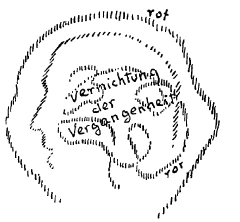
[ 6 ] If one correctly considers the human head, one must say: It is this head that is the source of a process that destroys matter as such. The material is destroyed, and it is precisely through this that the head, as such, becomes the bearer of a special spiritual life. One can only say: the bearer of a special spiritual life, for it is precisely with regard to the formation of the human head that the materialistic view, as it usually appears, is entirely wrong. Because the presence of the human head in the organism makes the human being the bearer of thought life and imaginative life, this entire imaginative life is based on the fact that material life is, in effect, disintegrating. But because material life is disintegrating, a remarkable process takes place, which I would like to bring before your mind’s eye through an image.
[ 7 ] Just imagine—as I said, it’s just a picture, but it will help you grasp the very subtle process we’re dealing with here—just imagine a painting, say, Raphael’s Madonna. Of course, we have—otherwise the painting could not exist in the physical world—the material substance of what is on the canvas. Now imagine, however, that the material substance of the Sistine Madonna were to be completely pulverized, reduced to dust, and yet a fine, ethereal fabric might remain. So the Sistine Madonna would disintegrate physically, but everything that is painted on that material—including its coloration—would remain in the etheric realm, and someone capable of perceiving the etheric could, even though the physical form loses all significance, perceive what remains as an etheric form.
[ 8 ] This is the thought process; this is how thoughts are formed. When you become aware, in ordinary consciousness, of a thought or an idea, this becoming aware of the mental image or thought is based on the fact that, as we saw yesterday and the day before, by stepping out of the entire cosmos, the material loses all meaning, and the human being is constantly compelled to, so to speak, revitalize the head, because all the details of the head are constantly in a state of decay, of fading away. And as this fading occurs, the etheric aspect of the head emerges (see drawing on page 103, red on the outside), and this emergence of the etheric aspect of the head signifies the grasping of thoughts. As the material aspect, so to speak, is shaken off and the etheric remains, the human being becomes conscious of his or her idea.
[ 9 ] Remember that I said: There is already, to a greater or lesser extent, something like a physical apparatus present in the senses. The eye is a physical apparatus; it is simply interwoven with the human etheric body. It is already the case, as I am now describing it, for the rest of the head, for the nervous tissue. So that we can say the following—I ask you to consider this sentence I am about to utter very carefully: In the senses, that is, specifically in the head senses, a distinct etheric being weaves its way through during perception. — So insofar as we live in the senses, we have a kind of free etheric process taking place in the sphere of the senses.
[ 10 ] Take the eye, for example. It is a physical apparatus, but it is permeated by the ethereal. And within this permeation of an inorganic substance—one that is constantly tending toward decay, which actually represents something mechanical, one might say, something sub-mechanical—the ethereal being lives freely. So it is for the realm of the senses.
[ 11 ] As for the nervous region—which is, after all, the inward extension of the sensory region—it is true that the nervous region connects the etheric body more intimately with matter, but our entire nervous life is constantly striving to become sensory life. So imagine this: You see, let’s say, some colored surface. At first, you have the sensory perception. Here, the etheric body weaves freely. But when you now turn away from the sensory perception and surrender to your nervous life, your entire nervous being becomes a sensory being: the mental image is present in your consciousness. One might say: Insofar as a human being is a nervous being, he becomes, in his mental imagery, a sensory being through and through.
[ 12 ] Then comes the reaction. The senses are oriented toward the physical realm. They are capable of continuous reception. The nervous system takes in whatever the senses present to it. It transforms itself into a sensory being. But in doing so, it destroys itself. It would become entirely an eye or entirely an ear, or something of that sort. To prevent this from happening, the vital principle—the life principle—from the rest of the organism penetrates it once more. Human beings, so to speak, allow the concept to fade away. So that we can say: Toward the head, human beings annihilate their past. Through this, as a nervous-sensory being, they become the bearer of images; they have an experience of images—an experience of images that weaves within the etheric.
[ 13 ] As you can see, if one adopts a humanities-based, anthroposophical approach, it is entirely possible to describe this life of thought as it arises in consciousness. And it is necessary to draw on anthroposophy in order to describe this life of thought in consciousness.
[ 14 ] We can therefore say: As human beings develop the head in terms of form, they develop it in the sense that, in the present day, they are exposed to the influences of those forces that develop in the cosmos when the Sun is in the signs of Pisces, Aries, Taurus, and so on; but human beings raise their heads in terms of form. As a result, the human head does not become an animal head; rather, the human being, one might say, turns toward the human vertical, while the animal remains within the zodiac.
[ 15 ] When we consider life, we can say that, as we saw yesterday, life develops toward the head under the influence of the outer planets, Saturn and Jupiter. But the human being sets this aspect of their life apart, and the following happens: If it were never overshadowed by the Sun—remember what I explained yesterday regarding Saturn and Jupiter—then the entire nervous life would increasingly become sensory life. Human beings would certainly have visual perception, but it would continue into the nervous life; they would have auditory perception, and it would continue into the nervous life—the sensory life of the twelve senses would intermingle chaotically and inorganically within the nervous life. Because these outermost planets are now obscured, the nervous life is torn away from sensory life, and the human being is able to behave exactly as I have described: to act consciously and arbitrarily in the life of imagination, to become, as it were, consciousness itself, to recall again by being able to arbitrarily suppress images, and so on.
[ 16 ] So that we can say: A distinct, ethereal essence is at work within the senses during perception. Within the nervous organism, a sensory life—weakened and connected to the body—is at work. — The whole takes on an imaginal character, because that which would cause us to deal not with an imaginal character but with a material one is destroyed by the human being’s emergence into the human vertical, while the animal remains within the animal circle. The animal has only dream-images, not pictorial images as the human being has. And dream-images are something that springs forth from the vital principle of the organism, whereas pictorial images are purely lifted up into the free ethereal life that is no longer connected to the physical body. It must be emphatically stressed that through the organization of the human being—through the elevation of the head region out of the images of the zodiac and out of the planetary weaves—a free etheric life arises in the human being directed toward the head region; that this free etheric life in the head is then permeated by the astral body and by the “I,” which thereby participate in the weaves of thought and imagination of the etheric body.
[ 17 ] This can already show us how to understand the soul when we know what it is that makes a person’s life of thought a spiritual one—that is, one that does not participate in material life.
[ 18 ] Let us now move on. We have shown—and let us now consider the other pole—how human beings develop in terms of form and life toward the other side. We saw the day before yesterday how human beings develop their external activity as beings of the limbs. I have shown you how human beings—and to do so we had to look back to the Greek era—are active as hunters, as animal breeders, as farmers, and as merchants sailing the seas. But human beings remain within this sphere of human activity by withdrawing from the influence of the corresponding fixed-star zodiac constellations. Animals, on the other hand, remain entirely under the influence of Sagittarius, Capricorn, Aquarius, and Pisces. As a result, animals develop their forms in such a way that they align themselves with the earthly realm; they develop exactly as they are. If one studies the zodiac, one can see why animals have developed their limb systems in a certain way. Human beings develop their limb systems in such a way that they align with the earthly realm when these zodiac constellations are situated below the Earth—that is, when the Earth is in that part of the zodiac in the northern hemisphere for a certain period of time. As a result, the continents are also habitable in various ways from a geographical perspective. However, human beings can transfer what they develop in one place to another. What is described here, of course, applies to earlier times; in the present day, the various human forms on Earth are intermingled, and when one studies geography today, one no longer has a pure picture of what the human being is in relation to the macrocosm. The human being thus breaks away from the zodiacal line in a different way. In a sense, he moves toward the other side, into the human vertical, into the human axis. And while he remains fully exposed—both in form to the images of the zodiac and to the outer planets with regard to his head—he withdraws from both planetary influence and the influence of the zodiac by standing on Earth and allowing the Earth to shield him from the other side. Saturn and Jupiter influence human beings by radiating their light down upon the Earth. The human being who lives a life of images in the head also receives the images of these stellar worlds, just as he receives the images of planetary movements, by developing his life being in the direction of the head. There he develops a life of images and also absorbs the images from the cosmos, from the macrocosm.
[ 19 ] He does not absorb the images from the other side. This gives rise to the forms I showed the day before yesterday—the limbs, which are the opposite forms of the main forms. And he also develops activities that elude the macrocosmic influence, that do not allow this macrocosmic influence to approach him.
[ 20 ] Now, while we can say that human beings destroy their past at the level of their head, the opposite is true at the level of their limbs. If a human being were to stand on a transparent Earth, so that the zodiac and the movements of the planets could also affect him from the other side, then, first of all, he would not be able to carry out independent, free actions. He would be under the influence of planetary and fixed-star life. It is only because the Earth shields him from this planetary and fixed-star life that he is able to freely develop his activity. But moreover, if he were fully exposed to it—especially during his specific lifetime, with his repeatedly recurring earthly existence—he would develop a lignified life, a strongly hardened life, within his limb system. He would not be able to break down the matter; rather, the organic matter would become keratinized before reaching maturity. In fact, human beings would have only limbs that were calloused in a completely different way—much like the hooves of horses or cattle—extending far up the body. Human beings are spared this callousing precisely because they rise above the animal realm.
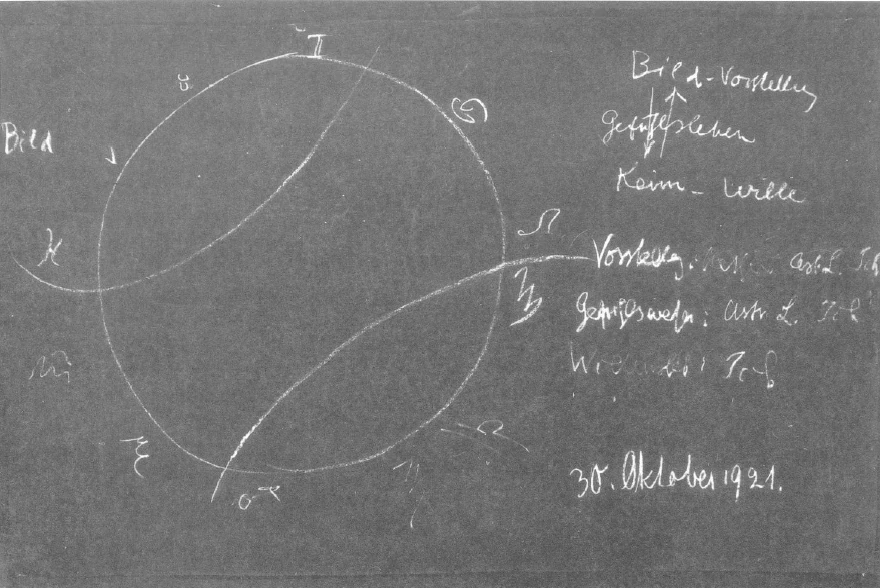
[ 21 ] But this results in the opposite process from what occurs after the “head end.” After the “head end,” the past is destroyed and matter is atomized. After the “limb end,” the human being develops in such a way that he does not allow matter to reach full cosmic maturity. It remains behind. He holds it back. We have fingers and toes only because we do not allow our limbs to grow to their full extent. If we were to let them grow fully, they would not only be covered with nails, but they would be completely stiffened and calloused. We therefore hold them back at an earlier stage. By holding back our limbs in this way, we are able to develop within them the will that then serves as the foundation for subsequent earthly lives. If we were to allow human beings to mature as “limb-beings,” then life would come to an end with our single earthly life. We preserve what carries over into the future by not allowing our “limb-human” to fully mature. So the opposite is true here: While, toward the end of the thought-life, the soul life becomes a life of images, in fact—if I may put it crudely—toward the end of the limb-life, life remains carnally material, organically material, and young, I might say. It does not grow old, it does not become calloused; it remains young. Because it remains young, the material aspect can then fall away, and the image of the young passes through death into the next earthly life. There, within that, the will can then develop. That is the end of the will. So that we can say: The end of the human will is an organic formation that has not yet come to an end. — If we can speak here (at the head end) of an image, then there we must speak of something else. What, then, is an organic formation that has not yet come to an end? A germ. For the germ can continue to develop. While at the head end we have something like an oyster shell—something that has separated as matter and is pure matter—after the end of the limbs we have something like germs. Here (above), we can say: We experience the pure etheric—the image—spiritually. Here (below), we do not experience the image, but rather we experience germinating life. (See illustration on page 112.) Here we experience a connection above with matter. That is why we can also move our limbs—because we are connected to matter. A person cannot move much in the head, except to the extent that the senses are transformed into limbs and the person is, in a sense, a human being with limbs in the head as well. Everything interpenetrates; each individual limb penetrates the others. In a certain sense, the eyes are also hands, insofar as they can move. But not much is movable on the head; the head is mostly immobile, and voluntary movement is, above all, denied—let us say—to the cerebral lobes and the like. But even on the outer surface of the head, little is movable, and it is indeed a rarity when a person can move certain ear muscles; he can already distinguish himself extraordinarily with this ability.
[ 22 ] This experience within matter does not allow consciousness to arise. But this very fact enables us to develop our will. So that here (above) we destroy matter, but here (below), when matter falls away from us at death, we retain seeds as a source of strength for our next earthly lives.
[ 23 ] What lies in between—we described it yesterday, on the one hand, as the respiratory system, when we consider life, or the circulatory system. We then saw how this is assigned as a form to that which lies between the upper zodiacal images and the lower zodiacal images.
[ 24 ] So if you imagine the fixed-star sky as it appears today in the following order: Aries, Taurus, Gemini, Cancer, Leo, Virgo, Libra, Scorpio, Sagittarius, Capricorn, Aquarius, Pisces—then we would have to assign these four zodiac signs (Pisces, Aries, Taurus, Gemini, see illustration) to the head, and under their influence, the head is endowed with a life that is fading away, in accordance with the planetary movements above the Earth. Thus, the head has an experience of images, an experience of imagination as a soul activity. The other four opposite signs for the present day—for the Greek system it would be somewhat different—would then be Virgo, Libra, Scorpio, and Sagittarius. And we would then have, for the rhythmic human being, what lies in between, just as we have Mars and Mercury from planetary life as the intermediate position, the planets that lie in between. There, we can say, the human being is such that he oscillates back and forth between the image and the germ within. The respiratory-blood life shows you this, I would say, wonderfully, as in an external image. The human being takes in the life-giving oxygen, which is connected to his limb system, to everything that moves within him. He combines the oxygen with carbon. Carbon first acts as a stimulant—as that which kills—on the nervous-sensory life; then it is expelled as that which first dies. There we have, in a material sense, the ultimate life in oxygen and the ultimate death in carbon: dying-reviving, dying-reviving. Life oscillates back and forth between dying and reviving.
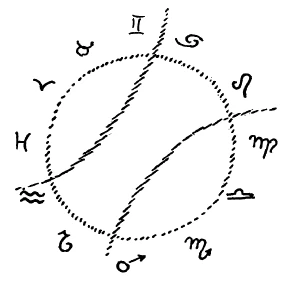
[ 25 ] Psychologically, however, what happens is that we experience something internally that, on the one hand—like our life of thought—is purely etheric; but the etheric body perceives certain structures, namely the glands. These glands secrete matter. Physically, this is what happens: the etheric body acts upon the glands. The glands do not connect to the etheric life in the same way as, for example, the muscles—which primarily belong to the limb system—but rather, as the etheric life takes hold of the glands, the gland secretes matter. It is, therefore, not a complete fusion of the etheric life with the material life. It is a transition. It is a grasping of matter, but at the same time a resistance on the part of matter, a secretion of matter. When you study the muscle or the bone—which belong to the limb system—you find that matter is strictly grasped—most so in the case of the bone—by the human etheric body. There, nothing is atomized; everything remains fresh and alive. There, matter is directly embraced by the human etheric body. In the head, nothing is embraced by matter; rather, as the head develops, matter dissipates. The free etheric weaving develops as the life of thought. As the etheric body embraces the glands, it does indeed connect with them, but they do not suffer from it; the muscle suffers from it. The muscle absorbs the etheric body. The gland is not affected by it; it immediately secretes matter and drives the ether right back out. This, in the soul, is the life of feeling.
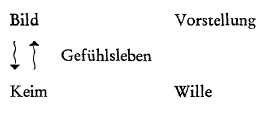
[ 26 ] So that we can now truly describe how the life of thought unfolds. Thought life proceeds in such a way that matter is not involved; it extends only as far as the etheric, and consciousness lives within this etheric. Emotional life proceeds in such a way that the etheric body takes hold of the glandular life, but the glandular life is not affected by it. However, while the etheric body disappears into the glandular life before the actual secretion takes effect, the human being does not have his etheric body at that moment; his etheric body disappears into the glands. He therefore experiences himself only in his “I” and in his astral body. And so it is with feeling.
Introduction: Etheric Body, Astral Body, Self
Emotional Life: Astral Body, Self
Volitional Life: Self
[ 27 ] So when we have the concepts of the life of thought: the life of the physical body is pushed aside, and the human being experiences itself in the etheric body, in the astral body, in the “I”—in the human head is the “I,” which interweaves the astral body, which interweaves the etheric body, and pushes the physical body aside; thereby the I, with the help of the astral body, experiences thoughts and thinking within the etheric body.
[ 28 ] The Emotional Being: The etheric body is taken from the human being as it takes hold of the gland; until the gland has completed its secretion, the etheric body is now withdrawn from the human being. It remains inside the physical body. At this point, the human being has only the astral body and the “I” for their inner, conscious experience. They experience this in a dreamlike, emotional way, because they are, after all, immersed in the physical body.
[ 29 ] Now we come to the life of the will. Here it is truly the case that the human being, with his etheric body, is completely immersed in organic matter. But in the waking state, the etheric body carries the astral body along with it. This is what enables a person to move. The person takes the astral body with them into matter. There, the astral body is also withdrawn from the person, and the person experiences only the “I” in their consciousness.
[ 30 ] As you can see, we find a complete connection between the soul life and the physical life. We need only be clear, based on anthroposophical insight, about how the I, the astral body, and the etheric body participate in the physical body; then we perceive the difference between the spiritual life of thought, the spiritual life of feeling, and the spiritual life of will, and we find that the spiritual life of thought resides in the part of the organism that is dying off—the part that has torn itself away from the upper world of fixed stars and the upper planetary world—dissolving the past and thereby becoming an experience of images. We find that in the middle region—in the rhythmic human being—the human being can, on the one hand, experience the past and thus also the macrocosm, which has indeed formed out of the past; but because a continuous rhythmic process is taking place—either a rhythmic combination of oxygen and carbon or the stimulation and secretion of the glands—the human being reacts to it. In being gripped by and grasping the macrocosmic life of the human being, and in the secretion, the microcosm—the individual human being—reacts to it. Human beings do not live in rhythm only inwardly; they live in rhythm with the world, opening themselves to the world and taking it into themselves. Human beings take the world into themselves; they are half-individual beings and oscillate rhythmically back and forth between the macrocosm and the microcosm. This is life and the weaving of feeling. And one can even see quite clearly how the material-physical aspect of the organism interacts with the soul-spiritual aspect. In the life of the will, it is the case that the material-physical is most strongly engaged, that there the human being is most purely a microcosm, and that in his activity he withdraws completely from macrocosmic activity.
[ 31 ] If he lives in the northern hemisphere, he simply withdraws from the other fixed stars and planets in the same way we do; in the southern hemisphere in a similar way—after all, the whole system rotates—and in this way, the human being, as a being of limbs, living as such between birth and death, is a complete microcosm, possessing a world of his own that can therefore carry itself forward into the future. Now he develops the youngest member of the soul life, the will, which still requires the full support of the physical body, which alone allows the “I” to come into being, while the astral body and the etheric body are absorbed into the physical body.
[ 32 ] No one will be able to understand the life of the soul unless they can grasp it in such a way that they can distinguish between the “I,” the astral body, and the etheric body; for the life of thought, the life of feeling, or the life of will will never be comprehensible to anyone unless the matter is grasped in such a concrete, inner way. If one rejects this understanding in the present day, what is the result?
[ 33 ] This leads to a situation where official representatives stand up and tell people: “Actually, we can know nothing about the soul, but nevertheless, based on certain phenomena, we must assume that there is such a thing as a ‘psychoid.’ They then stand there and explain how Descartes and Spinoza endeavored to determine the nature of this interaction, but they remain stuck at the abstract level: on one side the body, on the other the soul. One can never get to the heart of the matter this way, because in intellectual life the soul interacts with the body differently than in emotional life and in volitional life, and because one cannot understand this interaction if one simply muddles the entire life of the soul and speaks of a “psychoid,” instead of engaging with this configuration, this concretization of life in the “I,” the astral body, and the etheric body. Today there is—one might say—a terrible rejection of the truth; instead, there is mere stammering and, on the one hand, a partial rejection of Fechnerism, and on the other, talk of “psychoid.” This is just as if someone were to refrain from looking at a human being and speak of an “anthropoid” because they wish to avoid speaking of the “anthropos.” Essentially, such a science is not Anthroposophy at all, but rather Anthropoid-Sophy, Psychoidology.
[ 34 ] If one truly delves into the soul-spiritual life, then one can point out in every detail what people call “interaction” and so on. One then gains a real understanding of things, and one need not merely, I would say, neatly arrange what one cuts out of the liver and what one cuts out of the brain—as if they were abstract tissues—side by side; rather, one must know how the human being, at the head end, relates to the entire macrocosm in a different way than at the extremities. At the head, the human being disperses it; there, he annihilates the past. At the extremities, he does not allow his tendency toward growth to come to an end; he remains a germ.
[ 35 ] The worst thing is when, having ruled out a realistic view of reality, people then speculate about the nature of the body as well as the nature of the spiritual-soul, and then, in essence, speak in hackneyed words that they turn into “clichés,” without actually grasping what is at stake. There are people today who no longer even have the slightest idea of how to move from a word to a concept. For example, in Germany today, everywhere in the free religious communities and in the monistic communities—which are, in fact, both associations whose members live off the dregs of the materialistic natural science of the 1860s and 1870s—lectures are being held everywhere by a man named Arthur Drews, who is, in fact, constituted as follows: He once studied Hartmann’s philosophy—he always flitted around Hartmann in his younger years—but essentially absorbed only the words from this Hartmannian philosophy. These words are in his head like the play of automatic mechanisms; they roll around, and he has no idea how to move from a word to any concept. And with these words from Hartmann’s philosophy, swirling around in his head like automatons, he criticizes anthroposophy.
[ 36 ] These are the fruits of our present civilization, the fruits of our present education, which is determined to refuse to truly engage with the question of how one might gain insight into the connection between human beings and the cosmos, so that one can describe the form and life of the human being from the perspective of the cosmos and also understand how the specific separation of the human being from the cosmos causes him, on the one hand, to develop the pictorial, imaginative soul-being within a life that is withering away, and, on the other hand, to develop the volitional element of the soul within a life that remains in a germinal state.
[ 37 ] To those who are officially engaged in science today, these things actually sound like something they cannot understand. One should really refrain from expecting that those who have reached a certain age in official science—as a rule, I say, of course: as a rule—can still find their way into such matters, for they have, after all, essentially lost all concepts and thus all reality to their kaleidoscope of words. For those who see through reality, such lectures on psychoids are, in essence, nothing more than kaleidoscopes of words; what is expounded there—from Descartes, through Spinoza, and so on up to Fechner—actually has no inner connection; these are merely kaleidoscopes of words. For what could give these scraps of words—which are jumbled and swirling about like a kaleidoscope—an inner meaning is precisely the insight into the “I,” the astral body, the etheric body, and so on. One almost feels sorry that one must speak of the present in this way; but it is precisely where the so-called spiritual life is concerned that one must speak of the present in this way. The philosophers have lost their way because they lost the concepts behind the words several decades ago. Now it has been decided to appoint natural scientists in the modern style to the chairs of philosophy. They are then expected to pass on philosophy. It began with Mach, and one of the foremost representatives of this school today is Driesch. Since the philosophers have already lost all the content in their minds, while the natural scientists at least still possess external sensory observation, natural scientists have been appointed to the chairs of philosophy. Naturally, they speak of philosophy even more vacuously than the philosophers do. The philosophers at least still had the words. But a curious development has already taken place. We have witnessed how the philosophy of the first half of the 19th century—which still had substance—has completely evaporated into the “word heroes,” let us say of the Kuno Fischer variety. Yet even in the Kuno Fischer era, philosophers were still teaching from the lecterns. There was no longer any inner substance in this philosophy.
[ 38 ] But what is absolutely necessary is that we see through this connection, that we realize there must be at least some people in the world who see through all the nonsense spouted by the psychoids and who know just how deeply we are mired in decadence, particularly with regard to our scholarly education. One cannot emphasize this enough; and I believe it is good for you to delve deeply into what I have tried to present to your soul in these three lectures—namely, how the human being, on the one hand, seemed to connect with the universe through his outer form and his life, yet breaks away from the universe in both directions in order to merge, as a rhythmic being, into the rhythm of the universe; separates in order, on the one hand, to develop the life of thought as a life of imagery—that is, in freedom from matter—and, on the other hand, to develop the life of will in such a way that it preserves matter in its embryonic state, so that it does not yet assume the rigid form that might be imposed upon it by the macrocosm, so that the human being may remain flexible at this end and develop from Earth toward a Jupiter-, Venus, and Vulcan existence, so that human beings may preserve their flexibility in order to evolve beyond.
[ 39 ] If you hold all this together, you will see how what appears as knowledge in anthroposophy actually seeks to engage, first, the human sense of truth; second, the aesthetic sense, when you study the human being as a form—just as form emerges from the macrocosm; and third, the orientation toward goodness and religious life. It will become clear to you from these three lectures in particular just how deeply justified it is—as has often been stated here in courses and elsewhere—that we must seek a synthesis, a union, a harmony of religion, art, and science. But a union of religion, art, and science cannot be achieved without rising to a true cosmology that clarifies for us what the human being is in terms of form and life.
[ 40 ] What we need further is a doctrine of freedom with regard to the soul, one that explains to us what a human being is by breaking away from the macrocosm toward its two extremes, toward its two poles. And on the other hand, we need an understanding of what the human being develops in freedom toward the future of the worlds—toward what the Earth will give way to within the macrocosm. This then gives rise to deeply religious sentiments and feelings.
[ 41 ] In order for humanity to achieve a true advancement of our culture, it first needs a cosmology that encompasses humanity itself—one that does not, like our current cosmology, leave humanity out of the picture. We need a philosophy of freedom, and we need an ethics capable of showing how the goodness inherent in us is the seed of worlds. We need an ethics that embodies reality—not merely abstract values, but values that possess the power to actualize themselves. Cosmology, a philosophy of freedom, and ethics are what humanity needs for its ascent.