Anthroposophy as Cosmosophy I
Human Traits in the Earthly and Cosmic Realms
GA 205
29 October 1921, Dornach
Translated by Steiner Online Library
Sixteenth Lecture
[ 1 ] Yesterday we spoke about the formation of the human being and saw how the inner and outer form of the human being is shaped out of the universe; at the same time, we saw how profoundly, in times of older, instinctive knowledge, people had grasped this connection between the human form and the entire universe. However, we must note the following in this regard. In one of the drawings, I showed how the entire zodiac can be depicted within the human form. But as the human form, we actually had to depict the embryonic form of the human being. And when we depict this embryonic form, we have literally reproduced the shape of the zodiac within the human form itself. But in his life here on Earth, between birth and death, the human being, so to speak, breaks free from this embryonic form. During the embryonic period, he is entirely formed out of the universe. I would say: He then stretches out during his time on Earth. In doing so, he raises his head out of the circle that is modeled on the zodiac. And by raising his head—that is, by retaining during his physical lifetime the form he was endowed with embryonically, yet no longer integrating it into the fixed-star sky—human beings thereby gain, at least with regard to the form of the head, the ability to incorporate into this head form that which they bring over from their previous earthly life.
[ 2 ] The animal retains its horizontal spinal alignment. The head is attached to the spine only at the front. Essentially, the animal retains much more of this zodiacal form. As a result, however, the animal cannot, even with the help of its head, absorb anything from a previous earthly life. This is the case when we consider the human form from one perspective—that is, when we ask ourselves: If the human were modeled exactly after the zodiac, would it have this form (embryo)? Then, if he were to retain this form throughout his life, he would not be able to absorb his essence from the previous incarnation through the form of the head. By raising the head out of this position, the form is enabled to serve as a vessel for what comes from the previous earthly life.
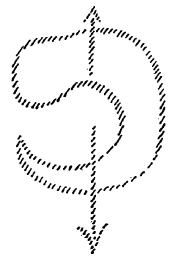
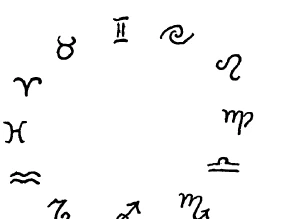
[ 3 ] But in the same way, human beings then emphasize the other side, which is oriented toward the last signs of the zodiac—Sagittarius, Capricorn, Aquarius, and Pisces—that is, as we said yesterday, toward external life, toward the older external conditions of life: hunting, animal husbandry, agriculture, trade, and seafaring. Because human beings, in turn, shape these activities out of their own will—that is, out of their system of limbs, which they have raised above the orientation of the zodiac—they retain, in all these activities of theirs, in all human activities in general, the possibility, the seed, of future earthly lives. The animal remains entirely oriented within the zodiac. Consequently, the animal has no possibility of taking anything in from a previous earthly life or of looking ahead to a subsequent one. This is why what we have called the “circle of orientation”—the zodiac—is, out of a deep wisdom rooted in ancient instinctive knowledge, specifically named the zodiac.
[ 4 ] From all this you can see just how profound this older, instinctive wisdom actually was, and how, when we engage in spiritual science again today, we now arrive at the same facts—not out of instinct, but out of clear consciousness—and thereby recognize once again what was so vividly present in that ancient, instinctive knowledge, as I have indicated here in my recent lectures, and for which we gain ever greater respect the more insight we gain into this primordial wisdom of humanity. That is what I would like to say to you first about form.
[ 5 ] What, so to speak, flows into this form in human beings—what is poured into this form—is life. We find this human life localized in the human etheric body just as we find the form localized in the physical body. And it is entirely appropriate, when considering the human physical body, to study it in terms of its form, for form is the essential aspect of the physical body. Added to the physical body is the etheric body, and this etheric body of the human being primarily represents what life is. So yesterday we discussed form, and today we will focus on life.
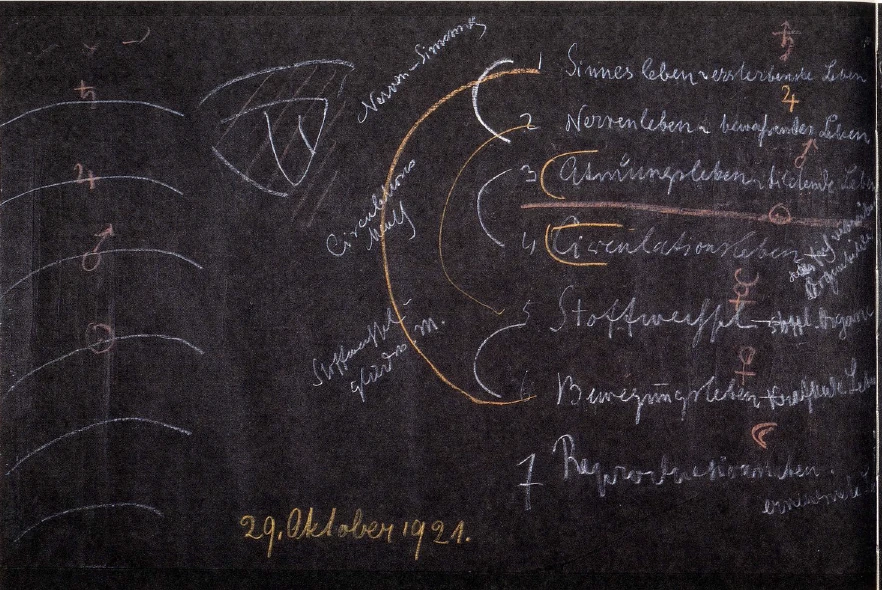
[ 6 ] Yesterday we saw how the form is actually composed of twelve different forms, and we tried to study these twelve different forms. The overall form of the human being, both internally and externally, arises, as we have seen, from twelve individual forms. Similarly, human life arises from a series of individual stages of life. And these individual stages of life can initially be visualized in the following way before the soul (see diagram on page 86).
[ 7 ] The first thing that people in their everyday consciousness usually do not yet regard as a stage of life is sensory life. The senses are, of course, integrated into the entire human being, but they lie so far on the periphery, on the outskirts of the human being, that in everyday life people actually forget that this sensory life is the outermost layer of their existence. Yet we have this outermost layer of our existence—the sensory life—on the outskirts.
[ 8 ] If we proceed further inward, then—by limiting ourselves to the consideration of life—we arrive at the continuation of sensory life inward, and this sensory life continues inward into nervous life. After all, the nerves extend inward from the sense organs. Nervous life is a continuation of sensory life.
[ 9 ] But nervous life, in turn, comes into contact with another form of life, with another level of life that unfolds within the human being. From certain perspectives, I have already described this on previous occasions. I have drawn your attention to how a person breathes in. By breathing in, they take in the air they breathe. This breath initially sets the human being into a kind of inner rhythm. This rhythm continues through the spinal canal all the way to the brain. And I have pointed out what arises from these extensions. Here, the nervous life comes into contact with the respiratory life. And the next level of life, as we move inward, is in fact the respiratory life.
[ 10 ] The respiratory life, for its part, is closely linked to another level of life. Breathing, if we may put it that way, constantly renews the blood. Thus, the rhythm of breathing is connected to the rhythm of the blood, and we can move from the life of breathing to the life of circulation—the life contained within the rhythm of circulation.
[ 11 ] Circulation, in turn, is connected to the entire metabolic process from another perspective. Circulation incorporates metabolism, bringing us to the next stage of life: metabolism.
[ 12 ] Metabolism, in turn, stimulates the actions we perform in our external movements. It is only because human beings live through metabolism that they are able to move externally. Human metabolism—and animal metabolism as well—is such that the human soul can utilize what takes place in metabolism to bring about movements, and this leads us to our life of movement. There we once again integrate ourselves into the external world. There, through what we produce, we participate in the external world.
[ 13 ] And then there is yet another stage of life: reproductive life. In motion, a person does indeed continually consume themselves, and internal reproduction must take place precisely because the person is in motion. So that instead of “life of movement,” one could also write its correlate: “internal reproduction,” if one were to remain within the person’s skin. And when this reproduction occurs independently, it occurs in the life of procreation—in the life of reproduction proper.
1. Sensory Life
2. Nervous Life
3. Respiratory Life
4. Circulatory Life
5. Metabolic Life
6. Motor Life
7. Reproductive Life
[ 14 ] Just as we developed twelve elements of the human form yesterday, today we have developed seven stages of life. These seven stages of life are such that, in relation to their etheric body, human beings live in different ways at these various stages. We cannot speak of a single, indistinct life if we wish to consider these matters seriously.
[ 15 ] Our etheric body lives, if I may put it that way, primarily in the sensory realm. It lives the sensory life within the sensory realm. This life in the sensory realm is the life that we, in fact, hardly perceive as life anymore. Through it, we participate in the external world. Our etheric body—let’s say, for example, when we consider the eye—permeates the eye. It is alive. Through this, it animates the eye in a subtle way. But it comes into contact with a substantial element in the eye that is close to dying. It is only because the etheric body still permeates this eye that it remains a living organ. Apart from the etheric body that permeates it, it is actually a physical apparatus.
[ 16 ] Now, the various senses are structured in a wide variety of ways, in that, on the one hand, they are physical organs and, on the other hand, they are permeated by the etheric body. But on the whole, it is certainly the case that the sense organs are actually dead organs that are simply permeated by the etheric body. Thus, one can already call sensory life “dying life” (see table on page 89).
[ 17 ] Nervous life, on the other hand, takes what is experienced through the senses and transforms it into what sensory life can then retain. All aftereffects are based on nervous life—for example, when we look at the eye—so that in nervous life we have a kind of resting life, a life that we might call resting or preserving.
[ 18 ] Respiratory life, on the other hand, is what gives this fleeting yet enduring sensory life its pictorial quality. It is the interaction of the respiratory rhythm with the nerve currents that enables us to form images of the external world. Thoughts—abstract thoughts—are still entirely bound to nervous life, but the pictorial is bound to respiratory life. So one can say: Here we have the formative life. — Thus, by breathing, we have formative life within us. This formative life naturally lives within the human form. By living within the human form, it participates in the human form.
[ 19 ] The human form, as we have seen, is shaped according to the zodiac. Because this very formative life, mediated through breathing, lives within the human form, it also participates in the entire outer form shaped by the starry sky. Through this, this form also extends into the inner being of the human being. And it is through breathing that not only does what the human being holds in consciousness emerge from the breathing process, but that what first emerges from the breathing process are the images of all the internal organs, modeled after the external form. The internal organs are thus first formed as images through the indirect process of breathing. At this stage, they are not yet substantial. Breathing first forms an image of the human being, an image of the inner human being. As we breathe—for we breathe in the world, moving with the Earth through the zodiac—we continually inhale the images of our inner organization. From external life, we inhale the images of our inner organization. So that we can say: Here we have the formative life. — These images that are inhaled are now distributed throughout the entire organism by the circulatory life. The circulatory life and the respiratory life together lead the human being to be, inwardly, an image of the world. We can therefore say: Here is the formative life, and then we can say: the spreading images, the spreading, the spreading organ images.
[ 20 ] Now, because the circulatory life is linked to metabolism, matter is incorporated into these images, and the physical organs arise at the fifth stage of life. Matter pushes its way into the images. It colors the images. So through our higher self, through our respiratory life, we have our inner image, and we transform these images into realities, so to speak, through the coloring substance that pushes its way into them.
[ 21 ] The life force flows from the life of movement into the physical organs. So we can say: We have the physical organs, and within them we have the life force at work. And the reproductive life is then the life that renews itself.
[ 22 ] At the same time, you can see how the threefold human being is constituted: the nervous-sensory human being, the circulatory human being, the rhythmic human being, and the metabolic-limb human being, or the metabolic-movement human being. It is through reproduction, after all, that the new human being comes into being.
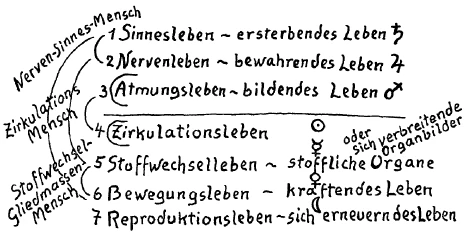
[ 23 ] These attributes, which I have listed here on the right, give you an idea of the differences that exist between the stages of life. Because our etheric body lives in the senses, it lives a kind of dying life. In the life of preservation, it exists within the nervous life, within the nerve currents. In the life of respiration, our etheric body actually becomes the true body of formative forces, which designs the images. And the life of circulation is what enables these images to truly become the entire inner organization. This is filled with substance through the metabolic life. As the etheric body permeates the metabolism, it colors the actual body of formative forces. And then the subjective human force enters through the life of the limbs and so on.
[ 24 ] Ancient instinctive wisdom also understood these connections. It knew that human beings take in life from the outside and shape it further within—truly shape it further within. This is roughly how those ancient sages conceived of the matter. They said to themselves: Let us take the outermost layer of the Earth’s orbit, the world sphere; let us take the next layer; let us take yet another layer—thus we have the outermost layer, which is initially closest to the fixed-star sky, that is, the one in the cosmos to which human beings owe their form. His life, said this ancient, instinctive wisdom, does not flow to him from the fixed-star sky, but from the planetary sky. Thus, people first distinguished Saturn, Jupiter, Mars, and the Sun. If we consider the Sun in its true essence—I have, after all, spoken often about this true essence of the Sun—it differs from the other members of the planetary system belonging to the Earth—which is why it is called a fixed star in popular astronomy—in that it appears as a source of light. It appears as a source of light. It differs from the other members in that the other members do not appear as sources of light, but rather as images. That is why, in popular astronomy, it is said: They have borrowed light; they reflect the light of the Sun. — The Sun itself, in the popular sense, produces the light; the other planetary bodies reflect the light.
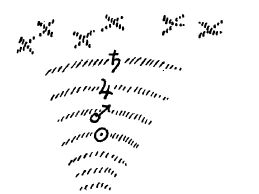
[ 25 ] Consider the difference: whether one has the Sun, which allows one’s own essence to emerge in its light, or whether one has the other celestial bodies—the planets—which merely reveal the image of their outer form, so to speak, only what they bear on their surface, by reflecting the Sun’s light. It is a fundamental difference.
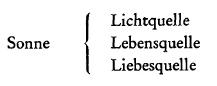
[ 26] And since the sun is, in a sense, the source of light, it is also the source of life. And it is yet another source as well. Throughout the ages, people have spoken—based on instinctive knowledge—of a threefold sun: the sun as a source of light, a source of life, and a source of love. This trinity is indeed contained within the sun.
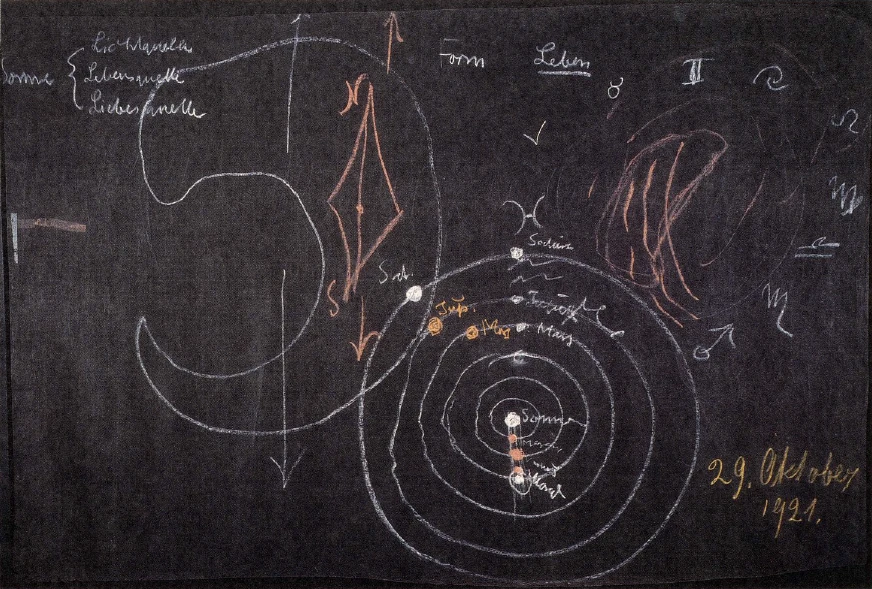
[ 27 ] Now, you don’t have to go against the Copernican system of the world today; rather, you can certainly retain it and still, from within this Copernican system, come to understand what the ancients—who possessed an instinctive cosmic insight—meant by their own system of the world. So let’s assume—following Copernican thought—that the Sun is at the center, or, if you will, at a focal point, though we can disregard that for now; let’s say the Sun is there; Mercury, Venus, Earth, and Mars—we can disregard the asteroids for now—as well as Jupiter and Saturn, revolve around it.
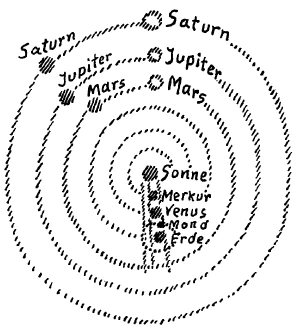
[ 28 ] But let’s look at it this way: Let’s take the position—which is certainly possible—where we have Saturn, Jupiter, and Mars here (at the top), and then we come to the Sun, Mercury, Venus, and Earth, along with the Moon, which we place here like this.
[ 29 ] Now, of course, it is not necessary to consider such a configuration; I am merely presenting it to show you that, in fact, despite the Copernican system, the order assumed by the ancients—Moon, Venus, Mercury, Sun, Mars, Jupiter, Saturn—is also possible. One need only consider the constellations in such a way that the Earth is on one side of the Sun and the outer planets are somewhere on the other. It is by no means necessary for such an opposition or conjunction to occur; it can also happen alternately, in turn, but this sequence is certainly conceivable. And this sequence was conceived by an ancient, instinctive wisdom.
[ 30 ] Why? Because this order seemed important to them. The ancient person said to himself: Let’s assume that human beings live here on Earth. Human beings are exposed to the universe. They experience the sun’s rays. At first, the sun’s rays are a source of light, a source of life, and a source of love for them. Through them, light, life, and love enter into them. The sun is the source of these three. But human beings are not only exposed to the life of the sun, the love of the sun, and the light of the sun, but also to the imagery of Saturn. If human beings, developing here on Earth, were exposed only to the life of the sun, they would not be able to develop the life of their senses. Take the eyes—one of the senses: they would not emerge as physical organs. They would simply be located inside the body, just like any other part of the human body. They would be something like muscular organs or vessels. So if human beings were constantly exposed to the Sun, they would simply not be able to develop their eyes, nor their other senses. The fact that they can develop their senses is due to the fact that Saturn, which moves in the outermost sphere, attenuates the Sun’s influence. So Saturn, in a sense, dries out the vessel, and this gives rise to the physical apparatus, roughly speaking. Thus, based on this instinctive insight—which we will return to today—the ancient people said: “Sensory life is brought about by Saturn.”
[ 31 ] And a second point: Human beings are not merely subject to the life of Saturn. If they were constantly exposed to the life of the Sun, not only would they be unable to develop their senses, but they would also be unable to develop their nervous life. The nervous system dries out; otherwise, it would grow out of control. The nerves would also be organs, just like the muscles. This drying-out process in the nervous system corresponds to the influence of Jupiter. That is why the ancients said: The nervous system is stimulated by Jupiter.
[ 32 ] You see, Saturn orbits the Sun in roughly thirty years. So, naturally, a person living on Earth will experience, at least once, a time when Saturn is, so to speak, obscured by the Sun. If a person is fortunate enough to experience Saturn being particularly strongly obscured by the Sun, then a powerful solar life begins to dawn within their sensory life. One might say: The eyes or other senses—though the eyes are actually the least relevant here, we can best illustrate this with them because they are the most obvious—the eyes are then stimulated. So if a person experiences, during their earthly life, a constellation in which Saturn, so to speak, does not act upon their senses, then it may be that they discover how a particular cosmic influence takes place precisely through their senses. They receive a stimulus. They become more sensitive. Such things exist. People then want to explain them as all sorts of things, just not as what they actually are.
[ 33 ] There is a vast body of American literature on these subjects today. Take William James, for example, who speaks of all kinds of “awakenings.” He discusses how there are people in whom life undergoes a special awakening. Just take a look at the books by William James and those of his students, and you will find that this constitutes a special phenomenon: that a person experiences a special stimulation at some point in time. Of course, these people do not know where this comes from; they do not know that it stems from the fact that such a constellation occurs either with Saturn or Jupiter. When the Saturn life is obscured, the sensory life is particularly stimulated; when the Jupiter life is obscured—which, incidentally, can be even easier, since Jupiter orbits every twelve years, that is, more quickly—the person experiences a stimulation of their nervous life.
[ 34 ] All these things that are listed there are relegated to the subconscious. This subconscious is nothing more than a cozy refuge today for people of the sort of William James, of the sort of psychoanalysts. This subconscious—it’s, after all, a purely negative concept—is a spittoon into which one can spit everything for which one no longer has any explanation in life. This subconscious is nothing but a spittoon. Everything has to go in there, in, in; that’s where the hidden “provinces” of the soul are, aren’t they, inside, which then occasionally react and so on. It would be highly desirable for all these theories—both pragmatic and psychoanalytic—to be subjected to a more thorough examination.
[ 35 ] The third planet is Mars. It tempers the vigorous life force of respiration. Of course, it can also happen that the Sun obscures it. In that case, the respiratory life can experience a special stimulation. But since Mars orbits very quickly—in about two years—almost everyone experiences this, and therefore everyone receives certain stimulations in their respiratory life and in their experience of images. These aren’t always of the highest order, but people who receive these stimulations in their respiratory life then become poets or the like, or composers. It does not go so deep that people like James would speculate about it. It is seen as something that can be explained. Thus, the ancient, instinctive sages regarded Mars as a source of inspiration for the respiratory life.
[ 36 ] Then it is the life of the sun itself that stimulates human beings—the sun itself, the sun as the source of life, love, and light: externally a source of light, internally a source of love, and, in interaction with the outside world, a source of life. This is now placed at the center between the respiratory life and the circulatory life, where ancient wisdom also placed it. Between the respiratory life and the circulatory life lies the heart—the expression, not the motor, but the expression of what takes place between circulation and respiration.
[ 37 ] And then we come to metabolism. As I said, ancient science viewed the constellation in this way: it did not regard Mercury by focusing on the extent to which the Sun can obscure it, as it does the other planets, but rather on the extent to which it obscures the Sun as seen from Earth—that is, that it obscures the Sun. For Mercury, ancient wisdom considered its position between the Sun and Earth to be the essential factor. For Jupiter, ancient wisdom regarded its position outside the Sun as the essential factor. For Mercury, it considered the position between the Sun and the Earth to be important for the development of human life. There, Mercury obscures the Sun. Otherwise, the Sun has always obscured the other planets; here, Mercury obscures the Sun, which means it weakens life. Because this exerts an effect—that is, the solar life is weakened—the weakened life within is stirred. If this life were not weakened, a person—whenever he consumed anything—would, if you’ll pardon the expression, immediately vomit it back up; he would not tolerate any external substance within himself at all; he would vomit constantly. He would then give up eating altogether, because that would be far too tedious. The life of the Sun is precisely that strong within the human being. If, therefore, there were only heart life—that is, solar life—the human being would be unable to process any substances within himself. He would vomit everything up immediately. The fact that the human being can develop a metabolism is due solely to the fact that the Mercury life somewhat weakens the solar life. For this reason, ancient wisdom, acting as a continuing influence from the cosmos, conceived of the Mercury being as intervening between the circulatory life and the metabolic life. The Mercury being thus pushes the substance through the human organism into the individual organs. The force, however, is propelled into them by the life of movement.
[ 38 ] The life of movement is just as dependent on the Venus life as the life of metabolism is on the Mercury life. Therefore, ancient wisdom has attributed to the Venusic life the power that flows through us—that is, this inner self-renewal, this feeling of a second, powerful being within oneself.
[ 39 ] The lunar life, which is closely linked to earthly life itself, does not merely have a dampening effect in the sense that it causes humans to process matter and energy. I once explained the basis of reproduction: matter is set aside; in a sense, it is organically pushed back. This is the basis of germ formation in humans—that matter is organically pushed back and that the embryo is, in terms of its power, actually organized from the cosmos. In this respect, the life of reproduction is based on the lunar life.
[ 40 ] Just as I was able to illustrate to you yesterday the relationship of the human form in its twelve parts to the fixed-star sky, so today I have endeavored to show you how, in harmony with both ancient instinctive wisdom and modern anthroposophical science, human life in its various stages is connected to planetary-cosmic life. And this occurs because, in fact, the Earth’s varying position relative to the members of the planetary system and to its center—the Sun—modifies life in the most diverse ways. It is rendered dormant, preserved, and driven toward development in the higher human being. It is weakened in the lower human being, so that the human being can absorb from the Earth the material substance and the Earth’s power. Human beings simply absorb the Earth’s repulsive force into their own strength and thereby develop the strength of their organs, and so on.
[ 41 ] In this way, we also see human life emerging from the cosmos (see list: Planets).
[ 42 ] Here we have the opportunity to say to ourselves: When we look up at the fixed-star sky, we see in it the representatives—namely, in the signs of the zodiac—of the formation of the human form. If we observe the movement of the planets, we find in them what explains to us, from the cosmos, the various stages of human life. We look as far as Saturn, considering the sensory life; as far as Jupiter, considering the nervous life; and as far as Mars, considering the respiratory life. This respiratory life works through images.
[ 43 ] Now let us focus specifically on this respiratory life. I told you: The images are received from the cosmos—form. So what is experienced through the zodiac in movement flows inward, as it were, as the images of the internal organs. But the human being stands on Earth between birth and death. The lower realm acts upward toward the upper realm. As a result, everything is always formed in a polar manner. These images do indeed flow inward; otherwise, we simply would not have organs if the images did not flow inward and could be imbued with matter. But a counter-process takes place everywhere. So we can say: When we breathe, the images—let’s say, for example, the image of the kidney—are driven inward. The substance then fills this out (red); but a counterpart arises, again directed upward. That is to say, these images are, as it were, thrown back in an echo. So these are the images that the human being has once taken in. You need not think of simultaneity; the organs are already there. The human being naturally formed these things in the early stages of their earthly existence, but the rebound can occur continuously. We will see tomorrow how the soul is involved in this process. The rebound occurs continuously. So imagine each one for itself: You take in the images of your internal organs through the life processes. This is then pushed back; that is, the echoes of these images—including the zodiac, particularly with the respiratory life within it—come back up again. Well, you need only think of your ears, and you have this rebound. These images are formed in the air—these are the vowels and the consonants! The vowels come more from the planets, while the consonants come from the images of the zodiac. This rebound is language. What goes in forms the organs. What is rebounded back lives in language. Consonants and vowels are, so to speak, driven into us, forming the foundation of our organs. What is more form within us comes more from the zodiacal signs; what is more life comes more from the planets. When more of the life is reflected back, we vocalize; when more of the forms are reflected back, we consonantize. All of this is connected in a certain way to the life of breathing. Well, in language you can clearly see how it is connected to the life of breathing.
[ 44 ] You see, there’s nothing wrong with trying to explain human beings by laying them on a dissection table and examining what’s inside their skin. That’s no different from someone taking a magnetic needle and trying to ignore the fact that the Earth itself is a large magnet—with the top half on the left (red)—so that one end is drawn northward and the other southward by an external force. If someone absolutely wants to explain why this magnetic needle inherently tends to point in a certain direction — for when I turn it, it always turns back around — if one attributes this to the needle itself, that is, if one invents a theory as to why the magnetic needle aligns itself in this way of its own accord, without taking into account that the Earth’s forces are directing it, then one is doing exactly the same thing that is done today in anatomy and physiology when attempting to explain human beings based on what lies within their skin. It cannot be explained by what lies within the skin. All those who, for example, seek to explain language based on what is inside the human being stand on the same level as this explanation of the magnetic needle, whereas the truth is that the human being takes in the form of the fixed-star life, echoes it back, and thereby forms consonants. He takes in the movements of planetary life, which bring about his own life. Images are formed there, particularly through the respiratory life. But these are reflected back; this gives rise to the vowels. Human speech can only be explained by attributing the consonants to the constellations and the vowels to the planetary movements—or, more precisely, to the superimpositions of the planets—that is, by explaining what humans speak in terms of the entire cosmos.
[ 45 ] Here, in the sun (see drawing on page 89, horizontal line), you have, so to speak, the center. Take the three upper members, and you have the upper human being. Take the three lower members, and you have the lower human being. The reproductive life, after all, brings forth the new human being. Now consider the respiratory life and the circulatory life. It is the circulatory life, in particular, that reflects planetary movement. Our blood circulation is, in essence, nothing but a reflection of planetary life. So we can also say: the vowels arise from the circulatory life, and the consonants from the respiratory life. And now you have another curious correspondence. You can associate the metabolic life with the nervous life; you can associate the movement life with the sensory life. The sensory life, however, is associated with Saturn, with the movement of Saturn. The movement of Saturn, if I may put it that way, passes closest to the zodiac, just as in the movement life, the human being is best reflected outwardly. If, therefore, one wishes to have the cosmic mysteries represented through the human being, one has the sensory life at one pole and the motor life at the other, and from this one obtains—eurythmy. In eurythmy, then, one can see directly a reflection of the human being’s peripheral cosmic relationship. I just wanted to hint at that for now.
[ 46 ] So what I have sought to develop for you today is the connection between the human being and the cosmos in relation to human life. Yesterday I sought to explain to you the connection between the human being and the cosmos in relation to human form. Tomorrow we will move on to considering the third element of the human being in relation to the world: the soul. We will then have examined form, life, and soul. So tomorrow we will place the human soul within the context of cosmic life.