Anthroposophy as Cosmosophy I
GA 208
29 October 1921, Dornach
Translate the original German text into any language:
Versions Available:
Anthroposophy as Cosmosophy II, tr. SOL
Sechzehnter Vortrag
Sixteenth Lecture
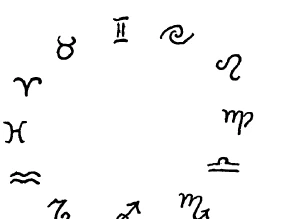
[ 1 ] Wir haben gestern gesprochen von der Formung des Menschen und haben gesehen, wie die innere und äußere Form des Menschen herausgebildet wird aus dem Weltenall, und haben zugleich gesehen, wie bedeutsam in Zeiten älteren instinktiven Erkennens die Menschen diesen Zusammenhang der menschlichen Form mit dem ganzen Weltenall durchschaut haben. Wir müssen aber dabei doch das Folgende festhalten. Ich habe in einer der Zeichnungen gezeigt, wie man einzeichnen kann in die menschliche Gestalt den ganzen Tierkreis. Aber wir mußten als menschliche Gestalt dann eigentlich die Embryonalform des Menschen aufzeichnen. Und wenn wir diese Embryonalform aufzeichnen, dann haben wir förmlich in der Gestalt des Menschen selber die Tierkreisform nachgebildet. Der Mensch aber reißt sich gewissermaßen in seinem Leben hier auf der Erde zwischen Geburt und Tod aus dieser Embryonalform heraus. Er ist während der Embryonalzeit durchaus aus dem Weltenall heraus geformt. Ich möchte sagen: Er streckt sich dann während seiner Erdenzeit. Dadurch hebt er sein Haupt heraus aus dem Kreise, der dem Tierkreis nachgebildet ist. Und dadurch, daß er sein Haupt heraushebt, daß er also während seiner physischen Lebenszeit zwar noch die Form hat, die er embryonal veranlagt bekommt, aber sie nicht mehr eingliedert in den Fixsternhimmel, dadurch bekommt der Mensch zunächst in bezug auf die Hauptesform die Möglichkeit, in diese Hauptesform aufzunehmen dasjenige, was er herüberbringt aus dem vorigen Erdenleben.
[ 1 ] Yesterday we spoke about the formation of the human being and saw how the inner and outer form of the human being is shaped out of the universe; at the same time, we saw how profoundly, in times of older, instinctive knowledge, people had grasped this connection between the human form and the entire universe. However, we must note the following in this regard. In one of the drawings, I showed how the entire zodiac can be depicted within the human form. But as the human form, we actually had to depict the embryonic form of the human being. And when we depict this embryonic form, we have literally reproduced the shape of the zodiac within the human form itself. But in his life here on Earth, between birth and death, the human being, so to speak, breaks free from this embryonic form. During the embryonic period, he is entirely formed out of the universe. I would say: He then stretches out during his time on Earth. In doing so, he raises his head out of the circle that is modeled on the zodiac. And by raising his head—that is, by retaining during his physical lifetime the form he was endowed with embryonically, yet no longer integrating it into the fixed-star sky—human beings thereby gain, at least with regard to the form of the head, the ability to incorporate into this head form that which they bring over from their previous earthly life.
[ 2 ] Das Tier behält seine horizontale Rückgratlage. Der Kopf hängt vorne nur an dem Rückgrat daran. Das Tier behält im Grunde genommen viel mehr bei von dieser Tierkreisstellung. Dadurch aber kann das Tier auch mit Hilfe seines Hauptes nichts aufnehmen von einem vorigen Erdenleben. Das ist so, wenn wir die Form des Menschen nach der einen Seite betrachten, wenn wir uns also sagen: Würde der Mensch genau dem Tierkreis nachgebildet sein, würde er diese Form haben ink (Embryo). Dann, wenn er während des Lebens diese Form beibehielte, würde er nicht sein Wesen aus der vorigen Inkarnation durch die Hauptesform aufnehmen können. Dadurch, daß er das Haupt heraushebt aus dieser Stellung, dadurch wird die Form in die Möglichkeit versetzt, Umhüllung zu sein für das, was aus dem vorigen Erdenleben kommt.
[ 2 ] The animal retains its horizontal spinal alignment. The head is attached to the spine only at the front. Essentially, the animal retains much more of this zodiacal form. As a result, however, the animal cannot, even with the help of its head, absorb anything from a previous earthly life. This is the case when we consider the human form from one perspective—that is, when we ask ourselves: If the human were modeled exactly after the zodiac, would it have this form (embryo)? Then, if he were to retain this form throughout his life, he would not be able to absorb his essence from the previous incarnation through the form of the head. By raising the head out of this position, the form is enabled to serve as a vessel for what comes from the previous earthly life.
[ 3 ] Ebenso aber hebt der Mensch dann die andere Seite heraus, die nach den letzten Tierkreisbildern hin orientiert ist, nach dem Schützen, dem Steinbock, dem Wassermann und den Fischen, also, wie wir gestern gesagt haben, nach dem äußeren Leben, nach den älteren äußeren Lebensverhältnissen: der Jagd, der Tierzüchtung, dem Ackerbau und dem Handel, der Schiffahrt. Dadurch, daß der Mensch wiederum diese Verrichtungen aus seinem Wollen heraus bildet, also aus seinem Gliedmaßensystem, das er aus der Tierkreisorientierung herausgehoben hat, dadurch bleibt ihm in alldem, was diese seine Verrichtungen, was überhaupt menschliche Verrichtungen sind, die Möglichkeit, der Keim zu späteren Erdenleben. Das Tier bleibt durchaus im Tierkreis drinnen orientiert. Dadurch hat das Tier keine Möglichkeit, von einem vorigen Erdenleben irgend etwas aufzunehmen oder nach einem folgenden Erdenleben hinüberzublicken. Daher wird auch das, was wir als den Orientierungskreis, den Tierkreis bezeichnet haben, aus einer tiefen Weisheit der älteren instinktiven Erkenntnis heraus eben der Tierkreis genannt.
[ 3 ] But in the same way, human beings then emphasize the other side, which is oriented toward the last signs of the zodiac—Sagittarius, Capricorn, Aquarius, and Pisces—that is, as we said yesterday, toward external life, toward the older external conditions of life: hunting, animal husbandry, agriculture, trade, and seafaring. Because human beings, in turn, shape these activities out of their own will—that is, out of their system of limbs, which they have raised above the orientation of the zodiac—they retain, in all these activities of theirs, in all human activities in general, the possibility, the seed, of future earthly lives. The animal remains entirely oriented within the zodiac. Consequently, the animal has no possibility of taking anything in from a previous earthly life or of looking ahead to a subsequent one. This is why what we have called the “circle of orientation”—the zodiac—is, out of a deep wisdom rooted in ancient instinctive knowledge, specifically named the zodiac.
[ 4 ] Aus alldem ersehen Sie, wie gründlich eigentlich diese ältere instinktive Weisheit war, und wie wir, wenn wir heute wiederum Geisteswissenschaft treiben, jetzt nicht aus Instinkt, sondern aus einem klaren Bewußtsein heraus zu denselben Tatsachen kommen und dadurch wieder erkennen, was in einer alten instinktiven Erkenntnis so gelebt hat, wie ich es in den letzten Vorträgen hier angedeutet habe, und wovor wir immer mehr und mehr Respekt bekommen, je mehr wir Einblick gewinnen in diese Urweisheit der Menschen. Das ist es, was ich Ihnen zunächst über die Form sagen möchte.
[ 4 ] From all this you can see just how profound this older, instinctive wisdom actually was, and how, when we engage in spiritual science again today, we now arrive at the same facts—not out of instinct, but out of clear consciousness—and thereby recognize once again what was so vividly present in that ancient, instinctive knowledge, as I have indicated here in my recent lectures, and for which we gain ever greater respect the more insight we gain into this primordial wisdom of humanity. That is what I would like to say to you first about form.
[ 5 ] Was nun in diese Form beim Menschen gewissermaßen einfließt, was in diese Form ergossen ist, das ist das Leben. Dieses Leben des Menschen, das finden wir ebenso im Ätherleib des Menschen lokalisiert, wie wir die Form im physischen Leib lokalisiert finden. Und es ist durchaus das Richtige, wenn man den physischen Leib des Menschen betrachtet, ihn seiner Form nach zu studieren, denn die Form ist das Wesentliche an dem physischen Leibe. Zu dem physischen Leibe kommt der Ätherleib hinzu, und dieser Ätherleib des Menschen, der repräsentiert vorzugsweise dasjenige, was das Leben ist. Wir haben also gestern die Form besprochen und wollen heute das Leben beoben Mitte sprechen.
[ 5 ] What, so to speak, flows into this form in human beings—what is poured into this form—is life. We find this human life localized in the human etheric body just as we find the form localized in the physical body. And it is entirely appropriate, when considering the human physical body, to study it in terms of its form, for form is the essential aspect of the physical body. Added to the physical body is the etheric body, and this etheric body of the human being primarily represents what life is. So yesterday we discussed form, and today we will focus on life.
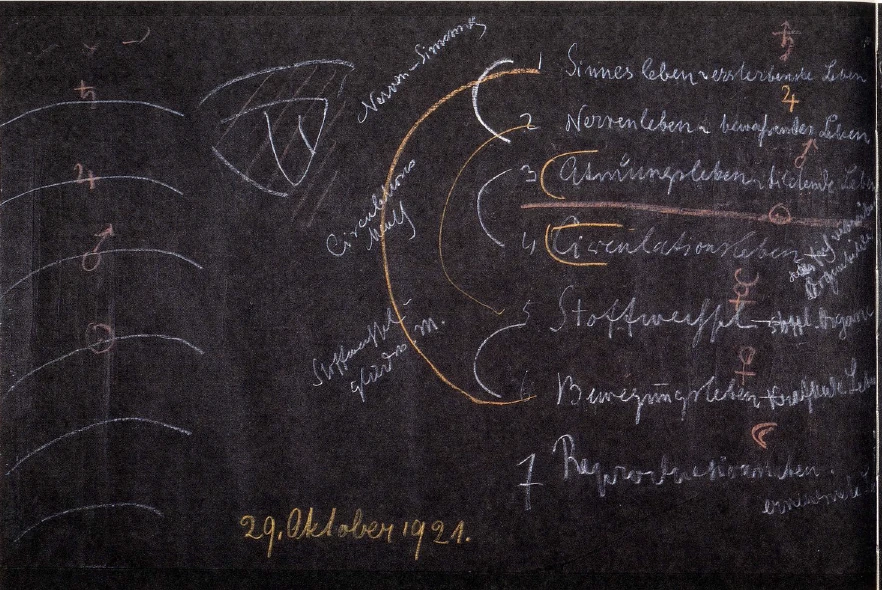
[ 6 ] Wir haben gestern gesehen, wie die Form sich eigentlich aus zwölf verschiedenen Formen zusammensetzt, und wir haben versucht, diese zwölf verschiedenen Formen zu studieren. Die Gesamtform des Menschen, innerlich und äußerlich, ergibt sich, wie wir gesehen haben, aus zwölf einzelnen Formen. Ebenso ergibt sich das Leben des Menschen aus einer Reihe von einzelnen Lebensstufen. Und diese einzelnen Lebensstufen, sie kann man sich in der folgenden Weise zunächst vor die rechts Seele stellen (siehe Aufstellung Seite 86).
[ 6 ] Yesterday we saw how the form is actually composed of twelve different forms, and we tried to study these twelve different forms. The overall form of the human being, both internally and externally, arises, as we have seen, from twelve individual forms. Similarly, human life arises from a series of individual stages of life. And these individual stages of life can initially be visualized in the following way before the soul (see diagram on page 86).
[ 7 ] Das erste, was der Mensch in seinem alltäglichen Bewußtsein gewöhnlich noch nicht als eine Lebensstufe ansieht, das ist das Sinnesleben. Die Sinne sind ja eingegliedert in die gesamte menschliche Wesenheit, aber sie liegen so sehr an der Peripherie, im Umkreis des Menschen, daß der Mensch eigentlich im alltäglichen Leben vergißt, daß dieses Sinnesleben die äußerste Schichte seines Lebens ist. Wir haben aber im Umkreise diese äußerste Schichte unseres Lebens, das Sinnesleben.
[ 7 ] The first thing that people in their everyday consciousness usually do not yet regard as a stage of life is sensory life. The senses are, of course, integrated into the entire human being, but they lie so far on the periphery, on the outskirts of the human being, that in everyday life people actually forget that this sensory life is the outermost layer of their existence. Yet we have this outermost layer of our existence—the sensory life—on the outskirts.
[ 8 ] Gehen wir weiter nach dem Inneren, dann kommen wir, indem wir uns auf die Betrachtung des Lebens beschränken, zu der Fortsetzung des Sinneslebens nach innen, und dieses Sinnesleben, das setzt sich nach innen fort in dem Nervenleben. Die Nerven gehen ja von den Sinnesorganen nach innen. Das Nervenleben setzt das Sinnesleben fort.
[ 8 ] If we proceed further inward, then—by limiting ourselves to the consideration of life—we arrive at the continuation of sensory life inward, and this sensory life continues inward into nervous life. After all, the nerves extend inward from the sense organs. Nervous life is a continuation of sensory life.
[ 9 ] Das Nervenleben kommt nun aber seinerseits in Berührung mit einem anderen Leben, mit einer anderen Lebensstufe, die sich im menschlichen Lebewesen entfaltet. Von gewissen Gesichtspunkten aus habe ich dieses schon bei früheren Anlässen charakterisiert. Ich habe Sie darauf aufmerksam gemacht, wie der Mensch einatmet. Indem er einatmet, nimmt er die Atemluft auf. Diese Atemluft, die versetzt zunächst den Menschen in eine Art inneren Rhythmus. Der setzt sich fort durch den Rückenmarkskanal bis in das Gehirn. Und ich habe darauf aufmerksam gemacht, was auf diesen Fortsetzungen beruht. Da kommt das Nervenleben in Kontakt mit dem Atmungsleben. Und die nächste Lebensstufe, wenn wir nach innen gehen, ist in der Tat das Atmungsleben.
[ 9 ] But nervous life, in turn, comes into contact with another form of life, with another level of life that unfolds within the human being. From certain perspectives, I have already described this on previous occasions. I have drawn your attention to how a person breathes in. By breathing in, they take in the air they breathe. This breath initially sets the human being into a kind of inner rhythm. This rhythm continues through the spinal canal all the way to the brain. And I have pointed out what arises from these extensions. Here, the nervous life comes into contact with the respiratory life. And the next level of life, as we move inward, is in fact the respiratory life.
[ 10 ] Das Atmungsleben seinerseits wiederum, das schließt sich zusammen mit einer anderen Lebensstufe. Der Atem erneuert, wenn wir so sagen dürfen, beständig das Blut. Damit steht der Atmungsrhythmus mit dem Blutrhythmus in einem Zusammenhang, und wir können hinübergehen vom Atmungsleben in das Zirkulationsleben, in das Leben, das im Zirkulationsrhythmus enthalten ist.
[ 10 ] The respiratory life, for its part, is closely linked to another level of life. Breathing, if we may put it that way, constantly renews the blood. Thus, the rhythm of breathing is connected to the rhythm of the blood, and we can move from the life of breathing to the life of circulation—the life contained within the rhythm of circulation.
[ 11 ] Die Zirkulation wiederum, sie steht nach der anderen Seite im Zusammenhang mit dem gesamten Stoffwechsel. Die Zirkulation nimmt den Stoffwechsel auf, so daß wir zur nächsten Lebensstufe, zum Stoffwechsel kommen.
[ 11 ] Circulation, in turn, is connected to the entire metabolic process from another perspective. Circulation incorporates metabolism, bringing us to the next stage of life: metabolism.
[ 12 ] Der Stoffwechsel hinwiederum, der regt an, was wir in der äußeren Bewegung vollziehen. Nur dadurch, daß der Mensch im Stoffwechsel lebt, kann er sich äußerlich bewegen. Der menschliche Stoffwechsel — und auch der tierische — ist ja so geartet, daß des Menschen Seele das, was im Stoffwechsel vor sich geht, verwenden kann, um dadurch Bewegungen hervorzubringen, und wir kommen dann zu dem Bewegungsleben. Da ordnen wir uns schon wiederum in die Außenwelt ein. Da nehmen wir mit dem, was wir hervorbringen, an der Außenwelt teil.
[ 12 ] Metabolism, in turn, stimulates the actions we perform in our external movements. It is only because human beings live through metabolism that they are able to move externally. Human metabolism—and animal metabolism as well—is such that the human soul can utilize what takes place in metabolism to bring about movements, and this leads us to our life of movement. There we once again integrate ourselves into the external world. There, through what we produce, we participate in the external world.
[ 13 ] Und dann gibt es noch eine weitere Lebensstufe. Das ist das Reproduktionsleben, das Fortpflanzungsleben. In der Bewegung verbraucht der Mensch in der Tat fortwährend sich selber, und eine innere Reproduktion muß stattfinden eben deshalb, weil der Mensch in Bewegung ist. So daß man statt Bewegungsleben auch sein Korrelat schreiben könnte: innere Reproduktion, wenn man innerhalb der Haut des Menschen stehenbleiben würde. Und wenn dann diese Reproduktion selbständig auftritt, so tritt sie auf im Fortpflanzungs-, im eigentlichen Reproduktionsleben.
[ 13 ] And then there is yet another stage of life: reproductive life. In motion, a person does indeed continually consume themselves, and internal reproduction must take place precisely because the person is in motion. So that instead of “life of movement,” one could also write its correlate: “internal reproduction,” if one were to remain within the person’s skin. And when this reproduction occurs independently, it occurs in the life of procreation—in the life of reproduction proper.
1. Sinnesleben
2. Nervenleben
3. Atmungsleben
4. Zirkulationsleben
5. Stoffwechselleben
6. Bewegungsleben
7. Reproduktionsleben
1. Sensory Life
2. Nervous Life
3. Respiratory Life
4. Circulatory Life
5. Metabolic Life
6. Motor Life
7. Reproductive Life
[ 14 ] Wir haben auf diese Weise, wie wir gestern zwölf Formelemente der Gesamtform des Menschen entwickelten, heute sieben Lebensstufen entwickelt. Diese sieben Lebensstufen, sie sind in der Tat so, daß der Mensch mit Bezug auf seinen Ätherleib in verschiedener Weise lebt auf diesen verschiedenen Lebensstufen. Wir können nicht von einem einzelnen, verwaschenen Leben reden, wenn wir die Dinge im Ernste ins Auge fassen wollen.
[ 14 ] Just as we developed twelve elements of the human form yesterday, today we have developed seven stages of life. These seven stages of life are such that, in relation to their etheric body, human beings live in different ways at these various stages. We cannot speak of a single, indistinct life if we wish to consider these matters seriously.
[ 15 ] Unser Ätherleib lebt zunächst, wenn ich so sagen darf, in der Sinnenschichte. Er lebt in der Sinnenschichte das Sinnesleben. Dieses Leben in der Sinnenschichte, das ist das Leben, das wir in der Tat kaum mehr als Leben empfinden. Wir nehmen dadurch an der Außenwelt teil. Unser Ätherleib, sagen wir, wenn wir da zum Beispiel das Auge haben, durchdringt das Auge. Er ist lebendig. Er belebt dadurch in einer gehalblinks issen Weise das Auge. Aber er berührt sich mit einem Substantiellen im Auge, das nahe dem Sterben ist. Nur dadurch, daß der Ätherleib dieses Auge noch durchdringt, ist es ein lebendiges Organ. Es ist eigentlich, abgesehen von dem es durchdringenden Ätherleib, ein physikalischer Apparat.
[ 15 ] Our etheric body lives, if I may put it that way, primarily in the sensory realm. It lives the sensory life within the sensory realm. This life in the sensory realm is the life that we, in fact, hardly perceive as life anymore. Through it, we participate in the external world. Our etheric body—let’s say, for example, when we consider the eye—permeates the eye. It is alive. Through this, it animates the eye in a subtle way. But it comes into contact with a substantial element in the eye that is close to dying. It is only because the etheric body still permeates this eye that it remains a living organ. Apart from the etheric body that permeates it, it is actually a physical apparatus.
[ 16 ] Nun ist das bei den verschiedenen Sinnen in der verschiedensten Weise ausgebildet, daß sie auf der einen Seite ein physikalischer Apparat sind und dann vom Ätherleib durchdrungen sind. Aber im großen und ganzen ist es doch durchaus so, daß die Sinnesorgane eigentlich tote Organe sind, die eben nur einfach vom Ätherleib durchdrungen sind. So daß man das Sinnesleben schon nennen kann das ersterbende Leben (siehe Aufstellung Seite 89).
[ 16 ] Now, the various senses are structured in a wide variety of ways, in that, on the one hand, they are physical organs and, on the other hand, they are permeated by the etheric body. But on the whole, it is certainly the case that the sense organs are actually dead organs that are simply permeated by the etheric body. Thus, one can already call sensory life “dying life” (see table on page 89).
[ 17 ] Das Nervenleben hingegen, das bildet aus dem, was in den Sinnen erlebt wird, das, was das Sinnesleben dann bewahren kann. Auf dem Nervenleben beruhen alle Nachklänge, Nachwirkungen zum Beispiel, wenn wir das Auge betrachten, so daß wir im Nervenleben eine Art von ruhendem Leben haben, ein, wir können sagen, ruhendes oder bewahrendes Leben.
[ 17 ] Nervous life, on the other hand, takes what is experienced through the senses and transforms it into what sensory life can then retain. All aftereffects are based on nervous life—for example, when we look at the eye—so that in nervous life we have a kind of resting life, a life that we might call resting or preserving.
[ 18 ] Das Atmungsleben dagegen, das bringt dieses flüchtige und sich bewahrende Sinnesleben zur Bildhaftigkeit. Auf der Berührung des Atmungsrhythmus mit den Nervenströmungen beruht es, daß wir uns Bilder machen können von der äußeren Welt. Gedanken, abstrakte Gedanken sind noch durchaus an das Nervenleben gebunden, aber das Bildhafte ist an das Atmungsleben gebunden. So daß man sagen kann: Hier haben wir das bildende Leben. — Wir haben also, indem wir atmen, bildendes Leben in uns. Dieses bildende Leben lebt natürlich in der menschlichen Form. Dadurch, daß es in der menschlichen Form lebt, nimmt es teil an der menschlichen Form.
[ 18 ] Respiratory life, on the other hand, is what gives this fleeting yet enduring sensory life its pictorial quality. It is the interaction of the respiratory rhythm with the nerve currents that enables us to form images of the external world. Thoughts—abstract thoughts—are still entirely bound to nervous life, but the pictorial is bound to respiratory life. So one can say: Here we have the formative life. — Thus, by breathing, we have formative life within us. This formative life naturally lives within the human form. By living within the human form, it participates in the human form.
[ 19 ] Die menschliche Form, sie ist, wie wir gesehen haben, gebildet nach dem Tierkreis. Indem gerade dieses bildende Leben, das durch das Atmen vermittelt wird, in der Form des Menschen lebt, nimmt es auch teil an der gesamten äußeren, aus dem Sternenhimmel herausgebildeten Form. Dadurch gliedert sich diese Form auch in das Innere des Menschen hinein. Und es beruht dann auf dem Atmen, daß aus dem Atmungsprozeß nicht nur herauskommt, was der Mensch im Bewußtsein hat, sondern daß herauskommen aus dem Atmungsprozeß zunächst die Bilder sämtlicher innerer Organe in der Nachbildung an die äußere Form. Die inneren Organe werden also auf dem Umwege durch den Atmungsprozeß zunächst als Bilder gebildet. Da sind sie noch nicht substantiell. Der Atem bildet zunächst ein Bild des Menschen, ein Bild des inneren Menschen. Indem wir atmen — wir atmen ja in der Welt, bewegen uns mit der Erde im Tierkreis —, atmen wir fortwährend die Bilder unserer inneren Organisation ein. Aus dem äußeren Leben atmen wir die Bilder unserer inneren Organisation ein. So daß wir sagen können: Hier haben wir das bildende Leben. — Diese Bilder, die da eingeatmet werden, die werden nun durch das Zirkulationsleben über den ganzen Organismus verbreitet. Zirkulationsleben und Atmungsleben zusammen führen den Menschen dazu, innerlich Bild der Welt zu sein. Wir können also sagen: Hier das bildende Leben, und dann können wir sagen: die sich verbreitenden Bilder, das sich Verbreitende, die sich verbreitenden Organbilder.
[ 19 ] The human form, as we have seen, is shaped according to the zodiac. Because this very formative life, mediated through breathing, lives within the human form, it also participates in the entire outer form shaped by the starry sky. Through this, this form also extends into the inner being of the human being. And it is through breathing that not only does what the human being holds in consciousness emerge from the breathing process, but that what first emerges from the breathing process are the images of all the internal organs, modeled after the external form. The internal organs are thus first formed as images through the indirect process of breathing. At this stage, they are not yet substantial. Breathing first forms an image of the human being, an image of the inner human being. As we breathe—for we breathe in the world, moving with the Earth through the zodiac—we continually inhale the images of our inner organization. From external life, we inhale the images of our inner organization. So that we can say: Here we have the formative life. — These images that are inhaled are now distributed throughout the entire organism by the circulatory life. The circulatory life and the respiratory life together lead the human being to be, inwardly, an image of the world. We can therefore say: Here is the formative life, and then we can say: the spreading images, the spreading, the spreading organ images.
[ 20 ] Dadurch nun, daß das Zirkulationsleben an den Stoffwechsel sich anschließt, wird der Stoff eingefügt diesen Bildern, und es entstehen bei der fünften Lebensstufe die stofflichen Organe. Es schiebt sich der Stoff in die Bilder hinein. Er tingiert die Bilder. Wir haben also durch unseren oberen Menschen, durch unser Atmungsleben unser inneres Bild, und die Bilder machen wir gewissermaßen zu Wirklichkeiten durch den tingierenden Stoff, der sich da hineinschiebt.
[ 20 ] Now, because the circulatory life is linked to metabolism, matter is incorporated into these images, and the physical organs arise at the fifth stage of life. Matter pushes its way into the images. It colors the images. So through our higher self, through our respiratory life, we have our inner image, and we transform these images into realities, so to speak, through the coloring substance that pushes its way into them.
[ 21 ] Aus dem Bewegungsleben schiebt sich in die stofflichen Organe die Kraft ein. So daß wir sagen können: Wir haben die stofflichen Organe, und hier haben wir das kraftende Leben in den Organen. Und das Reproduktionsleben ist dann das sich erneuernde Leben.
[ 21 ] The life force flows from the life of movement into the physical organs. So we can say: We have the physical organs, and within them we have the life force at work. And the reproductive life is then the life that renews itself.
[ 22 ] Sie sehen da zu gleicher Zeit, wie der dreigegliederte Mensch gebildet ist: der Nerven-Sinnesmensch, der Zirkulationsmensch, der Mensch des Rhythmus, und der Stoffwechsel-Gliedmaßenmensch oder Stoffwechsel-Bewegungsmensch. Durch die Reproduktion entsteht ja wiederum erst der neue Mensch.
[ 22 ] At the same time, you can see how the threefold human being is constituted: the nervous-sensory human being, the circulatory human being, the rhythmic human being, and the metabolic-limb human being, or the metabolic-movement human being. It is through reproduction, after all, that the new human being comes into being.
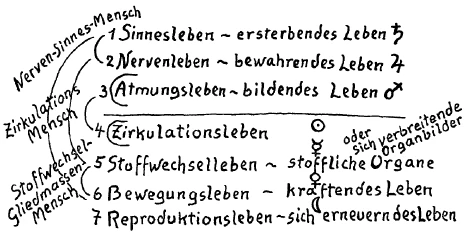
[ 23 ] Diese Attribute, die ich Ihnen hier rechts dazugeschrieben habe, die geben Ihnen eine Vorstellung von den Unterschieden, die zwischen den Lebensstufen bestehen. Indem unser Ätherleib in den Sinnen lebt, lebt er in einer Art ersterbendem Leben. In einem bewahrenden Leben lebt er, indem er im Nervenleben, in den Nervenströmen ist. Im Atmungsleben wird eigentlich unser Ätherleib der richtige Bildekräfteleib, der die Bilder entwirft. Und daß diese Bilder dann wirklich zur gesamten inneren Organisation werden, das vermittelt das Zirkulationsleben. Mit Stoff füllt sich das aus vom Stoffwechselleben. Indem der Ätherleib den Stoffwechsel durchdringt, tingiert er den eigentlichen Bildekräfteleib. Und dann kommt die subjektive menschliche Kraft hinein durch das Leben der Gliedmaßen und so weiter.
[ 23 ] These attributes, which I have listed here on the right, give you an idea of the differences that exist between the stages of life. Because our etheric body lives in the senses, it lives a kind of dying life. In the life of preservation, it exists within the nervous life, within the nerve currents. In the life of respiration, our etheric body actually becomes the true body of formative forces, which designs the images. And the life of circulation is what enables these images to truly become the entire inner organization. This is filled with substance through the metabolic life. As the etheric body permeates the metabolism, it colors the actual body of formative forces. And then the subjective human force enters through the life of the limbs and so on.
[ 24 ] Auch diese Zusammenhänge hat eine alte instinktive Weisheit durchschaut. Sie wußte, daß der Mensch das Leben von außen aufnimmt und innerlich weiterbildet, richtig innerlich weiterbildet. So etwa dachten sich diese älteren Weisen die Sache. Sie sagten sich: Nehmen wir eine äußerste Schichte des Erdenumkreises, der Weltensphäre, nehmen wir eine nächste Schichte, nehmen wir eine weitere Schichte — so haben wir die äußerste Schichte zunächst am nächsten dem Fixsternhimmel, also demjenigen im Weltenall, dem der Mensch seine Form verdankt. Sein Leben, sagte nun diese ältere instinktive Weisheit, erfließt ihm nicht aus dem Fixsternhimmel, sondern aus dem planetarischen Himmel. Da unterschied er zunächst den Saturn, den Jupiter, den Mars, die Sonne. Wenn wir die Sonne in ihrer wahren Wesenheit ins Auge fassen, ich habe ja über diese wahre Wesenheit der Sonne des öfteren gesprochen, so unterscheidet sie sich — man nennt sie deshalb in der populären Astronomie einen Fixstern — von den übrigen Gliedern des Planetensystems, das zur Erde gehört, dadurch, daß sie als Lichtquelle erscheint. Sie erscheint als Lichtquelle. Sie ist insofern von den anderen Gliedern verschieden, als die anderen Glieder nicht als Lichtquellen erscheinen, sondern sie erscheinen als Bilder. Man sagt ja deshalb auch in der populären Astronomie: Sie haben das erborgte Licht, sie strahlen das Licht der Sonne zurück. — Die Sonne selbst erzeugt, im populären Sinne gesprochen, das Licht; die anderen planetarischen Körper strahlen das Licht zurück.
[ 24 ] Ancient instinctive wisdom also understood these connections. It knew that human beings take in life from the outside and shape it further within—truly shape it further within. This is roughly how those ancient sages conceived of the matter. They said to themselves: Let us take the outermost layer of the Earth’s orbit, the world sphere; let us take the next layer; let us take yet another layer—thus we have the outermost layer, which is initially closest to the fixed-star sky, that is, the one in the cosmos to which human beings owe their form. His life, said this ancient, instinctive wisdom, does not flow to him from the fixed-star sky, but from the planetary sky. Thus, people first distinguished Saturn, Jupiter, Mars, and the Sun. If we consider the Sun in its true essence—I have, after all, spoken often about this true essence of the Sun—it differs from the other members of the planetary system belonging to the Earth—which is why it is called a fixed star in popular astronomy—in that it appears as a source of light. It appears as a source of light. It differs from the other members in that the other members do not appear as sources of light, but rather as images. That is why, in popular astronomy, it is said: They have borrowed light; they reflect the light of the Sun. — The Sun itself, in the popular sense, produces the light; the other planetary bodies reflect the light.
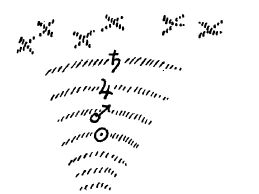
[ 25 ] Vergegenwärtigen Sie sich den Unterschied: ob man Sonne hat, die das eigene Wesen aus sich hervorgehen läßt in dem Lichte, oder ob man die anderen Himmelskörper, die Planeten hat, die nur das Bild des äußeren Wesens zeigen, gewissermaßen nur, was sie an der Oberfläche tragen, dadurch sichtbar machen, daß sie das Sonnenlicht zurückwerfen. Es ist ein wesentlicher Unterschied.
[ 25 ] Consider the difference: whether one has the Sun, which allows one’s own essence to emerge in its light, or whether one has the other celestial bodies—the planets—which merely reveal the image of their outer form, so to speak, only what they bear on their surface, by reflecting the Sun’s light. It is a fundamental difference.
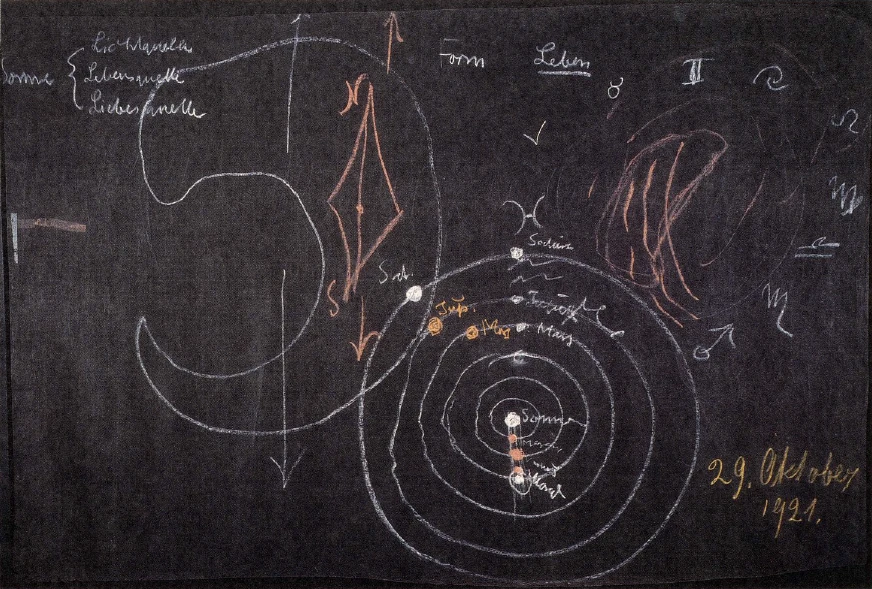
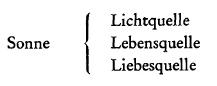
[ 26] Und indem die Sonne gewissermaßen die Quelle des Lichtes ist, ist sie auch die Quelle des Lebens. Und sie ist auch noch eine andere Quelle. Zu allen Zeiten hat man schon innerhalb der instinktiven Erkenntnis gesprochen von einer dreifachen Sonne, von der Sonne als Lichtquelle, Lebensquelle, Liebesquelle. Diese Trinität ist durchaus in der Sonne enthalten.
[ 26] And since the sun is, in a sense, the source of light, it is also the source of life. And it is yet another source as well. Throughout the ages, people have spoken—based on instinctive knowledge—of a threefold sun: the sun as a source of light, a source of life, and a source of love. This trinity is indeed contained within the sun.
[ 27 ] Nun brauchen Sie heute gar nicht zu sündigen wider das kopernikanische Weltensystem, sondern Sie können es durchaus beibehalten und können dennoch aus diesem kopernikanischen Weltensystem heraus einsehen, was die Alten, die eine instinktive kosmische Erkenntnis gehabt haben, mit ihrem Weltensystem gemeint haben. Nehmen wir also an, kopernikanisch gedacht in der Mitte, oder meinetwillen in einem Brennpunkte, aber das können wir jetzt unbeachtet lassen, da stehe die Sonne; es drehen sich Merkur, Venus, Erde, Mars — die Planetoiden können wir heute unberücksichtigt lassen —, Jupiter, Saturn um sie herum.
[ 27 ] Now, you don’t have to go against the Copernican system of the world today; rather, you can certainly retain it and still, from within this Copernican system, come to understand what the ancients—who possessed an instinctive cosmic insight—meant by their own system of the world. So let’s assume—following Copernican thought—that the Sun is at the center, or, if you will, at a focal point, though we can disregard that for now; let’s say the Sun is there; Mercury, Venus, Earth, and Mars—we can disregard the asteroids for now—as well as Jupiter and Saturn, revolve around it.
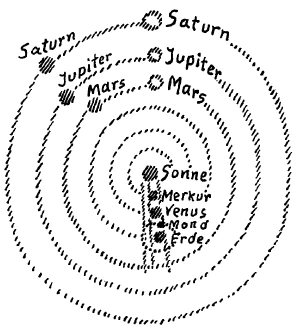
[ 28 ] Nun nehmen wir die Sache aber so; Nehmen wir hier die Stellung, die ja durchaus auch möglich ist, daß wir hier (oben) haben Saturn, Jupiter, Mars, und nun kommen wir zu Sonne, Merkur, Venus, Erde mit dem Mond aber, den wir hier so aufstellen.
[ 28 ] But let’s look at it this way: Let’s take the position—which is certainly possible—where we have Saturn, Jupiter, and Mars here (at the top), and then we come to the Sun, Mercury, Venus, and Earth, along with the Moon, which we place here like this.
[ 29 ] Nun ist eine solche Stellung natürlich nicht notwendig ins Auge zu fassen, sondern ich stelle sie nur deshalb hin, um Ihnen zu zeigen, daß in der Tat, trotz des kopernikanischen Systems, auch die Reihenfolge möglich ist, welche die Alten angenommen haben: Mond, Venus, Merkur, Sonne, Mars, Jupiter, Saturn. Man braucht nur die Konstellationen so zu nehmen, daß eben die Erde auf einer Seite von der Sonne steht und irgendwo auf der anderen die äußeren Planeten. Es ist ja gar nicht nötig, daß eine solche Oppositions- oder Konjunktionsstellung stattfindet, das kann ja auch alternierend geschehen, abwechselnd, aber diese Reihenfolge ist eben durchaus auch denkbar. Und an diese Reihenfolge hat eine alte instinktive Weisheit gedacht.
[ 29 ] Now, of course, it is not necessary to consider such a configuration; I am merely presenting it to show you that, in fact, despite the Copernican system, the order assumed by the ancients—Moon, Venus, Mercury, Sun, Mars, Jupiter, Saturn—is also possible. One need only consider the constellations in such a way that the Earth is on one side of the Sun and the outer planets are somewhere on the other. It is by no means necessary for such an opposition or conjunction to occur; it can also happen alternately, in turn, but this sequence is certainly conceivable. And this sequence was conceived by an ancient, instinctive wisdom.
[ 30 ] Warum? Weil ihr diese Reihenfolge wichtig erschien. Der alte Mensch sagte sich: Nehmen wir an, hier auf der Erde lebe der Mensch. Der Mensch ist ausgesetzt dem Universum. Er erlebt die Sonnenstrahlen. Die Sonnenstrahlen sind ihm zunächst Lichtquelle, Lebensquelle, Liebesquelle. Dadurch kommt Licht, Leben, Liebe in ihn hinein. Die Sonne ist die Quelle von diesen dreien. Nun ist aber der Mensch nicht nur ausgesetzt dem Sonnenleben, der Sonnenliebe, dem Sonnenlichte, sondern auch dem Bildhaften des Saturn. Wenn der Mensch bloß, auf der Erde sich entwickelnd, dem Sonnenleben ausgesetzt wäre, dann würde er das Leben seiner Sinne nicht entwickeln können. Nehmen wir die Augen — einen Sinn: sie würden sich nicht als physikalische Apparate absondern. Sie würden so wie irgendein anderer Teil des menschlichen Körpers dadrinnen sitzen. Sie würden etwa Muskelorgane oder so etwas sein, Gefäße. Also wenn der Mensch fortwährend der Sonne ausgesetzt wäre, würde er eben seine Augen, aber auch die anderen Sinne nicht entwickeln können. Daß er die Sinne entwickeln kann, das verdankt er dem Umstande, daß den Sonneneinfluß abschwächt der Saturn, der in der äußersten Sphäre sich herumbewegt. Also dieser Saturn trocknet gewissermaßen das Gefäß aus, und es entsteht dadurch der physikalische Apparat, grob gesprochen. So daß aus dieser instinktiven Erkenntnis heraus, auf die wir heute wieder kommen, der alte Mensch sagte: Das Sinnesleben ist hereingewirkt vom Saturn.
[ 30 ] Why? Because this order seemed important to them. The ancient person said to himself: Let’s assume that human beings live here on Earth. Human beings are exposed to the universe. They experience the sun’s rays. At first, the sun’s rays are a source of light, a source of life, and a source of love for them. Through them, light, life, and love enter into them. The sun is the source of these three. But human beings are not only exposed to the life of the sun, the love of the sun, and the light of the sun, but also to the imagery of Saturn. If human beings, developing here on Earth, were exposed only to the life of the sun, they would not be able to develop the life of their senses. Take the eyes—one of the senses: they would not emerge as physical organs. They would simply be located inside the body, just like any other part of the human body. They would be something like muscular organs or vessels. So if human beings were constantly exposed to the Sun, they would simply not be able to develop their eyes, nor their other senses. The fact that they can develop their senses is due to the fact that Saturn, which moves in the outermost sphere, attenuates the Sun’s influence. So Saturn, in a sense, dries out the vessel, and this gives rise to the physical apparatus, roughly speaking. Thus, based on this instinctive insight—which we will return to today—the ancient people said: “Sensory life is brought about by Saturn.”
[ 31 ] Und ein Zweites: Der Mensch ist nun nicht bloß dem Saturnleben ausgesetzt. Wenn er dem Sonnenleben fortwährend ausgesetzt wäre, würde er nicht nur keine Sinne entwickeln können, sondern er würde auch sein Nervenleben nicht entwickeln können. Das Nervenleben, das trocknet aus, sonst würde es überwuchern. Die Nerven würden auch Organe sein so wie etwa die Muskeln. Dieses Austrocknende im Nervenleben, das ist der Einwirkung von Jupiter entsprechend. So daß der alte Mensch gesagt hat: Das Nervenleben wird angeregt vom Jupiter.
[ 31 ] And a second point: Human beings are not merely subject to the life of Saturn. If they were constantly exposed to the life of the Sun, not only would they be unable to develop their senses, but they would also be unable to develop their nervous life. The nervous system dries out; otherwise, it would grow out of control. The nerves would also be organs, just like the muscles. This drying-out process in the nervous system corresponds to the influence of Jupiter. That is why the ancients said: The nervous system is stimulated by Jupiter.
[ 32 ] Sehen Sie, der Saturn kreist um die Sonne herum in dreißig Jahren etwa annähernd. Da erlebt natürlich der Mensch, wenn er auf der Erde lebt, einmal annähernd, daß der Saturn gewissermaßen von der Sonne zugedeckt ist. Wenn der Mensch das Glück hat, den Saturn von der Sonne besonders stark zugedeckt zu erhalten, dann dämmert in sein Sinnesleben hinein ein starkes Sonnenleben. Man möchte sagen: Die Augen oder andere Sinne — die Augen kommen dabei allerdings am wenigsten in Betracht, aber wir können an ihnen, weil sie am deutlichsten sind, am besten exemplifizieren —, die Augen bekommen dann eine Anregung. Wenn der Mensch also während seines Erdenlebens einmal die Konstellation erlebt, daß gewissermaßen der Saturn auf seine Sinne nicht wirkt, dann kann es sein, daß er die Entdeckung macht, wie gerade durch seine Sinne eine besondere kosmische Einwirkung geschieht. Er bekommt eine Anregung. Er wird sinnlich stärker. Solche Dinge gibt es. Die wollen dann die Menschen als alles mögliche erklären, nur nicht als das, was sie sind.
[ 32 ] You see, Saturn orbits the Sun in roughly thirty years. So, naturally, a person living on Earth will experience, at least once, a time when Saturn is, so to speak, obscured by the Sun. If a person is fortunate enough to experience Saturn being particularly strongly obscured by the Sun, then a powerful solar life begins to dawn within their sensory life. One might say: The eyes or other senses—though the eyes are actually the least relevant here, we can best illustrate this with them because they are the most obvious—the eyes are then stimulated. So if a person experiences, during their earthly life, a constellation in which Saturn, so to speak, does not act upon their senses, then it may be that they discover how a particular cosmic influence takes place precisely through their senses. They receive a stimulus. They become more sensitive. Such things exist. People then want to explain them as all sorts of things, just not as what they actually are.
[ 33 ] Es gibt heute eine ganz große amerikanische Literatur über diese Dinge. Da kommt William James und redet von allerlei «Erweckungen». Er redet davon, wie es Menschen gibt, in denen das Leben eine besondere Erweckung erfährt. Lesen Sie nur einmal nach in den Büchern dieses William James und in denen seiner Schüler, da werden Sie finden, daß das ein besonderes Phänomen ausmacht, daß der Mensch zu irgendeiner Zeit eine besondere Anregung erfährt. Natürlich wissen diese Leute nicht, wovon das kommt, wissen nicht, daß das davon kommt, daß solch eine Konstellation eintritt entweder mit Saturn oder Jupiter. Wenn das Saturnleben verdeckt wird, wird das Sinnesleben besonders angeregt; wenn das Jupiterleben verdeckt wird, was noch leichter sein kann übrigens, weil Jupiter alle zwölf Jahre, also schneller herumkreist, da findet der Mensch eine Anregung seines Nervenlebens.
[ 33 ] There is a vast body of American literature on these subjects today. Take William James, for example, who speaks of all kinds of “awakenings.” He discusses how there are people in whom life undergoes a special awakening. Just take a look at the books by William James and those of his students, and you will find that this constitutes a special phenomenon: that a person experiences a special stimulation at some point in time. Of course, these people do not know where this comes from; they do not know that it stems from the fact that such a constellation occurs either with Saturn or Jupiter. When the Saturn life is obscured, the sensory life is particularly stimulated; when the Jupiter life is obscured—which, incidentally, can be even easier, since Jupiter orbits every twelve years, that is, more quickly—the person experiences a stimulation of their nervous life.
[ 34 ] Alle diese Dinge, die da verzeichnet werden, die werden ins Unterbewußtsein verlegt. Dieses Unterbewußtsein, das ist das reine Faulbett heute für alle Leute von der Sorte des William James, von der Sorte der Psychoanalytiker. Dieses Unterbewußtsein, es ist ja ein rein negativer Begriff, es ist ein Spucknapf, in den man alles hineinspucken kann, wofür man gar keine Erklärung mehr hat im Leben. Ein reiner Spucktopf ist dieses Unterbewußtsein. Da muß alles herein, ’rein, ’rein; da sind die verborgenen Seelen-«Provinzen», nicht wahr, drinnen, die dann gelegentlich reagieren und so weiter. Es wäre schon im höchsten Grade wünschenswert, daß alle diese sowohl pragmatischen wie psychoanalytischen Theorien einmal eine gründlichere Beleuchtung erfahren würden.
[ 34 ] All these things that are listed there are relegated to the subconscious. This subconscious is nothing more than a cozy refuge today for people of the sort of William James, of the sort of psychoanalysts. This subconscious—it’s, after all, a purely negative concept—is a spittoon into which one can spit everything for which one no longer has any explanation in life. This subconscious is nothing but a spittoon. Everything has to go in there, in, in; that’s where the hidden “provinces” of the soul are, aren’t they, inside, which then occasionally react and so on. It would be highly desirable for all these theories—both pragmatic and psychoanalytic—to be subjected to a more thorough examination.
[ 35 ] Der dritte Planet ist dann der Mars. Er schwächt das wuchtende Leben zur Atmung ab. Auch bei ihm kann natürlich das der Fall sein, daß die Sonne ihn zudeckt. Dann kann das Atmungsleben eine besondere Anregung erfahren. Da der Mars aber sehr rasch, etwa in zwei Jahren herumkreist, so ist das so, daß das fast jeder Mensch erfährt, und daher jeder Mensch in seinem Atmungsleben, in seinem Bild-Erleben gewisse Anregungen bekommt. Sie sind ja nicht immer allerersten Ranges, aber die Menschen werden dann Dichter oder so was dergleichen, oder Komponisten, die Anregungen in ihrem Atmungsleben empfangen. Da geht es dann nicht so tief, daß dann Leute wie James dem nachspekulieren. Das findet man als etwas Erklärliches. Also den Mars betrachteten die alten instinktiven Weisen als Anreger für das Atmungsleben.
[ 35 ] The third planet is Mars. It tempers the vigorous life force of respiration. Of course, it can also happen that the Sun obscures it. In that case, the respiratory life can experience a special stimulation. But since Mars orbits very quickly—in about two years—almost everyone experiences this, and therefore everyone receives certain stimulations in their respiratory life and in their experience of images. These aren’t always of the highest order, but people who receive these stimulations in their respiratory life then become poets or the like, or composers. It does not go so deep that people like James would speculate about it. It is seen as something that can be explained. Thus, the ancient, instinctive sages regarded Mars as a source of inspiration for the respiratory life.
[ 36 ] Dann ist es das Sonnenleben selber, welches den Menschen anregt, die Sonne selber, die Sonne als das Leben-, Liebe-, Licht-Erregende, äußerlich Licht-Erregende, innerlich Liebe-Erregende und im Verkehr mit der Außenwelt Leben-Erregende. Das wird nun in die Mitte zwischen Atmungsleben und Zirkulationsleben versetzt, wohin es auch die alte Weisheit versetzt hat. Zwischen dem Atmungsleben und dem Zirkulationsleben liegt ja das Herz, der Ausdruck, nicht der Motor, aber der Ausdruck für das, was zwischen Zirkulation und Atmung sich abspielt.
[ 36 ] Then it is the life of the sun itself that stimulates human beings—the sun itself, the sun as the source of life, love, and light: externally a source of light, internally a source of love, and, in interaction with the outside world, a source of life. This is now placed at the center between the respiratory life and the circulatory life, where ancient wisdom also placed it. Between the respiratory life and the circulatory life lies the heart—the expression, not the motor, but the expression of what takes place between circulation and respiration.
[ 37 ] Und wir kommen dann zum Stoffwechsel. Wie gesagt, die alte Wissenschaft hat nun die Konstellation so betrachtet: den Merkur hat sie nun nicht so betrachtet, daß sie das Hauptaugenmerk darauf legte, inwiefern die Sonne ihn zudecken kann wie die anderen Planeten, sondern inwiefern er die Sonne zudeckt gegenüber der Erde, also daß er die Sonne zudeckt. Für den Merkur betrachtete die alte Weisheit die Stellung zwischen Sonne und Erde als das Wesentliche. Für den Jupiter betrachtete die alte Weisheit die Stellung außerhalb der Sonne als das Wesentliche. Für den Merkur fand sie wichtig für die Entwickelung des Lebens des Menschen die Stellung zwischen Sonne und Erde. Da deckt der Merkur die Sonne zu. Sonst hat immer die Sonne die anderen zugedeckt; hier deckt der Merkur die Sonne zu, das heißt, er schwächt das Leben ab. Indem dadurch eine Wirkung ausgeübt wird, daß also das Sonnenleben abgeschwächt wird, regt sich das abgeschwächte Leben im Inneren. Der Mensch würde — wenn sich dieses Leben nicht abschwächen würde —, er würde, wenn er irgend etwas zu sich nehmen würde, es — verzeihen Sie — sofort wieder ausspeien; er würde gar nichts von äußerem Stoff in sich dulden, er würde fortwährend speien. Er würde sich dann das Essen abgewöhnen, weil das ja zu langweilig wäre. Das Leben der Sonne ist eben so stark im Menschen. Wenn also nur Herz-, das heißt Sonnenleben wäre, würde der Mensch nichts in sich verarbeiten können von Stoffen. Er würde alles gleich ausspeien. Daß der Mensch einen Stoffwechsel entwickeln kann, das verdankt er lediglich dem Umstande, daß hier das Merkurleben etwas abschwächt das Sonnenleben. So daß aus diesem Grunde die alte Weisheit eingeschaltet sich dachte, als fortwirkend aus dem Kosmos, zwischen das Zirkulationsleben und das Stoffwechselleben, das Merkurwesen. Das Merkurwesen schiebt also den Stoff durch den menschlichen Organismus hindurch in die einzelnen Organe hinein. Die Kraft aber wird hineingestoßen durch das Bewegungsleben.
[ 37 ] And then we come to metabolism. As I said, ancient science viewed the constellation in this way: it did not regard Mercury by focusing on the extent to which the Sun can obscure it, as it does the other planets, but rather on the extent to which it obscures the Sun as seen from Earth—that is, that it obscures the Sun. For Mercury, ancient wisdom considered its position between the Sun and Earth to be the essential factor. For Jupiter, ancient wisdom regarded its position outside the Sun as the essential factor. For Mercury, it considered the position between the Sun and the Earth to be important for the development of human life. There, Mercury obscures the Sun. Otherwise, the Sun has always obscured the other planets; here, Mercury obscures the Sun, which means it weakens life. Because this exerts an effect—that is, the solar life is weakened—the weakened life within is stirred. If this life were not weakened, a person—whenever he consumed anything—would, if you’ll pardon the expression, immediately vomit it back up; he would not tolerate any external substance within himself at all; he would vomit constantly. He would then give up eating altogether, because that would be far too tedious. The life of the Sun is precisely that strong within the human being. If, therefore, there were only heart life—that is, solar life—the human being would be unable to process any substances within himself. He would vomit everything up immediately. The fact that the human being can develop a metabolism is due solely to the fact that the Mercury life somewhat weakens the solar life. For this reason, ancient wisdom, acting as a continuing influence from the cosmos, conceived of the Mercury being as intervening between the circulatory life and the metabolic life. The Mercury being thus pushes the substance through the human organism into the individual organs. The force, however, is propelled into them by the life of movement.
[ 38 ] Das Bewegungsleben, das ist nun ebenso abhängig von dem Venusleben wie das Stoffwechselleben von dem Merkurleben. Daher hat die alte Weisheit hier die Kraft, welche durchfließt, also dieses innerliche Sich-selbst-Erneuern, dieses Einen-zweiten-Kraftmenschen-in-sich-Fühlen, dem Venusleben zugeschrieben.
[ 38 ] The life of movement is just as dependent on the Venus life as the life of metabolism is on the Mercury life. Therefore, ancient wisdom has attributed to the Venusic life the power that flows through us—that is, this inner self-renewal, this feeling of a second, powerful being within oneself.
[ 39 ] Das Mondenleben, das nahe dem Erdenleben selber liegt, das wirkt nun nicht bloß so abschwächend, daß der Mensch Stoff, daß er Kraft verarbeitet. Ich habe das einmal auseinandergesetzt, worauf die Reproduktion beruht: Es wird ausgespart, es wird gewissermaßen organisch Materie zurückgeschoben. Darauf beruht ja die Keimesbildung im Menschen, daß organisch Materie zurückgeschoben wird und daß aus dem Kosmos heraus der Embryo eigentlich seiner Kraft nach organisiert wird. Das Reproduktionsleben beruht in dieser Beziehung auf dem Mondenleben.
[ 39 ] The lunar life, which is closely linked to earthly life itself, does not merely have a dampening effect in the sense that it causes humans to process matter and energy. I once explained the basis of reproduction: matter is set aside; in a sense, it is organically pushed back. This is the basis of germ formation in humans—that matter is organically pushed back and that the embryo is, in terms of its power, actually organized from the cosmos. In this respect, the life of reproduction is based on the lunar life.
[ 40 ] So wie ich Ihnen gestern die Beziehung der menschlichen Form in ihren zwölf Stücken darstellen konnte in Beziehung auf den Fixsternhimmel, so habe ich mich heute bemüht, Ihnen zu zeigen, wie sowohl im Einklange mit der alten instinktiven Weisheit, wie im Einklange mit der neueren anthroposophischen Wissenschaft das Leben des Menschen in seinen verschiedenen Stufen zusammenhängt mit dem planetarisch-kosmischen Leben. Und das geschieht dadurch, daß in der Tat durch die verschiedene Stellung der Erde zu den Gliedern des Planetensystems und zu dessen Mittelpunkt, der Sonne, das Leben in der verschiedensten Weise modifiziert wird. Es wird erstorben gemacht, bewahrt, in Bildung getrieben im oberen Menschen. Es wird abgeschwächt im unteren Menschen, so daß der Mensch von der Erde aufnehmen kann das Stoffliche, die Kraft der Erde. Der Mensch nimmt einfach die Abstoßungskraft der Erde in seine eigene Kraft auf und bildet dadurch die Kraft seiner Organe aus und so weiter.
[ 40 ] Just as I was able to illustrate to you yesterday the relationship of the human form in its twelve parts to the fixed-star sky, so today I have endeavored to show you how, in harmony with both ancient instinctive wisdom and modern anthroposophical science, human life in its various stages is connected to planetary-cosmic life. And this occurs because, in fact, the Earth’s varying position relative to the members of the planetary system and to its center—the Sun—modifies life in the most diverse ways. It is rendered dormant, preserved, and driven toward development in the higher human being. It is weakened in the lower human being, so that the human being can absorb from the Earth the material substance and the Earth’s power. Human beings simply absorb the Earth’s repulsive force into their own strength and thereby develop the strength of their organs, and so on.
[ 41 ] So sehen wir auch das Leben des Menschen aus dem Kosmos hervorgehen (siehe Aufstellung: Planeten).
[ 41 ] In this way, we also see human life emerging from the cosmos (see list: Planets).
[ 42 ] Wir haben hier die Möglichkeit, uns zu sagen: Schauen wir zum Fixsternhimmel hinauf, dann sehen wir im Fixsternhimmel die Repräsentanten, nämlich in den Tierkreisbildern die Repräsentanten der Bildung der menschlichen Form. Beobachten wir die Bewegung der Planeten, so haben wir darinnen das, was uns aus dem Kosmos heraus erklärlich macht die verschiedenen menschlichen Lebensstufen. Wir blikken bis zum Saturn, indem wir das Sinnesleben nehmen, bis zum Jupiter, indem wir das Nervenleben nehmen, bis zum Mars, indem wir das Atmungsleben nehmen. Dieses Atmungsleben wirkt in Bildern.
[ 42 ] Here we have the opportunity to say to ourselves: When we look up at the fixed-star sky, we see in it the representatives—namely, in the signs of the zodiac—of the formation of the human form. If we observe the movement of the planets, we find in them what explains to us, from the cosmos, the various stages of human life. We look as far as Saturn, considering the sensory life; as far as Jupiter, considering the nervous life; and as far as Mars, considering the respiratory life. This respiratory life works through images.
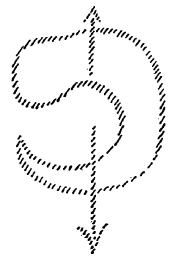
[ 43 ] Nun stellen wir einmal dieses Atmungsleben besonders heraus. Ich sagte Ihnen: Die Bilder werden aufgenommen aus dem Kosmos heraus: Form. Also das, was aus dem Tierkreis heraus erlebt wird in der Bewegung, das fließt gewissermaßen als die Bilder der inneren Organe nach innen. Aber der Mensch steht zwischen Geburt und Tod auf der Erde. Das Untere wirkt nach dem Oberen hinauf. Dadurch wird immer alles polarisch ausgebildet. Diese Bilder gehen schon nach innen; sonst hätten wir eben keine Organe, wenn die Bilder nicht nach innen gehen würden und tingiert werden könnten mit dem Stoffe. Aber es findet überall ein Gegenüber statt. So daß wir sagen können: Wenn wir atmen, werden die Bilder — sagen wir also zum Beispiel das Bild der Niere — nach innen getrieben. Der Stoff, der füllt dann das aus (rot); aber es entsteht ein Gegenüber, nach oben wiederum. Das heißt, es werden gewissermaßen im Echo diese Bilder wieder zurückgeworfen. Also die Bilder, die hat der Mensch einmal aufgenommen. Sie müssen nicht an Gleichzeitigkeit denken, die Organe sind einmal da. Der Mensch hat die Dinge natürlich gebildet in den ersten Zeiten seines Erdendaseins, aber der Rückschlag kann fortwährend geschehen. Wie das Seelische dabei mitwirkt, werden wir dann morgen sehen. Der Rückschlag geschieht fortwährend. Also stellen Sie sich jedes für sich vor: Sie nehmen die Bilder für Ihre inneren Organe mit dem Lebensprozesse auf. Das wird wiederum zurückgestoßen, das heißt, es kommen wiederum herauf, zurück die Echos dieser Bilder, auch der Tierkreis, namentlich mit dem Atmungsleben darinnen. Nun, Sie brauchen bloß an Ihre Ohren zu denken, dann haben Sie diesen Rückschlag. Diese Bilder werden in die Luft hinein gebildet, das sind die Vokale, die Konsonanten! Von den Planeten kommen mehr die Vokale, von den Tierkreisbildern kommen die Konsonanten. Dieser Rückschlag ist die Sprache. Was hineingeht, bildet die Organe. Was wiederum zurückgeschlagen wird, lebt in der Sprache. Konsonanten und Vokale werden gewissermaßen in uns hineingetrieben, bilden die Grundlage unserer Organe. Was mehr Form ist in unserem Inneren, kommt mehr von den Tierkreisbildern, was mehr Leben ist, kommt mehr von den Planeten. Wenn mehr das Leben zurückgeschlagen wird, vokalisieren wir, wenn mehr die Formen zurückgeschlagen werden, konsonantisieren wir. Das alles hängt in einer gewissen Weise mit dem Atmungsleben zusammen. Nun, in der Sprache haben Sie es ja deutlich, wie sie mit dem Atmungsleben zusammenhängt.
[ 43 ] Now let us focus specifically on this respiratory life. I told you: The images are received from the cosmos—form. So what is experienced through the zodiac in movement flows inward, as it were, as the images of the internal organs. But the human being stands on Earth between birth and death. The lower realm acts upward toward the upper realm. As a result, everything is always formed in a polar manner. These images do indeed flow inward; otherwise, we simply would not have organs if the images did not flow inward and could be imbued with matter. But a counter-process takes place everywhere. So we can say: When we breathe, the images—let’s say, for example, the image of the kidney—are driven inward. The substance then fills this out (red); but a counterpart arises, again directed upward. That is to say, these images are, as it were, thrown back in an echo. So these are the images that the human being has once taken in. You need not think of simultaneity; the organs are already there. The human being naturally formed these things in the early stages of their earthly existence, but the rebound can occur continuously. We will see tomorrow how the soul is involved in this process. The rebound occurs continuously. So imagine each one for itself: You take in the images of your internal organs through the life processes. This is then pushed back; that is, the echoes of these images—including the zodiac, particularly with the respiratory life within it—come back up again. Well, you need only think of your ears, and you have this rebound. These images are formed in the air—these are the vowels and the consonants! The vowels come more from the planets, while the consonants come from the images of the zodiac. This rebound is language. What goes in forms the organs. What is rebounded back lives in language. Consonants and vowels are, so to speak, driven into us, forming the foundation of our organs. What is more form within us comes more from the zodiacal signs; what is more life comes more from the planets. When more of the life is reflected back, we vocalize; when more of the forms are reflected back, we consonantize. All of this is connected in a certain way to the life of breathing. Well, in language you can clearly see how it is connected to the life of breathing.
[ 44 ] Sehen Sie, es ist schon nichts damit, den Menschen so erklären zu wollen, daß man ihn auf den Seziertisch legt und untersucht, was innerhalb seiner Haut ist. Das gibt nichts anderes, als wenn jemand eine Magnetnadel nimmt und absehen will davon, daß die Erde selber ein oben halb links (rot) großer Magnet ist, so daß das eine Ende nach Norden getrieben wird, das andere nach Süden getrieben wird von außerhalb. Wenn einer durchaus erklären möchte, warum diese Magnetnadel in sich just die Tendenz hat, sich in eine Richtung zu stellen — denn drehe ich sie, sie dreht sich immer wieder um —, wenn man ihr das zuschreibt, wenn man also eine Theorie erfindet, warum die Magnetnadel aus sich heraus sich so stellt, wenn man keine Rücksicht darauf nehmen will, daß die Erdenkräfte sie richten, dann tut man genau dasselbe, was man heute tut innerhalb der Anatomie und Physiologie, wenn man den Menschen erklären will aus dem, was innerhalb seiner Haut liegt. Es ist nicht zu erklären aus dem, was innerhalb seiner Haut liegt. Alle die Leute, die da zum Beispiel die Sprache erklären wollen aus dem, was innerhalb des Menschen ist, die stehen auf der Stufe dieser Magnetnadelerklärung, während die Wahrheit diese ist, daß der Mensch in sich aufnimmt der Form nach das Fixsternleben, es wiedergibt im Echo, dadurch Konsonanten bildet. Er nimmt auf die Bewegungen des planetarischen Lebens, die sein eigenes Leben bewirken. Da wird namentlich durch das Atmungsleben in Bildern gebildet. Es wird aber zurückgeschlagen; dadurch entstehen die Vokale. Der Mensch in seiner Sprache ist nur erklärbar, wenn man die Konsonanten aus den Fixsterngruppierungen, die Vokale aus den Planetenbewegungen beziehungsweise aus den Übereinanderlagerungen der Planeten erklärt, wenn man also das, was der Mensch spricht, aus dem ganzen Kosmos erklärt.
[ 44 ] You see, there’s nothing wrong with trying to explain human beings by laying them on a dissection table and examining what’s inside their skin. That’s no different from someone taking a magnetic needle and trying to ignore the fact that the Earth itself is a large magnet—with the top half on the left (red)—so that one end is drawn northward and the other southward by an external force. If someone absolutely wants to explain why this magnetic needle inherently tends to point in a certain direction — for when I turn it, it always turns back around — if one attributes this to the needle itself, that is, if one invents a theory as to why the magnetic needle aligns itself in this way of its own accord, without taking into account that the Earth’s forces are directing it, then one is doing exactly the same thing that is done today in anatomy and physiology when attempting to explain human beings based on what lies within their skin. It cannot be explained by what lies within the skin. All those who, for example, seek to explain language based on what is inside the human being stand on the same level as this explanation of the magnetic needle, whereas the truth is that the human being takes in the form of the fixed-star life, echoes it back, and thereby forms consonants. He takes in the movements of planetary life, which bring about his own life. Images are formed there, particularly through the respiratory life. But these are reflected back; this gives rise to the vowels. Human speech can only be explained by attributing the consonants to the constellations and the vowels to the planetary movements—or, more precisely, to the superimpositions of the planets—that is, by explaining what humans speak in terms of the entire cosmos.
[ 45 ] Sie haben hier in der Sonne (siehe Zeichnung Seite 89, waagrechter Strich) gewissermaßen die Mitte. Nehmen Sie die drei oberen Glieder, so haben Sie den oberen Menschen. Nehmen Sie die drei unteren Glieder, so haben Sie den unteren Menschen. Das Reproduktionsleben bringt ja den neuen Menschen hervor. Nehmen Sie nun das Atmungsleben und Zirkulationsleben. Das Zirkulationsleben ist es namentlich, welches die planetarische Bewegung abbildet. Unser Blutkreislauf ist im Grunde genommen nichts als eine Abbildung des planetarischen Lebens. So daß wir auch sagen können: Aus dem Zirkulationsleben kommen die Vokale, aus dem Atmungsleben kommen die Konsonanten. Und nun bekommen Sie wieder eine merkwürdige Zuordnung. Das Stoffwechselleben können Sie dem Nervenleben zuordnen; das Bewegungsleben können Sie dem Sinnesleben zuordnen. Das Sinnesieben aber, das ist zugeordnet dem Saturn, der Saturnbewegung. Die Saturnbewegung geht, wenn ich so sagen darf, am nächsten vorbei an dem Tierkreise, geradeso wie im Bewegungsleben der Mensch sich am besten nach außen hinaus abbildet. Will man daher die kosmischen Geheimnisse durch den Menschen abbilden lassen, so hat man zu dem einen Pol das Sinnesleben, zu dem anderen Pol das Bewegungsleben, und man bekommt daraus — die Eurythmie. In der Eurythmie ist also unmittelbar ein Abbild der peripherisch kosmischen Beziehung des Menschen zu sehen. Das wollte ich nur zunächst andeuten.
[ 45 ] Here, in the sun (see drawing on page 89, horizontal line), you have, so to speak, the center. Take the three upper members, and you have the upper human being. Take the three lower members, and you have the lower human being. The reproductive life, after all, brings forth the new human being. Now consider the respiratory life and the circulatory life. It is the circulatory life, in particular, that reflects planetary movement. Our blood circulation is, in essence, nothing but a reflection of planetary life. So we can also say: the vowels arise from the circulatory life, and the consonants from the respiratory life. And now you have another curious correspondence. You can associate the metabolic life with the nervous life; you can associate the movement life with the sensory life. The sensory life, however, is associated with Saturn, with the movement of Saturn. The movement of Saturn, if I may put it that way, passes closest to the zodiac, just as in the movement life, the human being is best reflected outwardly. If, therefore, one wishes to have the cosmic mysteries represented through the human being, one has the sensory life at one pole and the motor life at the other, and from this one obtains—eurythmy. In eurythmy, then, one can see directly a reflection of the human being’s peripheral cosmic relationship. I just wanted to hint at that for now.
[ 46 ] Was ich Ihnen also heute habe entwickeln wollen, das ist der Zusammenhang des Menschen mit dem Kosmos in bezug auf sein Leben. Gestern wollte ich Ihnen den Zusammenhang des Menschen mit dem Kosmos in bezug auf seine Form darlegen. Morgen werden wir nun dazu übergehen, das dritte Element des Menschen im Verhältnis zur Welt zu betrachten, die Seele. Dann haben wir betrachtet: Form, Leben und Seele. Also morgen wollen wir die Seele des Menschen dem kosmischen Leben zuteilen.
[ 46 ] So what I have sought to develop for you today is the connection between the human being and the cosmos in relation to human life. Yesterday I sought to explain to you the connection between the human being and the cosmos in relation to human form. Tomorrow we will move on to considering the third element of the human being in relation to the world: the soul. We will then have examined form, life, and soul. So tomorrow we will place the human soul within the context of cosmic life.