Anthroposophy as Cosmosophy I
GA 208
30 October 1921, Dornach
Translate the original German text into any language:
Versions Available:
Anthroposophy as Cosmosophy II, tr. SOL
Siebzehnter Vortrag
Seventeenth Lecture
[ 1 ] Wir haben versucht, den Menschen zu betrachten, zusammenhängend mit dem Universum nach seiner Form und nach seinem Leben. Wir haben gesehen, wie der Mensch gewissermaßen nach dem Kopfende und nach dem Gliedmaßenende in verschiedener Weise zugeordnet ist dem Universum. Alle diese Dinge gelten natürlich im wesentlichen für den Zeitraum der menschlichen Entwickelung, in dem wir stehen, der nachatlantischen Zeit, und Sie müssen sich ja klar darüber sein, daß eben das, was gesagt werden kann über Welterscheinungen, immer nur für gewisse Epochen gilt, weil ja die Welt in Entwickelung ist und sich in den aufeinanderfolgenden Stadien ihrer Entwickelung radikal verändert.
[ 1 ] We have attempted to view the human being in relation to the universe, in terms of both its form and its life. We have seen how the human being is, in a sense, related to the universe in various ways through the head and the extremities. All of these things, of course, apply essentially to the period of human development in which we find ourselves—the post-Atlantean era—and you must be clear that what can be said about world phenomena always applies only to certain epochs, because the world is in a state of development and undergoes radical changes in the successive stages of its evolution.
[ 2 ] Wir haben gesehen, wie der Mensch sich in bezug auf die Form gewissermaßen herausreißt aus seinem Zugeordnetsein dem Tierkreise, also gegenüber dem tierischen Kopf, der im Tierkreis drinnen liegt, herausgehoben ist, gewissermaßen um einen rechten Winkel gedreht ist. Dieser Teil des Menschen, dieses Kopfende des Menschen ist ja erfüllt von einem Lebenswesen, das gewissermaßen zu der unorganischen, zu der leblosen Natur hinneigt. Es ist mehr oder weniger an diesem Ende des Menschen untergehendes, ersterbendes Leben. Also wir haben dieses Ende des Menschen so vor uns, daß sowohl die Form wie das Leben selbst nach dieser Seite hin sich aus dem Zusammenhange mit dem Kosmos herausreißt; daß es dadurch, daß es sich herausreißt, sich gewissermaßen in eine Art von Erstarrung, in eine Art von beginnender Leblosigkeit bringt.
[ 2 ] We have seen how, in terms of form, the human being, as it were, breaks free from its affiliation with the zodiac; that is, it is set apart from the animal head, which lies within the zodiac, and is, as it were, rotated by a right angle. This part of the human being—the head—is, after all, filled with a life force that, in a sense, tends toward inorganic, lifeless nature. It is, more or less, a life that is fading and dying at this end of the human being. So we have this end of the human being before us in such a way that both the form and life itself break away from their connection with the cosmos on this side; that by breaking away, it brings itself, so to speak, into a kind of rigidity, into a kind of nascent lifelessness.
[ 3 ] Nun ist das, was wir so als Menschen an uns tragen, ja im wesentlichen das Ergebnis der vergangenen Entwickelung. Sie brauchen nur zunächst an das Individuelle des Menschen zu denken, und Sie werden sich erinnern, wie ich wiederholt auseinandergesetzt habe, daß das Haupt des Menschen eine Metamorphose des anderen Menschen ist aus dem früheren Lebenslaufe, daß also das Haupt hinweist auf die Vergangenheit, während ja, wie wir betonen mußten, der Gliedmaßenmensch hinweist auf die Zukunft.
[ 3 ] Now, what we as human beings carry within us is, in essence, the result of past development. You need only think, for a moment, of the individual nature of the human being, and you will recall how I have repeatedly explained that the head of a human being is a metamorphosis of another human being from a previous life—that is, the head points to the past, whereas, as we have had to emphasize, the human being as a collection of limbs points to the future.
[ 4 ] Auch sonst weist uns ja gerade dieses Hauptesende des Menschen auf die kosmischen Weiten der Vergangenheit zurück. Wir wissen ja, daß das Haupt der vorzüglichste Träger der Sinnesorgane ist. Wir wissen aber, daß die Sinnesorgane ihre erste Anlage während der alten Saturnzeit erfahren haben. Die ausgebildetsten Sinne — es kommen ja immer auch wiederum Sinnesbildungen nach während der Sonnen- und Mondenzeit —, aber die ausgebildetsten Sinne gehen also in die frühesten Zeiten der kosmischen Erdenentwickelung zurück. Alles also am menschlichen Haupte weist auf die Vergangenheit zurück, und in einer gewissen Beziehung kann man sagen: Indem sich während des Erdendaseins das Mineralreich ausgebildet hat, nimmt das Haupt des Menschen als die älteste Bildung am stärksten an dieser Mineralisierung des Menschen teil. Und indem der Mensch sich noch außerdem aus dem Kosmos herausreißt, konserviert er in einer gewissen Beziehung während seines Lebens zwischen Geburt und Tod diese erstens nicht mehr mit dem Kosmos zusammenhängende Form, zweitens das ersterbende, sich mineralisierende Leben. So daß man sagen kann: Hätte der Mensch sich bewahrt seine tierische Bildung, das heißt mit anderen Worten, wäre sein Haupt in der Tierkreisrichtung drinnen geblieben, wäre in ihm jenes wuchtigere Leben, das im tierischen Haupte drinnen ist, dann würde der Mensch dadurch in seinem Haupte ganz ein Ergebnis seiner Vorzeit sein. Er würde gewissermaßen in seinem Haupte etwas an sich tragen, dem man unmittelbar ansehen würde, wie es sich ergibt aus der ganzen vergangenen kosmischen Entwickelung. Dadurch aber, daß der Mensch das, was er da erhält als Ergebnis der vorhergehenden kosmischen Entwickelung, herausreißt, dadurch zerstört er, vernichtet er in einer gewissen Weise seine kosmische Vergangenheit.
[ 4 ] In other respects, too, it is precisely this main purpose of the human head that points us back to the cosmic expanses of the past. We know, after all, that the head is the foremost bearer of the sense organs. But we also know that the sense organs first took shape during the ancient Saturn period. The most highly developed senses—though new sensory faculties did indeed emerge during the Sun and Moon periods—date back to the earliest times of Earth’s cosmic evolution. Thus, everything about the human head points back to the past, and in a certain sense one can say: As the mineral kingdom has developed during Earth’s existence, the human head—as the oldest formation—participates most strongly in this mineralization of the human being. And as the human being further detaches itself from the cosmos, it preserves, in a certain sense, during its life between birth and death, first, this form that is no longer connected to the cosmos, and second, the life that is dying off and becoming mineralized. So one can say: If human beings had retained their animal form—that is to say, if their head had remained within the zodiacal sphere—and if they possessed within themselves that more powerful life found in the animal head, then human beings would thereby be, in their head, entirely a product of their past. He would, so to speak, carry within his head something that one could immediately see as the result of the entire past cosmic evolution. But by tearing out of himself what he receives as the result of the preceding cosmic evolution, he thereby destroys, in a certain sense, his cosmic past.
[ 5 ] Und das ist etwas außerordentlich Wichtiges, daß wir durch diejenigen Zusammenhänge, die wir gestern und vorgestern vor unsere Seele geführt haben, erkennen, wie der Mensch in seiner Hauptesbildung im Grunde genommen seine kosmische Vergangenheit vernichtet. Es ist so, daß der Mensch innerhalb seines Hauptes in der Tat noch hinausgeht über den eigentlichen Mineralisierungsprozeß zu einer Art außerordentlich feinen Verteilung der Materie. Es durchdringen ja selbstverständlich die organischen Gebilde auch das Haupt. Dadurch ist eingebettet in das Organische diese eigentlich noch über die mineralische Stufe hinausgehende Zerstäubung des materiellen Lebens.
[ 5 ] And this is something extraordinarily important: that through the connections we brought before our souls yesterday and the day before, we come to recognize how, in the formation of the head, the human being essentially destroys his cosmic past. The fact is that within the human head, the process actually goes beyond the actual process of mineralization to a kind of extraordinarily fine distribution of matter. Of course, organic structures also permeate the head. As a result, this atomization of material life—which actually extends beyond the mineral stage—is embedded within the organic structure.
[ 6 ] Wenn man in richtiger Weise das Haupt des Menschen ins Auge faßt, so muß man sagen: Es ist dieses Haupt der Herd eines die Materie als solche vernichtenden Prozesses. Das Materielle wird vernichtet, und dadurch gerade wird das Haupt als solches der Träger des besonderen seelischen Lebens. Man kann nur sagen: der Träger des besonderen seelischen Lebens, denn gerade mit Bezug auf die menschliche Hauptesbildung ist die materialistische Anschauung durchaus falsch, so wie sie gewöhnlich auftritt. Indem durch die Anwesenheit des menschlichen Hauptes im Organismus der Mensch der Träger des Gedankenlebens wird, des Vorstellungslebens, beruht dieses ganze Vorstellungsleben darauf, daß eigentlich das materielle Leben zerstäubt. Dadurch aber, daß das materielle Leben zerstäubt, findet ein merkwürdiger Prozeß statt, den ich Ihnen durch ein Bild vor die Seele führen möchte.
[ 6 ] If one correctly considers the human head, one must say: It is this head that is the source of a process that destroys matter as such. The material is destroyed, and it is precisely through this that the head, as such, becomes the bearer of a special spiritual life. One can only say: the bearer of a special spiritual life, for it is precisely with regard to the formation of the human head that the materialistic view, as it usually appears, is entirely wrong. Because the presence of the human head in the organism makes the human being the bearer of thought life and imaginative life, this entire imaginative life is based on the fact that material life is, in effect, disintegrating. But because material life is disintegrating, a remarkable process takes place, which I would like to bring before your mind’s eye through an image.
[ 7 ] Denken Sie sich einmal — wie gesagt, es ist ein Bild, aber es wird Ihnen den sehr subtilen Vorgang, mit dem wir es da zu tun haben, doch etwas vor die Seele rücken —, denken Sie sich einmal ein Gemälde, meinetwillen die Raffaelsche Madonna. Wir haben natürlich, sonst würde das Gemälde in der physischen Welt nicht vorhanden sein können, das, was wir auf der Tafel haben, materiell. Nun denken Sie sich aber, das Materielle der Sixtinischen Madonna würde ganz zerstäubt werden, zu Staub zerfallen, und es würde doch ein feines ätherisches Gewebe bleiben können. Also die Sixtinische Madonna würde materiell zerstäuben, aber alles das, was in dieser Materie gemalt ist, auch mit seiner Farbentingierung, das würde ätherisch verbleiben, und jemand, der das ätherisch wahrnehmen könnte, würde, trotzdem das Materielle jede Bedeutung verliert, er würde wahrnehmen können, was als ätherisches Gebilde zurückbleibt.
[ 7 ] Just imagine—as I said, it’s just a picture, but it will help you grasp the very subtle process we’re dealing with here—just imagine a painting, say, Raphael’s Madonna. Of course, we have—otherwise the painting could not exist in the physical world—the material substance of what is on the canvas. Now imagine, however, that the material substance of the Sistine Madonna were to be completely pulverized, reduced to dust, and yet a fine, ethereal fabric might remain. So the Sistine Madonna would disintegrate physically, but everything that is painted on that material—including its coloration—would remain in the etheric realm, and someone capable of perceiving the etheric could, even though the physical form loses all significance, perceive what remains as an etheric form.
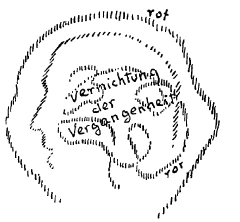
[ 8 ] So ist der Denkvorgang, so ist der Vorgang in der Gedankenbildung. Wenn Sie sich bewußt werden im gewöhnlichen Bewußtsein eines Gedankens, einer Vorstellung, so beruht dieses Bewußtwerden der Vorstellung, des Gedankens darauf, daß durch das Herausgehen aus dem ganzen Kosmos, wie wir das gestern und vorgestern gesehen haben, das Materielle jede Bedeutung verliert, der Mensch fortwährend genötigt ist, sein Haupt gewissermaßen neu zu beleben, weil alle Einzelheiten des Hauptes fortwährend im Zerfall, im Ersterben sind. Und während dieses Ersterbens hebt sich das Ätherische des Hauptes heraus (siehe Zeichnung Seite 103, rot außen), und dieses Herausheben des Atherischen des Hauptes bedeutet das Fassen von Gedanken. Indem gewissermaßen abstäubt das Materielle und das Ätherische bleibt, wird sich der Mensch bewußt seiner Vorstellung.
[ 8 ] This is the thought process; this is how thoughts are formed. When you become aware, in ordinary consciousness, of a thought or an idea, this becoming aware of the mental image or thought is based on the fact that, as we saw yesterday and the day before, by stepping out of the entire cosmos, the material loses all meaning, and the human being is constantly compelled to, so to speak, revitalize the head, because all the details of the head are constantly in a state of decay, of fading away. And as this fading occurs, the etheric aspect of the head emerges (see drawing on page 103, red on the outside), and this emergence of the etheric aspect of the head signifies the grasping of thoughts. As the material aspect, so to speak, is shaken off and the etheric remains, the human being becomes conscious of his or her idea.
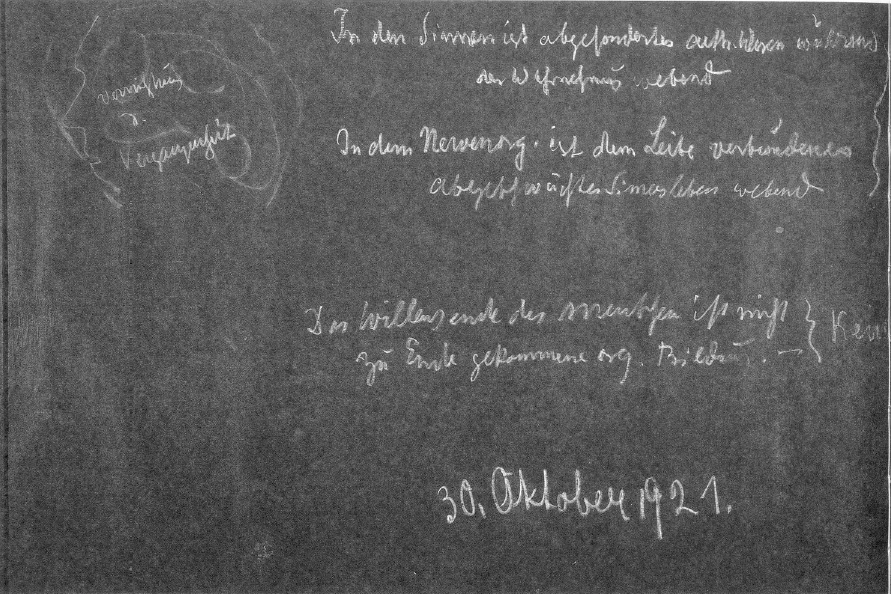
[ 9 ] Erinnern Sie sich, daß ich gesagt habe: In den Sinnen ist schon mehr oder weniger etwas wie ein physikalischer Apparat vorhanden. Das Auge ist ein physikalischer Apparat, ist eben nur von dem Ätherleib des Menschen durchwebt. Da ist es schon so, wie ich es jetzt beschreibe für das übrige Haupt, für das Nervengewebe. So daß wir folgendes sagen können — ich bitte Sie, diesen Satz, den ich jetzt aussprechen werde, recht genau ins Auge zu fassen: In den Sinnen, also namentlich in den Hauptessinnen, ist abgesondertes ätherisches Wesen während der Wahrnehmung webend. — Also insofern wir in den Sinnen leben, haben wir eine Art freien ätherischen Prozesses, der sich abspielt in der Sinnensphäre.
[ 9 ] Remember that I said: There is already, to a greater or lesser extent, something like a physical apparatus present in the senses. The eye is a physical apparatus; it is simply interwoven with the human etheric body. It is already the case, as I am now describing it, for the rest of the head, for the nervous tissue. So that we can say the following—I ask you to consider this sentence I am about to utter very carefully: In the senses, that is, specifically in the head senses, a distinct etheric being weaves its way through during perception. — So insofar as we live in the senses, we have a kind of free etheric process taking place in the sphere of the senses.
[ 10 ] Nehmen Sie das Auge. Es ist ein physikalischer Apparat, aber es ist durchzogen von dem Ätherischen. Und in diesem Durchziehen eines Unorganischen, eines solchen, welches fortwährend zerfallen will, das eigentlich ein Mechanisches, man möchte sagen, ein Untermechanisches darstellt, in dem lebt frei das ätherische Wesen. So ist es für die Sinnesregion.
[ 10 ] Take the eye, for example. It is a physical apparatus, but it is permeated by the ethereal. And within this permeation of an inorganic substance—one that is constantly tending toward decay, which actually represents something mechanical, one might say, something sub-mechanical—the ethereal being lives freely. So it is for the realm of the senses.
[ 11 ] Für die Nervenregion, die ja die Fortsetzung der Sinnesregion nach innen ist, ist es so, daß zwar die Nervenregion inniger verbunden hat den Ätherleib mit der Materie, aber fortwährend will unser gesamtes Nervenleben Sinnesleben werden. Also stellen Sie sich vor: Sie sehen, sagen wir, irgendeine farbige Fläche. Da haben Sie zunächst die Sinneswahrnehmung. Da ist es so, daß der Ätherleib frei webt. Indem Sie jetzt absehen von der Sinneswahrnehmung und sich dem Nervenleben überlassen, wird das ganze Nervenwesen Sinneswesen: da ist die Vorstellung in Ihrem Bewußtsein anwesend. Man möchte sagen: Insofern der Mensch Nervenmensch ist, wird er in der Vorstellung durch und durch Sinneswesen.
[ 11 ] As for the nervous region—which is, after all, the inward extension of the sensory region—it is true that the nervous region connects the etheric body more intimately with matter, but our entire nervous life is constantly striving to become sensory life. So imagine this: You see, let’s say, some colored surface. At first, you have the sensory perception. Here, the etheric body weaves freely. But when you now turn away from the sensory perception and surrender to your nervous life, your entire nervous being becomes a sensory being: the mental image is present in your consciousness. One might say: Insofar as a human being is a nervous being, he becomes, in his mental imagery, a sensory being through and through.
[ 12 ] Dann kommt die Reaktion. Die Sinne, sie sind nach dem Physikalischen hin orientiert. Die vertragen ein fortwährendes Aufnehmen. Der Organismus der Nerven, der nimmt auf in sich, was ihm die Sinne darbieten. Er gestaltet sich um zum Sinneswesen. Aber damit ertötet er sich. Er würde ganz Auge oder ganz Ohr oder so etwas werden. Damit er das nicht wird, durchdringt ihn wiederum das Vitalprinzip, das Lebensprinzip aus dem übrigen Organismus. Der Mensch läßt gewissermaßen die Vorstellung hinschwinden. So daß wir sagen können: Nach dem Kopfende hin vernichtet der Mensch seine Vergangenheit. Dadurch wird er als Nerven-Sinnesmensch der Träger von Bildern, hat er ein Bild-Erleben; ein Bild-Erleben, das im Ätherischen webt.
[ 12 ] Then comes the reaction. The senses are oriented toward the physical realm. They are capable of continuous reception. The nervous system takes in whatever the senses present to it. It transforms itself into a sensory being. But in doing so, it destroys itself. It would become entirely an eye or entirely an ear, or something of that sort. To prevent this from happening, the vital principle—the life principle—from the rest of the organism penetrates it once more. Human beings, so to speak, allow the concept to fade away. So that we can say: Toward the head, human beings annihilate their past. Through this, as a nervous-sensory being, they become the bearer of images; they have an experience of images—an experience of images that weaves within the etheric.
[ 13 ] Sie sehen, man kann, wenn man geisteswissenschaftlich-anthroposophisch vorgeht, dieses Gedankenleben, wie es im Bewußtsein urständet, durchaus beschreiben. Und es ist notwendig, daß man zur Anthroposophie greift, um dieses Leben der Gedanken im Bewußtsein zu beschreiben.
[ 13 ] As you can see, if one adopts a humanities-based, anthroposophical approach, it is entirely possible to describe this life of thought as it arises in consciousness. And it is necessary to draw on anthroposophy in order to describe this life of thought in consciousness.
[ 14 ] Wir können also sagen: Indem der Mensch das Kopfende der Form nach entwickelt, entwickelt er es in dem Sinne, daß er für die heutige Zeit ausgesetzt ist den Einwirkungen jener Kräfte, die sich im Kosmos entwickeln, wenn die Sonne im Zeichen der Fische, des Widders, des Stiers und so weiter steht; aber der Mensch hebt seinen Kopf der Form nach heraus. Dadurch wird er nicht tierischer Kopf, sondern er wendet sich, dieser Mensch, man möchte sagen, in die Menschenvertikale, während das Tier im Tierkreis stehenbleibt.
[ 14 ] We can therefore say: As human beings develop the head in terms of form, they develop it in the sense that, in the present day, they are exposed to the influences of those forces that develop in the cosmos when the Sun is in the signs of Pisces, Aries, Taurus, and so on; but human beings raise their heads in terms of form. As a result, the human head does not become an animal head; rather, the human being, one might say, turns toward the human vertical, while the animal remains within the zodiac.
[ 15 ] Wenn wir das Leben betrachten, so können wir sagen: Nach dem Kopfende zu entwickelt sich das Leben unter der Einwirkung der äußeren Planeten, des Saturn und Jupiter, wie wir gestern gesehen haben. Aber der Mensch hebt heraus dieses sein Leben, und folgendes geschieht: Würden sie durch die Sonne niemals bedeckt — erinnern Sie sich an das, was ich gestern auseinandergesetzt habe in bezug auf Saturn und Jupiter —, dann würde das ganze Nervenleben immer mehr Sinnesleben werden. Der Mensch würde durchaus die Augenempfindung haben, aber sie würde sich ins Nervenleben fortsetzen; er würde die Gehörempfindung haben, sie würde sich ins Nervenleben fortsetzen — es würde im Nervenleben chaotisch-unorganisch durcheinanderschießen das Sinnesleben der zwölf Sinne. Dadurch, daß nun diese äußersten Planeten bedeckt werden, dadurch wird das Nervenleben aus dem Sinnesleben herausgerissen, und der Mensch ist in der Lage, eben sich so zu verhalten, wie ich gesagt habe, daß er im Vorstellungsleben bewußt willkürlich wirkt, daß er gewissermaßen Sinn wird, sich wiederum entsinnt, indem er die Vorstellungen willkürlich unterdrükken kann und so weiter.
[ 15 ] When we consider life, we can say that, as we saw yesterday, life develops toward the head under the influence of the outer planets, Saturn and Jupiter. But the human being sets this aspect of their life apart, and the following happens: If it were never overshadowed by the Sun—remember what I explained yesterday regarding Saturn and Jupiter—then the entire nervous life would increasingly become sensory life. Human beings would certainly have visual perception, but it would continue into the nervous life; they would have auditory perception, and it would continue into the nervous life—the sensory life of the twelve senses would intermingle chaotically and inorganically within the nervous life. Because these outermost planets are now obscured, the nervous life is torn away from sensory life, and the human being is able to behave exactly as I have described: to act consciously and arbitrarily in the life of imagination, to become, as it were, consciousness itself, to recall again by being able to arbitrarily suppress images, and so on.
[ 16 ] So daß wir sagen können: In den Sinnen ist abgesondertes ätherisches Wesen während der Wahrnehmung webend. In dem Nervenorganismus ist dem Leibe verbundenes, abgeschwächtes Sinnenleben webend. — Das Ganze bekommt einen Bildcharakter, weil das, was bewirken würde, daß man es nicht mit einem Bildcharakter zu tun hätte, sondern mit einem materiellen Charakter, vernichtet wird durch das Herausgehen des Menschen in die Menschenvertikale, während das Tier im Tierkreise drinnen bleibt. Das Tier hat eben nur Traumvorstellungen, nicht Bildvorstellungen, wie sie der Mensch hat. Und Traumvorstellungen sind etwas, was hervorsprießt aus dem Vitalprinzip des Organismus, während die Bildvorstellungen rein herausgehoben sind ins freie ätherische Leben, das nicht mehr mit dem physischen Leib verbunden ist. Es muß durchaus betont werden, daß durch die Organisation des Menschen, durch das Herausheben seines Kopfendes aus den Tierkreisbildern und aus dem Planetenweben, daß dadurch im Menschen ein freies ätherisches Leben nach dem Kopfende hin entsteht; daß dieses freie ätherische Leben in dem Kopf dann erst von dem astralischen Leib durchzogen ist, von dem Ich durchzogen ist, die dadurch teilnehmen an dem Gedanken- und Vorstellungsweben des ätherischen Leibes.
[ 16 ] So that we can say: A distinct, ethereal essence is at work within the senses during perception. Within the nervous organism, a sensory life—weakened and connected to the body—is at work. — The whole takes on an imaginal character, because that which would cause us to deal not with an imaginal character but with a material one is destroyed by the human being’s emergence into the human vertical, while the animal remains within the animal circle. The animal has only dream-images, not pictorial images as the human being has. And dream-images are something that springs forth from the vital principle of the organism, whereas pictorial images are purely lifted up into the free ethereal life that is no longer connected to the physical body. It must be emphatically stressed that through the organization of the human being—through the elevation of the head region out of the images of the zodiac and out of the planetary weaves—a free etheric life arises in the human being directed toward the head region; that this free etheric life in the head is then permeated by the astral body and by the “I,” which thereby participate in the weaves of thought and imagination of the etheric body.
[ 17 ] Dieses kann uns schon zeigen, wie man das Seelische dann erfaßt, wenn man weiß, wodurch eben das Gedankenleben im Menschen ein Seelisches ist, das heißt, nicht teilnimmt an dem materiellen Leben.
[ 17 ] This can already show us how to understand the soul when we know what it is that makes a person’s life of thought a spiritual one—that is, one that does not participate in material life.
[ 18 ] Gehen wir nun weiter. Wir haben gezeigt — wir wollen den anderen Pol betrachten —, wie der Mensch nach der anderen Seite hin sich der Form und dem Leben nach entwickelt. Wir haben gesehen, vorgestern, wie der Mensch seine äußere Tätigkeit als Gliedmaßenmensch entwickelt. Ich habe Ihnen gezeigt, wie der Mensch — und wir mußten dazu noch zu den griechischen Zuständen zurückblicken — als Jäger, als Tierzüchter, als Ackerbauer, als die Meere befahrender Handelsmann sich betätigt. In dieser menschlichen Betätigung verharrt der Mensch dann aber dadurch, daß er sich entzieht der Einwirkung der entsprechenden Fixstern-Tierkreisbilder. Das Tier bleibt durchaus unter der Einwirkung des Schützen, des Steinbocks, des Wassermanns, der Fische. Dadurch bilden sich die Tiere in ihrer Form so aus, daß sie sich hinordnen auf das Irdische, bilden sich so aus, wie sie sind. Studiert man den Tierkreis, so kann man erkennen, warum die Tiere in einer gewissen Weise ihr Gliedmaßensystem ausgebildet haben. Der Mensch bildet sein Gliedmaßensystem so aus, daß er eshinordnet auf das Irdische, wenn diese Tierkreisbilder eben unter dem Irdischen sind, wenn die Erde für einige Zeit dort im Tierkreis auf der nördlichen Hemisphäre ist. Es sind dadurch auch geographisch die Erdteile in verschiedener Weise bewohnbar. Der Mensch kann aber, was er an einem Orte ausbildet, auf einen anderen übertragen. Das, was hier entwickelt wird, muß natürlich für die älteren Zeiten gelten; für die heutigen vermischen sich die verschiedenen Menschenformen auf der Erde, und man hat, wenn man heute Geographie studiert, nicht mehr ein reines Bild von dem, was der Mensch im Zusammenhange mit dem Makrokosmos ist. Der Mensch reißt sich also da auf eine andere Art heraus aus der Tierkreislinie. Er bringt sich gewissermaßen nach der anderen Seite hin in die Menschenvertikale, in die Menschensenkrechte. Und während er voll ausgesetzt bleibt sowohl der Form nach den Tierkreisbildern, wie auch den äußeren Planeten in bezug auf sein Hauptesende, entzieht er sich sowohl der planetarischen Einwirkung wie auch der Tierkreiseinwirkung, indem er auf der Erde steht und sich die andere Seite zudecken läßt von der Erde. Saturn und Jupiter wirken auf den Menschen, indem sie ihr Licht auf die Erde herabstrahlen. Der Mensch, der in seinem Hauptesende ein Bildesleben hat, empfängt auch die Bilder dieser Sternwelten, ebenso wie er die Bilder der planetarischen Bewegungen empfängt, indem er sein Lebenswesen nach dem Hauptesende zu entwickelt. Er entwickelt da ein Bildleben und nimmt auch vom Kosmos, vom Makrokosmos die Bilder auf.
[ 18 ] Let us now move on. We have shown—and let us now consider the other pole—how human beings develop in terms of form and life toward the other side. We saw the day before yesterday how human beings develop their external activity as beings of the limbs. I have shown you how human beings—and to do so we had to look back to the Greek era—are active as hunters, as animal breeders, as farmers, and as merchants sailing the seas. But human beings remain within this sphere of human activity by withdrawing from the influence of the corresponding fixed-star zodiac constellations. Animals, on the other hand, remain entirely under the influence of Sagittarius, Capricorn, Aquarius, and Pisces. As a result, animals develop their forms in such a way that they align themselves with the earthly realm; they develop exactly as they are. If one studies the zodiac, one can see why animals have developed their limb systems in a certain way. Human beings develop their limb systems in such a way that they align with the earthly realm when these zodiac constellations are situated below the Earth—that is, when the Earth is in that part of the zodiac in the northern hemisphere for a certain period of time. As a result, the continents are also habitable in various ways from a geographical perspective. However, human beings can transfer what they develop in one place to another. What is described here, of course, applies to earlier times; in the present day, the various human forms on Earth are intermingled, and when one studies geography today, one no longer has a pure picture of what the human being is in relation to the macrocosm. The human being thus breaks away from the zodiacal line in a different way. In a sense, he moves toward the other side, into the human vertical, into the human axis. And while he remains fully exposed—both in form to the images of the zodiac and to the outer planets with regard to his head—he withdraws from both planetary influence and the influence of the zodiac by standing on Earth and allowing the Earth to shield him from the other side. Saturn and Jupiter influence human beings by radiating their light down upon the Earth. The human being who lives a life of images in the head also receives the images of these stellar worlds, just as he receives the images of planetary movements, by developing his life being in the direction of the head. There he develops a life of images and also absorbs the images from the cosmos, from the macrocosm.
[ 19 ] Von der anderen Seite nimmt er die Bilder nicht auf. Daher entstehen jene Formen, die ich vorgestern gezeigt habe, die die Gliedmaßen sind, die entgegengesetzten Formen von den Hauptesformen. Und er entwickelt aber auch Tätigkeiten, die sich entziehen dem makrokosmischen Einfluß, die diesen makrokosmischen Einfluß nicht herankommen lassen.
[ 19 ] He does not absorb the images from the other side. This gives rise to the forms I showed the day before yesterday—the limbs, which are the opposite forms of the main forms. And he also develops activities that elude the macrocosmic influence, that do not allow this macrocosmic influence to approach him.
[ 20 ] Nun ist es so, daß, wenn wir sagen können, daß der Mensch seinem Kopfende nach seine Vergangenheit vernichtet, so ist das Entgegengesetzte der Fall nach dem Gliedmaßenende hin. Würde der Mensch auf einer durchsichtigen Erde stehen, so daß auch von der anderen Seite Tierkreis und Planetenbewegung auf ihn wirken könnten, dann würde er erstens nicht selbständige, freie Taten entfalten können. Er würde unter dem Einflusse des Planetarischen und des Fixsternlebens stehen. Nur dadurch, daß ihm die Erde dieses Planetarische und Fixsternleben zudeckt, kommt er zu der freien Entfaltung seiner Tätigkeit. Aber er würde außerdem, wenn er ihm voll ausgesetzt wäre gerade mit seiner besonderen Lebenszeit, mit seinem sich immer wiederholenden Erdenleben, in seinem Gliedmaßensystem ein verholzendes Leben, ein sich stark verhärtetes Leben entwickeln. Er würde ja die Materie nicht zerstäuben können, sondern die organische Materie würde vor der Ausreifung verhornen. Der Mensch würde eigentlich nur Gliedmaßen haben, die in ganz anderer Weise noch wie die Hufe der Pferde oder Rinder verhornt wären bis weit an den Leib heran. Der Mensch ist dieser Verhornung dadurch entzogen, daß er sich heraushebt aus dem Tierkreise.
[ 20 ] Now, while we can say that human beings destroy their past at the level of their head, the opposite is true at the level of their limbs. If a human being were to stand on a transparent Earth, so that the zodiac and the movements of the planets could also affect him from the other side, then, first of all, he would not be able to carry out independent, free actions. He would be under the influence of planetary and fixed-star life. It is only because the Earth shields him from this planetary and fixed-star life that he is able to freely develop his activity. But moreover, if he were fully exposed to it—especially during his specific lifetime, with his repeatedly recurring earthly existence—he would develop a lignified life, a strongly hardened life, within his limb system. He would not be able to break down the matter; rather, the organic matter would become keratinized before reaching maturity. In fact, human beings would have only limbs that were calloused in a completely different way—much like the hooves of horses or cattle—extending far up the body. Human beings are spared this callousing precisely because they rise above the animal realm.
[ 21 ] Dadurch aber findet der entgegengesetzte Prozeß statt wie nach dem Hauptesende. Nach dem Hauptesende wird die Vergangenheit vernichtet, die Materie zerstäubt. Nach dem Gliedmaßenende entwickelt sich der Mensch so, daß er die Materie nicht zur vollen kosmischen Reife gelangen läßt. Sie bleibt zurück. Er hält sie zurück. Wir haben nur dadurch Finger, wir haben nur dadurch Zehen, daß wir unsere Gliedmaßen nicht auswachsen lassen. Würden wir sie auswachsen lassen, so wären sie nicht nur mit Nägeln besetzt, sondern sie wären ganz versteift, verhornt. Wir halten sie also auf einer früheren Stufe zurück. Dadurch, daß wir unsere Gliedmaßen so zurückhalten, dadurch können wir in ihnen den Willen entwickeln, der dann die Anlage ist für die folgenden Erdenleben. Würden wir den Menschen als Gliedmaßenmenschen ausreifen lassen, dann würde mit unserem einen Erdenleben das Leben abschließen. Wir bewahren das, was in die Zukunft hinübergeht, dadurch, daß wir unseren Gliedmaßenmenschen nicht voll ausreifen lassen. Es ist also hier das Gegenteil der Fall: Während nach dem Gedankenende hin das seelische Leben ein Bildleben wird, bleibt in der Tat, wenn ich mich grob ausdrücken darf, nach dem Gliedmaßenende hin das Leben fleischlich materiell, organisch materiell jung, möchte ich sagen. Es wird nicht alt, es verhornt nicht, es bleibt jung. Dadurch, daß es jung bleibt, kann dann das Materielle abfallen, und das Bild des Jungen geht hinüber durch den Tod in das folgende Erdenleben. Da drinnen kann sich der Wille dann entwickeln. Da ist das Willensende. So daß wir sagen können: Das Willensende des Menschen ist nicht zu Ende gekommene organische Bildung. — Können wir hier (am Kopfende) vom Bild sprechen, so müssen wir da von etwas anderem sprechen. Was ist denn eine nicht zu Ende gekommene organische Bildung? Ein Keim. Denn der Keim kann sich weiter entwickeln. Während wir am Kopfende etwas haben wie eine Austernschale, wie etwas, was als Materie sich abgesondert hat und reine Materie ist, haben wir nach dem Gliedmaßenende etwas wie Keime. Hier (oben) können wir sagen: Wir erleben seelisch das reine Ätherische, das Bild. Hier (unten) erleben wir nicht das Bild, sondern wir erleben keimendes Leben. (Siehe Darstellung Seite 112.) Hier erleben wir Verbundensein oben mit der Materie. Deshalb können wir auch unsere Gliedmaßen bewegen, weil wir mit der Materie verbunden sind. Am Kopf kann der Mensch nicht viel bewegen, höchstens insofern seine Sinne zu Glied maßen umgebildet sind und der Mensch auch am Kopf Gliedmaßen mensch ist. Es durchdringt sich ja alles, jedes einzelne Glied durch dringt die anderen. In gewissem Sinne sind die Augen auch Hand, in sofern sie sich bewegen können. Aber nicht vieles ist beweglich am Kopf, der Kopf ist zumeist unbeweglich, und der willkürlichen Bewegung sind vor allen Dingen, sagen wir, die Gehirnlappen und der gleichen entzogen. Aber auch am Außenhaupte ist wenig beweglich, und es ist schon eine Seltenheit, wenn der Mensch gewisse Ohrmuskeln bewegen kann; er kann damit schon außerordentlich brillieren.
[ 21 ] But this results in the opposite process from what occurs after the “head end.” After the “head end,” the past is destroyed and matter is atomized. After the “limb end,” the human being develops in such a way that he does not allow matter to reach full cosmic maturity. It remains behind. He holds it back. We have fingers and toes only because we do not allow our limbs to grow to their full extent. If we were to let them grow fully, they would not only be covered with nails, but they would be completely stiffened and calloused. We therefore hold them back at an earlier stage. By holding back our limbs in this way, we are able to develop within them the will that then serves as the foundation for subsequent earthly lives. If we were to allow human beings to mature as “limb-beings,” then life would come to an end with our single earthly life. We preserve what carries over into the future by not allowing our “limb-human” to fully mature. So the opposite is true here: While, toward the end of the thought-life, the soul life becomes a life of images, in fact—if I may put it crudely—toward the end of the limb-life, life remains carnally material, organically material, and young, I might say. It does not grow old, it does not become calloused; it remains young. Because it remains young, the material aspect can then fall away, and the image of the young passes through death into the next earthly life. There, within that, the will can then develop. That is the end of the will. So that we can say: The end of the human will is an organic formation that has not yet come to an end. — If we can speak here (at the head end) of an image, then there we must speak of something else. What, then, is an organic formation that has not yet come to an end? A germ. For the germ can continue to develop. While at the head end we have something like an oyster shell—something that has separated as matter and is pure matter—after the end of the limbs we have something like germs. Here (above), we can say: We experience the pure etheric—the image—spiritually. Here (below), we do not experience the image, but rather we experience germinating life. (See illustration on page 112.) Here we experience a connection above with matter. That is why we can also move our limbs—because we are connected to matter. A person cannot move much in the head, except to the extent that the senses are transformed into limbs and the person is, in a sense, a human being with limbs in the head as well. Everything interpenetrates; each individual limb penetrates the others. In a certain sense, the eyes are also hands, insofar as they can move. But not much is movable on the head; the head is mostly immobile, and voluntary movement is, above all, denied—let us say—to the cerebral lobes and the like. But even on the outer surface of the head, little is movable, and it is indeed a rarity when a person can move certain ear muscles; he can already distinguish himself extraordinarily with this ability.
[ 22 ] Dieses Erleben in der Materie läßt das Bewußtsein nicht aufkommen. Dadurch aber sind wir in der Lage, den Willen eben zu entwikkeln. So daß wir hier (oben) die Materie vernichten, hier (unten) aber behalten wir, wenn die Materie von uns abfällt im Tode, Keime zurück als Kraft für die nächsten Erdenleben.
[ 22 ] This experience within matter does not allow consciousness to arise. But this very fact enables us to develop our will. So that here (above) we destroy matter, but here (below), when matter falls away from us at death, we retain seeds as a source of strength for our next earthly lives.
[ 23 ] Was dazwischen liegt, wir haben es gestern bezeichnet auf der einen Seite als das Atmungswesen, wenn wir auf das Leben sehen, oder das Zirkulationswesen. Wir haben dann gesehen, wie das zugeteilt ist als Form demjenigen, was da liegt zwischen den oberen Tierkreisbildern und den unteren Tierkreisbildern.
[ 23 ] What lies in between—we described it yesterday, on the one hand, as the respiratory system, when we consider life, or the circulatory system. We then saw how this is assigned as a form to that which lies between the upper zodiacal images and the lower zodiacal images.
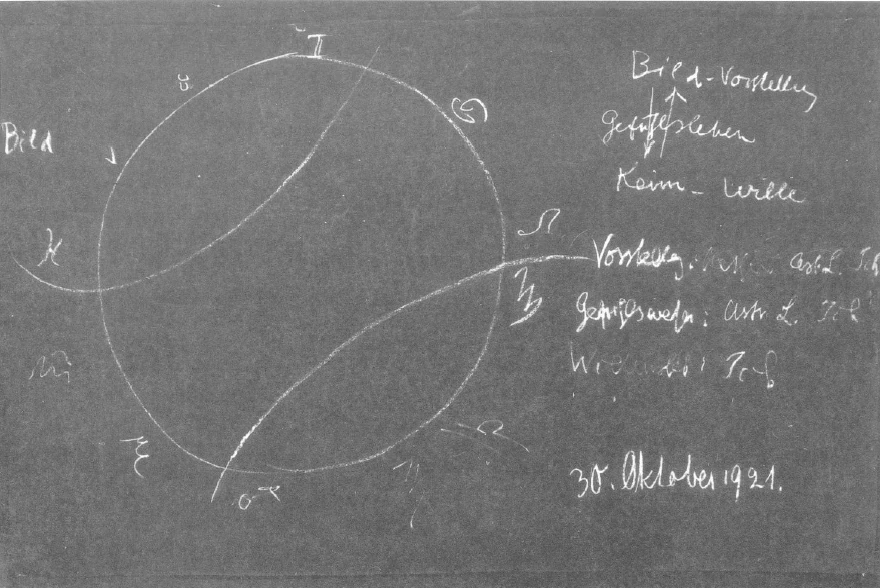
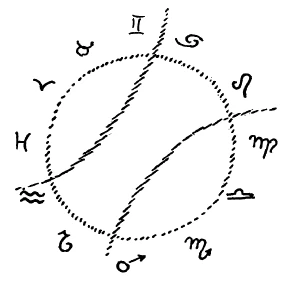
[ 24 ] Wenn Sie also für die heutige Zeit den Fixsternhimmel sich in folIinks gender Weise repräsentiert denken: Widder, Stier, Zwillinge, Krebs, Löwe, Jungfrau, Waage, Skorpion, Schütze, Steinbock, Wassermann, Fische — dann würden wir diese vier Tierkreisbilder (Fische, Widder, Stier, Zwillinge, siehe Zeichnung) dem Haupte zuzuteilen haben, und unter ihrer Einwirkung wird das Haupt im Sinne derjenigen Planetenbewegungen, die über der Erde sind, mit einem ersterbenden Leben ausgerüstet. So daß das Haupt ein Bild-Erleben hat, ein Vorstellungserleben als Seelisches. Die anderen vier entgegengesetzten Zeichen für das Heutige — für das Griechische wäre es etwas anders — wären dann Jungfrau, Waage, Skorpion, Schütze. Und wir hätten dann für den rhythmischen Menschen das, was dazwischen liegt, wie wir vom planetarischen Leben den Mars und den Merkur als die Zwischenlage haben, die dazwischen liegenden Planeten haben. Da, können wir sagen, ist der Mensch so, daß er zwischen dem Bilde und dem Keime drinnen hin- und herpendelt. Das Atmungs-Blutleben zeigt Ihnen ja das, ich möchte sagen, wie in einem äußeren Bilde wunderbar. Der Mensch nimmt den belebenden Sauerstoff auf, der mit seinem Gliedmaßenorganismus, mit allem Beweglichen in ihm verbunden ist. Er verbindet den Sauerstoff mit dem Kohlenstoff. Der Kohlenstoff wirkt zuerst anregend als das Ertötende auf das Nerven-Sinnesleben, dann wird er ausgestoßen als das Ersterbende. Da haben wir fortwährend schon materiell das äußerste Leben im Sauerstoff, den äußersten Tod im Kohlenstoff: ErsterbenBeleben, Ersterben-Beleben. Es schwingt das Leben zwischen Ersterben und Beleben hin und her.
[ 24 ] So if you imagine the fixed-star sky as it appears today in the following order: Aries, Taurus, Gemini, Cancer, Leo, Virgo, Libra, Scorpio, Sagittarius, Capricorn, Aquarius, Pisces—then we would have to assign these four zodiac signs (Pisces, Aries, Taurus, Gemini, see illustration) to the head, and under their influence, the head is endowed with a life that is fading away, in accordance with the planetary movements above the Earth. Thus, the head has an experience of images, an experience of imagination as a soul activity. The other four opposite signs for the present day—for the Greek system it would be somewhat different—would then be Virgo, Libra, Scorpio, and Sagittarius. And we would then have, for the rhythmic human being, what lies in between, just as we have Mars and Mercury from planetary life as the intermediate position, the planets that lie in between. There, we can say, the human being is such that he oscillates back and forth between the image and the germ within. The respiratory-blood life shows you this, I would say, wonderfully, as in an external image. The human being takes in the life-giving oxygen, which is connected to his limb system, to everything that moves within him. He combines the oxygen with carbon. Carbon first acts as a stimulant—as that which kills—on the nervous-sensory life; then it is expelled as that which first dies. There we have, in a material sense, the ultimate life in oxygen and the ultimate death in carbon: dying-reviving, dying-reviving. Life oscillates back and forth between dying and reviving.
[ 25 ] Seelisch ist das aber so, daß wir innerlich etwas erleben, was auf der einen Seite, wie noch das Gedankenleben, rein ätherisch ist; aber der Ätherleib erfaßt gewisse Gebilde, Drüsengebilde. Diese Drüsen sondern Materie ab. Es ist das, was körperlich so vor sich geht, daß der Ätherleib auf die Drüsen wirkt. Die Drüsen verbinden sich nicht so wie etwa die Muskeln — die dann vorzugsweise dem Gliedmaßenorganismus angehören — mit dem ätherischen Leben, sondern indem das Atherleben die Drüsen ergreift, sondert die Drüse Materie ab. Es ist also ein nicht vollständiges Zusammenschmelzen des ätherischen Lebens mit dem materiellen Leben. Es ist der Übergang. Es ist ein Ergreifen der Materie, aber zugleich ein Sich-Wehren der Materie, ein Absondern der Materie. Wenn Sie den Muskel studieren, den Knochen studieren, was zum Gliedmaßensystem gehört, dann haben Sie das so, daß die Materie streng — am meisten beim Knochen — ergriffen wird von dem Ätherleib des Menschen. Da zerstäubt nichts, da bleibt alles frisch-lebendig. Da wird die Materie unmittelbar ergriffen von dem Ätherleib des Menschen. Im Haupte wird nichts ergriffen von der Materie, sondern indem das Haupt sich entwickelt, zerstäubt die Materie. Das freie ätherische Weben entwickelt sich als Gedankenleben. Indem der Ätherleib die Drüsen ergreift, verbindet er sich zwar mit den Drüsen, aber die leiden ihn nicht; der Muskel leidet ihn. Der Muskel nimmt den Ätherleib auf. Die Drüse leidet ihn nicht; sie sondert sogleich Materie ab, treibt den Äther gleich wieder heraus. Das ist, seelisch, das Gefühlsleben.
[ 25 ] Psychologically, however, what happens is that we experience something internally that, on the one hand—like our life of thought—is purely etheric; but the etheric body perceives certain structures, namely the glands. These glands secrete matter. Physically, this is what happens: the etheric body acts upon the glands. The glands do not connect to the etheric life in the same way as, for example, the muscles—which primarily belong to the limb system—but rather, as the etheric life takes hold of the glands, the gland secretes matter. It is, therefore, not a complete fusion of the etheric life with the material life. It is a transition. It is a grasping of matter, but at the same time a resistance on the part of matter, a secretion of matter. When you study the muscle or the bone—which belong to the limb system—you find that matter is strictly grasped—most so in the case of the bone—by the human etheric body. There, nothing is atomized; everything remains fresh and alive. There, matter is directly embraced by the human etheric body. In the head, nothing is embraced by matter; rather, as the head develops, matter dissipates. The free etheric weaving develops as the life of thought. As the etheric body embraces the glands, it does indeed connect with them, but they do not suffer from it; the muscle suffers from it. The muscle absorbs the etheric body. The gland is not affected by it; it immediately secretes matter and drives the ether right back out. This, in the soul, is the life of feeling.
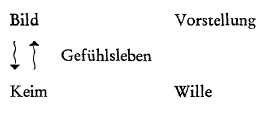
[ 26 ] So daß wir jetzt wirklich beschreiben können, wie das Gedankenleben vor sich geht. Das Gedankenleben geht so vor sich, daß die Materie nicht in Anspruch genommen wird, daß es nur bis zu dem Ätherischen herankommt und das Bewußtsein in diesem Ätherischen lebt. Das Gefühlsleben geht so vor sich, daß der Ätherleib das Drüsenleben ergreift, aber das Drüsenleben leidet ihn nicht. Während aber der Ätherleib in das Drüsenleben hinein verschwindet, bevor die eigentliche Absonderung sich geltend macht, da hat der Mensch seinen Ätherleib nicht, da verschwindet ihm sein Ätherleib in die Drüsen hinein. Er erlebt sich daher nur in seinem Ich und in seinem astralischen Leib. Und so ist es beim Gefühl.
[ 26 ] So that we can now truly describe how the life of thought unfolds. Thought life proceeds in such a way that matter is not involved; it extends only as far as the etheric, and consciousness lives within this etheric. Emotional life proceeds in such a way that the etheric body takes hold of the glandular life, but the glandular life is not affected by it. However, while the etheric body disappears into the glandular life before the actual secretion takes effect, the human being does not have his etheric body at that moment; his etheric body disappears into the glands. He therefore experiences himself only in his “I” and in his astral body. And so it is with feeling.
Vorstellung: Ätherleib, Astralleib, Ich
Gefühlswesen: Astralleib, Ich
Willensleben: Ich
Introduction: Etheric Body, Astral Body, Self
Emotional Life: Astral Body, Self
Volitional Life: Self
[ 27 ] Wenn wir also die Vorstellungen des Gedankenlebens haben: abgestoßen wird da das Leben des physischen Leibes, der Mensch erlebt sich im Ätherleib, im astralischen Leib, im Ich — im menschlichen Haupt ist das Ich, das durchwebt den astralischen Leib, das durchwebt den Ätherleib, stößt das Physische aus; dadurch erlebt das Ich mit Hilfe des astralischen Leibes im Ätherleib die Gedanken, das Denken.
[ 27 ] So when we have the concepts of the life of thought: the life of the physical body is pushed aside, and the human being experiences itself in the etheric body, in the astral body, in the “I”—in the human head is the “I,” which interweaves the astral body, which interweaves the etheric body, and pushes the physical body aside; thereby the I, with the help of the astral body, experiences thoughts and thinking within the etheric body.
[ 28 ] Das Gefühlswesen: Da wird dem Menschen der Ätherleib genommen, indem der Ätherleib die Drüse ergreift; so lange bis die Drüse voll abgesondert hat, ist nun der Ätherleib dem Menschen entzogen. Er steckt drinnen im physischen Leib. Da hat der Mensch zu seinem inneren bewußten Erleben nur den Astralleib und das Ich. Das erlebt er gefühlsmäßig-traumhaft, weil er ja untertaucht in den physischen Leib.
[ 28 ] The Emotional Being: The etheric body is taken from the human being as it takes hold of the gland; until the gland has completed its secretion, the etheric body is now withdrawn from the human being. It remains inside the physical body. At this point, the human being has only the astral body and the “I” for their inner, conscious experience. They experience this in a dreamlike, emotional way, because they are, after all, immersed in the physical body.
[ 29 ] Nun kommen wir zum Willensleben. Da ist es wirklich so, daß der Mensch mit seinem ätherischen Leibe ganz untertaucht in die organische Materie. Aber im wachenden Zustand nimmt der ätherische Leib den astralischen Leib mit. Dadurch ist ja der Mensch imstande, die Bewegung auszuführen. Er nimmt den astralischen Leib mit in die Materie hinein. Da ist auch der astralische Leib dem Menschen entzogen, und der Mensch erlebt im Bewußtsein nur das Ich.
[ 29 ] Now we come to the life of the will. Here it is truly the case that the human being, with his etheric body, is completely immersed in organic matter. But in the waking state, the etheric body carries the astral body along with it. This is what enables a person to move. The person takes the astral body with them into matter. There, the astral body is also withdrawn from the person, and the person experiences only the “I” in their consciousness.
[ 30 ] Sie sehen, wir finden einen vollständigen Zusammenhang zwischen dem seelischen Leben und dem leiblichen Leben. Wir müssen nur aus anthroposophischer Erkenntnis heraus uns klar sein, wie Ich, astralischer Leib, Ätherleib teilnehmen an dem physischen Leib, dann merken wir den Unterschied zwischen dem seelischen Gedankenleben, dem seelischen Gefühlsleben, dem seelischen Willensleben und finden, daß das seelische Gedankenleben im ersterbenden Organismusteil ist, der sich aus der oberen Fixsternwelt und der oberen planetarischen Welt herausgerissen hat, das Vergangene zerstäubt und dadurch zum BildErleben wird. Wir finden, daß in der mittleren Region, im rhythmischen Menschen, der Mensch auf der einen Seite miterleben kann das Vergangene, deshalb auch den Makrokosmos, der sich aus der Vergangenheit heraus ja gebildet hat; aber dadurch, daß ein fortwährendes Rhythmisches stattfindet, entweder ein rhythmisches Verbinden des Sauerstoffs mit dem Kohlenstoff oder aber ein Ergreifen der Drüsen und Absondern der Drüsen, reagiert der Mensch darauf. In dem Ergriffenwerden und Ergreifen des makrokosmischen Lebens des Menschen, in der Absonderung reagiert der Mikrokosmos, der einzelne Mensch, darauf. Der Mensch lebt im Rhythmus nicht nur innerlich; er lebt im Rhythmus mit der Welt, er öffnet sich der Welt, nimmt sie in sich zurück. Der Mensch nimmt die Welt in sich herein, ist halb ein individuelles Wesen und pendelt rhythmisch hin und her zwischen Makrokosmos und Mikrokosmos. Das ist das Leben und Weben im Gefühl. Und man kann sogar ganz genau sehen, wie das MateriellPhysische des Organismus mit dem Seelisch-Geistigen zusammenwirkt. Im Willensleben ist es so, daß das Materiell-Physische am meisten ergriffen wird, daß da der Mensch am meisten bloß Mikrokosmos ist, daß er sich völlig entzieht in seiner Tätigkeit der makrokosmischen Tätigkeit.
[ 30 ] As you can see, we find a complete connection between the soul life and the physical life. We need only be clear, based on anthroposophical insight, about how the I, the astral body, and the etheric body participate in the physical body; then we perceive the difference between the spiritual life of thought, the spiritual life of feeling, and the spiritual life of will, and we find that the spiritual life of thought resides in the part of the organism that is dying off—the part that has torn itself away from the upper world of fixed stars and the upper planetary world—dissolving the past and thereby becoming an experience of images. We find that in the middle region—in the rhythmic human being—the human being can, on the one hand, experience the past and thus also the macrocosm, which has indeed formed out of the past; but because a continuous rhythmic process is taking place—either a rhythmic combination of oxygen and carbon or the stimulation and secretion of the glands—the human being reacts to it. In being gripped by and grasping the macrocosmic life of the human being, and in the secretion, the microcosm—the individual human being—reacts to it. Human beings do not live in rhythm only inwardly; they live in rhythm with the world, opening themselves to the world and taking it into themselves. Human beings take the world into themselves; they are half-individual beings and oscillate rhythmically back and forth between the macrocosm and the microcosm. This is life and the weaving of feeling. And one can even see quite clearly how the material-physical aspect of the organism interacts with the soul-spiritual aspect. In the life of the will, it is the case that the material-physical is most strongly engaged, that there the human being is most purely a microcosm, and that in his activity he withdraws completely from macrocosmic activity.
[ 31 ] Lebt er auf der nördlichen Halbkugel, so entzieht er sich eben in unserer Weise den übrigen Fixsternen und übrigen Planeten; auf der südlichen Halbkugel in ähnlicher Weise, das Ganze dreht sich ja herum, und auf diese Weise ist der Mensch als Gliedmaßenmensch, indem er als solcher lebt zwischen Geburt und Tod, ganz Mikrokosmos, hat eine Welt für sich, die deshalb sich selber auch in eine Zukunft hinübertragen kann. Jetzt entwickelt er das jüngste Glied des Seelenlebens, den Willen, der noch ganz der Stütze des physischen Leibes bedarf, der nur das Ich zu sich selber kommen läßt, während astralischer Leib und Ätherleib in dem physischen Leib untergehen.
[ 31 ] If he lives in the northern hemisphere, he simply withdraws from the other fixed stars and planets in the same way we do; in the southern hemisphere in a similar way—after all, the whole system rotates—and in this way, the human being, as a being of limbs, living as such between birth and death, is a complete microcosm, possessing a world of his own that can therefore carry itself forward into the future. Now he develops the youngest member of the soul life, the will, which still requires the full support of the physical body, which alone allows the “I” to come into being, while the astral body and the etheric body are absorbed into the physical body.
[ 32 ] Niemand wird das Seelenleben begreifen, der es nicht in einer solchen Weise begreifen kann, daß er unterscheiden kann zwischen Ich, astralischem Leib und ätherischem Leib; denn niemals wird irgend jemandem begreiflich erscheinen können das Gedankenleben, das Gefühlsleben oder das Willensleben, ohne daß die Sache so innerlich konkret erfaßt wird. Weist man diese Erfassung in der heutigen Zeit zurück, was kommt dann zustande?
[ 32 ] No one will be able to understand the life of the soul unless they can grasp it in such a way that they can distinguish between the “I,” the astral body, and the etheric body; for the life of thought, the life of feeling, or the life of will will never be comprehensible to anyone unless the matter is grasped in such a concrete, inner way. If one rejects this understanding in the present day, what is the result?
[ 33 ] Dann kommt das zustande, daß die offiziellen Vertreter sich hinstellen und den Leuten erzählen: Eigentlich kann man über das Seelische nichts wissen, aber dennoch, man muß aus gewissen Erscheinungen annehmen, daß es so ein Seelenartiges, ein «Psychoid» gibt. Man stellt sich dann hin und erklärt, wie der Descartes und der Spinoza sich bemüht haben, darauf zu kommen, wie die Wechselwirkung ist, aber man bleibt bei dem Abstrakten stehen: auf der einen Seite der Körper, auf der anderen Seite die Seele. Da kommt man niemals hinein, weil im Gedankenleben die Seele mit dem Leib anders zusammenwirkt als im Gefühlsleben und als im Willensleben, und weil man dieses Zusammenwirken nicht verstehen kann, wenn man das ganze Seelenleben einfach durcheinanderwirft und von einem «Psychoid» spricht, statt daß man sich einläßt auf diese Konfiguration, auf diese Konkretisierung des Lebens in Ich, astralischen Leib und Ätherleib. Es ist heute ein furchtbares, möchte man sagen, Ablehnen der Wahrheit vorhanden, dafür aber dann ein bloßes Stammeln und ein Bekämpfen teilweise des Fechnerismus, auf der anderen Seite ein Reden von «Psychoid». Das ist gerade so, wie wenn einer verzichten würde, den Menschen anzuschauen und vom «Anthropoid» reden würde, weil er vermeiden möchte, vom Anthropos zu reden. Im Grunde genommen ist solche Wissenschaft eben nicht Anthroposophie, sondern Anthropoid-Sophie, Psychoidologie.
[ 33 ] This leads to a situation where official representatives stand up and tell people: “Actually, we can know nothing about the soul, but nevertheless, based on certain phenomena, we must assume that there is such a thing as a ‘psychoid.’ They then stand there and explain how Descartes and Spinoza endeavored to determine the nature of this interaction, but they remain stuck at the abstract level: on one side the body, on the other the soul. One can never get to the heart of the matter this way, because in intellectual life the soul interacts with the body differently than in emotional life and in volitional life, and because one cannot understand this interaction if one simply muddles the entire life of the soul and speaks of a “psychoid,” instead of engaging with this configuration, this concretization of life in the “I,” the astral body, and the etheric body. Today there is—one might say—a terrible rejection of the truth; instead, there is mere stammering and, on the one hand, a partial rejection of Fechnerism, and on the other, talk of “psychoid.” This is just as if someone were to refrain from looking at a human being and speak of an “anthropoid” because they wish to avoid speaking of the “anthropos.” Essentially, such a science is not Anthroposophy at all, but rather Anthropoid-Sophy, Psychoidology.
[ 34 ] Wenn man wirklich eingeht auf das seelisch-geistige Leben, dann kann man in allen Einzelheiten hinweisen auf das, was die Leute «Wechselwirkung» und so weiter nennen. Man bekommt dann tatsächliche Vorstellungen von den Dingen, und man muß auch nicht bloß, ich möchte sagen, anatomisch so hübsch hinlegen, was man aus der Leber herausschneidet, und was man aus dem Gehirn herausschneidet und es als abstrakte Gewebe nebeneinanderlegen, sondern man muß wissen, wie der Mensch am Kopfende in anderer Weise sich zu dem ganzen Makrokosmos verhält als am Gliedmaßenende. Am Kopfende zerstäubt er ihn, da vernichtet er die Vergangenheit. Am Gliedmaßenende läßt er seine Wachstumstendenz nicht zu Ende kommen, er bleibt Keim.
[ 34 ] If one truly delves into the soul-spiritual life, then one can point out in every detail what people call “interaction” and so on. One then gains a real understanding of things, and one need not merely, I would say, neatly arrange what one cuts out of the liver and what one cuts out of the brain—as if they were abstract tissues—side by side; rather, one must know how the human being, at the head end, relates to the entire macrocosm in a different way than at the extremities. At the head, the human being disperses it; there, he annihilates the past. At the extremities, he does not allow his tendency toward growth to come to an end; he remains a germ.
[ 35 ] Am schrecklichsten ist es, wenn mit Ausschluß einer wirklichkeitsgemäßen Anschauung die Leute dann herumspekulieren über das Wesen des Leibes sowohl wie über das Wesen des Geistig-Seelischen, und dann im Grunde genommen in altabgebrauchten Worten reden, die sie zu «oiden» machen, und eigentlich das, um was es sich handelt, gar nicht ergreifen. Es gibt Leute, die heute gar nicht einmal mehr eine Ahnung davon haben, wie man vom Worte zu einem Begriff kommt. So zum Beispiel werden jetzt in Deutschland überall in den freireligiösen Gemeinden und in den monistischen Gemeinden, die eigentlich beide Vereinigungen sind, die da leben von dem Abwaschwasser der materialistischen Naturwissenschaft der sechziger und siebziger Jahre des 19. Jahrhunderts, da werden überall Vorträge veranstaltet von einem Menschen, Arthur Drews heißt er, der eigentlich so konstituiert ist: Er hat einmal Hartmannsche Philosophie studiert — er tänzelte ja immer in seinen Jugendjahren um Hartmann herum —, aber von dieser Hartmannschen Philosophie im Grunde genommen nur die Worte aufgenommen. Diese Worte sind in seinem Kopfe wie das Spiel von automatischen Dingen, da rollt es herum, und er hat keine Ahnung davon, wie man von dem Worte zu irgendeinem Begriff kommt. Und mit diesen aus der Hartmannschen Philosophie in seinem Kopfe automatenhaft herumwirbelnden Worten kritisiert er die Anthroposophie.
[ 35 ] The worst thing is when, having ruled out a realistic view of reality, people then speculate about the nature of the body as well as the nature of the spiritual-soul, and then, in essence, speak in hackneyed words that they turn into “clichés,” without actually grasping what is at stake. There are people today who no longer even have the slightest idea of how to move from a word to a concept. For example, in Germany today, everywhere in the free religious communities and in the monistic communities—which are, in fact, both associations whose members live off the dregs of the materialistic natural science of the 1860s and 1870s—lectures are being held everywhere by a man named Arthur Drews, who is, in fact, constituted as follows: He once studied Hartmann’s philosophy—he always flitted around Hartmann in his younger years—but essentially absorbed only the words from this Hartmannian philosophy. These words are in his head like the play of automatic mechanisms; they roll around, and he has no idea how to move from a word to any concept. And with these words from Hartmann’s philosophy, swirling around in his head like automatons, he criticizes anthroposophy.
[ 36 ] Das sind die Früchte der gegenwärtigen Zivilisation, die Früchte der gegenwärtigen Bildung, die es durchaus ablehnen will, sich wirklich einzulassen darauf, wie man eine Einsicht bekommen kann in den Zusammenhang des Menschen mit dem Kosmos, so daß man des Menschen Form und des Menschen Leben aus dem Kosmos heraus beschreibt und auch begreift, wie das besondere Herausreißen des Menschen aus dem Kosmos eben bewirkt, daß er auf der einen Seite in einem ersterbenden Leben das bildhafte Vorstellungs-Seelenwesen entwickeln kann, auf der anderen Seite in einem keimhaft bleibenden Leben das willensartige Element des Seelischen entwickeln kann.
[ 36 ] These are the fruits of our present civilization, the fruits of our present education, which is determined to refuse to truly engage with the question of how one might gain insight into the connection between human beings and the cosmos, so that one can describe the form and life of the human being from the perspective of the cosmos and also understand how the specific separation of the human being from the cosmos causes him, on the one hand, to develop the pictorial, imaginative soul-being within a life that is withering away, and, on the other hand, to develop the volitional element of the soul within a life that remains in a germinal state.
[ 37 ] Diese Dinge klingen ja eigentlich denjenigen, die heute offiziell Wissenschaft treiben, als etwas, was sie nicht verstehen können. Man sollte eigentlich darauf verzichten, daß diejenigen, die einmal in der offiziellen Wissenschaft ein bestimmtes Alter erreicht haben, in der Regel ich sage natürlich: in der Regel — sich noch hineinfinden können in so etwas, denn sie haben ja alle Begriffe und damit alle Wirklichkeit aus ihrem Wortkaleidoskop im Grunde genommen verloren. Denn solche Vorträge über Psychoide sind für den, der die Wirklichkeit durchschaut, im Grunde genommen nichts anderes als Wortkaleidoskope; was da über Descartes, über Spinoza und so weiter bis zu Fechner herauf auseinandergesetzt wird, das hat eigentlich keinen inneren Zusammenhang, das sind Wortkaleidoskope. Denn was diesen Wortfetzen, die da kaleidoskopartig durcheinanderwurlen, -wellen, was denen einen inneren Sinn geben könnte, das ist eben die Einsicht in Ich, astralischen Leib, Ätherleib und so weiter. Es tut einem ja fast leid, daß man über die Gegenwart so sprechen muß; aber es muß eben gerade da, wo es sich um das sogenannte Geistesleben handelt, über diese Gegenwart so gesprochen werden. Die Philosophen haben sich nicht mehr zurechtgefunden, weil sie schon vor einigen Dezennien aus den Worten die Begriffe verloren haben. Jetzt ist man darauf gekommen, daß man an die philosophischen Lehrkanzeln Naturgelehrte im heutigen Stil beruft. Die müssen dann Philosophie tradieren. Bei Mach hat es angefangen, und einer der hauptsächlichsten Repräsentanten dieser Sorte ist heute der Driesch. Weil die Philosophen allen Inhalt ihres Kopfes schon verloren haben, die Naturforscher wenigstens noch die äußere Sinnesbeobachtung haben, hat man die Naturforscher an die philosophischen Lehrkanzeln berufen. Über Philosophie reden sie ja natürlich noch inhaltloser als die Philosophen. Die Philosophen haben wenigstens noch die Worte gehabt. Aber eine merkwürdige Entwickelung hat sich schon zugetragen. Man hat es erlebt, daß zunächst die noch inhaltsvolle Philosophie von der ersten Hälfte des 19. Jahrhunderts vollständig verduftet ist in den Worthelden, sagen wir von der Sorte eines Kuno Fischer. Aber in der Kuno-Fischer-Zeit haben noch Philosophen an den Lehrkanzeln gelehrt. Innerer Gehalt war in dieser Philosophie nicht mehr.
[ 37 ] To those who are officially engaged in science today, these things actually sound like something they cannot understand. One should really refrain from expecting that those who have reached a certain age in official science—as a rule, I say, of course: as a rule—can still find their way into such matters, for they have, after all, essentially lost all concepts and thus all reality to their kaleidoscope of words. For those who see through reality, such lectures on psychoids are, in essence, nothing more than kaleidoscopes of words; what is expounded there—from Descartes, through Spinoza, and so on up to Fechner—actually has no inner connection; these are merely kaleidoscopes of words. For what could give these scraps of words—which are jumbled and swirling about like a kaleidoscope—an inner meaning is precisely the insight into the “I,” the astral body, the etheric body, and so on. One almost feels sorry that one must speak of the present in this way; but it is precisely where the so-called spiritual life is concerned that one must speak of the present in this way. The philosophers have lost their way because they lost the concepts behind the words several decades ago. Now it has been decided to appoint natural scientists in the modern style to the chairs of philosophy. They are then expected to pass on philosophy. It began with Mach, and one of the foremost representatives of this school today is Driesch. Since the philosophers have already lost all the content in their minds, while the natural scientists at least still possess external sensory observation, natural scientists have been appointed to the chairs of philosophy. Naturally, they speak of philosophy even more vacuously than the philosophers do. The philosophers at least still had the words. But a curious development has already taken place. We have witnessed how the philosophy of the first half of the 19th century—which still had substance—has completely evaporated into the “word heroes,” let us say of the Kuno Fischer variety. Yet even in the Kuno Fischer era, philosophers were still teaching from the lecterns. There was no longer any inner substance in this philosophy.
[ 38 ] Aber was eben notwendig ist, das ist durchaus, daß wir diesen Zusammenhang durchschauen, daß wir uns darüber klar sind, daß wenigstens einige Menschen in der Welt da sein müssen, die all das Geflunker von den Psychoiden durchschauen und die wissen, wie stark wir in der Dekadenz drinnenstecken gerade in bezug auf unsere gelehrte Bildung. Man kann nicht stark genug dieses wissen; und ich glaube, es ist gut, wenn Sie sich vertiefen in das, was ich versuchte, in diesen drei Vorträgen vor Ihre Seele hinzustellen, nämlich wie der Mensch auf der einen Seite durch seine äußere Form, durch sein Leben, anzuknüpfen schien an das Universum, aber sich von dem Universum nach beiden Seiten hin lossagt, um nur als rhythmischer Mensch im Rhythmus des Universums aufzugehen; lossagt, um auf der einen Seite das Gedankenleben als Bildleben, also in Freiheit von der Materie zu entwickeln, nach der anderen Seite hin das Willensleben so zu entwickeln, daß er die Materie im Keime erhält, so daß sie nicht schon die starre Form, die ihr von dem Makrokosmos aufgezwungen werden kann, annimmt, damit der Mensch an diesem Ende sich noch beweglich erhält und von der Erde zum Jupiter-, Venus- und Vulkandasein hinüber sich entwickle, damit der Mensch in beweglicher Form sich erhalte, um sich hinüber zu entwickeln.
[ 38 ] But what is absolutely necessary is that we see through this connection, that we realize there must be at least some people in the world who see through all the nonsense spouted by the psychoids and who know just how deeply we are mired in decadence, particularly with regard to our scholarly education. One cannot emphasize this enough; and I believe it is good for you to delve deeply into what I have tried to present to your soul in these three lectures—namely, how the human being, on the one hand, seemed to connect with the universe through his outer form and his life, yet breaks away from the universe in both directions in order to merge, as a rhythmic being, into the rhythm of the universe; separates in order, on the one hand, to develop the life of thought as a life of imagery—that is, in freedom from matter—and, on the other hand, to develop the life of will in such a way that it preserves matter in its embryonic state, so that it does not yet assume the rigid form that might be imposed upon it by the macrocosm, so that the human being may remain flexible at this end and develop from Earth toward a Jupiter-, Venus, and Vulcan existence, so that human beings may preserve their flexibility in order to evolve beyond.
[ 39 ] Wenn Sie dieses zusammenhalten, dann werden Sie sehen, wie tatsächlich das, was in der Anthroposophie als Erkenntnis auftritt, ergreifen will erstens das Wahrheitsgefühl des Menschen, zweitens das ästhetische Gefühl, wenn Sie studieren den Menschen als Form, so wie sich die Form herausergibt aus dem Makrokosmos, und drittens auch nach der Richtung des Guten und des religiösen Lebens. Es wird Ihnen gerade aus diesen drei Vorträgen hervorgehen können, mit welcher tiefen Berechtigung oftmals hier in Kursen und sonst ausgesprochen worden ist, daß gesucht werden muß eine Synthese, eine Vereinigung, eine Harmonie von Religion, Kunst und Wissenschaft. Aber eine Vereinigung von Religion, Kunst und Wissenschaft erlangt man nicht, ohne daß man sich aufschwingt zu einer wirklichen Kosmologie, welche uns klarlegt, was der Mensch nach Form und Leben ist.
[ 39 ] If you hold all this together, you will see how what appears as knowledge in anthroposophy actually seeks to engage, first, the human sense of truth; second, the aesthetic sense, when you study the human being as a form—just as form emerges from the macrocosm; and third, the orientation toward goodness and religious life. It will become clear to you from these three lectures in particular just how deeply justified it is—as has often been stated here in courses and elsewhere—that we must seek a synthesis, a union, a harmony of religion, art, and science. But a union of religion, art, and science cannot be achieved without rising to a true cosmology that clarifies for us what the human being is in terms of form and life.
[ 40 ] Was wir weiter brauchen, ist eine Freiheitslehre in bezug auf das Seelische, welche uns darlegt, was der Mensch ist dadurch, daß er sich losreißt von dem Makrokosmos nach seinen zwei Enden hin, nach seinen zwei Polen hin. Und auf der anderen Seite braucht man die Erkenntnis dessen, was der Mensch in Freiheit entwickelt nach der Weltenzukunft, nach dem, was die Erde im Makrokosmos ablösen wird. Das entwickelt dann tief religiöse Empfindungen, Gefühle.
[ 40 ] What we need further is a doctrine of freedom with regard to the soul, one that explains to us what a human being is by breaking away from the macrocosm toward its two extremes, toward its two poles. And on the other hand, we need an understanding of what the human being develops in freedom toward the future of the worlds—toward what the Earth will give way to within the macrocosm. This then gives rise to deeply religious sentiments and feelings.
[ 41 ] Damit der Mensch zu einem wirklichen Aufstieg unserer Kultur kommt, braucht er erstens eine Kosmologie, welche den Menschen selbst umfaßt, die den Menschen nicht, wie unsere heutige Kosmologie, links liegen läßt. Man braucht eine Freiheitslehre, und man braucht eine Ethik, welche imstande ist zu zeigen, wie das in ihr veranlagte Gute der Keim zu Welten ist. Man braucht eine Ethik, die Realität in sich enthält, nicht bloße abstrakte Werte, sondern Werte, die in sich die Kraft haben, sich zu realisieren. Kosmologie, Freiheitslehre, Ethik sind dasjenige, was der Mensch braucht zum Aufstieg.
[ 41 ] In order for humanity to achieve a true advancement of our culture, it first needs a cosmology that encompasses humanity itself—one that does not, like our current cosmology, leave humanity out of the picture. We need a philosophy of freedom, and we need an ethics capable of showing how the goodness inherent in us is the seed of worlds. We need an ethics that embodies reality—not merely abstract values, but values that possess the power to actualize themselves. Cosmology, a philosophy of freedom, and ethics are what humanity needs for its ascent.