Anthroposophy as Cosmosophy I
Human Traits in the Earthly and Cosmic Realms
GA 205
28 October 1921, Dornach
Translated by Steiner Online Library
Fifteenth Lecture
[ 1 ] Today we want to study the human being in terms of his form and see how, from this perspective, we can gain further insights and a deeper understanding of what we have been considering recently. If we first bear in mind that the human form, in the broadest sense, is naturally and thoroughly connected to the human being’s entire life, then we must take this entire life into account if we truly wish to grasp the human form from within. After all, the human being is first and foremost integrated into the entire universe, into the entire cosmos. And if you consider how the human being, in terms of the structure of the head, is in fact a reflection of the sphere, of the cosmic universe, you will find, as it were, that the human being is placed within the entire cosmos, starting from the head. But one can only understand the way in which the human being is situated within the entire cosmos—and yet is, at the same time, an inner, self-contained being—by keeping in mind the human being’s relationships to the environment.
[ 2 ] And so, when we first consider the form of the human being, we say to ourselves: Through all of his thinking—insofar as it is connected to the head—the human being turns, through his head, toward the entire cosmos. And as he brings his head from the spiritual world into physical existence at birth, he is able—while enclosed within his body—to look back, in a certain sense, upon his true being, upon his inner spiritual-soul being; he can look back upon a time when he was not enclosed within such a body. We may best grasp what I mean here if we consider how human beings, in a certain sense, arrive at their insights by looking back within themselves, so to speak. It is indeed a looking back within ourselves when we engage in, say, arithmetic or geometry. We recognize the laws of geometry simply because we are human beings, because we can draw the laws of space from within ourselves. But on the other hand, we know that these laws pervade the entire universe. So we have something here that we necessarily see when we look out through our eyes; everything is arranged geometrically, and even the eyes themselves are geometrically constructed—they adjust themselves geometrically.
[ 3 ] We can therefore say: To the extent that human beings, through their thinking—which is connected to the head—confront the world, they, in a sense, draw into themselves what is spread out in the universe. And so we should imagine their initial relationship to the universe in such a way that we say: It is an embracing of the universe, a kind of looking back at the universe. By looking back at oneself, one finds the universe. There, I would say, lies the very outermost relationship of human beings to the universe from which they are formed.
[ 4 ] We can make some progress if we next consider how a human being then brings to life within themselves what they take in from the outside. Consider this: when a child is born, it actually carries within itself everything it experienced between death and a new birth. If it could develop a consciousness in this direction, it would be able to look back on what it experienced before birth. But then what was experienced there begins to stir within. Human beings do not merely look back within themselves to rediscover the universe within, but they also look around them. They perceive an environment. We can therefore say: It is no longer merely a matter of taking in the universe, but of gazing out into the universe’s surroundings and incorporating the universe’s dynamism. One becomes inwardly dynamic.
[ 5 ] But the third point: When we consider the first two, we see that human beings are not yet fully present within themselves. By carrying the universe within themselves—let us say, as geometry—they actually live in the external world. When a child moves by internally imitating the universe, it lives in the external world. How does a human being become inwardly present? How does he grasp himself?
[ 6 ] All you need to do is gently clasp your left hand with your right; all you need to do is touch yourself, and then you remain entirely within yourself. You perform an action with your right hand, but what you are touching in the process is yourself. Just as you would otherwise touch an external object while feeling around, you are in fact touching yourself. All awareness of the self, of inner life, is fundamentally based on this touching of oneself. We also do this in a derived way with our eyes. When we focus on any point, the right and left visual axes intersect, just as the right hand rests over the left. And animals have less inner life because they engage in this act of touching themselves to a much lesser extent. So we can say, as a third point: the experience or touching of oneself. — We are actually in the external world and perceive ourselves. We are not yet within our own skin.
[ 7 ] But now, in a sense, we focus on the boundary between the exterior and the interior. We’ll illustrate this process: If we move the hand—the right hand grasping the left—up and down, we trace a surface. This surface is everywhere within ourselves. Thus, through the covering of our bodies, we enclose our inner self. So, fourthly, we say: to enclose oneself. If you vividly empathize with your form—insofar as the skin forms this shape—then you experience this self-enclosure.
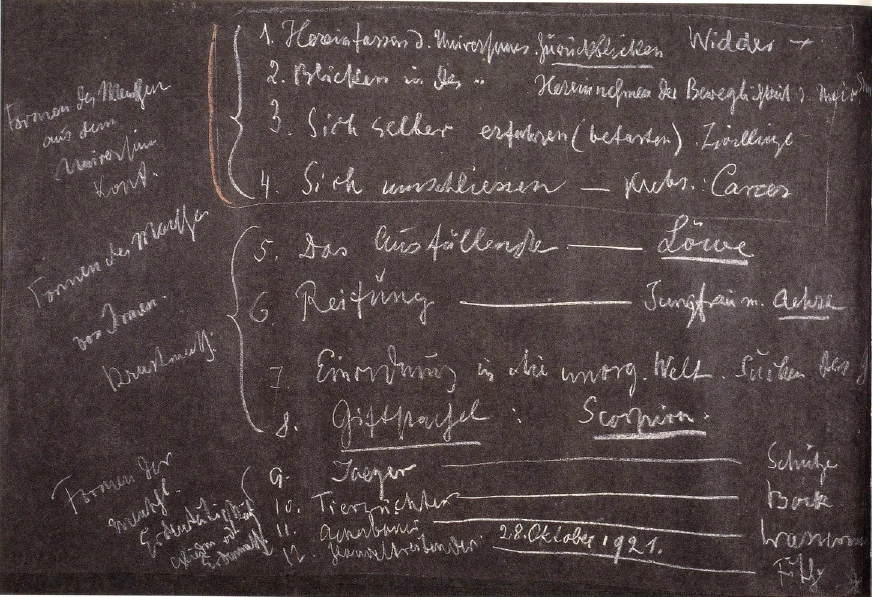
1. Embracing the universe. Looking back
2. Gazing into the universe. Taking in the universe’s movement
3. Experiencing oneself, touching oneself
4. Enveloping oneself.
[ 8 ] In these four stages, we see what is essentially the gradual shaping of the human being from the outside in: first, the entire universe—at this point, one is still outside oneself; then, imitating the universe—one has not yet come to oneself, but imitates the universe. When one takes hold of oneself, one comes to oneself from outside oneself. Only now, in the fourth stage, does one achieve self-enclosure.
[ 9 ] In the fifth point, we must seek that which is already within us, that which fills us, that which surges through us and interweaves with us. We can say, fifthly: that which fills us, that which surges through us and interweaves with us.
[ 10 ] But now, sixthly: Since we have now—by virtue of the fact that we not only have, so to speak, a skin, but that this skin is also filled—entered into ourselves in this way, that which dissolves the form, that which in turn causes the form to recede, already begins; that which not only fills the human being inwardly, but makes him, well, let’s say, like a fruit as it ripens. Let us follow the fruit to the point where it is just on the verge of ripening; if it passes this point, it withers, and then it begins to wither. So here, sixthly, we may say: ripening.
[ 11 ] But then imagine this process of maturation. As we mature, we begin, in a sense, to disintegrate inwardly once more. We are already ceasing, to some extent, to become human. We are human, but we are disintegrating inwardly; we are, in a sense, turning into dust within. We are becoming mineral. In this way, we reintegrate ourselves into the external world. We are completely within the Filling One. Then, as we disintegrate inwardly, we reintegrate ourselves into the mineral realm. We become, so to speak, a heavier body. So, seventhly, we can say: integration into the inorganic world.
[ 12 ] I once described how, when we weigh a person as they walk around, they actually behave like a mineral. This brings us to the idea of aligning oneself with the external forces of nature. We could also say: This alignment with the external forces of nature—just think about it: when you walk, you align yourself with the external forces of nature; if you don’t walk properly, you fall over—so it is actually the first thing that happens when we align ourselves: a search for balance.
[ 13 ] The eighth point: This brings us to the fact that we no longer merely fit ourselves into the external world, but rather that we take in the external world. We breathe, we eat; we take the external world into ourselves. In the past, we only opened ourselves up to what we already had within us. That is, in essence, this opening up of the self. Then it is a life within. But we take the external into the internal. Now, when one reaches this point, one must above all be very clear that everything a person takes in from the outside is something that does not belong within the person.
[ 14 ] The world actually has a misconception about this process of taking in anything from the outside. Basically, everything we eat is a little bit toxic. Life consists, in fact, of our taking in food and not actually allowing it to become completely one with us, but rather resisting it—and in this resistance, in this repulsion, life actually consists. It’s just that the foods we consume as food are so slightly toxic that we are able to sustain ourselves against them. When we ingest a true poison, it destroys us; then we can no longer defend ourselves against it.
[ 15 ] So we can say: As the external world penetrates us, a kind of poisonous sting enters us. One must choose concise expressions here, but such expressions do not exist in today’s language or in our current understanding. You must therefore understand what I actually mean as I explain this to you.
5. The Filler
6. Maturation
7. Integration into the inorganic world. Search for balance
8. Poisonous sting
[ 16 ] At this point, the human being would be ready to take in the external world. We would thus have first moved beyond the formation of the human being from the universe. Here, we have proceeded through the formation of the human being from within, and have already arrived at the point where the inner self takes shape by resisting the external world.
[ 17 ] But human beings—or at least their lives, and to some extent their very nature—are shaped by how they behave outwardly and how they act in the external world. Well, our activities are actually no longer something truly connected to the human being; we must go back to earlier times if we want to understand the human being as one who still properly positions himself as a human being within his surroundings, so that he participates in the world with a human contribution. And there we can say: Ninth, human activity consists in taking part in the external world, in being situated on Earth—not in the universe. In the external life into which he is, so to speak, culturally situated, he is first and foremost a hunter. Ninth: hunter.
[ 18 ] He then moves forward by continuing his activities: He becomes a livestock breeder. That is, after all, the next stage. Tenth: livestock breeder. Eleventh: he becomes a farmer. That is the next stage of perfection. And finally, twelfth: he becomes a merchant. Why I do not include the subsequent activities—you will see later. These are the secondary activities. The actual primary occupations of human beings are those of hunter, animal breeder, farmer, and merchant. With this, we have characterized human beings in terms of their form—how they position themselves on Earth, whether they are hunters, animal breeders, farmers, or merchants. These, then, are forms of human activity, of human activity on Earth.
9. Hunter
10. Livestock farmer
11. Farmer
12. Merchant
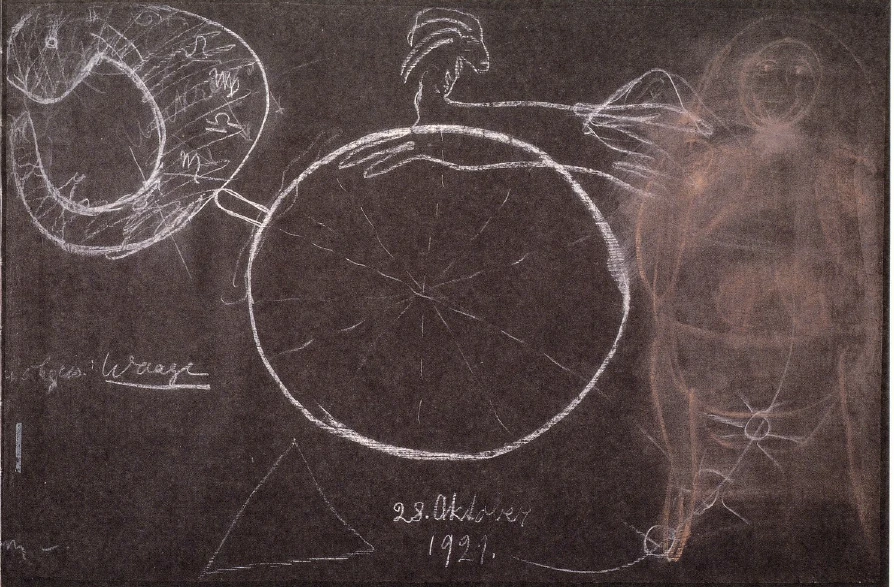
[ 19 ] We could now draw the following schematic diagram to illustrate what we have written down here. Let’s start by saying that we have the Earth here. Let’s assume for a moment that we have human beings on Earth. In terms of these four formative principles, humanity would be dependent on the Earth’s circumference—that is, it would be formed from the Earth’s circumference. Here, humanity takes shape from within (see drawing on page 70, left). Let’s set that aside for now and consider the scenario where humanity is formed by the Earth as hunters and herders; in that case, we would have the opposite situation. If, for example, the constellations here on the outer circumference influence the human being, the effect of the constellations located below (below the dotted line)—because the Earth covers them—reaches the human being only through the Earth when a human is initially conceived here (on the left). In that case, the human would therefore orient themselves toward the Earth with regard to their stars. And what lies in the middle would offer him the opportunity for inner development.
[ 20 ] One could therefore say: These four (upper) members of the human form (see table on page 72) lead us out into the universe; the last four members lead us down to the Earth, and the stars come into consideration insofar as they are covered by the Earth. With the four middle members, it is precisely the case that the stars and the Earth are in balance. There, the human being is in his innermost being.
[ 21 ] You see, even in ancient times people sensed this and said: A certain part of the starry sky exerts such an influence on human beings that it shapes them from the outside, from the universe. And, depending on the era, of course, people had to identify different stars with this influence. The constellations change. But let’s just consider, broadly speaking, the age in which we live. If we were to adopt the perspective of a Greek who had reflected on these matters, he would say: The stars near Aries exert an influence from the outside; as do those near Taurus, those near Gemini, and those near Cancer. Through these constellations—Aries, Taurus, Gemini, and Cancer—human beings have their retrospective nature, their inner mobility, their sense of self-contact, and their enveloping quality (see table on page 72). Through the other stars, which stand down below on the opposite side—those covered by the Earth—human beings have their hunter nature through Sagittarius; they have their animal-breeder nature by taming the goat: Capricorn; he embodies his life as a farmer—let’s take the simplest form of farming for now—by pouring out water, that is, by walking across the field and pouring out water: Aquarius. And he becomes a merchant through the constellation that represents what carries him across the sea. In very ancient times, every ship was shaped somewhat like a fish. And two ships side by side, sailing across the sea to trade, are actually the symbol of commerce. So, if one were to call the ships “fish,” here we would have the fish.
[ 22 ] In the middle, then, we have what lies in between—the filling element, that is, what acts within the human being as the blood that fills the body. Now, what is the best way to symbolize this filling blood? One might choose the animal whose heart activity is most intense: the lion. Ripening—one need only look at the field where the wheat or grain is ripening; the ear of grain represents precisely the state in which the fruiting phase gives way to the ripening phase: it is the Virgin with the ear of grain. The ear of grain is the central element here. And when we consider the point where the human being reintegrates into the external world—that is, seeks balance—we have Libra. And where the human being feels the poisonous sting, where they sense that everything is somewhat toxic—we have Scorpio.
Human Forms from the Universe: Head
1. Embracing the universe. Looking back—Aries
2. Gazing into the universe. Taking in the universe’s movement—Taurus
3. Experiencing (feeling) oneself—Gemini
4. Enveloping oneself—CancerShapes of the Human Body from the Inside: The Breast-Centered Human
5. The Fulfilling Lion
6. Maturity — Virgo with an Ear of Wheat
7. Integration into the inorganic world. Seeking balance: Libra
8. The Scorpion’s Poisonous StingerForms of Human Activity on Earth: Limbs or Earthlings
9. Hunter Sagittarius
10. Animal Breeder Capricorn
11. Farmer Aquarius
12. Merchant Pisces
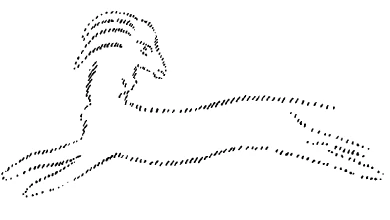
[ 23 ] You see, in earlier times people actually sensed this connection between human beings, the universe, and the Earth; it is only modern people who can no longer interpret these things. They say: Aries, Taurus, Gemini, Cancer, Leo—and draw a ram and so on—but deep down they really have no idea what these things mean. One must also view these things in the right way. If you look at an ancient depiction of Aries, you will realize that it is not a naturalistic-materialistic representation of a ram that is at issue here; rather, the defining feature is always that the ram looks back upward, and that gesture is the main point. This looking back by the ram—that is the essence of it. And this looking back by the ram is present in the human being’s looking back upon themselves, in this looking back upon the universe that lives within them. One must not, therefore, view the ram merely in a naturalistic-materialistic way. It is not meant to be a representation in that sense; rather, it is the gesture of looking back that matters. And when you see Taurus in old illustrations—it’s always looking to the side and leaping! It is this gesture, in turn, that is at the heart of the matter: the looking around and the inner stirring of that which lives as a general, universal principle. So, once again, it is this gesture that matters. And when you see Gemini, you truly have the right-hand and left-hand human beings; only—it is always a human being, but it is never depicted any other way than with the right hand of the right-hand human and the left hand of the left-hand human encircling and overlapping one another, and this gesture, in turn, is what matters. This is the touching and feeling of one another. It is simply that the right and left human beings are presented as independent beings because, in a sense, the human being is still outside of itself, still taking in its prenatal self through the act of touching itself.
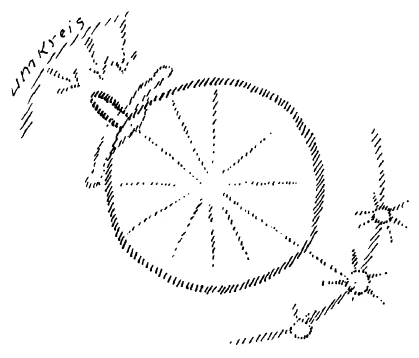
[ 24 ] Enclosing, surrounding oneself: cancer. Now, once again, cancer is taken as a metaphor from a materialistic-naturalistic perspective. But what mattered to those who chose cancer as the symbol for this act of enclosure was that cancer can enclose its victim with its claws, that it wraps its claws around it. Well, it is indeed in the word “cancer,” which encompasses human beings; the act of enclosing oneself is already preserved within the word itself. Cancer is the enclosing force. It is actually there as the symbol of the human being who encloses himself inwardly—who does not merely touch and feel himself, but who encloses himself from the outside in.
[ 25 ] The lion, by virtue of its particularly well-developed heart, represents the concept of the “heart animal.” We can indeed regard the lion as a heart animal. It thus specifically embodies what is to be understood as the fifth element.
[ 26 ] During the ripening process, the Virgin stands with the ear of grain, and it is this ear of grain that matters—this state of the fruit just beginning to wither. And Libra represents the search for balance. Scorpio is, of course, the venomous sting. And Sagittarius is, in reality, actually an animal—something with an animal form—but tapering forward into a human figure holding a bow and arrow. That is the zodiac sign of Sagittarius: a human figure holding a bow and arrow, seated centaur-like atop an animal’s body. So this represents the hunter.
[ 27 ] The goat is actually a goat that ends in a fish tail—in other words, something that no longer exists in nature. There is no goat with a fish tail. But humans, by taming wild animals—by becoming breeders—make wild animals as tame as domesticated fish. So what we have here is an artificial symbol.
[ 28 ] For agriculture, we have Aquarius. Naturally, people have always associated him with water and the like, which, in a certain spiritual sense, is justified. But you will always see: his stride is significant; he holds two urns in his hands and pours out water. He waters. He is, therefore, the gardener, the farmer.
[ 29 ] And the fish—as I have already indicated—represent commerce, because ships used to have fish heads on their prows—dolphin heads, for example, even though the dolphin is not a fish; but the ancients regarded it as such. So this is definitely what points to the commercial aspect in this symbol.
[ 30 ] We must not view things in such a schematic, superficial way, as is often the case today, but rather we must start from this formation of the human being and, from there, see how we can ascend to the human being’s relationship to the universe and to the Earth. In this way, we gradually learn to understand the human being—through form—as a part, as a link in the whole universe.
[ 31 ] Now, of course, we can look at the matter from another angle. Let’s now consider it from the following perspective. Here we have, let’s say, Aries. Let’s first consider everything from the standpoint of the ancient Greeks: Aries, Taurus, Gemini, Cancer, Leo, Virgo, Libra, Scorpio, Sagittarius, Capricorn, Aquarius, Pisces—so we can say, when we consider the human form: The human being—take everything I’ve said together—is shaped from the outside, by the universe, in terms of the shape of their head. So if we take the matter from the Greek point of view, we will say: The human being is shaped in terms of the form of his head from within the universe. Then something stirs within. The possibilities arise for him to become symmetrical. But then we are compelled to understand the influence exerted on the human being by the last groups of constellations in the opposite sense. Here, the human being receives influences from the Earth. Activities affect him. If we draw this part (above) broadly (see drawing on page 75), then on this other side it is best to draw this part (below) narrowly, and we will say: If a person wants to become a hunter, he must have particularly well-developed what can be understood here as the Archer. You know, this is what the human thighs represent. He must have these particularly well-developed if he wants to become a hunter. If he becomes a livestock breeder, he must move a lot while squatting. If he becomes a farmer, he must walk; he is therefore depicted as striding, and so on. Trading: If one wants to find a symbol in the human being himself, it will be the feet. But these organs are, in any case, formed from the outside in. The other element is then located in the center, where the human being forms itself.
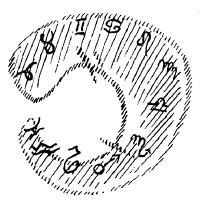
[ 32 ] When I draw this figure for you, it actually emerges of its own accord from the twelve signs. We can say: There (in the middle), the universe and the stars act more from within the human being; there (above), the stars act from the outside; and there (below), they press down on him. But you can see in what I’ve drawn there the form of the human embryo! And if you take the human embryo, then when you draw the zodiac, you must actually draw it according to its own laws—just as when you want to draw a figure that encloses 180 degrees, you end up with a triangle. If you draw the zodiac in such a way—transforming it so that its laws in relation to the Earth become apparent—then, through its inner laws, you obtain the form of the human embryo. And with that, you have directly demonstrated that the human embryo is indeed formed from the entire universe, that it is a product of the universe.
[ 33 ] I said earlier that we must adopt the Greek perspective, because today we can no longer begin with Aries; today we must begin with Pisces. After all, we have been in the sign of Pisces for centuries, and it is precisely in the sign of Pisces that the transition to human intellectualism takes place. But if you go back to the time when Aries was still relevant—when one could still speak of the zodiac in the old sense—then you have little more than Sagittarius, Capricorn, Aquarius, and Pisces, or, respectively, the professions of hunter, animal breeder, farmer, and merchant. Everything that has emerged in the realm of industry and so on already belongs to Pisces; that is already a repetition. Just think about it: We live in the Age of Pisces; that is where everything that today constitutes our machine culture and so on has developed. If we go back beyond that to the Age of Aries, we still have the four authentic professions—even if they are somewhat more complicated and modified—that place human beings within nature. And then we can go even further back—into the Age of Taurus, the third, second, and first post-Atlantean epochs, the last Atlantean, the penultimate Atlantean, and so on: in this way we would go back, and if we continued back until we reached the Age of Pisces once more, we would still find humanity as a completely ethereal being that had not yet descended into the physical world. And because we find him there in the Age of Pisces, where he once was as an ethereal being, he is essentially repeating what he went through back then during his actual becoming human. He has been repeating it since the middle of the 15th century, but he repeats it in an abstract way. Back then, he grew concretely into his humanity. Since then, he has been growing into his abstractions, for a machine is also an abstraction. Since then—since the Age of Pisces has returned—humanity has, in fact, been placed within that which dissolves it. And if humanity is indeed to return once more to the Age of Aquarius, then this dissolution will proceed much further; above all, humanity will not be able to maintain even the slightest connection with the world unless it holds fast to the spiritual world. It is precisely because of this repetition that humanity must enter the spiritual world.
[ 34 ] From this, too, you can see once again that the human being is actually a threefold being: formed from the universe as a “head human”; forming within, in correspondence with the external world, as a “chest human”; and forming limbs and metabolism by integrating into the earthly world, that is, as a “limb human” or “earth human” (see table on page 72).
[ 35 ] And in yet another respect, there is a threefold aspect at work here. Consider this: when a human being is born, the first four force impulses are actually already present within them. They develop these later, but in a certain sense, they are already a complete human being at that moment—it’s just that the other eight members are rudimentary. The head is a complete human being, but the other members attached to it are rudimentary. The chest-human, in turn, is a complete human being, though the first four impulses of force are rudimentary, as are the last four. The limb-human is also a complete human being, though the chest and head are rudimentary in relation to it. In this way, there are actually three human beings within the human being. The first, the head-human, is actually the transformation of the previous incarnation. The chest-human is actually the present incarnation itself. And what the human being does—how he acts in the outer world, which is expressed specifically in his limbs and in his metabolism—carries him over into the next incarnation. So in this respect, too, the human being is a threefold being. In this way, one can study the form of the human being in its entirety.
[ 36 ] So one should really say: When drawing a person, one should draw their head. But then you have a complete person. You can see from this that you have a complete person: If you take the lower jaw, it’s actually legs, only they’re directed backward on the head; this person is sitting with his legs. The head is a whole person, only the legs are turned inside out—they’re the lower jaws here. The person is sitting on them, so that I could draw it in such a way that I would actually be drawing a whole person here, even if he is sitting.
[ 37 ] Then again, the “chest human” is a complete human being: the arms are, in a sense, the external representatives of the etheric eyes. And again, the “limb human” is a complete human being. For example, the kidneys would in turn be the eyes. So that we have three interlocking human beings even in terms of form, such that in the human being who has disappeared into the head—who has become a sphere—we see what has carried over from the previous incarnation; in the chest-human, the actual present human being; and in the one that moves about, what is pushing its way into the next incarnation.
[ 38 ] But in a certain sense, one can say that even modern human beings exhibit a threefold structure in their entire behavior. Take the limb-metabolism human: he is capable of producing a whole human being. You need only take the human germ, the human embryo, from the mother’s womb, and you have the limb-metabolism human who wants to become a whole human being.
[ 39 ] Take the breast-human: you can see how, in a child who is still an infant, the head-human and the breast-human truly belong together as a whole. Thus, this threefold structure is also present as the human being grows up. And then, once a person is no longer an infant, they are educated: the head of one person, as the educator, educates another person—the child’s head educates the child’s head, for, fundamentally speaking, a person always remains a child in regard to their head. They become old—that is, of middle age—only in regard to the middle human, the chest human, and they become very old in regard to the limb human. People notice this, too, as they grow old. And just as the old riddle goes: “In youth one walks on all fours, in middle age on two, and then on three”—people realize that this is where they first begin to grow old. From that point on, they grow old. So, with regard to the head, a human being always remains, in a sense, a product of their last incarnation. The head actually remains, in essence, a child’s head throughout one’s entire life. And one can certainly say: Educational science must actually solve the problem of how best to ensure that the teacher with a child’s mind treats the student with a child’s mind in the best possible way.
[ 40 ] These things may seem humorous, but there is a profound truth behind them that one must simply acknowledge in order to truly gain the right perspective on oneself.
[ 41 ] Consider, after all, that the human head is essentially the passenger, constantly being carried by the rest of the human being. The head always keeps its legs in a seated position; it does not even attempt to walk on its own. It is constantly carried, just like a man riding in a carriage. This head is, in essence, the human being’s passenger. The chest is the human being’s caretaker. And the limbs are the working part of the human being—the one used as a slave, the worker, the one who actually does the work, the human being who is actually living through life. That is why we have a head, insofar as we are heads as whole human beings; I have said this many times. As long as one is enclosed within oneself, one is still the head; right up to the point of cancer, one is still the head. This is given from heaven without any effort on one’s part. Here (in the middle) one must breathe and eat: this is the caretaker, the nurse. And the actual working person belongs to the realms of Sagittarius, Capricorn, Aquarius, and Pisces.
[ 42 ] You see, in this way one can truly grasp the nature of humanity in relation to the entire universe. You must take these things—even if they are presented to you, I would say, not with pedantry but in a more lighthearted manner—you must take them very seriously; then you will see that in everything I have said today, on the one hand lies the possibility of comprehending the form of the human being within the context of the entire universe, and on the other hand, there lies that which fills one with profound reverence for the primordial insights of the ancients, who—through their instinctive clairvoyance—were truly able to imbue their zodiac symbols with a science of humanity of the most immense kind. In contrast, we have a science today in which people stare at Aries in the zodiac images but do not know that the main point is that it turns around; they stare at Taurus, not knowing that the essential thing is that it leaps and looks to the side; and with Gemini, this touching of one another, this reaching across, and so on. Everything in these zodiac symbols is immensely profound, immensely significant—every gesture of each individual sign—and where it is not a gesture, as with the Lion, the symbolism is chosen in such a way that the sign itself already contains the gesture, because the Lion has the strongest heartbeat; that is why it was chosen. So fulfillment is represented by the Lion. In this way, one can bring back the primordial wisdom of ancient times when one finds it within oneself today.
[ 43 ] Today I have discussed the form of human beings with you; tomorrow I would like to discuss human life in relation to the universe, and then, in the third lecture, we will discuss the human soul in relation to the universe.