Anthroposophy as Cosmosophy I
Human Traits in the Earthly and Cosmic Realms
GA 205
5 November 1921, Dornach
Translated by Steiner Online Library
Nineteenth Lecture
[ 1 ] We have recently been reflecting on human beings and their relationship to the cosmos. To those who are immersed solely in today’s worldview, it still seems—one might say—quite absurd to link the nature of human beings to the nature of the cosmos in this way, and in the broadest circles today, such a connection is unlikely to be considered scientific. Nevertheless, in the face of contemporary intellectual trends, it is already urgently necessary today to draw attention with all our energy to precisely such matters as we have now considered in these reflections. For one can say: These matters are very much in line with contemporary thinking. Yet at the same time, they are vehemently rejected by that very same contemporary thinking. This, however, inflicts unspeakable harm on the spiritual life of humanity.
[ 2 ] Let us first try to form a kind of summary of what I have presented here recently. We have, after all, considered the form of the human being as a result whose causes must be sought in the fixed-star sky, namely in its representative, the zodiac. So we have seen: We must first look to the zodiac—as the representative of the fixed-star sky—if we want to understand the human form, its formation, and its structure. There we have the twelve-part zodiac, and by studying this twelve-part zodiac, we can understand the human form down to its finest details.
[ 3 ] If we want to understand the stages of human life, we must look to the planetary system and find within it the elements necessary for understanding those stages.
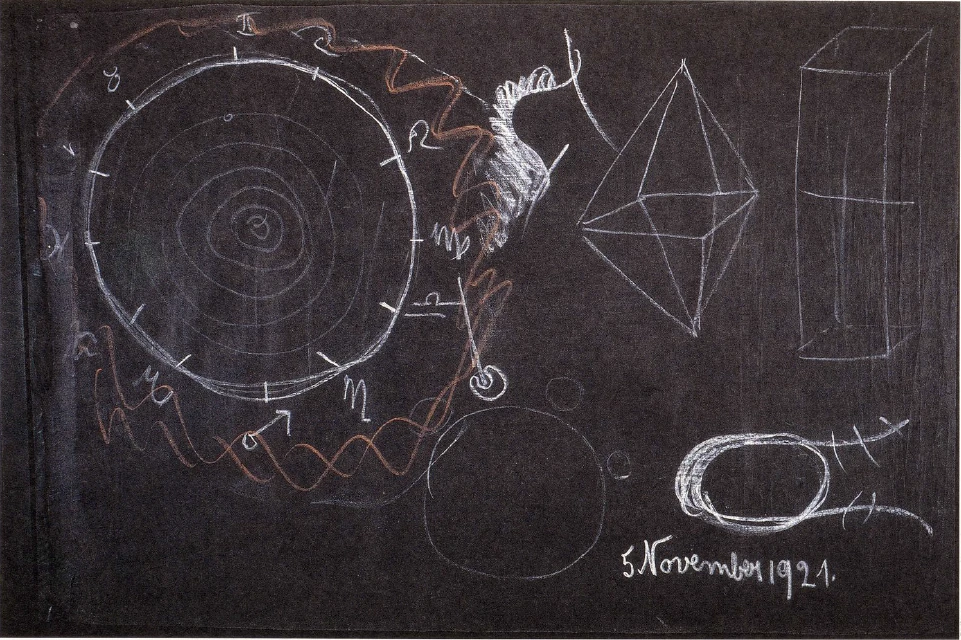
[ 4 ] We then moved from an understanding of the stages of life to an understanding of the soul. But to do that, we had to approach the human being himself—what is formed within him, what lives within him. And we then attempted to identify the soul—in terms of imagination, feeling, and will—within the human form and across the stages of life. And yesterday, we also tried to find the spiritual aspect of the human being within the soul.
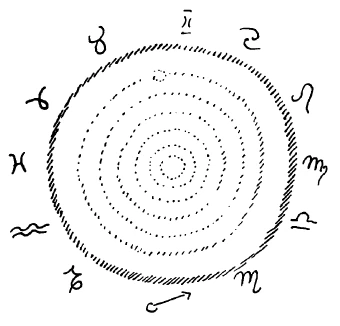
[ 5 ] So now, by considering the spiritual realm—or, I might say, from the sphere of the world—we enter into actual earthly life, namely when we consider the spiritual realm in the life of the human being between birth and death. We can indeed observe it when we consider it in its true relationship to the human form and to human life.
[ 6 ] Once again, the spirit—which, as we saw yesterday, human beings actually experience only figuratively—we must seek within the soul. There, if I may put it that way, we descend from the heavens to Earth. When we consider the form of the human being, we must go as far as the fixed stars; when we consider human life, we must go as far as the planetary sphere; when we consider the human soul in its relationship between birth and death, we must first descend to the earthly realm. In this contemplation, the human being, in its connection with the cosmos, becomes a whole for us.
[ 7 ] Now, if we give this fact its due consideration, then we are also able to use it to draw the line between the animal and the human. And this can be done in the following way. If we first consider what we can come to understand through the zodiac—and observe this in both humans and animals—it actually presents itself to us in different ways. But in order to grasp this entire context, we must start by examining how these various elements—the zodiac, the planetary sphere, and the Earth with everything we considered yesterday—affect humans and animals.
[ 8 ] After all, the first thing we encounter in a human being is his physical body. This physical body of the human being does not, however, appear to us in the form that we otherwise recognize as “physical” outside of the human being. The physical appears to us outside of human beings in the mineral kingdom and its forms. What we encounter in the mineral kingdom and its forms is, however, very dissimilar to the physical body of a human being. But it is only dissimilar to the human physical body because, in human beings, the physical is clothed in the etheric, the astral, and the I-being—all of which transform the physical and adapt it to themselves—whereas in the external physical world, this physical appears to us in the mineral kingdom without being permeated by the etheric, the astral, or the I-being.
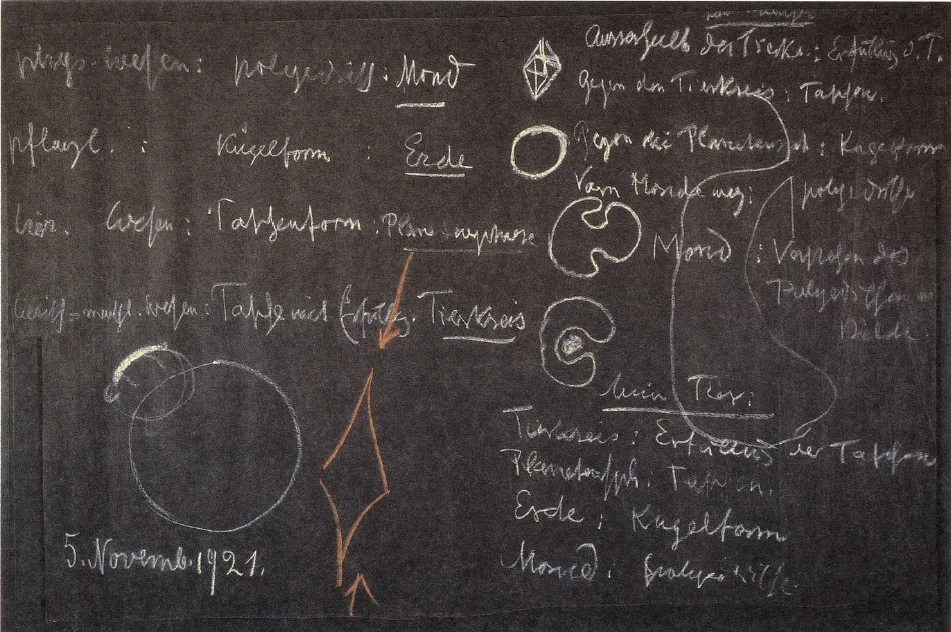
[ 9 ] When we consider the intrinsic form of the mineral, it is the crystalline form, the polyhedral form (see drawing); in the upper right corner, the mineral appears to us as a sort of polyhedron. This polyhedral form, which appears to us in one form in one mineral and in another form in another mineral, we cannot understand in any other way than by first looking at the material substance that has been formed out of the forces active within the mineral’s space. We must imagine: If we have any elongated mineral, then the forces acting in this direction (drawing on the right) are precisely suited to pulling the mineral along its length. The forces acting at an angle to this direction (right, horizontal line in the middle) may then exert a lesser force—or, as we might put it—that causes the mineral to narrow in that direction, and so on. In short, in order to speak of minerals at all—regardless of whether these forces act from the outside in or from the inside out—we must imagine that these forces are at angles to one another, act in certain directions, and, above all, we must imagine that these forces simply exist in the universe, or at least that they are active within the Earth’s sphere.
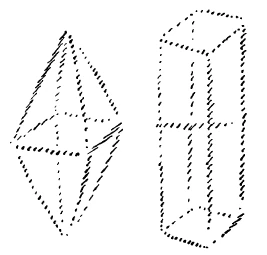
[ 10 ] But then, if they are effective, they must also act upon the human physical body, and the human physical body must have within itself the tendency to become polyhedral. It simply does not actually become polyhedral because it still has its etheric body and its astral body, which prevent the human being from becoming a cube, an octahedron, a tetrahedron, an icosahedron, and so on. But the tendency to become such a thing is present in the human being, so that we can already say: Insofar as the human being is a physical being, he strives to become polyhedral. If you are glad that you do not wander around as a cube, a tetrahedron, or an octahedron, it is precisely because the other forces—those of the etheric body and the astral body—counteract the octahedral or cubic forces within you.
[ 11 ] But human beings are not merely physical bodies; rather, they carry their etheric bodies within themselves. What they are through their etheric bodies is what, in turn, makes them, as beings, one with the plant world. Just as, through his physical body, he represents the environment—insofar as it is mineral and physical—so, through what he is by virtue of his etheric body, he represents the environment—insofar as it is plant-like.
[ 12 ] Since the plant is also integrated into the physical realm, it naturally has a tendency to be polyhedral, but in addition to this tendency, it exhibits another one: that of being spherical. A mineral can, of course, take on a spherical shape through various processes, but the spherical form is not actually inherent to it. It must be a pebble or something similar for it to appear spherical. Its true, inherent form is the polyhedral one. But in plants we find the spherical form, and every single cell of the plant actually strives to take on a spherical shape. This striving toward the spherical form—which humans only begin to experience to a small extent in their minds—is thus inherent to the plant kingdom. It is to this plant essence, then, that humans also owe their spherical form. The fact that plants are not all spheres is due to the circumstance that, first of all, the spherical form struggles against the polyhedral form within them, resulting in a compromise; but the plant form also struggles against a cosmic-astral force. As you know from earlier lectures, a cosmic-astral force presses down on the plant from above. This modifies the spherical form. Spheres also stack on top of one another. But the primordial form of the plant is, in fact, the spherical.
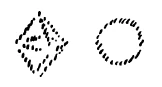
[ 13 ] But in this way, as the plant strives toward a spherical shape, it takes on the very form of the Earth itself. The plant takes on the form of the Earth. The Earth, as you know, is spherical in shape within the cosmos. Every drop of water, too, is spherical in shape. Only the parts of the Earth—its mineral parts—are polyhedral in shape. The entire Earth is spherical in the cosmos. So we can say: The plant shares the spherical form with the Earth itself. Thus, the plant—or the living being—strives toward the spherical form and actually seeks to replicate in that form what the Earth itself is shaped like.
[ 14 ] But let us now turn to what a human being is through his astral body. There, the human being is something through which he represents what exists in the animal world: the animal nature. So when we look for the polyhedral form in the physical being and in the mineral being, we find in the plant being the spherical form modeled after the Earth (see drawing).

[ 15 ] Well, the animal nature becomes understandable to us when we do not stop at the spherical form, but when we move on to something else—that is, when we add something to the spherical form in its configuration. What is it that we must add to the spherical form? It is the pouch-like form—I could also say: the sack-like form, the pouch. For the animal realm exhibits the peculiarity that it breaks through the spherical form everywhere with this pouch-like quality. Pouch-like indentations form everywhere within the sphere. This is the essence of animal formation: that pouches sink inward from the outside. Look at their eye sockets—two pockets that extend from the outside to the inside. Look at their nasal cavities: two pockets. Finally, consider the entire digestive system, starting from the mouth and extending into the stomach: you can visualize it as a pouch extending downward from the mouth. Everywhere, it is the pouch-like form that is added to the spherical form when it comes to making the transition from the plant kingdom to the animal kingdom. It is the pouch-like form.
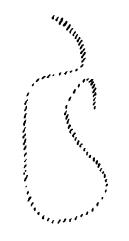
[ 16 ] This “pouch-like” shape becomes clear to us when we look up from Earth toward the planetary system. You can easily imagine it: Earth strives to give its own form to everything living on it. But when a planet exerts an influence from the outside, it counteracts the Earth’s forces and causes what the Earth has given as a spherical form to sag, and the various animal beings are shaped in the most diverse ways with such sagging or pouch-like features. Let us look at the planets in their various effects. Saturn collapses in a different way than Jupiter or Mars. The lion is simply endowed with a different kind of inner “sack-like” quality because the same planetary influences are not exerted upon it as, for example, upon the camel and so on. So there we have the collapses.
[ 17 ] Now, however, in animals and also in humans—namely, above all in higher animals; in lower animals it is somewhat different—but in higher animals, something occurs that does not come solely from the planetary realm; rather, we can say: In the animal-human being—because higher animals exhibit something similar—it is not merely the “pocket” form that appears. That would occur if only the planets existed, if the fixed-star sky had no influence. But something else is added to the “pocket” form. Under certain circumstances, a human is quite content not only to have a pouch but also to have something inside it, and this does indeed occur in the animal-human being, in that the pouch appears with its contents. That is to say: a spherical pouch, and the pouch is filled.

[ 18 ] You need only consider the sense organs—the eye, for example—and there you have a “pocket” to begin with: the eye sockets; then there is the “filling.” And this “filling,” which occurs particularly in the sense organs, is connected—just as the shape of the pocket is connected to the planetary sphere—to the zodiac. Human beings, who in this respect possess the most perfect animal organization, therefore also have twelve cavities filled with substance, even though they are masked in the most varied ways. That is why I had to list the twelve sense organs in my book Anthroposophy.
[ 19 ] Now we can ask in return: To what cosmic principle is the polyhedral form related? You see, as the Earth confronts us, it actually has the form of life as a whole, and it would only display this form if it were nothing but water. But disturbances enter the water in the most varied ways. You can observe these disturbances, for example, during high and low tides. That is when the water takes on form.
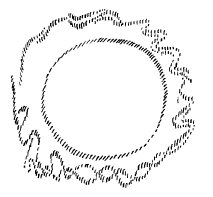
[ 20 ] And now let us look back to earlier times in the formation of the liquid Earth, when it was subjected to solid impacts. Even today, we know how the tides are connected to the Moon. Likewise, everything polyhedral—everything that takes on a polyhedral form within the Earth—is connected to the Moon. So we can say: The polyhedral or physical nature of the human being is connected to the Moon; his plant-like or etheric nature to the Earth; his astral nature, which would give rise to the “pocket” form, to the planetary sphere; and the filling of the “pocket” to the zodiac.
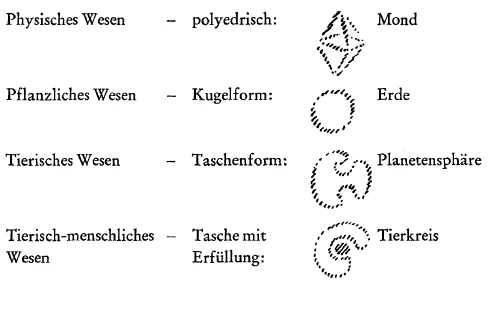
[ 21 ] But what I have written here applies to humans in a different way than it does to animals. You see, for animals, it is truly the case that the heavens—that is, everything within the zodiac—have meaning only up to the zodiac. What lies outside the zodiac has no significance for animals. Ancient wisdom was therefore quite correct in calling it the zodiac, for it could add: Everything that exists out there in the universe beyond the zodiac could just as well not be there, and the animals on Earth would be exactly as they are. Only what lies beneath the zodiac—together with the Earth and the Moon—has significance for animals. For humans, however, what lies outside the zodiac does have significance. Specifically, what lies outside the zodiac is significant for humans insofar as it affects the contents of their pockets. In other words, what fills our pockets is also influenced by what lies outside the zodiac. This is not the case with animals. It is only true for humans: what exists outside the zodiac influences the contents of our pockets.
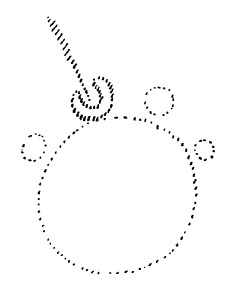
[ 22 ] In the case of animals, we must say: Everything within the zodiac influences the filling of their pockets. So, when it comes to animals, we must enter the zodiac itself; only then can we explain what the filling of their pockets looks like. In the case of humans, we must go beyond the zodiac if we want to explain, for example, what is happening in their senses. As a result, humans, through their relationship to the cosmos, transcend the zodiac. Animals do not. In animals, the planetary sphere as such continues to act directly on the “pockets.” So we can say: It acts upon the pouches. Because the planetary sphere acts directly upon the pouches in animals—and the pouches extend inward and form the internal organs—the animal’s internal organs are thus perfectly formed, adequately mirroring what corresponds to the planetary sphere. Human beings, in turn, move a little further out. And we can say: In human beings, it is already the region toward the zodiac that acts upon their “pockets.”
[ 23 ] In animals, the earth acts directly on everything within them that seeks to be spherical—directly on their spherical form. This is not the case with humans. Otherwise, humans would also be animals, and their striving for sphericity would be the same as that of animals. After all, in a certain sense, the animal actually wants to become spherical. Here (see drawing), it has its spine, then its legs. It is only prevented from forming a complete sphere. A part of this sphere is the spine. The human being, however, strives away from the earthly realm just as he has already striven away from the zodiac, from the planetary sphere toward the zodiac. We can say: The human being’s spherical form is shaped in opposition to the planetary sphere. He becomes an upright being. He strives away from mere adaptation to the earthly realm.
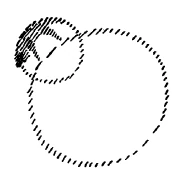
[ 24 ] And if we look at the polyhedral aspect, we must say of the animal: It is the Moon itself that gives it its polyhedral nature. Human beings, too, strive out of the Moon’s influences—we might say, away from the Moon—and receive there, between the Earth and the Moon, that which gives them their polyhedral nature. So, in a sense, we must look between the Earth and the Moon for what gives human beings their polyhedral nature. Through this, however, the Moon still exerts an influence on human beings. As the Moon, it remains effective nonetheless. So in the fifth, we must look to the Moon itself, which, after all, brings about the polyhedral quality in animals. What does it do in human beings? It also brings about the polyhedral quality, but in the form of an image; and while the animal possesses the polyhedral quality in its physical structure, human beings are able to extract it from their organism. And this mathematical-geometric imagination becomes an image; it emerges from the body. Today, human beings tend to think mathematically and wish to understand everything mathematically because, through the influence of the Moon, they can bring their own polyhedral nature to the fore, and in this way it enters their consciousness. So we can say: The understanding of the polyhedral in the form of an image comes from the Moon.
| For human beings: | Outside the zodiac Against the zodiac Against the planetary sphere Away from the Moon Moon |
Filling the pockets Pockets Spherical Polyhedral Understanding the polyhedral in the image |
| In animals: | Zodiac Planetary sphere Earth Moon |
Filling of the pockets Pockets Spherical shape Polyhedral |
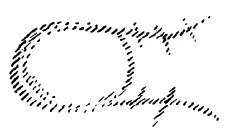
[ 25 ] You see, by tracing the connection between the human being and the cosmos, we not only arrive at this kind of structure—which we have already studied in recent years—but we also come to understand how the human being is structured internally, for example, how the nasal cavity is formed as a sac, as a pouch, and how the stomach is formed as a pouch. If we were to go even further, we would come to understand the organs themselves—how they form from within the entire cosmos. But everywhere we must turn to the cosmos for help if we want to understand the human being. Everywhere, so to speak, we must turn to the cosmos for help when we ask: Why does the human being have this or that organ—the lungs, for example—which, strictly speaking, can only be understood if we first conceive of them, while the human being is still an embryo, as a sack-like invagination to which material substance attaches; and then the sack-like invagination tears outward, and the organ closes off as such on the inside. We learn why the lungs—or indeed any organ—are located inside the human body when we conceive of this organ as emerging from a sac, and the inner end of the sac—where the sac ends blindly—thickens and takes on a specific configuration due to other factors. When we have an organ such as the stomach, the sac turns inward. When we have an organ such as the lung, the heart, or the kidney, and observe how it forms: it is initially also sac-like in structure, but then the sac thickens, tears off at its outer end—the sac thickens here (see drawing), tears off here, and the organ is present as an internally enclosed organ.
[ 26 ] But even with these enclosed organs, when we ask ourselves: Why are they located in a specific place within the human body, why do they have this or that shape? — we must always come to view the human being in connection with the entire universe. And we can only understand the inner structure of the human being if we view it in connection with the universe. Now, today’s natural scientist will say, when he hears that anthroposophy seeks to explain the lungs, heart, liver, and so on in terms of the cosmos: “Totally crazy!”—“Totally crazy,” says today’s natural scientist. Doctors, in particular, will say: “Totally crazy!” — But they really shouldn’t, because they should realize how anthroposophy actually meets them halfway on the paths they wish to follow, paths they are determined to take only with certain preconceptions. And to that end, I would like to provide you with a sort of small proof.
[ 27 ] I have before me a pamphlet written in 1894 by Moriz Benedikt, the physician, medical scientist, biologist, and forensic anthropologist whom I have mentioned here on several occasions. I often quote Moriz Benedikt, although I actually don’t like doing so at all, because, first of all, the man is truly—one might say—vain on every page he writes. He is an extraordinarily vain man who is very pleased with himself. Second, he is a die-hard Kantian. However, one mitigating factor is that he shaped Kantianism to suit his own ideas and then defends it with a certain rigidity. But the man is, after all, extraordinarily gifted. Although he doesn’t want to know the slightest thing about anything related to anthroposophy or similar fields, one can still say that simply by being immersed in medicine and the natural sciences, he arrives at a certain unbiased judgment regarding the value of his own scientific approach. He cannot break free; yet, in a curious way, he peeks out. The others are also trapped in their science as if in a prison, but they don’t even peek out. He, however, is constantly peeking out, and that’s how he arrives at extraordinarily interesting insights. And since his vanity has made him many enemies, he says quite a bit about others who reveal themselves to him as unmasked enemies; otherwise, everyone is always “good friends” with one another. So he says something about his colleagues—among whom he has, after all, never really been able to make a name for himself—and what he says is extraordinarily revealing. Of course, he knows absolutely nothing about anthroposophy, but even so, one can consider anthroposophy in terms of its qualities and say that he is, in any case, anti-anthroposophical in his outlook. But this anti-anthroposophist, for example, says in a pamphlet lying here before me: “Pharisaism ignores or denies all teachings and facts that do not fit into its worldview, and it persecutes not only the teaching but, with even greater bitterness, the teachers. Pharisaism is a very peculiar dish. It smells good to the noses of the Pharisees and gives off a sharp, pungent odor to others. Pharisaism is so naturally intertwined with the scholarly craft that, despite my hatred of the Pharisees, I often ask myself: How often have you been a Pharisee, and in how many instances are you one? I would be very grateful to anyone who could answer this question precisely.”
[ 28 ] I, for one, am convinced, however, that he would not be grateful, but would instead launch into a good rant if someone were to point out his own pharisaism to him—that is, if he were caught out on it himself. But in his own peculiar way, he is exceptionally good at spotting pharisaism in others.
[ 29 ] But now he turns to his own personal history, through which he seeks to explain that he has become a different kind of physician than his colleagues. He says: “Two severe blows of fate were decisive for my personal development and also for my scientific position on the issue that concerns us here.”
[ 30 ] Of course, you will immediately sense a touch of vanity in this account: “The first is that, before I became a physician, I studied mathematics and mechanics. Back then, at the University of Vienna, we had a highly distinguished mathematician, Professor von Ettingshausen, who presented the most difficult problems in mathematical physics to us and captivated us with them. From him I heard the teachings of Cauchy and Poisson unfold, and from Petzval we learned to cast mechanical problems into mathematical formulas. However, it will now be easy to show just how disastrous mathematical thinking is for a physician—and especially for a clinician.”
[ 31 ] Let’s wait and see. We’ll soon find out why that’s disastrous, especially if he knows anything about medicine! Now Professor Benedikt continues his story. One might think that this was a stroke of good fortune for him, given that he was a mathematician, but he calls it a stroke of bad fortune, for the reason that it taught him to think. Other clinicians were unable to do that. That is why they hated him. They hated him because he had studied that; otherwise, he would have understood nothing more than what the other clinicians understood about medicine. “The second stroke of fate that befell me in my youth was that I was a student of Skoda’s and still adhere to his teachings today. He was the Kant of medical epistemology, and he did not develop the pinnacle of his intellect in books, but rather in the discussion of diagnoses, therapeutic indications, and especially in the postmortem reports following autopsies. Skoda had been a mathematician in his youth”—which was, in itself, a stroke of fate!—“and from that discipline he had brought into medicine the most important, the most fundamental principle of medical methodology, though unfortunately only on a lasting basis for individual questions; this important principle, which I received from Skoda and had already internalized through my mathematical studies, is: that in any scientific process of proof, one must be aware not only of what one knows, but also of what is still unknown.” So Benedikt had also been with Skoda. In the current scientific method—for that is what they were discussing—one should indeed be aware not only of what one knows, but also of what is still unknown. Benedikt has in fact advocated this principle with a certain fanaticism in numerous treatises: that one must take into account not only what one knows, but also what one does not know. He goes on to say: “But this fundamental rule in medicine is unknown to the vast majority of biologists—indeed, it is even incomprehensible to them. For example, a few years ago, when I sent a manuscript in a foreign language to a famous anatomist abroad, asking him to correct the language, he wrote in the margin—when I quoted the above sentence—that he did not understand its meaning.” So Benedict wrote that one should also take into account what one does not know, and he wanted the other person to correctly translate the meaning of the sentence into French. The other person then wrote that he did not understand it.
[ 32 ] “When I showed the marginal note to a professor at the technical university, he smiled. For anyone in the exact sciences, that sentence goes without saying.”
[ 33 ] He smiled because he understands mathematical reasoning; he smiled because, deep down, he was making fun of the doctors who believe they don’t need to take into account what they don’t know. The engineer must know this, since he has a background in mathematics.
[ 34 ] “But when I shared the remark made by my colleague from abroad with a renowned medical scholar in Vienna as a curiosity, he said naively: ‘Yes, how could one possibly know the unknown?’ — This historical anecdote sheds a harsh light on the medical way of thinking that still prevails today and on the colossal errors committed daily and hourly in the medical literature.”
[ 35 ] I’ll read you the words of a physician! But now comes something extraordinarily important. Namely, Moriz Benedikt writes that this is how things are in medical science because the unknown is never taken into account: “In biology, the problems are mostly given—for example, the function of an organ. The conditions for this function are partly unknown and still to be discovered.”
[ 36 ] He then gives an example: “The liver, for example, secretes bile. This secretion is primarily due to the specific biochemical properties of the cells.”
[ 37 ] We will set aside the fact that he is discussing the biochemical properties of cells here, which doesn't really make sense. But that is precisely the same standpoint from which he discusses the liver.
[ 38 ] “The cause of these differential characteristics must be sought”—that is, he wants to find the reason why the liver is differentiated from other organs; in other words, he now wants to focus on the unknown. What is known is that the liver secretes bile. But now comes the unknown, and—mark my words—he places quite a lot of importance on it.
[ 39 ] “We must seek to understand how these differential characteristics arise, how the organ is constructed from its elements, how it comes to occupy its place, why it exists precisely in its current connection with the surrounding organs, how it maintains the specificity of its cells with the help of specific hemodynamic forces and hemostatic conditions, and how it stimulates the function of the central and centrifugal nervous systems at the right time and with the right intensity through reflex mechanisms, central, and centrifugal nervous systems to perform its function at the right time and with the right intensity, what the conditions of overall nutrition are for maintaining the function and its timely performance, and what conditions have a harmful effect on it, leading to temporary or permanent functional disturbances, et cetera.”
[ 40 ] All of this is unknown. We must bear this unknown in mind. But then Moriz Benedikt goes on to say: “Science encounters these questions one after another over the course of long periods of time.” — So it’s only the questions that arise! — “The literature of every era, however, takes the known for granted without questioning the unknown and acts as if the fundamental problem had already been completely solved.” — That is to say, it does not speak of the unknown. People like Moriz Benedikt at least go so far as to list all these unknowns. “That is why the prevailing doctrines of each era are true only to a small extent, and they contain a colossal percentage of contemporary and inherited errors, which are passed down as original sin to future generations.”
[ 41 ] What exactly is this physician saying? He says: We have medical literature, but it really only takes into account what is known. Yet the unknown keeps reappearing after long periods of time. What does Benedikt want? He wants us to always be aware of the unknown. So what would happen, for example, with the liver? A proper physician on the opposite side from Benedikt who were to describe the liver would try to identify the biochemical properties of the liver cells and would try to highlight the fact that the liver secretes bile. Then he would be satisfied, because he isn’t talking about the unknown. Benedikt would say: Well, the liver secretes bile; that stems from the biochemical nature of the liver cells. But I am a conscientious researcher, so I must also mention everything I do not know about the liver and bile. So he will write in his book: “This is known; but we do not know how the liver comes to be in its place, how blood statics—that is, circulatory statics and dynamics—affect the liver, what the nervous system has to do with the liver—both the nervous system as a whole and the individual nerves—and how the liver contributes to nutrition.” Throughout the book, it would state: “That is not known.” This is what would set Benedikt’s books apart from the others. Scientifically speaking, he would thus be very modest.
[ 42 ] But this question, he says—this question about the unknown—has arisen over the centuries; but the way these questions are posed here—if one traces them back to their true foundations—even if Benedict’s mindset remains, one could wait until Judgment Day and would always end up noting the known and then the unknown, along with its many questions. Benedict’s books would differ from the others only in that they always contain the unknown, for Benedict would never concede that an unknown must be carried out into the cosmos; that it will remain unknown until it is explained away from the cosmos.
[ 43 ] You see, a reasonable physician states, based on his medical knowledge: With the means at our disposal, we cannot explain human beings; we can only record the unknown. Yet he stubbornly refuses to engage with what is now—albeit naturally, slowly, and gradually—providing answers to these questions, which he must treat as unknowns.
[ 44 ] So these questions do exist in conventional science. Anthroposophy addresses the questions of conventional science. That is how it is. This should be emphasized again and again with all our energy. Moriz Benedikt believes that all the shortcomings present in his field of science, in particular, stem from the fact that people know nothing of the unknown and approach humanity based solely on what they observe from the purely sensory and factual realm. Here he becomes quite sarcastic again as he characterizes this further: “This scientific mismanagement is still just as rampant today... .” — it is not his own, it is that of his colleagues! — “this scientific mismanagement is still just as rampant today as it was a thousand years ago; indeed, it is worse than ever, since the pace of production has increased.”
[ 45 ] In the past, Benedikt says, people couldn't get their bad habits out into the open so quickly.
[ 46 ] “Every fleeting thought, every fleeting endeavor is published so quickly today that the only thing missing from medical journalism is ‘telegraphic reports,’ and that we may even live to see telephone booths installed, just so that scientific ‘ideas’ do not lie dormant for nine minutes. In earlier times, a publication was preceded by more years than there are now hours.”
[ 47 ] Well, after all, Moriz Benedikt is certainly right to address the audience that listens to the doctors and swears by them! He simply characterizes this audience with a saying, stating: “Meier, Müller, Schulze, Schmidt—they’ll go along with any misdeed.”
[ 48 ] But then he returns—for the misdeeds are, in fact, those of his colleagues—to the subject of what he now has to reproach this group of colleagues for, and there he goes on to say the following: “These problems in biology will not improve until the great reform of medical education begins with the teachers. Anyone who cannot prove that he has undertaken serious studies in mathematics and mechanics is not mature enough to be a thinker or researcher, and is therefore even less suited to be a teacher. Personal genius has achieved much; yet it limps—and will always limp—as long as it has not been through the school of mathematics.”
[ 49 ] Of course, mathematics is not a prerequisite for anyone who wants to listen to reasonable arguments. But the study—the true study—of a genuine science certainly requires a mathematically trained method of thinking. That is why even Plato—whom, incidentally, Moriz Benedikt has thoroughly disparaged—wrote on the door, on the gate: “Admission here is reserved for those with a mathematical education”—namely, to the Platonic Academy—which, of course, does not prevent modern philosophers without mathematical training from writing about Plato. So one can truly say: Most of those who write about Plato today are people who, if Plato and his school were still around, would be allowed to sit only outside the gate.
[ 50 ] But from what I have shared with you from Moriz Benedikt’s brochure, you will see how the current state of scientific inquiry compares to what it ought to aspire to be, and how someone who, while not an anthroposophist, has—precisely because he is somewhat vain and has come into conflict with his colleagues due to his vanity—finally had a lightbulb moment regarding the damage—how such a person judges the matter. So let us be absolutely clear: The situation today is already as it must be described by unbiased anthroposophical insight, and the evidence can be found everywhere within the scientific community itself, if one is only willing to look.
[ 51 ] But what we must grasp is that we really learn to observe human beings in the same way that we find entirely reasonable in physics. I have already given you this analogy in recent days: If one studies the magnetic needle and were to study it only in such a way as to say that it aligns itself through its internal forces, one would never understand the north-south forces of the magnetic needle. One must be clear that the entire Earth has two forces, and that the poles of these two forces are determined from the outside. Similarly, it is absurd to lay a human being on the dissection table and attempt to explain his entire being based solely on what lies within his skin. One needs the whole world to truly understand what is within and around the human being.