Anthroposophy as Cosmosophy I
Human Traits in the Earthly and Cosmic Realms
GA 205
22 October 1921, Dornach
Translated by Steiner Online Library
Thirteenth Lecture
[ 1 ] If you take another look at the course I gave in 1914 on life between “death and a new birth,” you will find in it some information that may complement what I have been preparing in recent days and weeks. Today I would like to draw your attention in particular to that transition in states of consciousness that also takes place between death and a new birth—just as, here in life, the transition between waking and sleeping occurs between birth and death. After all, our normal consciousness—which is what actually makes us human between birth and death—is present precisely when we are awake, while during sleep our consciousness is, so to speak, subdued. Our consciousness is then below the threshold of wakefulness, and we experience the processes we undergo between falling asleep and waking up only dimly—either very dimly in deep sleep, or in such a way that certain life memories or inner processes of the organism appear as images in the form of dreams. A similar transition also exists in the life between death and a new birth. Only there, everything is, so to speak, reversed in relation to the states in which we now find ourselves. I described to you yesterday how radically different a person’s experience is between death and a new birth compared to the experience here on Earth. The same is true of these states of altered consciousness. Between death and a new birth, we have the experiences I described yesterday: the experiences that our “I” reveals to us through its actions and impulses of will. This state of consciousness in which we have our “I” is, in a sense, the normal state for these spiritual states of life, just as the waking state is the normal one here. We have seen, after all, that here we are, so to speak, composed of a physical body, an etheric body, an astral body, and the “I”; there, we are composed—in potential, at least—of the “I,” the spiritual self, the life spirit, and the spiritual human being. The “I,” then, is the lowest link between death and a new birth. But just as we here become inwardly aware of our “I” in waking consciousness, so there, in a state of consciousness comparable to that here, we become aware of our “I” as it were as an external experience—in the actions and impulses of the will that we look back upon, which we experience as if they were radiating back to us from the Earth, as I have described.
[ 2 ] This state now alternates with another, in such a way that here in earthly life we can speak of waking consciousness, sleep consciousness, and that we can, in a sense, also associate a subconscious with waking consciousness, whereas between death and a new birth we must speak of the consciousness just described and a kind of superconsciousness, in which higher beings are present within us, or rather, higher beings fill our consciousness.
[ 3 ] In our earthly state of sleep, we do indeed descend into a kind of plant-like existence. Between death and a new birth, we ascend into the superconscious state—a kind of archangelic consciousness, a consciousness that lies above our own. I said that when we are in our normal state, we have, so to speak, the hierarchies of higher spiritual beings behind us. In this superconscious state, we literally move back toward them. We then live within them. We learn more from them than we could otherwise know as human beings. If, between death and a new birth, we were to experience only what we experience, so to speak, with our “I”—which radiates from us but still belongs to us—we would not be able to experience, in the way I have described, all the processes that must be experienced in order to rebuild our organism for a new earthly existence. We can do this only by alternating these normal states of consciousness with the influx of states of knowledge from the Archangeloi into our human being—even from the Archai—and these then enter our normal consciousness, so to speak, like memories, just as dreams here flow from the subconscious into our consciousness. We therefore live between death and a new birth in such a way that we have the consciousness described yesterday, but in between there are always superconscious states in which we also attain superhuman knowledge—knowledge that alone gives us the possibility of truly building up our own existence in the next earthly life in the way that is necessary.
[ 4 ] So you see: there are indeed analogies between life here—between birth and death—and the other life—between death and a new birth. But one must certainly take into account the stark, radical differences that exist between these two states of existence.
[ 5 ] We will now examine these matters in even greater detail, taking into account the mediating factor between the two, and familiarizing ourselves with what, so to speak, as a higher kind of being, extends into both states—our earthly life and our life between death and a new birth. First of all, in our earthly life, as we pass through our existence, we have the external sensory impressions. We have seen how the impulses of will and action are interwoven with these external sensory impressions. But for now, we must first direct our attention to the external sensory impressions.
[ 6 ] Try for a moment to imagine, as you go through life while awake, how you constantly receive a multitude of external sensory impressions through all your human senses, and how this very tapestry of sensations is woven from them. Usually, we regard these sensory impressions only in such a way that we say they are “on” things; individual things or entities appear in colors that make an impression on the eyes. Other entities produce sounds, thus making an impression on the organ of hearing. But let us once place this entire world of sensory impressions before our soul and ask ourselves what it actually is in reality.
[ 7 ] I have pointed this out to you many times before: There is absolutely no question of a fantastical world of atoms—such as physicists dream of—lying behind these sensory impressions; rather, there is a spiritual reality behind this sensory world. Thus, there is also a spiritual reality within the sensory world itself; only it is not initially perceptible to ordinary consciousness. Ordinary consciousness simply has this tapestry of sensory impressions before it. But what is actually contained within this tapestry of sensory impressions? In reality, this tapestry of sensory impressions contains the sum total of beings that you will find summarized in my *Outline of Esoteric Science* as the spirits of form. Everything that appears to us in space has a certain form. Indeed, it is the colored surface of a thing that gives it its form. Within what we experience through our senses in space, the Spirits of Form dwell—the very same beings referred to in the Old Testament as the Elohim. These are, in fact, the Spirits of Form.
[ 8 ] We are right to call this world of sensory phenomena a world of appearances, a world of phenomena. But this is true only because we humans, with our ordinary consciousness, initially perceive nothing more of this world than precisely these phenomena, these appearances, this outward semblance; as the Easterners say: the Maya. But the moment consciousness awakens and becomes imaginative, this entire sensory world is filled—or rather, it transforms into a world of weaving images. This world of weaving images immediately reveals, woven into its very fabric, the world of the Angeloi, the angels. And when we come to inspiration, we are indeed inspired from all around us by this world. It transforms into a world of inspiration. Woven into this inspiration are the beings of the Archangeloi, the archangels. It is then the world of intuitions that we later experience. There we advance—instead of having only the sensory world before us, as is usually the case—into the world of the Archai.
[ 9 ] Well, indeed, once we have advanced into the world of the Archai, it is also possible for us, with the help of this world of the Archai, to look back in turn at what we have already experienced from higher hierarchies in earlier lives between death and a new birth. We become aware of how, behind the Archai within this world, lie the beings called Elohim in the Bible—whom you will find referred to in my *Secret Science* as the Spirits of Form. We can therefore say: By looking out into the world through our senses, we are actually looking into the world of the Spirits of Form (see summary on page 40): the sensory world.
[ 10 ] Now, once we have brought the sensory world before our soul and are compelled to say that we weave with it in the world of spirit forms, we can now turn our attention once more inward—but to that inner realm which still maintains a very intimate relationship with the external world, a realm designed to represent the external world within us in such a way that we can carry it within as a memory. In other words, we can move forward from the sensory world toward the inner world of our thoughts (see summary on page 40).
[ 11 ] The world of thought is, after all, initially given to us as the world of pictorial thoughts. You will not be tempted to regard what initially lives within you as a thought—just as it lives in this ordinary consciousness—as a reality. But just as realities are hidden in the sensory world—namely, the realities of the spirits of form—so it is also with the world of thought. To ordinary consciousness, thoughts are at first precisely those fleeting inner formations as which we know them; but just as spiritual beings are discovered in the fabric of the sensory world when we ascend to higher insights through imagination and inspiration, as I have described, so too can the activity of spiritual beings be perceived within the world of thought. It is these spiritual beings who dwell in the accompanying phenomena of the thoughts that unfold within us as we think.
[ 12 ] As you know from previous lectures, there are processes taking place within us while we think. While we think, processes are constantly occurring within us that we can describe, by way of comparison, as if, say, salt were dissolving in a glass of water until it is completely dissolved and the glass is clear. If we now let the water cool down a bit, it becomes cloudy; the salt precipitates out of the water. In the same way, such clouding processes take place within us—processes of condensation—while we are thinking. It is indeed a kind of mineralization process within us while we think. It is this mineralization process within us—which takes place while we think—that the spiritual beings, who actually interweave the element of thought, are concerned with. These are the beings we have always called the Archai, the primal forces. Thus we can know: When we live in our thoughts, the Archai are present within our thought life, just as the Elohim, the spirits of form, are present within our sensory perception.
[ 13 ] In the external world, these spirits of form can then be perceived only through imaginative cognition. When we study the external world with the consciousness that people today regard as normal, we arrive at what are called the laws of nature. These laws of nature are abstractions. As soon as one advances to imaginative cognition, one no longer has such abstract laws of nature, which are formulated in sentences, but rather one has images, a life of images. These are not the same images I spoke of earlier, but rather images that condense into the images we receive when beholding the Elohim as obscuring images, as it were, as tingeing images. There we have the activity of the Archai in the outer world. We can observe it in the outer world; we can observe it in the inner world.
[ 14 ] Now it may be particularly useful if, rather than focusing on the inner life of a person, you look instead at an expression of life. The thought lives within us first and foremost, even though it connects us to the outside world, even though the mysteries of the external world are revealed to us through our thoughts—the thought lives within us first and foremost. But it expresses itself. It expresses itself when we communicate with another person. And language is indeed an element of human life through which we give our thoughts an outward form.
[ 15 ] Let us now turn our attention from the world of thought to the world of language. I have often pointed out that human beings naturally experience their world of language more than their world of thought. This flows into speech. Although the will also influences the element of thought, this is noticed only to a very limited extent by ordinary consciousness. But the human will flows strongly into speech—to the point where it is already noticeable to ordinary consciousness. Yet what actually lives in language is grasped to an extraordinarily small degree by ordinary consciousness. In today’s intellectualistic age, people perceive what lives in sound as little more than a kind of sign—something that designates something else to them. The inner life of sound is, after all, something that has receded far beyond the consciousness of present-day humanity. For people today, one can only point out how they can reflect on the fact that there is something in sound—in the tones of sounds—that can be grasped as a distinct element of life.
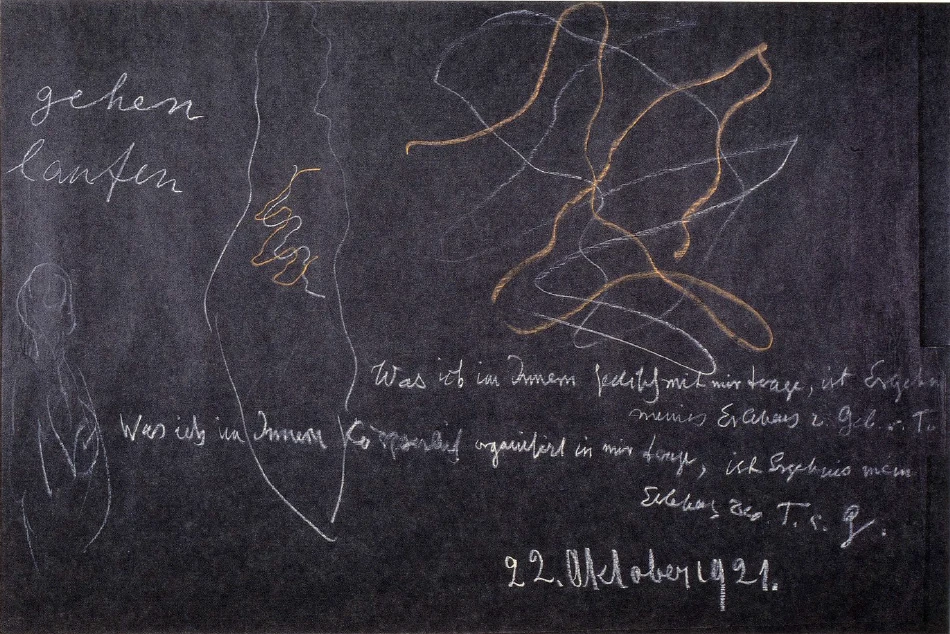
[ 16 ] Let’s take, for example, a word that contains two E’s: gehen. In these two E’s in “gehen,” if you have a sense of them in the upper left, you can clearly feel the calm, unhurried walking—the kind that doesn’t agitate you—the peaceful walking. That calm, leisurely stroll is definitely present in those two E’s. If, for example, you have an A in place of the E, as in “laufen,” then in the sound of the A you feel what you experience not in a leisurely walk, but in one that places greater demands on your breathing. You can feel what you experience in faster breathing by expressing it through the “Au.” You could not experience leisurely walking any better than through the two “E” sounds—which are now also to be experienced leisurely—and the running in the “Au” that is contained within it. Language possesses a spiritual quality, and I have already drawn your attention to this on repeated occasions through a wide variety of examples, showing how language certainly has an inner genius. So for people today, this is largely dormant, but in other eras, when people still had the proper inner experience of the sounds, the world of thought lived more consciously—more so than through sensory perception and thinking—and what one can already sense as a spiritual weaving and life lived more fully within language.
[ 17 ] Within what constitutes the world of language, the Archai and the Archangeloi now dwell, just as they do in the world of thought. And because they live within the genius of language, they are also what I have often described as the Archangeloi: they are indeed the guiding spirits of the peoples, the national spirits. And they express themselves precisely through the element of speech.
[ 18 ] Far more than one might think, human beings are themselves a product of their language, just as they are, on the other hand, a product of their world of thought. We derive our form entirely from the external world, and in turn we imbue the external world with form through our will. What constitutes our life originates from the same realm as our thoughts. The Archai dwell within it. What is expressed in our language—through which we belong to a people—conveys all those physical characteristics that now limit us as human beings to a far greater extent than is the case with the elements of thought. People share the same thoughts, but their languages differ. People differentiate themselves through language; yet they have, after all, something in common in their language—for a person belongs to a small or large people—that they share with many others.
[ 19 ] But if we descend to the essence of the Angeloi, then—as I have explained to you on several occasions, and again in this lecture—human beings have a unique, individual relationship with their Angelos. This individual relationship that human beings have with their Angelos is expressed in two ways. It is expressed inwardly when a human being surrenders to his or her inner self to such an extent that he or she actually transcends himself or herself within that inner self. In everyday life, however—since this is, after all, an intimate human experience—something Luciferic can immediately creep into the matter; but nevertheless: a human being can transcend himself or herself inwardly and, in a sense, experience something objective within the imagination. Imagination is, in many respects, something just as creative—but individually creative—as language, and, fundamentally speaking, the activity of imagination underlies language. Just as a person usually experiences language only as something abstract, just as they do not always sense the linguistic genius—who is an Archangelos—in language, I would say, spread his wings—so too in the imagination—which, when interwoven with Luciferic forces, becomes fantasy—so too does the human being fail to perceive in the imagination that an angel is actually slipping through his individual life as he lives within the imagination.
[ 20 ] The true poet, the true artist—one who has not become a cynic, a frivolous person, or a superficial person—knows, however, that a higher spirituality permeates him as he creates art. It is this same higher spirituality that actually carries us from life to life like an individual guardian spirit: the Angelos, the angel. And it is, in fact, the thinking of the Angelos that plays a role in the regulated human imagination. One can certainly recognize in certain statements by Goethe—I would say, in a subtle way—how he is aware that something unconscious is actually at work here, yet it has a real effect precisely within the imagination.
[ 21 ] But if a person does not step outside of themselves inwardly, but is truly outside of themselves during sleep, and if they then penetrate, in sleep, the region where the waking imagination is otherwise rooted, then the same thing that announces itself thoughtfully in the imagination manifests itself more within consciousness than in dreaming. Just as the imagination can degenerate into fantasy when it is permeated by Luciferic forces, so too can dreaming degenerate into all manner of irregularities, which a person then even takes to be reality, when Ahrimanic influences act upon the dreaming process. Dreaming as such does indeed extend into the Luciferic realm, but it can be permeated by Ahrimanic forces. Yet in reality, when our dreams are—one might say—innocent and purely human, they are inhabited by what we call the Angelos, the very being that also permeates us in the imagination when we, so to speak, step outward from within ourselves.
[ 22 ] Now the world of language, which the Archangel governs, recedes inward into a world that exists right in the midst of feeling and thought: the world of ideas; one could also say: the world of emotional ideas (see compilation). Imagination and dreaming give way to the world of feelings themselves—feelings and that which lives within them as a matter of the will; we could also say: feelings of the will. But as we now descend further, moving downward from the Angelos, where do we arrive? Well, there we arrive at ourselves; there we arrive at the human “I.” In the human “I,” we must now step out of ourselves in a more intense way than we do when the Angelos lives within us. And this stepping out takes place precisely when we carry out impulses of the will in external actions, as I demonstrated yesterday.
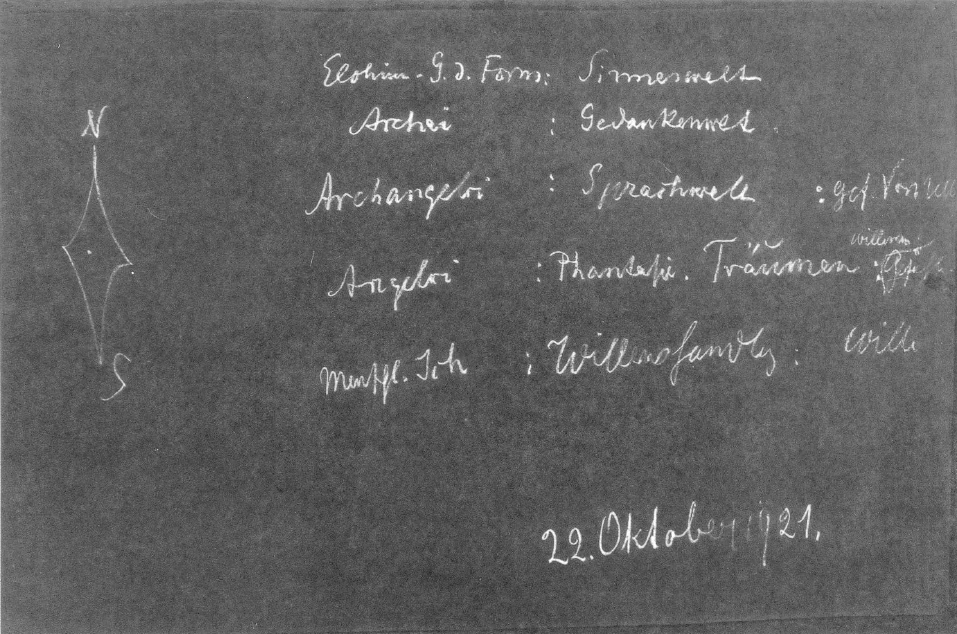
Elohim, Spirits of Form: The Sensory World
Archai: World of Thought
Archangeloi: World of Language: Emotional Imagination
Angeloi: Imagination. Dreaming: Volitional, Emotional
Human Ego: Volitional Action: Will
[ 23 ] When we dream, we are certainly outside ourselves, but we step outside ourselves only mentally. Although we do not physically step outside ourselves in an act of will, we set our physical body in motion, and the “I” is actually based on these impulses of will. So we can say: In the act of the will—well, it is the will itself that lives in the act of the will, and the will, so to speak, burrows into the external world. We have descended all the way to the physical world. We actually develop independently in the physical world only through our acts of the will. Only in that which remains to us at death—as I described yesterday as the sum of all our actions—does our “I” live, upon which we then look back. But in everything else—in imagination and dreams, in the world of language, in the world of thought, and in sensory perceptions—higher spiritual forces actually live, which continually permeate us as human beings.
[ 24 ] You see, you have now extracted from ordinary life the relationship between human beings and the spiritual cosmos. But now, through the following idea, we can also come closer to what spiritual science derives from supersensible perception. Take your life in the sensory world, for example. You move through this sensory world. You now have certain impressions. You may still remember those impressions you have now tomorrow. I don’t mean to say that everyone does this, for I don’t know whether we can assume, for example, that everyone sitting here will still have an inner experience tomorrow of what they are hearing here today as a lecture! But in general, one can say that what a person perceives from their surroundings continues to live on within them as a memory.
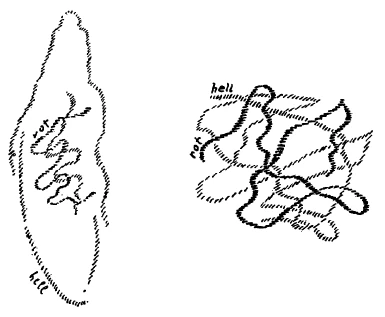
[ 25 ] I’d like you to consider this for a moment so we can make some progress (hatched area), and let’s imagine we’re actually drawing the world of the environment from the inside (see drawings, light-colored); here is the human being (red). What constitutes the world of the environment now lives on within the human being. It lives on in a spiritual way. What you experience together with the environment—I have depicted it here—lives on within you as a soul world. You see, in a certain sense, this is initially a very abstract experience. At the very least, the environment—which we experience only in the form of sensory appearances—lives on in abstract soul experiences, in thoughts and feelings, which then stimulate impulses of the will. But you can certainly say—if we bring this very clearly before our soul—that what I carry within myself as a soul experience is the result of my experiences between birth and death, or rather, between birth and the present moment.
[ 26 ] But now let us turn our attention to that which we carry within us not merely in an abstract, spiritual sense—not merely as an image—but let us turn our attention to that which we carry within us, I would say, in a more concrete, material sense: to the organs lying within our skin—the lungs, the heart, the liver, and so on. This, too, is something we carry within us. A true mystic would say: That doesn’t interest me at all. I’m only interested in the spiritual and the psychological. I am already content that I carry within me my soulful impressions of the world around me. The material is far too insignificant to me, too unimportant.” — Yes, but in such talk, the mystic precisely reveals how deeply materialistic he actually still is; how he does not yet know that what appears to be material is, in reality, spiritual. It is not only what we carry within us in an abstract sense as soul experiences—the aftereffects of external experiences between birth and death—that is spiritual; our lungs and our liver are also spiritual. They merely appear to us, in our ordinary consciousness, in material form; they are entirely the products of the spirit. When you sit in your little room, it occurs to you: The human being consists of a physical body, an etheric body, an astral body, and the I. — You possess this as part of your inner being. Once upon a time, it was something external. It first came to you—perhaps from a book or a lecture, that is, from the outside world—and I have sketched it out schematically here. But you also carry within you lungs, a heart, a liver, a brain, and so on, materially and internally. You carry these within you as well as a result of experiences. So if you were to simply sketch a diagram of a human being with their individual organs (Plate 4, bottom left), this inner aspect is the result of all of that—not, of course, the physical matter, which comes only with conception, birth, and so on, but in terms of its form, its inner organization, it is the result of what is experienced between death and a new birth. Just as you hear what I am saying here, and this then becomes your soul experience, so your heart, your lungs, and your liver become the result of what you experience between death and a new birth. We can therefore say: What I carry within me, physically organized, is the result of my experiences between death and a new birth.
What I carry within me emotionally,
is the result of my experiences between birth and death.What I carry within me, physically organized,
is the result of my life between death and birth.
[ 27 ] Of course, the materialist will object: Everything that constitutes the human organs is, after all, physically inherited from our ancestors. —That is a complete error. It is not so. Certainly, the matter is inherited from ancestors, but what constitutes the germ is usually viewed quite incorrectly. It must also be viewed incorrectly if one considers it solely from a material perspective. For fertilization does not consist in the human being being “brought down” materially from previous generations, but rather in the creation, as it were, of empty space—in the breakdown of matter within the human being and the incorporation of the entire universe into the human being. Matter then pushes its way into this spiritual structure—the lungs, heart, and liver are entirely spiritual structures. But the organizing forces are shaped entirely from the entire universe, from the experience between death and new birth. This is precisely what the human being experiences—in the manner I described earlier—in a state of heightened consciousness when we are lifted up into the region of the Archangeloi and Archai. Between death and new birth, the human being consciously—or rather, superconsciously—experiences what is then built into his or her organs.
[ 28 ] Our organs are indeed structured in such a way that they correspond to our karma—that is, to what we bring with us from previous earthly lives. So what appears to be mere physical processes unfolding over generations are not merely physical processes, but processes that are indeed brought about by the entire universe.
[ 29 ] I have often needed an analogy to help explain things when ordinary, materialistic, trivial-minded people come along and say: “Just don’t explain the origin of the human being in the mother’s womb by referring to the entire universe; don’t take us out into the universe; you simply have to explain it through the continuity of the germ plasma across generations.” — I said that one can get around this by saying: Someone has a magnetic needle that points north and south. Now someone comes along and says: There are crazy physicists who claim that the entire Earth is a magnet and that the Earth’s magnetic south pole attracts this needle toward itself. The reasons why the magnetic needle aligns this way can only be found within the magnetic needle itself. What does the Earth have to do with this magnetic needle! — But that is more or less how our biologists speak today when they talk about the germ. They look only at the germ. Just as the entire Earth is at work in the magnetic needle, so the entire universe is at work in the formation of the germ. Only, of course, the part that the human being plays in this lies hidden in the unconscious.
[ 30 ] You see, when viewed in this way, human beings are linked with their entire existence to both a material and a spiritual universe. We tell ourselves: Through cognition, through ordinary conscious experience, we transform the external world into an inner world. From a certain point of view, I told you yesterday: When a human being passes through the gate of death, the inner becomes outer, and the outer becomes inner. Today I have presented another perspective from which you can see how what lies before birth—or rather, before conception—must be approached in such a way that we must seek our physical inner world in the outer world, in its preparatory processes during the life between death and a new birth: The external becomes internal. What we experience, as it were, spreading throughout the entire universe becomes a deeply unconscious experience within our organs.
[ 31 ] These organs within us are, in fact, such that an entire world lives within them. And if we consider solely what external anatomy and physiology reveal about our internal organs, we actually have a much stronger form of Maya before us than we do in the external world.
[ 32 ] As I told you, when we look out into the sensory world, we look as far as the Elohim. But when we now look down into the innermost depths of our physical being, we must ascend even further to find that which lives within us in such a way that it forms our organs. As you know, in my *Secret Science* you will find other beings associated with the spirits of form. And these other beings are not merely outside the human being; rather, they are at work within the human being. We come to know them between death and a new birth—though with our own consciousness we ascend only as far as the Archai—but through the Archai we learn of these beings. And in this superconsciousness, we learn from them what we then infuse into our own being. We actually carry the world of the hierarchies within our inner constitution through life.
[ 33 ] Such things can be explored again today. In ancient times, such things were known through a certain instinctive, clairvoyant awareness—in those times when it was said that the human organism is a temple of the gods, in those times when people sought to gain insight into the entire world precisely within the human microcosm by interpreting that microcosm.
[ 34 ] Is it not the case that we know about the world—the world we have lived through here in our earthly life since we first became conscious, the world we have experienced as our own—through our memories? We can reflect on everything we are able to draw from our memories. We look within ourselves and find the world we have experienced externally within us; we can, so to speak, view these images that we carry within our souls in such a way that this life out there has flowed into them. We come to understand our experiences anew when we look back on these images of memory. If we now look at our physical constitution and understand it, we thereby understand the world process. Through our inner memories, we understand our experiences. Through our entire human constitution—if we know how to view it correctly—we understand the world process. But this is only true anthroposophy when one can understand the human being through and through.
[ 35 ] But anthroposophy is, at the same time, cosmosophy. For just as memory is, for us, a bringing to mind of our own lives, so anthroposophical knowledge is a memory of the world—a bringing to mind of the entire process of the world—cosmosophy. The two cannot be conceived of separately from one another. Cosmosophy and anthroposophy belong together; humanity is to be found in the world, and the world in humanity. Therefore, it is not anthropomorphism in my *Secret Science* when, as development is brought about by Saturn, the Sun, the Moon, and so on, there is at the same time a development of humanity. World evolution is a given, and human evolution is a given, because the deeper one penetrates into the mysteries of existence, the more the world and humanity flow together; the more it becomes apparent that the separation we experience in our earthly life between the world and humanity is actually nothing but an illusion; that humanity belongs to the world and the world to humanity; that humanity is to be found in the world and the world in humanity.