

Human Questions and Cosmic Answers
GA 213
25 June 1922, Dornach
Translate the original German text into any language:
Versions Available:
Human Questions and Cosmic Answers, tr. SOL
Zweiter Vortrag
Second Lecture
[ 1 ] Gestern habe ich mich bemüht, in einer etwas abgelegeneren Betrachtung zu zeigen, wie man aus dem Räumlich-Physischen auch der menschlichen Leiblichkeit den Übergang finden kann zu demjenigen, was dann schon dadurch geistig gedacht werden kann, daß eben die drei Raumdimensionen gewissermaßen reduziert werden auf zwei und eine Dimension und auch auf das Punktuelle. Nun möchte ich heute gewissermaßen gegenüberstellen der gestrigen Betrachtung eine Art kosmischer Betrachtung, die Ihnen zeigen soll, wie auf der anderen Seite wiederum die Welt, die unsere Umgebung bildet, in Zusammenhang gedacht werden kann mit dem Geistigen und Seelischen. Es ist ja dem modernen Bewußtsein recht unmöglich, die rein stofflich-physische Welt, die den Menschen umgibt, so anzusehen, daß zu ihr das Seelisch-Geistige im Menschen irgendeine unmittelbare Beziehung hat. Das muß ja durchaus in bezug auf die Erkenntnis gerechtfertigt werden, wenn der moderne Mensch nicht sagen soll, er könne sich nichts darunter vorstellen, wenn Anthroposophie behauptet, das Seelisch-Geistige, das Ich und der astralische Leib also, verlassen den physischen Leib und den Ätherleib und seien dann außerhalb desselben. Wo sind sie? — frägt nun der Mensch, der aus dem heutigen materialistischen Bewußtsein heraus seine Erkenntnisse holt. Daß sich irgendwo im Raume ein Seelisches aufhält, das kann sich natürlich der moderne Mensch nicht denken. Er kann sich höchstens noch denken, daß sich die Luft irgendwo aufhält, daß der Raum lichtdurchsetzt ist; aber daß im Raume irgendein Geistig-Seelisches vorhanden ist, das kann er sich nicht denken. Und von dieser Unmöglichkeit ist dann nur eine kurze Strecke Weges zu der anderen Unmöglichkeit, daß sich eben dieser moderne, aus dem materialistischen Bewußtsein herausgewachsene Mensch keine Vorstellung davon machen kann, wohin das Geistig-Seelische kommt, wenn es mit dem Tode den menschlichen Leib verläßt.
[ 1 ] Yesterday I endeavored, in a somewhat more abstract consideration, to show how one can make the transition from the spatial-physical—including human physicality—to that which can then be conceived spiritually simply by reducing the three spatial dimensions, so to speak, to two and one dimension, and even to the point. Today I would like, in a sense, to contrast yesterday’s reflection with a kind of cosmic perspective that is intended to show you how, on the other hand, the world that surrounds us can be conceived in connection with the spiritual and the soul. After all, it is quite impossible for modern consciousness to view the purely material-physical world that surrounds human beings in such a way that the soul-spiritual within the human being has any direct relationship to it. This must certainly be justified in terms of understanding, lest modern people say they cannot conceive of it when anthroposophy asserts that the soul and spirit—that is, the “I” and the astral body—leave the physical body and the etheric body and are then outside of them. “Where are they?” asks the person who derives his or her understanding from today’s materialistic consciousness. Of course, modern man cannot conceive of a soul element existing somewhere in space. At most, he can still conceive of air existing somewhere, or that space is permeated by light; but he cannot conceive of any spiritual-soul element being present in space. And from this impossibility, it is only a short step to the other impossibility: that this very modern person, shaped by materialistic consciousness, cannot form any conception of where the spiritual-soul element goes when it leaves the human body at death.
[ 2 ] Gewiß, der moderne Mensch behauptet, an diese Dinge glauben zu können. In dem Augenblick aber, wo er sein eigentliches Denkvermögen zu Hilfe nimmt, kommt er sogleich in Konflikte hinein. Diese Konflikte hören auf, wenn man versucht, zum Geisteswissenschaftlichen aufzusteigen. Aber da die Ideen, die man dabei aufnehmen muß, etwas Ungewohntes sind für den Menschen der heutigen Zeit, so kann man sich ihnen eigentlich nur langsam und allmählich nähern. Und da wird es gut sein, an Tatsachen anzuknüpfen des geistig-geschichtlichen Lebens, an Tatsachen, die ja heute der äußeren Welt weniger bekannt sind.
[ 2 ] Certainly, modern people claim to be able to believe in these things. But the moment they call upon their actual powers of thought, they immediately find themselves in conflict. These conflicts cease when one attempts to rise to the level of spiritual science. But since the ideas one must take in in the process are somewhat unfamiliar to people of today, one can really only approach them slowly and gradually. And so it will be good to build upon facts from spiritual-historical life—facts that are, after all, less well known to the outer world today.
[ 3 ] Wir wissen alle, daß dasjenige, was heute die Menschen an alten, ehrwürdigen traditionellen Vorstellungen haben, die dann in die Religionen übergegangen sind, an die geglaubt wird, daß diese Vorstellungen zurückführen auf uralte Erkenntnisse; wir wissen, daß es in alten Zeiten Mysterienstätten gegeben hat, welche Kirchen, Schulen und Kunstanstalten in einem zugleich waren, und aus denen auch alles dasjenige hervorgegangen ist, was dann sich verbreitet hat in den Menschenmassen als Erkenntnisse, aber auch als die Impulse, welche das Handeln der Menschen bestimmten.
[ 3 ] We all know that the ancient, venerable traditional beliefs people hold today—which have since become the religions in which people believe—can be traced back to ancient insights; we know that in ancient times there were mystery sites that were at once churches, schools, and art institutions, and from which emerged everything that later spread among the masses—not only as insights but also as the impulses that guided human action.
[ 4 ] In diesen Mysterienstätten waren die sogenannten Eingeweihten, welche durch die besonderen Vorgänge, denen sie sich unterworfen hatten, eben zu höheren Erkenntnissen gekommen waren. Durch diese Prüfungen, durch die sie hindurchgegangen waren, hatten sie aber auch ein gewisses Verhältnis zur Welt gewonnen, zum Beispiel ein solches Verhältnis zur Welt, durch das sie ablauschen konnten den Weltenvorgängen, dem Weltenverlaufe dasjenige, was sie über die Welt wissen wollten.
[ 4 ] In these mystery sites were the so-called initiates, who, through the special rituals to which they had subjected themselves, had indeed attained higher insights. Through these trials they had undergone, however, they had also gained a certain relationship to the world—for example, a relationship through which they could discern from the world’s processes and the course of the world precisely what they wished to know about it.
[ 5 ] In der äußeren Geschichte sind ja eigentlich nur die, ich möchte sagen, schon verderbten Arten von solchen Ablauschungen gegenüber den Weltenvorgängen vorhanden. Sie alle haben gelesen, wie in griechischen Tempelstätten, Orakelstätten man herangezogen hat gewisse Persönlichkeiten wie zu einer Art von Medien, die dann etwa über aufsteigenden Erdendünsten in dasjenige gekommen sind, was man in der neueren Zeit bei jenen Menschen, die doch immer dilettantisch nur bleiben in bezug auf das Geistige, Trance nennt, durch die man ja etwas Wahres, etwas Wirkliches nicht gewinnen kann, sondern die eigentlich ein unberechtigter Hokuspokus ist. Aber in den Zeiten, in denen die ältere Art, zu der Welt sich in Beziehung zu setzen, schon in die Verderbnis gekommen war, hat man zu solchen Orakelstätten seine Zuflucht genommen. Und was dann da hereingeholt worden war in einer Art von tranceartigem Zustand, hat man als Offenbarung genommen, um etwas zu wissen, sozusagen was die wirklich geistigen Mächte als Absichten hegen, die göttlich-geistigen Mächte, die hinter dem Verlaufe der Weltenerscheinungen stehen. Nach solchen Orakelsprüchen hat man sich dann gerichtet.
[ 5 ] In external history, in fact, there are really only—I would say—already corrupted forms of such eavesdropping on world events. You have all read how, in Greek temples, certain individuals were summoned—as if they were a kind of medium—who then, through rising earth vapors, entered into what is called “trance” in modern times among those people who, after all, remain mere dilettantes when it comes to spiritual matters; through this, one cannot gain anything true or real, but it is actually nothing more than unwarranted hocus-pocus. But in times when the older way of relating to the world had already fallen into decay, people took refuge in such oracle sites. And what was then received there in a kind of trance-like state was taken as a revelation in order to gain knowledge—so to speak—of the intentions harbored by the truly spiritual powers, the divine-spiritual powers that stand behind the course of worldly phenomena. People then guided their lives according to such oracular pronouncements.
[ 6 ] Aber diese Orakelsprüche waren ja gar nicht das Ursprüngliche. Das bestand in etwas ganz anderem. Als man zu solchen Orakelsprüchen seine Zuflucht nahm, da war es durchaus schon so, daß man die alten Fähigkeiten, welche die Eingeweihten in den Mysterien gepflegt haben, verloren hatte, und man zu äußerlichen Maßnahmen seine Zuflucht nahm. Ich möchte Ihnen einen der Vorgänge schildern, durch den in sehr alten Zeiten die Eingeweihten, die Initiierten der Mysterien, der Welt ihre Geheimnisse abgelauscht haben, diejenigen Geheimnisse, welche in den Absichten der hinter den Naturerscheinungen stehenden göttlich-geistigen Wesenheiten vorhanden waren.
[ 6 ] But these oracular utterances were not, in fact, the original source. That lay in something entirely different. By the time people turned to such oracular utterances, it was already the case that the ancient abilities cultivated by the initiates in the mysteries had been lost, and people had resorted to external measures. I would like to describe to you one of the processes through which, in very ancient times, the initiates of the Mysteries gleaned the world’s secrets—those secrets that lay in the intentions of the divine-spiritual beings standing behind natural phenomena.
[ 7 ] Solche Eingeweihte, nachdem sie ihren ganzen Menschen in langer Zeit dafür zubereitet hatten, auf die feineren Vorgänge des Lebens sorgfältig zu achten, konnten dann dahin kommen, daß sie namentlich der aufgehenden Sonne gegenüber sich in einen besonderen Gemütszustand brachten. Das war eine Übung, welche der alte Eingeweihte in den Mysterien immer wieder vornahm: der aufgehenden Sonne, der heraufkommenden Morgenröte gegenüber zu einer recht empfänglichen, geistempfänglichen Stimmung zu kommen. Gerade die Morgenröte und die auf ihr erscheinende Sonne war etwas, was eine ehrfürchtige, aber zugleich von allerlei hingebungsvollen inneren Stimmungen durchsetzte Seelenverfassung hervorrufen sollte bei diesen alten Eingeweihten. Von der zum Teil aus Andacht, zum Teil aber auch aus Wißbegierde zusammengewobenen Stimmung, in die alte Eingeweihte gegenüber dem Sonnenaufgang gekommen sind, wenn sie dazu in der richtigen Weise vorbereitet waren, von dieser Stimmung macht man sich heute gar keinen Begriff mehr. Ich glaube, daß die letzte Empfindung aus der äußeren Welt von solchen Stimmungen eigentlich nur noch etwas zur Vorstellung kommen kann, wenn man die wunderschönen Schilderungen liest — die aber jetzt auch schon wiederum mehr als ein Jahrhundert hinter uns liegen —, die noch Johann Gottfried Herder, der ausgezeichnete deutsche Dichter und Schriftsteller, gerade vom Sonnenaufgang gegeben hat, aber nicht etwa so, wie es triviale neuere Dichter ja auch machen können, sondern vom Sonnenaufgang, insofern dieser eine Art Symbolum ist für alles Erwachende, Erwachende nicht nur in der Natur, sondern im Menschengemüt, in der Menschenseele. Gewissermaßen dasjenige, was hervorruft in der Menschenseele selber eine Art Morgenröte, in die dann die Sonne wie innerlich hinein aufgeht, das hat ja Herder in einer wunderbaren Weise geschildert, als er darzustellen suchte, wie die poetische Stimmung einmal in der Menschheitsentwickelung Platz gegriffen hat, und wie diese poetische Stimmung ihren Ausgangspunkt nehmen konnte von alledem, was der Mensch erleben kann bei Morgenröte und Sonnenaufgang.
[ 7 ] Such initiates, after having spent a long time preparing their entire being to pay careful attention to the subtler processes of life, were then able to reach a point where they could, specifically when facing the rising sun, bring themselves into a particular state of mind. This was an exercise that the ancient initiate in the Mysteries performed time and again: to enter into a truly receptive, spiritually receptive mood in the presence of the rising sun and the dawning dawn. It was precisely the dawn and the sun appearing within it that were intended to evoke in these ancient initiates a state of mind that was reverent yet at the same time imbued with all manner of devotional inner feelings. The state of mind—woven in part from devotion and in part from a thirst for knowledge—into which the ancient initiates entered as they faced the sunrise, when they were properly prepared for it—we can no longer even begin to conceive of such a state today. I believe that the only way to even begin to imagine the last sensation from the outer world evoked by such moods is by reading the beautiful descriptions—which, however, now lie more than a century behind us—that Johann Gottfried Herder, the outstanding German poet and writer, provided specifically about the sunrise, but not in the way that trivial modern poets might do, but rather the sunrise insofar as it is a kind of symbol for all that is awakening—not only in nature, but in the human mind and in the human soul. In a sense, that which evokes within the human soul itself a kind of dawn, into which the sun then rises as if from within, Herder described this in a wonderful way when he sought to illustrate how the poetic mood once took root in human development, and how this poetic mood could take its starting point from all that a person can experience at dawn and sunrise.
[ 8 ] In einer noch intensiveren Weise haben die Geheimnisse der Morgenröte und des Sonnenaufgangs Menschen wie etwa Jakob Böhme empfunden, dessen erstes Werk, wie Ihnen ja bekannt ist, «Aurora oder die Morgenröte im Aufgang» heißt. Und nicht ohne Bezug auf diese Geheimnisse des Morgenrotes sind ja Worte wie die aus Goethes «Faust»: «Auf, bade Schüler, unverdrossen, die ird’sche Brust im Morgenrot!» Je weiter wir zurückgehen in der Geschichte der Menschheitsentwickelung, desto wunderbarer finden wir die Stimmungen der Menschenseele bei dem ersten Hereindringen der Sonnenstrahlen des Morgens, wo sie gewissermaßen noch auf ihren Wellen hereintragen das tätige, aktive Weltenlicht. Und alte Initiierte in den Mysterienstätten, die hatten sich dazu vorbereitet, daß sie ihre ernstesten, ihre heiligsten Fragen an die Weltengeister während des Morgenrotes gewissermaßen aus ihren Herzen hinaussandten in die Weiten der Welt. Sie sagten sich: Wenn die Sonne ihren ersten Strahl hereinsendet auf die Erde, dann ist den Menschenfragen der beste Weg gegeben, um hinauszudringen in die Weiten des Kosmos. Und so strahlten gewissermaßen die alten Eingeweihten ihre Fragen, ihre Herzens- und Menschenrätsel in die Weiten der Welt hinaus. Und dann gingen sie nicht so trivial, banal etwa an die Antwort, wie wir das heute in unserer physischen Wissenschaft gewöhnt sind, sondern sie kamen in die Stimmung hinein, in der sie sich sagten: Wir haben jetzt unsere Rätselfragen der Weite der Welt übergeben; im Weltenschoße ruhen sie, die Götter empfangen unsere Rätselfragen.
[ 8 ] People such as Jakob Böhme have experienced the mysteries of the dawn and the sunrise in an even more intense way; as you know, his first work is titled Aurora, or the Dawn at Sunrise. And it is certainly not without reference to these mysteries of the dawn that we find words such as those from Goethe’s Faust: “Arise, disciples, undaunted, and bathe your earthly breast in the dawn!” The further back we go in the history of human development, the more wondrous we find the moods of the human soul at the first penetration of the morning sun’s rays, when, as it were, the active, dynamic light of the world still carries in on their waves. And the ancient initiates in the mystery temples had prepared themselves so that, during the dawn, they might, as it were, send their most serious, their most sacred questions to the spirits of the world from their hearts out into the vastness of the world. They told themselves: When the sun sends its first ray down upon the earth, then the best path is opened for human questions to reach out into the vastness of the cosmos. And so, in a sense, the ancient initiates beamed their questions—the mysteries of their hearts and of human existence—out into the vastness of the world. And then they did not approach the answer in such a trivial or banal way as we are accustomed to today in our physical science, but rather they entered into a state of mind in which they said to themselves: We have now entrusted our riddles to the vastness of the world; they rest in the bosom of the world, and the gods receive our riddles.
[ 9 ] Ich schildere nur. Man mag denken wie man will über diese Dinge, sie waren einmal da, man übte sie so. Und dann haben solche Initiierte gewartet und in nächtlicher Stunde ihre Herzen bereitgemacht, etwas entgegenzunehmen. Das war jetzt auch wiederum eine hingebungsvolle, aber nicht eine, ich möchte sagen, die Frage aufwerfende Stimmung, sondern sie gaben ihre Herzen hin einer ganz empfänglichen, einer auch andächtigen, aber empfänglichen Stimmung. Und so haben sie entgegengestellt ihre Andacht dem hereinbrechenden Schein des Vollmondes. Und da haben sie gefühlt: Jetzt bekommen sie zurück die Antwort aus dem Weltenall.
[ 9 ] I am merely describing. One may think what one will about these things; they once existed, and that is how they were practiced. And then such initiates would wait and, in the dead of night, prepare their hearts to receive something. This, too, was a devotional mood—but not one, I would say, that raised questions; rather, they surrendered their hearts to a mood that was entirely receptive, one that was also devout, yet receptive. And so they set their devotion in contrast to the breaking light of the full moon. And then they felt: Now they are receiving the answer from the cosmos.
[ 10 ] Das war in älteren Mysterien ein sehr gewöhnlicher Vorgang. Man hat zu einer gewissen Zeit seine Rätselfragen mit der Welt abgemacht, indem man sie hinausgesendet hat in die Weltenweiten, und hat sich die Antworten geholt, die vom Vollmonde aus, im Scheine des Vollmondes die Götter der Erde wiederum zugesendet haben.
[ 10 ] This was a very common practice in the ancient mysteries. At a certain time, people would pose their riddles to the world by sending them out into the vastness of the cosmos, and would receive the answers that the gods of the earth sent back from the full moon, in the light of the full moon.
[ 11 ] So korrespondierte der Mensch einmal mit der Welt. Er war nicht so hochmütig, daß er etwa wie ein heutiger Philosoph in seinem Kopf die Fragen aufgeworfen hätte, dann auch wiederum flugs die Antworten dazu gesucht hätte, er war nicht so hochmütig, zu glauben, daß man sich über ein Stück weißes Papier setzen, und daß der Menschenkopf nun mit sich allein die großen Rätselfragen des Daseins abmachen könne. Er war vielmehr des Glaubens, dieser alte Initiierte, daß mit demjenigen, was als göttlich-geistige Mächte die Welt durchwellt und durchwallt, daß man mit dem zusammen besprechen müsse dasjenige, was man abmachen will über Fragen und Antworten bezüglich der Weltenrätsel. Er tat das aus dem Grunde, weil er wußte: Da draußen in der Welt, da sind nicht nur die physisch-sinnlichen Wahrnehmungsinhalte, da waltet und webt überall Geistiges. Und indem der Sonnenstrahl zu mir dringt, kann ich ihm entgegensenden dasjenige, was der Inhalt meines Willens ist.
[ 11 ] That is how humans once interacted with the world. He was not so arrogant as to raise questions in his mind—as a philosopher of today might—and then immediately seek answers to them; he was not so arrogant as to believe that one could sit down with a sheet of white paper and that the human mind alone could resolve the great enigmas of existence. Rather, this ancient initiate believed that whatever it is—those divine-spiritual powers that ripple and surge through the world—one must discuss with them whatever one wishes to resolve regarding questions and answers about the world’s mysteries. He did this because he knew: Out there in the world, there are not only the contents of physical and sensory perception; the spiritual reigns and weaves everywhere. And as the sunbeam reaches me, I can send back to it that which is the content of my will.
[ 12 ] Dieses Geheimnis ist dem Menschenforschen ganz verlorengegangen. Aber es war einmal ein wirkliches Wissen, eine wirkliche Erkenntnis der Menschheit. Und einer der letzten in Europa, die eine allerdings nicht deutliche, aber doch lebendige Tradition gehabt haben von diesen Dingen, und die auch dafür kämpfen wollten, war Julian Apostata. Er war so unvorsichtig, diese Dinge noch ernst zu nehmen, und ist ja dadurch gerade ein Opfer seiner Gegner geworden.
[ 12 ] This mystery has been completely lost to the study of humanity. But there was once a time when this was genuine knowledge, a true understanding of humanity. And one of the last people in Europe to have maintained a tradition—admittedly not a clear one, but nonetheless a living one—regarding these matters, and who was also willing to fight for them, was Julian the Apostate. He was so imprudent as to still take these matters seriously, and it was precisely this that made him a victim of his opponents.
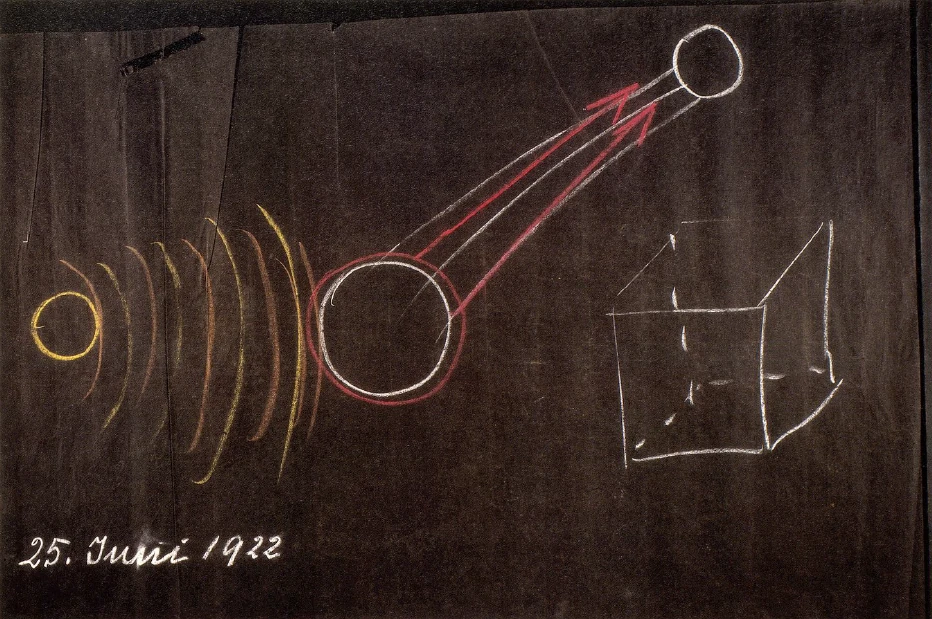
[ 13 ] Der heutige Mensch zeichnet — es ist nur eine schematische Zeichnung, aber sie soll ja auch nur versinnlichen, um was es sich handelt — die Erde und die Sonne — natürlich müßte ich es viel weiter hinauszeichnen — so, daß die Sonne ihre Strahlen zur Erde heruntersendet. Der alte Eingeweihte würde gesagt haben: Das ist ja nur physisch; das Geistige davon ist das, daß auf der Erde die Menschen wohnen, und die Menschen entwickeln auf der Erde ihren Willen (rot), und während die Sonnenstrahlen von der Sonne auf die Erde herunterkommen, kann der Mensch seinen Willen in der Richtung der Sonne in den Weltenraum hinaussenden (Pfeile). Gewissermaßen auf den Wogen des Willens, der von der Erde zur Sonne hinstrahlt, sandten die alten Eingeweihten ihre Fragen in das Weltenall hinaus. Und wenn der moderne Mensch sagt: Auf der anderen Seite ist irgendwie der Mond, der seinen Schein auf die Erde hereinstrahlen läßt (gelb), so sagte der alte Eingeweihte:: Das ist aber nur das Physische; in Wahrheit kommen die Gedanken auf den Wellen dieses Scheins zur Erde herein (orange). Und soübergab der.alte Eingeweihte den Willensstrahlen, die von der Erde zur Sonne gehen, seine Fragen, und empfing von den Gedankenstrahlen, die vom Mond zur Erde kommen, die Antworten. Die heutige Wissenschaft kennt nur die eine Seite der Sache. Die sieht auf das Physische der Sonne und des Mondes. Der alte Eingeweihte aber sagte: Während die Sonne fortwährend ihr Licht zur Erde sendet, sendet die Erde in den Weltenraum die Willensstrahlungen, den Willen von all den Menschen, die auf der Erde leben, fortwährend in die Welt hinaus. Und wenn der Mensch im Scheine des Mondes sich aufhält, dann werden ihm die Gedankenstrahlen aus dem Kosmos geschickt.
[ 13 ] People today draw—it is only a schematic drawing, but its purpose is simply to help visualize what is being described—the Earth and the Sun—of course, I would have to draw it extending much further—so that the Sun sends its rays down toward the Earth. The ancient initiate would have said: That is merely the physical aspect; the spiritual aspect is that human beings dwell on Earth, and human beings develop their will (red) on Earth, and while the sun’s rays descend from the Sun to Earth, human beings can send their will out into space in the direction of the Sun (arrows). In a sense, riding the waves of the will that radiates from the Earth toward the Sun, the ancient initiates sent their questions out into the cosmos. And when modern man says, “On the other side, in a way, is the Moon, which lets its light shine down onto the Earth” (yellow), the ancient initiate would say: “But that is only the physical aspect; in truth, thoughts come to Earth on the waves of this light (orange).” And so the ancient initiate entrusted his questions to the rays of will that travel from Earth to the Sun, and received the answers from the rays of thought that come from the Moon to Earth. Modern science knows only one side of the matter. It looks at the physical aspects of the Sun and the Moon. The ancient initiate, however, said: While the Sun continually sends its light to Earth, Earth continually sends out into space the rays of will—the will of all the people living on Earth—into the world. And when a person stands in the moonlight, the thought-rays are sent to him from the cosmos.
[ 14 ] Die menschliche Organisation hat sich geändert. So könnte der heute nach übersinnlicher Erkenntnis Suchende nicht verfahren. Die menschliche Auffassung ist gröber geworden, als sie in alten Zeiten war. Gewiß, auch heute gehen unsere Willensstrahlen ins Weltenall hinaus. Aber der Mensch empfindet seine Fragen nicht so brennend, wie man sie einmal empfunden hat, als daß seine Willensstrahlen nun wirklich diese Fragen mit hinausnehmen würden. Wir sind als Menschen heute zu intellektualistisch geworden, und der Intellekt, der kühlt alles Fragen ab. Von der Riesenwißbegierde, welche einmal die Menschen in bezug auf die heiligsten Fragen des Daseins entwickelt haben, haben wir heute nicht viel Empfindung. Wir sind nicht mehr so wißbegierig; wir sind eigentlich nur noch neugierig und möchten schnell alles wissen, ohne daß wir uns mit der Welt auseinandersetzen. Und im Mondenschein träumen höchstens noch die Liebenden; die Gelehrten würden es als einen furchtbaren Aberglauben betrachten, wenn sie nun auch von dem Scheine des Mondes die Antworten auf die brennenden Rätselfragen des Daseins empfangen sollten.
[ 14 ] Human organization has changed. Thus, someone seeking supersensory knowledge today could not proceed in this way. Human perception has become coarser than it was in ancient times. Certainly, even today our rays of will extend out into the cosmos. But people do not feel their questions as urgently as they once did, to the extent that their rays of will would truly carry these questions with them. As human beings, we have become too intellectualistic today, and the intellect cools all questions. We have little sense today of the immense thirst for knowledge that people once developed regarding the most sacred questions of existence. We are no longer so eager for knowledge; we are, in fact, merely curious and want to know everything quickly, without really engaging with the world. And in the moonlight, at most, only lovers still dream; scholars would regard it as a terrible superstition if they were now to receive the answers to the burning mysteries of existence from the moon’s glow as well.
[ 15 ] Man sieht eben durchaus die Welt entgeistigt. Man weiß nichts mehr von dem Geist, der die Welt überall durchsetzt, oder wenn man davon spricht, so spricht man in verschwommen-pantheistischer Weise, nicht in der konkreten Weise, daß man weiß, wie sich des Menschen Willensstrahlen zu den Sonnenstrahlen verhalten, wie sich des Menschen Gedankenformen zu dem Schein des Mondes verhalten.
[ 15 ] One certainly sees the world as having lost its spiritual dimension. People no longer know anything about the spirit that permeates the world everywhere, or if they speak of it, they do so in a vague, pantheistic way, not in the concrete sense of knowing how the rays of human will relate to the rays of the sun, or how the forms of human thought relate to the glow of the moon.
[ 16 ] Aber wir können auch in der modernen Initiation wiederum zu einem Verkehr mit dem Kosmos und mit dem Geist der Welt kommen. Nur macht es die heutige Initiation anders. Die vorbereitenden Übungen zur Initiation, Sie finden sie ja geschildert in meinen Büchern, namentlich in dem Buche «Wie erlangt man Erkenntnisse der höheren Welten?». Aber das alles, das tendiert ja darauf hin, das zielt ja darauf hin, daß der Mensch wirklich dazu komme, durch solche Übungen auch heute noch Antwort zu bekommen, allerdings nicht so, wie man es im heutigen Hochmut tut, die Fragen im Kopfe zu wälzen und mit dem Kopfe die Antworten zu geben. Da bekommt man doch nichts anderes heraus als die Dinge, die ja sehr gescheit sind; aber Gescheitheit ist nicht etwas, was zu einer wirklichen Antwort über die Rätselfragen des Lebens führt. Durch dieses Wälzen im Kopfe schließt man sich ab von der Welt. Man muß durchaus, wenn man Antwort haben will von der Welt, aus sich herausgehen. Man muß mit der Welt in Beziehung treten. Und so ist es denn, daß der moderne Initiierte auch seine Fragen stellen muß und auch Geduld haben muß, wenn er nicht gleich eine Antwort erhält. Der moderne Initiierte kommt nämlich immer mehr und mehr dazu, die Außenwelt nicht bloß so anzuschauen, daß er nun seine Neugierde befriedigen läßt durch dasjenige, was als Eindruck auf seine Augen, auf seine Ohren, auf seine sonstigen Sinne gemacht wird. Gewiß, er empfängt auch diese Sinneswahrnehmungen von außen, aber indem er ebenso genau, ebenso intim sich die Blumen, die Sonne, den Mond, die Sterne, andere Menschen, Pflanzen, Tiere und so weiter anschaut, indem er überallhin seine Sinne richtet und dasjenige gewissermaßen durch sich hindurchgehen läßt, was er als Eindrücke von den äußeren Sinnen empfängt, schickt er dem eine Strömung aus sich selbst entgegen. Und das ist die Strömung, welche in ihm die Rätselfrage des Daseins bedeutet. Man sieht eine schöne Blume. Man sieht sie an, aber nicht bloß passiv, sondern man lenkt zum Beispiel den Blick auf das Gelb. Man läßt das Gelb auf sich einen Eindruck machen. Aber zu gleicher Zeit sendet man dem Gelb seine Rätselfrage entgegen, und man läßt untertauchen in das Gelb der Blume oder meinetwillen auch in das Morgenrot untertauchen dasjenige, was man als Rätselfragen des Daseins zu stellen hat.
[ 16 ] But even in modern initiation, we can once again come into communion with the cosmos and with the spirit of the world. It’s just that today’s initiation does it differently. The preparatory exercises for initiation—you’ll find them described in my books, particularly in the book How Does One Attain Knowledge of the Higher Worlds? But all of this tends toward—and aims toward—the goal that human beings may truly, even today, receive answers through such exercises; though not in the way that today’s arrogance does it—by mulling over the questions in one’s head and providing the answers with one’s head. That way, one gets nothing but things that are, of course, very clever; but cleverness is not something that leads to a real answer to life’s enigmatic questions. By mulling things over in one’s head, one cuts oneself off from the world. If one wants answers from the world, one must absolutely step outside of oneself. One must enter into a relationship with the world. And so it is that the modern initiate must also ask his questions and must also have patience if he does not receive an answer right away. For the modern initiate is increasingly coming to view the external world not merely in such a way that he allows his curiosity to be satisfied by what makes an impression on his eyes, his ears, and his other senses. Certainly, he also receives these sensory perceptions from the outside, but by observing the flowers, the sun, the moon, the stars, other people, plants, animals, and so on just as closely and intimately, by directing his senses everywhere and, so to speak, allowing what he receives as impressions from the external senses to pass through him, he sends a current from within himself to meet them. And that is the current that, within him, constitutes the riddle of existence. One sees a beautiful flower. One looks at it, but not merely passively; rather, one directs one’s gaze, for example, to the yellow. One allows the yellow to make an impression on oneself. But at the same time, one sends one’s enigmatic question toward the yellow, and one allows what one must pose as the enigmatic questions of existence to be immersed in the yellow of the flower—or, for that matter, in the dawn.
[ 17 ] Man übergibt nun nicht einem bestimmten Eindrucke, wie der aufgehenden Sonne, sozusagen alle Fragen seines Herzens, sondern man gießt sie aus in alle Sinneswahrnehmungen. Würde man nun wiederum erwarten, daß einem die Sinneswahrnehmungen selbst die Antworten geben, so wäre das, wie wenn der alte Eingeweihte dem Morgenrot der aufgehenden Sonne seine Rätselfragen entgegengesendet hätte, um dann von diesem auch die Antwort zu empfangen, und nicht von dem Vollmonde, auf den er dann gewartet hat.
[ 17 ] One does not, so to speak, entrust all the questions of one’s heart to a single impression, such as that of the rising sun, but rather pours them out into all sensory perceptions. If, on the other hand, one were to expect that the sensory perceptions themselves would provide the answers, that would be like the ancient initiate sending his riddles out to the dawn of the rising sun, only to receive the answer from it—and not from the full moon, for which he was then waiting.
[ 18 ] Mindestens mußte so ein alter Eingeweihter vierzehn Tage warten; denn er hat während des Neumondes der aufgehenden Sonne seine Fragen gestellt, und während des Vollmondes dann die Antworten empfangen. So lange wartet kein moderner Philosoph, denn — wenigstens in der Zeit, in der man noch leichter gedruckt hat — dann mußte ja das Buch schon beim Buchdrucker sein!
[ 18 ] At the very least, such an ancient initiate had to wait fourteen days; for he asked his questions during the new moon of the rising sun, and then received the answers during the full moon. No modern philosopher waits that long, because—at least in the days when printing was still a simpler process—the book would already have to be at the printer’s by then!
[ 19 ] Nun muß man aber Geduld haben. Wenn man seine Fragen übergibt den Sinneseindrücken, wenn man sie untertauchen läßt in alle Dinge, so darf man nicht erwarten, daß einem die Sinneseindrücke nun auch irgend etwas enthüllen, und man muß — und es gelingt einem dieses auch, wenn man lange genug die Vorbereitungen dazu gemacht hat — nunmehr warten, bis einem dasjenige — man muß den Augenblick manchmal lange abwarten —, was man nach außen der Welt übergeben hat, von innen heraufkommt als Antwort.
[ 19 ] But one must be patient. If one entrusts one’s questions to sensory impressions, if one allows them to be immersed in all things, one must not expect that the sensory impressions will now reveal anything to one, and one must—and one will succeed in doing so if one has made the necessary preparations for long enough—now wait until that which one has entrusted to the outer world—one must sometimes wait a long time for that moment—rises up from within as an answer.
[ 20 ] Sie können ganz sicher sein: Wenn Sie die Fragen aufwerfen ins Blaue hinaus, werden Sie Zufallsantworten bekommen, die schließlich für den einzelnen eine egoistische Befriedigung gewähren können, die aber doch nicht wirkliche Antworten sind. Sie müssen untertauchen in Blume und Meer, in das Firmament, in die Sterne, in alles dasjenige, was von außen auf Sie als Eindruck kommt, in das müssen Sie untertauchen Ihre Rätselfragen, und dann müssen Sie abwarten, bis einmal aus Ihrem Inneren die Antworten auftauchen. Sie können nicht vierzehn Tage warten, Sie können nicht einmal die Zeit bestimmen, die die alten Eingeweihten bestimmen konnten. Sie müssen warten, bis der richtige Moment gekommen ist, daß das Äußere ein Inneres geworden ist, und aus Ihrem Inneren heraus die Antwort kommt.
[ 20 ] You can be absolutely certain: If you ask questions into the void, you will receive random answers that may ultimately provide selfish satisfaction for the individual, but which are not real answers. You must immerse yourself in flowers and the sea, in the firmament, in the stars, in everything that comes to you from the outside as an impression—you must immerse your riddle-like questions in all of that, and then you must wait until the answers emerge from within you. You cannot wait fourteen days; you cannot even determine the time that the ancient initiates were able to determine. You must wait until the right moment has come, until the external has become internal, and the answer emerges from within you.
[ 21 ] Darin besteht gerade die Kunst der geistigen Weltenforschung, daß man warten kann, daß man nicht glaubt, flugs die Antworten zu bekommen. Aber man bekommt natürlich auch nicht Antworten, ohne daß man die Fragen gestellt hat. Wenn Sie sich bei solchen Menschen erkundigen, die wirklich zu Erkenntnissen im Sinne der modernen Initiation gekommen sind, so werden sie Ihnen alle erzählen: Ich war vielleicht fünfunddreißig Jahre alt, da habe ich diese oder jene große Rätselfrage an das Dasein ganz besonders tief empfunden; ich habe dazumal diese Rätselfrage irgendwelchen besonderen äußeren Eindrücken übergeben, und als ich fünfzig Jahre alt geworden bin, da ging mir aus meinem Inneren die Antwort hervor.
[ 21 ] The art of spiritual research lies precisely in the ability to wait—in not expecting to receive answers immediately. But of course, one cannot receive answers without first asking the questions. If you ask people who have truly attained insights in the sense of modern initiation, they will all tell you: “I was perhaps thirty-five years old when I felt this or that great mystery of existence particularly deeply; at that time, I entrusted this mystery to certain special external impressions, and when I turned fifty, the answer arose from within me.”
[ 22 ] Man muß heute in den Strom der Zeit versenken dasjenige, was man als das große Gespräch mit dem Kosmos entfalten will, wie in den Schoß des Raumes die alten Eingeweihten ihre Fragen gelegt haben, damit sie ihnen wiedergeboren werden konnten aus dem Raume heraus: das Sonnenhafte aus dem Mondenhaften. Und das Kosmische muß wiedererscheinen, wiedergeboren werden aus der Menschenseele heraus nach einer Zeit, die die kosmischen Mächte selbst bestimmen, und man muß nur dazu kommen, in der richtigen Weise zu empfinden, wann eine wirkliche Götterantwort im Inneren da ist, nicht bloß eine Menschenantwort, auf Fragen, die man gestellt hat.
[ 22 ] Today, one must immerse in the flow of time that which one wishes to unfold as the great dialogue with the cosmos, just as the ancient initiates placed their questions in the bosom of space so that they might be reborn to them from within space: the solar from the lunar. And the cosmic must reappear, be reborn from within the human soul after a time determined by the cosmic powers themselves, and one must simply come to sense in the right way when a true divine answer is present within, not merely a human answer, to the questions one has asked.
[ 23 ] So ist in einer gewissen Weise dasjenige wieder da in einer anderen Form, was den Inhalt der alten Einweihung gebildet hat. Aber Sie sehen, auf was es in diesem Falle ankommt. Sie sehen, daß es darauf ankommt, daß der Mensch, wenn er an die großen Rätselfragen des Daseins herandringen will, sich in eine geistig-seelische Beziehung zu den geistig-seelischen Mächten des Kosmos zu setzen in der Lage ist, daß der Mensch nicht ein Eremit des Daseins bleibt, der alles mit sich selbst in egoistischer Weise abmachen möchte, sondern daß er warten kann, bis ihm der Kosmos dasjenige beantwortet, was er erst selbst hineingestrahlt hat in diesen Kosmos als Rätselfragen.
[ 23 ] In a certain sense, what constituted the content of the ancient initiation is present again here in a different form. But you can see what is essential in this case. You can see that what matters is that, if a person wishes to grapple with the great mysteries of existence, they must be able to establish a spiritual -soul connection with the spiritual-soul forces of the cosmos—so that the human being does not remain a hermit of existence who wishes to settle everything with himself in a selfish manner, but rather is able to wait until the cosmos answers what he himself has first radiated into it as enigmatic questions.
[ 24 ] Nun, sehen Sie, die Sache ist ja so, daß wenn man auf der einen Seite einmal gelernt hat, das Seelische gewissermaßen hinauszustrahlen in den Kosmos und es wiederum zu empfangen, daß man dann auch in einer besseren Weise vorbereitet wird, Geburt und Tod zu verstehen. Wer einmal anfängt zu verstehen, wie das Seelische im Willenselement zur Sonne strömt, den Sonnenstrahlen entgegenströmt, wie es in all dasjenige hineinströmt, was als äußere Eindrücke uns von der Außenwelt gegeben wird, der beginnt auch zu verstehen, wie das Geistig-Seelische auf den Wogen des Geistigen des Kosmos hinausströmt in die Welt, wenn der physische Mensch dem Tode verfällt. Und er lernt auch verstehen, wie das Geistige wiederum zurückkommt vom Mondenhaften, vom Scheinhaften der Welt, wenn er gelernt hat, wie er seine besten Gedanken eben auch wiederum aus dem Kosmos zurückbekommt, wenn das auch beim modernen Menschen so ist, daß diese Gedanken im Inneren aufsteigen; es ist das Mondenhafte in dem eigenen menschlichen Organismus, aus dem dann die Gedanken heraufkommen.
[ 24 ] Well, you see, the thing is that once you have learned, on the one hand, to radiate the soul out into the cosmos, so to speak, and to receive it back again, you are then better prepared to understand birth and death. Anyone who begins to understand how the soul, through the element of will, flows toward the sun, flows toward the sun’s rays, and flows into all that is given to us as external impressions from the outside world, also begins to understand how the spiritual-soul aspect flows out into the world on the waves of the spiritual of the cosmos when the physical human being succumbs to death. And one also learns to understand how the spiritual returns once more from the lunar, from the illusory aspect of the world, once one has learned how to receive one’s best thoughts back from the cosmos—even though in modern human beings these thoughts arise from within; it is the lunar aspect within one’s own human organism from which the thoughts then emerge.
[ 25 ] Man lernt dann aber auch solche Übergangserscheinungen in der richtigen Weise bewerten, die, ich möchte sagen, zwischen dem rein Physisch-Kosmischen und dem Kosmisch-Geistigen mitten drinnen stehen. Der moderne Mensch, der seine Schulung bloß im materialistischen Bewußtsein erlangt hat, der schildert ja alles auch bloß physisch. Er sagt: Es gibt Sonnenfinsternisse; eine Sonnenfinsternis kommt dadurch zustande, daß der Mond zwischen der Erde und der Sonne steht und sich vor die Sonnenstrahlen hinstellt, so daß er die Sonne verfinstert. — Eine physische Erklärung, vom nächsten Physischen genommen. Wenn da ein Licht steht, und da ein Auge ist, und ich halte die Hand vor, so ist das Licht verfinstert — eine rein räumliche Erklärung. Bei dem bleibt aber das moderne Bewußtsein stehen. Wir müssen uns wiederum hindurchringen zu einer Erkenntnis solcher nicht jeden Tag, sondern seltener vorkommenden Dinge, die aber durchaus ihre geistige Seite haben.
[ 25 ] But one then also learns to evaluate in the proper way those transitional phenomena which, I would say, lie right in the middle between the purely physical-cosmic and the cosmic-spiritual. Modern people, who have received their education solely within a materialistic framework, describe everything in purely physical terms. They say: There are solar eclipses; a solar eclipse occurs when the Moon comes between the Earth and the Sun and blocks the Sun’s rays, thereby eclipsing the Sun. — A physical explanation, derived from the immediate physical realm. If there is a light, and there is an eye, and I hold my hand in front of it, then the light is obscured—a purely spatial explanation. But modern consciousness stops there. We must once again strive to gain an understanding of such phenomena—not those that occur every day, but rather those that occur more rarely, yet which certainly have a spiritual aspect.
[ 26 ] Wenn eine Sonnenfinsternis da ist, dann geht unter den. veränderten Verhältnissen desjenigen Teiles der Erde, auf den die Sonnenfinsternis eine Wirkung hat, doch etwas ganz anderes vor sich, als wenn die Sonnenfinsternis nicht da ist. Wenn wir wissen, daß die Sonnenstrahlen zu uns dringen und die Willensstrahlen der Sonne entgegendringen, so werden wir uns auch vorstellen können, wie eine Sonnenfinsternis auf die Willensstrahlen, die nun geistig sind, einen gewissen Einfluß haben kann. Die Lichtstrahlen hält der Mond auf, das ist ein rein physischer Vorgang. Die Willensstrahlen können durch die physische Materie des Mondes nicht aufgehalten werden. Sie strahlen hinein in das Dunkel, und es ist einmal eine Zeit, wenn auch eine kurze, da, in welcher dasjenige, was auf der Erde willenhaft ist, anders in den Weltenraum hinausströmt, als es hinausströmt, wenn nun keine Sonnenfinsternis ist. Das Physische des Sonnenlichtes verbindet sich sonst immer mit den ausgesandten Willensstrahlen. In diesem Fall gehen die ausgesandten Willensstrahlen in einem Strahlenkegel ungehindert in den Weltenraum hinaus. Die alten Eingeweihten haben gewußt: In einem solchen Falle bewegt sich in den Weltenraum hinaus alles dasjenige, was der Mensch an ungezügeltem Willen, an ungezügelten Instinkten und Trieben in sich hegt. Und die alten Eingeweihten haben ihren Schülern erklärt: Unter gewöhnlichen Verhältnissen wird dasjenige, was der schlechte Wille der Menschen hinausstrahlt in den Weltenraum, von den Sonnenstrahlen in einer gewissen Weise verbrannt, so daß es nur dem Menschen selber schadet, aber nicht im Kosmos Schaden anrichtet. Wenn aber eine Sonnenfinsternis ist, dann ist die Gelegenheit dazu vorhanden, daß die Schlechtigkeit der Erde in allen Weltenhimmeln sich verbreitet. Da haben wir ein physisches Ereignis, das durchaus einen geistigen Inhalt hat.
[ 26 ] When a solar eclipse occurs, something entirely different takes place under the altered conditions of that part of the Earth affected by the eclipse than when there is no solar eclipse. If we know that the sun’s rays penetrate to us and the sun’s rays of will penetrate toward it, then we can also imagine how a solar eclipse can exert a certain influence on the rays of will, which are now spiritual. The moon blocks the rays of light; this is a purely physical process. The rays of will cannot be blocked by the physical matter of the moon. They radiate into the darkness, and there is a time—albeit a brief one—during which that which is volitional on Earth flows out into outer space differently than it does when there is no solar eclipse. The physical aspect of sunlight is otherwise always combined with the emitted rays of will. In this case, the emitted rays of will flow unhindered into outer space in a cone of light. The ancient initiates knew that in such a case, everything that human beings harbor within themselves—unbridled will, unbridled instincts, and unbridled drives—flows out into outer space. And the ancient initiates explained to their disciples: Under normal circumstances, what the evil will of human beings radiates out into the cosmos is, in a certain sense, burned away by the sun’s rays, so that it harms only the human being himself but causes no harm in the cosmos. But when there is a solar eclipse, the opportunity arises for the evil of the Earth to spread throughout all the heavens. Here we have a physical event that certainly has a spiritual content.
[ 27 ] Und wiederum, wenn Mondenfinsternis ist — nun ja, das moderne Bewußtsein sagt: Da steht die Erde zwischen Sonne und Mond, deshalb sieht man den Schatten der Erde auf dem Monde. — Das ist eine physische Erklärung. Aber wiederum wußte der alte Initiierte, daß da ein Geistiges zugrunde liegt, daß, indem der Mond verfinstert ist, die Gedanken durch die Dunkelheit hinunterströmen, daß sie also eine innigere Beziehung zu dem Unterbewußten des Menschen haben als zu dem Bewußten. Und die alten Eingeweihten sagten oftmals im Gleichnisse zu ihren Schülern — ich übersetze es in die moderne Sprache: Die schwärmerischen Menschen gehen bei Vollmondschein spazieren; diejenigen Menschen aber, welche die Teufelsgedanken aufnehmen wollen aus dem Weltenall, nicht die guten Gedanken, die gehen bei Mondenfinsternis spazieren.
[ 27 ] And again, when there is a lunar eclipse—well, modern thinking says: The Earth is positioned between the Sun and the Moon, which is why we see the Earth’s shadow on the Moon. — That is a physical explanation. But the ancient initiates knew that there is a spiritual basis to this, that when the Moon is eclipsed, thoughts flow down through the darkness, and thus have a deeper connection to the human subconscious than to the conscious mind. And the ancient initiates often spoke in parables to their disciples—I’ll translate it into modern language: Enthusiastic people go for walks in the light of the full moon; but those who wish to absorb the devilish thoughts from the cosmos—not the good thoughts—go for walks during a lunar eclipse.
[ 28 ] Da haben wir wiederum das Herankommen an ein Geistiges bei einem physischen Ereignis. Wir können nicht in der alten Form diese Dinge aufnehmen, das würde zum Aberglauben führen. Aber wir müssen wiederum dahin kommen, in einzelnen wichtigen Weltenereignissen auch das Geistige sehen zu können. Denn in der Tat ist es so, daß wenn in jedem Jahre sich Sonnen- und Mondenfinsternisse wiederholen, diese gewissermaßen, ich möchte sagen, «entgegengesetzte Ventile» sind. Ventile werden ja angebracht, damit kein Schaden entsteht, damit sie sich öffnen zur rechten Zeit, zum Beispiel den Dampf auslassen. Diese Ventile, die in den Welterscheinungen als Sonnen- und Mondenfinsternisse auftreten, sind gerade dazu da, damit dasjenige, was, wenn es sich um eine Sonnenfinsternis handelt, als Schlechtigkeit auf der Erde sich verbreitet, in luziferischer Weise in den Weltenraum hinausgetragen werden kann und dort weiteres Unheil anrichtet, während die Mondenfinsternisse dazu eingerichtet sind, daß zu denjenigen Menschen, die ganz besonders von bösen Gedanken besessen werden wollen, die bösen Gedanken des Weltenalls kommen können. Mit vollem Wissen wird ja so etwas nicht mitgemacht, aber die Sachen sind real, wirklich ebenso real, wie die Anziehung eines Magneten auf gewisse Eisenteilchen ist. Das sind Kräfte, die im Weltenall wirken, geradeso wie diejenigen, die wir heute studieren in der Klinik oder im chemischen oder physikalischen Laboratorium.
[ 28 ] Here again we encounter the spiritual aspect of a physical event. We cannot perceive these things in the old way; that would lead to superstition. But we must once again come to the point where we can also see the spiritual aspect in individual significant world events. For it is indeed the case that when solar and lunar eclipses recur every year, they are, so to speak—I would say—“opposing valves.” Valves are, after all, installed to prevent damage, so that they open at the right time—for example, to release steam. These valves, which appear in world phenomena as solar and lunar eclipses, are there precisely so that what, in the case of a solar eclipse, spreads as evil on Earth, can be carried out into the cosmos in a Luciferic manner and cause further harm there, while lunar eclipses are designed so that the evil thoughts of the cosmos can reach those people who are particularly prone to being possessed by evil thoughts. Of course, no one would willingly participate in such a thing with full knowledge of the facts, but these phenomena are real—just as real as the attraction of a magnet to certain iron particles. These are forces at work in the universe, just like those we study today in hospitals or in chemical or physics laboratories.
[ 29 ] Und nicht eher wird die Menschheit aus ihren Niedergangskräften herauskommen, als bis sie wiederum ein Herz und einen Sinn fassen kann für ein solches geistiges Wirken. Dann werden der Menschheit auch wiederum erblühen reale Vorstellungen über Geburt und Tod. Und diese realen Vorstellungen über Geburt und Tod, die braucht die heutige, stark in die Verfinsterung eingetauchte Menschheit. Man wird wiederum lernen müssen, was eigentlich die Sonne bedeutet, indem sie ihr Licht uns entgegensendet; denn wenn die Sonne ihr Licht uns entgegensendet, macht sie gewissermaßen den Raum um uns herum frei für die Wege der Seelen, die von den Gestorbenen in den weiten Weltenraum hinausdringen müssen.
[ 29 ] And humanity will not emerge from its forces of decline until it can once again find a common heart and mind for such spiritual work. Then, too, real conceptions of birth and death will once again blossom within humanity. And these real conceptions of birth and death are what today’s humanity—which is deeply immersed in darkness—needs. We will have to learn once more what the sun actually signifies by sending its light toward us; for when the sun sends its light toward us, it clears, as it were, the space around us for the paths of the souls that must journey out from the dead into the vast expanse of the cosmos.
[ 30 ] Wenn die Sonne auf die Erde ihr Licht sendet, sendet die Erde ihre Seelen in die Weltenweiten hinaus. Sie strahlen hinaus, indem die Menschen sterben, strahlen in die Weiten. Und in den Weiten machen sie Veränderungen durch. Und sie kommen wiederum zurück zu den Menschen, vom Mond her, geistig gestaltet, ergreifen wiederum einen physischen Leib, der ihnen in der physischen Vererbungsströmung zukommt. Und nicht eher werden wir wiederum in ein richtiges Verhältnis zum Weltenall kommen, als bis wir solche Dinge ganz real empfinden können.
[ 30 ] When the sun sends its light to the Earth, the Earth sends its souls out into the vastness of the universe. They radiate outward as people die, radiating into the vastness. And in the vastness of the cosmos, they undergo transformations. And they return once more to humanity, coming from the Moon in spiritual form, taking on once again a physical body that is destined for them through the physical stream of heredity. And we will not regain a true relationship with the universe until we can perceive such things in a truly real way.
[ 31 ] Wir lernen heute Astronomie, Spektralanalyse und so weiter. Wir lernen, wie die Sonnenstrahlen hereindringen auf die Erde und glauben, damit fertig zu sein. Wir lernen, wie die Sonnenstrahlen auf den Mond fallen, wiederum zur Erde zurückgestrahlt werden, und sehen uns in dieser Weise physisch den Schein des Mondes an. Das beschäftigt unseren Verstand. Aber Verstandeswissen bedeutet nicht viel. Verstandeswissen sondert den Menschen heraus aus dem Weltenall, macht ihn nicht lebendig, innerlich-seelisch nicht lebendig. Seelisch-innerlich lebendig kann er erst wiederum werden, wenn er ein wirkliches, auch geistseelisches Verhältnis zum Weltenall gewinnt. Das kann er nur gewinnen, wenn er sich zum Beispiel wieder sagen kann: Ein Mensch ist gestorben, seine Seele strahlt entgegen der Sonne, und entgegen dem Wege der Sonnenstrahlen strömt sie hinaus in das Weltenall, bis sie ankommt dort, wo der Raum zu Ende ist, wo die drei Dimensionen aufhören, drei Dimensionen zu sein, wo sie übergehen in die Ebene. Da geschehen außer dem Raume und außer der Zeit Vorgänge. Dann kommt nach einiger Zeit von der entgegengesetzten Seite, von derjenigen Richtung, in der das Mondenlicht zu uns dringt, die Seele wiederum zurück, vereinigt sich mit einem physischen Menschenleibe und kommt wiederum auf die Erde.
[ 31 ] Today we study astronomy, spectral analysis, and so on. We learn how the sun’s rays penetrate the Earth and believe that covers it. We learn how the sun’s rays fall on the Moon, are reflected back to Earth, and in this way we physically observe the Moon’s glow. This occupies our intellect. But intellectual knowledge does not mean much. Intellectual knowledge isolates the human being from the universe; it does not make him alive—not alive in his inner soul. He can only become alive in his inner soul again when he gains a genuine, spiritual-soul relationship with the universe. He can only achieve this if, for example, he can once again say to himself: A person has died; his soul shines toward the sun, and against the path of the sun’s rays, it flows out into the universe until it arrives where space ends, where the three dimensions cease to be three dimensions, where they merge into the plane. There, events take place beyond space and time. Then, after some time, the soul returns from the opposite side—from the direction in which the moonlight reaches us—reunites with a physical human body, and returns to Earth.
[ 32 ] Wenn der Mensch wiederum lernt, zu sagen: O Sonne, deinem Strahl entgegen gehen die Seelen der Toten; o Mondenschein, mit deinem Wogen ziehen die jungen Seelen ins Erdenleben herein —, wenn die Menschen wiederum lernen, die Naturerscheinungen in dieser Weise konkret durchsetzt mit Geistigem zu empfinden, dann wird wiederum ein Wissen da sein auf der Erde, das zu gleicher Zeit Religion ist, dann wird wieder eine Erkenntnis da sein, die zu gleicher Zeit Frömmigkeit ist. Denn dasjenige Wissen, das sich nur über das Stofflich-Materielle ergeht, das kann nimmermehr zur Religion werden. Und diejenige Religion, die nur aus einem Glauben, aus keiner Erkenntnis quillt, kann niemals harmonisch sich mit demjenigen vereinigen, was der Mensch aus dem Weltenall heraus erschaut. Die Menschen sprechen heute die alten Gebete nach, und wenn man sagt, in den alten Gebeten ist ein tiefes Geistiges, wie ich es geschildert habe zum Beispiel in dem kleinen Büchelchen über das Vaterunser, dann kommen die heutigen sehr gescheiten Menschen und sagen: Das alles ist hineingeträumt, das alles ist Phantasie. — Es ist nicht Phantasie! Es ist aus der Erkenntnis heraus gesagt, daß eben diejenigen Gebete, die von alters her in der Tradition an die Menschen herangebracht worden sind, aus tiefen Erkenntnissen der Weltenzusammenhänge heraus gefaßt sind. Aber wir müssen wiederum aus unserer eigenen Erkenntnis heraus zu demjenigen kommen, was uns in ein religionsartiges Verhältnis zu allen einzelnen Erscheinungen des Weltenalls kommen läßt. Wir müssen wiederum sagen können: O Sonne, du scheinst mir das Licht entgegen; auf den Wegen aber, die das Licht sich bahnt von dir, o Sonne, zu mir auf der Erde, auf diesen Wegen, nur in entgegengesetzter Richtung, strömen die menschlichen Seelen, wenn die Menschen gestorben sind, in die Weltenweiten hinaus! O Mondenlicht, du strahlst milde vom Himmel herunter zur Erde; aber auf den Wellen deines milden Lichtes kommen die Seelen herein aus den Weltenweiten, indem sie zum irdischen Dasein schreiten.
[ 32 ] When humankind learns once more to say: O Sun, the souls of the dead journey toward your rays; O moonlight, with your ebb and flow the young souls enter earthly life—if people once again learn to perceive natural phenomena in this way, concretely interwoven with the spiritual, then there will once again be a form of knowledge on Earth that is at the same time religion; then there will once again be an insight that is at the same time piety. For that knowledge which concerns itself only with the physical and material can never become religion. And that religion which springs only from faith, and not from insight, can never harmoniously unite with what human beings perceive from the universe. People today recite the old prayers, and when one says that there is a deep spiritual dimension in the old prayers—as I have described, for example, in the little booklet on the Lord’s Prayer—then today’s very intelligent people come along and say: All of that is imagined; it’s all fantasy. — It is not fantasy! It is spoken from the realization that precisely those prayers which have been handed down to people through tradition since ancient times are formulated out of deep insights into the interrelationships of the universe. But we must, in turn, arrive—from our own insight—at that which brings us into a religious-like relationship with all the individual phenomena of the universe. We must once again be able to say: O Sun, you shine your light toward me; but along the paths that the light carves out from you, O Sun, to me here on Earth—along these very paths, only in the opposite direction—human souls stream out into the vastness of the cosmos when people have died! O moonlight, you shine gently down from the heavens to the earth; but on the waves of your gentle light, souls come in from the vastness of the worlds as they make their way toward earthly existence.
[ 33 ] Auf diese Weise finden wir wiederum den Zusammenhang desjenigen, was in der Welt draußen scheint und strahlt, mit demjenigen, was in der Menschheit selber lebt und wirkt. Und wir werden nicht mehr bloß gedankenlos sagen: Da draußen ist das physische Weltenall mit seinen Stoffen, und man weiß nicht, was die Menschenseele machen soll, wenn sie sich vom Leibe trennt in diesem bloß stofflichen Weltenall; sondern man wird wissen, daß, indem der Sonnenstrahl gewissermaßen durch den Raum sich bohrt, er entgegenarbeitet der menschlichen Willensstrahlung, die dort ihre Wege findet, wo das Licht sie ihr zubereitet hat. Und wiederum wird man erkennen, daß das milde Mondenlicht nicht umsonst seine wellenartigen Ergießungen über die Welt sendet, sondern daß in diesen Mondenwellen des scheinenden milden Lichtes Geistiges durch den Raum hindurch wallt und strömt. Wenn das einmal so angesehen werden wird, dann wird einem aber auch nicht gleichgültig sein, was man erfahren kann, wenn man etwa auf die Pflanze und ihr Verhalten hinschaut des Morgens, wenn noch das junge Morgensonnenlicht diese Pflanze bestrahlt. Da verhält sich die Pflanze in einer ganz bestimmten Weise, da dringen ihre Säfte, die durch die feinen Gefäße von unten nach oben strömen, in das Blütenhafte oder in das Blätterhafte hinauf. Da machen die Strahlen der Sonne, die zur Pflanze herunterkommen, den Willenskräften der Erde Platz. Und nicht nur strömen da die Säfte, wie unsere heutigen Physiker es schildern, durch die Pflanzen, sondern es strömen die Willenskräfte, die in den Tiefen der Erde sitzen, durch die Pflanze hindurch von der Wurzel nach der Blüte hin. Und des Abends, wenn sich die Blätter einrollen und schließen, wenn die Sonnenstrahlen keine Wege mehr den Willensströmungen, die von der Erde heraufkommen, bereiten, dann wird die Pflanze innerlich untätig, dann wird ihr Leben stillgelegt. Aber sie ist auch ausgesetzt dem milden Mondenlichte. Dieses milde Mondenlicht hat nicht nur Einfluß auf die Liebenden, sondern auch auf die stillgelegte Pflanze; denn in der stillgelegten Pflanze wirkt dasjenige, was da mit dem Mondenlichte als Weltgedanke hinunterströmt auf die Pflanze.
[ 33 ] In this way, we once again discover the connection between what appears and shines in the outer world and what lives and works within humanity itself. And we will no longer simply say thoughtlessly: Out there is the physical universe with its matter, and one does not know what the human soul is to do when it separates from the body in this purely material universe; rather, one will know that as the sunbeam, so to speak, pierces through space, it works in harmony with the human will-radiation, which finds its paths where the light has prepared them. And again, one will recognize that the gentle moonlight does not send its wave-like effusions over the world in vain, but that within these lunar waves of gentle, radiant light, spiritual forces surge and flow through space. Once this is viewed in this light, one will no longer be indifferent to what one can observe, for example, when looking at a plant and its behavior in the morning, while the young morning sunlight is still shining upon it. At that moment, the plant behaves in a very specific way; its sap, flowing from bottom to top through the fine vessels, surges upward into the flower or the leaves. There, the sun’s rays, descending upon the plant, make way for the Earth’s forces of will. And it is not merely the sap that flows through the plant, as our modern physicists describe it, but the forces of will, which reside in the depths of the earth, flow through the plant from the root toward the flower. And in the evening, when the leaves curl up and close, when the sun’s rays no longer make way for the streams of will rising from the earth, then the plant becomes inwardly inactive; its life is suspended. But it is also exposed to the gentle moonlight. This gentle moonlight influences not only lovers but also the dormant plant; for within the dormant plant, that which flows down with the moonlight as a world-idea takes effect upon the plant.
[ 34 ] Und so lernt man die Pflanze anschauen als ein Ineinander-Verwobensein von Erdenwillen und Weltengedanken. Man schaut jede einzelne Pflanzenform an, inwiefern sie zusammengewoben ist aus Weltengedanken und Erdenwillen. Und lernt man erkennen, wie aus dem Geiste heraus die Heilkräfte quillen in Weltengedanken und Erdenwillen, dann gehen einem die heilenden Kräfte der Pflanze auf, und man lernt die Pflanze als Heilkraut erkennen. Aber man lernt die Pflanze als Heilkraut eben nur aus einer intimen Erkenntnis des Kosmos heraus erkennen. |
[ 34 ] And so one learns to view the plant as an interweaving of earthly will and world-ideas. One observes each individual plant form to see to what extent it is woven together from world-ideas and earthly will. And when one learns to recognize how healing powers well up from the spirit into cosmic ideas and earthly will, then the plant’s healing powers become clear, and one learns to recognize the plant as a medicinal herb. But one can only recognize the plant as a medicinal herb through an intimate understanding of the cosmos. |
[ 35 ] Das ist etwas, was wir uns wiederum erringen müssen. Und wir müssen uns noch mehr erringen: Wenn wir den menschlichen Kopf ansehen — er ist der Erde selber nachgebildet. Er bildet sich auch zuerst im menschlichen Embryo. Er ist der Erde nachgebildet, das andere wird gewissermaßen angesetzt. Wenn der menschliche Kopf durchstrahlt wird von dem Lichte — und et wird ja durchstrahlt von dem Sonnenlichte-, dann wird dasjenige, was im menschlichen Kopf demErdenwillen ähnlich ist, besonders lebendig hinausgestrahlt in das Weltenall.
[ 35 ] This is something we must once again attain for ourselves. And we must attain even more: When we look at the human head—it is modeled after the Earth itself. It is also the first part to form in the human embryo. It is modeled after the Earth; the rest is, so to speak, added on. When the human head is permeated by light—and it is, after all, permeated by sunlight—then that which in the human head is akin to the will of the Earth is radiated out into the universe with particular vitality.
[ 36 ] Betrachten wir nun etwa eine Pflanzenwurzel, die besonders intensiv den Erdenwillen enthält, dann können wir wissen, daß diese Wurzel ja fortwährend dem Sonnenstrahl entzogen ist, daß diese Wurzel der Pflanze besonders lebendig dem Mondenlichte ausgesetzt ist, das tatsächlich, so schwach es nur herabstrahlt auf die Erde, dennoch die Erde durchdringt und bis zu den Wurzeln der Pflanze geht. Bringen wir dann das Lichthafte an die Pflanze heran, indem wir die Wurzeln verbrennen, die Wurzelasche suchen und aus der Wurzelasche ein Pulver bereiten, dann können wir durch die kosmischen Vorgänge erkennen, wie das Pulver aus dieser oder jener Pflanzenwurzel auf das menschliche Haupt, das in seinen Willenskräften ähnlich ist den Willenskräften der Erde, wirken kann. Es handelt sich darum, daß man überall, handle es sich um das kleinste Stoffteilchen oder die größte Stoffmasse, den Zusammenhang dieses Stoffes mit dem Geistigen ergründen kann. Dann wird man können, was man heute nur in der Mathematik kann: Man wird dasjenige, was man zuerst rein geistig erfaßt, auf die ganze Natur anwenden können.
[ 36 ] If we now consider, for example, a plant root that contains the will of the Earth particularly intensely, we can see that this root is constantly deprived of the sun’s rays, and that this root of the plant is particularly vividly exposed to the moonlight, which—though it shines down on the Earth only very faintly—nevertheless penetrates the Earth and reaches all the way to the plant’s roots. If we then bring the luminous element into contact with the plant by burning the roots, collecting the root ash, and preparing a powder from it, we can discern through cosmic processes how the powder derived from this or that plant root can act upon the human head, whose powers of will are similar to those of the Earth. The point is that everywhere—whether it be the smallest particle of matter or the largest mass of matter—one can fathom the connection between this matter and the spiritual. Then one will be able to do what is currently possible only in mathematics: one will be able to apply that which is first grasped purely spiritually to the whole of nature.
[ 37 ] Heute ist man ja nicht weiter, als daß man weiß: ein Würfel besteht aus sechs Quadraten. Das kann man sich ausdenken, das ist ein Gedankengebilde. Geht man zum Salz, zum gewöhnlichen Kochsalz, so zeigt einem das in der Natur diesen Würfel. Da fällt dasjenige, was man denkt, das Geistige, zusammen mit demjenigen, was materiell draußen ist. Aber ich frage Sie: Was wissen heute die Menschen davon, wieviel in einer Pflanzenwurzel von geistigen Willenskräften, von Weltengedankenkräften, von Erdengedankenkräften, von Willenskräften ist? Und dennoch, es ist derselbe Vorgang, den wir heute nur in alleräußerster Abstraktheit vollziehen, wenn wir ausdenken den Würfel und ihn wiederfinden beim Chlornatrium, beim Kochsalz.
[ 37 ] Today, we haven’t gotten any further than knowing that a cube consists of six squares. We can imagine that; it’s a mental construct. But if we look at salt—ordinary table salt—nature shows us this cube. There, what we think—the spiritual—coincides with what exists materially in the outside world. But I ask you: What do people today know about how much of spiritual will-powers, of world-thought-powers, of earth-thought-powers, and of will-powers there is in a plant root? And yet, it is the same process that we carry out today only in the most extreme abstraction when we conceive of the cube and find it again in sodium chloride, in table salt.
[ 38 ] Dasjenige, was wir heute nur mit der Mathematik machen, das müssen wir mit alledem machen, wozu die Menschenseele kommen kann. Mit der Mathematik läßt sich nicht für viele Menschen eine fromme Stimmung erzeugen. Für so sinnige Menschen wie für Novalis war selbst aus der Mathematik, die er als ein großes, wunderschönes Gedicht empfand, fromme Stimmung herauszuholen. Das ist aber nicht für viele Menschen so. Im allgemeinen lernt man wenig Menschen kennen, die fromm werden, indem sie mathematisieren. Aber wenn man weitergeht, wenn man sich das andere Geistige herausholt aus dem Menschen und es hinausträgt in die Welt — wo es aber schon ist, man erkennt es nur wieder —, dann wird schon Wissenschaft in religiöse Stimmung übergeführt, dann wird wirklich die Harmonisierung von Religion und Wissenschaft erzeugt. Das, meine lieben Freunde, wollte ich heute zu Ihren Herzen sprechen.
[ 38 ] What we do today only with mathematics, we must do with everything the human soul is capable of. Mathematics cannot evoke a devout mood in many people. For people as sensitive as Novalis, it was possible to draw a devout mood even from mathematics, which he perceived as a great, beautiful poem. But this is not the case for many people. In general, one meets few people who become devout through the practice of mathematics. But if one goes further, if one draws out the other spiritual aspect from within the human being and carries it out into the world—where it already exists; one merely recognizes it again—then science is indeed transformed into a religious mood, and the harmonization of religion and science is truly brought about. That, my dear friends, is what I wanted to speak to your hearts about today.