

Human Questions and Cosmic Answers
GA 205
25 June 1922, Dornach
Translated by Steiner Online Library
Second Lecture
[ 1 ] Yesterday I endeavored, in a somewhat more abstract consideration, to show how one can make the transition from the spatial-physical—including human physicality—to that which can then be conceived spiritually simply by reducing the three spatial dimensions, so to speak, to two and one dimension, and even to the point. Today I would like, in a sense, to contrast yesterday’s reflection with a kind of cosmic perspective that is intended to show you how, on the other hand, the world that surrounds us can be conceived in connection with the spiritual and the soul. After all, it is quite impossible for modern consciousness to view the purely material-physical world that surrounds human beings in such a way that the soul-spiritual within the human being has any direct relationship to it. This must certainly be justified in terms of understanding, lest modern people say they cannot conceive of it when anthroposophy asserts that the soul and spirit—that is, the “I” and the astral body—leave the physical body and the etheric body and are then outside of them. “Where are they?” asks the person who derives his or her understanding from today’s materialistic consciousness. Of course, modern man cannot conceive of a soul element existing somewhere in space. At most, he can still conceive of air existing somewhere, or that space is permeated by light; but he cannot conceive of any spiritual-soul element being present in space. And from this impossibility, it is only a short step to the other impossibility: that this very modern person, shaped by materialistic consciousness, cannot form any conception of where the spiritual-soul element goes when it leaves the human body at death.
[ 2 ] Certainly, modern people claim to be able to believe in these things. But the moment they call upon their actual powers of thought, they immediately find themselves in conflict. These conflicts cease when one attempts to rise to the level of spiritual science. But since the ideas one must take in in the process are somewhat unfamiliar to people of today, one can really only approach them slowly and gradually. And so it will be good to build upon facts from spiritual-historical life—facts that are, after all, less well known to the outer world today.
[ 3 ] We all know that the ancient, venerable traditional beliefs people hold today—which have since become the religions in which people believe—can be traced back to ancient insights; we know that in ancient times there were mystery sites that were at once churches, schools, and art institutions, and from which emerged everything that later spread among the masses—not only as insights but also as the impulses that guided human action.
[ 4 ] In these mystery sites were the so-called initiates, who, through the special rituals to which they had subjected themselves, had indeed attained higher insights. Through these trials they had undergone, however, they had also gained a certain relationship to the world—for example, a relationship through which they could discern from the world’s processes and the course of the world precisely what they wished to know about it.
[ 5 ] In external history, in fact, there are really only—I would say—already corrupted forms of such eavesdropping on world events. You have all read how, in Greek temples, certain individuals were summoned—as if they were a kind of medium—who then, through rising earth vapors, entered into what is called “trance” in modern times among those people who, after all, remain mere dilettantes when it comes to spiritual matters; through this, one cannot gain anything true or real, but it is actually nothing more than unwarranted hocus-pocus. But in times when the older way of relating to the world had already fallen into decay, people took refuge in such oracle sites. And what was then received there in a kind of trance-like state was taken as a revelation in order to gain knowledge—so to speak—of the intentions harbored by the truly spiritual powers, the divine-spiritual powers that stand behind the course of worldly phenomena. People then guided their lives according to such oracular pronouncements.
[ 6 ] But these oracular utterances were not, in fact, the original source. That lay in something entirely different. By the time people turned to such oracular utterances, it was already the case that the ancient abilities cultivated by the initiates in the mysteries had been lost, and people had resorted to external measures. I would like to describe to you one of the processes through which, in very ancient times, the initiates of the Mysteries gleaned the world’s secrets—those secrets that lay in the intentions of the divine-spiritual beings standing behind natural phenomena.
[ 7 ] Such initiates, after having spent a long time preparing their entire being to pay careful attention to the subtler processes of life, were then able to reach a point where they could, specifically when facing the rising sun, bring themselves into a particular state of mind. This was an exercise that the ancient initiate in the Mysteries performed time and again: to enter into a truly receptive, spiritually receptive mood in the presence of the rising sun and the dawning dawn. It was precisely the dawn and the sun appearing within it that were intended to evoke in these ancient initiates a state of mind that was reverent yet at the same time imbued with all manner of devotional inner feelings. The state of mind—woven in part from devotion and in part from a thirst for knowledge—into which the ancient initiates entered as they faced the sunrise, when they were properly prepared for it—we can no longer even begin to conceive of such a state today. I believe that the only way to even begin to imagine the last sensation from the outer world evoked by such moods is by reading the beautiful descriptions—which, however, now lie more than a century behind us—that Johann Gottfried Herder, the outstanding German poet and writer, provided specifically about the sunrise, but not in the way that trivial modern poets might do, but rather the sunrise insofar as it is a kind of symbol for all that is awakening—not only in nature, but in the human mind and in the human soul. In a sense, that which evokes within the human soul itself a kind of dawn, into which the sun then rises as if from within, Herder described this in a wonderful way when he sought to illustrate how the poetic mood once took root in human development, and how this poetic mood could take its starting point from all that a person can experience at dawn and sunrise.
[ 8 ] People such as Jakob Böhme have experienced the mysteries of the dawn and the sunrise in an even more intense way; as you know, his first work is titled Aurora, or the Dawn at Sunrise. And it is certainly not without reference to these mysteries of the dawn that we find words such as those from Goethe’s Faust: “Arise, disciples, undaunted, and bathe your earthly breast in the dawn!” The further back we go in the history of human development, the more wondrous we find the moods of the human soul at the first penetration of the morning sun’s rays, when, as it were, the active, dynamic light of the world still carries in on their waves. And the ancient initiates in the mystery temples had prepared themselves so that, during the dawn, they might, as it were, send their most serious, their most sacred questions to the spirits of the world from their hearts out into the vastness of the world. They told themselves: When the sun sends its first ray down upon the earth, then the best path is opened for human questions to reach out into the vastness of the cosmos. And so, in a sense, the ancient initiates beamed their questions—the mysteries of their hearts and of human existence—out into the vastness of the world. And then they did not approach the answer in such a trivial or banal way as we are accustomed to today in our physical science, but rather they entered into a state of mind in which they said to themselves: We have now entrusted our riddles to the vastness of the world; they rest in the bosom of the world, and the gods receive our riddles.
[ 9 ] I am merely describing. One may think what one will about these things; they once existed, and that is how they were practiced. And then such initiates would wait and, in the dead of night, prepare their hearts to receive something. This, too, was a devotional mood—but not one, I would say, that raised questions; rather, they surrendered their hearts to a mood that was entirely receptive, one that was also devout, yet receptive. And so they set their devotion in contrast to the breaking light of the full moon. And then they felt: Now they are receiving the answer from the cosmos.
[ 10 ] This was a very common practice in the ancient mysteries. At a certain time, people would pose their riddles to the world by sending them out into the vastness of the cosmos, and would receive the answers that the gods of the earth sent back from the full moon, in the light of the full moon.
[ 11 ] That is how humans once interacted with the world. He was not so arrogant as to raise questions in his mind—as a philosopher of today might—and then immediately seek answers to them; he was not so arrogant as to believe that one could sit down with a sheet of white paper and that the human mind alone could resolve the great enigmas of existence. Rather, this ancient initiate believed that whatever it is—those divine-spiritual powers that ripple and surge through the world—one must discuss with them whatever one wishes to resolve regarding questions and answers about the world’s mysteries. He did this because he knew: Out there in the world, there are not only the contents of physical and sensory perception; the spiritual reigns and weaves everywhere. And as the sunbeam reaches me, I can send back to it that which is the content of my will.
[ 12 ] This mystery has been completely lost to the study of humanity. But there was once a time when this was genuine knowledge, a true understanding of humanity. And one of the last people in Europe to have maintained a tradition—admittedly not a clear one, but nonetheless a living one—regarding these matters, and who was also willing to fight for them, was Julian the Apostate. He was so imprudent as to still take these matters seriously, and it was precisely this that made him a victim of his opponents.
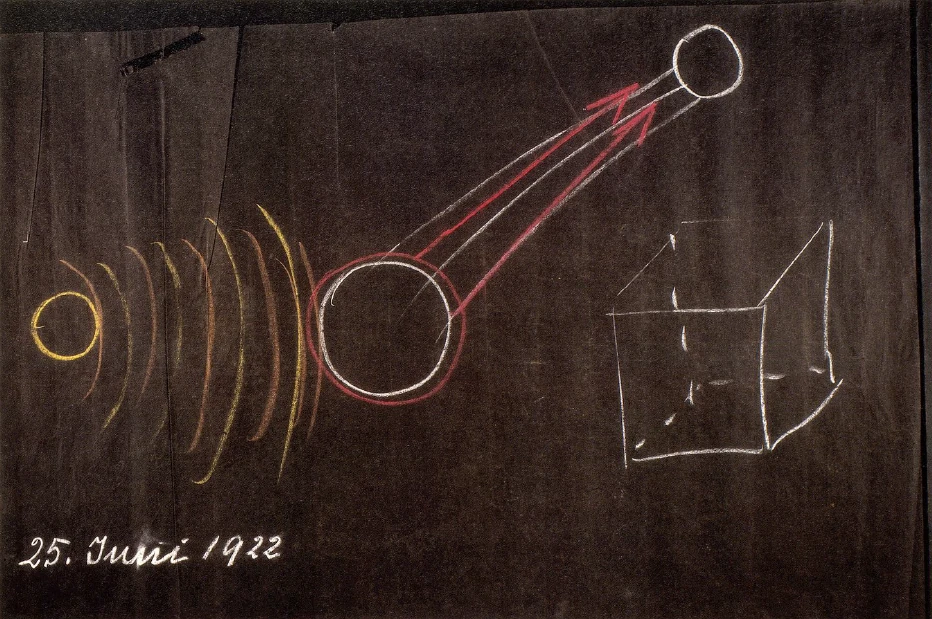
[ 13 ] People today draw—it is only a schematic drawing, but its purpose is simply to help visualize what is being described—the Earth and the Sun—of course, I would have to draw it extending much further—so that the Sun sends its rays down toward the Earth. The ancient initiate would have said: That is merely the physical aspect; the spiritual aspect is that human beings dwell on Earth, and human beings develop their will (red) on Earth, and while the sun’s rays descend from the Sun to Earth, human beings can send their will out into space in the direction of the Sun (arrows). In a sense, riding the waves of the will that radiates from the Earth toward the Sun, the ancient initiates sent their questions out into the cosmos. And when modern man says, “On the other side, in a way, is the Moon, which lets its light shine down onto the Earth” (yellow), the ancient initiate would say: “But that is only the physical aspect; in truth, thoughts come to Earth on the waves of this light (orange).” And so the ancient initiate entrusted his questions to the rays of will that travel from Earth to the Sun, and received the answers from the rays of thought that come from the Moon to Earth. Modern science knows only one side of the matter. It looks at the physical aspects of the Sun and the Moon. The ancient initiate, however, said: While the Sun continually sends its light to Earth, Earth continually sends out into space the rays of will—the will of all the people living on Earth—into the world. And when a person stands in the moonlight, the thought-rays are sent to him from the cosmos.
[ 14 ] Human organization has changed. Thus, someone seeking supersensory knowledge today could not proceed in this way. Human perception has become coarser than it was in ancient times. Certainly, even today our rays of will extend out into the cosmos. But people do not feel their questions as urgently as they once did, to the extent that their rays of will would truly carry these questions with them. As human beings, we have become too intellectualistic today, and the intellect cools all questions. We have little sense today of the immense thirst for knowledge that people once developed regarding the most sacred questions of existence. We are no longer so eager for knowledge; we are, in fact, merely curious and want to know everything quickly, without really engaging with the world. And in the moonlight, at most, only lovers still dream; scholars would regard it as a terrible superstition if they were now to receive the answers to the burning mysteries of existence from the moon’s glow as well.
[ 15 ] One certainly sees the world as having lost its spiritual dimension. People no longer know anything about the spirit that permeates the world everywhere, or if they speak of it, they do so in a vague, pantheistic way, not in the concrete sense of knowing how the rays of human will relate to the rays of the sun, or how the forms of human thought relate to the glow of the moon.
[ 16 ] But even in modern initiation, we can once again come into communion with the cosmos and with the spirit of the world. It’s just that today’s initiation does it differently. The preparatory exercises for initiation—you’ll find them described in my books, particularly in the book How Does One Attain Knowledge of the Higher Worlds? But all of this tends toward—and aims toward—the goal that human beings may truly, even today, receive answers through such exercises; though not in the way that today’s arrogance does it—by mulling over the questions in one’s head and providing the answers with one’s head. That way, one gets nothing but things that are, of course, very clever; but cleverness is not something that leads to a real answer to life’s enigmatic questions. By mulling things over in one’s head, one cuts oneself off from the world. If one wants answers from the world, one must absolutely step outside of oneself. One must enter into a relationship with the world. And so it is that the modern initiate must also ask his questions and must also have patience if he does not receive an answer right away. For the modern initiate is increasingly coming to view the external world not merely in such a way that he allows his curiosity to be satisfied by what makes an impression on his eyes, his ears, and his other senses. Certainly, he also receives these sensory perceptions from the outside, but by observing the flowers, the sun, the moon, the stars, other people, plants, animals, and so on just as closely and intimately, by directing his senses everywhere and, so to speak, allowing what he receives as impressions from the external senses to pass through him, he sends a current from within himself to meet them. And that is the current that, within him, constitutes the riddle of existence. One sees a beautiful flower. One looks at it, but not merely passively; rather, one directs one’s gaze, for example, to the yellow. One allows the yellow to make an impression on oneself. But at the same time, one sends one’s enigmatic question toward the yellow, and one allows what one must pose as the enigmatic questions of existence to be immersed in the yellow of the flower—or, for that matter, in the dawn.
[ 17 ] One does not, so to speak, entrust all the questions of one’s heart to a single impression, such as that of the rising sun, but rather pours them out into all sensory perceptions. If, on the other hand, one were to expect that the sensory perceptions themselves would provide the answers, that would be like the ancient initiate sending his riddles out to the dawn of the rising sun, only to receive the answer from it—and not from the full moon, for which he was then waiting.
[ 18 ] At the very least, such an ancient initiate had to wait fourteen days; for he asked his questions during the new moon of the rising sun, and then received the answers during the full moon. No modern philosopher waits that long, because—at least in the days when printing was still a simpler process—the book would already have to be at the printer’s by then!
[ 19 ] But one must be patient. If one entrusts one’s questions to sensory impressions, if one allows them to be immersed in all things, one must not expect that the sensory impressions will now reveal anything to one, and one must—and one will succeed in doing so if one has made the necessary preparations for long enough—now wait until that which one has entrusted to the outer world—one must sometimes wait a long time for that moment—rises up from within as an answer.
[ 20 ] You can be absolutely certain: If you ask questions into the void, you will receive random answers that may ultimately provide selfish satisfaction for the individual, but which are not real answers. You must immerse yourself in flowers and the sea, in the firmament, in the stars, in everything that comes to you from the outside as an impression—you must immerse your riddle-like questions in all of that, and then you must wait until the answers emerge from within you. You cannot wait fourteen days; you cannot even determine the time that the ancient initiates were able to determine. You must wait until the right moment has come, until the external has become internal, and the answer emerges from within you.
[ 21 ] The art of spiritual research lies precisely in the ability to wait—in not expecting to receive answers immediately. But of course, one cannot receive answers without first asking the questions. If you ask people who have truly attained insights in the sense of modern initiation, they will all tell you: “I was perhaps thirty-five years old when I felt this or that great mystery of existence particularly deeply; at that time, I entrusted this mystery to certain special external impressions, and when I turned fifty, the answer arose from within me.”
[ 22 ] Today, one must immerse in the flow of time that which one wishes to unfold as the great dialogue with the cosmos, just as the ancient initiates placed their questions in the bosom of space so that they might be reborn to them from within space: the solar from the lunar. And the cosmic must reappear, be reborn from within the human soul after a time determined by the cosmic powers themselves, and one must simply come to sense in the right way when a true divine answer is present within, not merely a human answer, to the questions one has asked.
[ 23 ] In a certain sense, what constituted the content of the ancient initiation is present again here in a different form. But you can see what is essential in this case. You can see that what matters is that, if a person wishes to grapple with the great mysteries of existence, they must be able to establish a spiritual -soul connection with the spiritual-soul forces of the cosmos—so that the human being does not remain a hermit of existence who wishes to settle everything with himself in a selfish manner, but rather is able to wait until the cosmos answers what he himself has first radiated into it as enigmatic questions.
[ 24 ] Well, you see, the thing is that once you have learned, on the one hand, to radiate the soul out into the cosmos, so to speak, and to receive it back again, you are then better prepared to understand birth and death. Anyone who begins to understand how the soul, through the element of will, flows toward the sun, flows toward the sun’s rays, and flows into all that is given to us as external impressions from the outside world, also begins to understand how the spiritual-soul aspect flows out into the world on the waves of the spiritual of the cosmos when the physical human being succumbs to death. And one also learns to understand how the spiritual returns once more from the lunar, from the illusory aspect of the world, once one has learned how to receive one’s best thoughts back from the cosmos—even though in modern human beings these thoughts arise from within; it is the lunar aspect within one’s own human organism from which the thoughts then emerge.
[ 25 ] But one then also learns to evaluate in the proper way those transitional phenomena which, I would say, lie right in the middle between the purely physical-cosmic and the cosmic-spiritual. Modern people, who have received their education solely within a materialistic framework, describe everything in purely physical terms. They say: There are solar eclipses; a solar eclipse occurs when the Moon comes between the Earth and the Sun and blocks the Sun’s rays, thereby eclipsing the Sun. — A physical explanation, derived from the immediate physical realm. If there is a light, and there is an eye, and I hold my hand in front of it, then the light is obscured—a purely spatial explanation. But modern consciousness stops there. We must once again strive to gain an understanding of such phenomena—not those that occur every day, but rather those that occur more rarely, yet which certainly have a spiritual aspect.
[ 26 ] When a solar eclipse occurs, something entirely different takes place under the altered conditions of that part of the Earth affected by the eclipse than when there is no solar eclipse. If we know that the sun’s rays penetrate to us and the sun’s rays of will penetrate toward it, then we can also imagine how a solar eclipse can exert a certain influence on the rays of will, which are now spiritual. The moon blocks the rays of light; this is a purely physical process. The rays of will cannot be blocked by the physical matter of the moon. They radiate into the darkness, and there is a time—albeit a brief one—during which that which is volitional on Earth flows out into outer space differently than it does when there is no solar eclipse. The physical aspect of sunlight is otherwise always combined with the emitted rays of will. In this case, the emitted rays of will flow unhindered into outer space in a cone of light. The ancient initiates knew that in such a case, everything that human beings harbor within themselves—unbridled will, unbridled instincts, and unbridled drives—flows out into outer space. And the ancient initiates explained to their disciples: Under normal circumstances, what the evil will of human beings radiates out into the cosmos is, in a certain sense, burned away by the sun’s rays, so that it harms only the human being himself but causes no harm in the cosmos. But when there is a solar eclipse, the opportunity arises for the evil of the Earth to spread throughout all the heavens. Here we have a physical event that certainly has a spiritual content.
[ 27 ] And again, when there is a lunar eclipse—well, modern thinking says: The Earth is positioned between the Sun and the Moon, which is why we see the Earth’s shadow on the Moon. — That is a physical explanation. But the ancient initiates knew that there is a spiritual basis to this, that when the Moon is eclipsed, thoughts flow down through the darkness, and thus have a deeper connection to the human subconscious than to the conscious mind. And the ancient initiates often spoke in parables to their disciples—I’ll translate it into modern language: Enthusiastic people go for walks in the light of the full moon; but those who wish to absorb the devilish thoughts from the cosmos—not the good thoughts—go for walks during a lunar eclipse.
[ 28 ] Here again we encounter the spiritual aspect of a physical event. We cannot perceive these things in the old way; that would lead to superstition. But we must once again come to the point where we can also see the spiritual aspect in individual significant world events. For it is indeed the case that when solar and lunar eclipses recur every year, they are, so to speak—I would say—“opposing valves.” Valves are, after all, installed to prevent damage, so that they open at the right time—for example, to release steam. These valves, which appear in world phenomena as solar and lunar eclipses, are there precisely so that what, in the case of a solar eclipse, spreads as evil on Earth, can be carried out into the cosmos in a Luciferic manner and cause further harm there, while lunar eclipses are designed so that the evil thoughts of the cosmos can reach those people who are particularly prone to being possessed by evil thoughts. Of course, no one would willingly participate in such a thing with full knowledge of the facts, but these phenomena are real—just as real as the attraction of a magnet to certain iron particles. These are forces at work in the universe, just like those we study today in hospitals or in chemical or physics laboratories.
[ 29 ] And humanity will not emerge from its forces of decline until it can once again find a common heart and mind for such spiritual work. Then, too, real conceptions of birth and death will once again blossom within humanity. And these real conceptions of birth and death are what today’s humanity—which is deeply immersed in darkness—needs. We will have to learn once more what the sun actually signifies by sending its light toward us; for when the sun sends its light toward us, it clears, as it were, the space around us for the paths of the souls that must journey out from the dead into the vast expanse of the cosmos.
[ 30 ] When the sun sends its light to the Earth, the Earth sends its souls out into the vastness of the universe. They radiate outward as people die, radiating into the vastness. And in the vastness of the cosmos, they undergo transformations. And they return once more to humanity, coming from the Moon in spiritual form, taking on once again a physical body that is destined for them through the physical stream of heredity. And we will not regain a true relationship with the universe until we can perceive such things in a truly real way.
[ 31 ] Today we study astronomy, spectral analysis, and so on. We learn how the sun’s rays penetrate the Earth and believe that covers it. We learn how the sun’s rays fall on the Moon, are reflected back to Earth, and in this way we physically observe the Moon’s glow. This occupies our intellect. But intellectual knowledge does not mean much. Intellectual knowledge isolates the human being from the universe; it does not make him alive—not alive in his inner soul. He can only become alive in his inner soul again when he gains a genuine, spiritual-soul relationship with the universe. He can only achieve this if, for example, he can once again say to himself: A person has died; his soul shines toward the sun, and against the path of the sun’s rays, it flows out into the universe until it arrives where space ends, where the three dimensions cease to be three dimensions, where they merge into the plane. There, events take place beyond space and time. Then, after some time, the soul returns from the opposite side—from the direction in which the moonlight reaches us—reunites with a physical human body, and returns to Earth.
[ 32 ] When humankind learns once more to say: O Sun, the souls of the dead journey toward your rays; O moonlight, with your ebb and flow the young souls enter earthly life—if people once again learn to perceive natural phenomena in this way, concretely interwoven with the spiritual, then there will once again be a form of knowledge on Earth that is at the same time religion; then there will once again be an insight that is at the same time piety. For that knowledge which concerns itself only with the physical and material can never become religion. And that religion which springs only from faith, and not from insight, can never harmoniously unite with what human beings perceive from the universe. People today recite the old prayers, and when one says that there is a deep spiritual dimension in the old prayers—as I have described, for example, in the little booklet on the Lord’s Prayer—then today’s very intelligent people come along and say: All of that is imagined; it’s all fantasy. — It is not fantasy! It is spoken from the realization that precisely those prayers which have been handed down to people through tradition since ancient times are formulated out of deep insights into the interrelationships of the universe. But we must, in turn, arrive—from our own insight—at that which brings us into a religious-like relationship with all the individual phenomena of the universe. We must once again be able to say: O Sun, you shine your light toward me; but along the paths that the light carves out from you, O Sun, to me here on Earth—along these very paths, only in the opposite direction—human souls stream out into the vastness of the cosmos when people have died! O moonlight, you shine gently down from the heavens to the earth; but on the waves of your gentle light, souls come in from the vastness of the worlds as they make their way toward earthly existence.
[ 33 ] In this way, we once again discover the connection between what appears and shines in the outer world and what lives and works within humanity itself. And we will no longer simply say thoughtlessly: Out there is the physical universe with its matter, and one does not know what the human soul is to do when it separates from the body in this purely material universe; rather, one will know that as the sunbeam, so to speak, pierces through space, it works in harmony with the human will-radiation, which finds its paths where the light has prepared them. And again, one will recognize that the gentle moonlight does not send its wave-like effusions over the world in vain, but that within these lunar waves of gentle, radiant light, spiritual forces surge and flow through space. Once this is viewed in this light, one will no longer be indifferent to what one can observe, for example, when looking at a plant and its behavior in the morning, while the young morning sunlight is still shining upon it. At that moment, the plant behaves in a very specific way; its sap, flowing from bottom to top through the fine vessels, surges upward into the flower or the leaves. There, the sun’s rays, descending upon the plant, make way for the Earth’s forces of will. And it is not merely the sap that flows through the plant, as our modern physicists describe it, but the forces of will, which reside in the depths of the earth, flow through the plant from the root toward the flower. And in the evening, when the leaves curl up and close, when the sun’s rays no longer make way for the streams of will rising from the earth, then the plant becomes inwardly inactive; its life is suspended. But it is also exposed to the gentle moonlight. This gentle moonlight influences not only lovers but also the dormant plant; for within the dormant plant, that which flows down with the moonlight as a world-idea takes effect upon the plant.
[ 34 ] And so one learns to view the plant as an interweaving of earthly will and world-ideas. One observes each individual plant form to see to what extent it is woven together from world-ideas and earthly will. And when one learns to recognize how healing powers well up from the spirit into cosmic ideas and earthly will, then the plant’s healing powers become clear, and one learns to recognize the plant as a medicinal herb. But one can only recognize the plant as a medicinal herb through an intimate understanding of the cosmos. |
[ 35 ] This is something we must once again attain for ourselves. And we must attain even more: When we look at the human head—it is modeled after the Earth itself. It is also the first part to form in the human embryo. It is modeled after the Earth; the rest is, so to speak, added on. When the human head is permeated by light—and it is, after all, permeated by sunlight—then that which in the human head is akin to the will of the Earth is radiated out into the universe with particular vitality.
[ 36 ] If we now consider, for example, a plant root that contains the will of the Earth particularly intensely, we can see that this root is constantly deprived of the sun’s rays, and that this root of the plant is particularly vividly exposed to the moonlight, which—though it shines down on the Earth only very faintly—nevertheless penetrates the Earth and reaches all the way to the plant’s roots. If we then bring the luminous element into contact with the plant by burning the roots, collecting the root ash, and preparing a powder from it, we can discern through cosmic processes how the powder derived from this or that plant root can act upon the human head, whose powers of will are similar to those of the Earth. The point is that everywhere—whether it be the smallest particle of matter or the largest mass of matter—one can fathom the connection between this matter and the spiritual. Then one will be able to do what is currently possible only in mathematics: one will be able to apply that which is first grasped purely spiritually to the whole of nature.
[ 37 ] Today, we haven’t gotten any further than knowing that a cube consists of six squares. We can imagine that; it’s a mental construct. But if we look at salt—ordinary table salt—nature shows us this cube. There, what we think—the spiritual—coincides with what exists materially in the outside world. But I ask you: What do people today know about how much of spiritual will-powers, of world-thought-powers, of earth-thought-powers, and of will-powers there is in a plant root? And yet, it is the same process that we carry out today only in the most extreme abstraction when we conceive of the cube and find it again in sodium chloride, in table salt.
[ 38 ] What we do today only with mathematics, we must do with everything the human soul is capable of. Mathematics cannot evoke a devout mood in many people. For people as sensitive as Novalis, it was possible to draw a devout mood even from mathematics, which he perceived as a great, beautiful poem. But this is not the case for many people. In general, one meets few people who become devout through the practice of mathematics. But if one goes further, if one draws out the other spiritual aspect from within the human being and carries it out into the world—where it already exists; one merely recognizes it again—then science is indeed transformed into a religious mood, and the harmonization of religion and science is truly brought about. That, my dear friends, is what I wanted to speak to your hearts about today.