Human Questions and Cosmic Answers
GA 205
24 June 1922, Dornach
Translated by Steiner Online Library
First Lecture
[ 1 ] Today I will be discussing a number of topics that may seem somewhat removed from the more concrete aspects of our anthroposophy, but which nonetheless must form the foundation for many of our views, and upon which many things can then be built in more intimate reflections.
[ 2 ] When we speak of the physical-bodily aspect of the human being on the one hand and the spiritual-soul aspect on the other, a difficulty arises for human understanding and perception. Human beings can form concepts of the physical-bodily aspect relatively easily. This physical-bodily aspect is, after all, given to them through the senses. It belongs, so to speak, to that which comes to meet them from all sides of their environment without them having to do anything substantial themselves—at least as far as their consciousness is concerned. The situation is different when we speak of the spiritual-soul aspect. The spiritual and soul-related is, after all, of such a nature that, if a person is open-minded enough, they have a clear awareness of its existence. Humanity has, after all, always incorporated terms, words, and phrases into its languages to describe the spiritual-soul realm, and the very fact that such words, phrases, and terms exist within language shows that, for the unbiased consciousness, there is indeed something that points human beings toward the spiritual-soul realm.
[ 3 ] However, the difficulty arises immediately when a person attempts to establish a relationship between the physical-bodily world and the spiritual-soul world. And this search for a connection presents the greatest possible difficulties, especially for those who, let us say, engage with such questions in a philosophical manner. They know that the physical-bodily realm is extended in space. They can even represent this physical-bodily realm in space. And it is relatively easy for a person to form concepts of this, because they can use precisely what space offers them—with its three dimensions—to form concepts of the physical-bodily realm. But ultimately, a person finds nowhere in space the spiritual as such.
[ 4 ] People who believe they are not materialistic in their outlook, but who in fact are all the more so, would naturally also like to imagine the spiritual and soul-related aspects of space, and in doing so fall into the well-known spiritualist errors. These spiritualist aberrations are, after all, materialistic aberrations; they represent an effort to introduce the spiritual-psychic into space. But quite apart from that, the fact is that human beings are aware of their own spiritual-psychic nature. They know how the spiritual-soul aspect works, for they tell themselves that the thought they harbor—for example, when they resolve to make a movement in space—is translated into movement through the will. The movement is in space; but an unbiased person cannot say that the thought itself is in space. And this is precisely where the greatest difficulties have arisen for philosophical thinking. One asks: How can the spiritual-psychic aspect of the human being—which includes the “I”—act upon the physical-bodily aspect, which is in space? How can something non-spatial act upon something spatial?
[ 5 ] A wide variety of “theories” have emerged, all of which, to a greater or lesser extent, struggle with the difficulty of relating the non-spatial spiritual-psychic to the spatial bodily-physical. It is said that the spiritual-psychic realm acts upon the physical through the will. But to begin with, no one with ordinary consciousness can say how thought flows into the will, and how the will—which is itself a kind of spiritual entity—comes to manifest itself in external forms of movement and external activity.
[ 6 ] On the other hand, the processes that are brought about, for example, by the physical world through the senses—that is, in the physical realm—are extended in space. As they transform into something spiritual-psychic, they become non-spatial. From the perspective of ordinary consciousness, a person cannot say how the spatial-physical—which occurs in sensory perception—exerts an effect on the non-spatial, on the spiritual-psychic.
[ 7 ] In recent times, people have come to rely on the concept I have mentioned on several occasions: they speak of “psychophysical parallelism.” This is actually an admission that they have no idea how to describe the relationship between the physical-bodily and the spiritual-psychic. For example, people say: A person walks, their legs move, and they change their location in external space. All of this constitutes a spatial, physical-bodily phenomenon.
[ 8 ] At the same time, when something is happening in his body, a spiritual-soul process unfolds—one involving thought, feeling, and will. All we know, so they say, is that when the physical process unfolds in space and time, the spiritual-psychic process also unfolds. But how one affects the other is something we cannot conceive of. Psychophysical parallelism means: a psychological, a psychic process takes place while a physical one is underway. But one cannot get beyond this—one might say—utter mystery that the two processes occur in parallel. One cannot form a conception of how the two interact with one another. This is how it is when people try to form a conception of the existence, the very being, of the spiritual-soul aspect in general.
[ 9 ] In the 19th century, when people’s views had become so deeply permeated by materialism, materialists also began to ask: Where in the universe do souls actually dwell once they have left the body? And there were even people who sought to refute spiritualism by attempting to highlight the impossibility inherent in the fact that, since so many people die and so many have already died, there is actually no room in the entire universe to accommodate all the souls that originate from deceased human beings. This absurd view did indeed arise frequently, particularly in the 19th century. It was said: Human beings cannot be immortal, for otherwise all the spaces in the world would have to be filled with immortal souls. All these things point to the difficulties that arise when considering the relationship between the physical body—which is clearly extended in space—and that which cannot initially be located in space: the spiritual-soul aspect.
[ 10 ] But now it has gradually come to pass that purely intellectual human thinking has sharply set the physical-bodily on one side and the spiritual-psychic on the other. In today’s consciousness, the two stand side by side without any mediation. Indeed, just as people have gradually come to think of the physical-bodily on one side and the spiritual-psychic on the other, there is absolutely no possibility of finding a connection between them. Today, people simply conceive of the spatial-physical realm in such a way that there is no room within it for the soul, and conversely, they conceive of the soul as so sharply separated from the physical-spatial realm that the entirely non-spatial spiritual-soul realm has no way of coming into contact with the physical or anything of the sort. But this stark opposition has only gradually been developed. We must adopt an entirely different perspective—one that can only emerge by drawing upon what anthroposophical spiritual science has to say. Anthroposophical spiritual science must first consider the will. To begin with, an unbiased observation undoubtedly provides proof that the human will follows human movements everywhere, and that human movements—those performed externally in space as the person moves, but also those taking place within the person as daily functions unfold—that, in short, all human activity here in the physical world is spatially three-dimensional. An unbiased person can have no doubt about this. All these movements are accompanied by the will; the will must therefore extend wherever the three dimensions are present. There can be no doubt about this either.
[ 11 ] So when we speak of the will as a spiritual-soul element, there can be no question whatsoever that this will—even though it is a spiritual-soul element—is three-dimensional and has a three-dimensional form. We simply have to think of it this way: When we perform, say, a movement with our hand through our will, the will permeates all the positions that the arm and hand assume in space. The will accompanies every movement of a limb. Thus, we must speak of the will itself as that aspect of the soul that can take on a three-dimensional form.
[ 12 ] Another question, however, is whether everything psychological takes on a three-dimensional form. And if we move from the will to the world of sensation, to the world of feeling, then a person, when simply reflecting on these things with ordinary consciousness, will certainly say to himself: If, let’s say, I am pricked by a needle here on the right side of my face, on my head, I feel it; if I am pricked on the left side, I feel it too. With ordinary consciousness, therefore, they may believe that their sensation extends throughout their entire body. And then he will also speak of sensation as three-dimensionally structured in the same sense that he speaks of the will as three-dimensionally structured.
[ 13 ] But he is deluding himself there. That is not the case. Rather, we must take into account how a person can initially have certain experiences within themselves, and we want to proceed from these experiences. Today’s discussion will be somewhat subtle, but without such subtle considerations, spiritual science cannot be thoroughly understood.
[ 14 ] Just take a moment to visualize—I mean, with the eye of the soul—what it’s like when you touch your left hand with your right hand. Through this, you gain a sense of yourself. Just as you normally perceive an external object, so do you perceive yourself when you touch your right hand with your left—let’s say through the mediation of the individual fingers.
[ 15 ] However, the fact at hand becomes even clearer when you consider that you have two eyes, and that when you focus on an object with both eyes, you must first exert your will. People often do not think about this exertion of will. For example, to focus on a very close object—which stands out more clearly than usual—you must turn your left eye to the right and your right eye to the left, and you focus on the object by bringing your lines of sight into contact with one another in much the same way as you bring your right hand into contact with your left when you, so to speak, grasp yourself.
[ 16 ] In this way, you can see how it is simply of some significance for people, in terms of their orientation in the world, to relate the left to the right—to establish a certain relationship between the left and the right.
[ 17 ] Well, ordinary consciousness usually does not go much further than bringing this underlying, highly significant fact to mind through the touching of hands and the crossing of the line of sight; but one can continue this line of thought.
[ 18 ] Let’s suppose we are pricked with a needle on the right side of our body: We perceive it; we feel the prick. But we cannot simply say where we feel the prick by, for example, pointing to a specific spot on our body’s surface. For without all the individual parts of our organism being in a relationship with one another—and specifically in a living, interactive relationship—so that they influence one another, our physical, psychological, and human being would not be at all what it is. And it is always the case—even if we do not grasp our left hand with our right in order to feel the left hand through the right, and even if our organism is, say, pricked on its right side—that a pathway exists from the right side to the plane of symmetry in the center, and the left half of the body must enter into a relationship with the right half of the body so that the sensation, the feeling, can come about.
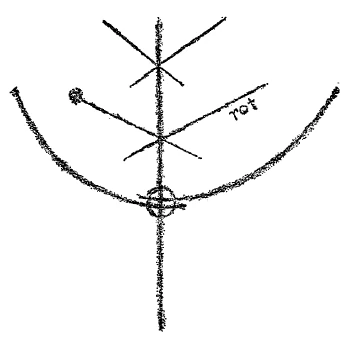
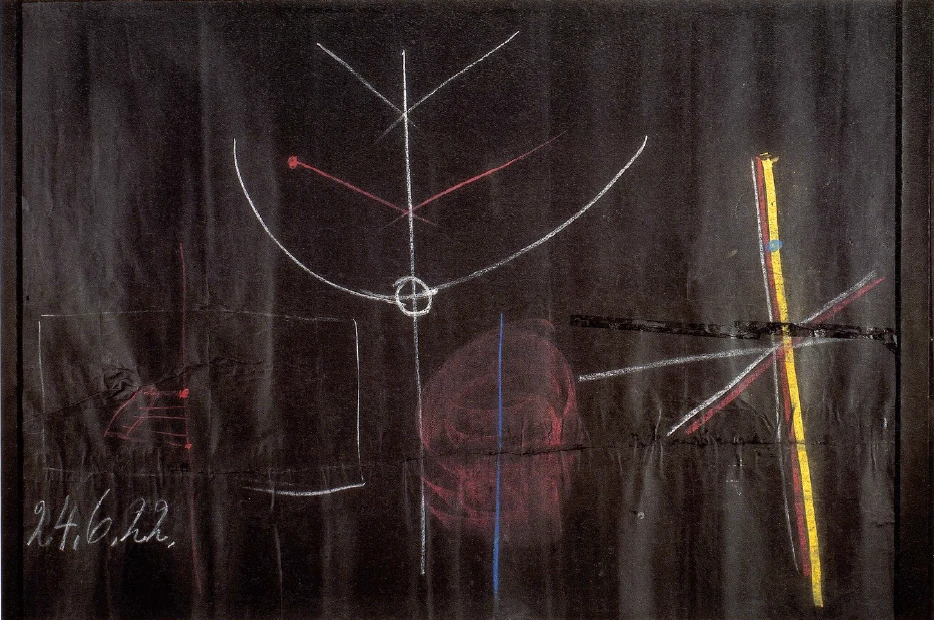
[ 19 ] It is relatively easy to tell oneself: If I have the plane of symmetry here—viewed from front to back—then the right hand touches the left hand, and the sensation of the two hands, each hand through the other, arises in the plane of symmetry. This is obviously how it is perceived, and it is relatively easy to speak of the intersection of the eye’s line of sight. But whenever, for example, we are stabbed on the right side, a pathway is present (red), and the left half of the body intersects with the right half of the body along these pathways; otherwise, the sensation would not arise. In all pathways of sensation and feeling, the fact that we have a right and a left half of the body—that we are symmetrically constructed—plays an immensely significant role. As a result, we always relate what happens to us on the right to the left, in that something from the left—in a sense, invisibly—always reaches across to intersect with what flows over from the right.
[ 20 ] This alone gives rise to feeling. Feeling never arises in three-dimensional space; feeling always arises on a plane. The world of feelings is not, in reality, spread out in three dimensions; in truth, the world of feelings is spread out only in two dimensions. Humans experience the world of feelings only on that plane which, if it were to be cut as a cross-section, would split a person into two symmetrical halves.
[ 21 ] Emotional life is, in fact, like a painting on a canvas, except that one does not paint from just one side, but from both sides. Imagine this: I stretch out a canvas, paint it from right to left and from left to right, and in the viewer’s perception, I allow what I have painted from the front and from the back—that is, from right to left and from left to right—to interact with one another. And the painting that results is, strictly speaking, only two-dimensional. Everything that is three-dimensional is, if I may put it that way, projected onto these two dimensions.
[ 22 ] You could also form this idea in a different way. Imagine that you were able to cast shadows of objects on the right and objects on the left onto a surface. Then you would have shadows of objects on the right and objects on the left on the stretched-out wall. So it is with our emotional world. It is not three-dimensional; it is two-dimensional. Human beings are, in essence, painters working from two sides: not simply by immersing themselves emotionally in space, but by using their three-dimensional will to transform everything they encounter in space as an emotional effect—using the will, which is indeed three-dimensional—that is the painter, the will— projects everything onto a plane extending from front to back in the form of shadows and paintings. Human beings live, through their feelings, within a painting that is drawn two-dimensionally through their body, a painting that is painted only from both sides. Thus, if we wish to seek for ourselves, for humanity, the transition in the soul from will to feeling, we must pass from the three-dimensional into the two-dimensional.
[ 23 ] But this means you have a different relationship—at least initially—between the psychological, which expresses itself in feeling, and the spatial, than if you simply said that the psychological is non-spatial. A plane has two dimensions, but it is not spatial. You can call a blackboard a plane, but in reality it is a solid, because it has thickness. A plane is indeed located within space, but it is not itself spatial; space must always have three dimensions. And only the will enters into this three-dimensional space. But feeling—that does not enter into the three dimensions of space. It is two-dimensional. Yet it still has a relationship to space, just as a shadow has a relationship to space.
[ 24 ] I am also drawing your attention to an extraordinarily significant fact that is not at all easy to grasp, for the reason that human beings, with their ordinary consciousness, are generally not inclined to comprehend the peculiar nature of their emotional world. This emotional world is, after all, always interwoven with the world of the will. Just think about it: if you were to actually feel the prick I mentioned on the right side of your body, you wouldn’t immediately separate the feeling from the will. You will undoubtedly not take this sting very patiently; but apart from the fact that you might reach out outwardly—that is, project your will very strongly into three-dimensional space when you are stung—apart from that, you have a defensive movement that does not manifest outwardly, one that reveals itself only in all sorts of small, intimate currents of blood and breath. What one does as a defensive reaction when stung by a mosquito—reaching out to swat it—is, after all, only the most crude and clumsy aspect. The more subtle defensive reaction—the one that actually takes place only through the movement of the blood, the movement of the breath, and all sorts of other internal processes—is usually overlooked. And so one does not separate what the will does from what is actually the content of feeling. The content of feeling is also too elusive. One can only bring it to light through very, very careful meditation. But once you are able to exclude everything that belongs to the will from your feeling, then you do indeed shrink on the right and left, and you become the plane in the middle. And then, when you are that level in the center and, as it were, consciously paint your experiences on this level as a painter, you begin to understand why the world of feeling differs so extraordinarily from ordinary experience.
[ 25 ] One can indeed experience this expansiveness, this flatness of feeling; but one must experience it meditatively. One must be aware of the entire shadowy existence of feelings in contrast to the robust experiences in three-dimensional space. One must first prepare oneself to be aware of it. But then one can indeed be aware of it. And then one will gradually approach the truth that feeling unfolds in two dimensions. And thinking—well, that can simply be characterized by admitting to oneself, with an open mind, just how little one can actually say that a thought is located within space. After all, the thought isn’t really located anywhere within space. But it must have some relationship to space. For undoubtedly, the brain—if not the tool, then at least the foundation—of thinking. One cannot think without a brain. But if thinking—which thus proceeds in connection with brain activity—had absolutely nothing to do with space, then the curious fact would arise that if one can think well at the age of twelve and has since outgrown, in terms of one’s mental development, the state one was in at twelve, one would have outgrown one’s own thinking. That is not the case. As one grows, one does not abandon thinking. And that alone indicates that, as one grows, one remains within the realm of thinking.
[ 26 ] Just as one can experience the world of feeling—the world of experiencing emotions—for oneself by gradually reaching one’s plane of symmetry, so too can thinking be experienced meditatively as that which actually extends only upward and downward. Thinking is entirely one-dimensional; in human beings, it proceeds in a linear fashion. One must therefore say: The will manifests itself three-dimensionally, feeling two-dimensionally, and thinking one-dimensionally.
[ 27 ] You see, when we differentiate within space, we do not arrive at such an abrupt transition as the mere intellect does. We arrive at a gradual transition. Pure intellect says: The physical is three-dimensionally extended in space; the spiritual-psychic is not extended at all, so no relationship can be found, for one cannot, of course, find any relationship between that which is not extended and that which is extended. But if one becomes aware that the will is three-dimensionally structured, one finds that the will pours out everywhere into the three-dimensional world. If one knows that feeling is structured two-dimensionally, then—by moving from the three dimensions to the two—one must arrive at something that still represents relationships, but which is simply no longer spatial, for the mere plane, the mere two dimensions, are indeed not spatial. Yet they are within space; they are not completely outside of space.
[ 28 ] And again, when we move from feeling to thinking, we move from two dimensions to one dimension—so we still have not entirely left space behind. We gradually move from the spatial into the non-spatial. I have often stated that the tragedy of materialism lies in the fact that it fails to understand precisely the material, the physical, in its three-dimensional extension. It believes it understands it, but it fails to understand precisely the physical. And in the 19th century, various historically significant phenomena emerged that cannot be properly unraveled today by ordinary consciousness. Just think of the great sensation that Schopenhauer’s philosophical system caused among many thinking people: “The World as Will and Representation.” According to this, only representation is unreal; will alone is the real. Indeed, why did Schopenhauer arrive at the idea that the world is nothing but will? Because he, too, was consumed by materialism! For in the world where matter extends in three dimensions, it is precisely will that is poured out. Anyone who wishes to include feelings in this world must seek out the relationship that exists between a three-dimensional object and a two-dimensional shadow image. What we experience in our feelings are shadow images of that in which our will also lives as a three-dimensional form. And what we experience in thought are forms in a single dimension. And only when we step completely out of the dimensions, when we transition to the dimensionless point, do we arrive at our “I.” This truly has no extension at all; it is entirely point-like. So that we can say: We transition from the three-dimensional (white) to the two-dimensional (red), to the one-dimensional (yellow), and to the point-like (blue).
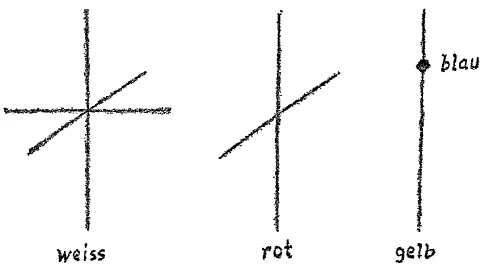
[ 29 ] But as long as we remain within the three-dimensional realm, our will is contained within those three dimensions. Feeling is also present there, as is thinking, but not extended in three dimensions. By omitting the third dimension and reducing it to two dimensions, we have the shadow of external existence, within which, however, the spiritual-soul aspect that lives in feeling expands. We are already moving further out of space. When we turn to thinking, we emerge even further from space, and as we move on to the “I,” we emerge even further from space. There we are, as it were, led out of space bit by bit. And we see that it simply makes no sense to speak merely of the contrast between the spiritual-soul aspect and the physical-bodily aspect. It makes no sense, for if one wishes to discover the relationship between the spiritual-soul and the physical-body, one must ask: How do things that are extended in three-dimensional space—for example, our own body—relate to the soul as a being of will? How does the physical-bodily aspect of a human being relate to the soul as a being of feeling? The physical-bodily aspect, as a physical entity, relates to the soul as a being of will in such a way that the physical-bodily aspect is simply permeated by the will in all directions, in all dimensions, just as a sponge is permeated by water.
[ 30 ] The physical-bodily realm, however, relates to feeling in the same way that objects cast their shadows onto a wall. And again, if we wish to move from the realm of feeling to that of thought, then we must become a painter of a very peculiar sort. There we must, in a single line, paint separately that which is otherwise contained within the two dimensions of the painting.
[ 31 ] Consider the following question. Of course, this requires a certain degree of inner contemplation, but imagine you were standing, say, in front of Leonardo da Vinci’s The Last Supper. At first, you see it as a flat surface before you. What you are considering is two-dimensional. Of course, we can disregard the thickness of the paint layers, can’t we? But what you have before you as a painting is two-dimensional. But now I imagine a line drawn down the center from top to bottom, and this line represents a one-dimensional being. This one-dimensional being would have the peculiarity that, let’s say, Judas here (p. 22) would not be indifferent to it; rather, the fact that Judas is there is something this being perceives in a certain way. This being perceives it this way: where Judas tilts his head toward it, it feels more; where Judas turns away, it feels less; and with regard to all the other figures, this one-dimensional being perceives them differently depending on whether the figure is blue or yellow. This one-dimensional being perceives everything that is on the left and right. Thus, everything in this painting is brought to life through the perception of this one-dimensional being.
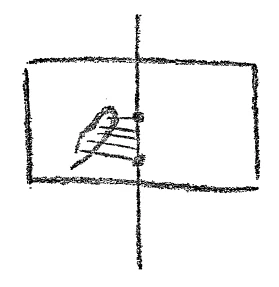
[ 32 ] But this is truly how our thinking exists within us. Our thinking is such a one-dimensional entity and participates in the rest of our human being only insofar as, first, it relates to the painting that divides us into a right-hand and a left-hand human being, and, second, it relates—indirectly through this painting—to the threefold world of the will.
[ 33 ] If we wish to form a conception of our spiritual-soul nature—insofar as it is willing, feeling, and thinking—even without the “I” at first, we need not actually imagine it as a cloud of mist, but rather by carrying out an inner, soul-level process. Let us therefore imagine the spiritual-soul nature schematically. We must, so to speak, look closely: At first, it appears to us as a cloud. But this is initially only a being of will. It constantly tends to compress itself; in doing so, it becomes a being of feeling. We first see a cloud of light, but then a cloud of light that generates a plane within itself and thereby feels itself. And this plane, in turn, strives to become a line. So we must continually imagine: cloud, plane, line—as a living entity in and of itself: something that continually wants to be a cloud, but wants to compress itself from a cloud into a plane, and wants to extend itself into a line. If you imagine a line that becomes a plane, and the plane in turn becomes a three-dimensional cloud—that is, if you imagine: cloud, plane, line—line, plane, cloud, and so on—then you have what can now schematically illustrate to you what your soul actually is in its inner being, in its inner essence. You cannot make do with an image that simply remains static within itself. No concept that remains static in itself can convey what the soul is. You must have a concept that itself carries out an inner activity—namely, an inner activity in which the soul, as it conceives, plays with the dimensions of space: It causes the third dimension to vanish, thereby losing the will; it causes the second dimension to vanish, thereby losing feeling; and one loses thinking only when one also causes the first dimension to vanish. Then one arrives at the point. Only then does one pass over to the “I.”
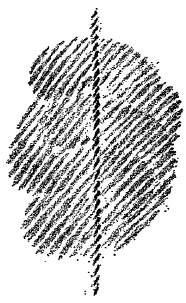
[ 34 ] That is precisely why this difficulty arises. People would like to understand the spiritual realm, but they are accustomed to forming only spatial concepts. So they form spatial concepts of the spiritual realm as well, however diluted they may be. But in doing so, they are dealing only with the volitional aspect. One would have to imagine the soul in such a way that, for example, when imagining a cloud, one would simultaneously and continuously compress that cloud and also imagine it as one-dimensional. Without making one’s thinking internally flexible, one cannot form any conception of the spiritual-soul at all. Someone who wants to imagine something spiritual-psychic and imagines the same thing in two successive moments has imagined only an act of the will. One simply must not imagine the spiritual-psychic in the same form in two successive moments. One must become inwardly flexible—not merely by moving from one point in space to another, but by moving from one dimension to another. This is precisely what is usually difficult for modern consciousness. It has even led to the point where even the most open-minded people—open-minded with regard to the concept of the spiritual—already want to step out of space, to transcend the three dimensions. Then they arrive at a fourth dimension. It is quite nice, after all, to move from the three-dimensional to the four-dimensional. As long as one remains within the realm of mathematics, all the thoughts one forms about it are entirely accurate; everything adds up. But when one moves on to reality, it is no longer true, for the peculiar thing is that when one truly conceives of the fourth dimension, it nullifies the third. Through the fourth dimension, the third dimension disappears; through the fifth dimension, the second disappears; and through the sixth, the first disappears; then one has arrived at the point.
[ 35 ] In reality, the transition from the third to the fourth dimension leads one into the spiritual realm, and it is by omitting dimensions—not by adding them—that one enters more and more deeply into the spiritual realm. Through such concepts, one also gains insights into the human form.
[ 36 ] Isn’t it true, when it comes to artistic sensibility, that one actually—I would say—looks at a person quite brutally when observing how they position themselves in the world in all directions with their three dimensions? Certainly, that is how one does it; but that is not the only aspect. One generally has a sense that the left and right halves of the body are essentially symmetrical. And this leads one beyond the three dimensions, by summarizing the human being in his or her midplane. One already moves over to this midplane there; and only then does one have a truly clear conception of the one dimension in which the human being grows. In art, this transition from three to two to one dimension is already utilized. And if we were to cultivate this artistic view of the human being more, we would also find it easier to make the transition to the spiritual realm. You would never be able to perceive a being as a unified, feeling being if it were not symmetrically formed.
[ 37 ] If you look at a starfish, which is not symmetrical but has five arms, you can of course walk past it without a second thought, but if you ask yourself intuitively, you can never tell yourself that it has a unified sense of self. The starfish cannot possibly relate a right side to a left side, or encircle a right side with a left side; rather, it must constantly relate one arm to one, two, three, or all four of the others. Consequently, what we know as feeling does not exist at all in the starfish.
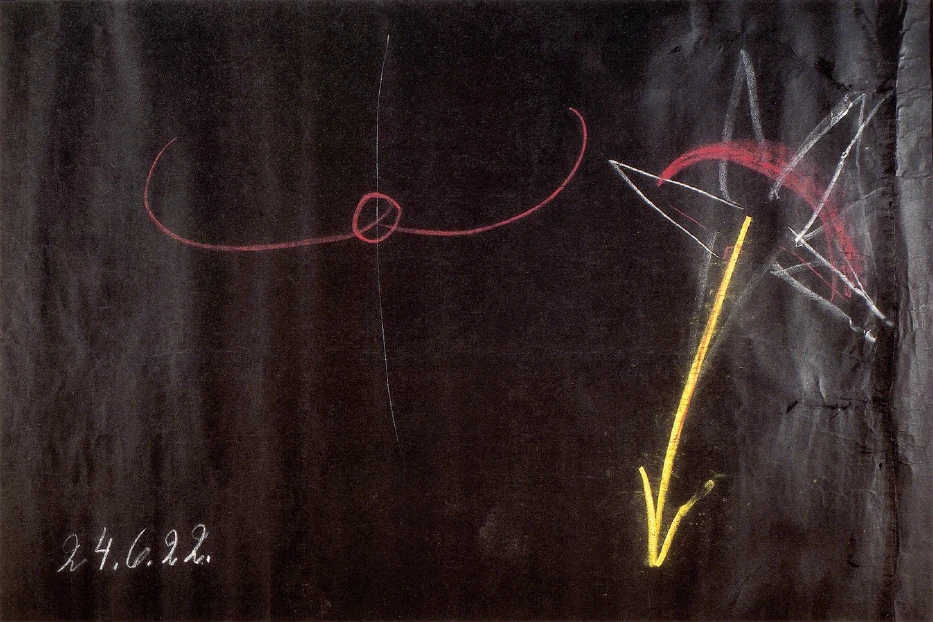
[ 38 ] What about that—I ask you to follow me in this intimate train of thought—which we know as feeling? What we know as feeling comes from the right, comes from the left, and maintains calm in the center. We move through the world by placing ourselves within it, with our feeling at rest. The starfish cannot do this. It cannot relate what it experiences here as the world’s effect upon itself (red arrow) symmetrically to anything else. It can relate it to (red) one or two, or to the third or fourth ray, but it will always have a more powerful force here (yellow). Therefore, the starfish does not possess an inner sense of stillness; rather, when it turns its attention, so to speak, toward one side, its internal structure gives rise to the experience: You are radiating in that direction; you are sending a ray there (yellow arrow). When it perceives from there, it feels as if something were shooting out of it. It has no sense of stillness. It has the feeling of shooting out of itself. It feels as if it were radiating out into the world.
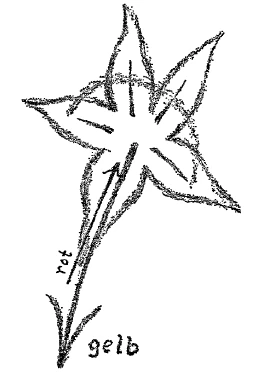
[ 39 ] If you refine your feelings, you will be able to experience this even when looking at the starfish. Look at any endpoint of a ray and then relate that to the entire starfish; in your imagination, the starfish will begin to move toward that single ray, as if it were light flowing and drifting in that direction. And so it is with other animals that are not symmetrically built, that do not have a true axis of symmetry.
[ 40 ] If only human beings would respond to this more subtle sense just once—if only, over the course of time, they had not, by becoming intellectual beings, surrendered themselves entirely to the intellectual—they could empathize with the world in a much more subtle way.
[ 41 ] In a certain sense, this is also true of the plant world. It is true of everything that surrounds us. And true self-knowledge carries us further and further into the very heart of things.
[ 42 ] I would like to build upon what I have developed today—in a somewhat more abstract way, I might say—tomorrow and in the days ahead.