

Human Questions and Cosmic Answers
GA 213
14 July 1922, Dornach
Translate the original German text into any language:
Versions Available:
Human Questions and Cosmic Answers, tr. SOL
Neunter Vortrag
Ninth Lecture
[ 1 ] Die Vorträge der letzten Woche sollten in einer gewissen Beziehung geschichtlich darauf hinweisen, wie gerade tiefer veranlagte Persönlichkeiten mit den Zeitströmungen des 19. Jahrhunderts zu kämpfen hatten, und es sollte namentlich gezeigt werden, wie die zeitgenössische naturwissenschaftliche Denkungsart gerade tiefere Naturen davon abgehalten hat, den Weg in die geistige Welt hinein zu finden. Man kann, wenn man auf das Persönliche hin gerichtete Betrachtungen anstellt, wie wir sie in bezug auf Franz Brentano angestellt haben, an den inneren Seelenkämpfen der Menschen, an dem, was sich in den Geistern da abgespielt hat, ja eigentlich viel intimer sehen, wie die großen Zeitkämpfe und Zeitströmungen sind, als wenn man nur im Abstrakten charakterisiert. Ich habe nun in der letzten Nummer unserer Zeitschrift «Das Goetheanum» darauf hingewiesen, wie Franz Brentano, der, vom Katholizismus ausgehend, in die naturwissenschaftliche Gesinnung untertauchend, sozusagen hängengeblieben ist am Physisch-Irdischen, nicht mehr den Rückweg gefunden hat in das Geistige, wie er einer anderen Persönlichkeit gegenüber gestanden hat, die eigentlich — wenn auch mit einiger Veränderung — demselben Schicksal unterlegen ist. Das ist die Persönlichkeit Nietzsches.
[ 1 ] Last week’s lectures were intended, in a certain sense, to shed historical light on how particularly deep-minded individuals struggled with the prevailing trends of the 19th century, and specifically to show how the contemporary scientific way of thinking prevented precisely such deep-minded individuals from finding their way into the spiritual world. When one engages in personal reflections, such as those we have undertaken with regard to Franz Brentano—examining the inner spiritual struggles of human beings and what took place within their minds—one can actually gain a much more intimate insight into the great struggles and currents of the age than when one merely characterizes them in abstract terms. In the latest issue of our journal *Das Goetheanum*, I pointed out how Franz Brentano—who, starting from Catholicism and immersing himself in the scientific mindset, became, so to speak, entangled in the physical and earthly realm and could no longer find his way back to the spiritual—stood in contrast to another personality who, in fact—albeit with some variation—suffered the same fate. That figure is Nietzsche.
[ 2 ] Geradeso wie man bei Brentano nachweisen kann, wie ihn aus seinem gläubigen Katholizismus, aus seinem wirklichen katholischen Frommsein heraus die naturwissenschaftliche Weltanschauung gepackt und nicht mehr losgelassen hat, und wie man zeigen kann, wie das ganze Schicksal seines Philosophenweges dadurch zu charakterisieren ist, so kann man auch ein Ähnliches bei Nietzsche zeigen. Man kann zeigen, daß Nietzsche nun zwar nicht vom Katholizismus, sondern von einer anderen Geistesart ausgehend, auch durch die Naturwissenschaft zurückgehalten wurde innerhalb des Physisch-Sinnlichen, wie er sich ebensowenig wie Brentano in das Geistige erheben konnte, wie aber dann sein Schicksal einen zwar ähnlichen, aber doch wiederum verschiedenen Weg genommen hat.
[ 2 ] Just as one can demonstrate in the case of Brentano how, stemming from his devout Catholicism and his genuine Catholic piety, the scientific worldview took hold of him and never let go, and how one can show that the entire course of his philosophical journey is characterized by this, so too can one demonstrate something similar in the case of Nietzsche. It can be shown that Nietzsche—though not starting from Catholicism but from a different mindset—was likewise held back by the natural sciences within the realm of the physical and sensory, just as he, no more than Brentano, was unable to rise to the spiritual; yet his fate then took a path that was similar, yet different.
[ 3 ] Brentano ist ja schon in den sechziger Jahren in die naturwissenschaftliche Gesinnung untergetaucht, und wir haben gesehen, wie ihn das Unfehlbarkeitsdogma, gewissermaßen als Schicksalswoge von außen an ihn heranschlagend, dann vollends seiner Kirche entfremdet hat. Nietzsche, der um einige Jahre jünger ist, hat einen ähnlichen Entwickelungsgang in den siebziger Jahren durchgemacht. Er ist nicht vom Katholizismus ausgegangen. Er ging eigentlich von einer antikisierenden, künstlerischen Weltanschauung aus, von dem, was der moderne Mensch als Weltanschauung entwickelt, wenn er in seiner Jugend mehr das Griechentum, die griechische Art, die Welt anzuschauen, in sich aufnimmt. Und man kann schon sagen: Nietzsche stand mit demselben Feuer, mit dem Brentano im Katholizismus gestanden hat, in der griechischen Art, die Welt anzuschauen, und in einer künstlerischen Weltanschauung überhaupt darinnen. Er glaubte, in Richard Wagner und seiner Kunst eine Erneuerung des Griechentums zu finden. Und geradeso wie Brentano alle katholische Praxis mitgemacht hat und sich ganz eingelebt hat in alles, was der katholische Kultus innerhalb eines Menschen hervorrufen kann, so lebte sich Nietzsche in die Wagnersche Kunst ein, in der er eine Wiederauferstehung dessen zu sehen glaubte, was griechische Art, die Welt anzusehen, war. So schrieb er seine ersten Schriften, und so erlebte er dann in den siebziger Jahren den Einbruch der naturwissenschaftlichen Denkungsweise in sein Seelenleben.
[ 3 ] Brentano had already immersed himself in the scientific mindset as early as the 1860s, and we have seen how the dogma of infallibility—sweeping over him, as it were, like a wave of fate from without—ultimately alienated him completely from his church. Nietzsche, who is a few years younger, underwent a similar development in the 1870s. He did not start from Catholicism. He actually began with an antiquarian, artistic worldview—the kind of worldview that modern man develops when, in his youth, he absorbs more of Greek culture and the Greek way of viewing the world. And one can certainly say: Nietzsche was imbued with the same fervor with which Brentano embraced Catholicism—in the Greek way of viewing the world and in an artistic worldview in general. He believed he had found a renewal of Hellenism in Richard Wagner and his art. And just as Brentano participated in all Catholic practices and fully immersed himself in everything that the Catholic liturgy can evoke within a person, so too did Nietzsche immerse himself in Wagner’s art, in which he believed he saw a resurrection of what the Greek way of viewing the world had been. This is how he wrote his early works, and this is how he then experienced, in the 1870s, the intrusion of the scientific way of thinking into his inner life.
[ 4 ] Vorher war er erfüllt von der Anschauung, daß dem Menschen in selbständiger Geistessphäre große Menschheitsideale gegeben sind, daß der Mensch sich diese großen Ideale, die sittlichen, die religiösen Ideale vor die Seele stellen kann, daß er in ihnen die Möglichkeit findet, sich über das Physisch-Menschliche zu erheben. Und Nietzsche findet mit außerordentlicher Begeisterung Worte hohen Schwungs, um das Einleben des Menschen in die Realität der Ideale zu schildern. Da kommt die naturwissenschaftliche Anschauung über ihn. Und er glaubt, sich immer mehr und mehr mit dem Gedanken durchdringen zu müssen, daß eigentlich das Leibliche im Menschen in seinem weitesten Umfange auch die Ideale als Ergebnisse aus sich heraussetzt. Es wirkt erschütternd auf ihn, den alten Glauben, daß die Ideale etwas Selbständiges sind, etwas, das in einer selbständigen Geisteswelt wurzelt, verlassen zu müssen, daß die Ideale eigentlich auftauchen als die Ergebnisse desjenigen, was leiblich-physische Prozesse sind. Nietzsche taucht gewissermaßen mit alledem, was in seinen Vorstellungen als Ideale lebt, unter in das Physiologische der Menschennatur. Was ihm früher als göttlich-geistig erschien, es erscheint ihm jetzt bloß als menschlich, ja als allzu menschlich. Er sah früher, wie sich der Mensch idealistischen Welten hingegeben hat, wie er sich durch die Hingabe an diese über die niedrige Natur erhoben hat. Jetzt glaubte er zu erkennen, daß die niedere Natur des Menschen nur eine Art von Trieb entwickelt, immer kraftvoller und kraftvoller zu werden, und daß auch das Vorhalten von Idealen nichts anderes sei als ein Mittel, die innere Intensität der Macht im Menschen zu verstärken. Kurz, Nietzsche strebte dahin, alle Ideale gewissermaßen als Scheingebilde der physiologischen Vorgänge im weitesten Sinne zu erklären. Er hat sich allerdings diese physiologischen Vorgänge im Menschen nicht so philiströs gedacht wie die heutige Naturwissenschaft; aber er wollte die Ideale als ein Ergebnis der physiologischen, der physischen Vorgänge im weitesten Sinne betrachten. Und so wurden ihm die Ideale zu etwas, wodurch sich Menschen, die die Sache nicht durchschauen, benebeln, während diejenigen, die die Sache durchschauen, sich aufklären darüber, daß eigentlich die Ideale ebenso wie die gewöhnlichen Triebe aus den physiologischen Untergründen des Menschen hervorgehen und nur dazu bestimmt sind, die leibliche Natur des Menschen im weitesten Sinne immer mehr zu mächtiger Geltung zu bringen.
[ 4 ] Previously, he had been filled with the conviction that human beings are endowed with great ideals of humanity within an independent sphere of the spirit; that human beings can set these great ideals—the moral and religious ideals—before their souls; and that in them they find the possibility of rising above the physical and human. And Nietzsche, with extraordinary enthusiasm, finds words of great eloquence to describe humanity’s immersion in the reality of ideals. Then the scientific worldview takes hold of him. And he feels compelled to increasingly internalize the thought that, in fact, the physical aspect of human beings, in its broadest sense, also produces ideals as outcomes from within itself. It has a shattering effect on him to have to abandon the old belief that ideals are something independent, something rooted in an independent spiritual world—that ideals actually emerge as the results of what are bodily-physical processes. Nietzsche, so to speak, plunges, along with everything that lives in his imagination as ideals, into the physiological realm of human nature. What had previously appeared to him as divine and spiritual now appears to him as merely human—indeed, all too human. He had previously observed how humanity had devoted itself to idealistic worlds, and how, through this devotion, it had risen above its base nature. Now he believed he recognized that man’s base nature develops only a kind of instinct to become ever more powerful, and that even the upholding of ideals is nothing other than a means of intensifying the inner power within man. In short, Nietzsche sought to explain all ideals, so to speak, as illusions arising from physiological processes in the broadest sense. He did not, however, conceive of these physiological processes in humans in such a philistine way as modern natural science does; but he wanted to regard ideals as a result of physiological, physical processes in the broadest sense. And so, for him, ideals became something by which people who do not see through the matter delude themselves, while those who do see through it come to realize that, in fact, ideals—just like ordinary instincts—arise from the physiological depths of human beings and are intended solely to bring the physical nature of human beings, in the broadest sense, into ever more powerful prominence.
[ 5 ] Natürlich ist das etwas radikal und retuschiert geschildert, aber es gibt doch im wesentlichen das wieder, was gerade auf Nietzsche so erschütternd gewirkt hat, namentlich auch als er glaubte, darauf gekommen zu sein, daß man auch das Gewissen nur aus physiologischen Untergründen heraus zu erklären habe.
[ 5 ] Of course, this is a somewhat radical and simplified account, but it essentially captures what had such a shattering effect on Nietzsche at the time—particularly when he believed he had come to the conclusion that even conscience could be explained solely on the basis of physiological factors.
[ 6 ] Es sind nur die Naturen der beiden Persönlichkeiten verschieden: Brentano ist ein feiner Geist, auf das Vorstellen, auf das Erkennen hin gestimmt; er bildet sich gewissermaßen mit der naturwissenschaftlichen Methode ein Instrument, mit dem er dann in einer feinsinnigen Weise das menschliche Seelenleben zergliedern will, wie die Naturwissenschaft das physische Leben zergliedert. Dieses Instrument wird aber stumpf in dem Momente, wo er an die wirkliche geistige Welt herangehen will. Nietzsche, als er darauf kommt, daß das Physiologische nach der Meinung der Naturwissenschaft der Grund von allem ist oder wenigstens nach deren Konsequenzen, bildet sich ein Instrument, das nicht ein feines Analysiermesser ist, wie das Brentanos, sondern das ein Hammer ist, robust genug, um alles, was geistig ist, auch aus dem Physischen physiologisch herauszuholen. Mit diesem Instrumente, das nun robust genug ist, um das Moralische, Idealische in ein Physiologisches zu verwandeln, zermürbt er das Geistige. Er hat eine seiner Schriften betitelt: «Götzendämmerung oder wie man mit dem Hammer philosophiert.»
[ 6 ] It is only the natures of the two personalities that differ: Brentano is a refined mind, attuned to imagination and cognition; he uses the scientific method, as it were, to fashion an instrument with which he then seeks to dissect human psychological life in a subtle manner, just as natural science dissects physical life. This instrument, however, becomes blunt the moment he attempts to approach the real spiritual world. Nietzsche, upon realizing that, according to natural science—or at least according to its implications—the physiological is the foundation of everything, devises a tool that is not a delicate analytical knife, like Brentano’s, but rather a hammer, robust enough to extract everything spiritual—even from the physical realm—in physiological terms. With this instrument—which is now robust enough to transform the moral and the ideal into the physiological—he wears down the spiritual. He titled one of his writings: “The Twilight of the Idols, or How to Philosophize with a Hammer.”
[ 7 ] Brentano zuckt gewissermaßen vor dem Geistigen zurück. Nietzsche zerschlägt das Geistige. Im Grunde genommen muß derjenige, der die innere Kulturgeschichte der neuesten Zeit betrachtet, bei aller Verschiedenheit eine tiefgehende Ähnlichkeit dieser beiden Persönlichkeiten finden. Und dennoch, gerade in der neuesten Schrift, von der ich Ihnen neulich gesprochen habe, hat Brentano ein kurzes Kapitel über Nietzsche, in dem er zeigt, daß er für Nietzsche gar nichts anderes hat als bloße Ablehnung. Er nennt ihn eine belletristisch schillernde Eintagsfliege. Er vergleicht ihn mit Jesus und findet, daß Nietzsche eine Karikatur von Jesus ist. Man kann nicht anders sagen als: Es ist eigentümlich, daß ein so außerordentlich feiner Mensch wie Franz Brentano nicht ein Organ entwickelt, um auch nur einigermaßen in das einzudringen, was ein anderer Geist erlebt, der ihm im Grunde und in seinem Schicksal so ähnlich ist, wie ich es Ihnen dargestellt habe.
[ 7 ] Brentano, in a sense, recoils from the intellectual. Nietzsche shatters the intellectual. Ultimately, anyone who examines the internal cultural history of modern times must find, despite all their differences, a profound similarity between these two figures. And yet, precisely in the most recent work I mentioned to you the other day, Brentano includes a short chapter on Nietzsche in which he shows that he has nothing but outright rejection for Nietzsche. He calls him a literary, dazzling mayfly. He compares him to Jesus and finds that Nietzsche is a caricature of Jesus. One cannot help but say: It is peculiar that a man of such extraordinary refinement as Franz Brentano did not develop the capacity to penetrate, even to a small degree, what another mind experiences—a mind that is, in essence and in its fate, so similar to his own, as I have described to you.
[ 8 ] Das ist aber überhaupt eine Zeiterscheinung für unsere Gegenwart und drückt nur an ausgezeichneten Beispielen aus, wie die Menschen heute sind. Sie leben sich nicht ineinander, sie leben sich auseinander. Ich habe es oftmals hervorgehoben, sie gehen aneinander ohne Verständnis vorbei, und das ist durchaus auch eine soziale Erscheinung unserer Zeit. Die Menschen gehen aneinander vorbei, selbst die stärksten Wahrheitssucher. Die anderen Menschen machen es allerdings auch so; nur kommt bei solchen ausgezeichneten Persönlichkeiten in bedeutungsvollen Symptomen zum Vorschein, was allgemeine Zeiterscheinung ist. Warum gehen denn die Menschen so verständnislos aneinander vorbei? Wir bräuchten so sehr die Möglichkeit des gegenseitigen Verständnisses! Wir bräuchten heute so sehr die Möglichkeit, daß jemand eindringt sowohl in Nietzsche wie in Brentano oder meinetwillen in Haeckel, in David Friedrich Strauß und so weiter, um zu zeigen, wie von den verschiedensten Gesichtspunkten aus diese verschiedenen Persönlichkeiten die Welt anschauen. Aber zu einer solchen, in die einzelnen persönlichen Standpunkte aufgehenden Betrachtung kommt doch nur die geisteswissenschaftliche Anschauung, diejenige, die nun wirklich zum Geiste aufsteigt. Und das gerade ist der Grund, warum die Menschen einander nicht verstehen: daß sie nicht zum Geiste aufsteigen. Wir werden in der Erscheinung, daß eine Persönlichkeit wie Brentano an dem bloßen Naturwissenschaftlichen hängen blieb, den Grund suchen müssen, warum er gar keine Brücke schaffen konnte zu einer anderen Persönlichkeit, die im Grunde genommen ein stark ähnliches Schicksal wie er selbst hatte. Erst die geisteswissenschaftliche Vertiefung wird in die verschiedensten Standpunkte eindringen können. Dazu aber ist eben eine eindringende Menschenbetrachtung, eine eindringende Menschenerkenntnis notwendig. Denn, wovor stehen im Grunde genommen solche Persönlichkeiten, die von der naturwissenschaftlichen Methodik des 19. Jahrhunderts ergriffen werden, wie Brentano, wie Nietzsche?
[ 8 ] But this is, in fact, a phenomenon of our time and merely illustrates, through striking examples, what people are like today. They do not grow closer to one another; they drift apart. I have often emphasized that they pass each other by without understanding, and this is certainly also a social phenomenon of our time. People pass each other by—even the most ardent seekers of truth. Others do the same, of course; it’s just that in such outstanding personalities, what is a general phenomenon of our time becomes evident in significant ways. Why, then, do people pass each other by with such a lack of understanding? We so desperately need the possibility of mutual understanding! We so desperately need today the possibility for someone to delve deeply into Nietzsche as well as into Brentano—or, for that matter, into Haeckel, David Friedrich Strauss, and so on—to show how these different personalities view the world from the most diverse perspectives. But only the humanistic perspective—the one that truly ascends to the spirit—can provide such an analysis that delves into these individual personal viewpoints. And that is precisely why people do not understand one another: because they do not ascend to the spirit. We must seek the reason, in the fact that a figure like Brentano remained fixated on the purely natural-scientific, why he was unable to build any bridge to another figure who, in essence, shared a fate very similar to his own. Only a deepening of spiritual science will be able to penetrate the most diverse points of view. But this requires a penetrating observation of human beings, a penetrating understanding of humanity. For what, fundamentally, do such personalities—who are gripped by the scientific methodology of the 19th century, such as Brentano and Nietzsche—actually face?
[ 9 ] Sie stehen eines Tages vor der Tatsache, daß sie als ehrliche Erkenntnissucher, als ehrliche Wahrheitssucher auf der einen Seite die physische Welt haben, die ausgezeichneten naturwissenschaftlichen Methoden, um in die physische Welt einzudringen; auf der anderen Seite eine geistige Welt. Bis zu jener Oberflächlichkeit, zu der es heute viele bringen, daß sie diese geistige Welt zunächst überhaupt gar nicht als den großen Gegensatz zu der physischen Welt sehen, konnten es Menschen wie Nietzsche und Brentano natürlich nicht bringen. Sie sehen also die physische Welt, sie sehen die geistige Welt, aber zwischen beiden ist keine Brücke zu schlagen. Sie sehen, was der Mensch aus seiner Naturgrundlage heraus will; sie sehen jenes Wollen, dem die Instinkte, die Triebe zugrunde liegen, sie versuchen, aus der physiologischen Natur des Menschen heraus diese Triebe, diese Instinkte zu erklären, wie sie sich gewissermaßen zusammenballen zum Wollen. Dann aber merken sie, daß eine geistige Welt Ideale über ihnen aufrichtet, denen nachzustreben ist; sie bemerken gegenüber dem Wollen das Sollen, und sie finden keine Brücke zwischen dem Wollen und dem Sollen. Ein Mensch wie Brentano wird Psychologe, Seelenwissenschafter. Die Physiologie ist ja bis zu einem gewissen Grade fertig. Er will aber die Seelenerscheinungen untersuchen. Er will es in der Untersuchung der Seelenerscheinungen der Naturwissenschaft nachmachen. Er ist zunächst einmal gar nicht sicher, ob er Seelenerscheinungen hat, weil ihm die Naturwissenschaft das in gewissem Sinne bestreitet. Brentano ist eigentlich nur deshalb sicher, daß es Seelenerscheinungen gibt, weil er so und so lange frommer Katholik war, nicht aus irgendeiner wissenschaftlichen Erkenntnis heraus.
[ 9 ] One day they are confronted with the fact that, as honest seekers of knowledge and truth, they have, on the one hand, the physical world and the excellent scientific methods for penetrating it; and, on the other hand, a spiritual world. People like Nietzsche and Brentano, of course, could not sink to the level of superficiality that many have reached today, where they do not even see this spiritual world as the great contrast to the physical world in the first place. So they see the physical world; they see the spiritual world; but no bridge can be built between the two. They see what human beings want based on their natural constitution; they see that will, which is grounded in instincts and drives; they attempt to explain these drives and instincts—how they, so to speak, coalesce into will—based on the physiological nature of human beings. But then they realize that a spiritual world establishes ideals above them that are to be striven for; they perceive “ought” in contrast to “will,” and they find no bridge between “will” and “ought.” A man like Brentano becomes a psychologist, a scholar of the soul. Physiology is, after all, complete to a certain degree. But he wants to investigate the phenomena of the soul. He wants to emulate the natural sciences in his investigation of mental phenomena. At first, he is not at all sure whether mental phenomena even exist, because the natural sciences, in a certain sense, dispute this. Brentano is actually certain that mental phenomena exist only because he was a devout Catholic for so long, not on the basis of any scientific insight.
[ 10 ] Dieser Zwiespalt steht furchtbar in der Seele dieser Menschen: die geistige Welt, die physische Welt, und keine Brücke zwischen beiden. Wie kommt man von einem zum anderen? Die sittlichen Ideale stehen da. Aber es ist mit der Erkenntnis nicht einzusehen, wie das, was die sittlichen Ideale wollen, die menschlichen Muskeln ergreifen kann, wie das den Menschen zum Handeln führen kann. Denn Naturwissenschaft sagt eben bloß, wie sich nach physikalischen Gesetzen die Muskeln und die Knochen bewegen, aber nicht, wie das Sollen einschlägt in die Bewegung der Muskeln und Knochen.
[ 10 ] This conflict weighs heavily on the souls of these people: the spiritual world, the physical world, and no bridge between the two. How does one get from one to the other? The moral ideals stand there. But even with this knowledge, it is impossible to understand how what these moral ideals demand can take hold of human muscles, how it can lead people to act. For natural science merely describes how muscles and bones move according to physical laws, but not how moral imperatives influence the movement of muscles and bones.
[ 11 ] Da handelt es sich darum, daß im Grunde genommen bei aller Vollkommenheit der naturwissenschaftlichen Methode dieses naturwissenschaftliche Jahrhundert dem Menschen gegenüber doch ganz hilflos war. Man konnte den Menschen einfach nicht untersuchen. Man konnte nicht darauf kommen, daß der Mensch ein dreigliedriges Wesen ist, in der Richtung, wie ich das in den letzten Abschnitten meines Buches «Von Seelenrätseln» dargestellt habe. Man konnte nicht dazu gelangen, den Menschen zu gliedern in einen NervenSinnesmenschen, der natürlich den ganzen Menschen ausfüllt, aber vorzugsweise im Haupte lokalisiert ist, in einen rhythmischen Menschen, der wiederum den ganzen Menschen durchzieht, vorzugsweise aber in den Atmungs- und Zirkulationsorganen konzentriert, lokalisiert ist, dann in den Gliedmaßen-Stoffwechselmenschen, der der übrige Mensch ist. Das ist ein so tiefgehender Tatsachenbestand, daß an ihn alles angeknüpft werden muß, was zum Verständnis des Menschen führen soll. Natürlich darf man nicht etwa sagen, die drei Glieder des Menschen seien Kopf, Brust und Gliedmaßen. Ich habe schon gesagt, der Mensch ist überall Nerven-Sinnesmensch, nur prägt sich dieses vorzugsweise im Kopfe aus. Aber sehen Sie sich diesen Kopf an. Er ist so gebildet, daß wir immer tiefer und tiefer in die Bewunderung hineinkommen müssen, wenn wir den Bau, gerade den Nervenbau dieses menschlichen Kopfes ins Auge fassen. Es ist innerhalb der physischen Erscheinungswelt nirgends ein wirklicher Grund aufzufinden, warum das menschliche Haupt, namentlich in seinen inneren Partien, gerade so gebildet ist, wie es eben gebildet ist.
[ 11 ] The point is that, despite all the perfection of the scientific method, this scientific century was, in essence, completely helpless when it came to human beings. It was simply impossible to study human beings. It did not occur to them that human beings are threefold beings, in the sense that I have described in the final sections of my book *The Mysteries of the Soul*. It was not possible to arrive at the conclusion that the human being consists of a nervous-sensory being—which, of course, fills the entire human being but is primarily localized in the head—a rhythmic being—which, in turn, permeates the entire human being but is primarily concentrated in the respiratory and circulatory organs—and finally, a limb-metabolic being, which constitutes the rest of the human being. This is such a profound set of facts that everything intended to lead to an understanding of the human being must be based on it. Of course, one must not simply say that the three members of the human being are the head, the chest, and the limbs. I have already said that the human being is a nervous-sensory being throughout, only that this manifests itself primarily in the head. But look at this head. It is formed in such a way that we cannot help but be filled with ever deeper and deeper admiration as we contemplate the structure—especially the nervous structure—of this human head. Nowhere within the physical world of phenomena can a real reason be found as to why the human head, particularly in its inner parts, is formed exactly as it is.
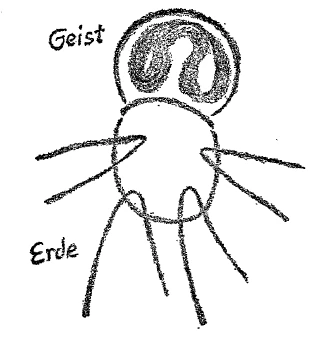
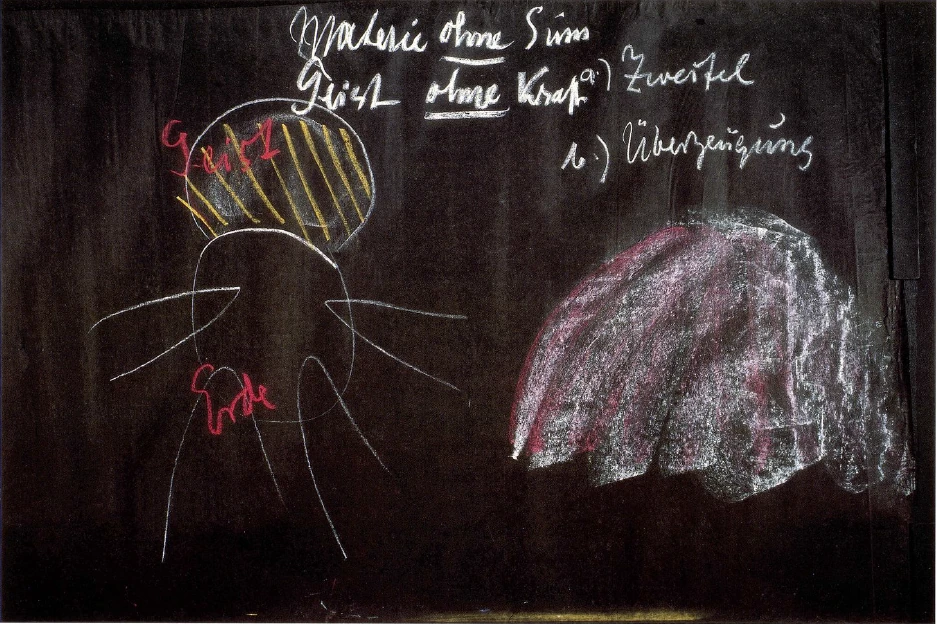
[ 12 ] Da tritt jene Erkenntnis ein, von der ich oftmals hier gesprochen habe. Der menschliche Kopf ist schon seiner äußeren Form nach, wenn Sie von der Kopfbasis absehen, dem Kosmos nachgebildet. Er ist ja eigentlich kugelig gebildet (s. Zeichnung). Er ist herausgeholt in seiner Form aus dem Kosmos. Es wirken ja auch alle kosmischen Kräfte im Leibe der Mutter zusammen, um in der Embryonalbildung zuerst das menschliche Haupt zu erzeugen. Wenn wir geistig auf die Sache eingehen, so ist es so, daß dasjenige, was vom Menschen geistig-seelisch in einer geistig-seelischen Welt lebt, bevor der Mensch heruntersteigt ins physisch-irdische Dasein, sich zunächst mit den kosmischen Kräften verbindet und dann erst die Vererbungskräfte ergreift. Der eigentliche geistig-seelische Mensch bildet sich zuerst aus dem Äther der Welt heraus und geht dann erst an die physisch ponderablen Materien, die ihm im Leibe der Mutter dargereicht werden. Eigentlich ist also dieses Haupt aus dem Kosmos heraus gebildet, und das, was vom Menschen heruntergestiegen ist aus geistig-seelischen Welten auf die Erde, ist eingebildet dieser kosmischen Gestaltung. Daher versteht auch im Physischen niemand den Bau des menschlichen Hauptes, der ihn nicht im geistigen Sinne so erklärt, daß er sagt: Das Haupt des Menschen ist ein Abbild, ein unmittelbarer Abdruck des Geistigen. Diese wunderbaren Gehirnwindungen, alles, was da physiologisch im menschlichen Haupte zu entdecken ist, ist so, als wenn es kristallisierter Geist wäre, in materieller Form vorhandener Geist. Das menschliche Haupt ist als physischer Leib unmittelbar Abbild des Geistes.
[ 12 ] This is where that insight I have often spoken of here comes into play. Even in its external form—if you disregard the base of the head—the human head is modeled after the cosmos. It is, in fact, spherical in shape (see drawing). Its form is drawn directly from the cosmos. All the cosmic forces also work together within the mother’s body to first form the human head during embryonic development. If we approach the matter spiritually, it is the case that what lives within the human being as spirit and soul in a spiritual-soul world—before the human being descends into physical-earthly existence—first unites with the cosmic forces and only then takes hold of the hereditary forces. The actual spiritual-soul human being first forms itself out of the ether of the world and only then turns to the physically ponderable matter provided to it within the mother’s body. In reality, therefore, this head is formed from the cosmos, and that which has descended from the spiritual-soul worlds to Earth is imprinted upon this cosmic form. Therefore, even in the physical realm, no one can understand the structure of the human head unless they explain it in a spiritual sense by saying: The human head is an image, a direct imprint of the spiritual. These marvelous convolutions of the brain—everything that can be discovered physiologically in the human head—are as if they were crystallized spirit, spirit existing in material form. The human head, as a physical body, is a direct reflection of the spirit.
[ 13 ] Wenn jemand den Geist als solchen als Bildhauer darstellen sollte, so müßte er eigentlich einen durchgeistigten Menschenkopf studieren. Er wird natürlich, wenn er Modellkünstler ist, nichts Besonderes treffen; aber wenn er nicht Modellkünstler ist, sondern aus dem Geistigen heraus schafft, dann wird er gerade ein wunderbares Abbild der innersten Natur der kosmischen Geisteskräfte zuwege bringen, wenn er das menschliche Haupt schafft. Es ist Intuition, Inspiration, Imagination der kosmischen Geistigkeit, was im menschlichen Haupte vorliegt. Es ist, wie wenn die Gottheit selber ein Bild des Geistigen hätte schaffen wollen und dem Menschen sein Haupt aufgesetzt hätte. Es ist deshalb im Grunde genommen drollig, wenn die Menschen Bilder vom Geist suchen, während sie das beste, das großartigste, das gewaltigste Bild des Geistes, aber eben das Bild des Geistes, nicht den Geist selbst, im menschlichen Haupte haben.
[ 13 ] If someone were to depict the spirit as such in a sculpture, he would actually have to study a human head imbued with spirit. Of course, if he is a modeler, he will not capture anything special; but if he is not a modeler, but rather creates from the spiritual realm, then he will produce a truly wondrous image of the innermost nature of the cosmic spiritual forces when he creates the human head. It is intuition, inspiration, and imagination of the cosmic spirit that are present in the human head. It is as if the Deity itself had wanted to create an image of the spiritual and had placed a head upon the human being. It is therefore, in essence, rather odd when people seek images of the spirit, while they have the best, the most magnificent, the most powerful image of the spirit—but precisely the image of the spirit, not the spirit itself—in the human head.
[ 14 ] Ganz entgegengesetzt ist es mit dem Gliedmaßenmenschen. Wenn Sie den Gliedmaßenmenschen dagegenstellen, so ist dieser nur der Erde angegliedert. Der hat nur einen Sinn als Angliederung an die Erde. Die Arme werden etwas herausgehoben aus dem Irdischen. Beim Tiere sind diejenigen Glieder, die beim Menschen die Arme sind, auch noch in die Erdenschwere eingestellt. Aber im wesentlichen ist die Gliedmaßennatur des Menschen durchaus auf die Erdenkräfte hinorganisiert. Geradeso wie das Haupt des Menschen ein Abbild ist der kosmischen Geistigkeit, so zeigt uns das, was uns in den menschlichen Gliedmaßen entgegentritt, wie der Geist da gebunden ist an die Kräfte der Erde. Man studiere nur einmal die Form eines menschlichen Beines mit dem menschlichen Fuß! Will man es plastisch verstehen, so muß man die Kräfte der Erde verstehen. Geradeso wie man die höchste Geistigkeit verstehen muß, wenn man das Menschenhaupt begreifen will, so muß man, um die Form der Gliedmaßen zu begreifen, dasjenige studieren, was den Menschen an die Erde bindet, ihn zur Erde drückt, was verursacht, daß der Mensch der Erde entlanggehen und sich im Weltall erhalten kann innerhalb der Schwerekräfte. Das alles muß man studieren, die ganze Art, wie die Erde auf ein Wesen wirkt, das in dieser Weise sich zu ihr stellt, wie der Mensch es tut. So wie man den Geist studieren muß, um das menschliche Haupt zu verstehen, so muß man das Physische der Erde mit ihren Kräften studieren, um den Gliedmaßen- und Stoffwechselmenschen zu verstehen.
[ 14 ] The situation is quite the opposite with the “limb-human.” If you contrast the limb-human with this, the limb-human is connected only to the Earth. Its sole purpose is as a connection to the Earth. The arms are somewhat raised above the earthly realm. In animals, the limbs that correspond to the human arms are also still attuned to the gravity of the Earth. But essentially, the nature of the human limbs is entirely organized in relation to the forces of the Earth. Just as the human head is a reflection of cosmic spirituality, so what we encounter in the human limbs shows us how the spirit is bound there to the forces of the Earth. One need only study the form of a human leg with its foot! If one wishes to understand it in a three-dimensional way, one must understand the forces of the earth. Just as one must understand the highest spirituality if one wishes to comprehend the human head, so too, in order to comprehend the form of the limbs, one must study that which binds the human being to the earth, presses him down toward the earth—that which enables the human being to walk upon the earth and sustain himself in the universe within the forces of gravity. One must study all of this—the entire way in which the Earth acts upon a being that relates to it in the manner that human beings do. Just as one must study the spirit to understand the human head, so must one study the physical nature of the Earth and its forces to understand the human being in terms of limbs and metabolism.
[ 15 ] Das aber hat eine sehr bedeutsame Folge. Erst wenn man so hineinsieht in den Menschen, wenn man hinzuschauen vermag auf das Haupt des Menschen, wie es sozusagen die zusammenkrtistallisierte, im ganzen Kosmos ausgebreitete wirkende geistige Welt ist, und wenn man in den Schwerelinien und wiederum in den Schwunglinien, in denen sich die Erde dreht, die Ursprünge der Formungen der menschlichen Gliedmaßen sieht, wenn man so durchschaut dynamisch, in der Kräftewirkung, die Art und Weise, wie der Mensch gestaltet und wie er gebaut ist, dann erst kann man ein Urteil darüber gewinnen, wie das Geistig-Seelische, das im Menschen selber auftritt, nun in den Menschen hineinwirkt. Und das möchte ich Ihnen heute an zwei Beispielen sagen.
[ 15 ] But this has a very significant consequence. Only when one looks into the human being in this way, when one is able to look at the human head as, so to speak, the crystallized spiritual world that is active and spread throughout the entire cosmos, and when one sees in the lines of gravity and, in turn, in the lines of rotation in which the Earth turns, the origins of the formations of the human limbs—when one thus perceives dynamically, through the interplay of forces, the manner in which the human being is shaped and constructed—only then can one form a judgment about how the spiritual-soul aspect, which arises within the human being itself, now works within the human being. And that is what I would like to explain to you today using two examples.
[ 16 ] Zwei Dinge können im menschlichen Seelenwesen eine große Rolle spielen, die sich gewissermaßen entgegengesetzt sind. Das eine ist das, was ich den Zweifel, das andere ist, was ich das Fürwahrhalten, die Überzeugung nennen möchte. Man könnte vielleicht auch andere, noch prägnantere Worte finden. Aber Sie alle werden verspüren, daß wir eine Art von polarischem Gegensatz des Seelenlebens haben, wenn wir auf der einen Seite von Zweifel, auf der anderen Seite von Überzeugung sprechen. Stellen Sie sich einmal vor, was da geschieht, wenn in einem intensiveren Umfange den Menschen ergreift, was einerseits im Zweifel und andererseits in der Überzeugung wirkt. Versuchen Sie einmal, sich zu vergegenwärtigen, wie Sie über irgend etwas, und sei es auch nur ein Sie stark in Anspruch nehmendes Ereignis, in Zweifel versetzt sind. Es braucht gar nicht eine große Weltenwahrheit, ein großes Weltenrätsel zu sein, sondern nur eine Sie stark interessierende Angelegenheit. Sie müssen mit diesem Zweifel zu Bett gehen. Stellen Sie sich vor, wie Sie sich herumwerfen, Unruhe empfinden, wie es innerlich rumort und Ihnen keine Ruhe läßt. Und versuchen Sie sich dann zu vergegenwärtigen, wie irgend etwas, was als eine wohltuende Überzeugung in Ihre Seele einfließt, eine innerliche Ruhe bewirkt, wie gewissermaßen eine Seelenwärme Sie ganz erfüllen kann. Kurz, Sie werden, wenn Sie wirklich innerlich die Sache unbefangen betrachten, sich schon die entgegengesetzten Naturen, des Zweifels auf der einen Seite, des Überzeugtseins auf der anderen Seite, vor Ihre Seele stellen können.
[ 16 ] Two things can play a major role in the human soul, and they are, in a sense, opposites. One is what I would like to call doubt; the other is what I would like to call belief, or conviction. One might perhaps find other, even more concise terms. But you will all sense that we are dealing with a kind of polar opposition in the life of the soul when we speak of doubt on the one hand and conviction on the other. Just imagine what happens when what operates through doubt on the one hand and through conviction on the other takes hold of a person to a greater degree. Try to picture for yourself how you are thrown into doubt about something—even if it is just an event that deeply preoccupies you. It doesn’t have to be a great universal truth or a great mystery of the world; it can simply be a matter that interests you deeply. You have to go to bed with this doubt. Imagine how you toss and turn, feeling restless, how it churns inside you and gives you no peace. And then try to picture how something—flowing into your soul as a soothing conviction—brings about inner peace, how, in a sense, a warmth of the soul can fill you completely. In short, if you truly view the matter with an open mind, you will already be able to place the opposing forces—doubt on one side and conviction on the other—before your soul.
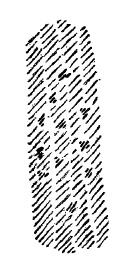
[ 17 ] Worin liegt der Unterschied in bezug auf die Wesenheit des Menschen? Das menschliche Haupt ist nachgebildet aus dem kosmischen Äther heraus dem, was wir in der geistigen Welt waren, das menschliche Haupt ist eine reine Nachbildung des Allermenschlichsten, nämlich des geistigen Menschen. Zweifelnde Vorstellungen kommen an das Haupt heran, sie finden in dem Haupte keinen Platz. Das Haupt nimmt sie nicht auf. Sie müssen durch das Haupt hindurchgehen bis in die Gliedmaßennatur herunter. In der Gliedmaßennatur, da verbinden sie sich mit alledem, was körnig wird in dem menschlichen Stoffwesen, was so wird, daß es dieses menschliche Stoffwesen körnig durchsetzt, was also eine atomistische Natur annimmt. Zweifelnde Vorstellungen gehen, wie wenn unser Kopf für sie durchlässig wäre, durch ihn hindurch. Das Blut nimmt diese zweifelnden Vorstellungen zunächst auf, dann werden sie hinuntergetragen in den ganzen Organismus, vorzugsweise vom Stoffwechsel aufgenommen, und dann erst dem Nervensystem übergeben, und sie leben in alldem, was in der menschlichen Natur atomistisch ist, was körnig, was salzig ist. Damit verbinden sie sich ganz besonders innig. Der Leib nimmt die Zweifelsvorstellungen auf, durch den Kopf gehen sie durch. Erst wenn man diese besondere Art des menschlichen Hauptes versteht, und daß die Materie des Hauptes nicht geeignet ist für Zweifelsvorstellungen, weil das Haupt ein Abbild der Wahrheit selber ist, aus der wir kommen, wenn wir vom Geistigen ins Physisch-Irdische heruntersteigen, dann begreifen wir: So wie das Licht durch ein durchsichtiges Glas, so gehen durch unseren Kopf die zweifelnden Vorstellungen hindurch und ergreifen den anderen Teil des Nervensystems und rumoren in unserem Stoffwechsel. Der Kopf nimmt die zweifelnden Vorstellungen nur insofern auf, als er selbst Stoffwechselnatur ist. Aber er leitet sie durch seine besondere Nervenorganisation hindurch und nimmt nur die überzeugenden Vorstellungen auf.
[ 17 ] What is the difference with regard to the essence of the human being? The human head is modeled from the cosmic ether after what we were in the spiritual world; the human head is a pure replica of what is most human, namely, the spiritual human being. Doubtful thoughts approach the head, but they find no place there. The head does not absorb them. They must pass through the head and descend into the nature of the limbs. In the nature of the limbs, they connect with everything that becomes granular in the human physical being—that which permeates this human physical being in a granular manner and thus takes on an atomistic nature. Doubtful ideas pass right through the head, as if it were permeable to them. The blood first absorbs these doubtful ideas; they are then carried down into the entire organism, primarily taken up by the metabolism, and only then handed over to the nervous system, where they live within all that is atomistic in human nature—that which is granular and that which is salty. With these elements, they connect in a particularly intimate way. The body absorbs the thoughts of doubt; they pass through the head. Only when we understand this particular nature of the human head—and that the substance of the head is not suited to thoughts of doubt, because the head is an image of truth itself, from which we come as we descend from the spiritual into the physical-earthly realm—do we grasp: Just as light passes through a transparent glass, so do doubting thoughts pass through our head, affecting the other part of the nervous system and causing turmoil in our metabolism. The head absorbs doubting thoughts only to the extent that it itself is of a metabolic nature. But it channels them through its special nervous organization and absorbs only the convincing thoughts.
[ 18 ] Die überzeugenden Vorstellungen finden überall, wenn sie in das Haupt des Menschen eindringen, verwandte Gebilde. Sie finden überall im Nervensystem Unterkunft. Sie lassen sich gleich im Haupte des Menschen nieder und gehen in den übrigen Leib nicht durch das Blut, sondern durch das Nervensystem, das noch dazu in einer Art von Zerstörungsprozeß ist, so daß sie unmittelbar in ihrer Geistigkeit übergehen an den ganzen übrigen Menschen. Aber vorzugsweise finden sie im Kopfe Unterkunft, erfüllen sie den Kopf. Und im Kopf, aus der Geistigkeit der Kopfesform, auch der inneren Formung, bekommen sie ihre für den ganzen Menschen passende Gestaltung und wirken daher so, wie wenn sie mit dem Menschen innig verwandt wären, wie wenn der Mensch selber innerlich in ihnen leben würde, wie wenn sie der Mensch selbst wären. Man möchte sagen: In den überzeugenden Vorstellungen formt das Haupt des Menschen etwas, was dem Menschen besonders angemessen ist.
[ 18 ] Convincing ideas find kindred forms everywhere once they penetrate a person’s mind. They find a home throughout the nervous system. They settle immediately in the human head and spread to the rest of the body not through the blood, but through the nervous system, which is, moreover, undergoing a kind of process of dissolution, so that their spiritual nature passes directly into the rest of the human being. But they find their home primarily in the head; they fill the head. And in the head, from the spirituality of the head’s form—including its inner structure—they take on a form appropriate for the whole human being and thus act as if they were intimately related to the human being, as if the human being himself were living within them, as if they were the human being himself. One might say: In the vivid images of the mind, the human head forms something that is particularly suited to the human being.
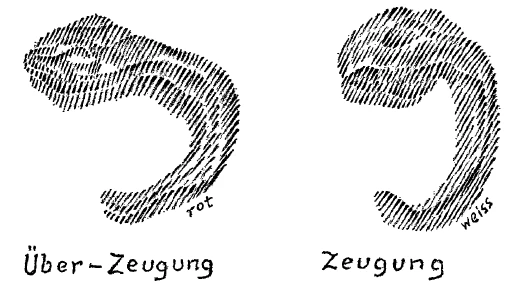
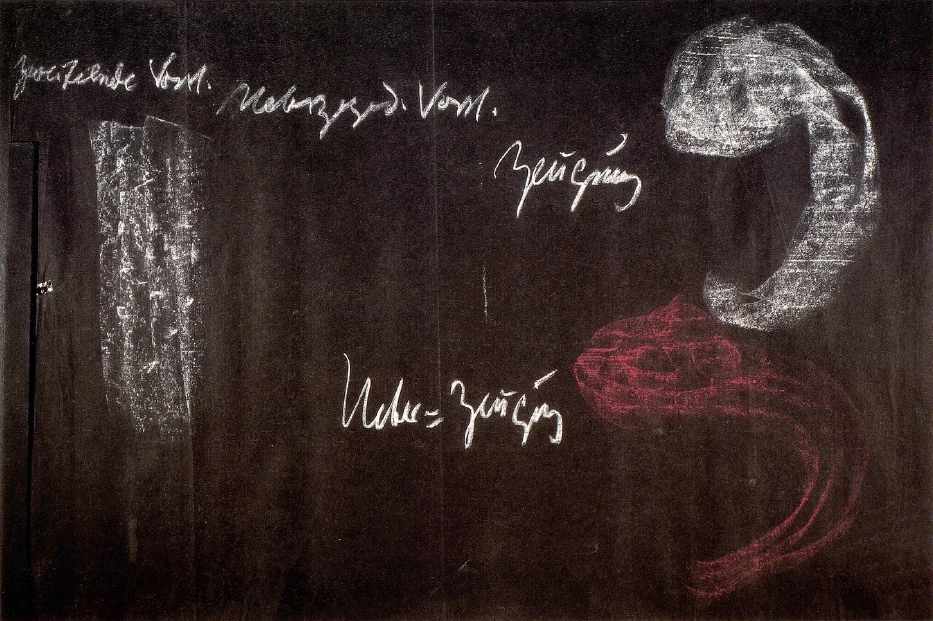
[ 19 ] Studieren Sie den menschlichen Embryo, Sie werden sehen, zuerst bildet sich das Haupt, dann bildet sich der übrige Organismus; denn von dem Haupte gehen diejenigen Kräfte aus, die das übrige bilden. Wenn Sie überzeugende Vorstellungen ins Haupt aufnehmen, so ist es ja geistig so: die werden zunächst im Haupte geistig aufgenommen, und das Haupt sendet sie dann dem übrigen Menschen zu. Wie physisch im Embryo der andere Mensch nachgebildet wird dem menschlichen Haupte, so wird hier das Geistige der Überzeugungen und Vorstellungen des übrigen Menschen ausgestrahlt, und es entsteht ein Mensch daraus auf geistige Weise aus den überzeugenden Vorstellungen (linke Zeichnung, rot). Ein inneres Menschenbild strahlt aus in dem Menschen. Und mit allem, was den Menschen wie Wärme durchzieht, verbindet sich das, was da ausstrahlt an überzeugenden Vorstellungen im Menschen. Wie die zweifelnden Vorstellungen alles Körnige, alles Atomistische ergreifen, so ergreifen die überzeugenden Vorstellungen die den Körper durchströmende Wärme, das erste Glied des Ätherischen, das den ganzen Menschen durchzieht, und gehen nicht weiter ein in das Physische.
[ 19 ] Study the human embryo, and you will see that the head forms first, followed by the rest of the organism; for it is from the head that the forces emanate which form the rest of the body. When you take convincing ideas into your head, the spiritual process is as follows: they are first spiritually received in the head, and the head then sends them to the rest of the person. Just as the rest of the human being is physically formed in the embryo in the image of the human head, so here the spiritual aspect of the convictions and ideas of the rest of the human being is radiated, and a human being arises from this in a spiritual way out of the convincing ideas (left drawing, red). An inner image of the human being radiates within the person. And everything that permeates the human being—such as warmth—connects with what radiates from the human being in the form of convincing ideas. Just as doubting ideas take hold of everything granular, everything atomistic, so do convincing ideas take hold of the warmth flowing through the body—the first link of the etheric that permeates the entire human being—and do not penetrate any further into the physical.
[ 20 ] Versuchen Sie einmal, so sich die Gegenwart der zweifelnden und der überzeugenden Vorstellungen in der menschlichen Natur vorzustellen, und Sie können jedesmal, wenn Sie das Wohltuende einer überzeugenden Vorstellung, das Folternde von zweifelnden Vorstellungen nachfühlen und erleben, die Wahrheit der Sache im unmittelbaren Leben ergreifen.
[ 20 ] Try to imagine the coexistence of doubting and convincing thoughts within human nature, and every time you feel and experience the comfort of a convincing thought and the torment of doubting thoughts, you will grasp the truth of the matter in your own life.
[ 21 ] Ich habe oftmals gesagt, daß der Sprachgeist ein Geist ist, der vernünftig wirkt. Und wenn man den natürlichen Embryo der Zeugung zuschreibt (Zeichnung rechts, weiß), so ist man gar nicht weiter überrascht, daß jene Bildung hier (links, rot) der Überzeugung zugeschrieben wird. Diese Dinge dürfen wir nicht als bloße Zufälligkeiten ansehen. Sie sind die Taten des waltenden Sprachgenius, der durchaus mehr weiß als der einzelne Mensch. Ich weiß, daß eine heutige linguistische Wissenschaft das als eine Spielerei ansieht. Aber wenn man einmal in das Wirken und Weben des waltenden Sprachgenius wirklich hineinschauen wird, so wird man manches der heutigen Philologie und Linguistik als Spielerei ansehen.
[ 21 ] I have often said that the spirit of language is a spirit that acts rationally. And if one attributes the natural embryo to procreation (drawing on the right, white), then it comes as no surprise at all that the formation here (on the left, red) is attributed to conviction. We must not regard these things as mere coincidences. They are the deeds of the reigning genius of language, who certainly knows more than any individual human being. I know that modern linguistic scholarship regards this as a mere trifle. But once one truly looks into the workings and weaving of the reigning genius of language, one will regard much of today’s philology and linguistics as mere trifles.
[ 22 ] Aber bedenken Sie jetzt, was das Ganze heißt. Sie bekommen ein Bild, wie zwei Seelenerlebnisse, der Zweifel und die Überzeugung, im physischen Menschen weiter wirken. Sie bekommen eine absolut begreifbare Brücke vom Seelisch-Geistigen in das Physische hinüber. Sie sagen sich, hier ist ein physischer Mensch, es schimmert und wellt durch seine physischen Körnchen im Leibe das, was er seelisch-geistig erlebt: das ist ein Skeptiker, das ist ein Zweifler. Sie schen es der inneren Struktur seines Stoffes an, wie da der Zweifelgeist in der Seele, im Körper weiter vibriert. Sie sehen sich den anderen an, bei dem in ruhiger Weise die Wärme durch die Glieder strömt, und Sie sehen in diesem ruhigen Strömen der Wärme den physischen Ausdruck des den Überzeugungen Hingegebenseins. Sie sehen im Menschen einen unmittelbaren physischen Ausdruck des Geistigen. So beginnen Sie erst das Physische zu verstehen. Der heutige Chemiker und Physiker sagt, wenn er den Menschen analysiert: Dadrinnen ist Kalk, Phosphor, Sauerstoff und Stickstoff, Kohlenstoff. — Ja, im Sauerstoff und Stickstoff und Kohlenstoff und Wasserstoff werden Sie niemals ein Geistiges finden. Da hat Du Bois- Reymond selbstverständlich ganz recht, wenn er sagt: Einer Anzahl von Sauerstoff- und Stickstoff- und Kohlenstoffatomen kann es höchst gleichgültig sein, wie sie liegen und sich bewegen. — Ja, wenn man den Stoff im Leibe nur als Kohlenstoff, Sauerstoff und so weiter anschaut, da verhält es sich so. Wenn man aber weiß, wie dadrinnen ein Stoff wirkt, der für den Geist in der verschiedensten Weise empfänglich ist, der im Haupte ein unmittelbares Nachbild von geistiger Wesenhaftigkeit ist, der im übrigen der Erde angegliedert ist, so daß dort das Irdische festhält, was als zweifelnde Vorstellungen durchgetrieben wird durch das Haupt, dann hört die Möglichkeit auf, zu denken, es sei in unserem Gehirn einer Anzahl von Kohlenstoff-, Stickstoffatomen und so weiter gleichgültig, wie sie lagen und sich bewegten, wie sie liegen und sich bewegen. Da sehen wir, wie es dem Stoffe nicht gleichgültig ist, ob sich in ihn der Wärmestrom ergießt, oder ob in ihm die Salzbildung wirksam ist, so daß der Leib die Tendenz bekommt, die körnige Struktur zu entwickeln. Das sind zwei Gegensätze, die sich im Stoffe zum Ausdruck bringen, und die aus dem Geistigen herstammen. Es ist tatsächlich so, daß wir nicht deshalb einen Materialismus im 19. Jahrhundert gekriegt haben, weil man den Geist nicht gekannt hat. Den Geist in seiner filtriertesten Form hat das materialistische Zeitalter am besten gekannt, denn alle früheren Zeitalter haben den Geist eigentlich nicht in Reinkultur gehabt, sie haben in die Bilder des Geistes, die sie sich geformt haben, immer Materielles hineingemischt; es waren Bilder, in die immer Materielles hineingemischt war. Die reinen geistigen Vorstellungen, die hat eigentlich erst das naturwissenschaftliche Zeitalter gebracht. Aber was das naturwissenschaftliche Zeitalter vernachlässigen mußte, das ist gerade die Kenntnis der Materie in Wirklichkeit, des Geistes in der Materie. Was uns in den Materialismus gebracht hat, das ist die zu geringe Kenntnis des materiellen Wesens der Welt, die Einsichtslosigkeit in das geistige Weben und Wirken im Materiellen. Materialistisch ist die Wissenschaft geworden durch Unkenntnis der materiellen Wirkungen. Dadurch, daß man nicht wußte, wie der Geist schöpferisch wirkt, stellte man sich diesen Geist immer abstrakter und abstrakter vor. Dadurch wurde das Sollen, wurden die sittlichen Ideale endlich etwas, wovon man nicht einmal fragen konnte, wo es herumfliegt im Raume, weil es nicht einmal die Materialität hatte, daß es herumfliegen konnte. Es war überhaupt nicht mehr da. Wenn man danach schnappte, war es ungefähr so, wie wenn man in einem Elemente atmen wollte, das nicht da ist. Wie wenn ein Mensch unter dem Rezipienten einer Luftpumpe atmen wollte, so kommen einem die Menschen des 19. Jahrhunderts vor! Wenn sie zum Beispiel nach den sittlichen Idealen schnappen — sie sind nicht da; sie möchten sie haben, aber sie sind nicht da, weil man keinen Begriff entwickeln wollte von dem Wirken des Geistig-Seelischen im Physisch-Leiblichen. Daher kamen all die kuriosen Theorien auf von der Wechselwirkung des Physisch-Leiblichen mit dem Seelisch-Geistigen, die alle Gespinste waren, während eine wirkliche Erkenntnis nur durch genaues Eingehen auf den Tatbestand gewonnen werden kann.
[ 22 ] But now consider what all this means. You get a picture of how two spiritual experiences—doubt and conviction—continue to influence the physical human being. You gain a perfectly comprehensible bridge from the soul-spiritual realm into the physical realm. You tell yourself: here is a physical human being; what he experiences soul-spiritually shimmers and ripples through the physical particles in his body—he is a skeptic, a doubter. You attribute it to the inner structure of his physical substance—how the spirit of doubt continues to vibrate in the soul and in the body. You look at the other person, in whom warmth flows calmly through the limbs, and you see in this calm flow of warmth the physical expression of devotion to convictions. You see in the human being a direct physical expression of the spiritual. Only then do you begin to understand the physical. Today’s chemist and physicist, when analyzing a human being, says: “Inside there is calcium, phosphorus, oxygen, nitrogen, and carbon.” — Yes, you will never find anything spiritual in oxygen, nitrogen, carbon, or hydrogen. Here, of course, Du Bois-Reymond is quite right when he says: “A collection of oxygen, nitrogen, and carbon atoms could not care less how they are arranged or how they move.” — Yes, if one views the matter in the body merely as carbon, oxygen, and so on, that is indeed the case. But if one knows how a substance acts within that is receptive to the spirit in the most diverse ways—a substance that is, in the head, a direct reflection of spiritual essence, and which, moreover, is connected to the earth so that the earthly holds fast there what is driven through the head as doubting ideas—then the possibility ceases to think that it is indifferent to our brain whether a certain number of carbon and nitrogen atoms, and so on, are arranged and move in a particular way. There we see how it is not indifferent to the substance whether a flow of heat pours into it or whether salt formation is at work within it, so that the body develops a tendency toward a granular structure. These are two opposites that find expression in matter and that originate in the spiritual. It is indeed the case that we did not arrive at materialism in the nineteenth century simply because people did not know the spirit. The materialistic age knew the spirit best in its most refined form, for all earlier ages did not actually have the spirit in its pure form; they always mixed material elements into the images of the spirit they had formed; these were images into which material elements were always mixed. It was actually the age of natural science that first brought about pure spiritual concepts. But what the age of natural science was forced to neglect is precisely the knowledge of matter as it really is—of the spirit within matter. What led us into materialism was an insufficient understanding of the material nature of the world and a lack of insight into the spiritual weaving and working within the material realm. Science became materialistic through ignorance of material effects. Because people did not know how the spirit works creatively, they imagined this spirit in increasingly abstract terms. As a result, moral obligations and ethical ideals ultimately became something about which one could not even ask where it was floating in space, because it did not even possess the materiality to float around. It was no longer there at all. Reaching out for it was much like trying to breathe in an element that isn’t there. Just as if a person were trying to breathe beneath the reservoir of an air pump—that is how the people of the 19th century appear to us! When, for example, they reach for moral ideals—they aren’t there; they want them, but they aren’t there, because people were unwilling to develop a concept of the influence of the spiritual-soul aspect on the physical-bodily realm. Hence all those curious theories arose about the interaction of the physical-bodily with the soul-spiritual, all of which were mere fantasies, whereas true understanding can only be gained through a precise examination of the facts.
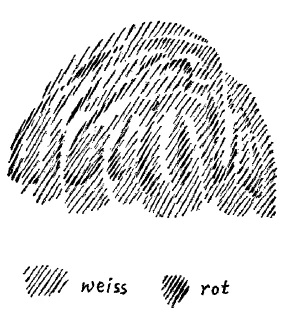
[ 23 ] Lernt man so kennen, wie der Zweifel, wie die Überzeugung die Menschennatur durchwallen und durchweben, dann ist man imstande, dasjenige, was man am Menschen kennengelernt hat, nun auch wiederum an der Welt kennenzulernen. Wir haben in der Welt die Sphäre des materiellen Schaffens. Wir sehen zum Beispiel, wie sich draußen in der Welt die Materie körnig gestalten muß, wie sie sich kristallisiert. Haben wir erst kennengelernt, wie der Zweifel in uns das Körnige im Organismus ergreift, dann lernen wir draußen den Zweifel schauen. Wir schauen aufden Berg (weiß), der sich mit seinem körnigen Gestein bildet ; aber wir finden zu gleicher Zeit, wie diesen Berg dasselbe durchzieht, was wir in uns als Zweifel kennenlernen (rot), und wir lernen die schöpferische Kraft des Zweifels kennen. Der Zweifel in uns macht uns körnig, weil wir eben Menschen sind und nicht Natur. Der Zweifel draußen in der Natur, der wirkt das Richtige. Wenn das, was draußen in der Natur wirkt, in uns einzieht, so bewirkt es das Unrichtige. Indem Sie auf die Felsen treten, treten Sie auf die physische Ausgestaltung dessen, was die Gottheit als Zweifel aussendet, damit die Welt körnig werden könne. Und wiederum, wenn Sie Ihre Überzeugungen studieren mit dem warmen Durchdrungensein, dann befinden Sie sich in demjenigen, was schöpferisch entsteht. Wenn Sie sich also denken, daß im Grunde genommen in der Wärme der Schoß der schöpferischen Weltenkräfte zu suchen ist, dann finden Sie, daß aus der warmen Materie heraus das wirkt, was kosmische Überzeugung ist.
[ 23 ] Once we come to understand how doubt and conviction surge through and interweave with human nature, we are then able to recognize in the world what we have come to know about human beings. In the world, we have the sphere of material creation. We see, for example, how matter out there in the world must take on a granular form, how it crystallizes. Once we have come to understand how doubt within us seizes upon the granular aspects of the organism, we then learn to perceive doubt out there. We look at the mountain (white), which is formed of granular rock; but at the same time, we discover that this mountain is permeated by the very same force that we come to know within ourselves as doubt (red), and we come to know the creative power of doubt. The doubt within us makes us granular, precisely because we are human beings and not nature. Doubt out there in nature has the right effect. When what is at work out there in nature enters into us, it has the wrong effect. By stepping on the rocks, you are stepping on the physical manifestation of what the Divine sends forth as doubt so that the world may become granular. And conversely, when you study your convictions with a warm sense of immersion, you find yourself within that which is creatively emerging. So if you consider that, fundamentally, the warmth of the creative forces of the world is to be found in the bosom of these forces, then you will discover that what emerges from this warm matter is cosmic conviction.
[ 24 ] Lernen Sie diese Dinge erst in Wahrheit in sich kennen, dann lernen Sie auch die Agenzien draußen im Kosmos in der richtigen Weise beurteilen. Wenn Sie dasjenige, was draußen abbröckelt und abbröselt, so daß wir gewissermaßen schon die erste Vorbereitung für das Zerstäuben unseres Irdischen im Weltenall vor uns haben, als Ausstrahlungen des Weltenzweifels ansehen, dann lernen Sie vieles im kosmischen Dasein begreifen. Und umgekehrt, wenn Sie das Überzeugende ins Kosmische hineinzuschauen vermögen, dann lernen Sie vieles von dem Schöpferischen kennen. Doch das sind Dinge, durch die ich Ihnen nur andeuten wollte, wie man erst den Menschen kennen muß, um überhaupt eine Aussicht zu haben, das Weltendasein zu kennen.
[ 24 ] Only when you truly come to know these things within yourself will you also learn to judge the forces out there in the cosmos correctly. If you regard that which is crumbling and crumbling away out there—so that, in a sense, we already have before us the first preparation for the disintegration of our earthly existence into the cosmos—as manifestations of cosmic doubt, then you will come to understand much about cosmic existence. And conversely, if you are able to look into the cosmos with conviction, then you will come to know much about the creative. But these are merely things through which I wanted to hint to you how one must first know human beings in order to have any prospect of knowing cosmic existence at all.
[ 25 ] Nun, sehen Sie, für Brentano waren in den sechziger Jahren, für Nietzsche in den siebziger Jahren die naturwissenschaftlichen Methoden da; die fanden Kohlenstoff, Wasserstoff, Sauerstoff, Stickstoff, Phosphor, etwas Schwefel und so weiter im Gehirn. Darin war wirklich kein Geistiges zu erkennen. Und wenn man die Methode, die zu diesem geführt hatte, nun auf den Geist anwandte, so konnte man natürlich zu nichts kommen als entweder zu der geistigen Ohnmacht, zu der Brentano gekommen ist, oder zu dem Zermürben des Geistigen, wozu Nietzsche, der mehr Willensnatur war, gekommen ist. Aber beide unterlagen eben dem Schicksal, daß sie nicht vom Physischen zum Geistigen hinkommen konnten, weil sie im Physischen eben das Geistige nicht finden konnten, und daher auch den Geist nicht als etwas empfanden, was mächtig genug ist, um das Physische aus sich hervorzubringen.
[ 25 ] Well, you see, for Brentano in the 1860s, and for Nietzsche in the 1870s, the methods of the natural sciences were available; they found carbon, hydrogen, oxygen, nitrogen, phosphorus, a little sulfur, and so on in the brain. There was truly nothing spiritual to be discerned in that. And if one were to apply the method that had led to this conclusion to the spirit, one could naturally arrive at nothing other than either the spiritual impotence to which Brentano arrived, or the erosion of the spiritual, to which Nietzsche—who was more of a man of will—arrived. But both were subject to the fate that they could not move from the physical to the spiritual, because they could not find the spiritual within the physical, and therefore did not perceive the spirit as something powerful enough to bring the physical into being from within itself.
[ 26 ] So standen solche Geister vor einer physischen Natur, die eigentlich keinen Sinn hatte, weil sie nirgends etwas Geistiges enthält, und vor einer geistigen Natur, die keine Kraft, keine Macht hat. Das ist das Schicksal der bedeutendsten Geister, die in der zweiten Hälfte des 19. Jahrhunderts und im Beginn des 20. Jahrhunderts vor der Materie ohne Sinn, vor dem Geist ohne Kraft standen.
[ 26 ] Thus, such minds were confronted with a physical nature that was essentially meaningless, because it contains nothing spiritual anywhere, and with a spiritual nature that has no strength, no power. Such is the fate of the most eminent minds who, in the second half of the 19th century and at the beginning of the 20th century, found themselves confronted with matter devoid of meaning and with spirit devoid of power.
[ 27 ] Die Historiker haben von Ideen in der Geschichte gesprochen. Das ist Geist ohne Kraft. Den Ideen können Sie wahrhaftig keine Kulturinstrumente in die Hand geben, durch die die Kultur entsteht, oder durch die überhaupt historische Ereignisse entstehen; Ideen als Abstraktes sind kraftlos, das ist Geist ohne Kraft. Demgegenüber steht die Natur, die man nur in ihrer ungeistigen Materie studiert: Materie ohne Sinn.
[ 27 ] Historians have spoken of “ideas” in history. That is spirit without power. You truly cannot place in the hands of ideas the cultural instruments through which culture arises, or through which historical events arise at all; ideas, as abstractions, are powerless—that is spirit without power. In contrast stands nature, which one studies only in its non-spiritual matter: matter without meaning.
[ 28 ] Niemals wird man die Brücke finden, wenn man auf der einen Seite das Unding erfindet: Materie ohne Sinn, und auf der anderen Seite den Ungeist: Geist ohne Kraft. Erst wenn man im Geist die Kraft findet, in der Überzeugung die Kraft, die Wärme durch den Körper hindurchzutreiben, weil der Mensch so und so organisiert ist, wenn man in dem Zweifel die Kraft findet, sich durch den Kopf hindurchzudrängen, weil in ihm keine Verwandtschaft mit dem Kopf besteht, und den übrigen Menschen innerlich zu zermürben, so daß er in körnige Strukturtendenz zerfällt, also erst wenn man in dem Geiste dasjenige findet, was Kraft hat, sowohl aufzulösen die körnige Struktur durch die Wärme, wie sie zu bilden in dem Salzbildungsprozeß, dann findet man eine Materie, in der Sinn ist, weil dann der kraftvolle Geist so wirkt, daß eben dasjenige, was in der Materie einem vor Augen tritt, sinnvoll dasteht. Und so haben wir die Materie mit Sinn und den Geist mit Kraft zu suchen.
[ 28 ] One will never find the bridge if, on one side, one invents the absurd—matter without meaning—and, on the other side, the spiritless—spirit without power. Only when one finds in the spirit the power—in conviction the power to drive warmth through the body, because the human being is organized in such and such a way—and when one finds in doubt the power to force one’s way through the head, because there is no affinity with the head, and to wear down the rest of the human being internally, so that he disintegrates into a granular structural tendency, that is, only when one finds within the spirit that which possesses the power both to dissolve the granular structure through warmth and to form it in the process of salt formation—only then does one find a substance in which there is meaning, because then the powerful spirit acts in such a way that precisely what appears before one’s eyes in the substance stands there as meaningful. And so we must seek substance with meaning and spirit with power.
[ 29 ] Das ist es, worauf ganz besonders solche Geister, wie Brentano und Nietzsche, in ihrem tragischen Schicksal, auch in ihren Persönlichkeiten hinweisen.
[ 29 ] This is precisely what thinkers such as Brentano and Nietzsche, in their tragic fates and even in their personalities, point to.