

Human Questions and Cosmic Answers
GA 205
14 July 1922, Dornach
Translated by Steiner Online Library
Ninth Lecture
[ 1 ] Last week’s lectures were intended, in a certain sense, to shed historical light on how particularly deep-minded individuals struggled with the prevailing trends of the 19th century, and specifically to show how the contemporary scientific way of thinking prevented precisely such deep-minded individuals from finding their way into the spiritual world. When one engages in personal reflections, such as those we have undertaken with regard to Franz Brentano—examining the inner spiritual struggles of human beings and what took place within their minds—one can actually gain a much more intimate insight into the great struggles and currents of the age than when one merely characterizes them in abstract terms. In the latest issue of our journal *Das Goetheanum*, I pointed out how Franz Brentano—who, starting from Catholicism and immersing himself in the scientific mindset, became, so to speak, entangled in the physical and earthly realm and could no longer find his way back to the spiritual—stood in contrast to another personality who, in fact—albeit with some variation—suffered the same fate. That figure is Nietzsche.
[ 2 ] Just as one can demonstrate in the case of Brentano how, stemming from his devout Catholicism and his genuine Catholic piety, the scientific worldview took hold of him and never let go, and how one can show that the entire course of his philosophical journey is characterized by this, so too can one demonstrate something similar in the case of Nietzsche. It can be shown that Nietzsche—though not starting from Catholicism but from a different mindset—was likewise held back by the natural sciences within the realm of the physical and sensory, just as he, no more than Brentano, was unable to rise to the spiritual; yet his fate then took a path that was similar, yet different.
[ 3 ] Brentano had already immersed himself in the scientific mindset as early as the 1860s, and we have seen how the dogma of infallibility—sweeping over him, as it were, like a wave of fate from without—ultimately alienated him completely from his church. Nietzsche, who is a few years younger, underwent a similar development in the 1870s. He did not start from Catholicism. He actually began with an antiquarian, artistic worldview—the kind of worldview that modern man develops when, in his youth, he absorbs more of Greek culture and the Greek way of viewing the world. And one can certainly say: Nietzsche was imbued with the same fervor with which Brentano embraced Catholicism—in the Greek way of viewing the world and in an artistic worldview in general. He believed he had found a renewal of Hellenism in Richard Wagner and his art. And just as Brentano participated in all Catholic practices and fully immersed himself in everything that the Catholic liturgy can evoke within a person, so too did Nietzsche immerse himself in Wagner’s art, in which he believed he saw a resurrection of what the Greek way of viewing the world had been. This is how he wrote his early works, and this is how he then experienced, in the 1870s, the intrusion of the scientific way of thinking into his inner life.
[ 4 ] Previously, he had been filled with the conviction that human beings are endowed with great ideals of humanity within an independent sphere of the spirit; that human beings can set these great ideals—the moral and religious ideals—before their souls; and that in them they find the possibility of rising above the physical and human. And Nietzsche, with extraordinary enthusiasm, finds words of great eloquence to describe humanity’s immersion in the reality of ideals. Then the scientific worldview takes hold of him. And he feels compelled to increasingly internalize the thought that, in fact, the physical aspect of human beings, in its broadest sense, also produces ideals as outcomes from within itself. It has a shattering effect on him to have to abandon the old belief that ideals are something independent, something rooted in an independent spiritual world—that ideals actually emerge as the results of what are bodily-physical processes. Nietzsche, so to speak, plunges, along with everything that lives in his imagination as ideals, into the physiological realm of human nature. What had previously appeared to him as divine and spiritual now appears to him as merely human—indeed, all too human. He had previously observed how humanity had devoted itself to idealistic worlds, and how, through this devotion, it had risen above its base nature. Now he believed he recognized that man’s base nature develops only a kind of instinct to become ever more powerful, and that even the upholding of ideals is nothing other than a means of intensifying the inner power within man. In short, Nietzsche sought to explain all ideals, so to speak, as illusions arising from physiological processes in the broadest sense. He did not, however, conceive of these physiological processes in humans in such a philistine way as modern natural science does; but he wanted to regard ideals as a result of physiological, physical processes in the broadest sense. And so, for him, ideals became something by which people who do not see through the matter delude themselves, while those who do see through it come to realize that, in fact, ideals—just like ordinary instincts—arise from the physiological depths of human beings and are intended solely to bring the physical nature of human beings, in the broadest sense, into ever more powerful prominence.
[ 5 ] Of course, this is a somewhat radical and simplified account, but it essentially captures what had such a shattering effect on Nietzsche at the time—particularly when he believed he had come to the conclusion that even conscience could be explained solely on the basis of physiological factors.
[ 6 ] It is only the natures of the two personalities that differ: Brentano is a refined mind, attuned to imagination and cognition; he uses the scientific method, as it were, to fashion an instrument with which he then seeks to dissect human psychological life in a subtle manner, just as natural science dissects physical life. This instrument, however, becomes blunt the moment he attempts to approach the real spiritual world. Nietzsche, upon realizing that, according to natural science—or at least according to its implications—the physiological is the foundation of everything, devises a tool that is not a delicate analytical knife, like Brentano’s, but rather a hammer, robust enough to extract everything spiritual—even from the physical realm—in physiological terms. With this instrument—which is now robust enough to transform the moral and the ideal into the physiological—he wears down the spiritual. He titled one of his writings: “The Twilight of the Idols, or How to Philosophize with a Hammer.”
[ 7 ] Brentano, in a sense, recoils from the intellectual. Nietzsche shatters the intellectual. Ultimately, anyone who examines the internal cultural history of modern times must find, despite all their differences, a profound similarity between these two figures. And yet, precisely in the most recent work I mentioned to you the other day, Brentano includes a short chapter on Nietzsche in which he shows that he has nothing but outright rejection for Nietzsche. He calls him a literary, dazzling mayfly. He compares him to Jesus and finds that Nietzsche is a caricature of Jesus. One cannot help but say: It is peculiar that a man of such extraordinary refinement as Franz Brentano did not develop the capacity to penetrate, even to a small degree, what another mind experiences—a mind that is, in essence and in its fate, so similar to his own, as I have described to you.
[ 8 ] But this is, in fact, a phenomenon of our time and merely illustrates, through striking examples, what people are like today. They do not grow closer to one another; they drift apart. I have often emphasized that they pass each other by without understanding, and this is certainly also a social phenomenon of our time. People pass each other by—even the most ardent seekers of truth. Others do the same, of course; it’s just that in such outstanding personalities, what is a general phenomenon of our time becomes evident in significant ways. Why, then, do people pass each other by with such a lack of understanding? We so desperately need the possibility of mutual understanding! We so desperately need today the possibility for someone to delve deeply into Nietzsche as well as into Brentano—or, for that matter, into Haeckel, David Friedrich Strauss, and so on—to show how these different personalities view the world from the most diverse perspectives. But only the humanistic perspective—the one that truly ascends to the spirit—can provide such an analysis that delves into these individual personal viewpoints. And that is precisely why people do not understand one another: because they do not ascend to the spirit. We must seek the reason, in the fact that a figure like Brentano remained fixated on the purely natural-scientific, why he was unable to build any bridge to another figure who, in essence, shared a fate very similar to his own. Only a deepening of spiritual science will be able to penetrate the most diverse points of view. But this requires a penetrating observation of human beings, a penetrating understanding of humanity. For what, fundamentally, do such personalities—who are gripped by the scientific methodology of the 19th century, such as Brentano and Nietzsche—actually face?
[ 9 ] One day they are confronted with the fact that, as honest seekers of knowledge and truth, they have, on the one hand, the physical world and the excellent scientific methods for penetrating it; and, on the other hand, a spiritual world. People like Nietzsche and Brentano, of course, could not sink to the level of superficiality that many have reached today, where they do not even see this spiritual world as the great contrast to the physical world in the first place. So they see the physical world; they see the spiritual world; but no bridge can be built between the two. They see what human beings want based on their natural constitution; they see that will, which is grounded in instincts and drives; they attempt to explain these drives and instincts—how they, so to speak, coalesce into will—based on the physiological nature of human beings. But then they realize that a spiritual world establishes ideals above them that are to be striven for; they perceive “ought” in contrast to “will,” and they find no bridge between “will” and “ought.” A man like Brentano becomes a psychologist, a scholar of the soul. Physiology is, after all, complete to a certain degree. But he wants to investigate the phenomena of the soul. He wants to emulate the natural sciences in his investigation of mental phenomena. At first, he is not at all sure whether mental phenomena even exist, because the natural sciences, in a certain sense, dispute this. Brentano is actually certain that mental phenomena exist only because he was a devout Catholic for so long, not on the basis of any scientific insight.
[ 10 ] This conflict weighs heavily on the souls of these people: the spiritual world, the physical world, and no bridge between the two. How does one get from one to the other? The moral ideals stand there. But even with this knowledge, it is impossible to understand how what these moral ideals demand can take hold of human muscles, how it can lead people to act. For natural science merely describes how muscles and bones move according to physical laws, but not how moral imperatives influence the movement of muscles and bones.
[ 11 ] The point is that, despite all the perfection of the scientific method, this scientific century was, in essence, completely helpless when it came to human beings. It was simply impossible to study human beings. It did not occur to them that human beings are threefold beings, in the sense that I have described in the final sections of my book *The Mysteries of the Soul*. It was not possible to arrive at the conclusion that the human being consists of a nervous-sensory being—which, of course, fills the entire human being but is primarily localized in the head—a rhythmic being—which, in turn, permeates the entire human being but is primarily concentrated in the respiratory and circulatory organs—and finally, a limb-metabolic being, which constitutes the rest of the human being. This is such a profound set of facts that everything intended to lead to an understanding of the human being must be based on it. Of course, one must not simply say that the three members of the human being are the head, the chest, and the limbs. I have already said that the human being is a nervous-sensory being throughout, only that this manifests itself primarily in the head. But look at this head. It is formed in such a way that we cannot help but be filled with ever deeper and deeper admiration as we contemplate the structure—especially the nervous structure—of this human head. Nowhere within the physical world of phenomena can a real reason be found as to why the human head, particularly in its inner parts, is formed exactly as it is.
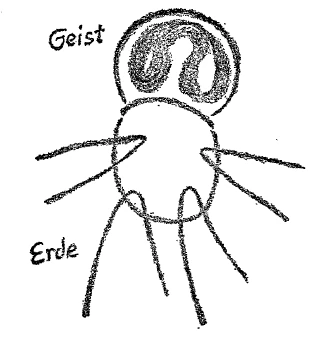
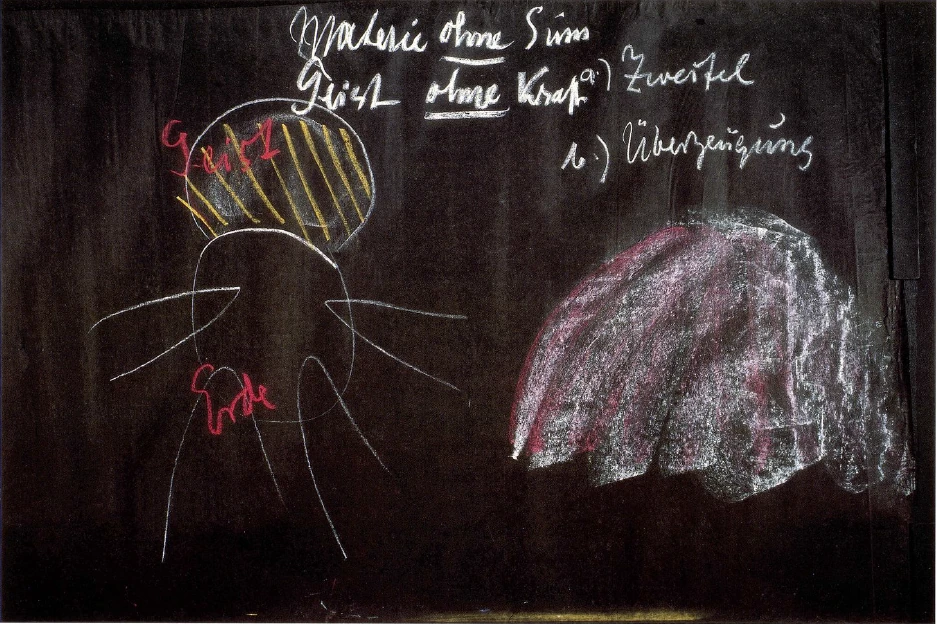
[ 12 ] This is where that insight I have often spoken of here comes into play. Even in its external form—if you disregard the base of the head—the human head is modeled after the cosmos. It is, in fact, spherical in shape (see drawing). Its form is drawn directly from the cosmos. All the cosmic forces also work together within the mother’s body to first form the human head during embryonic development. If we approach the matter spiritually, it is the case that what lives within the human being as spirit and soul in a spiritual-soul world—before the human being descends into physical-earthly existence—first unites with the cosmic forces and only then takes hold of the hereditary forces. The actual spiritual-soul human being first forms itself out of the ether of the world and only then turns to the physically ponderable matter provided to it within the mother’s body. In reality, therefore, this head is formed from the cosmos, and that which has descended from the spiritual-soul worlds to Earth is imprinted upon this cosmic form. Therefore, even in the physical realm, no one can understand the structure of the human head unless they explain it in a spiritual sense by saying: The human head is an image, a direct imprint of the spiritual. These marvelous convolutions of the brain—everything that can be discovered physiologically in the human head—are as if they were crystallized spirit, spirit existing in material form. The human head, as a physical body, is a direct reflection of the spirit.
[ 13 ] If someone were to depict the spirit as such in a sculpture, he would actually have to study a human head imbued with spirit. Of course, if he is a modeler, he will not capture anything special; but if he is not a modeler, but rather creates from the spiritual realm, then he will produce a truly wondrous image of the innermost nature of the cosmic spiritual forces when he creates the human head. It is intuition, inspiration, and imagination of the cosmic spirit that are present in the human head. It is as if the Deity itself had wanted to create an image of the spiritual and had placed a head upon the human being. It is therefore, in essence, rather odd when people seek images of the spirit, while they have the best, the most magnificent, the most powerful image of the spirit—but precisely the image of the spirit, not the spirit itself—in the human head.
[ 14 ] The situation is quite the opposite with the “limb-human.” If you contrast the limb-human with this, the limb-human is connected only to the Earth. Its sole purpose is as a connection to the Earth. The arms are somewhat raised above the earthly realm. In animals, the limbs that correspond to the human arms are also still attuned to the gravity of the Earth. But essentially, the nature of the human limbs is entirely organized in relation to the forces of the Earth. Just as the human head is a reflection of cosmic spirituality, so what we encounter in the human limbs shows us how the spirit is bound there to the forces of the Earth. One need only study the form of a human leg with its foot! If one wishes to understand it in a three-dimensional way, one must understand the forces of the earth. Just as one must understand the highest spirituality if one wishes to comprehend the human head, so too, in order to comprehend the form of the limbs, one must study that which binds the human being to the earth, presses him down toward the earth—that which enables the human being to walk upon the earth and sustain himself in the universe within the forces of gravity. One must study all of this—the entire way in which the Earth acts upon a being that relates to it in the manner that human beings do. Just as one must study the spirit to understand the human head, so must one study the physical nature of the Earth and its forces to understand the human being in terms of limbs and metabolism.
[ 15 ] But this has a very significant consequence. Only when one looks into the human being in this way, when one is able to look at the human head as, so to speak, the crystallized spiritual world that is active and spread throughout the entire cosmos, and when one sees in the lines of gravity and, in turn, in the lines of rotation in which the Earth turns, the origins of the formations of the human limbs—when one thus perceives dynamically, through the interplay of forces, the manner in which the human being is shaped and constructed—only then can one form a judgment about how the spiritual-soul aspect, which arises within the human being itself, now works within the human being. And that is what I would like to explain to you today using two examples.
[ 16 ] Two things can play a major role in the human soul, and they are, in a sense, opposites. One is what I would like to call doubt; the other is what I would like to call belief, or conviction. One might perhaps find other, even more concise terms. But you will all sense that we are dealing with a kind of polar opposition in the life of the soul when we speak of doubt on the one hand and conviction on the other. Just imagine what happens when what operates through doubt on the one hand and through conviction on the other takes hold of a person to a greater degree. Try to picture for yourself how you are thrown into doubt about something—even if it is just an event that deeply preoccupies you. It doesn’t have to be a great universal truth or a great mystery of the world; it can simply be a matter that interests you deeply. You have to go to bed with this doubt. Imagine how you toss and turn, feeling restless, how it churns inside you and gives you no peace. And then try to picture how something—flowing into your soul as a soothing conviction—brings about inner peace, how, in a sense, a warmth of the soul can fill you completely. In short, if you truly view the matter with an open mind, you will already be able to place the opposing forces—doubt on one side and conviction on the other—before your soul.
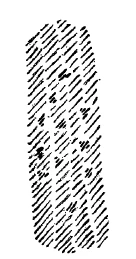
[ 17 ] What is the difference with regard to the essence of the human being? The human head is modeled from the cosmic ether after what we were in the spiritual world; the human head is a pure replica of what is most human, namely, the spiritual human being. Doubtful thoughts approach the head, but they find no place there. The head does not absorb them. They must pass through the head and descend into the nature of the limbs. In the nature of the limbs, they connect with everything that becomes granular in the human physical being—that which permeates this human physical being in a granular manner and thus takes on an atomistic nature. Doubtful ideas pass right through the head, as if it were permeable to them. The blood first absorbs these doubtful ideas; they are then carried down into the entire organism, primarily taken up by the metabolism, and only then handed over to the nervous system, where they live within all that is atomistic in human nature—that which is granular and that which is salty. With these elements, they connect in a particularly intimate way. The body absorbs the thoughts of doubt; they pass through the head. Only when we understand this particular nature of the human head—and that the substance of the head is not suited to thoughts of doubt, because the head is an image of truth itself, from which we come as we descend from the spiritual into the physical-earthly realm—do we grasp: Just as light passes through a transparent glass, so do doubting thoughts pass through our head, affecting the other part of the nervous system and causing turmoil in our metabolism. The head absorbs doubting thoughts only to the extent that it itself is of a metabolic nature. But it channels them through its special nervous organization and absorbs only the convincing thoughts.
[ 18 ] Convincing ideas find kindred forms everywhere once they penetrate a person’s mind. They find a home throughout the nervous system. They settle immediately in the human head and spread to the rest of the body not through the blood, but through the nervous system, which is, moreover, undergoing a kind of process of dissolution, so that their spiritual nature passes directly into the rest of the human being. But they find their home primarily in the head; they fill the head. And in the head, from the spirituality of the head’s form—including its inner structure—they take on a form appropriate for the whole human being and thus act as if they were intimately related to the human being, as if the human being himself were living within them, as if they were the human being himself. One might say: In the vivid images of the mind, the human head forms something that is particularly suited to the human being.
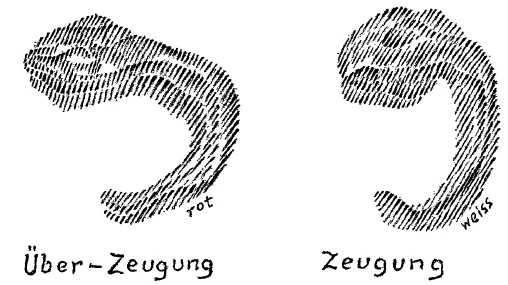
[ 19 ] Study the human embryo, and you will see that the head forms first, followed by the rest of the organism; for it is from the head that the forces emanate which form the rest of the body. When you take convincing ideas into your head, the spiritual process is as follows: they are first spiritually received in the head, and the head then sends them to the rest of the person. Just as the rest of the human being is physically formed in the embryo in the image of the human head, so here the spiritual aspect of the convictions and ideas of the rest of the human being is radiated, and a human being arises from this in a spiritual way out of the convincing ideas (left drawing, red). An inner image of the human being radiates within the person. And everything that permeates the human being—such as warmth—connects with what radiates from the human being in the form of convincing ideas. Just as doubting ideas take hold of everything granular, everything atomistic, so do convincing ideas take hold of the warmth flowing through the body—the first link of the etheric that permeates the entire human being—and do not penetrate any further into the physical.
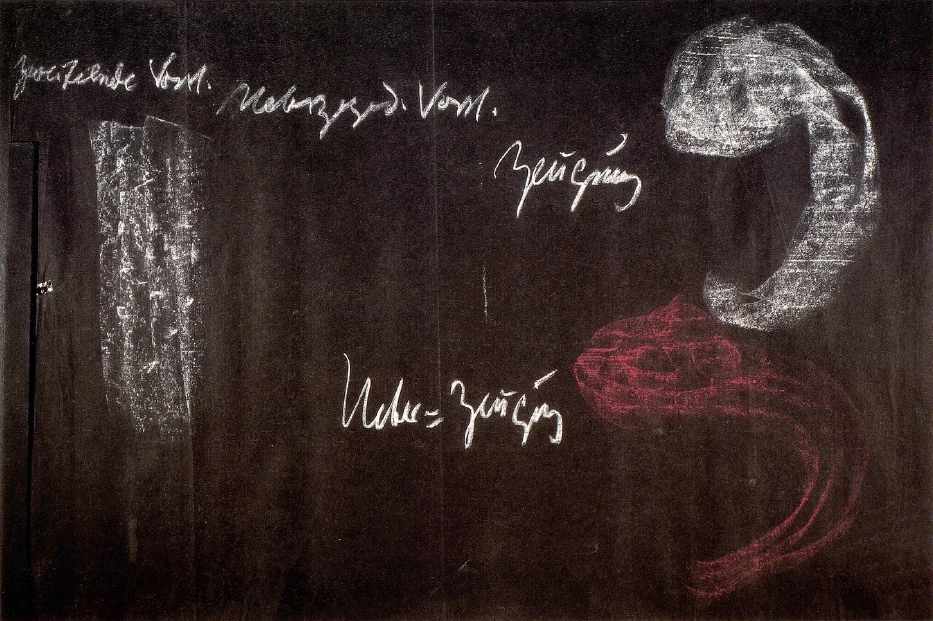
[ 20 ] Try to imagine the coexistence of doubting and convincing thoughts within human nature, and every time you feel and experience the comfort of a convincing thought and the torment of doubting thoughts, you will grasp the truth of the matter in your own life.
[ 21 ] I have often said that the spirit of language is a spirit that acts rationally. And if one attributes the natural embryo to procreation (drawing on the right, white), then it comes as no surprise at all that the formation here (on the left, red) is attributed to conviction. We must not regard these things as mere coincidences. They are the deeds of the reigning genius of language, who certainly knows more than any individual human being. I know that modern linguistic scholarship regards this as a mere trifle. But once one truly looks into the workings and weaving of the reigning genius of language, one will regard much of today’s philology and linguistics as mere trifles.
[ 22 ] But now consider what all this means. You get a picture of how two spiritual experiences—doubt and conviction—continue to influence the physical human being. You gain a perfectly comprehensible bridge from the soul-spiritual realm into the physical realm. You tell yourself: here is a physical human being; what he experiences soul-spiritually shimmers and ripples through the physical particles in his body—he is a skeptic, a doubter. You attribute it to the inner structure of his physical substance—how the spirit of doubt continues to vibrate in the soul and in the body. You look at the other person, in whom warmth flows calmly through the limbs, and you see in this calm flow of warmth the physical expression of devotion to convictions. You see in the human being a direct physical expression of the spiritual. Only then do you begin to understand the physical. Today’s chemist and physicist, when analyzing a human being, says: “Inside there is calcium, phosphorus, oxygen, nitrogen, and carbon.” — Yes, you will never find anything spiritual in oxygen, nitrogen, carbon, or hydrogen. Here, of course, Du Bois-Reymond is quite right when he says: “A collection of oxygen, nitrogen, and carbon atoms could not care less how they are arranged or how they move.” — Yes, if one views the matter in the body merely as carbon, oxygen, and so on, that is indeed the case. But if one knows how a substance acts within that is receptive to the spirit in the most diverse ways—a substance that is, in the head, a direct reflection of spiritual essence, and which, moreover, is connected to the earth so that the earthly holds fast there what is driven through the head as doubting ideas—then the possibility ceases to think that it is indifferent to our brain whether a certain number of carbon and nitrogen atoms, and so on, are arranged and move in a particular way. There we see how it is not indifferent to the substance whether a flow of heat pours into it or whether salt formation is at work within it, so that the body develops a tendency toward a granular structure. These are two opposites that find expression in matter and that originate in the spiritual. It is indeed the case that we did not arrive at materialism in the nineteenth century simply because people did not know the spirit. The materialistic age knew the spirit best in its most refined form, for all earlier ages did not actually have the spirit in its pure form; they always mixed material elements into the images of the spirit they had formed; these were images into which material elements were always mixed. It was actually the age of natural science that first brought about pure spiritual concepts. But what the age of natural science was forced to neglect is precisely the knowledge of matter as it really is—of the spirit within matter. What led us into materialism was an insufficient understanding of the material nature of the world and a lack of insight into the spiritual weaving and working within the material realm. Science became materialistic through ignorance of material effects. Because people did not know how the spirit works creatively, they imagined this spirit in increasingly abstract terms. As a result, moral obligations and ethical ideals ultimately became something about which one could not even ask where it was floating in space, because it did not even possess the materiality to float around. It was no longer there at all. Reaching out for it was much like trying to breathe in an element that isn’t there. Just as if a person were trying to breathe beneath the reservoir of an air pump—that is how the people of the 19th century appear to us! When, for example, they reach for moral ideals—they aren’t there; they want them, but they aren’t there, because people were unwilling to develop a concept of the influence of the spiritual-soul aspect on the physical-bodily realm. Hence all those curious theories arose about the interaction of the physical-bodily with the soul-spiritual, all of which were mere fantasies, whereas true understanding can only be gained through a precise examination of the facts.
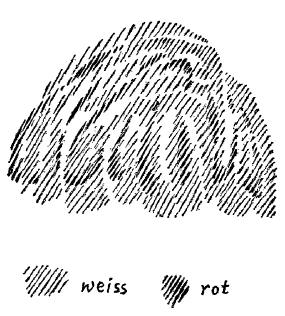
[ 23 ] Once we come to understand how doubt and conviction surge through and interweave with human nature, we are then able to recognize in the world what we have come to know about human beings. In the world, we have the sphere of material creation. We see, for example, how matter out there in the world must take on a granular form, how it crystallizes. Once we have come to understand how doubt within us seizes upon the granular aspects of the organism, we then learn to perceive doubt out there. We look at the mountain (white), which is formed of granular rock; but at the same time, we discover that this mountain is permeated by the very same force that we come to know within ourselves as doubt (red), and we come to know the creative power of doubt. The doubt within us makes us granular, precisely because we are human beings and not nature. Doubt out there in nature has the right effect. When what is at work out there in nature enters into us, it has the wrong effect. By stepping on the rocks, you are stepping on the physical manifestation of what the Divine sends forth as doubt so that the world may become granular. And conversely, when you study your convictions with a warm sense of immersion, you find yourself within that which is creatively emerging. So if you consider that, fundamentally, the warmth of the creative forces of the world is to be found in the bosom of these forces, then you will discover that what emerges from this warm matter is cosmic conviction.
[ 24 ] Only when you truly come to know these things within yourself will you also learn to judge the forces out there in the cosmos correctly. If you regard that which is crumbling and crumbling away out there—so that, in a sense, we already have before us the first preparation for the disintegration of our earthly existence into the cosmos—as manifestations of cosmic doubt, then you will come to understand much about cosmic existence. And conversely, if you are able to look into the cosmos with conviction, then you will come to know much about the creative. But these are merely things through which I wanted to hint to you how one must first know human beings in order to have any prospect of knowing cosmic existence at all.
[ 25 ] Well, you see, for Brentano in the 1860s, and for Nietzsche in the 1870s, the methods of the natural sciences were available; they found carbon, hydrogen, oxygen, nitrogen, phosphorus, a little sulfur, and so on in the brain. There was truly nothing spiritual to be discerned in that. And if one were to apply the method that had led to this conclusion to the spirit, one could naturally arrive at nothing other than either the spiritual impotence to which Brentano arrived, or the erosion of the spiritual, to which Nietzsche—who was more of a man of will—arrived. But both were subject to the fate that they could not move from the physical to the spiritual, because they could not find the spiritual within the physical, and therefore did not perceive the spirit as something powerful enough to bring the physical into being from within itself.
[ 26 ] Thus, such minds were confronted with a physical nature that was essentially meaningless, because it contains nothing spiritual anywhere, and with a spiritual nature that has no strength, no power. Such is the fate of the most eminent minds who, in the second half of the 19th century and at the beginning of the 20th century, found themselves confronted with matter devoid of meaning and with spirit devoid of power.
[ 27 ] Historians have spoken of “ideas” in history. That is spirit without power. You truly cannot place in the hands of ideas the cultural instruments through which culture arises, or through which historical events arise at all; ideas, as abstractions, are powerless—that is spirit without power. In contrast stands nature, which one studies only in its non-spiritual matter: matter without meaning.
[ 28 ] One will never find the bridge if, on one side, one invents the absurd—matter without meaning—and, on the other side, the spiritless—spirit without power. Only when one finds in the spirit the power—in conviction the power to drive warmth through the body, because the human being is organized in such and such a way—and when one finds in doubt the power to force one’s way through the head, because there is no affinity with the head, and to wear down the rest of the human being internally, so that he disintegrates into a granular structural tendency, that is, only when one finds within the spirit that which possesses the power both to dissolve the granular structure through warmth and to form it in the process of salt formation—only then does one find a substance in which there is meaning, because then the powerful spirit acts in such a way that precisely what appears before one’s eyes in the substance stands there as meaningful. And so we must seek substance with meaning and spirit with power.
[ 29 ] This is precisely what thinkers such as Brentano and Nietzsche, in their tragic fates and even in their personalities, point to.