

Human Questions and Cosmic Answers
GA 205
15 July 1922, Dornach
Translated by Steiner Online Library
Tenth Lecture
[ 1 ] It is, after all, something that should be taken into account: some time ago, opponents of the ideas presented at the Vienna Anthroposophical Congress convened a meeting at which a wide variety of speakers addressed the issues from the materialistic perspective of the present, and that, in the end, a particularly materialistically minded physician summarized the various speeches into a catchphrase intended to serve as a kind of motto for the opponents of anthroposophically oriented spiritual science: “The Struggle Against the Spirit.” — It is indeed the case that there are people today who regard the struggle against the spirit as a genuine motto.
[ 2 ] Whenever such a word is uttered, one is reminded time and again of how many people—kind-hearted, well-meaning people—there are today who are, in a sense, caught in a kind of slumber when it comes to what is happening in the civilized world, people who do not want to hear where things are headed. Matters of the utmost importance are regarded as insignificant passing trends, as the opinion of one person or another, whereas in fact, a striving that is present in the actual course of human development is clearly making itself felt today. And in fact, all those who are capable of understanding such a cause should be fully committed to it with all their hearts in order to truly bring it about.
[ 3 ] Building on the examples of these two figures, I have now attempted to show how it was precisely the more profound minds that were situated within the newer intellectual currents. I have contrasted these two figures—Franz Brentano and Nietzsche—to illustrate how people who are initially thoroughly oriented toward the spiritual are, in a sense, subsumed by the contemporary scientific way of thinking from a wide variety of angles. When one looks directly at figures for whom what I have indicated is their fate, one may perhaps be moved even more deeply than when such things are presented merely as abstract characteristics.
[ 4 ] In the case of Brentano, I wanted to illustrate how a person who grew up with an education shaped entirely by Catholicism retained, on the one hand, throughout his life, what Catholic Christianity had instilled in his soul in terms of a devotion to the spiritual world. It is precisely in Franz Brentano—who was born in 1838 and thus lived at a time when the 19th-century scientific way of thinking was overwhelming all human research and spiritual striving—that we see what endures from very ancient currents of worldview.
[ 5 ] When we look at the young Brentano, who studied in Catholic seminaries in the 1850s and 1860s, we see how his soul was filled with two things that initially guided him in a sure way. One of these is the Catholic doctrine of revelation, to which he held the same position as the theologians of the Catholic Church had held since the Middle Ages. The Catholic revelation concerning all spiritual matters is accepted as tradition. One finds oneself immersed in a kind of knowledge of the supersensible worlds bestowed upon human beings through grace. For Brentano, this was then combined with the other element through which he initially sought to understand what he had thus received through the Catholic doctrine of revelation. This was Aristotelian philosophy—the philosophy that had taken shape in ancient Greece. And until the mid-1860s, perhaps even a little longer, Brentano’s inner life was entirely in the spirit of a medieval scholastic: One must accept what human beings are to know about the supersensible worlds as the Church reveals it, and one may apply thought to the investigation of nature and life according to the guidance of the greatest teacher for such inquiry, according to the guidance of the Greek philosopher Aristotle.
[ 6 ] These two things—Aristotelianism and Catholic revelatory knowledge—were, after all, intertwined in the inner lives of the medieval scholastics, who regarded them as compatible. This tradition lived on in Franz Brentano. He was shaken in this view by what he encountered as the scientific method—so deeply shaken, in fact, that when he took up his position as a private lecturer in Würzburg, he posited as a central thesis that all philosophy must proceed in the same way as the natural sciences. And he then sought to establish a psychology—a theory of the soul—in which the life of the soul is viewed in the same way that the natural sciences view external natural phenomena.
[ 7 ] So one can certainly say: A truly radical transformation has taken place in this person. He wanted to integrate revelatory knowledge with rational knowledge—which is limited solely to the earthly realm—that is, the claim that science can only be that which is formed according to the model of the scientific method. One should really take a moment to reflect on what such a radical transformation actually means.
[ 8 ] What I would now like to draw your attention to first is that, up until this turning point, the medieval scholastic worldview still shines through in an extraordinary personality. This perspective continues to exert an influence, just as it does today among many of our contemporaries who are sincere adherents of Catholicism, and just as it is, in essence—albeit in a somewhat different form—present in many sincere adherents of the Protestant confessions. The reason I cited Nietzsche is that, while Nietzsche certainly did not harbor a survival of medieval scholasticism in his soul, something else lived on within him—namely, what later emerged during the Renaissance as a kind of reaction to scholasticism. Nietzsche possessed a kind of Greek artistic wisdom that formed the foundation of his entire worldview. He possessed it in much the same way as the people of the Renaissance did. But those Renaissance people by no means already had the urge or inclination to deny the reality of the spiritual. They still sensed and felt the reality of the spiritual. So that even in Nietzsche, something from time immemorial lived on in his soul. And he, too—as I told you yesterday—had to immerse himself in the 19th-century scientific worldview and completely lost what connected his soul to a spiritual world.
[ 9 ] What is implied here raises profoundly significant questions for the true seeker of truth in the present day. Let us consider the two spiritual currents that permeate the life of the soul, as found in medieval scholasticism. Let us illustrate what is actually at work here. I would like to do so in the following way. Within medieval scholasticism, we have a number of, let us say, doctrines concerning the supersensible world—for example, concerning the Trinity of the spiritual Primordial Being, concerning the Incarnation of Christ in the body of Jesus of Nazareth—that is, a whole series of doctrines of which it must be said that they refer not to the sensible but to the supersensible world, and which were discovered in very ancient times by people who were, at that time, initiates. For one must not, of course, imagine that something like the doctrine of the Trinity or the Incarnation was simply invented by someone in order to deceive people. Rather, these doctrines are the results of experiences and insights gained by the initiates of old. The fact that they were regarded as a supernatural revelation is only a later perspective. Such doctrines were originally discovered through the process of initiation. Later on, people simply stopped admitting that one could undergo such an initiation and, for example, arrive at the concept of the Trinity on one’s own.
[ 10 ] Something only becomes a dogma when one no longer has access to the source of one’s knowledge. If someone is an initiate and beholds the Trinity, it is not a dogma for them, but an experience. If it is claimed anywhere that one cannot perceive such a thing, but rather that it is revealed and must then be believed, then it is a dogma. Contempt for dogmas as such is, of course, not justified; rather, it is merely a certain attitude people have toward dogmas—and that is what is open to challenge. If one can trace dogmas that have a deep spiritual content back to the form in which an initiate once expressed them, then they cease to be dogmas. But this path—which a person must traverse to reach the place where one perceives these things—was no longer followed in the Middle Ages. People had old doctrines that were once the wisdom of initiation. They had become dogmas. One was now simply supposed to believe them. One was supposed to accept them as revelatory knowledge. So that was one current: revelatory knowledge. The other current was rational knowledge—that which the medieval scholasticists studied in the spirit of Aristotelian doctrine. But people thought of it this way: Through this rational knowledge, one can explore nature to a certain degree. One can also draw logical conclusions from this knowledge of nature—for example, the conclusion that there must be a God. One cannot discover the Trinity, but one can arrive at the rational conclusion that there must be a God, that the world had a beginning. That, then, was rational knowledge.
[ 11 ] There were certainly conclusions that medieval scholastics attributed to rational knowledge, which came close to the supernatural; however, they did not acknowledge the perception of the supernatural. But rational conclusions were acknowledged—conclusions through which, while one could not understand the actual insights of revelation, one could nevertheless approach such things as the existence of God or the origin of the world. These truths, which could be discovered through reason and which could then serve as a foundation for penetrating to that which could not be explored by reason alone—but which was to be the content of revelation—were called *Präambula fidei*.
[ 12 ] Now that we have juxtaposed these two currents of thought, these currents of knowledge, let us put ourselves in the mind of a person who juxtaposed them within his own soul. During the period when Scholasticism flourished—as I have often stated over the years—what lived within a Scholastic was by no means the terrible thing that uninformed people speak of today; rather, at a specific stage in medieval development, it was simply what was required by the course of human evolution. At a certain time, it was impossible to hold any other view. Today, of course, these things are outdated. Today, we must find different paths to knowledge and to the activity of the human soul than those that were characteristic of Scholasticism. But that is precisely why we should still strive to penetrate scholasticism with understanding. And this is possible only if we ask ourselves now: How did revelatory knowledge coexist in the soul of an honest scholastic alongside rational knowledge directed toward natural phenomena and one-sided rational conclusions drawn from those phenomena? How did these two things coexist?
[ 13 ] What did such a scholastic—and with him, indeed, all his faithful, all those who were sincerely committed to Catholicism—actually want when he put himself in that state of mind that was oriented toward revelation, when he said: “One must not try to comprehend what the dogmas teach; comprehension is not possible; one must accept them as revelation”? The scholastic sought to evoke a certain state of mind toward the supersensible world. He was completely imbued with the conviction that this supersensible world exists and stands in an intimate relationship to what lives within the human being as the soul. But within the human being, he did not seek a path of knowledge to reach, directly through one’s own personality, that which, as the supersensible world, stands in an intimate relationship to the human being.
[ 14 ] Imagine this atmosphere. It was the atmosphere surrounding, I would say, a familiar stranger, an unknown acquaintance—someone one is supposed to worship and revere, yet toward whom one should remain shy, so that, in a sense, one does not dare to look up at him.
[ 15 ] Alongside this stood rational knowledge. Scholastic reason was extraordinarily acute—something that has not been matched since. One might wish—and I have often expressed this here as well—that people who are engaged in the natural sciences or science in general today would learn to think as sharply as the Scholastics were able to. It was a rational understanding that denied itself the ability to go beyond certain limits: revelatory knowledge on the one hand, rational understanding on the other. But if we consistently compare the revelatory knowledge and rational understanding of the Scholastics with similar concepts of today, a great difference becomes apparent.
[ 16 ] The scholastic said to himself: You must not use your knowledge to intrude into the realm from which you are to receive only revelations. You must not, for example, venture into a contemplation of the Trinity or a contemplation of the Incarnation.” — Yet in the revelation he received through his Church, ideas about the Trinity and ideas about the Incarnation were indeed present. They were described. People said to themselves: Knowledge does not extend to these things, but one can think about them if one simply reflects on these matters in accordance with what has been revealed. One cannot say of the medieval Scholastics that they had merely a vague, mystical sense of the supernatural. That was not the case. It was, in fact, a form of thinking developed into vivid ideas that encompassed the content of revelation. People thought about the Trinity; they thought about the Incarnation. But they did not think in the same way as they do when they arrive at their own thoughts, but rather as one thinks thoughts that are revealed to them.
[ 17 ] You see, this, too, corresponds to a certain aspect of higher knowledge. Even today, there are still people who hold certain atavistic-clairvoyant views—as one might call them—who have dreamlike imaginings. There are certainly people who, for example, can rise through such atavistic-clairvoyant imaginings to a perception of the events of Atlantis. This still exists today. Do not for a moment believe that there are no thoughts alive in what such people experience as clairvoyant imaginings. Such clairvoyants often have much more vivid thoughts than our peculiar logicians, who learn to think through today’s educational system. Sometimes one might despair of the logic of those who learn to think through today’s educational system, whereas one need not despair of the logic that simply reveals itself in an atavistic-clairvoyant way; for that is often very rigorously developed.
[ 18 ] Thus, even today, one can still demonstrate how thought is already present within what is truly revealed in the supersensible realm for human perception. This was also the case in medieval scholasticism. It is, after all, a view of more recent times that one should, along with knowledge, also eliminate thoughts from the content of revelation, so that faith today seeks to distill not only knowledge but also thought from its content. The medieval scholastics did not do this. They did distill knowledge, but not thought. If you therefore examine the dogmatics of medieval scholasticism, you will find a highly developed system of thought within it.
[ 19 ] This lived on in a man like Franz Brentano. That is why he was able to think. He was able to formulate thoughts. One can see this even in the rudiments of his psychology, which he managed to complete only up to the first volume. There one can still see that he possesses a certain inner plasticity in the formation of thought, even though he constantly trips over his own feet in a terrible way and thus fails to make progress. As soon as he has any thought about a psychological structure—and he does have such thoughts—he immediately forbids himself to think about these things. This self-imposed prohibition is, of course, something extraordinary today. I have told you how an extraordinarily witty man, who wrote the significant book *The Whole of Philosophy and Its End*, recently said to me in Vienna: “I have my thoughts about what lies behind mere events as the primal factors.” But scientifically, he forbids himself from having these thoughts. One could quite well imagine—hypothetically, of course—that a person trained in the natural sciences today might, by some miracle, suddenly become clairvoyant, and that he would fight this clairvoyance within himself in the most vehement way. One could quite well imagine this hypothetically, because the authority of knowledge that clings to the external is immense. So that was one thing that lived in the soul of the medieval scholastic: a concretely shaped content of revelation. On the other hand stood a rational understanding that was directed toward nature, but which was not yet like our modern understanding of nature. To confirm this, just open a book on the history of natural science, for example by Albertus Magnus; there you will likely find natural objects as they are described today—though they are described differently than we describe them today—but alongside them you will also find all manner of elemental and spiritual beings. Spirit still lives in nature, and it is not the case that only the very dry, sensory appearance is described as natural history and natural science. These two things thus coexist: a content of revelation—which we forbid ourselves to know but which we nevertheless conceive, so that the human spirit still attains it in its thoughts—and a content of rational knowledge, which still possesses spirit but also has something that must be observed if one wishes to have it before oneself in its reality.
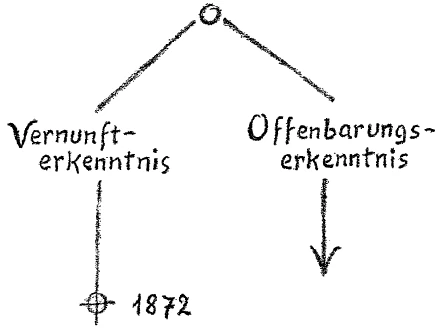
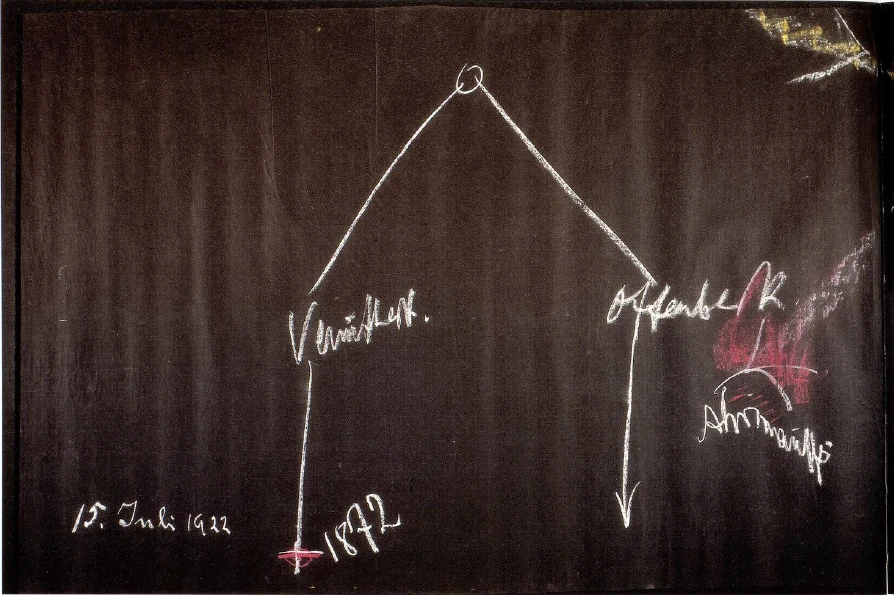
[ 20 ] The understanding of nature has indeed evolved from medieval scholasticism. One branch of scholasticism—rational understanding—has developed further and become the modern view of nature. But what has happened as a result? Imagine the ideas about the understanding of nature held by a scholastic philosopher quite vividly. There is still spiritual content there. What, then, did this spiritual content protect the medieval scholastic natural scientist from?
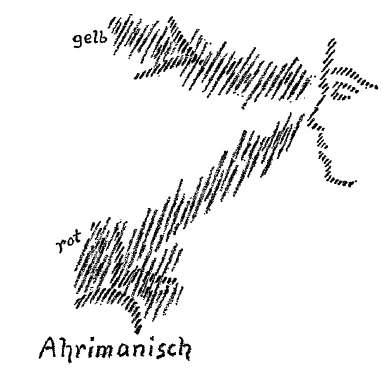
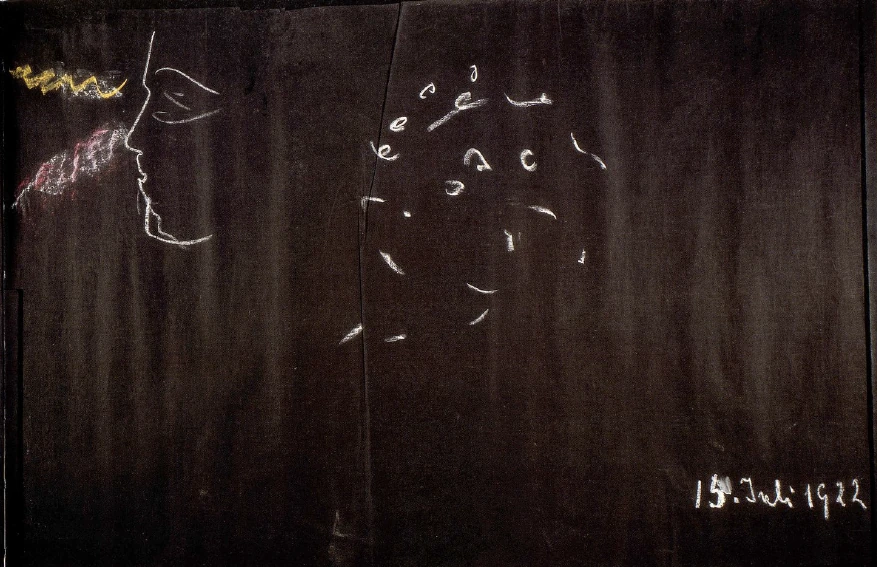
[ 21 ] Perhaps I may illustrate this schematically. Suppose this here was a medieval scholastic with his longing for revelatory knowledge directed upward and his longing for knowledge of nature directed downward. But he finds the spiritual in his knowledge of nature. I’ll highlight that in red. His knowledge of revelation contains thinking. I’ll highlight that in yellow. Where, then, does this rational knowledge actually aim? It aims outward toward the objects, toward the things around us. The thoughts one forms are meant to snap into place with the objects. You won’t want to recognize just any plant or form a concept of the plant without expecting that the concept will snap into place—it wants to snap into place. But for the scholastic, the spiritual content that still permeates his rational knowledge prevents him from truly snapping into place down there. It does not snap into place completely; it is, so to speak, thrown back somewhat. Into what does it not snap? For when today’s intellectualistic rational knowledge snaps into external nature—when it snaps in fully—it snaps fully into the Ahrimanic. So what does the spirituality of the medieval Scholastic mean in relation to his rational knowledge? That, fundamentally speaking, he wants to approach this rational knowledge as if it were something that burns just a little. But he feels the burning and keeps pulling back: Nature is sin! — He guards himself against Ahriman! But this is what further development has brought about: In the nineteenth century, it cast everything spiritual out of rational knowledge, and thus rational knowledge snapped into the Ahrimanic.
[ 22 ] And what does this rational understanding, which has become entangled in the outer Ahrimanic realm, actually say? It says: The world consists of atoms; atomic motion forms the basis of all scientific knowledge. It explains heat and light as atomic motions; it explains everything in the external world as atomic motions, for this satisfies our need for causality.
[ 23 ] In 1872, Da Bois-Reymond delivered his famous speech in Leipzig on the limits of knowledge of nature. It is the speech in which scholastic rationalism had advanced so far that everything spiritual had been cast aside; and with the motto “Ignorabimus,” the human spirit was to be snapped into the Ahrimanic. And Du Bois-Reymond describes very vividly how a human mind, now having an overview of all the atoms swirling throughout the universe, sees neither green nor blue—no colors at all—but perceives only atomic movements everywhere. He feels no warmth, but wherever there is warmth, he senses that movement I spoke to you about here eight days ago. He blocks out everything—all colors, states of warmth, sound, and so on. He fills his mind with a perception of the world consisting solely of atoms. Just imagine: such a mind conceives the entire world as consisting of atoms. He has this in his mind: Even at the very moment Caesar crossed the Rubicon, there was this specific constellation of atoms in our cosmos. Now he only needs to be able to set up the differential equation, and so, by continuing his calculations, he finds the next constellation, then the next, and so on. He can calculate the most distant future. Du Bois-Reymond called this—since it was also one of Laplace’s ideals—the “Laplacian mind.” So there we have, in 1872, a description of an intellect that comprehends the world universally, that understands that everything is atomic motion, and that one need only know the differential equations and then integrate them to arrive at the formula for the universe.

[ 24 ] But what has actually been achieved by this? What has been achieved is that one has learned to think in the way Ahriman thinks, in accordance with the Ahrimanic ideal of thought. One can only begin to recognize the full significance of what is happening in our time once one knows what it actually is. The “Ignorabimus” speech will be placed in the history of modern spiritual development, but one will only recognize its true value and significance when one is able to show that one branch of the scholastic spiritual current has indeed branched off into the Ahrimanic. You see, the scholastic, so to speak, kept his knowledge in a state of limbo. It did not quite reach what is out there. He always withdrew from Ahriman with his knowledge. Because of this, he had such a pressing need to develop truly incisive concepts; for incisive concepts must still be formed through human skill. Conducting experiments—well, there one needs human skill only to assemble the apparatus and so on, but a mode of thinking as subtle as that of Scholasticism is not part of it.
[ 25 ] This marked a very important turning point once one had become entangled in the Ahrimanic. For what you see out there as the sensory phenomena of the world—as your sensory environment—exists only as long as the Earth exists. It will perish along with our planet Earth. What lives on are the thoughts that become embedded in the outer world. When something is thought—such as what lies at the heart of Laplace’s thinking, or what Du Bois-Reymond presented as an ideal of scientific thought—this does not merely mean that it is thought; rather, these are real thoughts that become embedded in the outer world. And when everything we perceive with our senses on Earth has perished, these thoughts can live on—unless they are eradicated beforehand. Therefore, there is a very real danger that, if such thinking becomes the prevailing mindset, our Earth will transform into a planet that corresponds to the materialists’ conceptions. Materialism remains a mere doctrine only as long as it does not become reality. But the Ahrimanic forces strive to make the ideas of materialism so strong and widespread that what ultimately remains of the Earth are the atoms.
[ 26 ] When we say today that we must explain everything in terms of atoms, that is a mistake. But if everyone begins to think that everything must be explained in terms of atoms—if everyone adopts a Laplacian mindset—then the Earth will truly come to consist of atoms. It has not been true since time immemorial that the Earth consists of atoms and their constituents, but humanity can bring this about. That is the essential point. Human beings are not merely predisposed to hold false views; rather, false thoughts create false realities; when false thoughts become widespread, realities come into being.
[ 27 ] This Ahrimanic danger has already made itself evident today. The other danger in revelatory knowledge was one that the medieval scholastic sought to avoid by keeping revelatory knowledge clothed in thought. It was concrete thoughts that grasped the content of revelation. The dogmas were gradually given so little thought that people came to abandon them altogether in general. One is supposed to let go of what one does not understand—which is, on the one hand, entirely justified—and if people can no longer pursue the dogmas to the point of vision, it goes without saying that they will let them go. But what do they arrive at then? They arrive at the most abstract of thoughts—a dependence on some entirely indeterminate Eternal or Infinite. Then thoughts that carry the content of revelation within them are no longer formed in a concrete way; instead, only some vague, mystical sense of dependence on some Infinite is felt. Then the content of thought disappears. This path has also been taken in modern times. It is the one that leads toward the Luciferic. And just as surely as the path of rational knowledge has led to the Ahrimanic in modern times, so surely can the other path lead into the Luciferic.
[ 28 ] And now consider once more, in the sense I have described, a mind such as Franz Brentano’s. Franz Brentano approaches nature entirely with this mindset: Under no circumstances touch Ahriman! — and the supersensible world: Under no circumstances touch Lucifer! — In other words, under no circumstances become atomistic, under no circumstances become a mystic; it is with this attitude that he approaches natural science, which is such a powerful authority that he submits to it. He describes the phenomena of the soul in accordance with the scientific method. Had he come from a more superficial starting point, as many of today’s psychologists do, he would simply have written an Ahrimanic theory of the soul—a psychology, a “theory of the soul without a soul.” He could not do that. Therefore, he abandoned the project after the first volume and did not write the subsequent volumes—there were to have been four—because there was something within him that simply would not allow him to conceive of plunging entirely into the purely Ahrimanic realm.
[ 29 ] And take Nietzsche. Nietzsche, too, was captivated by the natural sciences. But how did he approach the natural sciences? He didn’t really concern himself much with the individual methods; rather, he focused solely on the scientific way of thinking in general. He told himself: Everything psychological is rooted in the physiological; it is “human, all too human.” What should actually be divine-spiritual ideals is an expression, a revelation of the human, of the all-too-human. He rejected precisely that kind of knowledge found in Brentano: rational knowledge. He allowed the will to become active within himself. And, as I said yesterday, he eroded the ideals; he eroded the spiritual. This is the other phenomenon in which a personality, so to speak, approaches the Ahrimanic but comes up against it. Instead of snapping shut, he strikes against it. He would also like to develop atomism, but he strikes against it as if against a wall.
[ 30 ] And so we see how such spirits in the 19th century develop their particular spiritual disposition, because they come so infinitely close to what enters our consciousness as Ahrimanic forces. It is the fate of such spirits in the nineteenth century that they come so incredibly close to Ahriman. And then they either find themselves in a situation like Brentano’s, where they timidly retreat right at the threshold and do not proceed any further with their insight, or they begin to lash out like Nietzsche. But it is the Ahrimanic power that brought its waves to the realm of knowledge precisely in the nineteenth century, which then carried over into the twentieth century. And this is what one must understand. And the original spirits who, in the nineteenth century, personally experienced this still half-veiled encounter with Ahriman had this tragic fate looming behind them. But the students—they were now given the thoughts that had already been prepared. These thoughts live within them. The Ahrimanic power had already shaped these thoughts. The first original spirits recoiled; the students received the incomplete Ahrimanic thoughts. These are now at work within them: “Struggle against the spirit”—against the spirit that refuses to surrender the Earth to the Ahrimanic forces—hatred of the spirit, struggle against the spirit!
[ 31 ] Today, one must view this as a genuine connection. This lives on today as a zeitgeist, as a state of mind. One must understand it in order to truly grasp how necessary it is to assert a genuine spiritual worldview in all the various cultural forms in which such a worldview must find expression.