

Human Questions and Cosmic Answers
GA 205
1 July 1922, Dornach
Translated by Steiner Online Library
Fourth Lecture
[ 1 ] What I presented yesterday, in a sense, provides the external perspective on what I now intend to discuss today.
[ 2 ] Yesterday I tried to show how human beings form a whole with the universe and how, in particular, what exists within human beings is connected in a wide variety of ways to processes and essences of the cosmos. If today’s discussions are not to seem completely without foundation to you, you must now view them in conjunction with what was presented here last Sunday and yesterday.
[ 3 ] One can view a human being by, so to speak, looking at them from the outside—either based on ordinary appearance or, let’s say, through anatomy and physiology, which is also a form of external observation. But one can also view human beings from the inside; then they reveal themselves to us through their soul qualities and their spiritual powers. When we consider the whole that human beings constitute together with the cosmic world, we can likewise view it from two aspects, only these aspects will be the reverse of those in the individual human being. With the individual human being, we speak of the outside and the inside. If we speak of the universe and of the human being merely as a part of the universe, then there must surely be the natural sense that we must reverse our use of these terms. By first considering the purely spatial existence of the universe, we stand within this existence; we look outward, so to speak, from our own vantage point. Thus, when we speak of the universe from the human standpoint, we are speaking of the inner aspect of the universe. We are, in fact, situated at some point within it. From this point, the universe presents its sensory aspect to us.
[ 4 ] Human beings present their physical aspect to us when we view them from the outside; they present their spiritual-soul aspect to us when we view them from the inside. The universe presents its soul-spiritual aspect to us when we view it from the outside. The terms we must use here are difficult, for they are almost entirely uncommon in contemporary language. With contemporary language, it is simply not possible to penetrate directly into the spiritual realm. The words must first be coined appropriately in every context. To attempt to study spiritual-soul matters by simply applying words in their ordinary sense is an absurdity.
[ 5 ] If we want to visualize what I have just tried to characterize—I would say, schematically—then we must put it something like this: When we consider a human being, we speak of their outer appearance as that which presents itself to the senses. When we look at them from within, we speak of their soul-spiritual nature. With the universe, with the cosmos, we must conceive of the opposite: We are at some point on the inside, and there the sensory appearance presents itself to us. If we can now view the world from the outside, then the soul-spiritual aspect reveals itself to us. The question, of course, is simply: Can one view the world from the outside?
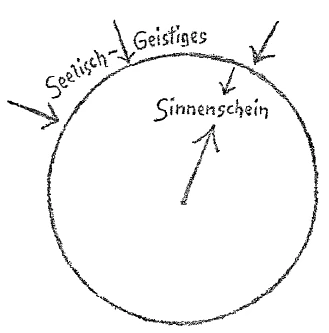
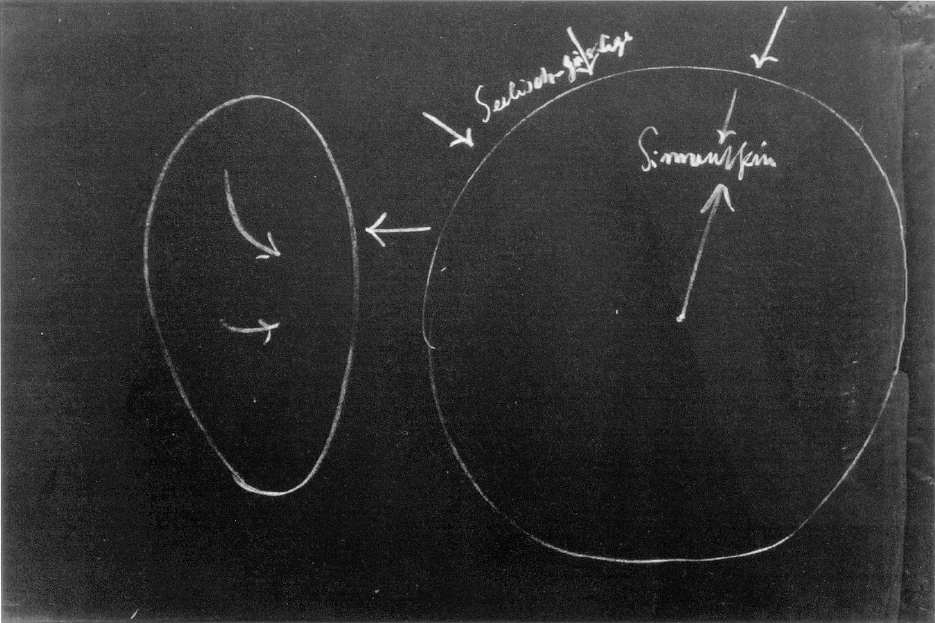
[ 6 ] Well, as we know, human beings alternate between the states in which they live between birth and death and those they experience between death and a new birth; and it is indeed the view of the world, the universe, the cosmos from the outside that is presented in the states between death and a new birth. If you read in my Theosophy what I have described regarding the conditions that human beings experience between death and a new birth, you will find descriptions there that already sufficiently indicate how the use of language must change.
[ 7 ] Now, the world in which we find ourselves between birth and death is already diverse enough. But it becomes much more diverse, much richer, when we consider it in the life between death and a new birth. Of course, whenever such a description is given, only individual, selected aspects can be presented, and I have always endeavored to add more and more to the things that were initially presented in a basic way. Today I would like to speak about the spiritual-soul aspect of what I described yesterday as the sensory-physical aspect—that is, what the cosmos looks like from within. Today I would like to describe it from the outside, as it appears when viewed from a spiritual-soul perspective that lies along the path of experience between ‘death and a new birth.’
[ 8 ] You know, of course, from the various discussions that have taken place here that such an observation is necessary, and you also know that an ordinary logical discussion of the matter could not possibly correspond to reality. Therefore, one must simply accept the insight that presents itself when the methods described in anthroposophical literature are applied.
[ 9 ] It is only gradually that human beings come to adopt a clear perspective outside the sensory-physical cosmos. Once they have attained this perspective—which can only happen some time after death—only then are the questions resolved for them that cannot be resolved within the realm of intellectual activity we engage in while in the body. Questions such as these have always played a role in philosophical discussions: Is the spatial world, the spatial cosmos, finite or infinite? One can discuss this as much as one likes—in this regard, Kant’s Critique of Pure Reason is correct—but one will never reach a conclusion regarding questions such as the spatial or temporal limits of the world through a discussion conducted solely within the physical body. One might just as well prove the finiteness as the infinity of the world. These questions can only be resolved when one can actually shift one’s perspective, when one is able, so to speak, to view the world from the other side—that is, not from a point within, but from the outside looking in. In fact, at least in the intermediate stages between death and rebirth, one is beyond the boundary of the sensory-physical cosmos. One can only say: The boundary of the sensory-physical cosmos lies precisely in the middle of what one sees here from the earthly standpoint and what one sees in the life between death and a new birth.
[ 10 ] It is indeed true that part of wisdom lies in knowing which questions, though raised within earthly existence, cannot be answered within that existence, because thought there is limited to the physical foundations of the body. Such questions can only be answered when a person, outside of this physical existence—either through initiation or through death—is able to change their perspective.
[ 11 ] Well, if one actually changes these perspectives, then experiences arise that one would not initially expect. If one stands here at any point in earthly existence and gazes upon the cosmos, it is a single cosmos. It appears to one as a single cosmos. We speak of our solar system as a unified cosmic world. I will now limit my observations to our solar system. When one changes one’s point of view, no single point from the outside comes into consideration at all; point-like existence ceases completely—not for the inner life of the soul, but certainly for the outer spatial realm—and the point increasingly becomes a circle. When one is out there, it ceases to make sense to speak of a world—that is, for example, of a single solar system. At the very moment we undergo this reversal of life—through which, in the disembodied state between death and a new birth, we are able to look back upon the world in which we find ourselves here, that is, to observe its spiritual and soul aspects from the outside—at that very moment, it ceases to make sense to speak of a single solar system. There are, in fact, countless solar systems—as many solar systems as there are human souls inhabiting the Earth. — I am describing only the outer experience; I am describing only what presents itself to experience. So this, too, is completely reversed: Here we have the distinct feeling that we are standing in a physical-sensory world. The moment we view this physical-sensory world from a spiritual-soul perspective, it no longer makes sense to speak of a single unity; rather, there are as many such worlds—and thus as many suns—as there are human souls connected to the Earth. But there is also something else present as a surprising experience. When we look back at the Earth from the outside, human nature—the human being—also appears to us. I myself have already dared to suggest in public lectures that when we, as human beings, stand between death and a new birth, we—while looking out from here on Earth into the cosmos—are actually looking in from the outside; but what we behold there is the inner being of the human being. So, when we approach earthly life again, our outer world is actually the organic inner world—not the soul, but the organic inner world of the human being. We see this constantly when we look back from the outside at the cosmos in which we exist between birth and death. We look back upon human nature. We never actually lose human nature. When we die, the sight of human nature remains with us; it’s just that we no longer experience it from within. We are no longer immersed in it as we are between birth and death, but rather we experience it from the outside; we look at it from the outside. But the peculiar thing is that the diversity of human beings disappears when we emerge from that realm. And while we behold many cosmic forms—as many as there are human souls connected to the Earth—when we look back at the Earth, in terms of time and space, we see the human being only once. Between death and a new birth, there are many worlds and only one human being.
[ 12 ] You see, without thoroughly and meditatively considering this from all angles—for it is of immense significance—one cannot truly arrive at a complete understanding of this radical difference that exists in the worldview between the experience within the cycle of birth and death and the experience between death and a new birth. Within the cycle of birth and death, we experience one world and many people; within the life between death and a new birth, we experience many worlds that constitute our present unified world, and only one human nature. When we look back from our life between death and a new birth onto earthly life, people are not present in a manifold way; rather, all people are contained within a single human nature. So everything is truly completely reversed, and attention must indeed be drawn to this radical reversal. For it is absolutely necessary to clearly confront oneself with the fact that it is impossible to form adequate conceptions of the spiritual world without adopting completely transformed concepts. It is simply not possible to gain true insights within the comfortable methods people usually employ to form ideas about the spiritual world. One must be willing to transform one’s ideas thoroughly—indeed, to the point of complete reversal. This is precisely what many people do not want, and hence the struggle against a true science of the spirit.
[ 13 ] Yesterday I showed you in more detail how the human being relates, on the one hand, to the solar principle and, on the other hand, to the lunar principle, as well as to the individual planetary beings. All of this was discussed from the perspective of Earth’s evolution. I told you about the human being’s relationship to the Venusic being, the Mercurial being, and so on; I told you that through modern spiritual science we are once again arriving, in a completely independent way, at insights that were cultivated in an ancient, dreamlike, inspired wisdom within the ancient mysteries. Everything I presented to you yesterday is simply a description of the matter from one particular perspective. As long as we try to gain knowledge only in the way that the initiates of the ancient mysteries did within the life span between birth and “death,” or as it is done today, we will continue to form, for example, the kinds of conceptions about our planetary world that I described yesterday. But the moment we step outside—when we stand, so to speak, outside this cosmos in which we live between birth and death—and observe the spiritual-soul realm from the outside, at that very moment all the individual things we described yesterday reveal to us their other aspects as well, their reversal.
[ 14 ] We said yesterday: When we consider the Mercury-like aspect in the world—whether material or planetary—we find the force that permeates the universe, helping human beings to take possession, through their spiritual and soul-life, of the solid components of their organism. The Venusian aspect enables the human being to take possession of the fluid elements of his organism, and so on. The moment we now reverse this entire perspective, all these qualities also appear to us in a different light. Then, first of all, when we look—leaving Neptune and Uranus aside—at the outermost part of our planetary system, at Saturn, so to speak from the other side of existence, and consider the Saturn beings, we gain the opportunity to see not what we spoke of yesterday: that Saturn helps human beings to maintain their spiritual-soul life in the face of chemical processes—which is precisely the aspect seen from here, from Earth—but when we view it from the other side, we come to know, through all the faculties we possess between death and a new birth, the true instinctual life of the human being. The instinctual life within the human being, which wells up from the depths of the subconscious, cannot in fact be fully understood in terms of its true nature through the faculties that are attained only here on Earth; rather, it must be understood either between death and a new birth or through higher supersensible knowledge—namely, in the science of initiation.
[ 15 ] One can therefore say: If one looks at the Saturn being here on Earth with the spiritual eye, one gains an understanding of the forces that help human beings feel themselves as independent spiritual-soul beings in the face of the chemical processes at work within their organism. If we look at this Saturnian existence from the outside in its spiritual-soul aspect, it reveals to us the forces in the cosmos that implant instincts into human nature.
[ 16 ] And the Jupiter nature (see diagram on page 70) represents everything in human beings that is already present in a more spiritual way than the instincts themselves; that is, what exists in human beings as inclinations and sympathies; for while the instincts are still entirely animal in nature, the inclinations are already of an animal-psychic nature.
[ 17 ] The Mars nature represents everything that, while not moral precepts one imposes on oneself internally, is nonetheless—I would say—impulses arising from the entire characterological makeup of the human being. Whether a person is courageous in their moral actions or whether they are careless depends on the forces one comes to know when viewing the Mars order from the other side; that is, not the fully conscious, moral impulses that I described in my Philosophy of Freedom as rooted in pure thought, but rather the impulses that are still marked by a high degree of unconsciousness.
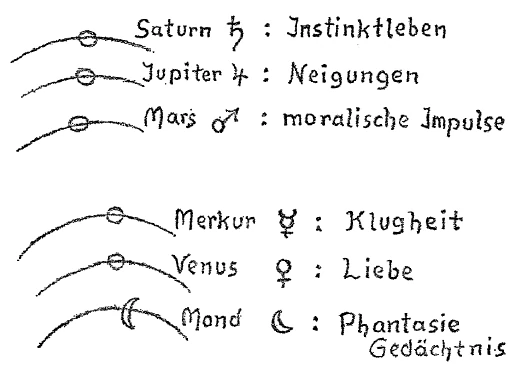
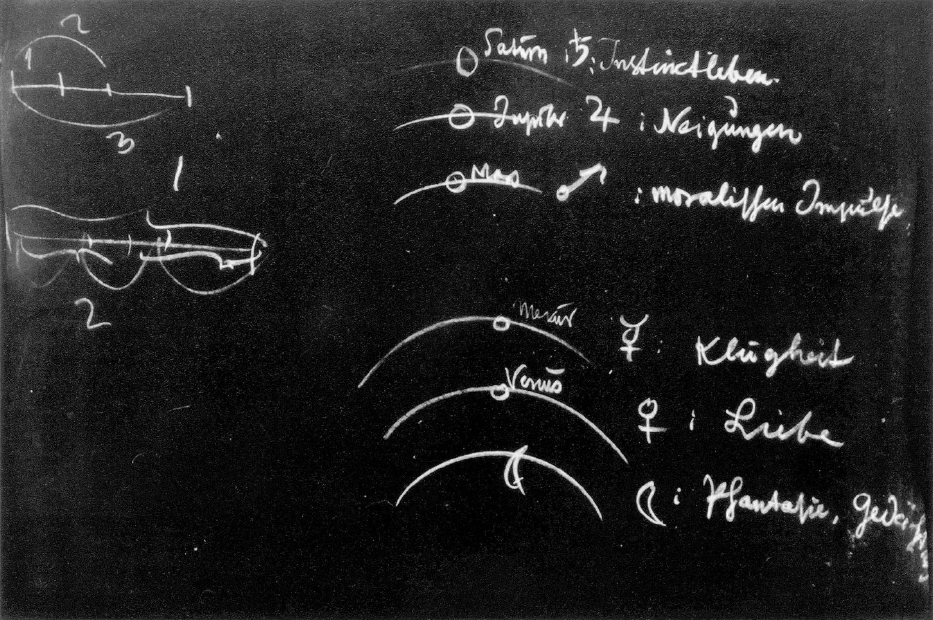
[ 18 ] So that when one considers the connection between human beings and these outer planets, one finds what relates more to the virtues within human beings, which, in a certain sense, are nevertheless bound to the human organism. What one is born with comes from the cosmos, from the universe; what manifests more instinctively—what, so to speak, bubbles up instinctively from the entire organism—is Saturnian. What bubbles up as inclinations and emotions is Jupiter-like. That which bubbles up as directly active, initiative forces, yet remains bound to the organism, is Mars-like.
[ 19 ] Now we come to the qualities of the human being that have already been more deeply internalized. These also present themselves to us insofar as they originate from forces that are present in the cosmos. For example, if we set aside the solar aspect for the moment, we have Mercury. People generally do not believe that human intelligence is something that is grounded in the entire universe. But it is. And if you were to look at the phenomena of the world with complete impartiality, even just once, you would say to yourself: What your intellect ultimately finds within itself in an active way is, in fact, realized in the phenomena of the world. The intellect is, after all, present within the phenomena of the world. Now, the forces that represent this intellectual aspect in the universe—which is then born within us as our intellectual faculties, as our intelligence—that is the Mercury-like aspect in the universe. |
[ 20 ] The Venusian aspect—which traditions have, after all, sufficiently developed—manifests itself in everything that love is. The lunar aspect manifests itself in all imaginative activities, including memory—but not in the sense that it represents the organic activity underlying recollection, but rather the formation of mental images. Memories, too, are in fact identical to images of the imagination; they are simply formed in complete fidelity to actual experiences. One can therefore say: imagination and memory—that is, the more inner virtues and abilities—are connected to those forces represented by the Lunar, Venusian, and Jovian beings, and so on. So one could say: If, for example, one looks at the sensory-physical aspect of Jupiter—that is, if one views Jupiter from within the universe—then, in the sense I described yesterday, it represents the concentration of those forces that enable human beings not to dissolve into the light, but to maintain themselves as spiritual-soul beings within the light. If one imagines the spiritual-soul nature of the Jupiter forces—that is, Jupiter from the outside—(in the case of human beings, one would have to say “from the inside” for the spiritual-soul forces)—then it represents those forces that human beings carry within themselves as inclinations, emotions, and so on. One could therefore say: the independence of the soul life from the light is the outer aspect of Jupiter. The bringing forth, the development, the generation of inclinations and emotions is the inner aspect, is the soul-spiritual aspect of Jupiter. When a human being passes through these stages after death or even during initiation, as I have described in my book Theosophy, a certain point in time arrives for them when, for example, they cease to see the stars—whether planetary or fixed stars—as one sees them from Earth with the instruments of the senses. It is, of course, understandable that they cease to see them; but they do not cease to know about the stars; they know about the stars. At first, he knows what I described yesterday. And from a certain point onward, he learns to recognize what the moral aspect of the stellar being is. He thus looks back upon the cosmos. But he actually sees the cosmos as a moral entity, no longer as a physical entity; and after having passed through that intermediate state in which he saw what I described yesterday, he then perceives from the outside, especially in the middle between death and a new birth, not what one might call Saturn in our sense, but the surging life of instinct in the cosmos, which he then appropriates as a human being when he re-enters physical earthly existence through a body. He sees the weaving life of inclinations and so on. A materialistic way of thinking can, of course, deny all of this, but that is just as sensible as denying the spiritual and soul aspects of a human being in the face of the mere physical body.
[ 21 ] Contemplating what I would call the moral cosmos—contemplating the moral planetary world—is something that fills a person during the time between death and a new birth. In a certain sense, however, the nature of these visions depends on the way in which the person passes through the gate of death. He beholds the life of instinct, the life of inclinations, the life of moral impulses, and so on, in accordance with the unconscious understanding he has acquired during his earthly life.
[ 22 ] A person, for example, who has met many people in life who deviate in a certain way from what is called the “norm of life”—who, therefore, does not regard other people as philistines but engages with them in a certain loving, understanding way, who gives people more credit rather than critically rebuking them— such a person acquires, in addition to the understanding they already gain for their own consciousness, a whole wealth of unconscious impulses; for there is great benefit in accepting people, seeking to understand them, and not criticizing them. Equipped with these impulses, one can then very well observe the mysteries of Saturn’s existence from the other side of life—from that side of life that unfolds between death and a new birth. And in this way, these mysteries of planetary existence reveal themselves in the most varied ways. Depending on one’s ability to grasp them, one can connect them into a whole and integrate them into one’s own human being when one descends once more to the earthly realm.
[ 23 ] And now you can already sense it: With this perspective that one has, one gains a certain kind of experience, just as here on Earth one gains experience based on the perspectives one has had. On Earth, one gets to know one person after another. Through this, one acquires knowledge of human nature. Based on what one perceives from the other side of life, one also gains experiences. The difference is that these experiences, which one acquires there, then become creative during the second half of life—between death and a new birth—and one carries them into the constitution one inherits. You will sense that this is connected to the shaping of karma, that something is taking place here that can be called the technique of karma formation. The experiences a person must undergo in order to shape their karma between death and a new birth are gained through having such insights—as I have characterized them—from the other side of life.
[ 24 ] Today I had to describe things in a more subtle way, so to speak, because we are dealing here with subtle matters, and because it must first be pointed out that our concepts must be radically transformed if we are to come to an understanding of the entire universe. For in everything we see here on Earth—first through our physical senses, but then also through spiritual contemplation—in all of this, only one side of existence is revealed. Indeed, even when we look out into the cosmos, only one side of existence is revealed. The other side of existence reveals itself only when we are able to observe the cosmos from outside the body, in a purely spiritual-soul existence. Then, however, the cosmos reveals itself as a spiritual-soul entity, as a moral entity.
[ 25 ] In very ancient times, people still carried with them a great deal of—I would say—“cosmic memory” when they entered their physical existence on Earth. These people of primeval times certainly looked more animal-like on the outside compared to people today, even if the very crude theory of human descent from animals is not correct; but they nevertheless still knew something of the other side of life even in their earthly existence. They carried it into their still imperfectly developed bodies. And this is the essence of humanity’s development on Earth: that human beings increasingly lose the memory of the other side of existence, where they live between death and a new birth; and as they lose these memories for the sake of earthly life, they are dependent solely on the experiences offered to them within earthly existence. Only in this way can human beings now incorporate into themselves as a force what they cannot incorporate anywhere else in the universe. Acting out of freedom—that must be acquired here during earthly existence; it is acquired and then remains for all of humanity’s earthly and cosmic future.
[ 26 ] Even today, in popular lectures—because people are naturally shocked by these things at first—one must speak in abstract terms about how, when a person remains in their spiritual-soul existence, the world appears to be turned upside down, as if in a reversal. But you see, one can also describe—right down to the individual concrete facts of our planetary existence—and one could even go further out into the world of the stars—how the human being is connected to the entire cosmos. Only on the basis of these insights is it possible to speak of the cosmos—as it appears from the Earth—as first and foremost the physical cosmos, including the Earth, and then the etheric cosmos. You know what is meant by both. In our ordinary physical space, there are actually only the physical cosmos and the etheric cosmos. The moment a human being, passing through the gateway of death or initiation, comes to experience himself in a purely spiritual-soul manner—that is, to view the universe from the other side—concepts of space cease to have any meaning for him.
[ 27 ] As long as we still have to speak in human terms, we can say: We look at our spatial universe from the outside; from that perspective, it still seems to us as if it were spatial, just as we are observing it. But it is no longer spatial, for I must say: When we look from a point here, we must conceive of that point as dispersed. The point is no longer a point; it is dispersed. We, so to speak, encompass space within ourselves and perceive the non-spatial; just as we see space from the point here, so, when we are outside our body, we see the point from within space, looking back toward the point. And this is, in fact, intrinsically linked to what presents itself to us through experience: that we see as many worlds as there are human souls connected to the Earth, and yet only one human nature, one human being. We are all a single human being when we view ourselves from the outside. That is why, in the science of initiation, one speaks of the mystery of the number, because in reality the number itself has only one meaning from this or that point of view. What is a unity here on Earth—the cosmos—is a multiplicity when viewed from the outside. What is a multiplicity here on Earth—human beings—is a unity when viewed from the outside. This, too, is an illusion—Maya—to perceive something as a multiplicity or as a unity. A unity can appear as a multiplicity from one perspective, and a multiplicity can appear as a unity from another perspective. This is something that has, in fact, also unfolded within the development of mathematical science on Earth. I have already alluded to this. Today we count by adding one unit to another. We say one, then two; we add another unit, then we have three, and so on. In the very ancient times of humanity, people did not count this way; instead, they counted as follows: the unit one, within the unit two, then within the unit three. They did not add one to the other; rather, the unit was that which always encompassed all numbers. All numbers were contained within the unit. For us, the unit is always contained within all numbers; in ancient mathematics, all numbers were always contained within the unit. This stemmed from different ways of thinking, which were also connected to those memories of an extra-cosmic science that still existed in the earliest times of humanity.