

Human Questions and Cosmic Answers
GA 205
2 July 1922, Dornach
Translated by Steiner Online Library
Fifth Lecture
[ 1 ] In recent days, I have described to you the relationship between human beings and the environment as it unfolds when we turn our gaze away from the Earth and out toward the world of the stars, specifically the world of the planets. Today I would like to add, at least in aphoristic form, some of the observations and experiences that arise from spiritual contemplation of humanity’s relationship to its immediate earthly surroundings. We usually view what surrounds us in a way that is, I would say, quite uniform, and thereby arrive at entirely unreal concepts of being. I would like to recall what I have often cited in this regard to illustrate the point: that when we look at a rock crystal, for example, we can say in a certain sense from our earthly perspective: This is a thing that is self-contained. — In the self-contained nature with which the rock crystal presents itself to us, we can always—in a certain sense, of course—see something self-contained.
[ 2 ] This is not the case, for example, when we pick a rose and bring it into our room. Within earthly existence, it is not at all conceivable as a rose with a stem; it is conceivable only when it grows on the rosebush, which has a stem and roots. Therefore, if we are to speak in accordance with reality, we must not call a rose an “object” in the same sense as, say, a rock crystal. For speaking in accordance with reality requires that we grasp only that which can exist, at least relatively, in and of itself. Certainly, from another point of view, the rock crystal cannot be regarded as something existing in and of itself either, but that is precisely a different point of view. The perspective of simply observing earthly existence provides us with a concept of being for the rock crystal that is entirely different from that of the rose. Unfortunately, such things are taken into account far too little. That is why people’s thinking is so unreal, and why they find it so difficult to connect what must be said on the basis of spiritual observation with clear concepts. One would indeed arrive at clear concepts if one were to observe simple things in the way I have just repeatedly explained.
[ 3 ] Now, when we consider our Earth—that is, humanity’s immediate surroundings—we first find various types of soil on the surface. If you look around here in the immediate vicinity, you will find calcareous soil. If you then head further south, you will find schistose soils. For now, I’ll mention only these two main types of rock: the calcareous rock—the limestone formation, which you can observe here in the immediate vicinity, particularly as Jurassic limestone—and the schist formations, where the rock, the mineral, is not arranged in such a compact manner as in the limestone formation, but rather has a schistose structure. Just think of clay shale, or even gneiss, mica schist, and so on, as you encounter them in the Central Alps. This is indeed a very important contrast in earthly existence: the schistose formation and the calcareous formation. When one considers such rock deposits—as they are commonly called—the current view is to explain them solely on the basis of mineral-physical laws. In doing so, no account is taken of the fact that the Earth is a whole. Let us take a look at what constitutes the science of geology today.
[ 4 ] One considers the types of earth. One considers the ores, metals, and minerals in general that are embedded in these types of earth. But when one looks at the earth from a geological perspective, one views it as if it did not at all harbor the currently living plant world or human beings. Such an examination of the Earth, as practiced by geology, is actually like looking at a human skeleton in isolation. If you were to look at a human skeleton in isolation, you would actually have to say: This is not, in truth, a self-contained being. Nowhere in the world can something like a human skeleton come into being on its own. It may be the remnant of a complete human being, but it could never come into being without muscles, nerves, blood, and so on accompanying it. We must not, therefore, regard the human skeleton as a self-contained entity and attempt to explain it solely in terms of itself.
[ 5 ] Nor can anyone who thinks not abstractly but in accordance with reality grasp the Earth with its rock types without taking into account that the Earth is a totality—that the plant kingdom, the animal kingdom, and the human kingdom belong to the Earth just as the muscles, blood, and so on belong to the human skeleton. One must therefore be clear that to view the Earth “geologically” means to renounce from the outset any attempt to address reality. One obtains nothing real. One obtains something that can exist within a planetary being only if the plant world, the animal world, and the human world are found within that planetary being.
[ 6 ] If we now consider, first of all, what I would describe as part of the Earth’s skeleton—the shale formations that run through the Earth—we see that, outwardly, they differ quite considerably from the compact limestone formations. And if we now apply the methods that have been used in relation to the broad outlines of the Earth’s development in my Outline of Esoteric Science, then we must indeed attribute the difference between the shale formation and the limestone formation to the relationship that each formation has to human, animal, and plant life. One must see how that which belongs to the Earth as soul-spiritual relates to these types of rock.
[ 7 ] One cannot understand the human skeleton unless one grasps it, not least, through the nature of the human will; and one cannot understand the shale formations or the limestone formations unless one understands them, not least, in terms of the tasks these formations have in relation to that which is also present spiritually and soulfully within earthly existence. And there one perceives an intimate connection between everything that constitutes slate formations and plant life, and between everything that constitutes limestone formations and animal life.
[ 8 ] Certainly, just as we see the Earth before us today, the rock found in the schistose formation is naturally also found in plants. It is the rock or the mineral element found within the animal realm that must be traced back to its origin in the most diverse formations. But that is less important now; what matters is that, for spiritual observation and spiritual experience, the specific way in which the plant realm—the entire plant realm—belongs to the Earth presents itself as having a certain relationship to the shale formation.
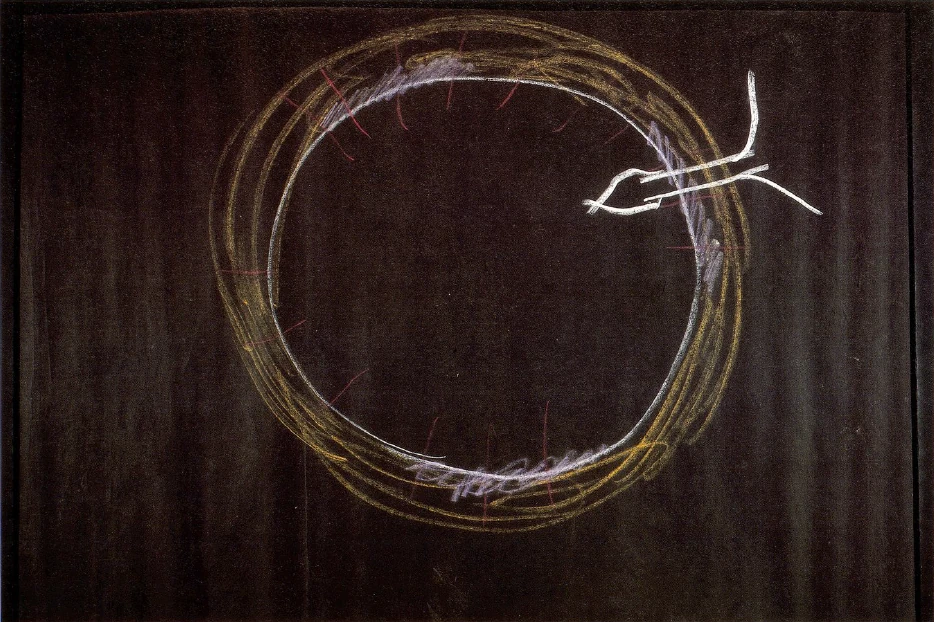
[ 9 ] If I were to sketch this schematically, I would draw something like this: I’d draw the Earth here (white), then the shale formation overlying it in some way (purple)—very schematically—and then the plants growing out of the Earth into the universe (red). Spatially, the plants need not coincide with the shale formation at all, just as, for example, the thought that has its basis in the brain need not coincide with the big toe when it is moved. This is not a matter of spatial coincidence, but rather of the fact that when one attempts to penetrate the slate formation not only through chemical and physical investigations, but also through the methods of spiritual research—as I have described, for example, in How Does One Gain Knowledge of the Higher Worlds? or Occult Science, one gains the insight that if the forces contained within the slate-like formation were to act alone on Earth, they would have to be connected to a living being that develops in exactly the same way as the plant world does. The plant world develops in such a way that it represents only physical and etheric corporeality; this is inherent in the plants themselves. But when we turn to the astral aspect of the plant world, we must conceive of this astral aspect as an astral atmosphere surrounding the Earth (orange). Plants do not possess astral bodies within themselves. But the Earth is surrounded by an astral atmosphere. And in the process of flower and fruit development, for example, this astral aspect is definitely at work. The entire plant world of the Earth thus actually has a unified astral body that does not penetrate into the plant itself at any point—at most a little when the flower transitions into fruiting—but essentially hovers like a cloud above the vegetation and stimulates it to produce flowers and fruit.
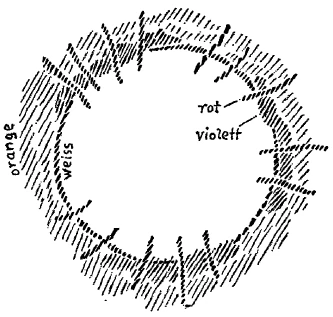
[ 10 ] What unfolds there would inevitably collapse if it weren’t for the radiating forces emanating from the rocks of the shale formations. Thus, within the shale formation, we find everything that strives to make the entire Earth into a single organism. In fact, we must view plants in relation to the Earth in much the same way as we view our hair in relation to ourselves as human beings—as a unified whole. And what holds this entire organization of the Earth together are the radiating forces emanating from the rocks of the shale formations.
[ 11 ] These things will, after all, one day be scientifically substantiated. People will say, for example: Human beings do indeed have a physical body and an etheric body. Their entire constitution is based on a plant-like existence. We can indeed regard the human being as a plant-like being to which the animal and human aspects have been superimposed. If we now treat a person—whether healthy or ill—with minerals derived from shale formations, we will be able to observe externally in the person—what I have just told you will be experienced through spiritual insight—how the minerals of the shale formations take effect. And it will be particularly significant to recognize which disease symptoms in the human being are based, for example, on an overgrowth of the plant element. An overgrowth of the plant element must always be counteracted by treating the human being with minerals derived from the shale formation. For everything that belongs to the shale formation keeps the plant element in the human being in a normal state—if I may put it that way—just as it continually normalizes plant life on Earth. Plant life would strive to overgrow into outer space if it were not held together by the corresponding mineral force radiations of the shale formation. One day, from this perspective, we will have to study a living geography and geology of the Earth, when we come to realize that what is, so to speak, the Earth’s skeleton must be studied not merely in geological terms, but in connection with the entire being of the Earth—including its organic and soul-spiritual aspects.
[ 12 ] Now, all plant life is intimately connected with the solar principle, with the sun’s activity. The effects of the sun are not merely the etheric-physical effects of the sun’s rays in the form of heat and light; rather, something spiritual-psychic is indeed integrated into heat and light. This spiritual-soul aspect corresponds to what is incorporated into the slate formation. The fact that, in a certain sense, slate is distributed throughout the earth is precisely related to the fact that plant life on earth takes on manifold forms. As I said, the local aspect is not of direct significance. One must not imagine, for example, that the slate formation must be present for the plant kingdom to grow out of it. The radiations of the slate formation flow out; they are carried across the Earth by all manner of currents—particularly magnetic ones—and the plant kingdom then lives off these radiations of the slate formation that are carried around the Earth. On the contrary, where the slate formation is itself most highly developed, plant life cannot thrive today, because the actual power of the plant kingdom is drawn too strongly into the earth itself and therefore cannot unfold. There, precisely what binds the plant kingdom to the earthly realm is so predominant that the development of the plant kingdom—which, after all, also includes the cosmic forces—simply does not take place. And so one will only be able to gain insight into what is slate-like within the Earth if one can go back—in the sense described in my Occult Science—to the time when the Earth itself existed as a sun. It was then, within the Earth, that the schist-like substance was prepared—not yet formed in its present shape, but prepared. Back then, when the Earth existed as a sun, the physical aspect of the Earth had, in general, only reached the stage of a luxuriant plant life. And one should actually say this: When one looks back from the Earth’s present form to its earlier lunar and solar forms—for these are, after all, its earlier planetary stages—the solar existence is not such that a certain plant or even animal being develops there. Today’s plants did not exist during the solar phase, but the Earth itself had a kind of plant existence, and out of this plant existence, on the one hand, the plant world arose, and on the other hand, that which is also a formative force within the plant world solidified into the shale formation. The slate formation is thus the Earth’s intellectual aspect drawn out of the Earth’s plant-like nature.
[ 13 ] If, on the other hand, we look at the limestone formation, it reveals to the supersensible eye that it is intimately connected with everything on Earth that permeates animal existence—if I may put it that way—with independence. The plant is bound to the ground; it is connected to the ground just as our hair is connected to the skin beneath it. The animal moves. But the radiations of the limestone formation are connected not so much with this movement as such—which is a spatial movement—as with the animal’s independent form.
[ 14 ] When you look at a plant, you can see that its roots grow toward the earth; they sink into the earth, striving, as it were, toward the center of the earth, and then unfold outward. In the form of the plant, one can recognize what results from the plant’s complete integration into earthly existence. With more complex forms, the description must naturally become more complex as well, but the essence remains the same. The plant is not independent. Where it is rooted in the earth, it contracts and connects with the earth’s existence; where it protrudes, it spreads out and, in its expansion, reaches toward the light that radiates in all directions. This form of the plant is best understood when viewed in close connection with the plant’s relationship to the earth.
[ 15 ] One may indeed find, in a certain—I would say “basic outline”—of the animal form, for example in the horizontally positioned spine or the limbs extending downward, something that is adapted to earthly existence; yet in its form, the animal stands apart from the earthly realm in a thoroughly independent way. One can see in every animal form that it is not merely an adaptation to the earthly realm, like the plant, but that it possesses something thoroughly independent, something formed in and of itself. The animal is, in fact, torn away from the earth, even in its form.
[ 16 ] The following now presents itself for supersensory contemplation: Everything that, in the sense I have described in recent days, radiates from the moonlight—that which flows down from the moon to the Earth as the reflected sunlight, passing through the formed world—and which then also flows into our life of thought and acts within it as the formative force—this is what also brings forth the animal forms. Essentially, everything that is indeterminate, formless will in the animal is to be found within the direct sunlight. But everything that gives the animal its independent form, which is not adapted to the earthly realm—that is—yes, it must be expressed in the truest sense—floating in from the radiance of the moonlight.
[ 17 ] All forms descend to Earth from the Moon. The fact that different animals have different forms depends on the Moon’s passage through the zodiac. Depending on whether it is in Aries, Taurus, or Gemini, it exerts a form-shaping force on the animal kingdom in various ways. This also gives rise to an interesting connection between the zodiac and the animal form itself, a connection that was intuited in the ancient, dreamlike wisdom. Now, what draws these forms down to Earth, so to speak—forms that would otherwise be lost in the atmosphere like a mist—are the forces emanating from the limestone formations. The mineral realm on Earth does not merely radiate radium; the mineral realm on Earth radiates many things. And so, on the one hand, we must seek in the shale formation that which anchors the plant kingdom to the Earth, and in the limestone formation that which, from the lunar realm, draws toward the Earth all that now lives in the specific animal forms. And so, through spiritual contemplation, we come to understand how the shale formation on Earth is connected to the structure of the plant world, and how the limestone formation is connected to the structure of the animal world.
[ 18 ] We must be clear that what we find in this way—for example, in the limestone formation—can be found again in every detail of organic life. If one equips oneself with the means for such observations, one can see quite clearly that there are, for example, people who, so to speak, have a strong tendency toward skeletal formation. By this I do not mean that they have a strong skeleton, but rather that they also have many calcium deposits throughout the rest of their organism. There are, if I may put it this way, people who are richer in calcium and people who are poorer in calcium. Of course, you must not imagine that this is terribly crude; it must, of course, be understood in very homeopathic doses, but it has its own great significance. The people with higher calcium content are generally the more intelligent ones—those who can hold subtle concepts together and then peel them apart again. Do not think that I am trying to explain the human being materialistically with such things; that would never occur to me, of course. For the fact that one person deposits more calcium than another is connected to their karma. Thus, both in the past and in the future, these things are indeed connected to the spiritual. But this is precisely what constitutes the true, penetrating understanding of the world: not speaking vaguely about the spiritual and the material, but knowing how the spiritual works creatively by shaping the material out of itself. A person who, through their previous earthly lives, is predisposed to become a particularly intelligent person in one incarnation—for example, a particularly good mathematician—develops, between death and a new birth, spiritual and soul forces that then cause the calcareous substance to be deposited within them. We depend on calcium deposits within us if we want to become intelligent. Conversely, we rely more on deposits of the clay-like element—that which lives, for example, in the formation of slate and clay—if we wish to develop our will more fully.
[ 19 ] One can only truly understand the material realm if one is able to perceive it in constant connection with the spiritual realm. Thus, one can say that the limestone formation contains within itself those radiations and currents that are capable not only of shaping the animal realm in its forms on Earth, but also that which now acts within us as the material foundation, enabling us to form thoughts within ourselves. Out there in space are the many animal forms. Within our intellect are the thought-forms. They are, after all, nothing other than the animal forms transformed into the spiritual realm. The entire animal kingdom is, at the same time, the intellect; this entire animal kingdom, projected into the inner being of the human being so that it appears there in the dynamic thought-forms—that is the intellect. But just as the animal kingdom out there needs the calcareous formation for its structure, so do we, in a sense, need a subtle inner calcareous deposit—that is, also a calcareous formation—in order to become intelligent. Of course, this must not happen to an excessive degree. If a human being were to secrete calcium to an excessive degree, he would, in turn, separate his intelligence from himself; it would not remain with him. He would, so to speak, provide the impetus for intelligence to develop objectively, but it would not remain with his personality. Everything is bound to a certain measure. And if we pursue these matters further, we arrive at interesting insights into how the mineral realm plays a certain role in the lives of humans, animals, and plants. When we look at all that acts within us as calcareous forces—as we have just said—we arrive at that which strives toward form, which leads us to become inwardly steadfast human beings. But what is connected within us to the forces of the clay-like and the clay-shale-like, in particular, leads us to become people who struggle against this solidity, who do not tolerate this solidity within themselves, but rather dissolve it, liquefy it, and make it plant-like. And the human being is, in fact, always a kind of interplay between the calcareous and the schistose—that is, of course, the inner forces present in the calcareous and schistose elements.
[ 20 ] We can now take a closer look at the schistose. In many schistose materials, we find the siliceous, the silicon-like quality—that which we find particularly in rock crystal and quartz. The forces present in rock crystal and quartz are certainly also present in their radiations and currents within human beings themselves. And if human beings possessed only these forces—which they already absorb through the harder, slate-like substances within themselves—if they possessed, so to speak, only the quartz-like forces within themselves, then they would be constantly exposed to the danger of their spiritual and soul nature being drawn back to what they were between death and rebirth, before they set foot on Earth. The quartz-like force constantly seeks to draw the human being out of himself, to bring him back to his as-yet-unembodied being. This force, which seeks to bring the human being back to his unembodied being, must be counteracted by another force, and that is the force of carbon. The human being possesses carbon in many forms within himself. Of course, modern science views carbon only from the outside, using only physical and chemical methods. In truth, however, carbon is what keeps us always with ourselves. It is, in fact, our home. It is that in which we dwell, while silicon constantly seeks to lead us out of our home and bring us back to the time when we existed before we moved into our carbon home.
[ 21 ] And so the carbon and silicon within us must wage a constant struggle. But our life lies in this struggle. If we were composed solely of carbon—for example, the physical plant world is based on carbon—then we would be bound only to the Earth. We would have no inkling of our existence beyond Earth. We owe our knowledge of this to the siliceous element within us. But when one understands this, one sees, in turn, what healing powers silicon, quartz, or the siliceous element contains. If a person is ill because they have an excessive tendency toward carbon—which is the case with all diseases linked to certain metabolic waste deposits—then they must be given silica as a remedy. Especially when the deposits are located in the periphery or in the head, silica is a powerful remedy against them.
[ 22 ] You see, then, that when one penetrates to the heart of these matters, one arrives—from a comprehensive understanding that is at once an understanding of nature and an understanding of the spirit, which seeks the spiritual in all that is merely material and, in turn, finds the material in all that is spiritual, by conceiving of the spiritual as creative— only then does what first explains human existence become clear, and then also explains how one should behave when the functions of this human existence are disrupted.
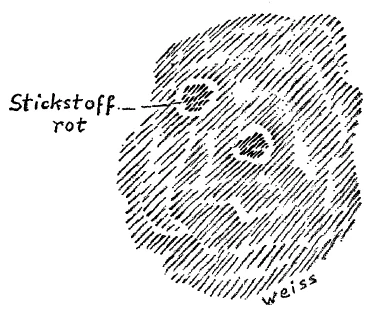
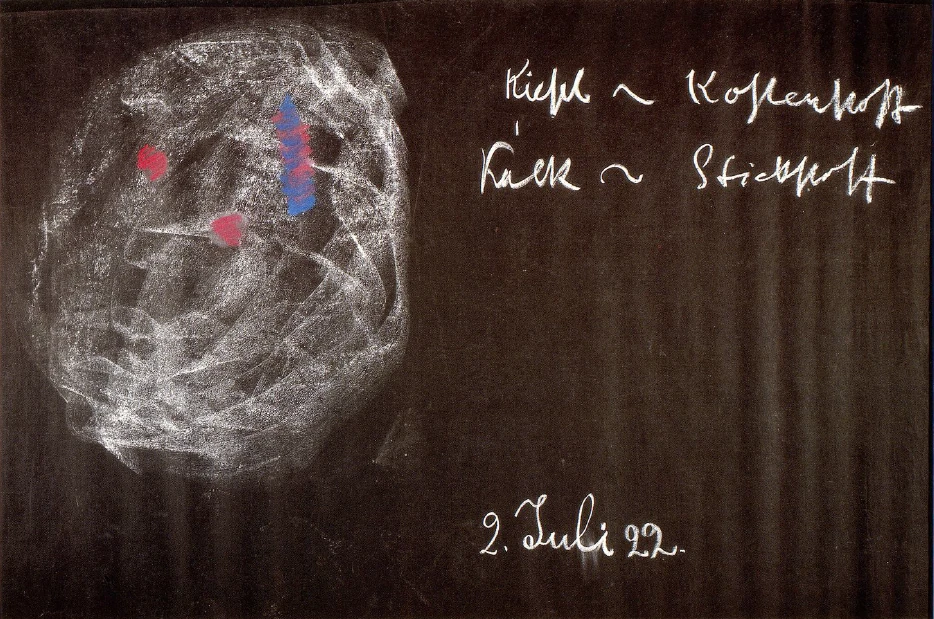
[ 23 ] It is therefore of particular importance to consider what exists within the human being in the form of nitrogen—nitrogen itself and its compounds. The fact that the human being contains nitrogen enables him, in a sense, to remain open to the universe at all times. I can really only illustrate this schematically. Let’s assume this is the human organism (white). Because the human being contains nitrogen—or, more precisely, bodies that contain nitrogen—the laws of the organism’s own organization are, in a sense, suspended everywhere: along the nitrogen lines in the body, the body ceases to assert its own laws. And through this, cosmic laws can enter everywhere (red). Along the nitrogen lines in the human body, the cosmic forces assert themselves within the body. You could say: To the extent that nitrogen is active within me, to that extent does the cosmos—all the way to the farthest star—work within me. The nitrogen forces contained within me draw the forces of the entire cosmos into me. If I were not a nitrogen-containing organism, I would close myself off from everything coming in from the cosmos. — And when the cosmic forces must unfold in a special way—as is the case, for example, during human conception, when the human embryo, which is modeled after the cosmos, develops within the mother’s womb—this is possible only because nitrogen-containing substances, in particular, open the human being up to the influence of the greater world, to the influence of the cosmos. But everything is arranged in the universe and in human existence in such a way that it must not reach extremes. If left to act on its own, everything would reach extremes. If nitrogen were able to unfold its full power within the human being, then the human being would not only be pulled outward by the siliceous element—where, I might say, it seeks to fall out of itself toward the past and into the spiritual—but also by nitrogen, where it constantly seeks to expand outward spatially—spiritually—and the human being would continually lose consciousness through nitrogen. It would not be able to hold itself together. They must be held within themselves.
[ 24 ] It is always interesting to note that, when observing something in nature or in human beings, important factors play a dual role. What, on the one hand, gives human beings the physical characteristics associated with intelligence—the calcareous element—counteracts, on the other hand, this effect of nitrogen. So we can say: On the one hand, silica and carbon form a polar opposition in human beings; on the other hand, nitrogen and calcium form a polar opposition.
[ 25 ] The calcareous element in human beings predisposes them to repeatedly substitute their own organization for that which, through nitrogen, seeks to influence them from the cosmic realm. A cosmic force (red) acts upon the human being through nitrogen; through the calcareous effect, however, a counteracting force (blue) arises in oscillation from the human organism itself. Thus, in various parts of the body, there is both a cosmic influence entering and a repulsion of these cosmic effects. And this is always a back-and-forth oscillation: nitrogenic effect, calcareous effect, nitrogenic effect, calcareous effect. So you see, we can not only relate the human being to the world of the stars, but also place him within his immediate earthly environment.
[ 26 ] In the latest issue of Goetheanum, I explicitly emphasized in an aphorism that materialism as a worldview does not actually stem from knowing matter too well; rather, it stems from knowing it too poorly. What, after all, do we really know
[ 27 ] Carbon? That it is found in nature as coal, graphite, and diamond. These substances are then described according to their physical properties. But we do not realize that carbon is what holds us together within ourselves, making us a unified human organism, and that it is constantly counteracted by silica, which seeks to rob us of our very selves.
[ 28 ] One only comes to know matter when one also comes to know its spiritual aspect. For wherever there is matter, spirit permeates it. But of course, one gets nowhere if one remains stuck at the level of mere nebulous, vague pantheism and simply says everywhere: Where there is matter, there is spirit. — Just as one can only make progress in life by considering things from all sides, one must not merely know that lime, silica, carbon, and nitrogen contain spirit; that goes without saying, but it is not enough. One must also know how the individual substances are, so to speak, embodiments or materializations of spiritual effects. One must be able to see how the calcareous organizes the human being within itself, and how the nitrogenous continually seeks to permeate him with the cosmic.
[ 29 ] Plants, which must always be related to the cosmos—since they grow from the earth out into the cosmos—require nitrogen compounds for their growth; and one will be able to study plant growth properly if one correctly grasps this connection that I have just discussed.
[ 30 ] First of all, these things have a cognitive aspect; we only come to know the world when we understand them. But they also have a practical side. And one actually always remains at the most primitive level if one cannot view things in their broader context. One will then have to delve into the details and see how the necessary nitrogen compounds actually enter into plant growth. Well, as you know, this is a very significant field of study in any case; but even in agriculture, this study can only become complete when these matters are viewed from the perspective of spiritual science. Spiritual science is, after all, the true science of reality.
[ 31 ] You see, everything I am presenting to you must be rediscovered through the methods of spiritual science as they exist today and continue to evolve into the future. For an older science had access to these things only through a kind of dreamlike clairvoyance. We must attain fully conscious clairvoyance. I have, after all, described this many times. Today we cannot simply take in these things again—things that humanity once knew from a completely different human organization. It is, of course, nonsense for people to want to study only ancient science, for that does not help them understand these things. On the contrary, one can only understand even the ancient things again when one is able to illuminate them spiritually in the right way. And yet it is wonderful how, fundamentally—I would say through a kind of instinct—scientific thought today is already tending everywhere toward what was once discovered through dream-like clairvoyance.
[ 32 ] Consider a specific case. Consider the case in which the ancient initiates assumed the presence of lead throughout earthly ethereal existence. For they attributed to the radiation of lead that which acts in the human form from the outermost end, from top to bottom. They saw in lead—which is widely distributed on Earth—something connected to the inner formation of the human form, and specifically to human self-consciousness. Now, of course, today’s materialistic thinker will say: But lead plays no role in the human organism. — To this, the ancient initiate would have replied: “We were not thinking of lead in such a coarse form as you imagine, but rather of very fine lead that exists only as a force. And such lead is very widespread.” — That is what the ancient initiate would have said.
[ 33 ] What does the modern natural scientist say? He says: There are minerals that emit radiation. These emissions include what are known as radioactive emissions. Isn’t that right? We know about the radiation emitted by uranium; we know that when certain rays—called alpha rays—are emitted, what is emitted is initially present; that which can then continue to emit radiation changes in a certain way, even acquiring, as they say in chemistry, a different atomic weight—in short, transformations also occur within what is present as radioactive matter. Indeed, some people today even speak of a kind of revival of alchemical transmutation. But now those who have investigated such things say: In the process, something is produced within this radiation that then appears as a product which is no longer radioactive—the so-called radium G—and this has the properties of lead. So, based purely on modern scientific principles, you can conclude: There are radioactive substances; within all this radioactive radiation, there is something that, in terms of its power, is in the process of formation. Lead is contained everywhere in the background radiation.
[ 34 ] You see, modern natural science is approaching the ancient science of initiation in a most thought-provoking way. And just as it is already encountering lead today—I would say with its “nose,” or at least with the “nose” of its physical instruments—it will also encounter the other metals. And then, little by little, it will come to understand what was meant when people said that lead is found everywhere in the Saturnian realm. You see, only with a spiritual-scientific perspective can one truly grasp the significance of what appears today even within the natural sciences—and which, within the broader realm of knowledge, we do not really know how to deal with.
[ 35 ] Now, however, there is one more important point in this area: As you know, the air—which is also part of our immediate earthly environment—consists of oxygen and nitrogen. We cannot make good use of nitrogen for our physical life, at least not initially. We breathe in oxygen. It is transformed within us—or rather, carbon dioxide is formed within us, which we then exhale. So the question might initially arise: What, then, is the primary significance of nitrogen, which is not chemically bound to oxygen at all, but merely exists out there in a kind of intimate mixture with oxygen? We cannot live on nitrogen alone. We need oxygen to sustain our lives. But without nitrogen, our ego and our astral body—when they are outside the physical body during sleep—would have no way of existing. We would perish from the moment we fall asleep until we wake up if we could not immerse ourselves in nitrogen. Our physical body and our etheric body need the oxygen from the air; our ego and our astral body need the nitrogen.
[ 36 ] Nitrogen is, in fact, what brings us into an intimate relationship with the spiritual world. It is the bridge to the spiritual world in the state our soul is in during sleep. Consider what I said earlier together with what I have said here about nitrogen. Nitrogen draws the cosmic into us from our surroundings. When it is within us, it prepares us for the cosmic. When it is outside of us, it actually allows that which is not meant for this Earth to live within it spiritually and soulfully. So we must say: Nitrogen is truly not mixed into the air for no reason; it is mixed in because it represents the physically deadened and the spiritually enlivened within earthly existence. And when we escape from that which is physically deaden—from falling asleep to waking up—to another state of being in relation to our soul life, we immerse ourselves in the nitrogen element, which forms the bridge between our spiritual-soul life and the spiritual-soul life of the cosmos. We are rooted with our earthly-personal existence in carbon, and with our spiritual-soul existence in nitrogen. Carbon and nitrogen in earthly existence have this relationship to one another and to the human being, which I have just characterized.
[ 37 ] Take a look at carbon. It is found in ordinary coal, in graphite, and in diamonds. These are the three different forms in which carbon can occur. What you see as carbon in black, sooty coal, in diamonds, and in graphite—we also carry that within us in a different form. We may not be much, but we are, after all, a little bit of diamond. That is what anchors us in our earthly home. That is where our spiritual-soul aspect resides when it dwells within the body.
[ 38 ] The nitrogen present in the various nitrogen compounds—nitric acid and so on—in the nitric-like substances is what constantly draws us out of ourselves; it forms the bridge, as I said, to the spiritual-soul aspect of the cosmos. This, too, must be rediscovered through modern spiritual science. It was already present within earthly knowledge once before, but only in a dreamlike way. In ancient clairvoyance, it was perceived by the ancient initiates.
[ 39 ] As I have often said, we only come to have true respect for an ancient initiate when we rediscover the things that cannot be recognized from the traditions. Only when we are able to discover them for ourselves can we truly appreciate them within the traditions as well. Thus, when we rediscover these things, we also come to a religious reverence for what was humanity’s primordial wisdom.
[ 40 ] Now, at the next opportunity, I will speak about how all this rediscovery is connected to the Mystery of Golgotha. To do so, I needed—I would say—prerequisites drawn from spiritual science and the natural sciences, and surely many aspects of the existence of the world and humanity have become clear to you precisely through these reflections.