Human Questions and Cosmic Answers
GA 205
7 July 1922, Dornach
Translated by Steiner Online Library
Sixth Lecture
[ 1 ] I would like to introduce some of the points I will be presenting here over the next few days by referring to the life and teachings of a figure whom I have already mentioned here and there in my lectures, and whom I have also discussed in greater detail in the third chapter of my work *On the Mysteries of the Soul*. I will have much to say about this figure, Franz Brentano, as one of the leading thinkers of the second half of the 19th century, for reasons that will become clear as we proceed with our reflections. Some hints can also be found in the journal *Das Goetheanum*. I am focusing particularly on Brentano’s teachings and life today because there is an external occasion for doing so, namely the publication of the first volume from Franz Brentano’s posthumous writings, which encompasses one of the most important chapters of his worldview—namely, the teachings of Jesus as illuminated by Franz Brentano himself.
[ 2 ] Franz Brentano died in Zurich in 1917 at the age of seventy-nine. This marked the end of a philosophical life that undoubtedly ranks among the most fascinating in history, and above all in the second half of the 19th century. Franz Brentano was not only a philosophical teacher, but also a philosophical personality—a personality in whom philosophical inquiry sprang from the full breadth and depth of his being.
[ 3 ] The philosopher Brentano comes from the same family as Clemens Brentano, the German Romantic writer, who was the uncle of the philosopher Franz Brentano. And Clemens Brentano belonged to the family that was friends with Goethe through Sophie La Roche and Maximiliane BrenZano, and that family directly united—I would say—as a family the two intellectual currents that were so closely intertwined at the beginning of the 19th century: On the one hand, there was Catholicism—the Brentano family was, after all, a devoutly Catholic family—and, on the other hand, the Romantic spirit. Clemens Brentano indeed created some of the most beautiful works of German Romantic poetry, and, emerging from the Romantic atmosphere of German intellectual life, he was an extraordinarily significant storyteller of fairy tales. One might say that, through the storytelling of the German Romantics, German fairy tales were transformed in such a way that a light from the spiritual world truly shone upon those to whom fairy tales were told from that very perspective. And our philosopher Franz Brentano, even as a very small child, heard fairy tales told by Clemens Brentano, his uncle.
[ 4 ] For us, two points are worth considering here. The first is that Franz Brentano emerged, in a spiritual sense, from this atmosphere. He was born in 1838. Clemens Brentano died in 1842. On the other hand, we must also consider that Franz Brentano, who emerged from Catholic Romanticism, came to embrace the most rigorous scientific worldview that prevailed in the intellectual life of modern civilization during the second half of the 19th century. Franz Brentano developed in such a way that a devout spirit truly took root in his soul even as a child. The religious element is for him something that arises naturally from his soul. And Catholicism does not enter his soul as something external, but as something that constitutes the very essence and fabric of that soul. With deep inner feeling, the boy Franz Brentano embraces Catholic piety and grows into it. Nurtured by Romanticism, he had awakened within himself a powerful, lofty sense of the spiritual. While among Romantics of Clemens Brentano’s caliber the spiritual lived in the form of fantasy, and while a genius such as Clemens Brentano paid little heed to the rules of logic and, in the flight but in the flight of the imagination, to grasp the spiritual world and live within it, this lofty sense for spiritual life—which was also fully developed in Franz Brentano—transformed into a special gift for the articulation of rigorous concepts.
[ 5 ] This was partly due to the fact that, coming from a Catholic background, it was, so to speak, a matter of course for Franz Brentano to pursue philosophical-theological studies as his own. And his refined intellect had enabled him to penetrate early on into the fabric of Aristotle’s thought and then also into the rigorous conceptual training of medieval scholasticism. As I have already described in more detail here, Aristotelianism continued to live on in this medieval scholasticism. And one might say: While Franz Brentano retained the predisposition for soaring into the spiritual realm, he could not develop, unconcerned with the logical faculties of the human soul—as, for example, Clemens Brentano did—but rather he cultivated the strictest logic and arrived at his conceptual framework solely through the path of the strictest logic. But as significant as Franz Brentano’s abilities were in terms of his logical training and his theological-philosophical development, his piety—held in the true Catholic sense—was actually even greater in his early youth.
[ 6 ] There is, after all, something peculiar about modern scholastic education, as Franz Brentano was just able to fully undergo it from within his Catholicism. One must say time and again: truly rigorous logic—not that superficial, hasty logic found in today’s everyday education and which also dominates science, but what truly rigorous logic is, the kind that involves the whole human being, not merely the human mind—this logic already emerges from Scholasticism. Scholasticism is, to the highest degree, the art of logical conceptualization. However, in the Middle Ages and within Catholicism to this day, this scholasticism has been used solely to support Catholic doctrine of revelation, in the sense that I once described when I analyzed “Thomism.”
[ 7 ] In a mind such as Franz Brentano’s, a very specific spiritual outlook developed precisely out of Catholic piety and the rigorous training of Scholasticism. He developed the ability to take the existence of a spiritual world for granted. By immersing himself in Catholicism and scholastic theology, he lived within that spirituality, and he could not help but live within it. And he grasped this spirituality precisely by elaborating it through rigorous logic. He was truly a genuine Catholic. He was a Catholic in such a strict sense that, even though he cultivated the strictest logic within himself, he would never have allowed himself, up to a certain point in his life, to even voice criticism of Catholic doctrine regarding revelation.
[ 8 ] I ask you to imagine, just for a moment, a person in all his human depth, within whom dwells the strictest logic—the very logic that has led so many modern thinkers to level the most scathing criticism at the Catholic doctrine of revelation. This planted strong doubts within him, but he suppressed them all into his subconscious, never allowing them to rise to the surface of his consciousness; for the moment they appeared in his consciousness, he pushed them back down. He told himself: The Catholic doctrine of revelation is a coherent system and demonstrates very clearly that it has come to Earth from the spiritual worlds themselves—albeit via the most diverse detours, and likely also through human beings. It demonstrates its own truth, and one must always assume, when doubts arise, that as an individual one can certainly be mistaken in the face of what appears as an all-encompassing system of such time-honored grandeur as Catholicism. — Since one of the teachings of Catholicism is that only the councils have ever been authorized to speak on the truth of the dogmas, Franz Brentano, given his state of mind, could never allow himself—if any doubt were to surface from the unconscious—to actually raise that doubt against the doctrine of revelation. He pushed everything aside; he simply told himself: It is impossible to truly accept such a doubt. But the doubts gnawed terribly at his soul—in his feelings, in his sensibilities, in his unconscious. He did not, as the Enlightenment thinkers of the 18th and 19th centuries did, surrender to this doubt; rather, he repeatedly suppressed such doubts as something forbidden.
[ 9 ] Then an event occurred that brought about a profound change in his soul. Brentano was born in 1838. He was ordained a Catholic priest in the 1860s and then, while serving as a Catholic priest but in the state of mind I have just described to you, became a professor of philosophy at the University of Würzburg. And so he was caught up in the movement for the dogma of infallibility, which unfolded toward the end of the 1860s. This dogma was to be proclaimed in 1870. As an outstanding theologian and devout Catholic, Franz Brentano—who was still a relatively young man at the time—was commissioned by the famous Bishop Kezteler to articulate what needed to be said about the dogma of infallibility from the standpoint of Catholic theology.
[ 10 ] I will first describe the sequence of external events. Ketteler was among those German bishops who strongly opposed the establishment of the dogma of infallibility. He had Franz Brentano draft a memorandum, which Ketteler himself was then to present at the bishops’ assembly in Fulda, with the aim of securing a resolution from the German bishops that they would not endorse the establishment of the dogma of infallibility. Ketteler also presented the full text of Brentano’s memorandum, which was directed against the dogma of infallibility, at the bishops’ assembly in Fulda. That is the external account, to which it need only be added that the German bishops ultimately changed their minds; when they were gathered in Rome and the dogma of infallibility was about to be proclaimed, they ultimately submitted and agreed to the dogma of infallibility. Thus, Franz Brentano criticized this dogma in a negative sense as a non-Catholic doctrine for Bishop Ketteler. And then the dogma of infallibility was proclaimed.
[ 11 ] What was Franz Brentano’s position as an outstanding theologian and a devout Catholic? He would never have allowed himself to criticize a dogma into which he had already been raised. But when Bishop Ketteler asked him to criticize the dogma of infallibility, it was not yet a dogma; it was only about to become one. So he allowed himself to challenge this emerging dogma with his intellect. This was, after all, entirely in line with Bishop Ketteler’s views, since he, too, had initially been opposed to the dogma of infallibility. So Franz Brentano would never, given his state of mind at that time—in the late 1860s—have challenged an existing dogma. But infallibility was not yet a dogma, and so he criticized it with tremendous acuity. For what Ketteler had presented at the bishops’ assembly in Fulda at that time was precisely Brentano’s memorandum.
[ 12 ] But now infallibility had become legitimate Catholic dogma. As you can see, it was not merely a rational consideration, but rather its intertwining with one of the most significant events in modern Catholicism that marked a decisive turning point for Franz Brentano. What might never have occurred through a mere intellectual step: his departure from the Church took place for him in connection with these events. He was the most prominent critic of the dogma of infallibility and had to ask himself at the time: Was Franz Brentano—the orthodox Christian who, drawing deeply from the depths of Catholic consciousness, had criticized the dogma of infallibility before 1870—still a Catholic after 1870, when the dogma of infallibility had now become a legitimate dogma? You see, there are facts here that play a greater role in people’s lives than an intellectual decision—which in most cases is, after all, worthless—ever could. And so a man as upright and vibrant in his conscience as Franz Brentano could do nothing other than leave the Church. One need only consider the entire context to see how deeply Franz Brentano had actually become intertwined with a certain aspect of intellectual life in the second half of the 19th century.
[ 13 ] Thus Franz Brentano stood there as a philosopher, in a sense cast out of his Catholic career. His education was quite different from that of the other philosophers of the 19th century; for the kind of education he had received is not otherwise evident among non-Catholic philosophers. But now he had been placed among the ranks of non-Catholic philosophers. At the same time, the scientific way of thinking of the 19th century had made the strongest possible impression on him. This scientific way of thinking had, after all, set the tone for the entire scientific world since the mid-19th century. And when Franz Brentano earned his habilitation in Würzburg, he did so with the thesis: “In philosophy, no methodological principles other than those of true natural science can prevail.” Natural science had made such a profound impression on him with its method that he could not help but say: Philosophy must employ the same methods as natural science if it is to be a true science.
[ 14 ] It is truly no easy task to untangle the emotional knot in which Franz Brentano found himself entangled in the 1860s. Let us just take a completely objective look at what was actually going on there. On the one hand, a man who was perhaps one of the greatest authorities on Thomism and Aristotelianism of his time—an extraordinarily sharp thinker and conceptualizer—but all of this grounded in Catholic doctrine; on the other hand, a man who was immensely impressed by the scientific method. How is that possible? Yes, it is entirely possible, and for the following reason. Consider the nature of medieval scholasticism. Medieval scholasticism is a science that works with the spiritual realm according to scholastic concepts, yet it is a science that limits itself to knowing only about the external sensory world—and even then, only certain insights derived through reasoning from that sensory world—while everything supernatural is left to revelation, which intellectual knowledge is not supposed to venture to approach.
[ 15 ] In medieval scholasticism, therefore, a strict distinction was made: the realm of sensory knowledge, including certain conclusions—such as the existence of God or other similar conclusions—which belong to human knowledge. In contrast, the true mysteries—the contents of the supersensible world—can only be attained through revelation, that is, through what the Church has preserved from the revelations of the supersensible worlds, which have come to humankind at various times in a manner the Church considers legitimate.
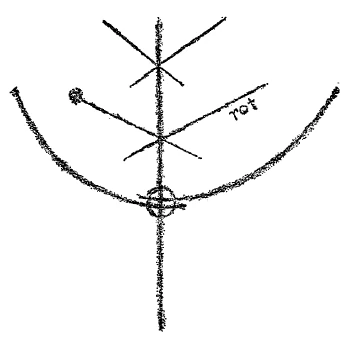
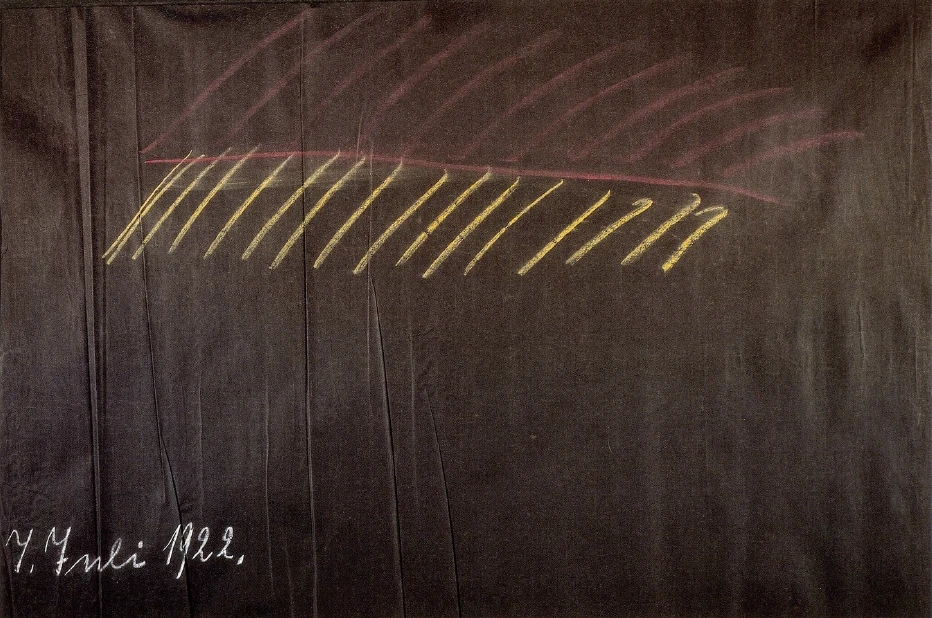
[ 16 ] But that was, after all, already the groundwork for the modern scientific view. This modern natural science, too, seeks only sensory knowledge and, at most, to draw some conclusions from that sensory knowledge. This modern natural science is completely unaware that it is the continuation of Scholasticism; it is just that certain radical minds have approached it somewhat differently than the Scholastics did. Let us visualize this schematically. The Scholastic says to himself: Through the intellect and ordinary science, I gain knowledge of the ordinary sensory world and of certain conclusions that arise from it (yellow); then there is a boundary beyond which lies the supersensible world, into which one cannot penetrate (red). Modern natural science is no different! It says: Through human knowledge, one penetrates the sensory world and can draw certain conclusions that follow from this knowledge. The Scholastics said: Beyond that lies the supersensible world, which must be known through revelation. Radical thinkers of the modern world said: One can only know the sensory world; we set aside the supersensible world, for it does not even exist—or at least cannot be known. Thus they became agnostics. What was common practice in Scholasticism with regard to knowledge of the sensory world and certain conclusions drawn from it simply continued in the modern scientific mindset, so that a mind which had so earnestly absorbed Scholastic training throughout his entire youth needed to see nothing else in the modern scientific method but the continuation of Scholastic views. However, because he was also a devout Catholic, the spiritual world was, in turn, a matter of course for him. Thus, Franz Brentano was actually only more consistent than hundreds upon hundreds of others, both on the Catholic and non-Catholic sides.
[ 17 ] Brentano thus turned to the scientific method. This scientific method, however, must either become aware of its own limitations or else declare agnosticism or the nonexistence of the supersensible world. If, however, one still takes the supernatural world for granted but can no longer hold fast to the truth of revelation—because one no longer believes in the truth of the Church—as was the case with Franz Brentano, then one finds oneself in a unique situation.
[ 18 ] A superficial mind has no trouble with this. It either denies the supernatural world or simply ignores it. Franz Brentano could not do that. But it was precisely because of his rigorous scholastic training that he was able to state the following thesis: True philosophy must employ no methods other than those of true natural science.
[ 19 ] Now, as you all know: Anyone who, despite affirming the scientific method, still wishes to arrive at a spiritual world through a cognitive process must rise from the ordinary scientific method to what I call exact clairvoyance or exact insight—which is developed through supersensible abilities using the methods I have described in my books. However, Franz Brentano recoiled from the development of this insight, from the development of any kind of methodology that goes beyond the natural sciences and yet is intended to be based on knowledge. This was due to the attitude he held, as a Catholic, toward revelation. Science was not allowed to enter into revelation. Consequently, he could understand a scientific method limited solely to the sensory world; but precisely when one takes this method seriously, one must develop the supersensory faculties. He shied away from this.
[ 20 ] It was in this spirit that Franz Brentano became a philosopher—no longer a theologian, but simply a philosopher. One might say: Such a personality—in whom all the storms and struggles found in the intellectual life of the time are very clearly evident, and yet about whom one must ultimately conclude that he did not emerge victorious within his own soul—such a personality is, of course, often far more significant and far more interesting than others who, with ease and in simplistic terms, manage to deal with all manner of things.
[ 21 ] It was in this state of mind that Franz Brentano was summoned to Vienna—to that Austria of which I spoke to you here not long ago. I have described his unique intellectual character to you, and if you recall what I said about Austria at that time, you will surely understand that a philosopher of this caliber could make a great impression precisely in Vienna. And that is exactly what Brentano did. Even in his outward appearance, he was an extraordinarily fascinating figure. He had a very intellectual-looking head and eyes that sparkled with intelligence, which probably had a similar gleam to them as the eyes of the Romantic poet Clemens Brentano. What made Franz Brentano’s personality particularly striking was that, when one saw him walking—for example, as he ascended the podium or the lectern—he always seemed to have a certain quality about him, as if he hadn’t quite slipped into his physical body. Almost every movement—whether walking, moving his arms, his facial expressions, or the very way he formed his words—had, at its core, something unnatural about it. One always had the feeling that something was swaying with his physical body, as if one were swaying in one’s clothes. And yet the whole effect made an extraordinarily sympathetic and spiritual impression. One could not help but feel that for this personality—with her consistently serious tone of voice and her constant striving to articulate concepts in the strictest manner, yet who, in turn, gave the impression of thinking not in her head but slightly above it— was, at the very core, quite natural—to feel in her physical body as if in a suit that did not quite fit, that was too big or too small—we might say, too big. And many things that one might have found coquettish in another person’s movements were interesting in Franz Brentano.
[ 22 ] Franz Brentano strove to apply the scientific method in every area. When he addressed intellectual problems, he did so with an attitude inspired by the scientific method. But I would like to say: The theologian was still present in his tone. There was indeed a great difference between, for example, hearing the scientific method applied by some ordinary natural scientist and hearing it applied by this philosopher who had grown out of theology.
[ 23 ] For those who were familiar with Franz Brentano, it was only natural that, when he arrived in Vienna in 1874, he initially became, in a certain sense, the darling of Viennese society—that is, of the segment of society that held such famous figures, as Franz Brentano was at the time, in particularly high regard. Women in particular—since the men in this circle were, after all, less concerned with education, especially in the 1870s—had a special fondness for Franz Brentano, for one could always hear witty remarks from him. He was superior to one, and yet, at the same time, he was not entirely superior; one was, in turn, also superior to him. When he arrived, he would clumsily take off his overcoat. That made it so easy to help him, and one could feel so superior regarding certain aspects of his nature when one was able to help him—for example, by supporting him so he wouldn’t trip over the threshold and the like, or when he couldn’t find his spoon right away, or when, as he particularly liked to do, cut the meat back and forth from one side to the other until it was no longer individual pieces but something that in some parts of Germany is called a “Knatsch.” So one could feel superior at the same time and yet, at the same time, see something like the revelation of a spiritual world shining through him.
[ 24 ] A poet—who was indeed sometimes extraordinarily witty, but who was actually never very receptive to the depths of human nature—Adolf Wilbrandt, attempted to mock this in a somewhat contemptuous manner in his “Gast vom Abendstern.” This novella was widely regarded in Vienna as a mockery of Franz Brentano, but it is really only so in the sense I have just described.
[ 25 ] Well, back then, when Franz Brentano was giving his Vienna lectures in the state of mind described above, he attracted an enormous following by the standards of the time. One must bear in mind that philosophy was not a very prestigious field back then. Franz Brentano, however, had already attracted a large following in Würzburg as an associate professor—in the very same lecture hall on whose door the students had written “sulfur shack” after his predecessor’s first lecture (they had not attended any subsequent lectures). In that very same Auditorium Maximum, Franz Brentano lectured on philosophy, and the lecture hall soon filled up. And so, too, the lecture halls where he lectured in Vienna were always full.
[ 26 ] One of his earliest literary works was his *Psychology*. He had set out to write a work on psychology using the scientific method. It was intended to span four or five volumes. The first volume was published in the spring of 1874. He had promised the second for the fall, and the series was to continue in this manner. Using the scientific method, in the strictest sense of the word, he had set out to investigate—just as one investigates whether a metal heats up or cools down, or whether heat is conducted from one metal to another—how one idea follows another, how one idea corresponds to another; in short, all the finer aspects of mental life. He got no further than that. But he already stated in the first volume: Science is also necessary for the study of the soul, for psychology. However, if this scientific rigor were to come at the cost of modern psychology having nothing to say about the fate of the better part of the human being once the body is surrendered to the elements of the earth, then something of immense value would indeed be sacrificed for the sake of this scientific rigor. For Brentano—for whom an inner life in the spiritual realm was self-evident, though he naturally could not prove it using the methods of the natural sciences—this spiritual realm was by no means something he was unwilling to regard as an object of knowledge. He certainly wanted to penetrate the spiritual world through knowledge, but he also wanted to remain within the realm of the natural sciences.
[ 27 ] And so this first volume remains the only part of Brentano’s *Psychology* that was ever published. He was too truthful a man, too scientifically conscientious at heart, to have continued writing in the spirit of mere formalism. Of course, he could easily have done so, and he could still have produced works of psychology like those of others. But if Brentano were to have continued writing a psychology, it would have had to be true on every page, just like the first volume—true, of course, within the limits within which human beings can arrive at truths. But Franz Brentano wanted to remain within the realm of the natural sciences. That left no room for a continuation into the realm of the psyche. Nor could he deny the psychological realm, as those psychologists did who wrote “treatises on the soul without a soul.” He could simply do nothing but fall silent. And so he wrote no second volume to accompany his first, much less the subsequent volumes.
[ 28 ] The Brentano students took offense at my pointing out this fact in the third chapter of my book *On the Mysteries of the Soul*, because they themselves are inclined to explain the matter in a much more superficial way. But even if one were to say, “Well, perhaps the Brentano scholars know better—that this was not the reason, based on Brentano’s posthumous papers or their close association with him”—the first volume of Franz Brentano’s posthumous papers, excellently edited and introduced by the Brentano scholar Alfred Kastil, demonstrates once again the same state of mind in Franz Brentano that prevented him from adding a second volume to the first volume of his *Psychology*. This first volume of Brentano’s posthumous writings contains, in its first chapter, “The Moral Teaching of Jesus According to the Gospels,” written well after his departure from the Church—long after his departure from the Church. In the strictest sense, he would accept nothing that was not compatible with a strictly scientific mindset. The second chapter is: “Jesus’ Teaching on God and the World, and on Jesus’ Own Person and Mission According to the Gospels.” The third chapter is particularly detailed and constitutes a critique of Pascal’s ideas on the defense of the Christian faith. Then, following a brief digression on Nietzsche as an imitator of Jesus, comes an appendix: “The Truth of Faith: A Brief Exposition of Its Essential Content.”
[ 29 ] It is incredibly moving to have this little book by Franz Brentano on the teachings of Jesus in front of me, given that in the 19th century, people wrote and spoke about Jesus and his teachings from every conceivable perspective—orthodox, semi-orthodox, free-thinking, liberal, and even completely atheistic—drawing on everything available, such as the work of David Friedrich Strauss in the field of mythology and so on. It is moving to see how the distinguished philosopher Franz Brentano—who had left the Church—relying solely on the teachings of the Gospels themselves, characterizes in his own way Jesus’ moral teachings and their enduring significance; then Jesus’ teaching about God, the world, and Jesus’ own mission; then the full significance of ecclesiastical dogma and church administration; and the significance of the Church as described apologetically by Pascal. It is moving to see how Franz Brentano, in turn, emerges in a forceful manner as a shrewd opponent of Pascal and now speaks out against Catholicism as such. It is moving because here we have before us the Brentano of his youth, with all his piety, with all his great ability to immerse himself naturally in the spiritual realm, and yet also the man of the strictest scientific mindset—a mindset that grows out of scientific methodology—the man whom, for example, so-called modernism naturally could not impress, because Brentano is a profound thinker and modernism, even Catholic modernism, is something shallow. Thus, even though he had fallen away from the Church, he did not speak of Modernism in any approving terms.
[ 30 ] In the 19th century, thinkers who believed they were standing on scientific ground—such as David Friedrich Strauss—had, in the strictest sense of the word, posed the question: Are we still Christians? Do we still believe in a God? — David Friedrich Strauss, along with countless others, asked these two questions and answered them in the negative. They simply lacked Brentano’s profound training. Their intellectual lives were therefore less tragic. They struggled less with the scientific method, for a certain superficiality made it easier for them to embrace it than it was for Franz Brentano, who found it difficult to do so from his depth of thought. Nevertheless, he considered this scientific method to be absolutely dictated by the times.
[ 31 ] I am presenting this to you because I believe that, by examining the example of this individual—taking only the bare facts of his inner and outer life—one can gain a more vivid insight into the fabric and essence of civilization in the second half of the 19th century than if I were to describe the whole thing merely in abstract terms. Franz Brentano’s mental disposition is such that, when one first considers him as a psychologist, one must say: All of this man’s abilities actually tend toward developing supersensible knowledge so that the spiritual realm can be contemplated. Had Brentano wished to write even just the second volume of his *Psychology*, he would have had to arrive at imaginative knowledge, and then at inspired knowledge, and so on. He did not want that. Because he did not want that, he conscientiously refrained from writing the second and third volumes. In a certain sense, however, he has become a victim of the scientific method—an honest, conscientious victim. And just as only supersensible knowledge—in the sense I have described, for example, in my book *How Does One Attain Knowledge of the Higher Worlds?*—can penetrate to the true essence of the soul, so too can only such supersensible knowledge advance from what natural science offers to that which exists as the all-pervading and weaving spiritual world.
[ 32 ] Purely scientific astronomy deals with celestial bodies floating out there in space. At most, it uses spectral analysis to analyze the nature of the light emitted by these celestial bodies. But to it, these are all merely spheres floating in space. All of this is devoid of spirit. And the content of zoology, biology, botany, and mineralogy is equally devoid of spirit. By virtue of its method, natural science must strip away the spiritless and leave the spirit out of consideration. Spiritual science in the anthroposophical sense, on the other hand, must lead back to the spirit. Supersensible knowledge—not only in psychology but also in the world at large—leads toward spirituality.
[ 33 ] Just as Brentano was unable to grasp the nature of the soul with his strictly scientific mindset in his *Psychology*, he was equally unable to truly grasp the Mystery of Golgotha once he had abandoned Catholic dogma. How can one approach the Mystery of Golgotha? Only by grasping that the world is interwoven with a supersensible spiritual realm. Within this supersensible spiritual realm is a being—as I have often described to you—Christ, who lived as the Christ-being in the body of Jesus of Nazareth when the Mystery of Golgotha unfolded. Without spiritual science, one can arrive at no understanding other than that of the personality of Jesus. Only anthroposophical spiritual science can reveal how the divine Christ lived within Jesus. Franz Brentano did not want this.
[ 34 ] But he still retained enough of his Catholic consciousness to realize that Jesus plays a central role in the entire development of the Earth. That much was clear to him. Just as it was clear to him that the soul is immortal—even though he could not intellectually grasp this immortality—so it was clear to him that Jesus forms the center of earthly evolution. But he could not find the transition from Jesus to Christ. And so we see that, on an emotional and volitional level, he is profoundly moved by the significance of the personality of Jesus and the teachings of Jesus. Take statements like this one: “Not overcome”—as David Friedrich Strauss, for example, suggests—“if one interprets them harmoniously and pays attention to their essential features, the teaching of Jesus has not yet been fully realized in history, nor in its perfection in life. Because of human weakness, it will still cost them hard struggles to achieve complete victory, but because of its inner strength, it is impossible for it ever to perish. Conscience will always bear witness to what it contains of truth and sacred beauty; indeed, it has already done so in pre-Christian times among pagans as well as Jews, and in the Asian East as well as in the European West, so that Jesus’ moral teaching marks a powerful advance not so much by proclaiming entirely new commandments as by the fact that Jesus illustrated them through the incomparable example he set in his life and death—in a way that first made the possibility of such sublime virtue fully comprehensible and thus, inspiring with a higher courage, impelled people to imitate him. This example will shine forth forever, and no prophecy is more certain than to say in this sense: “Jesus and no end.” So says the philosopher who left the Church, the distinguished theologian Franz Brentano, who—due to his scientific mindset—simply could not make the leap from Jesus to Christ!
[ 35 ] Compare these beautiful words about Jesus as the center of Earth’s evolution with much of what has been written by theologians who have remained within the Church, and form your own judgment about it. But also form your own judgment about what it means when a person with the spiritual disposition I have described to you says the following about Jesus’ worldview: “Jesus’ worldview was therefore not merely geocentric”—that is, not merely centered on the Earth—“but also Christocentric, and in such a way that not only the entire history of the Earth but also that of the pure spirits, both good and evil, is ordered around the person of Jesus, the one human being, and finds its meaning in every respect solely through its purposeful relationship to him. The world can be called a monarchy not only in relation to the one almighty God, but also in relation to that creature who, above all others, is made in His image.”
[ 36 ] This is how Franz Brentano approaches the personality of Jesus. — And yet, starting from this personality of Jesus—of whom he says that his worldview is not merely geocentric but Christocentric, and that not only human beings on earth but also higher spirits, both good and evil, are guided by it—he does not proceed from the personality of Jesus to the essence of Christ.
[ 37 ] And so a terrible contradiction rages within him. For he surely asks himself: What is the truth about this man Jesus, around whom the entire history of humanity revolves? — Yet there is no idea in Franz Brentano that would lead to such a reality that Christ could truly be grasped in Jesus. For only the one who grasps Christ in Jesus can even conceive of making him the center in such a way.
[ 38 ] Here, too, even though, for religious reasons, he at least brought it to a literary conclusion—which he then did not publish himself, but which was first published by his students—even here, Franz Brentano did not reach the end of his quest, even though he stood, so to speak, directly at the “gate” that he need only have opened to arrive at the immortality of the soul and also to grasp the mystery of Golgotha. That is why this little book by Franz Brentano, *The Teaching of Jesus and Its Enduring Significance*, is such an immensely interesting document, for Franz Brentano certainly had a conception of this enduring significance. Once again, after presenting the teachings of Jesus and their enduring significance in the second chapter, he asks: Are we still Christians? The answer, he says, will depend on the sense in which the question is posed. — And then, after essentially attributing the inability to develop a true idea of Christ to modern education, he says once more: “Perhaps someone will call the hopes I have expressed here vain, because the powerful influence that Jesus’ teaching and example have exerted on humanity is essentially connected to the fact that a divine nature was attributed to him and that people thus professed a faith which, by my own admission, even the most advanced among us no longer hold to today.” Here, I would say, he enters into a realm of obscurity.
[ 39 ] “But they overlook the fact that the possibility of such influence does not begin with belief in the divinity of Jesus; rather, it is precisely the view of his example, as presented to us in the Gospel accounts, that has been one of the most powerful motives leading to faith in the divinely transcendent nature of his person. No other... could be set alongside him, and the more these centuries grow into millennia, the more this will provide something that distinguishes him and serves as a guiding light for us in our own lives.”
[ 40 ] Once again, they sense how close Franz Brentano came to the gateway to the supersensible world, and how he was held back by the most powerful guiding force of modern civilization—the scientific method and the scientific mindset.
[ 41 ] And so, even after the publication of these works from Brentano’s estate, one can still say what one had to say about his writings published during his lifetime: Franz Brentano stands before us like a spirit from the second half of the 19th century, driven in every phase of his inner life toward an understanding of the supersensible world, yet one who allowed natural science to forbid him this understanding of the supersensible world, just as he had allowed the dogma itself to forbid him the critique of that very dogma in his own time. Thus, precisely because of what he was unable to achieve, Franz Brentano stands before us as a luminous figure, one of the most significant figures of the second half of the 19th century, and teaches us—perhaps as few others have—to recognize how the intellectual legacy of the 19th century, which carried over into the 20th century, actually relates to the development of humanity as a whole.