Living Knowledge of Nature,
Intellectual Fall from Grace
and Spiritual Elevation from Sin
GA 220
28 January 1923, Dornach
Translated by Steiner Online Library
Twelfth Lecture
[ 1 ] If one looks around at those figures who have sensed the spirit life of our time—that is, who have developed a sense of how one can truly carry this contemporary spirit life within oneself—and by “today” I mean, of course, the decades in which we live— then, among others of course, one comes to two figures: Herman Grimm, who is often mentioned here in this community, and the other, Friedrich Nietzsche.
[ 2 ] Of both, one can say: They tried to immerse themselves in the spiritual life of the present. They tried to sense how a person can experience, in their soul, what is happening spiritually today. And with Herman Grimm, one is struck by the way he portrayed people—or even individual people—based on this sense of the times. With Nietzsche, one tends to focus more on how he himself felt within that era. When one listens to Herman Grimm—for example, as he describes people of the present in general, or as he portrays individual people—one always has an image before one’s eyes; the description transforms into an image. And this image strikes me as that of a human being, a human figure, carrying an immense burden on his back. I cannot even shake the impression that this is the correct image for Herman Grimm’s otherwise excellent book on Michelangelo. When you read Herman Grimm’s book on Michelangelo, you certainly gain all sorts of beautiful impressions, but ultimately, the book also presents Michelangelo as a man trudging wearily along, bearing a heavy burden on his back. And Herman Grimm himself sensed this, as he often expressed it: “We modern people,” he said, “carry too much history with us.”
[ 3 ] We modern people really do carry a heavy burden—even if we were complete slackers in school and didn’t absorb anything about “history,” as it’s commonly called—we still carry with us far too much history, shaped by everything that has made an impression on us through our schooling since the age of six. We are not free; we carry the past on our backs.
[ 4 ] And when one looks away from Herman Grimm toward Nietzsche, Nietzsche himself strikes one as a figure who lumbers somewhat hysterically through the world, constantly shaking his head at the intellectual life of the present. And when you look at him more closely—whether he’s wandering through Italy or taking a walk up in Sils Maria—he’s shaking himself. But he also shakes himself in such a way that he keeps his upper body slightly bent forward. And when one then tries to figure out why he is shaking himself, one realizes that he actually wants to shake off history—that burden of history which humanity carries on its back.
[ 5 ] And that is exactly how he felt, for at a relatively young age he wrote the essay “On the Benefits and Drawbacks of History for Life,” which essentially says: People of the present, shake off the burden of history—for you will lose your lives if you constantly carry history with you. You do not know how to live in the present. At every opportunity, you ask: How did the ancients do it? — but you do not creatively bring anything from your own original thinking, feeling, and willing to the surface in order to truly live as people of the present.
[ 6 ] These two images that depict humanity—Herman Grimm, who always portrays him as bearing an immense burden on his back, and Nietzsche, who shakes off this burden—these two images are impossible to shake off when one considers the entire character of intellectual life in the last third of the 19th century and at the beginning of the 20th century. And when one delves deeper, one discovers how modern man is actually gasping under this historical burden. One might say: Modern man strikes one as a dog that is very hot and makes certain gestures with its tongue; that is how modern man appears under the burden of history. — Yes, if one looks more closely, it becomes strikingly apparent how modern man is actually gasping and trembling under the burden of history.
[ 7 ] Let’s look at the people of prehistoric times—we must once again turn our gaze to prehistory in accordance with the customs of that era, for it is extraordinarily difficult for us, as people of the present, to understand one another unless we at least draw upon images from ancient times. One can only truly succeed in doing what one ought to do in the present by showing what the ancients did and what we do not do. Now, let us at least begin with such a consideration as an introduction, so that we may then cast off the burden of history.
[ 8 ] When the ancients looked at nature, they created myths; they were able to shape myths out of the creative power of their souls. They were able to bring what happens in nature before their souls in a living, essential way. Modern man can no longer create myths. He does not create myths. When he does attempt to do so here and there, they are literary, like newspaper columns—they are wooden. First and foremost, humanity has forgotten how to embody the living essence of the creative world through myths. Modern man can, at best, interpret the old myths, as they say. Then, when man could no longer create myths, he at least turned to history. That was not so long ago. But since he had lost the power to create myths, he could no longer make proper use of history either. And so it came to pass that in the 19th century, for example, in the field of law, people declared: “Yes, we cannot create law; we must study historical law.” The historical school of law—which is, after all, something very peculiar—is an admission on the part of the uncreative human being of the present. He says he cannot create law, so he must study legal history and disseminate the law he learns from history. At the beginning of the 19th century, this was a phenomenon that was particularly rampant in Central Europe: people declared themselves incapable of living as people of the present and wanted to live only as people of history.
[ 9 ] And Nietzsche, who still had to study this eternal making of history, wanted to shake it off and wrote his book On the Use and Abuse of History for Life. It seemed to him that when he looked back on his student days and all that his professors had taught him about ancient times, he said: “You can’t breathe there—it’s all dust; it takes your breath away. Away with history! Life instead of history!”
[ 10 ] And then came the later period of the 19th century. Out of the historical mood of the time, fear arose. And this fear manifested itself in the fact that people’s teeth would chatter whenever they were even supposed to glimpse anything of nature from a human perspective. They gradually came to call this anthropomorphism. In ancient times, people readily projected their own human experiences onto nature, because they knew that these experiences came from the divine. Nature, too, comes from the divine. So when one connects one’s own human essence—which is divine—with the human essence found in the outside world, one arrives at the truth. But modern man truly began to shiver and get goosebumps whenever he became aware that anthropomorphism was present somewhere! He developed a hopeless fear of anthropomorphism.
[ 11 ] And we still live with this fear of anthropomorphism today, unaware that we are actually constantly engaging in anthropomorphism without even realizing it. When we speak in physics of the elasticity of two spheres, the word “impact” contains something—for an impact can also be a jab to the ribs delivered with one’s own hand—that extends the impact into the elastic force. Only we don’t notice it there. One notices it, however, when one introduces a human element into the governance of the world. So what has developed out of historicism is a hopeless fear of anthropomorphism. And people certainly live with this fear today.
[ 12 ] But in doing so, human beings sever all ties with the external world. And above all, they sever the connection to a living understanding of the Christ being. For Christ must be experienced as a living being, not merely as a figure to be understood through history. The task today, therefore, is not merely to pounce on history—or on the myth-forming power—with interpretation and rejection, but to penetrate even deeper into the mystery than one can through interpretation alone.
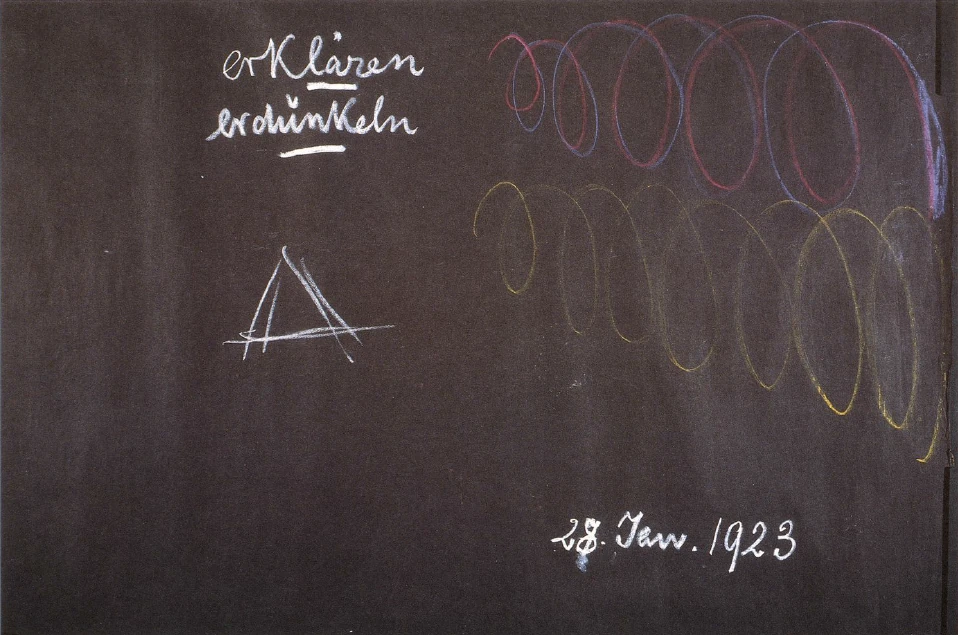
[ 13 ] When people today want to talk about any aspect of human endeavor, they generally do not speak directly from the immediacy of the present, but instead interpret Parzival or some even older work. One interprets; one explains. But this “explaining” is not really explaining at all—it is obscuring—for nothing becomes clear or bright through this “explaining”; instead, it grows ever darker.
[ 14 ] The reason for all of this lies in the fact that today, in two respects, we lack the courage to truly embrace the world with our souls. On the one hand, we have established a view of nature that progresses from the world’s primordial state of chaos through a state of complexity all the way to heat death. Within this framework, the moral world has no place; thus, we remain within the moral world in abstraction. I have mentioned this many times before. People today lack the capacity to recognize that what they establish through their moral impulses are the causes of future effects that will become visible and are real. This has been lost with the decline of scholastic realism mentioned yesterday.
[ 15 ] As a result, everything that constitutes moral impulses has become merely a figment of the imagination, something with which humanity—as a higher order of nature—does not know what to do. At most, it can look toward the state into which the Earth will be transformed. If it is honest, it must then say to itself: This is the great graveyard. There, too, the moral ideals that human beings have conceived will be buried. He has no honest conception of how a new globe will grow out of the perishing Earth—a globe that is, however, the mature form of the moral impulses that human beings are developing today. People today lack the courage to conceive of their moral impulses as the seeds of future worlds. Yet this is what matters, on the one hand. But there is something else that matters as well, which actually requires even greater courage today. On the one hand, we have the moral world order, which we must imagine not merely as a conceptual world order, but as one that is connected to reality and will one day—after the physical world has perished—become a new physical world. If we lack the courage to grasp this, then we have even less courage for something else.
[ 16 ] On the other hand, we see the natural order. This natural order, which stands in opposition to the moral order, has been brought to us by the magnificent natural sciences, the admirable natural sciences. But let us consider the main driving force behind the natural sciences today. This driving force permeates every sphere of life. I would say that the farmer today already knows more about what is disseminated through the scientific worldview than he does about a spiritual worldview. But under what banner has modern natural science developed? This can be made particularly clear with an example, because this example has developed extraordinarily rapidly. In fact, it was only at the turn of the 18th to the 19th century that what today permeates our entire external culture as a cultural element began to dawn. Just imagine the immense contrast! Think of that physicist who dissected a frog’s leg: a piece of metal from his window frame fell between the frog’s legs—the frog’s leg twitched, and that is how he discovered electricity. How long ago was that? Not even a century and a half. And today, electricity is an integral part of our culture. But it is not merely an integral part of our culture. You see, when people my age were still young, it never occurred to anyone in the field of physics to speak of atoms in any other way than as small, inelastic—or, for my part, elastic—spheres that collide with one another and the like, and the results of these collisions were then calculated. Back then, it would never have occurred to anyone to conceive of the atom quite as we do today: as an electron, as an entity that actually consists entirely of electricity.
[ 17 ] People’s minds have become completely entangled with electricity, and this has happened only relatively recently. Today we speak of atoms as something in which electricity is concentrated around a sort of small sun, around a central point; we speak of electrons. So when we look into the workings of the universe, we assume that electricity is everywhere. Here, external culture is already linked to thought. People who did not ride on electric trains would not imagine atoms in such an electrical way either.
[ 18 ] And if we now look at the ideas people held before the age of electricity, we can say of them: They still gave the natural philosopher the freedom to conceive of the spiritual within nature, at least in the abstract. — A tiny remnant of scholastic realism still remained. But electricity has gotten on modern people’s nerves and has knocked everything that points toward the spiritual out of their minds.
[ 19 ] It has actually gone even further than that. All that honest light that floods through the cosmos has gradually been slandered as being something similar to electricity. When people talk about these things today, it naturally seems to someone whose head is completely submerged in the wave of electrical culture as if they were spouting nothing but nonsense. But that is because this person—who regards it as nonsense—is dragging himself along with his head held high, his tongue hanging out like a dog that’s gotten quite warm, burdened by the weight of history on his back, weighed down by historical concepts, and unable to speak from the immediate present.
[ 20 ] For you see, with electricity one enters a realm that presents itself to the imagination differently than other realms of nature. As long as one remained in the realm of light, in the world of sounds—that is, in optics and acoustics—one did not need to make moral judgments about what a stone, plant, or animal revealed as colors in the light or as sounds in the auditory world, because one still had, albeit a faint one, an echo of the reality of concepts and ideas. But electricity drove that echo away. And if, on the one hand, one is unable today to find reality in the world of moral impulses, then, on the other hand, one is all the more unable to find the moral in the realm of what is now regarded as the most important element of nature.
[ 21 ] If anyone today attributes real efficacy to moral impulses—so that they possess the power, like a plant seed, to later become a tangible reality—then he is considered half a fool. But if, for example, someone were to come along today and attribute moral impulses to natural phenomena, then he would be considered a complete fool. And yet, anyone who has ever consciously felt an electric current passing through their nervous system with true spiritual insight knows that electricity is not merely a natural current, but that electricity in nature is at the same time a moral phenomenon, and that the moment we enter the realm of the electric, we simultaneously enter the realm of the moral. For when you insert your knuckle somewhere into a closed circuit, you immediately feel that your inner life is expanding into a realm of the inner self, where the moral dimension simultaneously emerges. You cannot seek the intrinsic electricity that lies within the human being in any other realm than where moral impulses also emerge. Whoever experiences the totality of the electrical also experiences, at the same time, the moral aspect of nature. And without realizing it, modern physicists have actually performed a strange bit of hocus-pocus. They have conceived of the atom in electrical terms and, out of the general consciousness of time, have forgotten that when they conceive of the atom electrically, they endow this atom—every atom—with a moral impulse, thereby simultaneously making it a moral being. But I am speaking incorrectly now. For by turning the atom into an electron, one does not make it a moral being, but rather an immoral being. In electricity, however, moral impulses—natural impulses—do indeed float about—but these are the immoral ones; these are the instincts of evil that must be overcome by the higher world.
[ 22 ] And the greatest contrast to electricity is light. And it is a mingling of good and evil to regard light as electricity. One has simply lost the true understanding of evil in the natural order if one is not aware that, by electrifying atoms, one is actually turning them into bearers of evil—not only, as I explained in the last course, into bearers of death, but into bearers of evil. One makes them bearers of death simply by allowing them to be atoms at all, by conceiving of matter in atomistic terms. The moment one electrifies this part of matter, at that very moment one conceives of nature as evil. For electric atoms are evil, little demons.
[ 23 ] That actually says quite a lot. For it implies that the modern explanation of nature is on its way to properly connecting with evil. Those strange people at the end of the Middle Ages, who were so afraid of Agrippa von Nettesheim, of Trithem von Sponheim, and all the others whom they had walking around with Faust’s evil poodle—they certainly expressed all this in a clumsy way. But even if their concepts were wrong, their intuition was not entirely wrong. For when we see the physicist today, as he unsuspectingly explains that nature consists of electrons, he is in fact declaring that nature consists of tiny demons of evil. And by recognizing only this aspect of nature, evil is thereby proclaimed to be the god of the world. If one were a person of the present and were to proceed not according to traditional concepts but according to reality, then one would come to the conclusion that—just as moral impulses have life, have a natural life, through which they realize themselves as a later, sensually real world—so too does the electrical in nature possess morality. Namely, if the moral has natural reality in the future, then the electrical had moral reality in the past. And when we look at it today, we see the images of a former moral reality that has, however, been transformed into evil.
[ 24 ] If anthroposophy were fanatical, if anthroposophy were ascetic, then of course a storm of criticism would now follow in the wake of the “culture of electricity.” But that would be self-evident nonsense, for only those worldviews that do not take reality into account can speak in such a way. They can say: “Oh, that’s Ahrimanic! Stay away from it!” — But that’s something one can only do in the abstract. For when one has just organized a sectarian gathering and railed there about guarding against Ahriman, one still walks down the stairs and boards the electric train. So all this ranting about Ahriman, no matter how sacred it may sound—forgive the trivial expression—is nonsense. One simply cannot shut oneself off from the fact that one must live with Ahriman. One must simply live with him in the right way; one must simply not allow oneself to be overwhelmed by him.
[ 25 ] And you can already see from my first Mystery Drama—from the final scene—what it means to be unaware of something. Read that final scene again, and you will see that it is quite a different matter whether I am lulled into unconsciousness regarding a matter or whether I grasp it consciously. Ahriman and Lucifer have the greatest power over human beings when they are unaware of them, when they can manipulate them without their knowledge. This is precisely what is expressed in the final scene of the first Mystery Drama. Therefore, Ahrimanic electricity exerts power over civilized humanity only as long as people, quite blissfully unaware and unsuspecting, electrify atoms and believe: “This is simply harmless.” In doing so, they simply fail to realize that they are thus imagining nature as consisting entirely of tiny demons of evil. And if he even goes so far as to electrify light, as a recent theory has done, then he attributes the characteristics of evil to the good God. It is actually terrifying to what a high degree our modern natural science, without any inkling of it, is a form of demonolatry—a worship of demons. One need only become aware of this, for awareness is what matters here—we live in the age of the conscious soul.
[ 26 ] Why don’t we understand how to live in the age of the conscious soul? We don’t understand because we are burdened by the weight of history, because we work not with new concepts, but only with old ones.
[ 27 ] And when someone feels this way, as Nietzsche did, he initially resorts only to criticism; yet, if he remains stuck in the realm of the old, he is unable to point the way in which development must proceed. Just look at this—I would say—brilliant young Nietzsche, who wrote that brilliant essay, “On the Use and Abuse of History for Life,” in which he truly demanded, with fiery words, that we cast off the burden of history and become fully present human beings, that we replace the past with life. What has become of it? He took up Darwinism and came to realize—well, yes: Man has emerged from the animal, so man will become the Übermensch. — But this Übermensch has remained a completely abstract construct; it has no substance; it is nothing but an empty shell of a human being. One can say all sorts of things about him physically, but one cannot conjure up any vivid image. Certainly, in Nietzsche’s sense, one can call natural scientists “calculating servants”; it is even a very beautifully coined term, for natural scientists today do little else but calculate. And if someone does not calculate—as Goethe, for example, did—then they throw him out of the temple of natural science. But what is at stake here is something else entirely. What is at stake is the courage to recognize the moral in its reality and the natural in its ideality in their proper places; to recognize moral impulses as the seed of future natural orders; to recognize the natural order with its electricity today as a moral order—even if it is an antimoral one, an evil order. One must have the courage to be able to attribute moral qualities to the right place in nature.
[ 28 ] Of course, this requires a proper understanding of human nature. For if a person were to think, in terms of modern physiology, about why an immoral impulse to which he yields should actually harm his body, he would be a fool to admit this based on modern physiology and biology. For they know all the mechanisms at work in the blood, the nerves, and so on: nowhere within them is there any mention of morality. And when people speak of electricity and attribute an inner electricity to human beings as well, they are unaware that this electricity can actually absorb and take in these immoral impulses. Today people speak of absorbing oxygen, of all kinds of absorption in the material sense. But the fact that the electricity within us absorbs the immoral—and that this is a law of nature just like other laws of nature—is not discussed, any more than it is discussed that the light we take in from the outside world is conserved within us, absorbing the good, moral impulses. We must bring the spiritual into physiology.
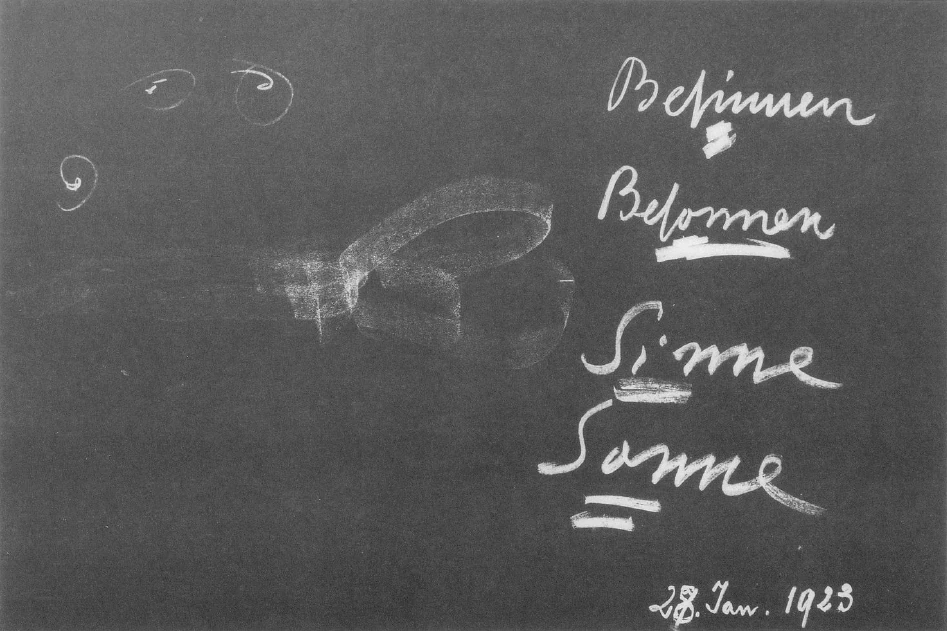
[ 29 ] But we can only do that if we free ourselves from the old conceptual burdens of history, which crawl and sting within us and, above all, trample on our backs. We can only do this if we remember: with the decline of scholastic realism, our concepts have become words—words in the negative sense—and words no longer allow us to approach reality. After all, we no longer live out the words; otherwise, in pursuing the sounds, we would still have something alive. Just think how often I have said here: The spirit that reigns in language is a wise spirit, far wiser than any individual human being. — People can perceive this at every opportunity if they develop a sense for the wonder that lives in the forms of words. Just think for a moment—and it is no different in other languages—when I say: “to reflect,” “I am reflecting,” and “I have reflected!” — Today, the teacher drags the burden of history onto his back and into the classroom; he does not cast off this burden, but teaches under its weight with a tongue that sticks, managing at best to tell the students grammatically: “I reflect”—that is the present tense—“I have reflected”—that is the perfect tense.
[ 30 ] But when I’ve come to my senses, I have to ask myself: What does that even mean—that I’ve come to my senses? — I’ve stepped out into the sun! And when I reflect, I’ve made use of the sunlight that’s within me; that’s when the “o” condenses into an “i.” — In fact, when the sun lives within me, it is—the senses! When I surrender myself to the sun, I no longer know anything of the senses; then they are the sun. From the senses, I step out into the world. I become a part of the cosmos by absorbing the past. One must live in harmony with language; one must feel what it means for an “i” to become an “o.” After all, it signifies something one does in the world when one allows an “i” to become an “o” in language!
[ 31 ] These things point precisely to how we need to return to the foundations of humanity in order to explain such longings as those felt by the greatest minds—Herman Grimm, Nietzsche. With something like eurythmy, we create something that goes back to the foundations of what it means to be human. That is why it is so important that anthroposophists, in particular, understand such artistic creation as eurythmy correctly, right down to its foundations. What matters is that we, as anthroposophists, feel what is truly meant by the renewal of civilization.
[ 32 ] So what really matters in the present is not that we bring in even more history, but that we become people of the present. This awareness must arise in the souls of anthroposophists. Otherwise, there will be repeated misunderstandings about how to approach anthroposophy. Here and there, such efforts keep cropping up that reveal a mindset based on the idea: “Can’t we introduce a little eurythmy here or there, so that people, amidst other things, might also see something eurythmic?” So that we can accommodate people, slipping in a little eurythmy or anthroposophy to suit their own tastes? — That must not be our aim; rather, we must present to the world, with absolute honesty and integrity, what anthroposophy truly must strive for. Otherwise, we will not make any progress. By being overly considerate of the old ways, we will not achieve the things I have just described—and which must be achieved so that humanity does not die out.
[ 33 ] Isn’t that right? “A change in thinking” and “a change in perspective” were the words I used yesterday. We must arrive at such a change in thinking and perspective—not merely at the consideration of a different worldview. And we must summon the courage to apply moral concepts—or, in this case, anti-moral concepts—when we speak of electricity. Modern people are, after all, horrified by these things. They find it unpleasant to admit that, when they board an electric train, they are sitting in Ahriman’s seat. So they prefer to mystify their way out of it, forming sectarian gatherings where they say: “One must guard against Ahriman.” — But that is not the point; what matters is that we know: From now on, the development of the Earth is such that the very forces of nature that influence cultural life must be Ahrimanized. And one must be fully aware of this, because only in this way will one find the right path.
[ 34 ] This, too, is something that the anthroposophist must develop as an insight in and of itself. And it certainly cannot be a matter of accepting anthroposophy merely as a kind of substitute for something that was previously provided by one’s former creed. Those have become boring to many so-called educated people today; anthroposophy is not yet so boring—it is more engaging—so they do not turn to this or that creed, but to anthroposophy. It cannot be that way; rather, what is at stake is this: that, out of a sense of the times, we quite objectively feel the connection of our hearts to the divine heart of the world. And this can be achieved precisely through the paths that have been described here.