Three Perspectives on Anthroposophy
Cultural Phenomena
from the Perspective of Spiritual Science
GA 225
5 May 1923, Dornach
Translated by Steiner Online Library
1. The Nature of the Spiritual Crisis of the Nineteenth Century
[ 1 ] Today I would like to shed light on something from a completely different perspective—something that has been occupying us a great deal here recently. Specifically, I would like to examine, from what one might call a historical perspective, the fact that the last third of the 19th century did indeed mark a decisive turning point for human spiritual life. This decisive turning point manifested itself in a wide variety of ways. And these events are, in essence, the underlying causes of all—I would say—the misery that gripped humanity in the 20th century, for the underlying causes of all this misery lie, after all, in the spiritual realm.
[ 2 ] But first, I would like to offer a brief characterization of the true nature of the spiritual crisis of the last third of the 19th century. During this period, on the one hand, there was materialism—the materialism of external life—and, behind it, the materialism of worldview. And one might say how timidly and gradually idealism, as a worldview, completely abandoned its position. I have just attempted to point out this contrast between materialism—which often did not want to be materialism and yet was—and idealism in the penultimate issue of Goetheanum. There I briefly outlined how idealistic minds—certain minds that continued the idealism of the first half of the 19th century—extended into this final third of the 19th century, but how these minds, precisely because they knew spiritual life only in the realm of ideas, could not penetrate all that asserted itself on the basis that natural science, in a sense, declared sovereign—a basis that led natural science, against which nothing can be objected, beyond its own sphere of validity, as if all world affairs could be decided by pure natural science alone. This natural science did, after all, achieve great successes during the period in question—successes in terms of knowledge, successes in terms of external, practical, and technical life. Those who wished to reject everything that, in their view, did not follow from the findings of this natural science were able to point to these successes.
[ 3 ] And so, on one side stood—I might say—the successful ones, who explained the natural sciences with such authority and yet advocated nothing other than materialism, and continue to advocate nothing other than that to this day; and on the other side stood those thinkers who sought to be the guardians of idealism. But they knew spiritual life only through ideas. They saw, so to speak, only ideas behind the material essence of the world, and behind the ideas nothing more—no active spirit. For them, the ideas were the end, the ultimate point they could reach. But these ideas are, after all, abstract. As they were cultivated by these thinkers in the first half of the 19th century, they were abstract and remained abstract, just as they were further elaborated by the idealists in the last third of the 19th century. And so these idealists, with their abstract ideas—which for them constituted the sole spirit—simply could not hold their ground against the, I might say, tangible results of the scientific worldview.
[ 4 ] That is the external aspect of history. But the internal aspect of history, which lies behind it, is something else entirely. It is this: that materialism, provided it remains consistent and possesses a spirit—even though it denies the existence of the spirit, materialism can still possess a great deal of spirit—cannot actually be refuted. Materialism cannot be refuted. It is entirely futile to believe that materialism is a worldview that can be refuted. There are no grounds on which one can prove that materialism is incorrect. Hence the entirely superfluous talk of those who always seek to refute materialism with some theoretical argument.
[ 5 ] Why can’t materialism be refuted? Well, you see, it cannot be refuted for the following reason. Let’s take that part of matter which, within the human being, serves as the basis for mental activity—let’s take the brain, or, more broadly, the nervous system. This brain—or, more broadly, the nervous system—is truly a reflection of the mind. Everything that occurs in the human mind can also be demonstrated in some form or another as a process within the brain or the nervous system. Thus, everything that can be cited as a mental expression of a human being is simply found in its reflection, in its material counterpart—in the brain and the nervous system.
[ 6 ] So how could anyone who points to this nervous system fail to say: “Now you see, everything you speak of as the soul, everything you speak of as the spirit—all of that is contained within the nervous system.” If someone were to look at a portrait and say, “This is the only thing of the person that is depicted here; there is no original at all”—and if one could not track down the person the portrait is of—then perhaps one could not prove in that case either that an original exists. One cannot at all provide proof from the portrait that the original exists. Nor can one provide proof from the material representation of the spiritual world that the spirit exists. There is no refutation of materialism. There is only one way to point to the will—how to find the spirit as such. One must find the spirit entirely independently of the material world; then one will indeed find it creatively at work within the material world. But no descriptions of the material world, nor any conclusions drawn from it, can ever lead to the spirit, because everything in the material world is a reflection of what exists in the spirit.
[ 7 ] This is the secret behind why, in a period such as the last third of the 19th century—when people did not have direct access to the Spirit—materialism stood there unchallenged and irrefutable, and why those who could point not to the Spirit itself, but only to the abstract, lifeless remnant of the Spirit—the ideas within human beings—why these idealist thinkers could not prevail against the materialist thinkers during that era. The dispute simply could not be played out in terms of proof and counterproof. It unfolded, so to speak, under the influence of the opposing, greater or lesser power of the contending parties. And in the last third of the 19th century, it was precisely those who could point to the easily comprehensible—because tangibly evident—advances and successes of the natural sciences, with their technical achievements, who held the greater power.
[ 8 ] Certainly, those people who, as idealists—as idealistic thinkers, as I characterized them in the penultimate issue of Goetheanum—preserved the traditions of the first half of the 19th century were the more spirited, the deeper thinkers; they were the ones whose arguments could touch people’s hearts far more deeply than those of the materialists; but the materialists were the more powerful ones. And the dispute was not decided by evidence; it was decided at that time as a question of power. One must simply face this fact without any illusions. One must be clear about the fact that attaining the spiritual requires seeking a direct path to it, not attempting to deduce it or prove it from material phenomena. For everything that is in the spiritual is also found in matter. So if someone has no direct path to the spiritual, they will find everything they can observe in the world somewhere within matter.
[ 9 ] Since even the noblest minds of the last third of the 19th century were unable to open a path to the spiritual, they—because the needs and longings for the spiritual still lived within them—found themselves plunged into a state of uncertainty regarding the entire constitution of the human soul. And behind many truly extraordinary personalities of the last third of the 19th century lies, as it were, a sense of instability—the fact that people, who despite being exceptionally intellectual were often exceptionally warm-hearted, would say to themselves: Yes, there is the material world; there are the ideas. Ideas are the only thing one can find behind the phenomena of nature and humanity, behind nature and history. — But then these people felt once again: Ideas are something abstract, something dead. And that is when they slipped into uncertainty, into a sense of instability.
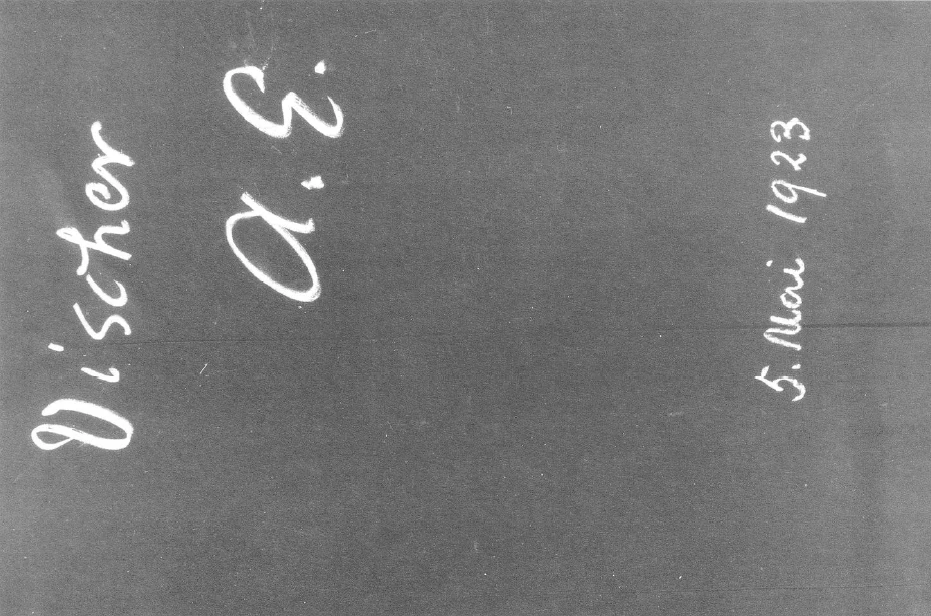
[ 10 ] I would like to highly recommend one example to you; today I would like to present a figure who is actually quite significant, so that you may also be shown in detail what this spiritual development—which ultimately led to our present time—was actually like. Today I would like to draw your attention to the so-called Schwaben-Vischer, who is also called V-Vischer because that is how he spells his name, in contrast to the other learned Fischers. Today I would like to draw your attention to Schwaben-Vischer, the aesthete.
[ 11 ] You see, he had completely outgrown the idealism of the first half of the 19th century. He could not bring himself to embrace crude materialism. He saw ideas everywhere behind material entities and material processes; indeed, he saw the moral order of the world, at its core, as a sum of ideas. He was particularly concerned with discovering the essence of beauty. Entirely in the Hegelian sense, he sought the essence of beauty in the emergence of the idea from sensory matter.
[ 12 ] When the artist shapes any material in such a way that something ideal emerges through this form—so that one is not merely faced with a product of nature that reveals nothing ideal—but rather when the artist arranges the material—be it the material of ore, the material of musical tones, or the material of words— arranges it in such a way that one senses an ideal emerging from its arrangement, then this is precisely the manifestation of the idea in a sensory form, in a sensory shape, and that is beauty. It may be the case that the idea proves so powerful that one perceives the sensory manifestation as too feeble to express the greatness of the idea. If, for example, a sculptor has something so immense in his idea that no material substance is sufficient to give form to the idea—so that one can only sense the idea as something immeasurably great behind the material—then the beautiful becomes the sublime. If the idea is small, so that one can play with the material, and the idea is expressed everywhere in a charming way through the playful treatment of the material, then the beautiful becomes the graceful.
[ 13 ] Thus, the graceful and the sublime are different forms of beauty. When a person perceives the harmony of the world in what is artistically created, they can turn either toward the sublime or toward the graceful, depending on how the artist portrays it. But then one can see, as has so often happened with Jean Paul, for example, how world events are depicted in such a way that one sees no harmony anywhere, that one sees only contradictions everywhere in the world, that harmony actually lies behind everything as something unattainable, yet at the same time the phenomena of the world appear to one as the most immediate reality. One sees, for example, how there is, say, a small-town schoolteacher who has an immensely idealistic spirit, who has a great longing for knowledge but no money to buy books, and instead of books, he has only book catalogs sent to him from used-bookstores, so that at least now he has the book titles instead of the books themselves. He can still afford white paper, so he now writes the books himself based on all these titles he has in the used bookstore catalog. Yes, but then he notices in the material the poet deals with that there is, after all, a harmony present once again; it is beautifully harmonious how he compensates for the disharmony caused by money. And yet, the books he writes for himself are not as clever as those listed in the catalogs. The contradiction remains. One is tossed back and forth between what ought to be, and what is there—and what ought not to be.
[ 14 ] If one can now come to terms in one’s mind with this contradiction—which cannot be resolved, where one contradiction replaces another, where one could never move beyond the contradiction but would have to dissolve into dust oneself—if, while lurching from contradiction to contradiction, one nevertheless knows how to find peace of mind, that is the mood of the beauty one savors in humor.
[ 15 ] Yes, in the case of Schwaben-Vischer—V-Vischer—it was precisely the case that he virtually glorified humor as an aesthetic principle; that, because he lived in an age when people were at a loss in the face of contradictions, and was at a loss in the face of the opposition between spirit and matter; and because human insight could not actually grasp the interpenetration of the world’s harmonies as something attainable, he sought to use humor as a way to transcend all of that. And so he glorified humor in particular. But then again, the nature of humor is such that there must still be some kind of harmonization behind it; otherwise, humor simply cannot arise—otherwise, one ultimately realizes that one is being soothed by something that one really shouldn’t be soothed by, unless one wants to become a wishy-washy person. And so behind all of this—the way Schwaben-Vischer wanted to enjoy the world (he was, after all, a leading figure in the second half of the 19th century)—behind all of this lies a striving, because one cannot penetrate the spiritual essence of the world, but only its ideas; a striving that, in turn, has something terribly philistine about it. A cheerful sense of humor, behind which, however, lies not a balanced state of mind but something convulsive—a humor that, when exploring the contrasts that exist in the world, finds only a foolish juxtaposition instead of a humorous balance,
[ 16 ] All of this stems from the fact that, in this second half of the 19th century, the nobler minds were simply unable to find what actually lies behind the world in spiritual terms; they therefore sought sources of insight, but these ultimately led them into a certain instability, into something convulsive. And yet, from these struggles of the last third of the 19th century, only the tragic and the unhealthy elements of the beginning—of the first half—of the 20th century could emerge.
[ 17 ] Well, when this Swabian Vischer—one might say, even though he resisted it—wanted to present his own self—for it is, after all, his own self—to the world in this way, he wrote the novel Auch Einer. One could say that the “hero” of this novel—as they call it in aesthetics, in such a philistine, one might say, scientific way—the hero of this novel—his real name is Albert Einhart, but V-Vischer shortens it to: A. E.—calls him simply “Auch Einer,” which is also the title of the novel—well, this “Auch Einer,” there’s something to him. He would like to be a “one” as a human being, a true “one.” He wants to be “One”—an individual who stands on his own. But now, despite his magnificent, formidable talents, he becomes merely “Just Another One”—not “One,” but “Just Another One,” just as perhaps not exactly twelve, but still a considerable number that adds up to a dozen! Yes, as I said, Vischer resisted the idea that the “Auch Einer” might be a portrait of his own nature. It isn’t, but nevertheless, Vischer has enshrined in this “Auch Einer” that which lived within him as inner disharmony. These are, at the same time, the discrepancies of the soul from the last third of the 19th century.
[ 18 ] This novel, Auch Einer, actually consists of three parts. The first describes how V-Vischer meets Albert Einhart, the “Auch Einer.” It is an interesting acquaintance made while traveling—the kind that doesn’t happen every day.
[ 19 ] You see, this V-Vischer, too, could ultimately see nothing more than the development of an idea in, let’s say, the way the Mystery of Golgotha relates to the development of the Earth. Christ was actually an abstract idea for him, one that had thus permeated the development of humanity. And on Golgotha, in the body of Jesus of Nazareth, it was actually an abstract idea—Christ—that was crucified. Isn’t that so? That has little sense of reality. It takes us right back to the time of David Friedrich Strauss and so on, when the actual content of religion was understood as if religion contained only images for something that was actually meant to be ideal and abstract. So Christ and the story of Christ would be understood merely as images—the incorporation of the highest ideas into earthly evolution—and the crucifixion merely as the manifestation of the idea in a particularly outstanding, physical human form, and so on. All of this was, of course, the subject of great intellectual endeavors in the nineteenth century and the source of immensely bitter disappointments for the deeper minds of that century, precisely because nothing truly spiritual could be found behind all that idealism. And people naturally thirsted for the spiritual, just as they always thirst for the spiritual—and most of all when they lack it. And those thinkers who believe they can prove that the spiritual does not exist at all—but only matter or only ideas—thirst for it most of all. One might say: By the end of the 19th century and the beginning of the 20th century, the more outstanding minds had actually grown weary of this intellectualistic quest to answer the question: How do ideas actually operate in nature? How do abstractions actually operate in history? Only superficial, mercurial figures like Arthur Drews, at most, brought back what had long since been dismissed among those who were truly capable of thinking. That is why something of this nature still extends into the 20th century through the personality of this mercurial non-thinker: an idea has been crucified, not a real spiritual being.
[ 20 ] But from what I am saying, you can infer that, ultimately, even for a thinker such as Schwaben-Vischer, everything of an intellectual nature eventually dissolved into ideas. In the end, these ideas, in their abstractness, were what worked its way through the world like a web. And everything recounted in the mythologies, in the religions all the way up to the Christian religion—that was, merely clothed in material form, something that was at most an image of the idea. And ultimately, this striving to see only the idea in sensory images everywhere must have led people to the conclusion that it is actually irrelevant in which sensory image one expresses the weaving and spinning of the idea within matter.
[ 21 ] And for an eccentric like Albert Einhart—who is “just another one”—matter now asserts itself in a most peculiar way. For Albert Einhart, at every possible opportunity, finds himself wanting to ascend to the sublime. Whenever he wants to ascend to the highest heights of the spiritual—which for him is, of course, only the ideal—he comes down with a cold, he has to sneeze terribly, or he has to clear his throat terribly. That’s when matter makes itself felt, isn’t it? That’s matter. He doesn’t usually feel matter as strongly as when he gets a cold or when he has a corn. After all, when you’re a thinker from the second half of the 19th century, you don’t know where to begin tackling materialism, which is precisely what ideas represent. It’s best to start where matter makes itself felt the most, where it always appears in such a way that it even subdues the spirit. And in the end, one even becomes, like Albert Einhart, “Auch Einer,” a critic of what already exists.
[ 22 ] For Albert Einhart does eventually come to realize: Those who have approached the subject in such a neutral manner have, in fact, succumbed to an error. Schiller portrayed Tell entirely incorrectly, for it cannot be that way; the subject is treated there at a level that is far too high. One must delve deeper. One must delve into the catarrhal realm if one wishes to truly grasp the subject matter. And so the correct composition of Tell would be this: as he pushes off in his little boat, he doesn’t simply cross over right away, but capsizes, falls out, and is caught by Gessler’s men, gets thoroughly soaked, but escapes again, falls into the water a second time, and catches a cold in the process. Now he catches a terrible cold, and just as he’s raising the crossbow, he has to sneeze. And the bailiff can’t say, “That’s Tell’s shot”—but rather, “That’s Tell’s sneeze!” That’s how Tell should actually be, says Albert Einhart, “Auch Einer.” Isn’t that right? One must delve deeper, more thoroughly into materialism if one wants to be consistent.
[ 23 ] There have been all sorts of interpretations and explanations for Othello—psychological explanations, among them—but, Einhart argues, one should consider that Othello is constantly preoccupied with a handkerchief, that he has a common cold that drives him into such despair that he ultimately strangles Desdemona. Nothing but a bad cold! One simply has to delve deeper into the matter, into what is actually material. One has to find it at the right point.
[ 24 ] This is what Vischer seeks through his cheerful, humorous perspective. He cannot transcend materialism. He cannot disprove it, and so he wants to at least set it aside in his mind. After all, he cannot simply set aside hydrogen and oxygen with a lighthearted attitude; well, one must at least set aside catarrh with a lighthearted attitude. And that is precisely a standpoint one can take toward materiality.
[ 25 ] This whole affair also gave Vischer the opportunity to explain how he actually came to know this peculiar eccentric. The man is staying at a hotel that—given the various circumstances, one can assume—must not be all that far from here, though it is deep in the high mountains, and because he is already suffering from a cold, he gets into a dispute with the hotel clerk, becomes somewhat violent, and as a result of this physical altercation, all of life’s scruples come flooding into his mind. And it gets to the point where he even wants to end his life. He throws himself off the cliff. But at that moment, the Swabian fisherman sees him and sets out to save him, tumbling down the slope in the process. The other man sees this, forgets that he had actually intended to kill himself, and comes to the Swabian fisherman’s aid. That’s how they meet. It’s not an everyday encounter. So they both tumble down. And there you can still hear the curses of this “Another One,” who is now proclaiming his worldview. You don’t actually hear it, because there’s a roar from all kinds of bodies of water; it’s not quiet, but you catch individual fragments like: “The world—a chill of the Absolute—in solitude—spat out, and the world was—the world coughed up by the Eternal, cleared its throat—a cesspool of shame—a breeding ground for plaguing devils”—and so on; you hear it faintly in the background. He must have said much more, of course!
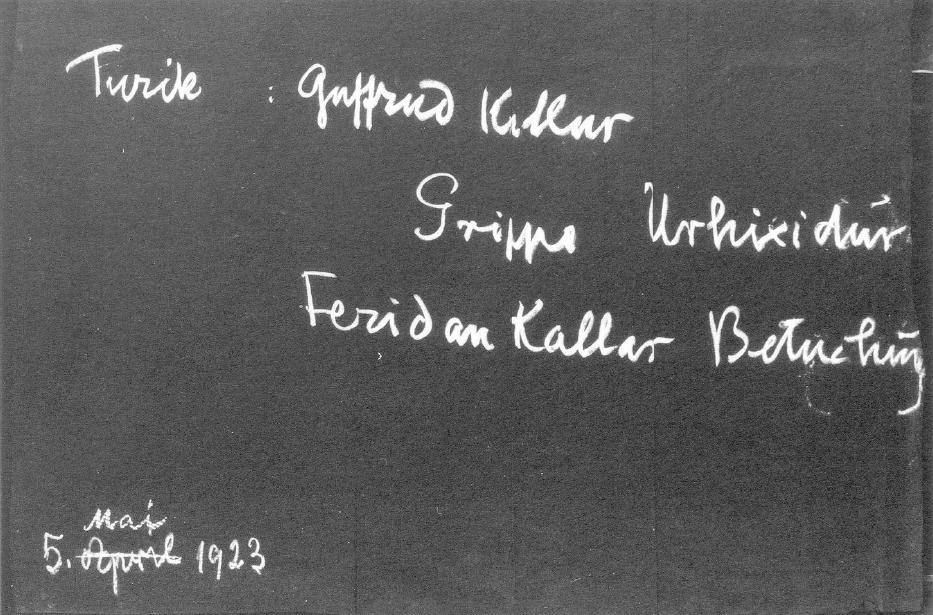
[ 26 ] So they made each other’s acquaintance in this way, the Swabian fisherman and the “Just Another Guy.” But they can’t communicate right away, because they both catch a cold and have to sneeze terribly. And so it takes a little longer for them to understand each other. The first part unfolds in the sort of way one makes acquaintances while traveling—in a manner that’s not quite ordinary or everyday. The second part is a story by “Auch Einer” that’s inserted into the narrative: a story about a pile-dwelling village. It depicts the life and goings-on in a pile-dwelling village. Of course, one could talk at length about the era in which this pile-dwelling village existed and so on, but there are also details in the text from which one can infer that the author sets “Auch Einer’s” pile-dwelling village near the city of Turik. This city is located nearby. And as for the time—well, the pile-dwelling villagers have to call on someone, a bard from Turik. And this bard from Turik is named Guffrud Kullur. Yes, it’s hard to say for sure exactly when this pile-dwelling village existed.
[ 27 ] This story of the pile-dwelling village is now developed in detail in the tale of the “Auch Einer,” and we are introduced to the ways in which, for example, the pile-dwelling villagers satisfy their religious needs. This reveals precisely what is described in Die Religionen regarding Schwaben-Vischer and his counterpart, Albert Einhart: everywhere, this has been the material, pictorial expression of the reign of ideas. And so this religion among the pile-dwelling villagers is also such that they lived in a time when no one could catch a cold. It was a truly paradisiacal time when no one could catch a cold. But these paradisiacal pile-dwelling people did not feel entirely at ease in it. Something gnawed at them during this completely cold-free, catarrh-free time, and so they succumbed to the temptation of the great god Grippo. This Grippo, who actually dwells in the Cold West, creates and works through fire, through heat. And so it came to pass that they succumbed to the temptation of the god Grippo, the people of the paradise stilt village! And they caught colds, had to sneeze constantly, and so they surrendered to the Spinner of Worlds, who often appears to people as a white cow. You see: a material, image-like manifestation, a form given to the spiritual. The World Spinner advises them to establish their village on the lake, where the lake constantly sends out damp, chilly mists. The cold is thoroughly driven out. The effects of the god Grippo emerge and are finally healed. This can only happen in pile-dwelling villages.
[ 28 ] Then a sort of heretic comes into this pile-dwelling village. But the pile-dwellers are led in an exceptionally good way by a druid. A druid who isn’t actually much smarter than the other stake villagers, but who has learned to teach the Catarrh religion properly—he completely controls these stake villagers. And there’s just one thing: Druids must live unmarried, so he doesn’t have a wife, but rather a housekeeper, Urhixidur, who in turn controls him, and through whom a great deal of influence flows in this pile-dwelling village. So now this heretic arrives, wanting to teach the pile-dwellers a kind of enlightened religion—a religion without God. But the pile-dwelling villagers have come to know not only the good gods, but also Grippo and all sorts of other things. And the druid, goaded on by Urhixidur, sets up a heresy trial. The Pfahldorfers do get a little confused by the druid, because an even deeper Pfahldorf is being excavated there, and now he can’t explain it. And so they summon Guffrud Kullur from the neighboring town, along with another scholar, Feridan Kallar. But here again is the curious thing: when pile-dwelling villages were excavated—not in Turik, but in another Swiss city—one of the explainers was Ferdinand Keller, who was summoned not from a city bearing its present name, but from Turik; just as, of course, the reference is not to Gottfried Keller, but to Guffrud Kullur. Now, conflicts are unfolding there between people adhering to a primal religion—the religion of catarrhal states—and a heretic who now seeks to teach a religion without God, a religion of the moral world order. These are interesting struggles. They come to a head in particular when the people of Pfahldorf celebrate a festival corresponding to Catholic Confirmation and Protestant Confirmation—namely, the Festival of Betuchung. This is when the children are inducted into the community. But of course, in keeping with the occasion, they receive a handkerchief—not the items that are usually given at Confirmation—but rather, they must be given a proper handkerchief to set them on their way through life.
[ 29 ] All sorts of cultural struggles are still taking place there. According to Auch Einer, it seems that these cultural struggles were not only visible externally throughout the world at that time, but also appear to have played out within the stake villages.
[ 30 ] Yes, I would say that Schwaben-Vischer forces a sense of humor upon us in order to portray this eccentric’s inability to come to terms with materialism. Whether one ultimately—as Schwaben-Vischer probably thought in his heart—adopts the concepts derived from materialist art historians, who, after all, draw on such neutral material, or others that illustrate the material more clearly: perhaps it really just comes down to choosing the clearer concepts.
[ 31 ] A man like Gottfried Semper emphasizes the workability of stone and the workability of wood when seeking to explain this or that architectural style. Yes, why should one even discuss the extent to which wood or stone can be worked? Why should one approach the matter from this angle? It is far wiser to examine how people were affected by the various architectural styles; then one grasps the connection between these styles and the human being and human development. In the case of the Greeks, it was probably because their architectural style was open on all sides that, if you spent a fair amount of time inside those buildings, you’d end up catching a pretty severe cold. These are the purely catarrhal architectural styles—the ancient ones. And with the Gothic architectural styles, one was more protected; one only caught a cold now and then when opening the windows: these, then, are the mixed-catarrhal architectural styles. And the ideal lies in the distant future: these will be the buildings in which one doesn’t catch a cold at all. You can distinguish them very clearly—as is done in scholarly writings—Architectural Style A: purely catarrhal; Architectural Style B: mixed-catarrhal; and Architectural Style C: where you no longer catch a cold at all. This is “Auch Einer’s” classification of architectural styles.
[ 32 ] As you can see, V-Vischer didn’t know how he should actually approach materialism. He wanted to tackle it with humor, so he simply highlighted that aspect of materialism where people sense matter within themselves in one way or another. That is, after all, what really underlies the novel Auch Einer.
[ 33 ] The third part then contains aphorisms by Albert Einhart. One gets to know him better, so to speak. One learns about his struggle against nature, his struggle with the spirit, with the moral world order, and with pure idealism; these are very witty reflections presented in the form of aphorisms. One sometimes gets the feeling that the somewhat philistine Schwaben-Vischer had already anticipated the witty insights of Friedrich Nietzsche. There really is, at times, something extraordinarily witty in this third part of Albert Einhart’s aphorisms.
[ 34 ] And Albert Einhart is also a truly original character. When we first meet him in the novel, he is, of course, retired—he used to be something like a police chief—but even then he was already quite a prominent figure. So apparently, Schwaben-Vischer wants to suggest that this in itself must be taken with a grain of humor: a prominent police chief. But precisely because he was prominent, he was once elected to the Chamber of Deputies, where he delivered an extraordinarily significant speech. In this significant speech, one sentence had a electrifying effect, then a second sentence had a similarly electrifying effect. But the second electrifying sentence had the same effect on the first as if the first had been doused with horrifically cold water. Strangely, the electrifying effect seemed as if the first flame were to be extinguished: Now, once again, there are people who belong to that old, terrible, barbaric era and who would like to introduce corporal punishment in its various forms in the military and in schools. This is something that takes us, in the most glaring way, back to a time when there was no idealism, when people did not yet live in pictorial religions, when they still held the purely moral view—religion without God. We must not expose ourselves to that in our time. Corporal punishment must not be allowed in our time; it must be thoroughly eradicated. In our time, many other evils must also be eradicated. We see how much barbarism still permeates our time. For example, we see how animals are tormented on the streets by cruel people, how these poor horses—which are not built for it—are beaten with whips. Or we see dogs—which, after all, do not have hooves but other organs on their feet, and are not suited for pulling carts—being forced to pull carts. In short, we see animals being tortured, and I would like to propose here in this chamber that all animal torturers be publicly flogged!
[ 35 ] These, in turn, are the kinds of things that—when the second spark of fire pours down on the first like a cold jet of water—can only be dealt with using a certain sense of humor. Yes, this Albert Einhart, this “Auch Einer,” is truly a creature of the last third of the 19th century! And much of what V-Vischer felt in his own inner conflicts, he brought to light in this “Auch Einer.” However, one must not, in turn, identify V-Vischer with “Auch Einer,” nor with the character who entered the village of Pfahldorf as a heretic, for example, and against whom a heresy trial was held—otherwise, one would arrive at some rather strange conclusions.
[ 36 ] Isn’t it true that Schwaben-Vischer, though not in Turik but in another city, served for a time as a sort of protector of heretics, and it didn’t end well for him? But one would find oneself in an all too humorous position vis-à-vis V-Vischer himself if one were to interpret such things. For V-Vischer wouldn’t even accept the second part of Goethe’s Faust and mocked the commentaries and the interpreters by naming himself—in a third part of Faust that he wrote, alluding to all those who find so many witty things in the second part of Faust—Deutobold Allegoriowitsch Mystifizinsky; Deutobold Symbolizetti Allegoriovich Mystifizinsky and so on—that’s what he called himself. And as such, he wrote the third part of Goethe’s Faust to mock the commentators who wanted to see a deeper wisdom in Goethe’s Faust. — Surely one doesn’t want to become such an Allegoriovich oneself and find one’s own fate—that of SchwabenVischer—explicitly stated or somehow hinted at in his Auch Einer.
[ 37 ] One might say it is truly remarkable how, in this final third of the 19th century, we find, on the one hand, Nietzsche—whose fate is so profoundly tragic, having been consumed by the inner conflicts that raged within his soul— and, on the other, this Schwaben-Vischer, who could do nothing but express the instability of the worldviews of his time in the way he did in the novel Auch Einer. One can only say that there is a certain unity even in this novel, just as there is a certain unity in certain scientific, materialistic views. After all, when you look at hydrogen, at oxygen, at zinc, at gold—they are such different things, but taken together, you find that one atomistic unity everywhere. Atoms are everywhere; they’re just arranged a little differently, so that they appear a little different. And here, in this novel, there is also a very remarkable unity.
[ 38 ] For example, “Auch Einer” finds the woman—the woman who truly inspired great respect in him during his lifetime—now a widow once again. It is a momentous occasion for him. He owes a deep debt of gratitude to the man who has died. He encounters the person he deeply revered, now a widow, in a hotel. She strikes up a conversation with him. And this conversation is interrupted because “Auch Einer” suddenly falls into a terrible sneezing fit. The conversation is left unfinished. It is always matter that has a devastating effect here, that rebels against this search for a worldview, for the spirit; it is always matter that intervenes and ultimately reduces everything to the material. One really has no choice but to attribute everything to materialism when one wants to express the most sublime revelations of the human soul—and now, isn’t it true, not even the word “Ideal” comes out, but rather “Ide-,” and then comes a long sneeze! One can see how matter asserts itself everywhere and how the ideal simply vanishes in the face of matter.
[ 39 ] This novel, Auch Einer, by the Swabian Vischer, is indeed an extraordinarily significant cultural-historical phenomenon—though, of course, one must also acknowledge that it contains a great deal of philistinism. But precisely because of this, it is a unique expression of its time. And it expresses precisely the fact that, ultimately, an intellectually inclined person could no longer find fulfillment for the needs of the human soul in what had become of spirit and matter—so that, just like the “Auch Einer,” one could, through the spirit, arrive at the most abstract ideas, which canceled each other out just as much as the abolition of corporal punishment and the public flogging of animal abusers. Thus, one idea cancels out the other. And if one now turned to matter, one encountered matter where it became most perceptible: in nasal mucus.
[ 40 ] That wasn’t exactly tasteful, one might say, but SchwabenVischer has, after all, written a very interesting book on frivolity and cynicism. He never wanted to be frivolous, which is why he hated the low-cut waists on women so much, but he found something extraordinarily true in cynicism—something that had to be applied wherever one wanted to portray this or that properly. And that is why he did not shy away from—one might say, not frivolously, but sometimes somewhat distastefully—depicting world events in a materialistic sense, though humorously, as he saw it.
[ 41 ] One must not seek to understand what is alive in the times merely through abstract thought, nor must one seek to grasp it merely through sentimentality; rather, one must seek to grasp it through moods. And I truly believe that something of the mood of the last third of the 19th century lay in those feelings that permeated this Swabian soul—that of Vischer—when he wrote the novel Auch Einer.