Three Perspectives on Anthroposophy
Cultural Phenomena
from the Perspective of Spiritual Science
GA 225
6 May 1923, Dornach
Translated by Steiner Online Library
2. The Mystery of the Head and That of the Lower Man
[ 1 ] When we consider a phenomenon such as the one we discussed yesterday, it becomes as clear as can be that it was not only in the last third of the 19th century that materialism emerged in the spiritual development of humanity, but that something that is, in essence, even worse than materialism has arisen: a certain uncertainty and lack of stability, particularly among those minds and thinkers who could not go along with materialism so unconditionally. In fact, we find the following situation in this last third of the 19th century. We find that the truly materialistically minded and inclined people already possessed a certain inner certainty at that very time. One need only cast a glance at all those people who, out of their—one might say—awareness of their power of knowledge, declared the findings of the natural sciences to be supreme and, on that basis, established a worldview. They presented themselves with a certain immense confidence. And it was not so much the content of what they presented, but rather the confidence in their demeanor that attracted a large materialist following at that time. In contrast, all those who, as I explained yesterday, clung to the spirit only through abstract ideas felt more or less as insecure as the Swabian Vischer, of whom I spoke yesterday. They could only hold on to the spirit by saying: “There are indeed ideas at work behind the phenomena of the external sensory world.” — But they could only present these ideas in the abstract. They could not bring a real spiritual life behind these ideas before people’s eyes. They could not speak of a real spiritual life. Therefore, the abstract ideas did not possess a guiding force for them themselves. And that is why, as early as the 1890s, there was actually nothing left in public life of that idealism which had certainly still held sway in the first half of the 19th century, which had then been championed by isolated individuals—as I indicated in the penultimate issue of Goetheanum—but which had indeed dried up by the turn of the century.
[ 2 ] It is characteristic, after all, that the final third of the 19th century was ushered in by a highly influential book, Friedrich Albert Lange’s History of Materialism. This History of Materialism made an extraordinarily deep impression. It was first published in 1866, thus effectively marking the beginning of the last third of the 19th century. This History of Materialism can truly be understood as a symptom of the state of mind toward which humanity was now heading. For what exactly is contained in this History of Materialism?
[ 3 ] Friedrich Albert Lange argues, in essence, that human beings cannot arrive at any other rational worldview than materialism; that, if they do not wish to succumb to illusions, they have no choice but to regard atomistically arranged matter as the starting point for understanding the world. Therefore, one must take as the basis of reality this material world of atoms that fills space.
[ 4 ] Friedrich Albert Lange did, however, notice that one must form concepts about this world and that these concepts—these ideas—are, after all, something other than what exists in atoms. But he said: “Well, concepts are simply a figment of the imagination.” — It was he, in fact, who coined the term “conceptual fiction.” And so human beings invent their concepts. Yet an extraordinarily curious fact arises: not every person invents their own concepts; rather, in order to understand one another to some extent, people end up inventing common concepts. But these concepts are invented. The only thing that is real is the atomic matter scattered throughout space.
[ 5 ] You see, that would be extreme materialism—declaring everything that goes beyond materialism to be fiction. And one might say: At least it’s a consistent position! But that’s not the point in Friedrich Albert Lange’s book. If he went only as far as I have described to you so far, he would simply be a consistent materialist. Fine. As I told you yesterday, consistent materialism cannot be refuted at all. And if someone has no access to the spiritual world—Friedrich Albert Lange certainly did not—then he can really do nothing else but posit materialism as the only valid worldview.
[ 6 ] But that is not what he does; rather, Friedrich Albert Lange says something else entirely, which, I would say, runs like a common thread through all the arguments in his book. He says: It is true that one can only assume the material atomic world to be real. But if one accepts that—if one goes on to say that the material atomic world is at work in space, arranged in such and such a way in hydrogen and nitrogen, interacting in such and such a way, that ideas are concocted in the brain, and so on—if one accepts all of that, then ultimately it is nothing more than conceptual fiction. So materialism, to which one must necessarily adhere, is itself actually nothing more than idealism, for one is, after all, merely inventing the atomic world.
[ 7 ] There is a much simpler image to express what Friedrich Albert Lange articulated in his world-famous book; with regard to logical form, there is a much simpler image. Namely, the famous Münchhausen character, who grabs hold of his own head of hair and pulls himself up. The idealist grabs hold of his idealistic head of hair and pulls himself into materialism.
[ 8 ] We see that even one of the world’s most famous works from the beginning of the last third of the 19th century is actually nothing more than utter nonsense; there’s simply no other way to put it—it really is utter nonsense. Isn’t that right? If it were materialism—this “History of Materialism”—then at least it would be something new. But the fact that it is a materialistic materialism, a fabricated materialism—well, that is pure nonsense. But what is happening in this last third of the 19th century, which was so successful in the natural sciences? One must, after all, hold this historical fact before one’s mind. What is happening? Friedrich Albert Lange’s book becomes world-famous, for it has been translated into virtually all major languages, and the most outstanding, most enlightened minds have regarded it as a redemptive act.
[ 9 ] You are familiar with the piece that has been performed so often in eurythmy: “Bim, Bam, Bum,” where the note “Bam” flies after the note “Bim”; but “Bim” has surrendered to “Bum”:
“He’s a good Christian, too,
but that’s just it.”
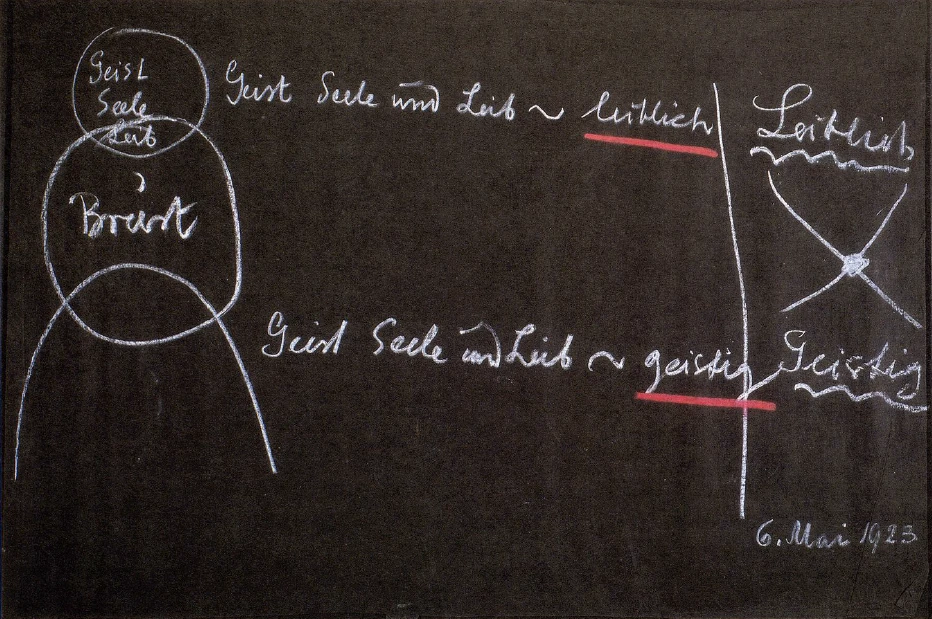
[ 10 ] I must remind you: All those who drew their wisdom from Friedrich Albert Lange—and who, in turn, laid the groundwork for the fact that, fundamentally, our entire public thinking is permeated by this idea—were, after all, enlightened minds—but that is precisely the point: this was true only for the last third of the 19th century! And those who were merely part of the general public took no notice of any of this. And so, when it comes to the deepest questions concerning humanity’s interests, an incredibly deep state of slumber has indeed set in.
[ 11 ] You will say: These things are exaggerated. — But they are not exaggerated at all! It is simply that the depth of the slumber that has overtaken humanity with regard to the greatest questions of spiritual life—the depth of this slumber—is, in fact, underestimated. It is not what I have said that is exaggerated, but rather the general view of these matters that is underestimated. And if a sound foundation is to be laid at all for a future spiritual life, one must bring this entire grave reality—as I have just characterized it—before one’s soul, bring it before one’s soul with all intensity. For it is precisely this that has eliminated humanity’s interest in the spiritual world from the very course of human development. And gradually, the situation came to be such that the less a person even touched upon spiritual problems, the more he was regarded as a great scientist. That was the situation at the turn of the century.
[ 12 ] It was into this situation that what sought to be anthroposophy found itself. And so, if I may put it this way, the task of anthroposophy must be understood in this way. It must be understood in such a way that it actually works from the foundation up; it must not build upon this or that which already exists in one school of thought or another. There is simply nothing there, and one must understand the essence of anthroposophy from the foundation up. Then, when one understands the essence of anthroposophy from the very foundation, one will find that the facts provided by the natural sciences are, everywhere, of the greatest use for anthroposophical research, and that these facts of the natural sciences only find their proper illumination through anthroposophical research. This is how the situation must be understood. But for this to happen, it is necessary that a certain portion of humanity truly resolve to lead intellectualism over into the spiritual realm.
[ 13 ] Certainly, the people who join the anthroposophical movement are all deeply filled with a certain urge and inclination toward the spiritual world. But very few of them love to carry the world of ideas of the present over into the spiritual realm. People would like to embrace anthroposophy—so to speak—as a kind of solace for the soul, while setting aside the world of ideas. But that will not be enough to give anthroposophy its impetus in spiritual life. You see, what is at stake here must truly be grasped in its particular, concrete details, and today I would like to present just one specific, concrete example to you.
[ 14 ] I’ve told you this many times before: What you have on your head today is the transformed organism from your previous life. You just have to mentally set aside the head from this organism of your previous earthly life. It really is true. There you were in your previous earthly life—you have to mentally set aside the head, for it dissolves into the cosmos. But what remains of the organism becomes the head of your next earthly life. And from this organism, in turn, the head of the next earthly life is formed, and so on. That is how it is.
[ 15 ] Now, of course, someone might say today: “But it wasn’t just my head that was buried in my previous earthly life—my entire organism was as well.” It didn’t have any opportunity at all to transform into the head of my present earthly life.” — Yes, that is a very superficial view. You are not looking at your head and the rest of your body, but rather at the physical matter that fills your head today. Yes, that, too, changes roughly every seven years during an earthly life. What you carry within you today as your physical matter is something you did not have eight years ago. What passes through the earthly life is, after all, the completely invisible, supersensible form.
[ 16 ] The matter that fills your head is, of course, something you have only taken in during this earthly life. But the form—the supersensible forces that today shape your eyes into their rounded form and give your nose its shape—are the same forces that formed your arms, legs, and the rest of your organism in your previous earthly life. The fact that you are seen by other people with their physical senses stems from the fact that completely formless matter fills your form. It is not, after all, the matter that gives you your form. When you eat salt, the salt wants to be cube-shaped; it does not want to be nose-shaped, nor eye-shaped—it wants to be cube-shaped, and so on. The fact that you have the form in which you appear as a human being does not come from the matter that is the basis of your physical visibility; but the form of your present head has indeed undergone metamorphoses through the form of your organism outside the head of your previous earthly life. As a result, however, your head was truly in an extraordinarily favorable situation. Because it had been treated so well in the cosmos, it was the first to appear—as a properly formed head—during embryonic life. Just imagine: the head is, in fact, very beautifully formed from the start, while the rest of the body in the early embryonic stage really hangs on to it only as accessory organs. The rest must first be shaped from the outside; it actually looks quite terrible in relation to the human form when you look at it, whereas the head is, in fact, already very beautifully formed from the very beginning. However, for those who consider only the fully grown human being, the embryo’s head will seem somewhat unappealing, but in reality it is already beautifully formed. This is because it brings its formative powers with it from its previous life.
[ 17 ] So, in this head, the work that took place between death and the present birth was actually carried out in the way I described some time ago in the lectures on cosmology, religion, and philosophy at the Goetheanum. This work between death and new birth relates precisely to the shaping of the formative forces of the human head.
[ 18 ] That is why, in relation to the cosmos, the human head is something extraordinarily perfect. The human head actually contains, in a material sense, the image of the human spirit, soul, and body. So when one looks at the head, one sees—in a material way, as they appear in shaped matter—the spirit, soul, and body working together. One could say: For the human head, the spirit, soul, and body are still physical. You see, this is the mystery of the human head: that the spirit appears there in a physical form, so that we can point to the marvelous structure of the brain as a material manifestation: this marvelous structure is an image of the spirit. Just as sealing wax expresses what is on the seal, so too are spirit, soul, and body given to us in a material form through the head.
[ 19 ] With the Metabolic-Limb-Human, you can say: Everything is actually more or less physically present. The legs, these two pillars, do not yet possess any of the marvelous structure of the human head. They will first undergo a metamorphosis. In the next earthly life, they will appear as the lower jaw with its marvelous function and mobility, while the arms, after their transformation in the next life, will be incorporated into the upper jaw, and so on. So one can say: In the musculoskeletal system—although the arms have already been somewhat reshaped since humans acquired their upright gait—the opposite is essentially true; there, the spirit, soul, and body are actually spiritual. There, the spirit, soul, and body are thoroughly spiritual.
[ 20 ] One might be tempted to say that, just as a human being appears physically in terms of their legs and everything attached to them, that is not the truth. It will only reveal itself in its true physical form in the next earthly life, when it has become a head. Right now it is still in its very early stages; in fact, in its material appearance, it is entirely insignificant. What is essential about it is what it becomes only through the will: the movement, the dynamics, the statics—everything that a person transfers from their motor system into the will. So what is spiritually intangible, what is spiritually supersensible, is what constitutes the rest of the human being. Whereas the head is a reflection of the spirit in every material being—and the spirit itself appears physically there—in the case of the motor system, the body is scarcely physical at all. If one wishes to find any meaning at all in the entire motor system, one must ask everywhere: To what extent is the physical suitable for the spiritual, for the spiritual revelation of the human being? So that one can say: This is the truly magnificent mystery of the head—that spirit, soul, and body are physical. That spirit, soul, and body are spiritual—that is the magnificent mystery of the lower human being.
[ 21 ] You see, the Old Testament understood these things much better—based on instinctive clairvoyance—than people do today. People today actually overestimate the role of the mind. I have already discussed this from various perspectives. In the Old Testament, you will never find the illusion presented that the brain concocts dreams! It speaks of how Yahweh tormented people in their sleep through their kidneys. Back then, people knew that what manifests in dreams lies within the metabolic system. They did not attribute everything to the head. Why, then, do people today attribute everything to the head? I’ll tell you why: People do not believe in the spirit, so they do not look at that part of the human being where even the body is still spiritual. They do not really look at the lower part of the human being; they are not proud of it. But they look at that part where even the spirit is physical and material—the head: They are proud of that, because that is where the spirit becomes physical and material.
[ 22 ] So, overestimating the head—that is already materialism. One wants only matter and wants the spirit, too, to be nothing but matter. That is why, in our physiological and scientific descriptions today, the head is described the way it is: because one wants the spirit to be only material. That is what it is, but within the head. Of course, people are unaware that before this head could bring the spirit down to a physical—that is, material—form, it had to pass through the entire life between death and a new birth. For this material image of the human spirit to have come into being in the head at all, it had to be preceded by a long spiritual development. This miraculous material formation of the human brain is the culmination of a wondrous spiritual development. But people want to focus solely on the material; they also want to acknowledge the spirit only in its material form.
[ 23 ] Well, let’s resolve, my dear friends, to pay close attention. Even if one is already past the age of fourteen, one can still pay close attention. Isn’t that right? Up above, we have a region within the human being that is entirely physical, and down below, we have a region within the human being that is entirely spiritual. Yes, mustn’t there be a middle point that is neither entirely physical nor entirely spiritual—that is both, and therefore neither? So there must be a neutral point in the middle where the spiritual transitions into the physical and the physical into the spiritual, where neither is present, where the human being is neither dependent on what is above nor on what is below, where he is independent of both. That must exist somewhere in the middle.
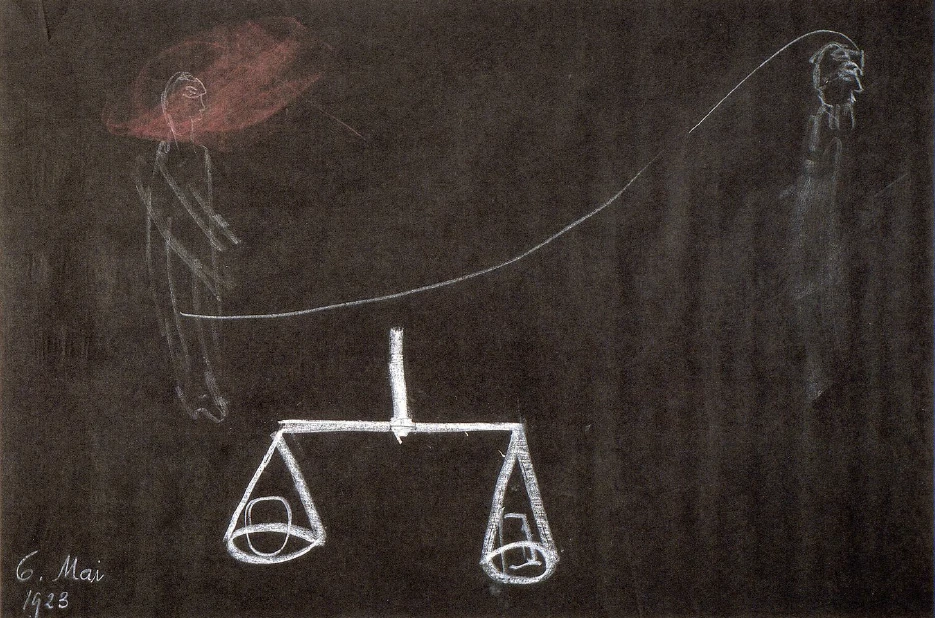
[ 24 ] Let us try to clarify the significance of this point, which must therefore lie within the middle human being, the chest-human. Imagine you have a set of scales here. Imagine a load on one side and weights on the other; now bring them into balance. I must not add too much weight here, or it will tip down; nor must I add too much weight there, or it will tip down; nor must I remove anything, or the whole thing will shift. But look, here is a point—a neutral point. You could add as much as you wanted to this point, and nothing would change in the balance of the scale. You could also take the scale there, and as long as you avoid creating an imbalance anywhere—due to a swing or something like that—you can move the scale around anywhere, and the balance remains the same. You can actually weigh things accurately while it’s moving. This is a point that has absolutely nothing to do with the entire system of the scale—a point of equilibrium. You can do whatever you want at that point, and it won’t change the balance of the scale in any way. For example, suppose someone has a load on one side here and weights on the other. Now it occurs to him: “The balance beam is made of iron; I don’t like that—I’ll make it out of gold.” — Now he just needs to enlarge the center point slightly, because the center of balance is actually a mathematical point, but it’s possible to enlarge it somewhat. You can easily place gold right here at the center of balance: the equilibrium won’t change. If you place the gold somewhere else here—outside the center point—then the equilibrium changes immediately. But if someone wants to create a hollow space there and put meat inside, they can do that too; it won’t change the balance. Someone else puts butter in there: the butter melts in the sun, but the balance of the scale doesn’t change. In short, there’s simply a point here—completely independent of the entire scale system—where you can do whatever you want.
[ 25 ] The point that lies there between the physical and the spiritual, serving as a point of balance, is in the same position. It is not dependent in any way on either the physical or the spiritual. From this point, a person can do whatever they want.
[ 26 ] If one simply imagines that human beings are physical beings and that everything is connected solely through cause and effect, then one will not find this point. If one imagines that human beings are merely spiritual beings and that everything is determined from above through divine worlds, then again there is nothing to be done, for then human beings must carry out what has been determined by the gods. But if one knows: There is a point of equilibrium, where the human being is divinely determined above and materially determined below, and with that one point—which is now verifiable in the human being’s middle realm—one can begin in the world whatever one wishes to begin from within oneself—if you have this threefold constitution of the human being, then you will find, in the middle realm, the fact of human freedom, which is scientifically verifiable. You could put it that way; it is just as scientific as solving any quadratic equation, finding a differential quotient, or anything else. It is something that can be treated according to the strict rules of science. So freedom is the result of a true understanding of the human constitution, because there is a point within the human being that is as independent upward and downward as the hypomochlion of a balance is independent of the weights on the right and left. You can carry the balance anywhere; you can replace this point, as I have told you, with whatever you want. In the same way, you can also find a point within the human being where natural causality—the relationships between cause and effect—ceases, where the influences from above also cease, including determination by the spiritual world, and where both maintain a balance. There, in this hypomochlion of human nature, human freedom is guaranteed. And it is scientifically verifiable with strict rigor, provided one has a true physiology and a true psychology—not what we have today, which, as I have already shown you, amounts to dilettantism squared in psychoanalysis.
[ 27 ] These are the things that should give people who learn about them pause for thought, as they consider the following. You can, of course, turn to all of literature and philosophy; you can read about the problem of freedom everywhere—yet no one can come to terms with the problem of freedom. Why? Because they have no real understanding of the human being. Such a view simply does not exist today except in anthroposophy. And the fact that people cannot come to terms with the problem of freedom points back, in turn, to the other fact that I tried to shed light on yesterday—albeit in a more humorous tone. But what I tried to characterize yesterday—in a humorous way, based on what was at least ostensibly a humorous creation—can certainly also be presented in all seriousness.
[ 28 ] And one must treat these matters seriously if one wishes to commit oneself to anthroposophy in earnest. Then it is truly a matter of engaging with genuine realities and applying them in the appropriate way. Isn’t it true that if one isn’t quite sure—should one profess faith in the spirit, since one knows the spirit only through abstract ideas, or should one profess materialism? Well, then one simply becomes a humorist like Schwaben-Vischer; as such a humorist, one devises a humorous world system that, I would say, is not at all suited to a more refined taste—the catarrhal world system. Certainly, one can laugh at it, but one cannot say with absolute certainty that it is not true—that the world came into being through a “sneeze of the Absolute.” Here, once again, the material is not being used in the right way. It is simply a matter of always using the material in the right way. Whether one merely wishes to recognize it or to make use of it, one must use this material element in the right way. I gave you an example of this yesterday; I described to you the perspective of the Swabian fisherman, who actually creates an entire world system out of catarrh as a compelling, overwhelming reality. Yes, in the field of anthroposophy, one does not do that! There, too, one has a cold, as I did yesterday, but I have always used it only occasionally for illustration: now and then the cold symptoms, the cough, would come up; that was used only for illustration, not to immediately establish some kind of foundation for a worldview, but only to provide illustrative instruction.
[ 29 ] Isn’t it true that when one wavers so aimlessly between the catarrhal matter and the purely ideal spirit, one ends up speaking of seduction and temptation by the god Grippo? After all, that is no longer possible within the framework of anthroposophy. So they’re promoting a flu remedy precisely to avoid being tempted to attach an entire myth of the Fall to the god Grippo! The point is to grasp the material aspect from the right angle and place it in its proper place.
[ 30 ] So things really need to change. If you were a man of the same spirit as Schwaben-Vischer in the last third of the 19th century, you would have gotten annoyed, spat, cleared your throat, and finally come up with the farce of the god Grippo. If you’re an anthroposophist, you simply try to fight the flu with our very effective flu remedy! These are the things that point to the real difference in how one approaches the material world from a spiritual perspective.
[ 31 ] Just from the very way in which the human head is viewed today from a scientific perspective, one can see that, in fact, the entire contemporary worldview harbors a deep affinity for materialism. And the fact that we are at a loss when it comes to the problem of freedom reflects our failure to recognize that two entirely different cosmic forces are at work in the higher human being and the lower human being. Those who, in ancient times, looked only to the higher human being concluded: Human beings cannot be free, for they are determined in every respect by the spiritual world. Those who look at human beings today all simply attribute what manifests in human beings to natural causality. From both of these perspectives, human beings cannot be free. But spiritual causality applies to the head, while natural causality applies to the metabolic-limb aspect of the human being. In between lies the rhythmic organization, which is rhythmic precisely because things balance each other out rhythmically within it. Within the rhythmic organization lies something that is determined neither in a spiritual nor in a material sense, something that is neither determined nor subject to causality—this represents the point from which the impulse toward freedom arises in human beings.
[ 32 ] As you can see, it is through such concrete examples that one can demonstrate how anthroposophy sheds light on the deepest problems of human existence. At the very moment when the threefold nature of the human being was presented in my book On the Mysteries of the Soul: the nervous-sensory human, the rhythmic human, and the metabolic-limb human—at that very moment, light was shed on the Philosophy of Freedom, in which freedom is simply presented as a fact. Light was shed on this fact of freedom in such a way that one could say: If you consider the human being, in terms of his true nature, as such a threefold organization, then you can arrive at a scientifically precise description of freedom in the human being, just as one arrives at a description of the hypomochlion in a balance or, in any system of forces, at a description of a point of equilibrium that exists there, independent of the rest of the interplay of the forces in that system. But you will also see from this that, no matter where you look today, you will find nowhere that the truth about these matters is represented. And based on those flawed concepts—which are entirely divorced from the true organization of the human being—people today are educated; they construct moral systems, religious systems, and, in particular, social systems from them. Indeed, it is no wonder that these social systems manifest themselves in such monstrosities of thought, as is so clearly evident from the example recently characterized by Leinhas in The Goetheanum, where one must admit that the views associated with Marxism have been refuted by life itself; life shows that they cannot hold true. But that is not decisive; one must first wait until someone scientifically proves that they cannot hold true. In fact, as Leinhas has done, one can only cite such things in quotation marks using the authority’s own words; for if one were to repeat them, one feels as though one’s head would explode. It is not merely a millwheel turning in one’s head, but one actually feels as though one’s head would explode just from having to think about such things.
[ 33 ] It is necessary not merely to go along with the anthroposophical movement while letting everything outside it take its own course, but rather to take an interest, first and foremost, in how chaotic our knowledge—and the many things that have been created in the world as a result of this knowledge—actually are.