Insight from Initiation
GA 227
23 August 1921, Penmaenmawr
Translate the original German text into any language:
Versions Available:
Insight from Initiation, tr. SOL
Des Menschen Beziehungen zu den drei Welten
Human Relations with the Three Worlds
[ 1 ] Der Traum, von dem wir einiges gesprochen haben, und der, wie ich schon sagte, mit Recht nicht als etwas allzu Wichtiges in das gewöhnliche Erdenleben hereingesetzt werden soll, ist aber von unermeßlicher Wichtigkeit, wenn man die Beziehungen des Menschen zur übersinnlichen Welt kennenlernen will. Und er führt uns ja eigentlich zunächst an dasjenige Gebiet des Erlebens heran, in dem der Mensch die übersinnliche Welt so berührt, daß da aufhören die äußeren Naturgesetze. So daß die Traumbilderwelt in der Tat dasteht wie ein Schleier, der die geistige Welt verhüllt. Man kann sagen: Hier ist der Mensch, hier der Schleier des Traumes. Dahinter ist die geistige Welt. Aber es ist nun der große Unterschied, ob man, wie es beim träumenden Bewußtsein geschieht, unbewußt in die geistige Welt hineingeht, oder ob man durch Imagination und Inspiration bewußt in diese geistige Welt hineingeht. Und geht man bewußt durch Imagination und Inspiration in diese geistige Welt hinein, dann nimmt sich alles anders aus als in der physisch-natürlichen Welt. Dann erweist sich vor allen Dingen hinter dem Schleier des Traumes, hinter dem also, was die Griechen das Chaos genannt haben, die sittlich-moralische Welt als eine ebenso wirkliche, wie hier in der Sinnenwelt die natürliche Welt, die Welt, die beherrscht ist von den Naturgesetzen. Aber das Chaotische des Traumes, das Durcheinanderwirbeln des Traumes, das macht uns ja schon aufmerksam darauf, daß es mit dieser Welt, die da hinter dem Chaosschleier liegt, seine ganz besondere Bewandtnis habe.
[ 1 ] The dream, about which we have spoken at some length, and which—as I have already said—should rightly not be regarded as something all too important in ordinary earthly life, is nevertheless of immeasurable importance if one wishes to understand the relationship between human beings and the supersensible world. And it actually leads us, first and foremost, into that realm of experience where human beings come into contact with the supersensible world in such a way that the external laws of nature cease to apply. Thus, the world of dream images indeed stands like a veil that shrouds the spiritual world. One might say: Here is the human being; here is the veil of the dream. Behind it lies the spiritual world. But there is a great difference between entering the spiritual world unconsciously, as happens in the dreaming state of consciousness, and entering it consciously through imagination and inspiration. And when one enters this spiritual world consciously through imagination and inspiration, everything appears different than in the physical-natural world. Then, above all, behind the veil of the dream—behind what the Greeks called “chaos”—the ethical-moral world reveals itself to be just as real as the natural world here in the sensory realm, the world governed by the laws of nature. But the chaotic nature of the dream, the whirl of confusion in the dream, already draws our attention to the fact that there is something quite special about this world that lies behind the veil of chaos.
[ 2 ] Von dieser Welt kann eigentlich erst gesprochen werden, wenn man in der Betrachtung so weit gekommen ist, wie wir Jetzt hier in diesen Vorträgen gekommen sind. Dasjenige, was der Mensch für das gewöhnliche Bewußtsein von der äußeren Welt sieht, das ist ja nur die äußere Offenbarung. Das ist eigentlich eine große Illusion. Denn hinter alledem steckt erst die geistige Wirklichkeit, die darinnen tätig ist. Und im Grunde genommen taucht der Mensch, indem er träumt, in diese geistige Wirklichkeit ein, aber noch nicht voll vorbereitet dazu, so daß ihm dasjenige, was ihm in der geistigen Welt entgegenkommt, durcheinanderwirbelt, daß es ihm ungeordnet erscheint. Und wir haben zunächst vorzugsweise die Aufgabe, zu erkennen, warum der Mensch mit dem Traume in eine gegenüber der natürlichen Welt so ungeordnete, so chaotische Welt hineinkommt.
[ 2 ] One can truly speak of this world only once one has progressed in one’s contemplation as far as we have now in these lectures. What human beings perceive as their ordinary consciousness of the external world is, after all, merely the external manifestation. It is, in fact, a great illusion. For behind all of this lies the spiritual reality that is at work within it. And fundamentally, when a person dreams, they plunge into this spiritual reality, but they are not yet fully prepared for it, so that what they encounter in the spiritual world swirls around them, appearing disordered to them. And our primary task, for the time being, is to recognize why, through dreaming, a person enters a world that is so disordered and chaotic in comparison to the natural world.
[ 3 ] Ich werde also gerade heute, um in der Betrachtung über den Traum weiterschreiten zu können, genötigt sein, Ihnen über dasjenige etwas zu berichten, was Imagination und Inspiration in der geistigen Welt schauen können, wahrnehmen können.
[ 3 ] So today, in order to continue my discussion of the dream, I will have to tell you a little about what the imagination and inspiration can see and perceive in the spiritual world.
[ 4 ] Da zeigt sich vor allen Dingen: Sobald man mit vollem Bewußtsein durch Imagination und Inspiration in diese geistige Welt eintritt, erscheint sie sofort als eine Dreiheit. Und so können wir von der Welt überhaupt erst sprechen und von unserem Thema: Entwiickelung der Welt und des Menschen, wenn wir es bis zu dieser Stelle der Betrachtung gebracht haben, an der wir jetzt stehen. Denn da erst kann ich davon sprechen, daß der Mensch vor der äußeren Welt, vor der also sinnlich sich offenbarenden, in Wirklichkeit geistigen Welt als vor einer Dreiheit steht, eigentlich vor drei Welten steht. In dem Augenblicke, wo man den Schleier durchdrungen hat, der das Chaos ist, steht man nicht vor einer Welt, steht man vor drei Welten. Und diese drei Welten haben ihre ganz bestimmten Beziehungen, ihre ganz bestimmten Verhältnisse zum Menschen.
[ 4 ] What becomes clear above all is this: As soon as one enters this spiritual world with full consciousness through imagination and inspiration, it immediately appears as a trinity. And so we can only begin to speak of the world in general—and of our topic, the development of the world and of humanity—once we have reached this point in our consideration, where we now stand. For only then can I speak of the fact that humanity stands before the outer world—that is, the world that reveals itself through the senses, but is in reality a spiritual world—as standing before a trinity, or rather, before three worlds. The moment one has penetrated the veil that is chaos, one stands not before one world, but before three worlds. And these three worlds have their very specific relationships, their very specific connections to humanity.
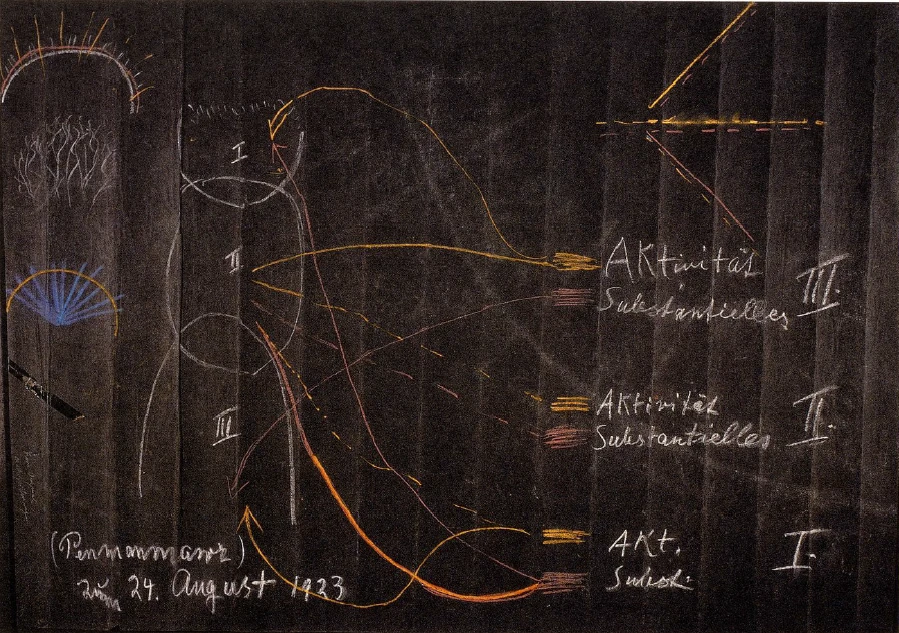
[ 5 ] Machen wir uns zunächst dasjenige, was hier vorliegt, durch eine Art schematischer Zeichnung klar: Wenn wir also hinauskommen durch den Schleier des Chaos hindurch — ich werde später zeigen, wie man dieses Hinauskommen auch beschreiben kann als ein Überschreiten der Schwelle in die geistige Welt hinein —, wenn man da hinauskommt, schaut man drei Welten. Diese drei Welten sind erstens diejenige, die man eben erst verlassen hat, die sich etwas verwandelt zeigt, die aber dennoch auch für das geistige Dasein da ist. Sie erscheint einem, wenn man den Schleier des Chaos durchstoßen hat, wie in einer Erinnerung. Man ist hinübergetreten in die geistige Welt, und so, wie man sich hier an etwas erinnert, so erinnert man sich an dasjenige in der geistigen Welt, was überhaupt physisch-sinnliche Welt ist. Es ist das also die erste Welt. Die zweite Welt, die einem entgegentritt, ist diejenige Welt, die ich in meinem Buche «Theosophie» die Seelenwelt genannt habe, die Welt der Seelen. Und die dritte Welt, die höchste der Welten, die einem da entgegentreten, das ist die eigentliche geistige Welt. Die dritte Welt ist also die Welt des Geistes.
[ 5 ] Let’s first clarify what we have here using a kind of schematic diagram: So when we emerge through the veil of chaos—I will show later how this emergence can also be described as crossing the threshold into the spiritual world—when we emerge there, we behold three worlds. These three worlds are, first, the one we have just left behind, which appears somewhat transformed but which nevertheless also exists for spiritual life. Once one has pierced the veil of chaos, it appears to one as if in a memory. One has crossed over into the spiritual world, and just as one remembers something here, so one remembers in the spiritual world that which is, in fact, the physical-sensory world. This, then, is the first world. The second world that one encounters is the one I have called the world of souls in my book Theosophy, the world of souls. And the third world, the highest of the worlds one encounters there, is the true spiritual world. The third world is thus the world of the Spirit.
[ 6 ] Ich werde die Sache zunächst nur schematisch erklären, aber durch die Beziehungen, in denen diese drei Welten zum Menschen stehen, wird Ihnen manches über diese drei Welten zum Bewußtsein kommen. Ich will also zu diesen drei Welten, die Ihnen, gewissermaßen in drei Etagen aufsteigend, als die unterste, die mittlere, die höchste Welt erscheinen —, ich will den Menschen zu diesen drei Welten in Beziehung setzen: [zur ersten Welt] den Kopf; [zur zweiten] die Brustorganisation, alles das, was Rhythmus umfaßt, Atmungsorganisation, Blutzirkulationssystem; und zur dritten das Stoffwechsel-Gliedmaßensystem, alles dasjenige, was den Stoffwechsel umfaßt: daß der Mensch sich ernährt, daß der Mensch verdaut, das Verdaute im Körper verbreitet, dadurch die Bewegungen erzeugt. Dadurch hat man es hier mit dem StoffwechselGliedmaßensystem zu tun.
[ 6 ] I will begin by explaining this matter only in general terms, but through the relationships these three worlds have with human beings, you will come to realize many things about them. So I want to relate human beings to these three worlds—which appear to you, as it were, rising in three levels as the lowest, the middle, and the highest worlds—I want to relate human beings to these three worlds: [to the first world] the head; [to the second] the chest region, everything that involves rhythm, the respiratory system, and the circulatory system; and to the third, the metabolic-limb system, everything that involves metabolism: how the human being takes in food, digests it, distributes the digested substances throughout the body, and thereby generates movement. Thus, we are dealing here with the metabolic-limb system.
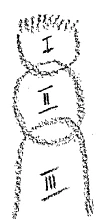
[ 7 ] Ich zeichne absichtlich hier [für die Brust] einen geschlossenen Kreis, für den Kopf einen offenen Kreis, und auch für das Gliedmaßensystem einen nicht geschlossenen Kreis. Ich mache das absichtlich, weil der Kopf des Menschen für die sinnliche Anschauung nach oben erst recht geschlossen erscheint. Ich müßte also, wenn ich für die sinnliche Anschauung zeichnete, den Kopf oben geschlossen zeichnen. Das ist er aber nicht, der Menschenkopf, für die geistige Anschauung. Für die geistige Anschauung ist der Menschenkopf nach oben offen. Denn dasjenige, was gar nicht dem Geisterland angehört vom Menschen, das ist die Knochenmasse. Die Knochenmasse ist ganz physischer Natur. Die gehört gar nicht dem Geisterland an. Wenn Sie geistig ein menschliches Haupt betrachten, hier die dicke Schädeldecke (weiß), so ist diese überhaupt für die geistige Betrachtung nicht da. Nur dasjenige, was darüber ist als Haut, das erscheint der geistigen Betrachtung noch etwas (rot). Da sind dann die Haare darauf.
[ 7 ] I am deliberately drawing a closed circle here [for the chest], an open circle for the head, and also a non-closed circle for the system of limbs. I am doing this deliberately because, to sensory perception, the human head appears even more closed at the top. So if I were drawing for sensory perception, I would have to draw the head as closed at the top. But that is not what the human head is like for spiritual perception. For spiritual perception, the human head is open at the top. For that part of the human being that does not belong to the spiritual realm at all is the mass of bones. The mass of bones is entirely of a physical nature. It does not belong to the spiritual realm at all. When you spiritually observe a human head—here, the thick skull (white)—this is not present at all for spiritual observation. Only what lies above it as skin still appears somewhat to spiritual observation (red). And then there is the hair on top of that.
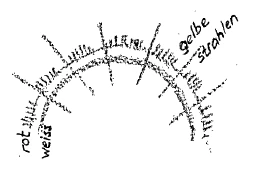
[ 8 ] Aber für die geistige Betrachtung tritt etwas anderes auf. Sehen Sie, da ist dasjenige, was ich hier weiß gezeichnet habe, nicht vorhanden, dagegen lauter «Geisthaare», das heißt Strahlen, die da in den Menschen eindringen, die nur etwas gehindert werden, abgehalten werden durch die physische Haut (gelbe Strahlen). Aber da, wo Knochen ist im Menschen, da kann der äußere Geist am leichtesten eindringen. Und er dringt strahlenförmig ein. So daß Sie, wenn Sie den Menschen zunächst mit physischem Auge betrachten, die physische Menschengestalt vor sich haben; da sehen Sie also oben am Kopf, wenn der Mensch noch nicht einen Kahlkopf bekommen hat, seine Haare (rot). Dann aber sehen Sie da, wo die Knochenwölbung oben ist, geistig nichts vom physischen Menschen, dagegen ganz strahlig, sonnig strahlig ziehen da die geistigen Welten in ihn ein (blau). So daß ich also dasjenige, was da ineinander sich schiebt bei der Menschenbetrachtung, eben so zeichnen müßte:
[ 8 ] But when it comes to spiritual observation, something else comes into play. You see, what I have drawn here does not exist; instead, there are nothing but “spiritual hairs”—that is, rays—that penetrate the human being, but are only slightly hindered and held back by the physical skin (yellow rays). But where there is bone in the human being, the outer spirit can penetrate most easily. And it penetrates in the form of rays. So that when you first look at a human being with your physical eye, you see the physical human form before you; there, at the top of the head—if the person has not yet gone bald—you see their hair (red). But then, where the bony arch is at the top, you see nothing of the physical human being spiritually; instead, the spiritual worlds flow into him in a radiant, sunlit manner (blue). So that I would have to draw what is interlocking there when observing a human being exactly like this:
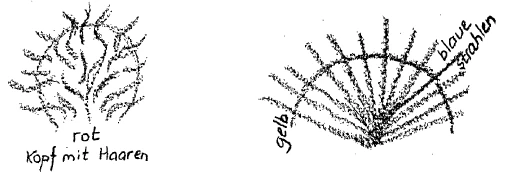
[ 9 ] Da ist der Mensch als physisches Wesen (Zeichnung links); und da ist der Mensch als geistiges Wesen [von sich aus] nichts — aber viele einziehende Strahlen (Zeichnung rechts).
[ 9 ] There is the human being as a physical being (drawing on the left); and there is the human being as a spiritual being—[in and of itself] nothing—but many incoming rays (drawing on the right).
[ 10 ] So daß ich aus diesem Grunde den Kopf hier oben nicht als einen geschlossenen Kreis, sondern ungeschlossen gezeichnet habe, weil in der Tat in das Menschenhaupt das Geistige fortwährend eindringen kann dadurch, daß hier ein peripherisches Knochengewölbe ist.
[ 10 ] For this reason, I have drawn the head here not as a closed circle but as an open one, because the spiritual can indeed continually penetrate the human head due to the presence of a peripheral bony vault.
[ 11 ] Nichts am Menschen ist unzweckmäßig. Der Mensch hat, ich möchte sagen, aus der vollen Bedachtheit der Weltregierung heraus, diesen oben abgeschlossenen Kopf. Denn da dringt durch dasjenige, was den Geist am leichtesten in den Menschen einläßt, durch die äußere Knochenmasse, das Geistige in das Innere.
[ 11 ] Nothing about human beings is without purpose. Human beings have—I would say—this head, which is closed off at the top, as a result of the world government’s profound deliberation. For it is through that which most easily allows the spirit to enter human beings—the outer bony structure—that the spiritual penetrates into the inner being.
[ 12 ] Wenn man in der Lage ist, den Menschen geistig zu betrachten, so kommt man darauf, das größte Erstaunen darüber zu haben, wie leer eigentlich der Menschenkopf durch das eigene Innere des Menschen ist. Dem Kopf gibt nämlich das eigene Innere des Menschen am allerwenigsten. Der Mensch hat eigentlich in bezug auf das Geistige von sich aus eine ganz leere hohle Kugel da oben sitzen. Und alles Geistige muß in den Kopf hineinkommen von außen.
[ 12 ] If one is able to view human beings from a spiritual perspective, one is struck by the greatest astonishment at just how empty the human head actually is, due to the person’s own inner self. For it is the person’s own inner self that contributes the very least to the head. In terms of the spiritual, a person actually has a completely empty, hollow sphere sitting up there. And everything spiritual must enter the head from the outside.
[ 13 ] Das ist nicht so mit den anderen Gliedern des menschlichen Organismus. Die sind, wie wir gleich nachher hören werden, von sich aus geistig. Nun unterscheiden wir danach also auch im Menschen drei Glieder: den Kopf, das rhythmische System, das Stoffwechsel-Gliedmaßensystem. Diese drei Glieder der menschlichen Natur stehen nun in einer ganz bestimmten Beziehung zu den drei Welten.
[ 13 ] This is not the case with the other members of the human organism. As we will hear shortly, they are spiritual in and of themselves. We therefore distinguish three members in the human being as well: the head, the rhythmic system, and the metabolic-limb system. These three members of human nature stand in a very specific relationship to the three worlds.
[ 14 ] Von dieser Beziehung des Menschen, von dem, was im menschlichen Haupte oder dem Nerven-Sinnessystem, von dem menschlichen Brustsystem oder dem Atmungs-Zirkulationssystem, oder dem dritten System, dem Bewegungs-Stoffwechselsystem, was vom Menschen zu diesen drei Welten in Beziehung steht, das werde ich dann weiter besprechen.
[ 14 ] I will then discuss in more detail this relationship of the human being—that is, what in the human head or the nervous-sensory system, in the human chest system or the respiratory-circulatory system, or in the third system, the motor-metabolic system, relates the human being to these three worlds.
[ 15 ] Wenn wir von dieser Charakteristik der Dreigeteiltheit des Menschen und der Dreigeteiltheit der Welt nun zu den Beziehungen zwischen beiden übergehen, dann ist es gut, wenn man in Jeder der drei Welten das Substantielle und die Aktivität unterscheidet. Ich werde also sowohl bei der geistigen Welt, wie bei der Seelenwelt, wie bei der stofflichen, sinnlich physischen Welt das Substantielle und die Tätigkeit, die Aktivität unterscheiden. In Wirklichkeit sind Substanz und Aktivität eines; aber sie wirken nach der Welt hin in verschiedener Weise. Sie können sich das an der Substantialität Ihres eigenen menschlichen Wesens klarmachen.
[ 15 ] As we now move from this characterization of the tripartite nature of the human being and the tripartite nature of the world to the relationships between the two, it is helpful to distinguish between substance and activity in each of the three worlds. I will therefore distinguish between the substantial and the activity in the spiritual world, in the world of the soul, and in the material, sensually physical world. In reality, substance and activity are one; but they manifest themselves in different ways in the world. You can understand this by considering the substantial nature of your own human being.
[ 16 ] Sie haben in Ihrem Arm Ihre Substanz. Wenn diese Substanz nicht in Ordnung ist, dann werden Sie irgendeinen Schmerz im Arme empfinden. Da zeigt sich, da offenbart sich dasjenige, was in der Substanz nicht in Ordnung ist, nach innen. Wenn die Tätigkeit des Armes nicht in Ordnung ist, so geben Sie vielleicht dem Mitmenschen einen Schlag. Das tut dem andern weh. Da ist die Tätigkeit nicht in Ordnung. Dennoch aber, dieses Substantielle und die Tätigkeit sind in Ihrem Arme eins; aber sie äußern sich, sie offenbaren sich in verschiedener Weise nach außen.
[ 16 ] Your arm contains your substance. If this substance is not in order, then you will feel some kind of pain in your arm. This is where what is wrong with the substance manifests itself inwardly. If the activity of the arm is not right, you might strike another person. That hurts the other person. In that case, the activity is not right. Nevertheless, this substance and this activity are one in your arm; but they express themselves, they manifest themselves outwardly in different ways.
[ 17 ] So müssen wir in jeder der drei Welten ein Substantielles und eine Aktivität unterscheiden. Ich will dieses so unterscheiden, daß ich das Substantielle überall als das Rote, die Tätigkeit überall als das Gelbe bezeichne. So daß wir also haben in der spirituellen Welt Aktivität (gelb), Substanz (rot); in der Seelenwelt Aktivität (gelb), Substanz (rot); in der physisch-sinnlichen Welt Aktivität (gelb), Substanz (rot).
[ 17 ] Thus, in each of the three worlds, we must distinguish between a substantial aspect and an activity. I will make this distinction by designating the substantial aspect everywhere as “red” and the activity everywhere as “yellow.” Thus, in the spiritual world we have activity (yellow) and substance (red); in the soul world, activity (yellow) and substance (red); and in the physical-sensory world, activity (yellow) and substance (red).
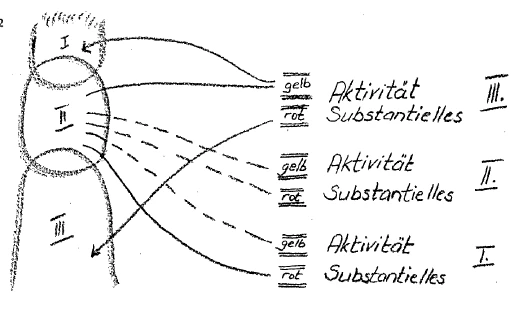
[ 18 ] Wenn wir nun den menschlichen Kopf betrachten, so ist dieser menschliche Kopf seiner Substanz nach ganz aus der physischen Welt heraus gebildet. Die Substanz des Kopfes ist zunächst während der menschlichen Embryonalbildung aus der Substanz, die von den Eltern herrührt, genommen; und die weitere Ausbildung des Kopfes erfolgt auch dadurch, daß dem ganzen menschlichen Kopf und Sinnes- und Nervensystem die Substanz dieser irdisch-stofflichen Welt zugrunde liegt. So daß ich sagen muß: Der Kopf ist aus der Substanz der physisch-sinnlichen Welt gebildet. Dagegen ist alle Tätigkeit, welche diese Formen des menschlichen Kopfes plastisch ausbildet, all dasjenige, was dem menschlichen Kopfe aus der Substanz heraus durch Aktivität Form gibt, das ist ganz und gar aus der geistigen Welt heraus gebildet. So daß der Kopf in bezug auf die Aktivität ganz und gar aus der geistigen Welt heraus gebildet ist. Deshalb muß der Kopf auch nach oben offen sein — in geistiger Beziehung —, damit die geistige Tätigkeit hereinkommen kann.
[ 18 ] If we now consider the human head, we see that, in terms of its substance, this human head is formed entirely from the physical world. The substance of the head is initially derived, during human embryonic development, from the substance that comes from the parents; and the further development of the head also takes place because the entire human head and the sensory and nervous systems are based on the substance of this earthly, material world. So I must say: The head is formed from the substance of the physical-sensory world. In contrast, all activity that sculpts these forms of the human head—everything that gives the human head its form through activity arising from the substance—is formed entirely from the spiritual world. Thus, in terms of activity, the head is formed entirely from the spiritual world. That is why the head must also be open at the top—in a spiritual sense—so that spiritual activity can enter.
[ 19 ] So daß Sie also in jedem Augenblicke Ihres Lebens sich sagen können: In meinem Haupte habe ich etwas, was der Substanz, dem Stoffe nach, ganz aus der Erde genommen ist, was aber so zusammengesetzt ist, so plastisch gebildet ist, daß niemals irdische Kräfte dieses menschliche Haupt bilden können. Die Formen dieses Menschenhauptes sind ganz und gar aus der geistigen Welt heraus gebildet, sind sozusagen Himmelsschöpfung. Es ist gerade sehr tiefgehend für den geistigen Betrachter, dieses menschliche Haupt in bezug auf die Welt zu betrachten.
[ 19 ] So that at every moment of your life you can say to yourself: In my head I have something that, in terms of its substance, is taken entirely from the earth, but which is composed and shaped so plastically that earthly forces could never form this human head. The forms of this human head are entirely shaped from the spiritual world; they are, so to speak, a heavenly creation. It is particularly profound for the spiritual observer to contemplate this human head in relation to the world.
[ 20 ] Der Mensch richtet, wenn er geistig betrachtet, seinen Blick auf irgendeine Pflanze. Er sagt sich: Die Pflanze hat eine bestimmte Form. Ihre Substanz hat sie aus der Erde genommen. Aber die Form ist aus der ätherischen Welt, also noch aus der Raumeswelt.
[ 20 ] When viewed from a spiritual perspective, a person directs their gaze toward a plant. They say to themselves: The plant has a specific form. It has drawn its substance from the earth. But its form comes from the ethereal world—that is, from the world of space.
[ 21 ] Betrachtet der Mensch ein Tier, so sagt er sich: Dieses Tier hat die Substanz seines Kopfes ganz und gar aus der Raumeswelt. Aber in seine Tätigkeit fiel schon etwas Geistiges herein. Das höchste Geistige, dasjenige, was man eigentlich himmlisch nennen kann, spielt aber erst in den Bau des menschlichen Kopfes herein. Dieser menschliche Kopf könnte niemals durch irgendwelche irdischen Kräfte entstehen, obwohl seine Substanz aus den Erdenstoffen genommen ist. So baut im menschlichen Haupte, das selber eine Art kleiner Kosmos ist, aus Erdenstoffen die Geisteswelt ein Gebilde auf.
[ 21 ] When a person observes an animal, they say to themselves: This animal derives the substance of its head entirely from the spatial world. But something spiritual has already entered into its activity. The highest spiritual element—that which can truly be called heavenly—only comes into play in the formation of the human head. This human head could never have come into being through any earthly forces, even though its substance is drawn from earthly materials. Thus, within the human head—which is itself a kind of miniature cosmos—the spiritual world builds a structure out of earthly materials.
[ 22 ] Gerade das Umgekehrte ist der Fall bei dem Stoffwechsel-Gliedmaßenmenschen, bei demjenigen Menschen, der also die Organe für die äußere Bewegung enthält, Beine, Arme, dasjenige, was sich von Beinen und Armen nach innen fortsetzt, die Verdauungsorgane.
[ 22 ] The exact opposite is true of the metabolic-limb human—that is, the human who possesses the organs for external movement: legs, arms, and what extends inward from the legs and arms—the digestive organs.
[ 23 ] Ich lasse in der Mitte aus zunächst die rhythmische Organisation, Atmungs- und Blutzirkulations-Organisation, und ich nehme jetzt dasjenige, was sich aus all dem zusammensetzt, was verdaut, was ernährt, und demjenigen, was aus der Verdauung, der Ernährung, also aus der inneren Verbrennung des Menschen hervorgeht als Bewegungen des Menschen.
[ 23 ] I will initially set aside the rhythmic organization—the organization of respiration and blood circulation—and focus instead on that which is composed of all these elements: that which digests, that which nourishes, and that which arises from digestion and nutrition—that is, from the human being’s internal metabolism—as human movements.
[ 24 ] Das ist nun seiner Substanz nach gar nicht aus der Erde aufgebaut. So unwahrscheinlich Ihnen das zunächst klingt, so tragen Sie gerade in Ihrem Stoffwechsel-Gliedmaßenmenschen etwas in sich, was seiner Substanz nach gar nicht aus der Erde aufgebaut ist, sondern das seiner Substanz nach ganz und gar besteht aus der Substanz der dritten Welt, aus der Substanz, die in der geistigen, in der spirituellen Welt vorhanden ist. Sie werden sagen: Aber ich sehe doch die Beine, sie sind doch physisch-sinnlich sichtbar. Wenn sie aus geistiger Substanz bestünden, so wären sie doch nicht sinnlich-physisch sichtbar! — Es ist ein ganz berechtigter Einwand, aber da kommt folgendes in Betracht.
[ 24 ] In essence, this is not at all composed of earthly matter. As improbable as this may sound to you at first, you carry within yourselves—precisely as metabolic, limb-bearing human beings—something that, in terms of its substance, is not at all composed of earth, but rather consists entirely of the substance of the third world, of the substance that exists in the spiritual world. You will say: But I can see the legs; they are physically and sensually visible. If they were made of spiritual substance, they would not be physically and sensually visible! — This is a perfectly valid objection, but the following must be taken into account.
[ 25 ] Ihre wahren Beine sind nämlich durchaus geistig, Ihre wahren Arme auch durchaus geistig, und der Stoff wird nur vom Kopf hineingeschickt. Der Kopf ist dasjenige Organ, das nun die Geistarme und Geisthände, Geistbeine und Geistfüße ausfüllt mit dem Stoffe. Der dringt nur ein in das Geistige der Gliedmaßen und der Verdauungsorgane. So daß dasjenige, was eigentlich ganz und gar aus der geistigen Welt heraus ist in der Substanz, durchsetzt wird, durchtränkt wird mit physischem Stoff, aber vom Kopfe aus. Deshalb ist es so, daß man zunächst mit physischer Wissenschaft so schwer begreifen kann, daß der Mensch aus Kopf-, Brust- und Gliedmaßen-, Verdauungsorganen besteht. Da stellen sich die Leute vor: Der Kopf ist oben, und der Mensch hat eigentlich nur da den Kopf, wo ihn der Enthauptete nicht mehr hat. Das ist aber nicht der Fall, sondern der Kopf des Menschen ist stofflich überall. Der Mensch ist auch in der großen Zehe Kopf, weil der Kopf da die Substanz hineinschickt. Aber ursprünglich, primär, ist nur Kopfsubstanz irdisch. Der Kopf gibt dann die Erdenstofflichkeit an die übrigen Substanzen ab; während die eigene Substanz der Stoffwechsel-Gliedmaßenorgane aus der geistigen Welt genommen ist.
[ 25 ] For your true legs are entirely spiritual, as are your true arms, and the physical substance is merely sent there from the head. The head is the organ that fills the spiritual arms, hands, legs, and feet with this physical substance. It merely penetrates the spiritual nature of the limbs and the digestive organs. Thus, that which is actually entirely of the spiritual world in substance is permeated and saturated with physical matter—but originating from the head. That is why it is so difficult at first, using physical science, to grasp that a human being consists of the head, chest, limbs, and digestive organs. People imagine: The head is on top, and a human being really only has a head where a decapitated person no longer has one. But that is not the case; rather, the human head is present in substance everywhere. A human being is also “head” in the big toe, because the head sends its substance there. But originally, primarily, only the substance of the head is earthly. The head then transfers this earthly materiality to the other substances, whereas the substance of the metabolic limb organs is drawn from the spiritual world.
[ 26 ] Bringt man es durch eine starke negative Autosuggestion dahin, sich den Kopf von einem Menschen wegzusuggerieren, so daß man imstande ist, nicht nur in Gedanken, sondern durch eine starke negative Autosuggestion den Menschen kopflos erscheinen zu lassen, dann verschwindet auch die übrige Organisation, und mit dem Kopf ist das weg, was der ganze Mensch ist als sinnlich anschaubares Wesen. Man muß dann das übrige seelisch-geistig anschauen, wenn es überhaupt noch für einen da sein soll, weil wir in Wirklichkeit herumgehen, bestimmt von den höheren Welten aus, mit Geistbeinen, mit Geistarmen, und nur der Kopf gewissermaßen das durchtränkt, ausfüllt mit physischen Stoffen.
[ 26 ] If, through strong negative autosuggestion, one manages to suggest away a person’s head—so that one is able, not only in thought but through strong negative autosuggestion, to make the person appear headless—then the rest of the organism also disappears, and with the head gone, what constitutes the whole human being as a sensually perceptible being is gone as well. One must then perceive the rest of the being in a soul-spiritual way, if it is to exist for one at all, because in reality we walk about, guided from the higher worlds, with spiritual legs and spiritual arms, and only the head, so to speak, permeates and fills this with physical substances.
[ 27 ] Dagegen sind die Kräfte, die Aktivität für alles das, was Stoffwechsel-Gliedmaßenmensch ist, von der physischen Welt her genommen. So daß, wenn Sie das eine Bein vorsetzen, oder den Arm bewegen mit Hebekräften nach mechanischer Ordnung, diese mechanische Ordnung, ja auch die chemischen Vorgänge, die in den Armen und in den Beinen vor sich gehen, wenn man sich bewegt, oder die chemischen Vorgänge, die in den Verdauungsorganen vor sich gehen, daß die irdischer Aktivität sind. So daß Sie also in Ihren Gliedmaßen an sich tragen unsichtbare Substanz, aber solche Kräfte, die dem Erdendasein entnommen sind. Wir sind also aufgebaut als Mensch in bezug auf unser Haupt für dasjenige, was dieses Haupt an Substanz enthält, von der Erde aus; wir sind durchsetzt von Kräften in bezug auf unser Haupt vom Himmel aus. Wir sind in bezug auf unsere Gliedmaßen aufgebaut ganz und gar aus einer Substanz, die vom Himmel herunter ist. Aber die Kräfte, die in dieser Himmelssubstanz während unseres Erdenlebens von der Geburt bis zum Tode spielen, das sind die Kräfte der Erde, Gravitation, das sind die anderen physischen Kräfte der Erde, das sind die chemischen Kräfte der Erde.
[ 27 ] In contrast, the forces that drive all activity in the human being—as a metabolic, limb-bearing entity—are drawn from the physical world. So that when you step forward with one leg or move your arm using lifting forces according to mechanical principles—this mechanical order, indeed even the chemical processes that take place in the arms and legs when you move, or the chemical processes that take place in the digestive organs—these are earthly activities. So you carry within your limbs, as such, an invisible substance, but forces that are derived from earthly existence. We are thus constituted as human beings, with regard to our head—in terms of the substance it contains—from the earth; we are permeated by forces, with regard to our head, from heaven. As for our limbs, we are constituted entirely of a substance that comes down from heaven. But the forces that operate within this heavenly substance during our earthly life, from birth to death—these are the forces of the earth: gravity, the other physical forces of the earth, and the chemical forces of the earth.
[ 28 ] Sie sehen also, das Entgegengesetzte ist bei Kopf und Gliedmaßen der Fall. Der Kopf besteht aus Erdenstoff und wird seinen plastischen Formen nach aus der Himmelsaktivität gebildet. Die Gliedmaßen des Menschen und damit zusammen die Verdauungsorganisation sind ganz und gar aus Himmelssubstanz gebildet. Man würde sie nicht sehen, wenn sie nicht vom Kopf durchtränkt würden mit irdischer Substanz. Aber indem der Mensch geht, indem der Mensch greift, indem der Mensch verdaut, bedient sich die Himmelssubstanz der irdischen Kräfte, um dieses Leben auf Erden von der Geburt bis zum Tode zu führen.
[ 28 ] So you see, the opposite is true for the head and the limbs. The head consists of earthly substance and is shaped in its plastic forms by celestial activity. The human limbs—and, along with them, the digestive system—are formed entirely of celestial substance. One would not see them if they were not permeated by earthly substance from the head. But as a person walks, grasps, and digests, the celestial substance makes use of earthly forces to sustain this life on earth from birth to death.
[ 29 ] In dieser komplizierteren Weise steht der Mensch in Relation, in Beziehung zu den drei Welten. Es hat also die geistige Welt ihrer Aktivität nach Anteil an seinem Kopfe, ihrer Substanz nach Anteil an dem dritten Örganisationssystem des Menschen, an dem Stoffwechsel-Gliedmaßensystem. Es hat die unterste, die am meisten sinnliche Welt durch ihre Aktivität Anteil an dem Stoffwechsel und den Gliedmaßenbewegungen. Durch ihre Substanz hat sie Anteil am Kopfe; dagegen ist das Substantielle des dritten menschlichen Systemes ganz und gar ein Geistiges.
[ 29 ] In this more complex way, the human being stands in relation to the three worlds. Thus, the spiritual world participates in the human head through its activity and in the third human system—the metabolic-limb system—through its substance. The lowest, most sensory world participates, through its activity, in metabolism and limb movements. Through its substance, it participates in the head; in contrast, the substance of the third human system is entirely spiritual.
[ 30 ] Im mittleren System, das die Atmung und die Blutzirkulation umfaßt, in dem gehen eben durcheinander geistige Aktivität, stoffliche Substantialität. Aber die geistige Aktivität, die durch unsere Atmungsbewegungen, durch unsere Herzbewegungen strömt, die ist wieder etwas begleitet von Substantialität. Und ebenso ist die Substantialität des irdischen Wesens, insofern sie durch den Sauerstoff in die Atmung einströmt, etwas begleitet von irdischer Tätigkeit. Sie sehen also, in dem mittleren Menschen, in dem zweiten System des Menschen, da strömt alles zusammen. Da strömt himmlische Substantialität und Aktivität ein, da strömt irdische Aktivität und Substantialität ein. Dadurch wird der Mensch empfänglich, nun auch hier entgegenzunehmen die Aktivität der mittleren Welt und die Substantialität der mittleren Welt.
[ 30 ] In the middle system, which encompasses respiration and blood circulation, spiritual activity and material substance are intertwined. But the spiritual activity that flows through our respiratory movements and our heartbeats is, in turn, accompanied to some extent by material substance. And likewise, the substance of the earthly being, insofar as it flows into the breath through oxygen, is accompanied to some extent by earthly activity. So you see, in the middle human being, in the second system of the human being, everything flows together. Heavenly substantiality and activity flow in there; earthly activity and substantiality flow in there. This makes the human being receptive to receiving, now also here, the activity of the middle world and the substantiality of the middle world.
[ 31 ] Es kommt also im mittleren Menschen viel durcheinander. Deshalb müssen wir im mittleren Menschen dieses wunderbar vollkommene rhythmische System haben, den Herzrhythmus, den Lungenrhythmus im Atmen, weil alles dasjenige, was da an Aktivität und Substantialität durcheinanderkommt, im Rhythmus sich ausgleichen, sich harmonisieren, sich melodisieren will und es auch kann, weil der Mensch so veranlagt ist.
[ 31 ] So there is a great deal of confusion within the average person. That is why we must have this wonderfully perfect rhythmic system within the average person—the heartbeat, the rhythm of the lungs as we breathe—because everything that becomes disordered in terms of activity and substance seeks to balance itself, harmonize, and become melodic through rhythm, and it is able to do so because that is how human beings are constituted.
[ 32 ] Während also Aktivität und Substantialität aus ganz verschiedenen Quellen im Kopfsystem, im Gliedmaßensystem kommen, strömt im mittleren System aus allen drei Welten, und noch dazu in verschiedenartiger Weise ein, hier die Aktivität von Substantialität begleitet, hier die Substantialität von Aktivität begleitet, hier reine Aktivität, hier reine Substantialität (siehe Zeichnung 5. 134); das strömt im mittleren Menschen ein. Und wenn Sie eines Menschen Pulsschlag beobachten als Arzt, so fühlen Sie eigentlich im Pulsschlag den Ausgleich zwischen Himmelsseele und irdischer Aktivität und Substantialität. Und wenn Sie die Atemzüge beobachten, so fühlen Sie wiederum dieses Streben des Menschen in seinem Innern nach der Ausgleichung dieser verschiedenen Agenzien, die aus der mittleren Welt in Beziehung zu ihm stehen. Sehen Sie, das ist die Beziehung des Menschen zu den drei Welten.
[ 32 ] While activity and substantiality originate from entirely different sources in the head system and the limb system, in the middle system they flow in from all three worlds—and in diverse ways at that: here, activity is accompanied by substantiality; here, substantiality is accompanied by activity; here, pure activity; here, pure substantiality (see Figure 5.134); this flows into the human being in the middle realm. And when you, as a doctor, observe a person’s pulse, you actually feel in the pulse the balance between the heavenly soul and earthly activity and substantiality. And when you observe the breaths, you again feel this inner striving of the human being toward the balancing of these various forces that relate to him from the middle world. You see, this is the human being’s relationship to the three worlds.
[ 33 ] Sie werden sagen: Das ist eine sehr komplizierte Sache. Und in der Tat, wenn man einen Vortragszyklus bis zu diesem Momente führt, dann erscheint er in der Regel leicht verständlich; wenn man ankommt an diesem Punkte, wo man nun die Beziehung des Menschen zur Welt ins Auge fassen muß, da sagen sich oftmals die Zuhörer: Da wird die Geschichte schwer verständlich. Da geht es nicht mehr recht mit.
[ 33 ] You will say: This is a very complicated matter. And indeed, when one delivers a series of lectures up to this point, it generally seems easy to understand; but when one reaches this point, where one must now consider humanity’s relationship to the world, the audience often says to themselves: “Now the story is becoming hard to follow. It’s getting a bit confusing.”
[ 34 ] Aber sehen Sie, ein vorurteilsfreies, wirklich subtiles Denken kommt schon mit. Und es gibt für dieses Denken des gesunden Menschenverstandes ja eigentlich einen Trost. Das ist der, daß man beim wirklichen Durchstoßen des Chaosschleiers, wie ich vorhin sagte, und beim Eintreten in diese Welt, die eine dreifache ist, die in einer ungeheuer komplizierten Art ihre Tätigkeit und ihre Substanz in die physische Welt hereinschickt, wo in der Tat die Dinge so verwirrend sind, daß man, indem man durch den Schleier hindurch aus der physisch-sinnlichen Welt in sie eintritt, in vollem Sinne des Wortes gewarnt wird, gewarnt wird, indem einem etwa — ich sage das scheinbar im Bilde, aber dieses Bild entspricht tatsächlich einer wirklichen Erfahrung — beim Eintritt in die geistige Welt gesagt wird: Willst du nicht alles zurücklassen, was du in der physischen Welt als deine gewöhnliche naturalistische Logik betrachtet hast, was du da als den Zusammenhang der Dinge betrachtet hast, willst du nicht dieses ganze physische Kleid zurücklassen, so tritt lieber nicht ein in die geistige Welt, denn da wirst du dich ganz anderer Ideenverbindungen, ganz anderer Ordnungen, einer ganz anderen Logik bedienen müssen. Und wenn du noch etwas hineintragen willst von deiner physischen Logik in diese geistige Welt, so wirst du darinnen unweigerlich in Verwirrung kommen. Und man muß unter denjenigen Dingen, die zur Vorbereitung gehören für Meditation und Konzentration, die ich schon erwähnt habe, auch das haben, daß man diese Warnung voll beobachtet, wirklich nicht die sinnliche Logik hineintragen will in die Logik der geistigen Welt.
[ 34 ] But you see, an unbiased, truly subtle way of thinking naturally comes along with it. And there is, in fact, a source of comfort in this common-sense way of thinking. That is, when one truly pierces the veil of chaos, as I said earlier, and enters this world—which is a threefold world that, in an immensely complex way, sends its activity and substance into the physical world, where things are indeed so confusing that, as one passes through the veil from the physical sensory world into it, one is warned in the full sense of the word—warned, for example, by being told—I say this seemingly as a metaphor, but this image actually corresponds to a real experience—upon entering the spiritual world: If you are not willing to leave behind everything you regarded in the physical world as your ordinary naturalistic logic—what you regarded there as the connection between things—if you are not willing to leave behind this entire physical garment, then you had better not enter the spiritual world, for there you will have to make use of entirely different associations of ideas, entirely different orders, and an entirely different logic. And if you still wish to carry anything of your physical logic into this spiritual world, you will inevitably become confused within it. And among the things that are part of the preparation for meditation and concentration—which I have already mentioned—one must also include the full observance of this warning: one must truly not carry sensory logic into the logic of the spiritual world.
[ 35 ] Ich möchte sagen, das ist die bedeutsame Warnung, die diejenige Macht — wir werden sie noch genauer kennenlernen in den folgenden Vorträgen —, die man den Hüter der Schwelle nennen kann, einem zunächst zuteil werden läßt, wenn man den Vorhang durchschreiten will.
[ 35 ] I would like to say that this is the significant warning that the power—which we will come to know more precisely in the following lectures—that can be called the Guardian of the Threshold initially bestows upon one when one seeks to pass through the veil.
[ 36 ] Aber auch wenn man wiederum zurückkehren will in die physisch-sinnliche Welt, dann erhält man von diesem Hüter eine mächtige, deutliche Warnung. Man muß ja wieder zurückkehren, wenn man Erdenmensch ist, sonst würde man niemals aus den Ereignissen der geistigen Welt herauskommen. Man würde seinen physischen Erdenleib allmählich tot zurücklassen. Man muß immer wieder zurückkommen. Man muß in der physischen Welt essen und trinken nach der naturalistischen Logik. Man muß sich sogar den anderen Gewohnheiten des Tages fügen nach naturalistischer Logik. Man muß also wieder eintreten in eine Welt, wo wirklich die Dinge so vor sich gehen, daß ganz naturalistisch-materialistische Logik drinnen ist, daß zum Beispiel zum Frühstück, zum Mittag und zum Abend immer geklingelt wird. Man muß also immer wiederum in diese naturalistische Welt zurückkehren. Dazu ist notwendig, daß man wiederum, wenn man eingedrungen ist in die geistige Welt und zurückkehrt in die physisch-sinnliche, damit man nun nicht als Mensch in eine unmögliche Lage kommt, die zweite Warnung des Hüters der Schwelle berücksichtigt, der an dem Orte steht, wo der Schleier des Chaos physisch-sinnliche Welt und geistig-himmlische Welt trennt. Und die besteht darinnen, daß er einem sagt: Vergiß in keinem Moment deines physischen Erdenlebens, daß du in der geistigen Welt drinnen warst. Dann allein wirst du dich auch wiederum in der physischen Erdenwelt für diejenigen Zeiten, in denen du dich drinnen aufhalten mußt, mit Sicherheit bewegen können.
[ 36 ] But even if one wishes to return to the physical, sensory world, one receives a powerful, clear warning from this guardian. After all, one must return if one is an earthly human being; otherwise, one would never emerge from the events of the spiritual world. One would gradually leave one’s physical earthly body behind, dead. One must return again and again. One must eat and drink in the physical world according to naturalistic logic. One must even conform to the other daily routines according to naturalistic logic. One must therefore re-enter a world where things truly unfold in such a way that they are governed entirely by naturalistic-materialistic logic—for example, where the bell always rings for breakfast, lunch, and dinner. One must therefore always return to this naturalistic world. To this end, it is necessary—once one has entered the spiritual world and returns to the physical-sensory world—to heed the second warning of the Keeper of the Threshold, who stands at the place where the veil of chaos separates the physical-sensory world from the spiritual-heavenly world, so that one does not find oneself in an impossible situation as a human being. And this warning consists in his telling you: Do not forget for a single moment of your physical earthly life that you were in the spiritual world. Only then will you be able to move with confidence in the physical earthly world during those times when you must remain there.
[ 37 ] So erhält man gegenüber dieser Welt, mit der der Mensch in der Art, wie ich es Ihnen schematisch dargestellt habe, durch seine drei Glieder in Beziehung steht, beim Eintritt die Warnung, alles abzulegen, was naturalistische Logik ist, zurückzulassen dieses sinnliche Gewand an der Schwelle, und hinüberzutreten mit der Voraussetzung, eine wirklich geistige Logik sich anzueignen, ein geistiges Denken, geistige Ideenzusammenhänge. Und wenn man wieder zurückgeht, erhält man die ebenso strenge, ja viel strengere Warnung, nun nicht zu vergessen, in keinem Augenblicke, dasjenige, was man da erlebt hat in der geistigen Welt; das heißt, sich: nicht wiederum bloß durch das gewöhnliche Bewußtsein den sinnlichen Trieben und so weiter zu überlassen, sondern in allem sich bewußt zu sein, daß man das Geistige hereinzutragen hat in diese physische Welt.
[ 3737 ] Thus, upon entering this world—with which human beings are connected through their three members, as I have schematically described to you—one receives the warning to cast off all naturalistic logic, to leave this sensory garment behind at the threshold, and to step across with the intention of acquiring a truly spiritual logic, spiritual thinking, and spiritual connections of ideas. And when one returns, one receives an equally strict—indeed, much stricter—warning not to forget, at any moment, what one has experienced in the spiritual world; that is, not to surrender oneself once again merely to ordinary consciousness, to sensual impulses, and so on, but to be conscious in everything that one must bring the spiritual into this physical world.
[ 38 ] Sie sehen, die zwei Warnungen sind sehr voneinander verschieden. Beim Eintritt in die geistige Welt spricht der Hüter der Schwelle: Vergiß für die Momente deines geistigen Erkennens die physisch-sinnliche Welt. Für den Austritt aus der geistigen in die physisch-sinnliche Welt spricht der Hüter der Schwelle: Vergiß niemals, erinnere dich stets auch wiederum in der physisch-irdischen Welt deiner Erfahrungen in der geistig-himmlischen Welt.
[ 38 ] As you can see, the two warnings are very different from one another. Upon entering the spiritual world, the Keeper of the Threshold says: “For the moments of your spiritual realization, forget the physical-sensory world.” Upon leaving the spiritual world and returning to the physical-sensory world, the Keeper of the Threshold says: “Never forget; always remember, even in the physical-earthly world, your experiences in the spiritual-heavenly world.”
[ 39 ] In bezug auf dasjenige, was ich zuletzt gesagt habe, ist wiederum ein beträchtlicher Unterschied zwischen den Menschen einer älteren Epoche der Menschheitsentwickelung und den gegenwärtigen Menschen. Bei jenen Menschen, von denen ich geschildert habe, daß sie in einer gewissen Weise zu den alten Mysterienlehrern, sei es als inspirierte Schüler, sei es als allgemeine Menschheit, kamen, bei denen war es durchaus so, daß sie schon durch ihre psychisch-spirituellen Instinkte den Übergang vom Schlafen ins Wachen oder vom Wachen ins Schlafen nicht ohne das Berücksichtigen des Hüters der Schwelle machten. Wie traumhaft stieg bei den Menschen vor drei bis viertausend Jahren herauf aus der Seele das Bild des Hüters der Schwelle, wenn sie in den Schlaf eintraten. Sie gingen an ihm vorüber. Und wiederum erschien dieses Bild, wenn sie aus dem Schlaf in das gewöhnliche Leben zurückkehrten. Sie hatten nicht eine so deutliche Warnung beim Eintritt in die geistige Welt und beim Austritte aus der geistigen Welt, wie ich es von demjenigen, der durch Inspiration und Imagination in diese geistige Welt eingezogen ist, gesagt habe; aber sie hatten ebenso etwa, wie ihre übrigen instinktiven Wahrnehmungen der geistigen Welt waren, ein traumhaftes Erleben des Vorübergehens vor dem Hüter der Schwelle beim Einschlafen und Aufwachen. Darin besteht eben gerade die Fortentwikkelung in der Menschheit, wie wir in den Vorträgen, die ich noch zu halten habe, sehen werden, die allein den Menschen zur Freiheit führen konnte, ihm aber auch nehmen mußte sein psychischspirituelles Anschauen: daß der Mensch verloren hat jenes schlafende, träumende Wachsein, jenen Zwischenzustand zwischen Schlafen und Wachen, durch den er sowohl beim Einschlafen wie beim Aufwachen den majestätischen Hüter der Schwelle wenigstens traumhaft schauen konnte. Heute geht der Mensch vorüber an diesem Hüter der Schwelle beim Einschlafen und Aufwachen. Er ignoriert ihn; er berücksichtigt ihn nicht. Und dadurch kommt er, dieser Mensch, in eine ganz ungeordnete Traumwelt hinein.
[ 39 ] With regard to what I said last, there is again a considerable difference between the people of an earlier epoch of human development and people today. For those people whom I have described as having come into contact, in a certain way, with the ancient mystery teachers—whether as inspired disciples or as humanity in general—it was certainly the case that, through their psychic and spiritual instincts alone, they did not make the transition from sleep to wakefulness or from wakefulness to sleep without taking the Guardian of the Threshold into account. How dreamlike was the image of the Guardian of the Threshold that arose from the soul of people three to four thousand years ago as they fell asleep. They passed by him. And this image appeared again when they returned from sleep to ordinary life. They did not have such a clear warning upon entering the spiritual world and upon leaving it, as I have described for those who have entered this spiritual world through inspiration and imagination; but they had, in much the same way as their other instinctive perceptions of the spiritual world, a dreamlike experience of passing before the Guardian of the Threshold as they fell asleep and awoke. This is precisely the further development of humanity—as we shall see in the lectures I have yet to give—which alone could lead human beings to freedom, but which also had to take away their psychospiritual perception: that humanity has lost that sleeping, dreaming wakefulness, that intermediate state between sleep and wakefulness, through which, both when falling asleep and when waking up, it could at least glimpse, as in a dream, the majestic Guardian of the Threshold. Today, human beings pass by this guardian of the threshold as they fall asleep and wake up. They ignore him; they pay him no mind. And as a result, human beings enter a completely disordered world of dreams.
[ 40 ] Sehen Sie nur einmal nach mit voller Unbefangenheit, wie anderes die Menschen älterer Zeitepochen über ihre Träume zu sagen wußten, als das in der heutigen Zeitepoche der Fall ist. Der Mensch erlebt, weil er den Hüter jeden Abend und jeden Morgen und bei jedem Nachmittagsschläfchen zweimal ignoriert, die Ungeordnetheit, das Chaotische seiner Traumeswelt. Das zeigt sich durchaus in der einzelnen Gestaltung der Träume.
[ 40 ] Just take a look, with complete impartiality, at how people from earlier eras spoke about their dreams—in a way that differs from how it is done in our current era. Because people ignore the Guardian twice every evening and every morning—and during every afternoon nap—they experience the disorder and chaos of their dream world. This is clearly evident in the specific nature of their dreams.
[ 41 ] Bedenken Sie nur, wenn wir die Schwelle überschreiten — und das tun wir bei jedem Einschlafen —, dann steht einmal an dieser Schwelle der majestätische Hüter der Schwelle. Er darf nicht ignoriert werden, ohne daß dasjenige, was einem entgegentritt in der geistigen Welt, in Unordnung kommt. Und wie es in Unordnung kommt, das sieht man am besten an der Metamorphose, die es durchmacht, wenn eben das geordnete Denken der physisch-naturalistischen Welt übergeht in die Gebilde des Traumes. Man kann sich das an einzelnen Träumen klarmachen.
[ 41 ] Just consider this: when we cross the threshold—and we do so every time we fall asleep—the majestic guardian of the threshold stands there. He must not be ignored, lest what we encounter in the spiritual world be thrown into disorder. And the best way to see how this leads to disorder is to observe the metamorphosis that takes place when the orderly thinking of the physical-naturalistic world transitions into the structures of the dream. One can understand this clearly by examining individual dreams.
[ 42 ] In der physisch-naturalistischen Welt benimmt man sich ja so, wie man es eben aus den Zusammenhängen innerhalb der physisch-sinnlichen Welt lernt. Nehmen wir einen einzelnen Fall: man gehe spazieren. Warum geht man spazieren? Nun, nicht wahr, heute gehen ja zu gewissen Spaziergängen die Menschen in den Städten namentlich deshalb, weil sie da dies oder jenes erleben. Sie treffen auf den Spaziergängen ihre Bekannten. Sie können ihre Kleidung sehen lassen, wenn sie gerade danach geartet sind, vor anderen, unbekannten Menschen, oder auch vor den bekannten Menschen. Das alles sind die Erlebnisse, die auf einem Spaziergange erlebt werden.
[ 42 ] In the physical-naturalistic world, people behave in the way they learn from the contexts within the physical-sensory world. Let’s take a single example: going for a walk. Why do people go for a walk? Well, isn’t it true that today, people in cities go on certain walks precisely because they want to experience this or that? They run into acquaintances on their walks. They can show off their clothes—if that’s what they’re in the mood for—in front of strangers or even people they know. These are all the experiences one has on a walk.
[ 43 ] Diese Erlebnisse, die werden dadurch erlebt, daß wir mit unserem Menschenwesen denken, vorstellen können, dadurch, daß wir in der Lage sind, mit unserem Kopf, ausschließlich mit unserer Kopforganisation zu sagen: ich denke. In dieser Kraft des «ich denke» liegt eben die Möglichkeit, so etwas zu erleben an der Außenwelt, wie ich es soeben geschildert habe. Man begegnet anderen Menschen; das wird für andere ein Erleben. Man zeigt seine Kleider oder meinetwillen auch sein schönes Gesicht. Es kommt auf dasjenige an, was man da gerade erlebt. Aber man hat bei diesem Sehen der anderen Menschen, bei diesem Zeigen dessen, was an einem ist, gegenüber den anderen Menschen auch Gefühle. Es gefällt einem das eine, oder es gefällt einem das andere nicht. Man entwickelt Sympathien oder Antipathien dabei. Es gefällt einem, wenn einem die anderen Menschen auf den Spaziergängen etwas sagen, was einem gerade paßt. Es gefällt einem nicht, man begleitet es mit Antipathie, wenn sie einem etwas sagen, was einem nicht paßt. So ist also dasjenige, was man da erlebt bei den Spaziergängen, durchaus mit Anschauungen verbunden, was durch den Kopf bewirkt wird durch das «ich denke», es ist verbunden durch dasjenige, was der rhythmische Mensch entwickelt: ich fühle, also mit dem Gefühl der Sympathie und Antipathie. Dadurch, daß wir gleichzeitig in einem zweiten Gliede unseres Wesens sagen können: ich fühle —, dadurch begleiten wir dasjenige, was wir im Anschauen auf einem Spaziergange erleben.
[ 43 ] These experiences are lived through the fact that, as human beings, we can think and imagine; through the fact that we are able to say—using our head, exclusively through our mental faculties—“I think.” It is precisely in this power of “I think” that the possibility lies to experience something in the external world as I have just described. One encounters other people; this becomes an experience for them. One shows one’s clothes or, for that matter, one’s beautiful face. It depends on what one is experiencing at that moment. But in this act of seeing other people—in this act of revealing what is within oneself to others—one also has feelings. One may like one thing, or dislike another. One develops sympathies or antipathies in the process. One is pleased when, during walks, other people say something that suits one’s current mood. You don’t like it—you respond with antipathy—when they say something that doesn’t suit you. So what you experience on these walks is thoroughly connected to perceptions—which are brought about in the mind by “I think”—and it is connected to what the rhythmic human being develops: “I feel,” that is, with the feelings of sympathy and antipathy. Because we can simultaneously say, in a second aspect of our being, “I feel”—it is through this that we accompany what we experience in our observations during a walk.
[ 44 ] Aber auch das Dritte im Menschen ist beteiligt an diesem Spaziergange, wenn wir wach den Spaziergang machen. Nicht wahr, man muß da schon auf gewisse Intimitäten des menschlichen Erlebens kommen. Man hat nun wiederum das Gefühl, daß es in der modernen Zivilisation nicht sein kann, daß man unbekleidet sich den Menschen zeigt, unbekleidet auf einen Spaziergang geht. Dieses Gefühl hat man. Die Unbekleidetheit ist einem antipathisch, die Bekleidetheit sympathisch. Das aber geht in die Willensimpulse über. Man zieht sich an. Man zieht sich sogar in einer gewissen Weise an. Das beschäftigt den Willen, das dritte Glied der menschlichen Organisation. Dieses, daß wir uns anziehen, das hängt also wiederum von dem Dritten im Menschen ab, von dem, daß wir sagen können: ich will. In der Willensimpulsivität liegt das Anziehen.
[ 44 ] But the third aspect of the human being is also involved in this walk when we take it while fully awake. Isn’t it true that one inevitably encounters certain intimate aspects of human experience? One has the feeling, however, that in modern civilization it is simply not acceptable to appear before others unclothed or to go for a walk unclothed. That is the feeling one has. Being unclothed is repulsive, while being clothed is appealing. But this translates into impulses of the will. One gets dressed. One even gets dressed in a certain way. This engages the will, the third member of the human organism. The fact that we get dressed thus depends, in turn, on the third member of the human being—on the fact that we can say: “I will.” Getting dressed lies in the impulsivity of the will.
I think Ich denke
I feel Ich fühle
I will Ich will
I think I think
I feel I feel
I will I will
[ 45 ] Indem wir sagen können: Ich will —, treten wir angezogen den Spaziergang an, mit dem Erfolge des «Ich will». Das alles ordnet sich für die physische Welt, in der wir wachend sind, eben durch die Logik in der physischen Welt an. Es ist uns entweder anerzogen, oder wir fügen uns den Lebensverhältnissen, die äußerlich in der Logik in der physischen Welt gegeben sind. Und wenn wir das nicht tun, so ist etwas in uns nicht in Ordnung. Wenn wir unbekleidet auf einen Spaziergang gehen, so ist etwas nicht in Ordnung in uns. Die Ordnung in der physischen Welt, dasjenige, was in der physischen Welt Logik ist, formt das zusammen. Es fällt uns gar nicht ein, auf einem Spaziergang die anderen Menschen in einem unbekleideten Zustande sehen zu wollen. Da kommt Zusammenhang in unsere Seelenerlebnisse, aber nicht durch uns, sondern durch den Zusammenhang der Welt. Das ergibt sich uns, daß nun alle dreie: ich denke, ich fühle, ich will — in Zusammenhang stehen. Das macht die Welt. Wir werden durch die Außenwelt veranlaßt, diesen Zusammenhang von Denken, Fühlen und Wollen zu bilden.
[ 45 ] By saying, “I want —,” we set out on our walk, driven by the power of “I want.” All of this falls into place in the physical world in which we are awake precisely through the logic of the physical world. Either we have been taught this, or we conform to the conditions of life that are externally given by the logic of the physical world. And if we do not do this, then something within us is not right. If we go for a walk unclothed, then something is not right within us. The order of the physical world—that which constitutes logic in the physical world—brings all this together. It would never occur to us to want to see other people in a state of undress while out for a walk. This brings coherence into our soul experiences, but not through us, rather through the coherence of the world. It becomes clear to us that all three—I think, I feel, I will—are interconnected. The world makes this so. We are prompted by the external world to form this connection between thinking, feeling, and willing.
[ 46 ] Wenn wir nun mit Ignorierung des Hüters der Schwelle über die Schwelle treten, so stehen wir drei Welten gegenüber und kennen uns zunächst nicht aus, weil wir dasjenige zum Teil hinübertragen in die andere, geistige Welt, an das wir hier gewöhnt sind; zum Teil aber macht die geistige Welt ihre Ordnung geltend. Und nun passiert folgendes: Denken Sie sich, Sie liegen schlafend im Bette. Sie sind zunächst mit Ihrem Gefühl, mit dem mittleren Teil des Menschen, an diesem schlafenden Zustand beteiligt. Die Decke löst sich von Ihnen los, ein Stück ihres Körpers friert. Es kommt Ihnen dadurch zum Traumbewußtsein, daß Sie an dieser Stelle unbekleidet sind. Und das dehnt sich aus, weil Sie sich nun nicht auskennen in der geistigen Welt, weil Sie das nicht bloß auf einen Teil beziehen, sondern auf die ganze Welt beziehen, das dehnt sich aus zu dem Gefühl: ich bin unbekleidet. Vielleicht ist Ihnen nur die Decke von einem Teil des Körpers abgefallen, aber Sie frieren da ein bißchen, und Sie fühlen: ich bin unbekleidet.
[ 46 ] When we cross the threshold, ignoring the Keeper of the Threshold, we find ourselves facing three worlds and are initially disoriented, because we carry over into the other, spiritual world some of what we are accustomed to here; but in part, the spiritual world asserts its own order. And now the following happens: Imagine you are lying asleep in bed. At first, you are engaged in this sleeping state through your feelings—the middle part of the human being. The blanket slips away from you, and a part of your body feels cold. This leads you to the dream-consciousness that you are unclothed in that spot. And this expands—because you are not yet familiar with the spiritual world, because you do not limit this perception to just one part but apply it to the entire world—it expands into the feeling: I am unclothed. Perhaps the blanket has slipped off only one part of your body, but you feel a little chill there, and you feel: I am unclothed.
[ 47 ] Nun aber, soeben waren Sie noch beschäftigt in Ihren Träumen damit, daß Sie dem Willensimpulse als wachender Mensch sich hingeben: Wenn ich unbekleidet bin, ziehe ich mich an. Jetzt aber fühlen Sie durch den Schlaf: ich kann mich nicht anziehen, ich bin behindert — weil Sie Ihre Glieder nicht bewegen können. Das kommt ins Traumbewußtsein herein.
[ 47 ] But just a moment ago, in your dreams, you were still occupied with surrendering to the impulse of the will as a waking person: When I am undressed, I get dressed. But now, through sleep, you feel: I cannot get dressed; I am hindered—because you cannot move your limbs. This enters your dream consciousness.
[ 48 ] Sehen Sie, diese zwei Dinge: ich fühle mich unbekleidet, ich kann mich nicht anziehen —, das bewirkt in Ihnen, weil jetzt die physische Welt fehlt, um die zwei Dinge zusammenzubringen, weil das eine der Welt II, das andere der Welt I angehört, daß Sie es in einer falschen Weise zusammenbringen. Und nun bringen Sie noch, indem Sie in derselben Nacht erlebt haben, daß Sie auf einen Spaziergang gegangen waren, dieses dazu; das kommt nun wieder in Ihren Traumzusammenhang herein. Das tritt für sich auf. Drei Bedingungen treten getrennt für sich auf: ich bin auf einem Spaziergang; ich bin unbekleidet, das ist mir schrecklich antipathisch; und: ich kann mich nicht anziehen.
[ 48 ] You see, these two things—I feel naked, I cannot get dressed—cause you, because the physical world is now missing to bring the two things together, since one belongs to World II and the other to World I, to bring them together in a false way. And now, having experienced that same night that you went for a walk, you add this to the mix; it re-enters the context of your dream. This occurs on its own. Three conditions occur separately: I am out for a walk; I am naked, which I find terribly unpleasant; and: I cannot get dressed.
[ 49 ] Nun denken Sie sich: diese drei Dinge, die Sie im gewöhnlichen materialistisch-physischen Leben durch die Logik des Lebens zusammenbringen, die zerfallen Ihnen, indem Sie an dem Hüter der Schwelle, ihn ignorierend, vorbeigehen,
[ 49 ] Now consider this: these three things, which you bring together in ordinary materialistic-physical life through the logic of life, fall apart as you pass by the Guardian of the Threshold, ignoring him,
in der ersten Welt: das Spazierengehen,
in der zweiten Welt: das Unbekleidetsein,
in the first world: going for a walk,
in the second world: being naked,
[ 50 ] in der dritten Welt erleben Sie, daß Sie sich nicht anziehen können, daß das ganz unmöglich ist. Und nun fühlen Sie sich in dieser Situation dreigeteilt, unter fremden Leuten, überall ausge‚setzt den Blicken unbekleidet, ohnmächtig sich anzukleiden. Das machen Sie im Traume durch. Das, was sich Ihnen im gewöhnlichen Leben durch die naturhafte Logik zusammenbindet, das trennt Ihnen der Traum, und Sie verbinden es chaotisch nach der Gewohnheit, die Sie hineingetragen haben über die Schwelle, Sie verbinden das, als ob es auch in der geistigen Welt so wäre, wenn man unbekleidet ist und so weiter. Sie tragen, indem Sie diesen Hüter der Schwelle ignorieren, die Gewohnheiten, die der physischen Welt entsprechen, in die geistige Welt hinein, Sie verbinden in chaotischer Weise die drei Welten nach den Gesetzen der physischen Welt, und Sie fühlen sich in dieser Situation.
[ 50 ] In the Third World, you find that you cannot get dressed—that it is completely impossible. And now, in this situation, you feel torn in three, among strangers, exposed everywhere to their gaze while unclothed, powerless to get dressed. You experience this in a dream. What is held together in your ordinary life by natural logic is separated by the dream, and you reconnect it chaotically according to the habits you have carried across the threshold; you reconnect it as if it were the same in the spiritual world—as if one were unclothed and so on. By ignoring this guardian of the threshold, you carry the habits that correspond to the physical world into the spiritual world; you connect the three worlds in a chaotic manner according to the laws of the physical world, and you find yourself in this situation.
[ 51 ] Das ist das Wesentliche unzähliger Träume, daß in dem Augenblicke, wo man die Schwelle überschreitet und die Warnungen des Hüters nicht beachtet, dasjenige, was man hier in der Welt des Physisch-Naturalistischen als eine Einheit im Harmonischen, als eine harmonische Einheit empfindet, daß einem das auseinandertritt und man drei Welten gegenübersteht. Dieses aber muß man durch die getreuliche Beobachtung der Warnungen des Hüters der Schwelle zusammenbringen können; diese drei Welten muß man zusammenbringen können. Und der Traum des Menschen der Gegenwart, nicht so sehr des Menschen einer älteren Zeitepoche das können Sie insbesondere bei den Träumen des Alten Testamentes sehen, daß das nicht so der Fall war —, aber der Traum des modernen Menschen, der stellt den Menschen vor drei Welten, die er als moderner Mensch verbinden will nach den Gesetzen des physisch-naturalistischen Daseins. Dadurch entstehen die ungeordneten Zusammenhänge in diesen drei Welten, in denen der Mensch jetzt ist.
[ 51 ] This is the essence of countless dreams: that at the very moment one crosses the threshold and disregards the warnings of the Guardian, that which one perceives here in the physical-naturalistic world as a unity in harmony—as a harmonious unity—falls apart, and one finds oneself facing three worlds. But one must be able to bring these together through faithful heeding of the warnings of the guardian of the threshold; one must be able to bring these three worlds together. And the dream of modern humanity—not so much that of people from an earlier epoch (as you can see especially in the dreams of the Old Testament, where this was not the case)—but the dream of modern humanity places people before three worlds, which they, as modern people, wish to unite according to the laws of physical-naturalistic existence. This gives rise to the disordered relationships within these three worlds in which humanity now finds itself.
[ 52 ] So sehen Sie: Schon der Traum zeigt uns diese ernste Tatsache, daß in dem Augenblicke, wo wir die Schwelle zur geistigen Welt überschreiten, wir zunächst drei Welten gegenüberstehen, und daß man in der richtigen Weise in diese drei Welten eintreten, aus diesen drei Welten wieder austreten muß. Der Traum ist dasjenige, woran der moderne Mensch ungeheuer viel für die Charakteristik der hiesigen, physisch-sinnlichen Welt, wie der anderen, geistig-seelischen Welt lernen kann. Wir wollen über diese Angelegenheit morgen weitersprechen.
[ 52 ] As you can see, the dream itself reveals to us this serious fact: that the moment we cross the threshold into the spiritual world, we are initially confronted with three worlds, and that one must enter these three worlds in the proper way and then emerge from them again. The dream is the very thing from which modern people can learn an immense amount about the nature of both this physical, sensory world and the other, spiritual-soul world. We will continue discussing this matter tomorrow.