Insight from Initiation
GA 227
23 August 1923, Penmaenmawr
Translated by Steiner Online Library
Human Relations with the Three Worlds
[ 1 ] The dream, about which we have spoken at some length, and which—as I have already said—should rightly not be regarded as something all too important in ordinary earthly life, is nevertheless of immeasurable importance if one wishes to understand the relationship between human beings and the supersensible world. And it actually leads us, first and foremost, into that realm of experience where human beings come into contact with the supersensible world in such a way that the external laws of nature cease to apply. Thus, the world of dream images indeed stands like a veil that shrouds the spiritual world. One might say: Here is the human being; here is the veil of the dream. Behind it lies the spiritual world. But there is a great difference between entering the spiritual world unconsciously, as happens in the dreaming state of consciousness, and entering it consciously through imagination and inspiration. And when one enters this spiritual world consciously through imagination and inspiration, everything appears different than in the physical-natural world. Then, above all, behind the veil of the dream—behind what the Greeks called “chaos”—the ethical-moral world reveals itself to be just as real as the natural world here in the sensory realm, the world governed by the laws of nature. But the chaotic nature of the dream, the whirl of confusion in the dream, already draws our attention to the fact that there is something quite special about this world that lies behind the veil of chaos.
[ 2 ] One can truly speak of this world only once one has progressed in one’s contemplation as far as we have now in these lectures. What human beings perceive as their ordinary consciousness of the external world is, after all, merely the external manifestation. It is, in fact, a great illusion. For behind all of this lies the spiritual reality that is at work within it. And fundamentally, when a person dreams, they plunge into this spiritual reality, but they are not yet fully prepared for it, so that what they encounter in the spiritual world swirls around them, appearing disordered to them. And our primary task, for the time being, is to recognize why, through dreaming, a person enters a world that is so disordered and chaotic in comparison to the natural world.
[ 3 ] So today, in order to continue my discussion of the dream, I will have to tell you a little about what the imagination and inspiration can see and perceive in the spiritual world.
[ 4 ] What becomes clear above all is this: As soon as one enters this spiritual world with full consciousness through imagination and inspiration, it immediately appears as a trinity. And so we can only begin to speak of the world in general—and of our topic, the development of the world and of humanity—once we have reached this point in our consideration, where we now stand. For only then can I speak of the fact that humanity stands before the outer world—that is, the world that reveals itself through the senses, but is in reality a spiritual world—as standing before a trinity, or rather, before three worlds. The moment one has penetrated the veil that is chaos, one stands not before one world, but before three worlds. And these three worlds have their very specific relationships, their very specific connections to humanity.
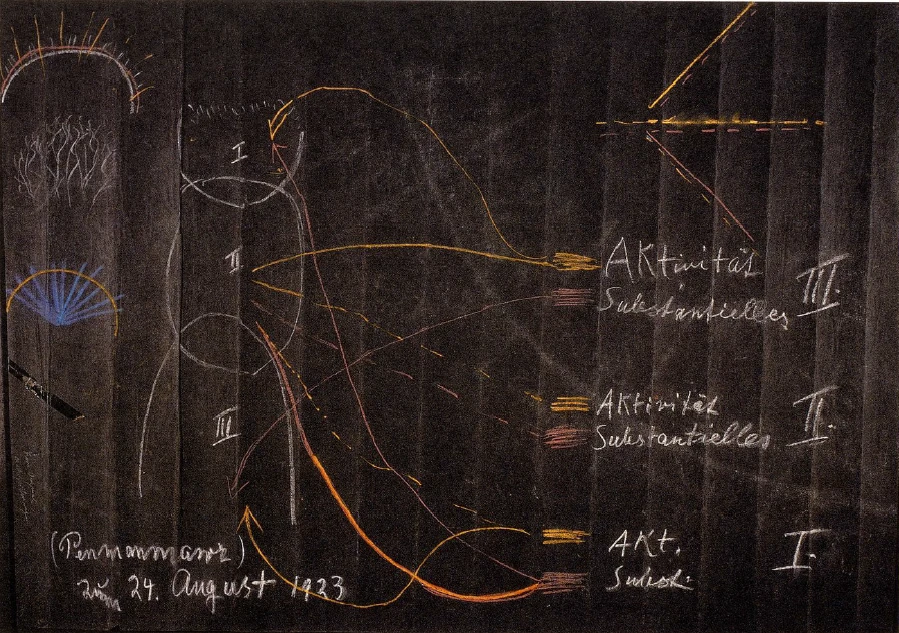
[ 5 ] Let’s first clarify what we have here using a kind of schematic diagram: So when we emerge through the veil of chaos—I will show later how this emergence can also be described as crossing the threshold into the spiritual world—when we emerge there, we behold three worlds. These three worlds are, first, the one we have just left behind, which appears somewhat transformed but which nevertheless also exists for spiritual life. Once one has pierced the veil of chaos, it appears to one as if in a memory. One has crossed over into the spiritual world, and just as one remembers something here, so one remembers in the spiritual world that which is, in fact, the physical-sensory world. This, then, is the first world. The second world that one encounters is the one I have called the world of souls in my book Theosophy, the world of souls. And the third world, the highest of the worlds one encounters there, is the true spiritual world. The third world is thus the world of the Spirit.
[ 6 ] I will begin by explaining this matter only in general terms, but through the relationships these three worlds have with human beings, you will come to realize many things about them. So I want to relate human beings to these three worlds—which appear to you, as it were, rising in three levels as the lowest, the middle, and the highest worlds—I want to relate human beings to these three worlds: [to the first world] the head; [to the second] the chest region, everything that involves rhythm, the respiratory system, and the circulatory system; and to the third, the metabolic-limb system, everything that involves metabolism: how the human being takes in food, digests it, distributes the digested substances throughout the body, and thereby generates movement. Thus, we are dealing here with the metabolic-limb system.
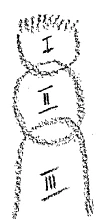
[ 7 ] I am deliberately drawing a closed circle here [for the chest], an open circle for the head, and also a non-closed circle for the system of limbs. I am doing this deliberately because, to sensory perception, the human head appears even more closed at the top. So if I were drawing for sensory perception, I would have to draw the head as closed at the top. But that is not what the human head is like for spiritual perception. For spiritual perception, the human head is open at the top. For that part of the human being that does not belong to the spiritual realm at all is the mass of bones. The mass of bones is entirely of a physical nature. It does not belong to the spiritual realm at all. When you spiritually observe a human head—here, the thick skull (white)—this is not present at all for spiritual observation. Only what lies above it as skin still appears somewhat to spiritual observation (red). And then there is the hair on top of that.
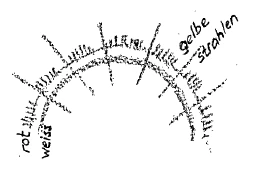
[ 8 ] But when it comes to spiritual observation, something else comes into play. You see, what I have drawn here does not exist; instead, there are nothing but “spiritual hairs”—that is, rays—that penetrate the human being, but are only slightly hindered and held back by the physical skin (yellow rays). But where there is bone in the human being, the outer spirit can penetrate most easily. And it penetrates in the form of rays. So that when you first look at a human being with your physical eye, you see the physical human form before you; there, at the top of the head—if the person has not yet gone bald—you see their hair (red). But then, where the bony arch is at the top, you see nothing of the physical human being spiritually; instead, the spiritual worlds flow into him in a radiant, sunlit manner (blue). So that I would have to draw what is interlocking there when observing a human being exactly like this:
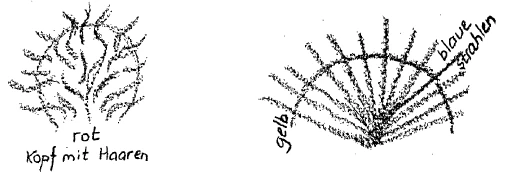
[ 9 ] There is the human being as a physical being (drawing on the left); and there is the human being as a spiritual being—[in and of itself] nothing—but many incoming rays (drawing on the right).
[ 10 ] For this reason, I have drawn the head here not as a closed circle but as an open one, because the spiritual can indeed continually penetrate the human head due to the presence of a peripheral bony vault.
[ 11 ] Nothing about human beings is without purpose. Human beings have—I would say—this head, which is closed off at the top, as a result of the world government’s profound deliberation. For it is through that which most easily allows the spirit to enter human beings—the outer bony structure—that the spiritual penetrates into the inner being.
[ 12 ] If one is able to view human beings from a spiritual perspective, one is struck by the greatest astonishment at just how empty the human head actually is, due to the person’s own inner self. For it is the person’s own inner self that contributes the very least to the head. In terms of the spiritual, a person actually has a completely empty, hollow sphere sitting up there. And everything spiritual must enter the head from the outside.
[ 13 ] This is not the case with the other members of the human organism. As we will hear shortly, they are spiritual in and of themselves. We therefore distinguish three members in the human being as well: the head, the rhythmic system, and the metabolic-limb system. These three members of human nature stand in a very specific relationship to the three worlds.
[ 14 ] I will then discuss in more detail this relationship of the human being—that is, what in the human head or the nervous-sensory system, in the human chest system or the respiratory-circulatory system, or in the third system, the motor-metabolic system, relates the human being to these three worlds.
[ 15 ] As we now move from this characterization of the tripartite nature of the human being and the tripartite nature of the world to the relationships between the two, it is helpful to distinguish between substance and activity in each of the three worlds. I will therefore distinguish between the substantial and the activity in the spiritual world, in the world of the soul, and in the material, sensually physical world. In reality, substance and activity are one; but they manifest themselves in different ways in the world. You can understand this by considering the substantial nature of your own human being.
[ 16 ] Your arm contains your substance. If this substance is not in order, then you will feel some kind of pain in your arm. This is where what is wrong with the substance manifests itself inwardly. If the activity of the arm is not right, you might strike another person. That hurts the other person. In that case, the activity is not right. Nevertheless, this substance and this activity are one in your arm; but they express themselves, they manifest themselves outwardly in different ways.
[ 17 ] Thus, in each of the three worlds, we must distinguish between a substantial aspect and an activity. I will make this distinction by designating the substantial aspect everywhere as “red” and the activity everywhere as “yellow.” Thus, in the spiritual world we have activity (yellow) and substance (red); in the soul world, activity (yellow) and substance (red); and in the physical-sensory world, activity (yellow) and substance (red).
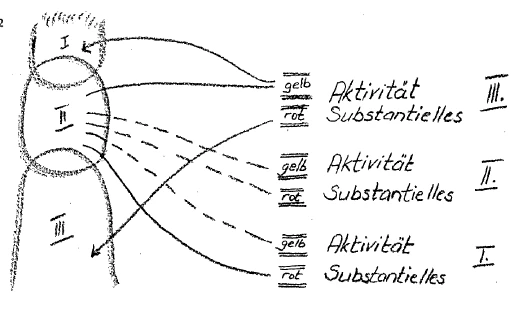
[ 18 ] If we now consider the human head, we see that, in terms of its substance, this human head is formed entirely from the physical world. The substance of the head is initially derived, during human embryonic development, from the substance that comes from the parents; and the further development of the head also takes place because the entire human head and the sensory and nervous systems are based on the substance of this earthly, material world. So I must say: The head is formed from the substance of the physical-sensory world. In contrast, all activity that sculpts these forms of the human head—everything that gives the human head its form through activity arising from the substance—is formed entirely from the spiritual world. Thus, in terms of activity, the head is formed entirely from the spiritual world. That is why the head must also be open at the top—in a spiritual sense—so that spiritual activity can enter.
[ 19 ] So that at every moment of your life you can say to yourself: In my head I have something that, in terms of its substance, is taken entirely from the earth, but which is composed and shaped so plastically that earthly forces could never form this human head. The forms of this human head are entirely shaped from the spiritual world; they are, so to speak, a heavenly creation. It is particularly profound for the spiritual observer to contemplate this human head in relation to the world.
[ 20 ] When viewed from a spiritual perspective, a person directs their gaze toward a plant. They say to themselves: The plant has a specific form. It has drawn its substance from the earth. But its form comes from the ethereal world—that is, from the world of space.
[ 21 ] When a person observes an animal, they say to themselves: This animal derives the substance of its head entirely from the spatial world. But something spiritual has already entered into its activity. The highest spiritual element—that which can truly be called heavenly—only comes into play in the formation of the human head. This human head could never have come into being through any earthly forces, even though its substance is drawn from earthly materials. Thus, within the human head—which is itself a kind of miniature cosmos—the spiritual world builds a structure out of earthly materials.
[ 22 ] The exact opposite is true of the metabolic-limb human—that is, the human who possesses the organs for external movement: legs, arms, and what extends inward from the legs and arms—the digestive organs.
[ 23 ] I will initially set aside the rhythmic organization—the organization of respiration and blood circulation—and focus instead on that which is composed of all these elements: that which digests, that which nourishes, and that which arises from digestion and nutrition—that is, from the human being’s internal metabolism—as human movements.
[ 24 ] In essence, this is not at all composed of earthly matter. As improbable as this may sound to you at first, you carry within yourselves—precisely as metabolic, limb-bearing human beings—something that, in terms of its substance, is not at all composed of earth, but rather consists entirely of the substance of the third world, of the substance that exists in the spiritual world. You will say: But I can see the legs; they are physically and sensually visible. If they were made of spiritual substance, they would not be physically and sensually visible! — This is a perfectly valid objection, but the following must be taken into account.
[ 25 ] For your true legs are entirely spiritual, as are your true arms, and the physical substance is merely sent there from the head. The head is the organ that fills the spiritual arms, hands, legs, and feet with this physical substance. It merely penetrates the spiritual nature of the limbs and the digestive organs. Thus, that which is actually entirely of the spiritual world in substance is permeated and saturated with physical matter—but originating from the head. That is why it is so difficult at first, using physical science, to grasp that a human being consists of the head, chest, limbs, and digestive organs. People imagine: The head is on top, and a human being really only has a head where a decapitated person no longer has one. But that is not the case; rather, the human head is present in substance everywhere. A human being is also “head” in the big toe, because the head sends its substance there. But originally, primarily, only the substance of the head is earthly. The head then transfers this earthly materiality to the other substances, whereas the substance of the metabolic limb organs is drawn from the spiritual world.
[ 26 ] If, through strong negative autosuggestion, one manages to suggest away a person’s head—so that one is able, not only in thought but through strong negative autosuggestion, to make the person appear headless—then the rest of the organism also disappears, and with the head gone, what constitutes the whole human being as a sensually perceptible being is gone as well. One must then perceive the rest of the being in a soul-spiritual way, if it is to exist for one at all, because in reality we walk about, guided from the higher worlds, with spiritual legs and spiritual arms, and only the head, so to speak, permeates and fills this with physical substances.
[ 27 ] In contrast, the forces that drive all activity in the human being—as a metabolic, limb-bearing entity—are drawn from the physical world. So that when you step forward with one leg or move your arm using lifting forces according to mechanical principles—this mechanical order, indeed even the chemical processes that take place in the arms and legs when you move, or the chemical processes that take place in the digestive organs—these are earthly activities. So you carry within your limbs, as such, an invisible substance, but forces that are derived from earthly existence. We are thus constituted as human beings, with regard to our head—in terms of the substance it contains—from the earth; we are permeated by forces, with regard to our head, from heaven. As for our limbs, we are constituted entirely of a substance that comes down from heaven. But the forces that operate within this heavenly substance during our earthly life, from birth to death—these are the forces of the earth: gravity, the other physical forces of the earth, and the chemical forces of the earth.
[ 28 ] So you see, the opposite is true for the head and the limbs. The head consists of earthly substance and is shaped in its plastic forms by celestial activity. The human limbs—and, along with them, the digestive system—are formed entirely of celestial substance. One would not see them if they were not permeated by earthly substance from the head. But as a person walks, grasps, and digests, the celestial substance makes use of earthly forces to sustain this life on earth from birth to death.
[ 29 ] In this more complex way, the human being stands in relation to the three worlds. Thus, the spiritual world participates in the human head through its activity and in the third human system—the metabolic-limb system—through its substance. The lowest, most sensory world participates, through its activity, in metabolism and limb movements. Through its substance, it participates in the head; in contrast, the substance of the third human system is entirely spiritual.
[ 30 ] In the middle system, which encompasses respiration and blood circulation, spiritual activity and material substance are intertwined. But the spiritual activity that flows through our respiratory movements and our heartbeats is, in turn, accompanied to some extent by material substance. And likewise, the substance of the earthly being, insofar as it flows into the breath through oxygen, is accompanied to some extent by earthly activity. So you see, in the middle human being, in the second system of the human being, everything flows together. Heavenly substantiality and activity flow in there; earthly activity and substantiality flow in there. This makes the human being receptive to receiving, now also here, the activity of the middle world and the substantiality of the middle world.
[ 31 ] So there is a great deal of confusion within the average person. That is why we must have this wonderfully perfect rhythmic system within the average person—the heartbeat, the rhythm of the lungs as we breathe—because everything that becomes disordered in terms of activity and substance seeks to balance itself, harmonize, and become melodic through rhythm, and it is able to do so because that is how human beings are constituted.
[ 32 ] While activity and substantiality originate from entirely different sources in the head system and the limb system, in the middle system they flow in from all three worlds—and in diverse ways at that: here, activity is accompanied by substantiality; here, substantiality is accompanied by activity; here, pure activity; here, pure substantiality (see Figure 5.134); this flows into the human being in the middle realm. And when you, as a doctor, observe a person’s pulse, you actually feel in the pulse the balance between the heavenly soul and earthly activity and substantiality. And when you observe the breaths, you again feel this inner striving of the human being toward the balancing of these various forces that relate to him from the middle world. You see, this is the human being’s relationship to the three worlds.
[ 33 ] You will say: This is a very complicated matter. And indeed, when one delivers a series of lectures up to this point, it generally seems easy to understand; but when one reaches this point, where one must now consider humanity’s relationship to the world, the audience often says to themselves: “Now the story is becoming hard to follow. It’s getting a bit confusing.”
[ 34 ] But you see, an unbiased, truly subtle way of thinking naturally comes along with it. And there is, in fact, a source of comfort in this common-sense way of thinking. That is, when one truly pierces the veil of chaos, as I said earlier, and enters this world—which is a threefold world that, in an immensely complex way, sends its activity and substance into the physical world, where things are indeed so confusing that, as one passes through the veil from the physical sensory world into it, one is warned in the full sense of the word—warned, for example, by being told—I say this seemingly as a metaphor, but this image actually corresponds to a real experience—upon entering the spiritual world: If you are not willing to leave behind everything you regarded in the physical world as your ordinary naturalistic logic—what you regarded there as the connection between things—if you are not willing to leave behind this entire physical garment, then you had better not enter the spiritual world, for there you will have to make use of entirely different associations of ideas, entirely different orders, and an entirely different logic. And if you still wish to carry anything of your physical logic into this spiritual world, you will inevitably become confused within it. And among the things that are part of the preparation for meditation and concentration—which I have already mentioned—one must also include the full observance of this warning: one must truly not carry sensory logic into the logic of the spiritual world.
[ 35 ] I would like to say that this is the significant warning that the power—which we will come to know more precisely in the following lectures—that can be called the Guardian of the Threshold initially bestows upon one when one seeks to pass through the veil.
[ 36 ] But even if one wishes to return to the physical, sensory world, one receives a powerful, clear warning from this guardian. After all, one must return if one is an earthly human being; otherwise, one would never emerge from the events of the spiritual world. One would gradually leave one’s physical earthly body behind, dead. One must return again and again. One must eat and drink in the physical world according to naturalistic logic. One must even conform to the other daily routines according to naturalistic logic. One must therefore re-enter a world where things truly unfold in such a way that they are governed entirely by naturalistic-materialistic logic—for example, where the bell always rings for breakfast, lunch, and dinner. One must therefore always return to this naturalistic world. To this end, it is necessary—once one has entered the spiritual world and returns to the physical-sensory world—to heed the second warning of the Keeper of the Threshold, who stands at the place where the veil of chaos separates the physical-sensory world from the spiritual-heavenly world, so that one does not find oneself in an impossible situation as a human being. And this warning consists in his telling you: Do not forget for a single moment of your physical earthly life that you were in the spiritual world. Only then will you be able to move with confidence in the physical earthly world during those times when you must remain there.
[ 3737 ] Thus, upon entering this world—with which human beings are connected through their three members, as I have schematically described to you—one receives the warning to cast off all naturalistic logic, to leave this sensory garment behind at the threshold, and to step across with the intention of acquiring a truly spiritual logic, spiritual thinking, and spiritual connections of ideas. And when one returns, one receives an equally strict—indeed, much stricter—warning not to forget, at any moment, what one has experienced in the spiritual world; that is, not to surrender oneself once again merely to ordinary consciousness, to sensual impulses, and so on, but to be conscious in everything that one must bring the spiritual into this physical world.
[ 38 ] As you can see, the two warnings are very different from one another. Upon entering the spiritual world, the Keeper of the Threshold says: “For the moments of your spiritual realization, forget the physical-sensory world.” Upon leaving the spiritual world and returning to the physical-sensory world, the Keeper of the Threshold says: “Never forget; always remember, even in the physical-earthly world, your experiences in the spiritual-heavenly world.”
[ 39 ] With regard to what I said last, there is again a considerable difference between the people of an earlier epoch of human development and people today. For those people whom I have described as having come into contact, in a certain way, with the ancient mystery teachers—whether as inspired disciples or as humanity in general—it was certainly the case that, through their psychic and spiritual instincts alone, they did not make the transition from sleep to wakefulness or from wakefulness to sleep without taking the Guardian of the Threshold into account. How dreamlike was the image of the Guardian of the Threshold that arose from the soul of people three to four thousand years ago as they fell asleep. They passed by him. And this image appeared again when they returned from sleep to ordinary life. They did not have such a clear warning upon entering the spiritual world and upon leaving it, as I have described for those who have entered this spiritual world through inspiration and imagination; but they had, in much the same way as their other instinctive perceptions of the spiritual world, a dreamlike experience of passing before the Guardian of the Threshold as they fell asleep and awoke. This is precisely the further development of humanity—as we shall see in the lectures I have yet to give—which alone could lead human beings to freedom, but which also had to take away their psychospiritual perception: that humanity has lost that sleeping, dreaming wakefulness, that intermediate state between sleep and wakefulness, through which, both when falling asleep and when waking up, it could at least glimpse, as in a dream, the majestic Guardian of the Threshold. Today, human beings pass by this guardian of the threshold as they fall asleep and wake up. They ignore him; they pay him no mind. And as a result, human beings enter a completely disordered world of dreams.
[ 40 ] Just take a look, with complete impartiality, at how people from earlier eras spoke about their dreams—in a way that differs from how it is done in our current era. Because people ignore the Guardian twice every evening and every morning—and during every afternoon nap—they experience the disorder and chaos of their dream world. This is clearly evident in the specific nature of their dreams.
[ 41 ] Just consider this: when we cross the threshold—and we do so every time we fall asleep—the majestic guardian of the threshold stands there. He must not be ignored, lest what we encounter in the spiritual world be thrown into disorder. And the best way to see how this leads to disorder is to observe the metamorphosis that takes place when the orderly thinking of the physical-naturalistic world transitions into the structures of the dream. One can understand this clearly by examining individual dreams.
[ 42 ] In the physical-naturalistic world, people behave in the way they learn from the contexts within the physical-sensory world. Let’s take a single example: going for a walk. Why do people go for a walk? Well, isn’t it true that today, people in cities go on certain walks precisely because they want to experience this or that? They run into acquaintances on their walks. They can show off their clothes—if that’s what they’re in the mood for—in front of strangers or even people they know. These are all the experiences one has on a walk.
[ 43 ] These experiences are lived through the fact that, as human beings, we can think and imagine; through the fact that we are able to say—using our head, exclusively through our mental faculties—“I think.” It is precisely in this power of “I think” that the possibility lies to experience something in the external world as I have just described. One encounters other people; this becomes an experience for them. One shows one’s clothes or, for that matter, one’s beautiful face. It depends on what one is experiencing at that moment. But in this act of seeing other people—in this act of revealing what is within oneself to others—one also has feelings. One may like one thing, or dislike another. One develops sympathies or antipathies in the process. One is pleased when, during walks, other people say something that suits one’s current mood. You don’t like it—you respond with antipathy—when they say something that doesn’t suit you. So what you experience on these walks is thoroughly connected to perceptions—which are brought about in the mind by “I think”—and it is connected to what the rhythmic human being develops: “I feel,” that is, with the feelings of sympathy and antipathy. Because we can simultaneously say, in a second aspect of our being, “I feel”—it is through this that we accompany what we experience in our observations during a walk.
[ 44 ] But the third aspect of the human being is also involved in this walk when we take it while fully awake. Isn’t it true that one inevitably encounters certain intimate aspects of human experience? One has the feeling, however, that in modern civilization it is simply not acceptable to appear before others unclothed or to go for a walk unclothed. That is the feeling one has. Being unclothed is repulsive, while being clothed is appealing. But this translates into impulses of the will. One gets dressed. One even gets dressed in a certain way. This engages the will, the third member of the human organism. The fact that we get dressed thus depends, in turn, on the third member of the human being—on the fact that we can say: “I will.” Getting dressed lies in the impulsivity of the will.
I think I think
I feel I feel
I will I will
[ 45 ] By saying, “I want —,” we set out on our walk, driven by the power of “I want.” All of this falls into place in the physical world in which we are awake precisely through the logic of the physical world. Either we have been taught this, or we conform to the conditions of life that are externally given by the logic of the physical world. And if we do not do this, then something within us is not right. If we go for a walk unclothed, then something is not right within us. The order of the physical world—that which constitutes logic in the physical world—brings all this together. It would never occur to us to want to see other people in a state of undress while out for a walk. This brings coherence into our soul experiences, but not through us, rather through the coherence of the world. It becomes clear to us that all three—I think, I feel, I will—are interconnected. The world makes this so. We are prompted by the external world to form this connection between thinking, feeling, and willing.
[ 46 ] When we cross the threshold, ignoring the Keeper of the Threshold, we find ourselves facing three worlds and are initially disoriented, because we carry over into the other, spiritual world some of what we are accustomed to here; but in part, the spiritual world asserts its own order. And now the following happens: Imagine you are lying asleep in bed. At first, you are engaged in this sleeping state through your feelings—the middle part of the human being. The blanket slips away from you, and a part of your body feels cold. This leads you to the dream-consciousness that you are unclothed in that spot. And this expands—because you are not yet familiar with the spiritual world, because you do not limit this perception to just one part but apply it to the entire world—it expands into the feeling: I am unclothed. Perhaps the blanket has slipped off only one part of your body, but you feel a little chill there, and you feel: I am unclothed.
[ 47 ] But just a moment ago, in your dreams, you were still occupied with surrendering to the impulse of the will as a waking person: When I am undressed, I get dressed. But now, through sleep, you feel: I cannot get dressed; I am hindered—because you cannot move your limbs. This enters your dream consciousness.
[ 48 ] You see, these two things—I feel naked, I cannot get dressed—cause you, because the physical world is now missing to bring the two things together, since one belongs to World II and the other to World I, to bring them together in a false way. And now, having experienced that same night that you went for a walk, you add this to the mix; it re-enters the context of your dream. This occurs on its own. Three conditions occur separately: I am out for a walk; I am naked, which I find terribly unpleasant; and: I cannot get dressed.
[ 49 ] Now consider this: these three things, which you bring together in ordinary materialistic-physical life through the logic of life, fall apart as you pass by the Guardian of the Threshold, ignoring him,
in the first world: going for a walk,
in the second world: being naked,
[ 50 ] In the Third World, you find that you cannot get dressed—that it is completely impossible. And now, in this situation, you feel torn in three, among strangers, exposed everywhere to their gaze while unclothed, powerless to get dressed. You experience this in a dream. What is held together in your ordinary life by natural logic is separated by the dream, and you reconnect it chaotically according to the habits you have carried across the threshold; you reconnect it as if it were the same in the spiritual world—as if one were unclothed and so on. By ignoring this guardian of the threshold, you carry the habits that correspond to the physical world into the spiritual world; you connect the three worlds in a chaotic manner according to the laws of the physical world, and you find yourself in this situation.
[ 51 ] This is the essence of countless dreams: that at the very moment one crosses the threshold and disregards the warnings of the Guardian, that which one perceives here in the physical-naturalistic world as a unity in harmony—as a harmonious unity—falls apart, and one finds oneself facing three worlds. But one must be able to bring these together through faithful heeding of the warnings of the guardian of the threshold; one must be able to bring these three worlds together. And the dream of modern humanity—not so much that of people from an earlier epoch (as you can see especially in the dreams of the Old Testament, where this was not the case)—but the dream of modern humanity places people before three worlds, which they, as modern people, wish to unite according to the laws of physical-naturalistic existence. This gives rise to the disordered relationships within these three worlds in which humanity now finds itself.
[ 52 ] As you can see, the dream itself reveals to us this serious fact: that the moment we cross the threshold into the spiritual world, we are initially confronted with three worlds, and that one must enter these three worlds in the proper way and then emerge from them again. The dream is the very thing from which modern people can learn an immense amount about the nature of both this physical, sensory world and the other, spiritual-soul world. We will continue discussing this matter tomorrow.