

Insight from Initiation
GA 227
24 August 1923, Penmaenmawr
Translated by Steiner Online Library
Spiritual Contemplation in Nature
[ 1 ] Yesterday I attempted to show how the confusion of the dream arises from the fact that, through sleep, a person unconsciously or semi-consciously crosses the so-called threshold from the physical-sensory world into the supersensory, spiritual world, and that, upon entering this spiritual world, they are confronted with three worlds: the memory of the ordinary physical world, the psychological world, and the truly spiritual world. The inner and outer events we experience in ordinary life, in earthly existence, are drawn from the revelations of all three worlds. But they become separated when we enter the supersensible world through sleep, and then what we experience is not related to the real world. This gives rise to the deception, the illusion in the dream, for ordinary memory consciousness. Imaginative consciousness does not merely view the dream in this way; rather, it views the dream by gazing at it, just as one gazes at a distant point in physical space. In this way, one gazes through imagination toward something else in time. Thus, one does not merely recall what has been dreamed, but rather gazes upon what has been dreamed. Only then does one gain a true understanding of the dream. And through this, one recognizes that a dream is correctly interpreted only when one does not relate it to the naturalistic-physical world, but rather when one relates its connections to the spiritual world—and, above all, in most cases, to the moral world. The dream does not mean what it expresses when its content is interpreted physically. It means what one arrives at when its content is interpreted in a moral and spiritual sense.
[ 2 ] Let’s take, for example, the dream I used yesterday to illustrate confusion—the dream in which one finds oneself naked, overcome by a terrible sense of shame, taking a walk in front of a crowd of people. I have pointed out to you how the entire state of mind within dream consciousness arises from the fact that one is confronted with three worlds. But if we take a proper look at such a dream, we must say that it reveals a content that appears to be sensory, yet within the sensory realm, the spiritual-moral seeks to reveal itself to us. And so the person who has such a dream should not focus on the immediate sequence of sensory images, but should ask themselves: Do I perhaps sometimes, in my waking consciousness, have a tendency not to present myself to others with complete inner truth? Do I not perhaps have a tendency to conform too much to conventional clothing and to wrap myself up in all sorts of things—well, what is conventionally done in the outer world? And do I not have the peculiarity of, precisely because of this, sometimes failing to present myself honestly in my deepest inner self, but rather presenting something untrue?
[ 3 ] When a person directs their thoughts in this way, they gradually arrive at a moral-spiritual interpretation of the dream. They relate what has appeared to them not to the natural world, but to the spiritual world, and they say to themselves: “As I crossed over into the supersensible world during sleep, spiritual beings from the supersensible world approached me and told me that I should not present myself in a false, untruthful guise, but rather that I should present myself as I truly am inwardly as a human being, in my soul and spirit.”
[ 4 ] When one interprets a dream in this way, one arrives at its moral and spiritual truth. And this is how a great many dreams are to be interpreted.
[ 5 ] The people of humanity’s ancient past, who became aware—even in their dreamlike imagery—of the Guardian of the Threshold falling asleep, heeded his warning not to carry into the spiritual world that which lives in the physical-sensory world. So if people in those earlier times had dreamed of walking around naked in the street, it would never have occurred to them to interpret this as a cause for shame—for that applies to the physical world and to the physical human body—but rather they would have heeded the warning: What applies in the physical world does not apply in the spiritual world; what appears in the spiritual world is what the gods say to human beings. Therefore, it must be interpreted as a statement, as a revelation from the gods. Thus, the naturalistic interpretation of dreams only emerged in the course of human development.
[ 6 ] Or let’s take another dream that occurs very frequently. In it, a person dreams that they are walking along a path. They enter a forest. After a while, they realize they’ve gotten lost and can’t go any further. They try to keep going but reach a point where there’s no path left—only trees. They feel a certain inner unease.
[ 7 ] Now, a person with ordinary consciousness very easily accepts such a dream simply as it presents itself, based on its content. But such a dream—if one accepts it in a way that overlooks its naturalistic context—reveals to us precisely from the spiritual world: The confusion you have fallen into lies within your thoughts. It’s just that, in waking consciousness, people are often reluctant to admit to themselves how confused their thoughts are, how easily they run into dead ends where they can go no further, where they keep going around in circles. This is a peculiarity that many people share, especially in our present-day civilization. They believe they are thinking in an enlightened way, but they are dancing in circles with their thoughts—either around conventional external matters, or around the atoms they construct in their minds, or around something else. Naturally, in their ordinary state of consciousness, people are not inclined to truly admit this to themselves.
[ 8 ] A dream is a revelation, expressed in sensory images, of what a human being truly is. Spiritual beings convey this to a person in dreams. And when a person accepts what they experience in this way in a dream with true self-knowledge, their self-knowledge is particularly enhanced by the dream.
[ 8 ] A dream is a revelation, expressed in sensory images, of what a human being truly is. Spiritual beings convey this to a person in dreams. And when a person accepts what they experience in this way in a dream with true self-knowledge, their self-knowledge is particularly enhanced by the dream.
[ 8 ] A dream is a revelation, expressed in sensory images, of what a human being truly is. Spiritual beings convey this to a person in dreams. And when a person accepts what they experience in this way in a dream with true self-knowledge, their self-knowledge is particularly enhanced by the dream.
[ 8 ] A dream is a revelation, expressed in sensory images, of what a human being truly is. Spiritual beings convey this to a person in dreams. And when a person accepts what they experience in this way in a dream with true self-knowledge, their self-knowledge is particularly enhanced by the dream.
[ 12 ] Therefore, when we are faced with, for example, a seed, we must not attempt to explain it solely through physical and chemical laws. No scientist who sees only physical and chemical laws in a seed or an embryo can explain the seed or the embryo, for nature dreams within the seed and the embryo. Therein lies the foundation of what weaves and lives in the dream. Therefore, if you place a plant seed here, a dream weaves and lives within that plant seed. You cannot penetrate it with the intellect, which only surveys the laws of nature; you must enter it with that human power which otherwise lives in dreams or in conscious imagination.
[ 13 ] But something like this, which exists in its nascent form, lives within our entire organism throughout our entire earthly existence. And in our human organism, we must therefore not merely seek the effects of chemical and physical forces; rather, when we consider the human being as a physical entity, we must regard this human being, with his or her external physical contours, as that which lives precisely within the earthly-physical sensory world. But behind this lies something else that no eye can see and no ear can hear—insofar as they are physical—but which the imagination can perceive, and which is also experienced in dreams as unconscious imagination. Nature dreams throughout the entire human body. It does not merely think in the same way that a human thinks with their intellect; rather, nature itself dreams. And from within the dream, our digestive forces are guided, our growth forces are guided. Everything is formed from within the dream. When we look back on our existence on Earth, we usually start from our own time, from the time—yes, what should we call our time? We can name it after a single phenomenon; let’s say we start from the time of the typewriter. So we start with the typewriter era, then, as we go back, arrive at the time when printing first began, then go further back in evolution, returning—for my part—to the Roman era, to the Greek era, and back to the Oriental era from which the Vedas originate. But then the external records leave us. No matter how many treasures are excavated from Egyptian royal tombs, there comes a time when external records fail us, when we must go back through pure imaginative and inspired spiritual insight. And then we reach a boundary beyond which, further back in the past, lies something indefinable to ordinary consciousness, just as sleep lies beyond the dream. Yes, as we go back through the development of time and the world, we do indeed come upon this veil of the dream, just as we experience it every night.
[ 14 ] And when we reach that point through conscious imagination, the more distant past shines forth in a spiritual way. But this past also looks different from the world we can perceive with our intellect and through historical records. This more distant past, which lies behind a veil of dreams in the evolution of the world, shows us human beings in direct connection with the divine spirits. There, human beings themselves are still divine-spiritual beings, and the divine-spiritual entities—who are destined for something other than incarnation on Earth—interact with them as they await their own incarnation on Earth.
[ 15 ] So when one looks back historically to this veil of chaos, to this veil of dreams in the distant past beyond the millennia of which I have spoken in recent days, one sees the direct interaction of the divine spirits with the soul—which was still spiritual at that time—within the human being, with the human being who was then to dwell fully on Earth.
[ 16 ] And then we will see how these things, which are connected with human evolution, in turn relate to cosmic evolution on the other side. Where this veil appears to the inspired imagination in a distant past, there we see how, even within cosmic evolution—we will have to speak more precisely about this—the Moon breaks away from the Earth, which was previously united with it, and goes out into outer space to then orbit the Earth. We thus look back through a veil of dreams, through an imaginative veil, and behind it find the Earth still united with the Moon, with human beings in direct communion with the divine-spiritual beings. We find that, at the moment when this veil of dreams appears for retrospective observation in the imagination, we see there how this point marks the important cosmic event in which the Moon pushes itself out of the Earth in a completely different form and enters outer space as a separate celestial body. Thus we look back upon a development of the Earth, humanity, and the cosmos in which the Earth was still united with the Moon; yet human beings were already present, albeit in a more spiritual and soulful state.
[ 17 ] In fact, as we look further and further back, we find no epoch in the evolution of the world in which we would not also find the beginnings of humankind. Thus, from the standpoint of spiritual science, we cannot say that the Earth developed for millions of years purely in an inorganic manner or with only lower beings, and that humankind then arose; rather, as we go back in time, we find humanity in other forms, always united with that evolution of the world—which we can, however, look back upon when we ascend in this way to what may appear to us, beyond the veil of chaos in dreams and beyond the veil of conscious imagination, as the divine-spiritual essence of the world.
[ 18 ] When, as I said above, we look at a seed, at something embryonic, we see—for imaginative cognition—a kind of dream-like weaving within this embryonic, seed-like state. And we see how something real—though it is like dream images—governs the matter within the germ and within the embryos. Thus, anyone capable of perceiving the spiritual aspect of the world will find this spiritual aspect everywhere, but in the most varied forms. It is precisely the spiritual that undergoes the most diverse metamorphoses. And once one has truly grasped how a dream-like weaving and being reigns in the seeds of plants and in the embryos of animals, one can then quite rightly raise the question: What, then, of the seemingly completely lifeless mineral world? When we look out our windows from here or go out onto the street, we see the barren mountains, the seemingly completely lifeless world, and we must ask ourselves: If a dreamlike image reigns within the plant seed we place before us, what of the vast masses of rock and mountains spread out before us? What about all the lifeless matter that forms the ground upon which our feet tread in the physical world? If we find a spiritual presence in plants that intervenes relatively easily into matter through its dreamlike weaving, then through imaginative insight we also find a spiritual element in the rock masses—a spiritual element consisting of concrete, individual beings.
[ 19 ] But this spiritual aspect—we do not find it in a state of dreaming; we find it in a state of deep sleep. When you look out at the mountains here, you should not imagine a general, sleeping mist pervading the rock masses and mountains, but rather concrete, individual beings—spiritual beings—who sleep within the rock masses. We will see later how these spiritual beings came into being through a separation from higher spiritual beings—beings with a high level of consciousness—who, however, separated these other beings, which in their present state of existence possess only a sleeping consciousness, from themselves; and how these elemental beings are sleeping everywhere out there in the inanimate world. So as we walk across the rocky massifs of the mountains, we should be aware that spiritual weaving and beings in individual, concrete spiritual forms lie dormant everywhere within the earth. And as we observe this slumber of the spirit-weaving forms in the inanimate world, we become aware that a certain mood lives within the sleep of these elemental beings. Imagination reveals these beings to us. Inspiration teaches us that a certain mood lives within these beings. The very mood that lives in these beings of the mountains, the rocks, and the earth’s surface upon which we walk—that same mood lives within these beings as we find it within ourselves when we are truly waiting for something, when we are filled with a mood of anticipation. And so this soul-spiritual weaving and being, which is present in the seemingly lifeless masses of rock, is permeated by a mood of anticipation.
[ 20 ] For these beings—as inspiration, and especially intuition, teaches us when we put ourselves in their place—are awaiting their awakening in dreams. Everything that looks back at us there as mountains expects that it will dream later, and that it will one day be able to take hold of the earthly matter—which has been pulverized into lifeless matter—in its dreaming consciousness, transform it into an embryonic, germinal state, and conjure up plant life once again from the rocks and mountains we see. It is precisely these beings that bring us, in the realm of the soul, a wondrous magic of nature—a creative force springing from the spiritual realm.
[ 21 ] And so it may become for us—not merely a figurative image, but a true and real insight—that walking among such rocks or over such rocks, that very thing which such rocks reflect in their physical light, may become for us a revelation of a dormant, elemental nature that will one day awaken to dream, and later to full waking life—elemental beings of nature who will one day become pure spiritual beings.
[ 22 ] The physical matter in the plant is still such that the spiritual weaving of dreams can permeate it. This matter [of the rock] crumbles. Everything inanimate—as we realize when we look back through imagination and inspiration—has arisen from the living. But as the living becomes inanimate, this dormant spirituality is immersed within it. And this dormant spirituality waits within the inanimate until it can awaken to dreaming and transform this inanimate matter into a cosmic embryonic life.
[ 23 ] And the various places, the various locations on Earth, reveal in different ways this slumber of these spiritual beings in the mountains, within the solid Earth’s crust. And one may say: these beings, who await their future, sleep differently in such regions of the Earth—such as this one, for example—than in other regions of the Earth.
[ 24 ] Here in Penmaenmawr, in particular, is a region where—due to the specific configuration of the earth and the way the rock formations have developed—these sleeping beings can penetrate as far as the airy realm, and indeed weave themselves into the light, whereas this is by no means the case in other parts of the world. So that when one considers not merely the outer, materialistic atmosphere here, but the workings of the spiritual atmosphere that permeates the air just as the human soul permeates the human body, one finds right here in Penmaenmawr that this spiritual aspect of the atmosphere is different from anywhere else. I would like to illustrate this to you with a specific example.
[ 25 ] Suppose that imaginative insight endeavors to present the imagination in a particular region of the Earth, just as it happens. This remains in consciousness to a greater or lesser degree, with varying degrees of difficulty or ease. In different regions, there are varying degrees to which imaginations remain in the foreground of consciousness or quickly dissolve. Here is a region where the imaginations linger for a remarkably long time, so that they develop into intense imagery.
[ 26 ] Druids and similar people chose precisely those areas for their temples and sanctuaries where this peculiarity existed—namely, that the images do not immediately dissipate, like clouds that quickly disperse, but rather that the images can linger. And so it is understandable that such sites in particular were still sought out for Druidic sanctuaries even in relatively late times.
[ 27 ] Here, one has always felt that one does not have such great difficulty with the imaginations coming to a standstill. Of course, everything has its pros and cons. Inspiration is, in fact, made more difficult precisely because the imagination remains fixed, but it is also more powerful as a result. Consequently, what needs to be said from the spiritual world pours into the words—I would say—with great intensity, but also with greater weight and significance.
[ 28 ] In this way, one can certainly perceive spiritual distinctions across the Earth. One could draw a map and mark those places where imaginations linger particularly easily before the imaginative consciousness. Those places on Earth where they pass by easily could be colored a different shade. This would result in an extraordinarily interesting map of the Earth. Here, one would have to apply a particularly intense color to represent what prevails in the spiritual atmosphere—a brilliant, luminous, and vivid color.
[ 29 ] That is why I truly believe that the people participating in this course can sense something here—what I would call a fundamentally present esoteric atmosphere. It looks in through the windows, it meets us here on our walks; it is present here in a way that is quite different from anywhere else.
[ 30 ] That is why I am extremely grateful to the organizers of this course for giving us the opportunity to be in a region where, so to speak, the esoteric comes to meet you right on the street—otherwise, one encounters it as well, but not so readily in such direct contact— I am extremely grateful that, among the various locations where such courses have already been held, this one is included as well, for from the perspective I have just discussed, this particular course fits beautifully into the overall evolution of the anthroposophical movement.
[ 31 ] Descriptions such as the ones I have given reveal how there is a boundary between the physical-sensory world and the spiritual-supersensory world—a boundary that one might, with some justification, call the threshold of the spiritual world (see illustration on p. 164). And I have already drawn attention in various ways to how this threshold must be crossed. Well, we will have to speak about this in greater detail later. But you will have already seen from my lectures that crossing this threshold in earlier epochs of human development was quite different from what it is today, at this present historical moment. In earlier epochs of human development, people were able to cross this threshold in a different way because they possessed a dreamlike consciousness even during the day—and thereby also a more intense awareness of the supersensible—and so, in the manner I have described, they passed the Guardian of the Threshold in a semi-conscious, dreamlike state as they fell asleep and awoke.
[ 32 ] This represents a transition—which I will describe in more detail later—from the older, less free humanity to a humanity that is becoming ever freer: namely, that the determinism associated with human beings—in which, every time they fell asleep and awoke, they perceived something of the Guardian of the Threshold standing before them as a warning—that this lack of freedom in which human beings once lived has given way, for present-day consciousness, to a non-perception of the spiritual world; and thereby, however, to a process of becoming freer and freer; in this lies a principle of human progress.
[ 33 ] One can therefore say that, viewed from the spiritual world, human beings have lost certain things, precisely because they had to be led toward freedom in their evolution. Now, what has been lost must be regained—as, for example, anthroposophy also seeks to demonstrate. And today is the historic moment when the striving for this regaining must begin.
[ 34 ] But everywhere, even among the most diverse people, legacies from the old era—when people had a different relationship to the supersensible world—still extend into our present. Consequently, in the case of a person who has been completely taken over by intellectualistic forces today, there is generally a sharp boundary in their consciousness between what they experience in the sensory world and what lies over in the spiritual world. The boundary is so sharp that enlightened minds of the present day, in particular, refuse to admit that human beings can cross this boundary at all.
[ 35 ] I have already hinted—by at least sketchily describing the paths leading into this supersensible world—that this boundary can be crossed, that a human being can enter this world in a fully conscious manner. But there are still remnants from that time—when human beings crossed over into the spiritual world in a more instinctive, unconscious manner, and when they still carried within themselves, even in their waking consciousness, more of this spiritual world—that have been passed down as an inheritance into the present stage of human development. And we find them in such a way that we must, above all, understand them through conscious spiritual insight. For if one does not understand them correctly, they present themselves to people in the most varied ways as errors. And then error can become very dangerous precisely in relation to these matters. I must therefore, through these lectures—which aim to illustrate the development of humanity and the world—also discuss these borderline issues, in which what was self-evident and natural to an earlier humanity extends into the present, but here, if not treated with the appropriate clear understanding, can lead into dangerous illusions. |
[ 36 ] Among these phenomena—which, for ordinary consciousness, already lie on the border between the sensory and supersensory worlds—are, for example, human visions: visions in which, in a kind of hallucination that is still more or less under the person’s control, images appear that take shape in a very specific way—they may even be colorful and audible, and which may also contain other elements in terms of content; yet, as they initially present themselves to consciousness, they do not correspond to external objects in such a way that the object outside would exist in the same manner as the vision that lives within. In everyday perception, the object is outside; the image—albeit very shadowy—is within. And the human being is fully aware of how his shadowy mental image within relates to the external world. The vision appears initially on its own, claiming to contain a reality within itself. A person also enters a state of mind in which they are no longer able to correctly assess the reality of the image that appears—appearing without their intervention. The first question that arises here, precisely at the point in the lectures where we now stand, is this: How do visions come about? Well, visions come about because human beings still possess the ability to carry over into the waking world what they experience in sleep, and to elevate it to a mental image in the waking world, just as they can otherwise elevate to a mental image what they perceive from the outside through the senses. Whether I look at a clock, which has a physical, sensory existence, and form an inner image of it, or whether I have experienced in sleep the configuration—the inner reality—of an external object and then, upon waking, form an image of what I have experienced—these are, in a certain sense, two processes that differ in no other way than that in one case I control the process, and therefore dim the image; in the other case, I do not control the process—I do not bring something present into my life of imagination, but rather something I experienced in a previous sleep, or the one before that, or even further back, when the soul was outside; and I form the vision. Such visions were something entirely natural in an earlier period of human development, when humanity instinctively mastered its relationship to the physical and spiritual worlds, and through human progress they have become what they are today: something uncontrolled, something illusory. Therefore, one must approach all of this with understanding, for modern human beings lack something: when they experience something in the spiritual world while asleep and return to the physical world through waking, they do not hear the admonisher, the guardian of the threshold: “You must remember everything you have experienced in the spiritual world and carry it over into the physical world.” — If one carries it over, then one knows what the vision contains. If the vision occurs only in the physical world, without one knowing how one carried it over or what one has carried over from the spiritual world, then one is initially uncontrolled and thus easily ensnared by illusions regarding the visionary experience. So that one can say: Visions arise when a person unconsciously carries over experiences from sleep into waking life, and when waking life shapes these sleep experiences into mental images that are then much richer and more substantial inwardly than ordinary, shadowy mental images; by carrying over such images, a person transforms them into vivid, colorful mental images.
[ 37 ] Another way is this: that a person carries over into the life of sleep what he feels and experiences here in physical life—the very way in which he feels and experiences things here. Then, when they carry these feelings, so to speak, out into the open sea of the life of sleep, they will already be warned there not to get into trouble. But when sleep is very light—as it is far more often than we realize—when we go about our ordinary lives, we sometimes doze off a little, just a little; one should pay more attention to this “sleeping a little” in general—when one sleeps like this, even without noticing it, one carries one’s everyday feelings across the threshold. And then those dark feelings arise, as if one were inwardly sensing something that will happen in the future to oneself or to another person. A premonition arises in this way. So while a vision arises when one carries the experience of sleep over into waking daily life—by unconsciously crossing the threshold with that experience—a premonition arises when one is in a very light, unnoticed sleep, so that one believes one is awake, and—again ignoring the Guardian of the Threshold—carries over what one actually already carries within one’s ordinary waking experience. But it lies so deep beneath consciousness that one does not notice it. For one is always in connection with the whole world. And if one could bring that awareness to the surface—that one is in connection with the whole world—one would be able to bring many things to the surface.
[ 38 ] If one carries across here what lies beyond the threshold, ignoring the guardian of the threshold, the following vision arises:
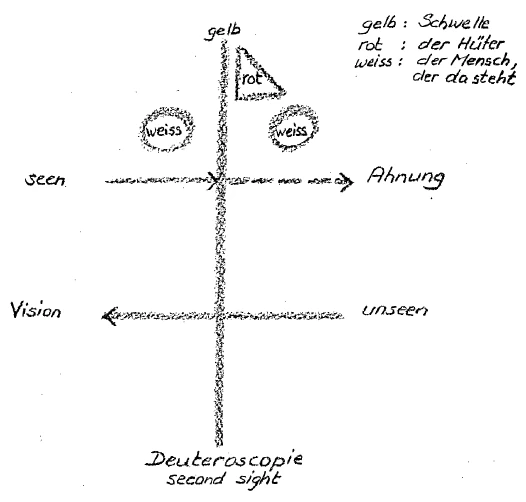
[ 39 ] So one can say: If this [indicated by a yellow line] is the threshold where the guardian stands, then the vision comes about when one carries over from the supersensible realm what one has experienced on the other side. And when one carries over into the spiritual world—during this gentle sleep—what one has experienced here in the sensory world, then what arises is what is called “intuition” in the interpretation.
[ 40 ] And now you see that, with these hereditary qualities—which human beings can experience, carried over from the old evolution—they stand here on this side with the vision, and over there with the premonition. But they can also stand right on the border, on the threshold, and not notice the guardian of the threshold. These moments can also occur when a person is, inwardly and spiritually, I would say, as if spellbound; but “spellbound” is not a very apt expression here, because one is not spellbound in the way one usually imagines being spellbound, but rather one is simply immersed in a particular state of soul. When one stands here on the threshold, so that one still senses, as it were, what is in the physical world, yet already senses what is in the supersensible world, then one experiences what is, in fact, very widespread in certain regions of the Earth—what can be called “deuteroscopy” or “second sight.” This is experienced precisely at the threshold in a semi-conscious state. So one can say: These ancient hereditary traits are either phenomena in human life that occur in a subdued state of consciousness—as visions on this side of the threshold, as premonitions on the other side, and as “second sight” precisely at the threshold.
[ 41 ] I will discuss the more detailed characteristics of these three realms tomorrow, in order to proceed from there to a description of those worlds that are currently hinted at in a veiled way through vision, intuition, and clairvoyance, but which must be brought to the full clarity of an elevated consciousness through new insight.