

Insight from Initiation
GA 227
25 August 1923, Penmaenmawr
Translated by Steiner Online Library
The Interplay of Different Worlds
[ 1 ] In human life, the supersensible world and the sensible world are constantly intertwined, and I have already pointed to those extreme cases in which the two worlds—or, actually, all three worlds—interact without the human being contributing to this through his or her own development. Today we will discuss such types of interaction between the different worlds; specifically, I intend to discuss first the common sleepwalker or moonwalker type, then the Jakob Böhme type, and finally the Swedenborg type.
[ 2 ] These three types are related to one another in such a way that each of them simultaneously—I would say, as if through a global experiment—draws our attention to how human development is connected to the development of the world as a whole. And I would also like to draw attention to this very point, specifically in relation to these three types.
[ 3 ] If we consider these three types, who enter the spiritual world and return again while to some extent ignoring the Keeper of the Threshold, we find, in particular, that the typical sleepwalker, the Jakob Böhme type, and the Swedenborg type perceive the supersensible world—or, as is especially the case with the sleepwalker type, act within it—in a different way than is done through imaginative, inspired, and intuitive knowledge. And this stems from the fact that when one enters the spiritual world—which every human being does unconsciously with every sleep—all things—as I have already indicated—become different from what they are here in the physical world.
[ 4 ] Above all, there are three characteristics of the supersensible world that are completely opposite to the characteristics of the physical world. And human beings perceive this contrast so strongly—as something that so profoundly affects everything they consider to be true, right, healthy, and so on in the physical world—that, given the current earthly condition of the soul and body, it is simply not possible for a person to be transported into this supersensible world without further ado.
[ 5 ] That is why, in my book How to Attain Knowledge of the Higher Worlds?, which has been translated into English under the title Initiation, I place such strong emphasis on how one must properly prepare for entering the supersensible world. And everything is described there in such a way that if a person follows the instructions in this book, they will make the proper preparations in every respect—that is, they will enter the supersensible world in the correct manner. But all three types I will be discussing today do not enter in such a prepared manner, but rather through their destiny, and are then also protected from any dangers by their destiny, by their karma; indeed, they bring it about that, precisely through their destiny and their karma, things become known to humanity at large that otherwise could only be known through imaginative, inspired, and intuitive insight.
[ 6 ] In the spiritual-supernatural world, first of all, all heaviness, all gravity ceases. When one is truly in the spiritual world, one is never in the ponderable realm, but rather in the imponderable. The first experience there is that, at the very moment one consciously enters the spiritual world, one has the sensation of having the ground pulled out from under one’s feet, as if in the physical world, and of having to hold oneself in place through inner strength.
[ 7 ] So, you must imagine that this feeling is absolutely necessary if you truly want to be inside the spiritual world—it would be the same as if, in the physical world, a demon were to pull the ground out from under your feet, and you were not allowed to follow the force of gravity, but instead had to hold yourself up freely in space through your own power.
[ 8 ] The second thing that occurs in the supersensible world is that what exists in the physical world as sensory perception ceases. To put it briefly: In the supersensible world, light ceases, and one is exposed to darkness. But this is only partially true, for in reality it is not merely light that ceases—light also ceases for the blind in the physical world, yet they still have their other sensory perceptions; however, in the science of the spirit, everything is often summarized under the concept of light—; that which is color and light itself, that which is audible, that which is tactile, that which is perceived as a sensation of warmth, and so on—all of this ceases in the supersensible world, and one then says—I would like to say with a mere hint, by taking the term from the one sensory perception that is the most important for most people—that everything becomes dark instead of being illuminated.
[ 9 ] And the third thing that occurs in the spiritual world—for which one must develop a keen sense—is that emptiness takes the place of fullness. Here in the physical world, you have something you can touch everywhere. When you are not touching anything, you have the air in which you exist. Fullness is everywhere. In the spiritual world, in contrast to fullness, emptiness is everywhere. Therefore, one can say: Here in the physical-sensory world, the ponderable—that which is luminous in the physical sense, by which all sensory perceptions are meant—and fullness prevail; in the spiritual world, the imponderable, the dark—which one must first illuminate oneself with the light one develops within during human evolution—and the void, which one must first fill oneself with the essential substance one absorbs by placing oneself, through intuition, into other spiritual beings and thereby filling the void once again for higher consciousness, prevail.
[ 10 ] If, through instinctive destiny, a person is led not into the ponderable—into heaviness—but into the realm where the imponderable initially prevails, then he is seized by external forces, by forces that lie outside the Earth. When a person moves about in the physical world on Earth—even when lying down, for that matter—they are always subject to gravity. If they are now relieved of this gravity for certain moments, then instead of gravity, the counterforce—counter-gravity—arises. The human being experiences within himself a force that actually pulls him away from the Earth, rather than binding him to it. This force is the same force that emanates from the Moon, apart from the reflected light.
[ 11 ] So when a person walks around on Earth [as shown in the diagram], in normal life they are subject to Earth’s gravity in this direction (arrow).
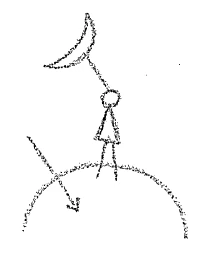
[ 12 ] He is held fast to the earth. When, through his karma—which is then linked to the natural forces at work within him—a person is freed from this earthly heaviness for certain moments of his life, the lunar forces begin to act as a counterweight, as an antigravity, and they are at work within the person, who begins to wander about even while asleep. He is then exposed to those forces that operate within his human being—in his physical and etheric bodies—and which are related not only to the forces reflected back from the Moon in the form of light, but also to the many other forces that are likewise reflected back from the Moon to the Earth. These forces attract the human being. These forces actually seek constantly to tear the human being away from the Earth. And so, at this moment in his life, when he is seized not by Earth’s gravitational forces but by the Moon’s antigravitational forces—which act in opposition to Earth’s forces—he may wander about, just as is the case with the sleepwalker or the lunatic. The forces at work within the human being in this instance are entirely different from the normal Earth forces. But this is true only for the current state of humanity. These forces, which you see only in the sleepwalker, are abnormal today. If you call out to him by his earthly name while he is wandering on a roof under the influence of the Moon’s forces, he will fall down. As he falls, he immediately enters the realm of earthly forces, because people receive names in the way they do today only in our present age; in other earthly epochs, they did not receive such names. But what is at work within the human being was, in fact, the norm for other earthly epochs. Anyone who understands this entire situation sees the Earth human in the state we today call “normal” as connected to the present Earth forces. Through the lunatic, human development points to world development—specifically to that epoch of world development in which this world development is lunar development.
[ 13 ] But the moment a human being enters the realm of lunar evolution, he behaves as if he were not living on Earth in the physical realm at all, but as if he were living in the astral world; only the astral realm communicates with his physical body. The astral body makes use of the physical body. And that which in this way gives physical form to the astral—that was once lunar evolution in ancient times. What still reminds us today of this astral activity in the physical realm was once world evolution, lunar evolution, and will be so [again] one day. Only then will human beings, in a conscious state, be able to walk on sloping surfaces in this way and move freely along vertical walls, as only flies can do today. It points to what will be in the future: the Jupiter stage of evolution. So that, if we correctly understand the lunatic, the sleepwalker, we can study—in the physical image he presents to us, as if nature itself were conducting an experiment before our eyes— that which was indeed experienced not in physical, corporeal matter, but in an infinitely finer substance during the Lunar stage, and which will be experienced again as we learn to master physical substance with complete clarity of consciousness in the future stage of development—the Jupiter stage. Thus, this condition points to what is past and what is the future of the world’s development.
[ 14 ] In this regard, we are indeed dealing with the kind of person we might call a “moon person.” And such moon people become sleepwalkers for certain moments of their lives.
[ 15 ] What a sleeping person does while sleepwalking—this moving about in a weightless, imponderable state—can be performed spiritually with full consciousness if the person also has the strength to remain completely still while doing so. So one can say: The sleepwalker follows the impulses of the lunar forces; he surrenders to them unconsciously; he makes every movement they impose upon him. The one who enters into conscious, precise clairvoyance, however, restrains every such movement; he carries out none of them. By not performing any such movement but holding them all back, these movements are transformed within him and become intuitions. Thus, conscious intuition—the highest and most precise form of clairvoyant development—actually consists in holding fast to what a person, as a sleepwalker, must perform out of instinct, because he must surrender himself to these forces and become completely absorbed in them. The one who transforms them does not, in fact, become absorbed in the physical lunar forces, but rather holds back the physical lunar forces within himself; through this, he intuitively attains devotion to the corresponding spiritual realm and arrives at intuition.
[ 16 ] So it is indeed very instructive to study, on the one hand, humanity’s relationship to the evolution of the world as reflected in these “lunar beings,” and on the other hand, what I would call the “exact clairvoyants”—who stand in contrast to the “night walkers.” For if the instinctive types are the sleepwalkers, the moon-obsessed, then the precise clairvoyants, the intuitive seers, are the upholders of action, those firmly anchored against the moon. This is what reveals to us, in this regard, the relationship of the human being to the world.
[ 17 ] The second type of person I would like to discuss today is the Jakob Böhme type. Jakob Böhme was such a person that, as if by a natural destiny—karma—at certain moments in his life he could perceive, while fully awake, a dark space instead of the sunlit world. As I have already indicated, it will be clear to you that this is not merely a matter of darkness in relation to light, but in relation to the silence of all sensory qualities. In certain states of his life, Jakob Böhme could perceive darkness instead of light, silence and stillness instead of the sounds the world produces, and indifference to warmth—or even cold, which one might call the “anti-warmth”—instead of warmth, and so on. So that, without him perceiving it that way himself, if one were to observe his state from the side, as it were, through inspiration, one would have had to say: Jakob Böhme, at certain moments in his life, perceives absolute darkness instead of a sunlit room.
[ 18 ] People who can experience this without being aware of it—so that, even in a light sleep, they still feel themselves to be within the sunlit world—such people possess what is called “deuteroscopy” or “second sight.” And Jakob Böhme possessed this very quality—what is called “second sight”—to the highest degree. In his case, it was developed in such a way that he applied it less to individual earthly matters and more to the constitution of the entire Earth. What was his perception like as a result?
[ 19 ] Just imagine—I’ll sketch it out schematically—: Other people have the “sunlight” right here in front of them. Jakob Böhme had—specifically from that very point where the rays of vision from the eyes normally cross as they focus on an object, whether near or far—behind this point where the rays of vision from the or even behind the point where, when one places the right hand over the left, one experiences not an external sensation but the sensation of one’s own self, so that here it is like a wall—Jakob Böhme thus had darkness before him there, the silence of the senses. Imagine this vividly: having darkness before you. It corresponds quite precisely to a sensory image. When you have a mirror in front of you—you do not see what is behind the mirror; you see only what is in front of the mirror. This is how it is spiritually for someone who sees as Jakob Böhme did. Because the darkness lies behind it, something like a mirrored wall arises in front of you, and you see what lies spiritually behind it—the earthly world in its spiritual nature—reflected. So if you belonged to the Jakob Böhme type, at certain moments in your life you would look into the darkness, and because the darkness reflects back to you that which lives spiritually in earthly existence, you would see the spiritual constitution of the Earth—that which occurs in earthly existence.
[ 20 ] In the case of Jakob Böhme, this is a powerful second sight. It may be the case with another person that, for certain moments in life, they are surrounded by darkness that hides physical light from them, which then offers them the opportunity to look into the spiritual realm. If such a person knows how to handle this spiritual mirror—which simply consists in the presence of darkness—in the right way, so to speak, he can, through the inner connections that exist between all earthly things—for my sake, the deeds or even the thoughts—perceive, while in Europe, those of his friend residing in America. For what one perceives with the physical eye, with the physical senses, consists above all of the effects of the sun. But there are hidden effects of the sun. These hidden effects of the sun live in all things—in minerals, plants, animals, and also in human beings. And while you are in Europe, through the hidden effects of the sun that are within you, you are in communication with what your friend—who, for my sake, lives in America—is experiencing right now through these same hidden effects of the sun.
[ 21 ] These communications have an effect on karma. For many people, fate has already brought them together—in marriage, friendship, or love—with someone they do not even know, who happens to be in America during a certain period of time; the hidden effects of the Sun are at work in the karmic effects on Earth. Here, the hidden influences of the Sun become visible, as if in a mirror.
[ 22 ] That this is especially true when dealing with people who live in isolation on islands, in mountain valleys, or in other areas conducive to this; that it is particularly the second sight, one might say, manifests itself so fully in all the people of such a region—stems from the fact that such people, who live in isolation within a certain way of life, are more easily attuned to inner communication and can thereby partially spread this darkness around them in their lives; hence the Scottish “second sight,” the Westphalian “second sight,” which Oberlin so beautifully described from the secluded Steintal valley in Alsace, and so on; these phenomena occur in specific locations on Earth. The realities that play out on Earth—and those that, if they are genuine, true realities, such as those I have just spoken of, are the hidden effects of the sun—must nevertheless be judged differently than one is usually inclined to judge them in today’s materialistic age.
[ 23 ] In today’s materialistic age, certain people—who think they’re being very clever—are debating whether King Arthur actually existed or not, whether he was real or a figure of legend. Well, anyone who sees through the whole thing will speak quite differently. To such a person, those who doubt that King Arthur ever lived are far more legendary than King Arthur himself! Such a scholar, who doubts Arthur’s existence, is—despite his physical presence—far more of a legend and a myth to the one who sees through to the realities than King Arthur himself. And so such people, who possess this “second sight”—which found its highest expression in Jakob Böhme—are special “sun people.” Just as a person outwardly perceives the effects of the sun through their eyes in the external world, so are they inwardly permeated by solar power, by the hidden forces of the sun. Just as the first type was the “moon person,” so the type of people with second sight—the Jakob Böhme type—is the “sun person”; sun people who, in turn, carry within themselves through their natural karma that which is considered abnormal today, but which nonetheless corresponds entirely to reality. Yet at certain times in the past, that which is considered abnormal today was, in fact, perfectly normal.
[ 24 ] And so, by bringing to mind what people with second sight are able to perceive—by bringing to mind the forces, the hidden solar forces, that permeate these “solar beings”—we are once again led to say: What is considered abnormal today—life within the hidden solar forces—was once normal in an earlier epoch of Earth’s evolution and will once again become normal. It was normal in that epoch of Earth’s evolution which preceded it as the solar phase of Earth’s development. In that epoch, it was normal for people everywhere to look into the darkness as if into a mirror, so that everything spiritual was reflected back to them. The entire Earth underwent that evolution which, drawing upon its own forces, transformed human beings at that time into “solar beings” with their light, ephemeral matter. This took place in a lowered, very lowered state of consciousness.
[ 25 ] It will return one day. Then, while fully awake, a person will be able to radiate the darkness into their surroundings with complete awareness, thereby creating for themselves a reflection of the entire world.
[ 26 ] And we then enter into the phase of development that I can describe as the Venusian phase, which is a future stage of Earth’s development. Human beings must shed their coarse sensuality, their coarse sensitivity, and their coarse perception of the physical world around them, and must draw forth from within themselves their free sensitivity if they wish to attain this “second sight.” This can also be achieved in a completely inner way, although the process is not without danger. It can be achieved by a person fixating their gaze externally—I do not recommend this to anyone; I merely wish to state the fact—on a shiny object; this induces a state of fascination. As a result, the external sensitivity is somewhat numbed, and the inner sensitivity thereby comes more to the fore. This gives rise to what appears as “second sight.” In earlier times, this second sight was quite systematically induced in certain contexts. And those stories that deal with this evocation of second sight speak of the so-called magic mirror. Magic mirrors were instruments used to induce a state of fascination, to dampen external sensation, and thereby to evoke internal sensation as a counteraction. Thus, through the instrument of the physical mirror, the spiritual reflection was evoked. What mattered was not what one saw in the physical mirror; rather, the physical mirror merely dampened external sensations, and one evoked inner sensations with this magic mirror. This gave rise to the belief that one could see, in the magic mirror itself, the feelings and thoughts of distant friends and so on. In reality, one saw within oneself the state of the soul brought about by the external, sensory-physical mirror.
[ 27 ] The one who sees in this way truly perceives realities. He sees the spiritual processes taking place in the realms of nature; and through this, he is, in a sense, connected to all that is sun-like within the Earth itself.
[ 28 ] If one truly wishes to understand Jakob Böhme’s writings, one must approach them from the perspective that their entire content is, in fact, a complex and wondrous vision.
[ 29 ] Another figure, Paracelsus, was organized in a similar yet somewhat different way. He possessed a stronger intellect in addition to his sensory perception. Consequently, he always interpreted his second-sight images himself. When one thinks intellectually about physical, sensory things, one does not alter them. Intellect is powerless against the constitution of physical, sensory things. But against what one sees in the reflection, as I have described it, intellect is not powerless. To perceive the inner constitution of the world purely through second sight is possible only for a person like Jakob Böhme, who was able to devote himself entirely and selflessly to external things. This infinite love, which indeed lived within Jakob Böhme, through which he saw all things, and which then permeated his conception of the mirror images of the spiritual in the world—this infinite love speaks from almost every line of Jakob Böhme’s writing. And so these reflections remained for him as pure as possible, as a kind of imagination of the spiritual in the world.
[ 30 ] In the case of Paracelsus, who possessed a strong intellectual capacity, they were altered accordingly by that intellectual capacity. They are therefore modified mirror images. You can see for yourself that even in the physical realm, mirror images can alter what they reflect—just look at your own face in a garden mirror ball. You certainly wouldn’t want your own face to look the way it does in those mirror balls set up in gardens! In this way, intellectuality, so to speak, alters the reflective surface through which one sees when one possesses an intellectuality such as that of Paracelsus. But through this, one also gains a deeper insight into the inner forces.
[ 31 ] Thus, Jakob Böhme, with his loving contemplation of things taken to its very highest degree, has become the contemplative observer. Paracelsus, who focused more on inner forces, who bent the mirror images and manipulated them, came closer to the healing powers hidden within things as solar forces.
[ 32 ] If, on the other hand, one learns to consciously master those forces that can live within a person as hidden solar powers—so that one does not use the spreading darkness to see reflections, but rather uses it to kindle that inner light that one has spiritually -psychically through meditation and concentration and so on—if one now carries this light into the darkness, so that one is able to fill the space otherwise illuminated by the outer physical sun with the inner, hidden solar forces, so that one oneself becomes luminous in a spiritual-psychic sense and can illuminate what is there, then conscious imagination arises. And this conscious imagination is precisely what, in full consciousness—just as one is otherwise accustomed to in the process of cognition—brings to light what Jakob Böhme, because he was a “sun-man,” wrote down in his writings in a state of a certain unconsciousness, albeit with a somewhat lesser mastery of the world of ideas and so on.
[ 33 ] And just as intuition is connected to the secret lunar forces at work within the human being—for the powers of intuition arise from these secret lunar forces, which the person develops as a sleepwalker while wandering about, when they are held in check— so too are the mirror images conjured forth from the spiritual darkness by the hidden solar forces transformed into conscious imagination. If these mirror images are not merely taken in but penetrated—if, instead of looking at them and allowing them to take effect, one looks right through them; in other words, if one consciously approaches “second sight,” so to speak, in the opposite manner—by looking right through it—then conscious imagination arises.
[ 34 ] Just as the somnambulist type is associated with the forces of the Moon and the Jakob Böhme type with the forces of the Sun, so a third type lives within the conditions of warmth and cold that are, in fact, always present in space—both near the Earth and in the wider surroundings of the Earth. But in their normal life, people become accustomed to this dominance of warmth. There is, however, a certain subtle, very inner sensitivity that becomes increasingly independent of external effects of warmth and cold, while at the same time becoming very receptive and highly sensitive to hidden effects of warmth and cold that pass through outer space. Swedenborg attained, at a certain point in his life, such an ability to perceive hidden effects of heat and cold—effects that exist in outer space in addition to the ordinary physical effects of heat and cold, under whose influence we feel hot and cold. If one seeks to penetrate the mysterious life of Swedenborg, it gradually becomes quite clear how this sensitivity to the heat and cold conditions of the cosmic space surrounding and permeating the Earth came about in Swedenborg at a certain age, precisely because, up to that point, he had been an outstanding scholar within the official scientific community of his time. Swedenborg’s works in the field of strictly official science are, in fact, very numerous. Not all of them were published at the time, and there is now even a society of Swedish scholars that intends to publish his posthumous writings in the purely scientific field in many volumes. However, Swedenborg poses a bit of a headache for precisely such scholars. They must acknowledge that, based on these brilliant works, he was clearly one of the most brilliant figures of his time. But at a certain point in his life, he became clairvoyant—which, in the view of those who are now publishing his officially recognized works, makes him, in their eyes, foolish. — And so today we must focus more on what developed within Swedenborg—after he had assimilated all the other recognized knowledge of his time—as a higher form of insight; we must examine more closely what caused him to be deemed “foolish” by external, official scholarship.
[ 35 ] Now, when one looks into Swedenborg’s personality, one realizes that he became so “foolish” precisely because, in his forties, he developed an intense love—an overwhelming love—for what he had learned up to that point. Like hardly any other person in the world, Swedenborg learned to love knowledge and insight for their own sake. And this love of insight itself led him, at a certain point in his life, to be able to look into the spiritual world in his own way, to become sensitive to the hidden conditions of warmth and cold in the cosmos.
[ 36 ] These hidden conditions of heat and cold in outer space do not come from the Moon or the Sun; they actually come, for the most part, from a star that, strictly speaking, shines very modestly in outer space—Saturn. Saturn’s peculiar, modest radiation into our planetary Earth’s space provides those hidden forces that particularly permeated Swedenborg at a certain point in his life.
[ 37 ] This enabled him to perceive emptiness in a particularly acute way in contrast to the fullness that surrounds us everywhere in the sensory world. One day, his sensitivity to emptiness dawned upon him. But it arose from an instinct. He did not strive for this. He did not undergo the kind of development I described in How Does One Attain Knowledge of the Higher Worlds?. It dawned on him as if through a subtle, higher instinct. And so he looked into that world—not a physical-sensory one—which one can only glimpse when one penetrates what flows through the cosmic space as conditions of warmth and cold, that is, as the radiation of Saturn. As a result, his vision became very peculiar.
[ 38 ] When you read what Swedenborg presented as the results of his visions, it actually seems almost like etherealized, refined earthly experiences. The spirits he sees—angels, archangels, and so on—do indeed move free from physical weight and the like, but they move almost to the same extent as earthly beings do. One might ask: Is what he saw there a real world? Is it something he merely projected out into the void from his inner fulfillment? It is neither. It is something entirely different. Apart from the world that humans perceive with their physical senses, and the world they experience as the second—the ethereal world— apart from these two spheres of the world, these two realms—the physical-sensory world and the etheric world—there is precisely that which surrounds us: a purely spiritual world in which spiritual beings who never descend to Earth move about vividly, in which such beings are actively engaged. But these beings, who are actively engaged in the purely spiritual world, must intervene in earthly life. Therefore, they must communicate what they do in the purely spiritual world to the Earth’s ether. So that we must schematically draw it like this [drawing not preserved]: Here is the Earth, surrounded and permeated by its Earth’s ether; outside—I can only draw it spatially, but in reality it is extraspatial—is the world of spiritually active beings. This world of spiritually active beings extends into the earthly realm. The Earth is what it is solely through the activity of these spiritually active beings.
[ 39 ] This activity radiates into the earthly realm, but in turn radiates back and manifests itself in the Earth’s ether. And these forces of the Earth’s ether are, in fact, etheric manifestations of the spiritual that stands above them. When we observe the Earth’s ether around us, we find within it the activity of spiritual beings, but in etheric images. The actual activity is above or within it. What immediately surrounds us on Earth is the activity that is projected downward—actually projected first into the Earth and then projected back from the Earth into the Earth’s ether. It is just as if the mirror images did not remain mere images, but rather began to develop an activity of their own. Thus, spiritual activity—which is actually radiated back from the Earth into the ether—is present there. This spiritual activity is a real projection of spiritual activity.
[ 40 ] Just as Jakob Böhme saw what was taking place within the human body or in nature reflected in a mirror, as I have described to you, so for Swedenborg the earth became a mirror that projected into the ether images of spiritual activity and the spiritual world. It is therefore just as reasonable to say that what Swedenborg saw is not the spiritual world as it is to say that it is the spiritual world. It is simply a realized reflection—a reflection of the Earth itself as a mirror. It is true, but it is precisely the true reflection of reality that lies outside the subject.
[ 41 ] This is what Swedenborg observed. He observed in the terrestrial ether the way in which the superterrestrial beings develop forces within it that then play a definite role in human life and in earthly life in general. For these etheric forces—which are not the angels or archangels themselves, but rather the forces vibrating within the ether—do indeed play a role in earthly life and in human life. Today, it is unusual for anyone to look into these hidden etheric forces, which, in the surrounding ether, indeed form an etheric image of the higher archetypes of the spirit.
[ 42 ] But that was once entirely normal in an earlier epoch of Earth’s development, in that time which preceded the Solar Age and can therefore be called the Old Saturn Age—the Old Saturn Age. This makes one realize that humanity will one day experience the Venus era, and that once the Venus era has come to an end, the Volcanic era will begin.
[ 43 ] This appeared in Swedenborg’s writings as a special vision: how the earth once existed, how it revealed itself to the people of that time, and how it will reveal itself again.
[ 44 ] When a person reaches the point of consciously penetrating what Swedenborg perceived as images in the ether—that is, when he sets his own fullness against the emptiness of cosmic space—then, at first, the entities that were reflected etherically for Swedenborg disappear from precise clairvoyance; they disappear, at first, from etheric vision; but they begin to become audible to spiritual hearing, to the spiritual ear. As one, so to speak, dispels them as visionary images, they begin to become inspirations that resound into one’s consciousness from the spiritual world.
[ 45 ] So one can say: That which, in Swedenborg’s case, was unconscious imagination—because it arose in the etheric image—is, if one carefully observes the warnings of the Keeper of the Threshold (something Swedenborg was unable to do), transformed from etheric imagination into astral inspiration, which can then arise in humans with full consciousness.
[ 46 ] In doing so, I have also described how the more subconscious states—the somnambulistic type, the Jakob Böhme type, and the Swedenborg type—relate to what can then be consciously attained through intuition, imagination, and inspiration.
[ 47 ] The order had to be different today because I described them from the perspective of the cosmos. If one does not go by names but by things, then when describing from different points of view, one must change the order, just as the order can sometimes change when viewing from a perspective: If two people are standing here, and I am standing between them, I have one behind me and one in front of me; but if I step in front of the one in front, then I have both of them in front of me. In the same way, things in the universe change depending on the viewpoints one must adopt.
[ 48 ] That is why you will also find in my lecture series that things appear in different orders because they must be described from different points of view. Anyone who fails to see this and focuses on the abstract will say: “But that doesn’t add up.” But only those who describe things based on assumptions have it so easy—they can constantly say things that even a purely intellectual person would then find consistent. Those who describe things based on reality must accept that reality itself can, from different points of view, actually appear contradictory.