Insight from Initiation
GA 227
22 August 1923, Penmaenmawr
Translated by Steiner Online Library
Dream Life
[ 1 ] Between a person’s waking life and their sleeping life—which I was able to describe to you, at least in outline form, in my last reflection—lies the life of dreams. This life of dreams, which can have so little significance for the immediate reality of everyday life, is nevertheless of the greatest possible importance for a deeper understanding of both the world and human beings. Not only because, in the spiritual science under discussion here, the significance of this dream must be fully recognized so that one can move from the study of dreams to many other areas, but also because this dream life has such special significance in that it represents, so to speak, the opening through which certain worlds other than the one experienced by human beings while awake shine into this ordinary world. Thus, it is often precisely through the enigmatic nature of dream images that a person becomes aware not only that there are other worlds in the depths or even on the surface of the world accessible to them, but also of what the nature of these worlds might be.
[ 2 ] But on the other hand, it is extremely difficult to penetrate this entire enigmatic world of dreams from the standpoint of higher consciousness, for in life, the dream is a force that can plunge a person into the greatest possible illusion. And one is easily inclined, precisely when it comes to dreams—which introduce an illusory element into life—to mistakenly attribute reality to them. Let us proceed in this way, referring entirely to what I have already said about the life of sleep and also about repeated earthly lives.
[ 3 ] An example that recurs in one form or another in our dream life is when, in a dream, one has done something that one could never even imagine having done in waking life—something that lay completely beyond the realm of possibility in one’s earthly life thus far. Then you dream that you cannot find what you have just made, and you search like a madman for this lost object that you believe you have made.
[ 4 ] Let’s look at this example in more detail. In the form I’ve described—albeit with variations here and there—this occurs in everyone’s dream life. Let’s examine it specifically. Let’s say a tailor—even though he’s just a very small-time tailor for the petty bourgeoisie—dreamed that he had made a ceremonial coat for a minister. Now he feels quite at ease making this ceremonial coat, which is supposed to already be there. But immediately afterward, the dream shifts to a situation where he’s searching everywhere for this coat when he’s supposed to deliver it to the minister, and he can’t find it anywhere.
[ 5 ] Here you have a dream that unfolds entirely in forms which the person in question cannot, admittedly, realize in life, but which he can still quite vividly imagine—as a wish—in the life he is currently leading on earth. He cannot carry it out because he is, after all, just a small tailor for the petty bourgeoisie, and one cannot order such a coat from him. But sometimes, through his bold daydreams, the desire to make such a state coat may have crossed his mind. Perhaps he cannot do it at all, but it becomes the desire of his daydreams.
[ 6 ] But what underlies this? It is, in fact, based on reality. When a person, with their ego and astral body, is asleep outside of their physical and etheric bodies, they are, in fact, within that entity that passes through repeated earthly lives.
[ 7 ] That which is active within, that which is actually at work within—first and foremost in its own being—while a person sleeps, is the “I” and the astral body: In its experiences, it does not merely have memories of the earthly life just now lived, but it can also have memories of other earthly lives. And I am not telling you something that is merely a hypothetical assumption, but something that definitely originates from the realm of reality of which I am speaking. It may therefore be that the person in question was indeed once involved—let’s say in ancient Roman times, in a previous earthly life—in the commissioning of a particularly stately toga. He need not even have been a tailor at that time, but he may somehow have been the servant or perhaps even the friend of a Roman statesman. His destiny may well have led him to his present profession in this incarnation precisely because he had such a vivid desire back then to present his master to the world in the most dignified manner possible. For in the life of humanity as a whole, it is precisely desires and thoughts that are of extraordinary importance. And so the memory of what was experienced in this way in a previous earthly life can permeate the soul and spirit of the human being—the I and the astral body. Then in the morning, when the human being sinks down—as I sketched out only briefly yesterday—with his I and astral body into the etheric body and the physical body, this soul, which just a moment ago was immersed in the recollection of the beauty of the state toga, now sinks into those ideas that the tailor in question may have in his present earthly life; which are embedded in his etheric body. There, what has just been experienced in relation to ancient Roman times becomes blocked; it gets stuck. It seeks to enter the ideas he might have during the day. But during the day, his only ideas are that he makes clothes for the petty bourgeoisie. Now, when the soul sinks into this state, it finds it extremely difficult to translate what it has just felt regarding the beautiful state toga; it finds it hard to imagine this in relation to the dreadful garments that the tailor has to make. So, during the transition—during this accumulation—it transforms from the image of the toga to the present-day ministerial coat, and only later, when the person in question has fully submerged himself in his ethereal and physical body, does what he must now imagine obliterate what he experienced just before waking up.
[ 8 ] Thus, our entire human life lies right there between falling asleep and waking up. Within ourselves, we must contrast our entire human life with what we can imagine and think about in this earthly life based on our experiences, and through this process we arrive at the strange forms of the dream. That is why it is so difficult, especially with dreams, to distinguish their content—which is presented to us at first and can be a complete illusion—from the true reality that is actually always lying behind it. This true reality can be something entirely different. But those who become aware that, in dreaming, one should pay less attention to the images conjured before the soul—for these images are formed by the etheric body, which is actually left behind in bed and carries the thoughts and ideas within itself—will gradually learn to find their way into the whole intricate process of dream life. After all, one does not possess these ideas within one’s actual inner being during sleep. One must distinguish the content of these ideas from something else, and this other thing I would like to call the dramatic course of the dream. One must gradually accustom oneself to directing one’s attention to the dramatic course of the dream in such a way that one asks oneself: Does this dream unfold in such a way that, if the events in question were experienced in waking life, they would bring immense joy? Did one also experience this joy, this liberation, in the dream, or is one sailing toward a catastrophe in the dream? Does one move from a certain exposition, where things can reveal themselves, then become entangled, and then a downfall occurs, leading to some catastrophe? These are the questions one should consider first and foremost when examining dream life—not the content of thought, but the dramatic unfolding.
[ 9 ] Someone might dream that they are climbing a mountain; the hike becomes increasingly difficult. They finally reach a point where they can go no further, where immense obstacles loom before them. They perceive these obstacles as something that significantly intrudes into their life. Well, someone might have this dream. One could elaborate on it further. But he or someone else might have a different dream: he moves through the entrance of a cave that, for the sake of argument, leads into a mountain cavern somewhere. After passing through the entrance, he still has some light. Then it grows darker and darker. But finally, he reaches a point where it is not only completely dark, but where he is also met by the most terrible effects of cold and the like, so that from this point on, he cannot penetrate any further into the mountain cave.
[ 10 ] You see, here you have two dreams that are quite different in content; dramatically, both depict an undertaking that starts off well, then encounters difficulties, and finally comes up against an insurmountable obstacle. The images are quite different, but the dramatic progression is the same. Both dreams may be based on the same event in the supersensible world—behind the scenes of life, so to speak. The exact same process may have taken place in the soul in both dreams, and the exact same process may manifest outwardly in the most diverse images.
[ 11 ] This is simply meant to draw attention to the fact that one should not draw conclusions from the content of dreams in a superficial way, as so often happens, but should first gain insight from the dramatic course of events into what the human soul and spirit may have gone through. Then, if one also supports one’s imagination with exercises such as those I have spoken of in recent days, one will gradually be able to move deeper and deeper into the dream’s illusory world of images and, through its dramatic structure, grasp what actually underlies the dream as a supersensory reality experienced between falling asleep and waking up.
[ 12 ] Before I discuss the details of the dream, its relationship to the human physical body and to the human spiritual realm—which I plan to do in the coming days—I would like to describe today how, through the world of dreams, the human being places itself within the entire cosmos, within the entire universe. One can indeed see how, in the dream, a completely different interconnection of life’s individual events begins to emerge than the one we experience in waking life. In waking life—as we have just seen in the examples mentioned—things present themselves in a certain interconnection according to the laws that govern the sensory world once we are immersed in it. What comes next must always follow what came before. The dream reveals that which can happen in the ordinary sensory world in a state of complete dissolution. Everything becomes different; everything dissolves. That which, like human beings themselves as sensory beings, is bound to the earth by gravity can suddenly fly in a dream. In a dream, a person performs aerobatics without an airplane. Things that one otherwise struggles with—a mathematical problem, for example—are experienced in a dream as if they had been solved with childlike ease. One may then no longer remember the solution while awake—well, that is a personal misfortune—but in any case, one has the impression that the inhibitions and obstacles to imagination that exist in daily life are not present. And so everything that has a fixed connection in daily life is, in a certain sense, dissolved in a dream. If we want to form a sensory image of what is actually happening in a dream—which, of course, only happens in our imagination—we can say: Let’s imagine a glass containing a liquid, such as water; we add some kind of salt that can dissolve into the water and then watch as it dissolves. Let’s assume the salt is even crystallized and has specific shapes. When we drop it in, the salt initially reveals the most distinct shapes. But then we see how these shapes dissolve, taking on the most fantastical forms, until finally all the salt has dissolved in the water and a more or less homogeneous liquid reappears.
[ 13 ] This is roughly how it works in the imagination, in the psychological experience of dreaming. Both the dream we have as we fall asleep and the dream we have upon waking take the ordinary experiences of the day, break them down, and give them all kinds of fantastical forms and all kinds of fantastical meanings; we call it “fantastic” from the standpoint of ordinary consciousness. The dissolution of certain salts in a liquid is a very good metaphor for what actually happens psychologically and spiritually in a dream.
[ 14 ] Now, once one has become thoroughly immersed in today’s worldview, it is not easy to arrive at an unbiased understanding of this fact, for today’s humanity—especially that which calls itself scientific—actually knows extraordinarily little about certain things.
[ 15 ] Truly, I am not saying these things now simply because I would like to take a swipe at science. That is not my intention at all. I value scientific rigor and would never want to see amateurism or dilettantism take the place of scientific practice. Precisely from the standpoint of the humanities, one must fully acknowledge the great advances—as well as the limited truth and certainty—of contemporary scientific practice. Having made that clear, the following must nevertheless be said.
[ 16 ] Today, when people want to know something, they turn to earthly things and earthly processes. They observe them and deduce the laws of nature from their observations. They also conduct experiments to uncover nature’s secrets, and in turn, allow the results of these experiments to reveal the laws of nature to them. And so one arrives at a certain kind of law, which one then calls “science.” And then one looks out into the vastness of the heavens. In the vastness of the heavens, one sees, for example, the marvelous spiral nebulae; one sees individual celestial bodies forming within these spiral nebulae and the like. Today, one even captures these phenomena using photographic methods, which reveal them much more precisely than ordinary observation through a telescope or similar instruments. And what does one do then to gain insights into what is happening out there in the vastness of space? One takes the laws of nature on Earth—what one has deduced from Earth, what one has experimentally verified there—and then speculates on how, according to those same laws of nature, such a spiral nebula might have formed in the depths of space. We formulate hypotheses and theories about the origin and end of the universe in order to apply what we have discovered in our laboratories—such as manganese, oxygen, and hydrogen on Earth—as laws of nature to the celestial sphere. And when new substances are discovered in the process, one sometimes makes such unconscious insinuations that one gets caught up in rather dubious scientific speculation. Hydrogen has been found everywhere in the vastness of space—helium, for example—but another substance has also been discovered that has a peculiar name, peculiar because it already hints at the confusion of thought that arises there. It is called nebulium. Thinking becomes foggy there—hence this “nebulium” alongside helium and hydrogen. When one simply applies what one has investigated as the laws of nature in one’s earthly laboratory, and then speculate—in the manner, for example, of the Swedish thinker Arrhenius, who has truly caused an infinite amount of harm in this regard—about what might be happening out there in the vastness of space, one inevitably falls into error upon error unless one can view the following with an open mind.
[ 17 ] You see, I would like to start with a comparison once again: As you know from the natural sciences, Newton, the English physicist and natural philosopher, formulated the theory of so-called gravitation, the force of gravity throughout the universe. He extended the law of gravitation—which can be observed in the ordinary falling stone attracted by the Earth—to the mutual relationships of all celestial bodies. He also explained how the force of this gravitation, its strength, decreases with distance.
[ 18 ] For physicists who might be present in this hall, one can say that the law states that gravity decreases with the square of the distance; thus, at a distance of 2, it is four times weaker, and at a distance of 3, it is nine times weaker; in other words, gravity decreases with the degree of distance.
[ 19 ] You see, for a force like this, one formulates a law like this. That is quite correct. But if one remains confined to a purely physical existence, one does not have the ability to conceive of this law as being universal enough. One imagines that if there is a celestial body here, its gravitational force decreases with distance; it is strong, then it grows weaker, weaker still, weaker still, and weaker and weaker.
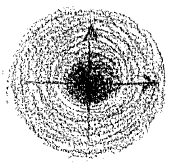
[ 20 ] It's the same with the propagation of light. Light that travels from a specific light source becomes weaker and weaker.
[ 21 ] Modern man, with his science, sees through this. But he does not see through the other fact: that when he formulates laws of nature here on Earth in his laboratory and expresses these laws of nature as ideas, the truth of these laws—the content of these laws—also ceases to apply the farther one moves away from Earth. So if one formulates a law on Earth governing the combination of elements—oxygen and hydrogen, or any other elements—or if one formulates the law of gravity on Earth, the truth of the content of that law also diminishes as one moves out into outer space. And if I have established a certain law of nature here in my laboratory and I apply this law to a spiral nebula in distant outer space, I have done exactly the same thing as if I believed that if I were to place a candle here, light it, and then extend it out through outer space into the spiral nebula, the candlelight would shine up there with the same intensity as it does here. I am committing precisely this same error when I believe that what I have established here in my laboratory also applies out there in distant space. Thus, a profound error arises precisely from applying what we find to be entirely correct laws of nature in an earthly laboratory to the vastness of outer space.
[ 22 ] But human beings are not excluded from that order of laws one enters when the laws of the Earth—such as the force of gravity or the speed of light—no longer apply. And if one were to seek a system of laws in space that differs from our natural laws, one would have to move farther and farther away from Earth. If one wishes to find it in a more inwardly human way, one passes from waking to sleeping. When we are awake, we are within the realm of these natural laws. We do everything we do in accordance with these natural laws. We resolve to raise our hand or our arm; the chemical and physical processes taking place in the muscles, the mechanical processes occurring in the skeletal structure—all unfold according to the laws we investigate here on Earth in our laboratories or through observation. That which lives within us as the soul leaves the physical body and the etheric body during sleep. And as it leaves, it enters a world that is not subject to the laws of nature. That is why the dream begins to become such a mocker of the laws of nature. We enter a completely different world. We enter a world into which we immerse ourselves while asleep, just as we immerse ourselves in the sensory world with our physical body while awake. But this world is different. This world does not follow our natural laws; rather, it has entirely different laws. Every night, as we step out of our physical and etheric bodies, we plunge into a world where our natural laws no longer apply. And the dream is the very force that presents an intense opposition to the natural laws.
[ 23 ] As I dream, the dream shows me that I live in a world that defies the laws of nature, a world that refuses to be subject to them. When I fall asleep in the evening and move out of my physical and etheric bodies, I am still half within the laws of nature; but I am already entering the world that is not governed by the laws of nature. This is how the confusion of natural laws and supersensible laws arises in dreams. The same is true upon waking.
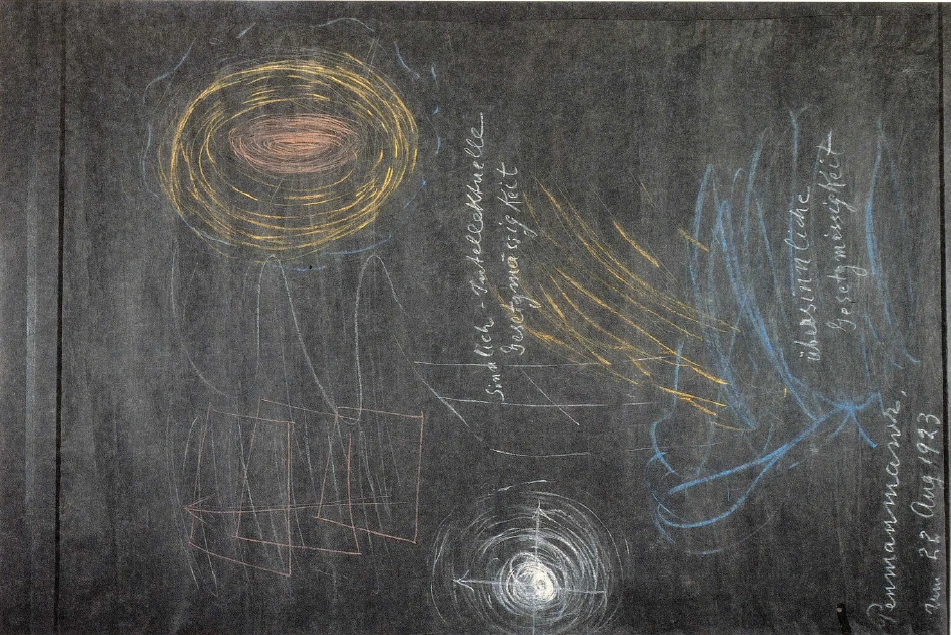
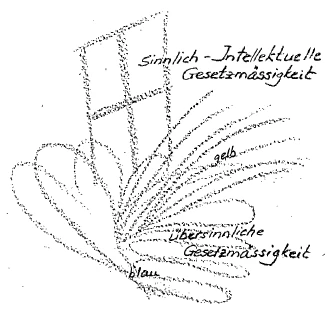
[ 24 ] One could say that every time we fall asleep, we dive into a world where our laws of nature do not apply, and every time we wake up, we surface from that world into the world where our laws of nature do apply. If we really imagine this process, it is indeed like this: Imagine the world of dreams as an ocean in which you live. Suppose you wake up from the surging dream life of the morning. It is as if you were moving out of that surging dream life. You are moving from a supersensory order of reality into the sensory-intellectual order of reality. And so it seems to you as if everything you see in sharp contours after waking up were born out of the fluid, the fleeting. Let’s say, for my sake, that you see windows here; if you first dream of a window, this window, too, will appear to you as emerging from something that has flowed away, from something indefinite perhaps, which here (yellow) has all manner of flames; then the window emerges, and if you were dreaming very vividly, you would see how the entire, sharply contoured, definite waking world of your consciousness emerges from this indeterminate state, as if waves were rising out of the sea (blue), but these waves would then take shape to form the waking world.
[ 25 ] And here is one of those points where, as a person living in the present who is exploring these things anew, one is filled with that sense of awe and wonder that one can feel toward the dreamlike imaginings of an earlier humanity—which I have also spoken about in recent days. I said that when we go back to what an earlier humanity experienced in the soul—even in waking life—as dreamlike imaginings, which they then shaped into myths and legends and tales of the gods—and which now seem so vague and indistinct compared to what we grasp today in our concrete view of nature—when we return to that with what we can rediscover today, entirely on our own, independent of these ancient, dreamlike imaginings—then we do indeed arrive at a sense of awe and wonder, at a reverent admiration for what lived in the souls of those people from earlier eras. And from ancient Greece, a word still echoes to us, bearing witness to us as we once again explore in this realm what the truth is; a word echoes to us from ancient Greece that testifies that the Greeks still knew something of these things, that the Greeks imagined: There is something that underlies the entire structure of the world, from which all specific forms arise, but which can only be reached when one steps out of the sensory world into the state of sleep, into a dreamlike state. The Greeks called this Chaos. And all speculation, all conceptual inquiry into what Chaos is, was in vain; for Chaos is something that modern man comes close to when he enters the realm of dreaming. Only in the Middle Ages does something of a knowledge of what lies at the foundation of all external substances—a supersensible, external substance that can scarcely even be called matter—still emerge, in that the Middle Ages speak of the so-called quintessence, the fifth essence, alongside the four other elements: earth, water, air, fire—the quintessence.
[ 26 ] Or perhaps something of the medieval worldview still permeates the poet’s vision when he says so vividly: “The world is woven from dreams.” A Greek would have said: The world is woven from that which—when you transcend the sensory realm and enter the world you experience free from your body—you perceive as chaos. — Thus, in order to understand what the Greeks meant by chaos, one must point to that which lies not in the sensory world but in the supersensory worlds.
[ 27 ] If one now traces the entire process of falling asleep, dreaming, sleeping, and waking up from the perspectives that arise when one follows the path I have described in recent days toward higher knowledge through imagination, inspiration, and intuition into the supersensible worlds—in other words, if one observes the dream, sleep, and waking lives from the perspective of this knowledge—then the following picture emerges: The human being drifts off from the ordinary waking state into the life of sleep, from which dreams can emerge in an indeterminately chaotic yet also admirable and internally unified manner. Left behind in bed are the physical body and the etheric body, which, as the actual animating, shaping, and growth-promoting force, permeates the physical body. A duality is left behind in bed.
[ 28 ] But a duality also emerges and penetrates that supersensible state of being between falling asleep and waking up, which I was thus able to describe to you today from the perspective of the dream experience.
[ 29 ] This duality presents itself to the higher insight of imagination, inspiration, and intuition in the following way: There is that which is peculiar to the human being when he emerges from the physical and etheric bodies as his astral body. Let us not, as I have already said, get hung up on words; words are necessary, but one could also use a different word for the astral body. I will shortly describe some characteristics of the astral body, and we will see that what matters is not the name but what one can grasp as concepts about it. This astral body is a sum of processes. Something happens within the human being as they grow out of their physical and etheric bodies. It is precisely this happening, these processes, that constitute the astral body. In the etheric body, we have left behind our concepts and thoughts. Here within the astral body is spiritualized light—cosmic warmth permeated by the power of the capacity for love. All of this is present in the astral body.
[ 30 ] That which is present in the astral body in this way can, upon waking, plunge into the etheric body, accumulate there, and then appear as the fabric, as the play of dreams; or, by moving out of the physical and etheric bodies and leaving the world of ideas, it can again appear as the fabric, the play of simple dreams. It is therefore essentially the astral body that carries us out of the physical and etheric bodies.
[ 31 ] And this astral body is the entity within us that, as I have already said, actually opposes the laws of nature. From morning to night, from waking to falling asleep, we are caught up in the workings of the laws of nature—the workings of the laws of nature that we can also grasp through mathematics in terms of their spatiality and temporality. As we fall asleep, we break free from both the fabric of the laws of nature and the mathematical laws. We also shed mathematics, for our astral body does not contain the dead, abstract mathematics of three-dimensional space, but rather a self-contained—I would say living, though spiritually living—mathematics that exists in only one dimension, that extends only in a straight line. I will have more to say about this dimensionality later. But it is actually this astral body that frees us from our attachment to the laws of nature, which exists between waking and falling asleep. Through our astral body, we are transported into a completely different world—the supersensible world.
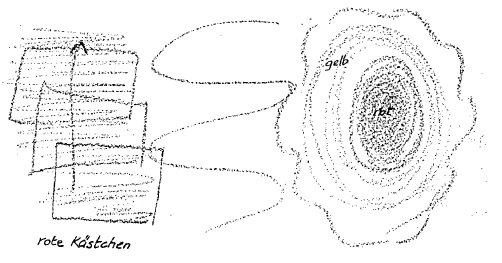
[ 32 ] If one were to sketch this process schematically, one would have to say: We exist within the realm of the laws of nature when we are awake (white). However, as we fall asleep, we emerge from this realm with our astral body—which, after all, is also contained within our physical body—(yellow). Here, within the physical and etheric bodies, our astral body is entirely subject to the laws of nature. It is so completely immersed in all its movements and processes that it lives within the laws of nature, as I have schematically illustrated in these figures (red boxes).
[ 33 ] Now the astral body comes to life by stepping out of the physical and etheric bodies and into the supersensible world, and now it is subject to a different, supersensible order of laws within that world. The astral body has become something entirely different. From the moment we wake up until we fall asleep, it is, so to speak, bound by the straitjacket of the laws of nature. It falls asleep—that is, it emerges from the physical and etheric bodies—and moves into the world of free laws, which are the laws appropriate to it. And what does it enter there? It now enters a world—that is, it carries us as human beings into a world that affords the “I,” the actual “I”-organization, which is now within the astral body and leaves the physical and etheric bodies with it as we fall asleep, a freedom of movement; the “I” becomes free in the world into which the astral body has carried it. Every night, the “I” becomes free in a world where the laws of nature do not apply, where the “I” can act as it pleases, free from the constraints of those laws. When we are in the state between falling asleep and waking up, and our astral body has freed us from the laws of nature—when gravity no longer applies, nor the law of energy, when none of these laws apply at all in the world into which we have now entered—then the way is clear for those moral impulses that can only be lived out here, I might say, under the compulsion of the sensory world order—in the world in which we find ourselves between waking and falling asleep. In a world where the moral law now attains the same power and authority as the laws of nature have here, the “I” lives from falling asleep until waking. And in this world, the “I” can make preparations. In this world, where it is freed from the laws of nature during sleep, the “I” can prepare what it must then carry out once it has passed through the gate of death. We will then discuss this path from death to a new birth in the subsequent lectures.
[ 34 ] The “I” can now prepare—initially in the form of images, in imaginations that are not merely visualized but are rather impulses of power—the “I” can prepare, between falling asleep and waking up, the images of what it must then accomplish in spiritual reality. For once it has passed through the gate of death, the moral laws will be just as our natural laws are here in the physical-sensory world. Here, between falling asleep and waking up, the “I”—liberated by the astral body—already prepares, in images, what must be experienced in spiritual reality between death and a new earthly life. So that we can say: The “I” is already working out—albeit in a nascent form, as in a very small spiritual seed—what it will then have to accomplish in the spiritual universe after death. And in what the “I” is already working out here in this state of sleep through images, there is already a hint of what we can carry over from this earthly life into the next—not through any natural laws, but only through the spiritual world. We can trace the causality of what we have taken in as moral beings—these moral impulses—only by submitting ourselves to them, as it were, with an inner obedience of the soul. Just as the “I” works them out during sleep and then continues to work on them between death and a new birth, so do these moral impulses acquire the same forces that are otherwise governed by natural laws here, and they clothe themselves in the next human body that we will bear in our next earthly life as our moral constitution, as our temperament, as our character disposition—which is wrongly attributed to mere heredity—and which is shaped in such a way that the “I” must already begin working on it during sleep, when, freed through the astral body, it reigns not in a natural world but in a purely spiritual one between falling asleep and waking up. And so we can see how, through the state of sleep, a person is already preparing for their future, how they are living their way into their future.
[ 35 ] And what does the dream reveal to us? I would say: The “I” is at work during sleep, but the dream presents this work to us in illusory images. We cannot yet bring into this earthly life what is already being woven during sleep for the next earthly life. The dream—as I explained at the beginning of my lecture today—can show us, in its confused images, what we have experienced in previous earthly lives, just as it reveals, in chaotic forms, what is being prepared in embryonic form for humanity’s future in times to come.
[ 36 ] Indeed, the correct interpretation of the dream leads us to recognize that the dream is, after all, something like a window—one through which we need only look in the right way—a window into the supersensible world. For behind this window lies the very fabric of ego activity, which extends from past earthly lives to future earthly lives. In a certain sense, when we are able to interpret the dream correctly, we already look through the window of the dream from the world of transience—in which we live as earthly human beings—into the world of permanence, of eternity, to which we belong with our true inner human being.
[ 37 ] I'll talk more about that tomorrow.