Humanity as the harmony of the
creative, formative, and shaping Word of the World
GA 230
9 November 1923, Dornach
Translate the original German text into any language:
Versions Available:
Humanity as the harmony of the creative, formative, and shaping Word, tr. SOL
Zehnter Vortrag
Tenth Lecture
[ 1 ] Sie werden gesehen haben, daß in diesen Vorträgen, die ich in der letzten Zeit gehalten habe, alles dahin drängt, die Welterscheinungen so zusammenzufassen, daß zuletzt dadurch eine wirkliche umfassende Menschenkenntnis herauskommt. Nach Menschenkenntnis drängt alles, was wir betrachtet haben, hin. Eine Menschenerkenntnis wird erst möglich sein, wenn sie beginnen kann mit den untersten Formen der Erscheinungswelt, mit alldem, was sich dem Menschen offenbart als die stoffliche Welt. Und was so beginnt mit der Betrachtung dessen, was sich als die stoffliche Welt offenbart, das muß schließen mit der Betrachtung der Hierarchienwelt. Von den untersten Formen des stofflichen Daseins bis hinauf zu den höchsten Formen des geistigen Daseins, bis zu der Welt der Hierarchien muß dasjenige gesucht werden, was dann zur wirklichen Menschenerkenntnis führen kann. Augenblicklich werden wir eine Art von Skizze entwerfen für eine solche Menschenerkenntnis in den Vorträgen, die ich jetzt vor Ihnen halten kann.
[ 1 ] You will have noticed that in these lectures I have given recently, everything tends toward summarizing the phenomena of the world in such a way that, ultimately, a truly comprehensive understanding of human nature emerges. Everything we have considered points toward an understanding of human nature. Such an understanding will only be possible if it begins with the lowest forms of the phenomenal world—with everything that reveals itself to human beings as the material world. And what begins with the contemplation of what reveals itself as the material world must conclude with the contemplation of the world of hierarchies. From the lowest forms of material existence all the way up to the highest forms of spiritual existence, up to the world of the hierarchies, we must seek that which can then lead to a true understanding of human nature. We will now sketch out a kind of outline for such an understanding of human nature in the lectures I am about to present to you.
[ 2 ] Wir müssen uns klar darüber sein, daß dasjenige, was als Mensch heute vor uns steht, das Ergebnis jener langen kosmischen Entwickelung ist, die ich immer zusammengefaßt habe als Saturn-, Sonnen-, Mond- und Erdenentwickelung. Die Erdenentwickelung ist noch nicht vollendet. Aber seien wir uns darüber klar, was eigentlich der Mensch der Erdenentwickelung im engeren Sinne, die also auf dieMondenentwickelung gefolgt ist, verdankt.
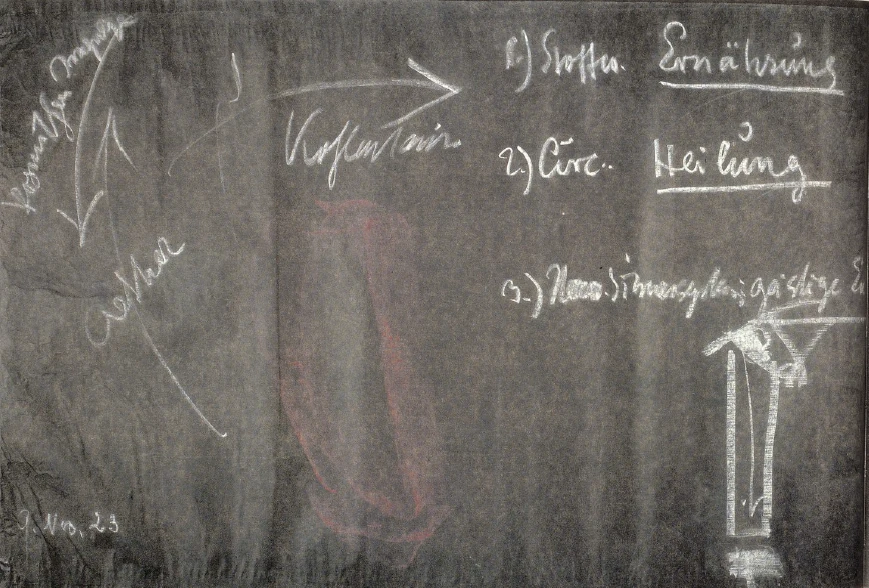
[ 2 ] We must be clear that what stands before us today as a human being is the result of that long cosmic evolution which I have always summarized as the Saturn, Sun, Moon, and Earth evolutions. The Earth evolution is not yet complete. But let us be clear about what humanity actually owes to the Earth evolution in the narrower sense—that is, the phase that followed the Moon evolution.
[ 3 ] Sehen Sie, wenn Sie Ihre Arme ausbreiten und bewegen, wenn Sie die Finger bewegen, wenn Sie irgendeine äußere Bewegung ausführen: alles, was in Ihrem Organismus dazu notwendig ist, daß Sie Arme und Beine, den Kopf, die Lippen und so weiter bewegen können — und die Kräfte zu solchen menschlichen Äußerungen gehen ja in die innersten Partien des menschlichen Organismus hinein —, alles das ist dem Menschen durch die Erdenentwickelung im engeren Sinne beschieden. Sehen Sie dagegen hinein in alles, was Stoffwechselentwickelung ist, in den Raum, der von der äußersten menschlichen Haut abgeschlossen ist, sehen Sie auf alles das, was da im physisch-körperlichen inneren Menschen vor sich geht als Stoffwechselentwickelung, dann haben Sie darin ein Bild von dem, was der Mensch der Mondenentwickelung verdankt. Und Sie haben ein Bild von dem, was der Mensch der alten Sonnenentwickelung verdankt, wenn Sie auf alles das hinschauen, was im Menschen irgendwie ein rhythmischer Vorgang ist. Atmungsvorgang, Blutzirkulationsvorgänge sind ja die wichtigsten rhythmischen Vorgänge; alle diese rhythmischen Vorgänge verdankt der Mensch der alten Sonnenentwikkelung. Und alles, was Nerven- und Sinnesentwickelung ist, wiederum über den ganzen Körper des heutigen Menschen ausgebreitet, das verdankt der Mensch der alten Saturnentwickelung.
[ 3 ] You see, when you spread your arms and move them, when you move your fingers, when you perform any outward movement: everything within your organism that is necessary for you to move your arms and legs, your head, your lips, and so on—and the forces behind such human expressions do, after all, extend into the innermost parts of the human organism—all of this has been bestowed upon humankind through Earth’s evolution in the narrower sense. Look, on the other hand, into everything that constitutes metabolic development, into the space bounded by the outermost layer of human skin; look at everything that takes place within the physical, bodily inner being as metabolic development—then you will have a picture of what humanity owes to the lunar evolution. And you have a picture of what humanity owes to the ancient solar evolution when you look at everything within the human being that is in any way a rhythmic process. The processes of breathing and blood circulation are, after all, the most important rhythmic processes; humanity owes all these rhythmic processes to the ancient solar evolution. And everything pertaining to nervous and sensory development—which, in turn, is spread throughout the entire body of modern humans—humanity owes to the ancient Saturn evolution.
[ 4 ] Aber bei alledem müssen Sie ins Auge fassen, daß der Mensch ein Ganzes ist, und daß die Weltenentwickelung ein Ganzes ist. Wenn wir heute so, wie ich es in meiner «Geheimwissenschaft im Umriß» getan habe, auf die alte Saturnentwickelung hinweisen, so meinen wir diejenige Entwickelung, die vor uralten Zeiten einmal der Sonnen- und Monden- und Erdenentwickelung vorangegangen ist. Aber das ist im Grunde genommen nur die eine Saturnentwickelung, die es bis zur Erde gebracht hat. Während sich die Erde entwickelt, entsteht ja auch eine Saturnentwickelung. Diese neue Saturnentwickelung ist in der Erdenentwickelung darinnen; sie ist sozusagen die jüngste Saturnentwickelung. Diejenige, die bis zu der Erdenentwickelung gekommen ist, ist die älteste. Diejenige, die als Saturnentwickelung in der alten Sonne gesteckt hat, ist die jüngere; die im Monde gesteckt hat, ist wieder jünger; und der Saturn, der heute die Erde ausfüllt, der im wesentlichen gewisse Wärmeorganisationen der Erde in Anspruch nimmt, der ist die jüngste Saturnentwickelung. Aber wir stecken mit unserem Menschen in dieser Saturnentwickelung drinnen.
[ 4 ] But in all of this, you must bear in mind that the human being is a whole, and that the evolution of the worlds is a whole. When we refer today to the ancient Saturn evolution, as I did in my *Outline of Esoteric Science*, we mean the evolution that, in time immemorial, preceded the evolution of the Sun, the Moon, and the Earth. But this is, in essence, only the one Saturn evolution that made it all the way to the Earth. As the Earth evolves, a Saturn evolution also arises. This new Saturn evolution is contained within the Earth’s evolution; it is, so to speak, the most recent Saturn evolution. The one that reached the Earth’s evolution is the oldest. The one that was present as a Saturn evolution in the ancient Sun is the younger one; the one that was present in the Moon is even younger; and the Saturn that now fills the Earth—which essentially makes use of certain thermal structures of the Earth—is the youngest Saturn evolution. But we, as human beings, are embedded within this Saturn evolution.
[ 5 ] So stecken wir in der kosmischen Entwickelung drinnen. Aber wir stecken auch in dem, was uns räumlich auf Erden umgibt. Nehmen Sie zum Beispiel das mineralische Reich. Wir stehen mit dem mineralischen Reich in Wechselwirkung. Wir nehmen die Mineralität durch Nahrung auf. Wir nehmen sie auch sonst auf durch die Atmung und so weiter. Wir verarbeiten das Mineralische in uns.
[ 5 ] So we are immersed in cosmic evolution. But we are also immersed in what surrounds us physically on Earth. Take the mineral kingdom, for example. We interact with the mineral kingdom. We absorb minerals through food. We also absorb them in other ways, such as through breathing and so on. We process the mineral elements within ourselves.
[ 6 ] Aber alle Entwickelung, alle Weltenvorgänge sind anders im Menschen als außerhalb des Menschen. Ich habe schon bemerkt: es ist die reine Lächerlichkeit, wenn wir heute im chemischen Laboratorium chemische Vorgänge studieren und dann uns denken, daß diese chemischen Vorgänge sich einfach, wenn der Mensch die Nahrungsmittel ißt, in das Innere des Menschen hinein fortsetzen. Der Mensch ist nicht irgendein Zusammenfluß von chemischen Wirkungen; da ändert sich ja alles, innerhalb des Menschen. Und von einem gewissen Gesichtspunkte aus erscheint diese Änderung in der folgenden Weise.
[ 6 ] But all development, all worldly processes, are different within human beings than they are outside of them. I have already noted: it is sheer absurdity when we study chemical processes in the chemistry lab today and then imagine that these chemical processes simply continue inside the human being when he eats food. A human being is not merely a convergence of chemical effects; everything changes within the human being. And from a certain point of view, this change appears as follows.
[ 7 ] Nehmen Sie an, wir nehmen Mineralisches auf. Alles, was wir an Mineralischem aufnehmen, muß im Menschen so weit getrieben werden, daß folgendes Geltung hat. Sie wissen, wir haben eine Eigenwärme; wir haben in unserer Blutwärme beim gesunden Menschen ungefähr siebenunddreißig Grad. Wir haben in unserer Blutwärme etwas, was die äußere Wärme im Mittel überragt. Alles, was wir mineralisch aufnehmen, muß aber in unserem Organismus so verwandelt, so metamorphosiert werden, daß das, was in unserer Blutwärme über die mittlere Wärme der äußeren Umgebung geht, was höher ist als die mittlere Wärme der äußeren Umgebung, daß das wohlgefällig das Mineralische aufnimmt. Wenn Sie ein Bröselchen Kochsalz genießen, so muß dieses Kochsalz von Ihrer Eigenwärme, nicht von der Wärme, die Sie mit der äußeren Welt gemein haben, sondern von Ihrer eigenen Wärme aufgesogen werden, muß wohlgefällig aufgenommen werden. Alles Mineralische muß sich in Wärmeäther verwandeln. Und in dem Augenblicke, wo der Mensch in seinem Organismus etwas hat, was irgendein Mineral verhindert, daß es sich in Wärmeäther verwandelt, in dem Augenblicke ist er krank.
[ 7 ] Suppose we ingest minerals. Everything we ingest in the form of minerals must be processed within the human body to such an extent that the following holds true. As you know, we possess our own internal heat; in a healthy person, our blood temperature is approximately thirty-seven degrees. Our blood temperature is, on average, slightly higher than the external temperature. However, everything we ingest in the form of minerals must be transformed—metamorphosed—within our organism in such a way that the portion of our blood temperature that exceeds the average temperature of the external environment—that is, the portion that is higher than the average temperature of the external environment—is able to readily absorb the mineral substances. When you savor a tiny crumb of table salt, this table salt must be absorbed by your own body heat—not by the heat you share with the external world, but by your own body heat—and must be readily absorbed. All mineral substances must be transformed into heat ether. And the moment a person has something in their organism that prevents a mineral from being transformed into heat ether, at that very moment they are ill.
[ 8 ] Gehen wir weiter, gehen wir zu dem Pflanzlichen, das der Mensch aufnimmt. Das Pflanzliche nimmt der Mensch auf; er selber gehört der Welt an, indem er das Pflanzliche auch in sich entwickelt. Der Mensch enthält Mineralisches, das aber hinneigt, fortwährend hintendiert, Wärmeäther zu werden. Das Pflanzliche tendiert fortwährend hin im Menschen, luftig zu werden, gasartig zu werden. So daß der Mensch das Pflanzliche in sich hat als Luftreich. Alles, was im Menschen von Pflanzen hineinkommt, oder was er selbst als innere Pflanzenorganisation entwickelt, muß luftig werden, muß in ihm Luftgestalt annehmen können. Wenn es nicht Luftgestalt annimmt, wenn seine Organisation so ist, daß sie ihn verhindert, alles, was pflanzlich sein will in ihm, in Luftgestalt übergehen zu lassen, ist er krank. Alles Tierische, das der Mensch aufnimmt, oder das er selber in sich ausbildet als Tierisches, alles das muß im Menschen, wenigstens zu irgendeiner Zeit, die flüssige, die wäßrige Form annehmen. Der Mensch darf nichts in sich haben von Tierischem, nicht von innerlich erzeugtem Tierischen, nicht von aufgenommenem Tierischen, das nicht in ihm den Vorgang durchmacht, daß es einmal in ihm flüssig wird. Ist der Mensch nicht imstande, sein eigenes Tierisches oder fremdes Tierisches flüssig zu machen, um es dann wiederum in Festes überzuführen, dann ist er krank. Nur das, was im Menschen die rein menschliche Form gebiert, was beim Menschen davon herkommt, daß er ein aufrecht gehendes Wesen ist, daß er in sich Impulse zum Sprechen und Denken hat, nur das, was ihn zum eigentlichen Menschen macht, was ihn über das Tier hinaushebt, das darf in das feste Irdische — und das macht nur zehn Prozent unserer Gesamtorganisation höchstens aus —, das darf in das Feste, in das Festgestaltete, in die Form hineingehen. Geht irgend etwas vom Tierischen oder Pflanzlichen in die menschliche feste Form hinein, so ist der Mensch krank.
[ 8 ] Let us move on to the plant realm, which human beings take in. Human beings take in the plant realm; they themselves belong to the world by developing the plant realm within themselves as well. Human beings contain the mineral realm, which, however, tends—and continually strives—to become warmth ether. The plant realm continually tends, within the human being, to become airy, to become gaseous. Thus, human beings have the plant realm within themselves as the airy realm. Everything that enters the human being from plants, or that he himself develops as an inner plant organization, must become airy; it must be able to take on an airy form within him. If it does not take on an airy form—if his constitution is such that it prevents everything within him that seeks to be plant-like from transforming into an airy form—then he is ill. Everything animal that a human being takes in, or that he himself develops within himself as animal, must, at least at some point, take on a liquid, watery form within him. A human being must not have anything animal within him—neither internally generated animal substance nor ingested animal substance—that does not undergo the process of becoming liquid within him at some point. If a human being is unable to transform their own animal nature or that of another into a liquid state, and then to transform it back into a solid state, then they are ill. Only that which gives rise to the purely human form within a human being—that which stems from the fact that they are an upright being, that they possess within themselves the impulses to speak and think— only that which makes him a true human being, that which elevates him above the animal—that alone may enter into the solid, earthly realm—and that constitutes at most ten percent of our entire organism—that alone may enter into the solid, into the solidly formed, into the form. If anything of the animal or plant realm enters into the human solid form, then the human being is ill.
[ 9 ] Alles Mineralische muß im Mensch einmal Wärmeäther werden. Alles Pflanzliche muß im Menschen das Durchgangsstadium des Luftartigen durchmachen. Alles Tierische muß im Menschen das Durchgangsstadium des Wäßrigen durchmachen. Alles Menschliche darf allein die irdisch-feste Form in ihm immer behalten. Das ist eines der Geheimnisse der menschlichen Organisation.
[ 9 ] Everything mineral must eventually become warmth-ether within the human being. Everything plant-like must pass through the transitional stage of the airy within the human being. Everything animal-like must pass through the transitional stage of the watery within the human being. Only that which is human may always retain its earthly, solid form within the human being. This is one of the mysteries of the human organism.
[ 10 ] Nun lassen wir zunächst dasjenige weg — die spätere Betrachtung wird das um so reichlicher machen —, was der Mensch von der Erde hat, nehmen wir das, was im Menschen Stoffwechselorganisation ist, was er allerdings während der Erdenorganisation umbildet, aber in der Anlage aus der alten Mondenzeit hat, nehmen wir also das, was sich als Stoffwechsel im engeren Sinne vollzieht innerhalb der menschlichen Haut, wobei wir die Ausscheidungen durchaus mit zum Stoffwechsel zu rechnen haben, so wird dieses, ich möchte sagen, fortwährend geändert durch die Aufnahme der Nahrungsstoffe. Die Nahrungsstoffe, die zunächst außerhalb des Menschen sind, gehen in den Menschen ein und gliedern sich zunächst diesem Stoffwechselsystem ein.
[ 10 ] Now, let us first set aside—the later discussion will address this in greater detail—what the human being derives from the Earth; let us consider what constitutes the human metabolic system, which the human being does indeed transform during the Earth phase, but which he possesses in its basic form from the ancient lunar era; let us take, then, what takes place as metabolism in the narrower sense within the human skin—and here we must certainly include excretions as part of the metabolism—and we see that this is, I would say, continually altered by the intake of nutrients. The nutrients, which are initially outside the human being, enter the human body and are first integrated into this metabolic system.
[ 11 ] Dieses Stoffwechselsystem verarbeitet das, was menschliche Umgebung ist, in Menschliches hinüber. Es beginnt alles Mineralische dem Wärmeäther anzunähern, alles Pflanzliche dem Gasig-Luftförmig-Duftigen anzunähern, es beginnt alles, was tierisch ist, namentlich was eigentierisch Erzeugtes ist, dem Wäßrigen anzunähern, und bildet als eine organisierte Formgestaltung das eigentlich Menschliche zum Festen. Das alles liegt der Tendenz nach im Stoffwechsel. Und der Stoffwechsel ist in dieser Beziehung etwas, was außerordentlich interessant ist.
[ 11 ] This metabolic system transforms the human environment into something human. It begins to bring all that is mineral closer to the warmth-ether, all that is plant-like closer to the gaseous, airy, and fragrant, and it begins to bring all that is animal—namely, what is produced by animals themselves—closer to the aqueous, and, as an organized form, shapes what is truly human into the solid. All of this is inherent in the tendency of metabolism. And in this regard, metabolism is something that is extraordinarily interesting.
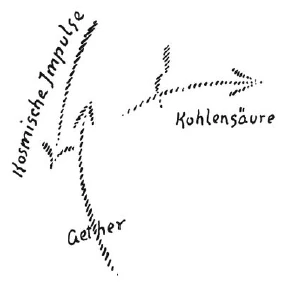
[ 12 ] Wenn wir den Stoffwechsel heraufverfolgen bis zum Atmen, so finden wir, daß der Mensch aus sich herausgestaltet den Kohlenstoff, der überall im Menschen zu finden ist. Er wird vom Sauerstoff aufgesucht, wird in Kohlensäure verwandelt, die dann der Mensch ausatmet. Die Kohlensäure ist die Verbindung des Kohlenstoffes mit dem Sauerstoff. Der Sauerstoff, der durch die Atmung eingesogen wird, macht sich über den Kohlenstoff her, nimmt den Kohlenstoff in sich auf; der Mensch atmet die Kohlensäure, die Verbindung, die der Sauerstoff mit dem Kohlenstoff eingegangen hat, aus. Aber bevor die Ausatmung geschieht, wird der Kohlenstoff sozusagen noch zum Wohltäter der menschlichen Natur. Denn dieser Kohlenstoff, indem er sich mit dem Sauerstoff verbindet, indem er gewissermaßen verbindet, was die Blutzirkulation bewirkt, mit dem, was die Atmung dann aus der Blutzirkulation macht, dieser Kohlenstoff, er wird zum Wohltäter der menschlichen Organisation; denn bevor er den menschlichen Organismus verläßt, verbreitet er in dem ganzen menschlichen Organismus eine Ausströmung von Äther. Die physische Wissenschaft sagt bloß: der Kohlenstoff wird mit der Kohlensäure ausgeatmet. Das ist aber nur die eine Seite des ganzen Vorganges. Der Mensch atmet die Kohlensäure aus, aber in seinem ganzen Organismus wird durch das Ausatmen zurückgelassen von dem Kohlenstoff, der in Anspruch genommen wird von dem Sauerstoff, Äther. Dieser Äther dringt in den Ätherleib des Menschen ein. Und dieser Äther, der immerzu von dem Kohlenstoff erzeugt wird, ist dasjenige, was nun die menschliche Organisation geeignet macht, sich den geistigen Einflüssen zu öffnen, was die astral-ätherischen Wirkungen aus dem Kosmos aufnimmt. Da werden von diesem Äther, den der Kohlenstoff zurückläßt, die kosmischen Impulse angezogen, jene kosmischen Impulse, die wiederum gestaltend auf den Menschen wirken, die zum Beispiel sein Nervensystem so bereiten, daß es der Träger der Gedanken werden kann. Dieser Äther muß fortwährend unsere Sinne, zum Beispiel unser Auge, durchdringen, damit die Augen sehen können, damit die Augen den äußeren Lichtäther aufnehmen können. Wir verdanken es also dem Kohlenstoff, daß wir eine Ätherbereitung in uns haben, die der Welt entgegenkommen kann.
[ 12 ] If we trace the metabolic process back to respiration, we find that the human being produces carbon—which is found throughout the body—from within. It is combined with oxygen and transformed into carbon dioxide, which the human being then exhales. Carbon dioxide is the compound of carbon and oxygen. The oxygen inhaled through breathing acts upon the carbon, absorbing it; the human being exhales carbon dioxide, the compound that oxygen has formed with carbon. But before exhalation occurs, the carbon, so to speak, still becomes a benefactor to human nature. For this carbon, by combining with oxygen—by, so to speak, linking what the blood circulation brings about with what respiration then does with the blood circulation—this carbon becomes a benefactor to the human organism; for before it leaves the human organism, it spreads an outflow of ether throughout the entire human organism. Physical science merely states: carbon is exhaled as carbon dioxide. But that is only one side of the entire process. The human being exhales carbon dioxide, but throughout their entire organism, the carbon—which is utilized by oxygen—leaves behind ether as a result of exhalation. This ether penetrates the human etheric body. And this ether, which is constantly produced by carbon, is what makes the human organism capable of opening itself to spiritual influences—it is what receives the astral-etheric effects from the cosmos. This ether, left behind by carbon, attracts the cosmic impulses—those cosmic impulses that in turn have a formative effect on the human being, preparing, for example, the nervous system so that it can become the carrier of thoughts. This ether must continually permeate our senses—for example, our eyes—so that the eyes can see, so that the eyes can receive the outer light ether. We therefore owe it to carbon that we possess within us an etheric preparation capable of responding to the world.
[ 13 ] Alles das wird schon im Stoffwechselsystem vorbereitet. Aber das Stoffwechselsystem ist als menschliches System in den ganzen Kosmos so hineingestellt, daß es für sich selbst nicht bestehen könnte. Das Stoffwechselsystem könnte nicht für sich selbst bestehen. Daher ist es auch erst als Drittes im Menschen gebildet worden in der Anlage. Die erste Anlage für das Nerven-Sinnessystem wurde gebildet während der alten Saturnzeit, die zweite Anlage für das rhythmische System während der alten Sonnenzeit, und erst, nachdem diese anderen Systeme da waren, konnte das Stoffwechselsystem im Menschen bewirkt werden, weil das Stoffwechselsystem für sich nicht bestehen könnte. Das Stoffwechselsystem ist, wenn wir zunächst die willkürlichen Bewegungen auslassen, im kosmischen Zusammenhang für den Menschen für die Ernährung berechnet. Aber diese Ernährung kann nicht für sich bestehen. Diese Ernährung braucht der Mensch, aber sie kann nicht für sich bestehen. Denn wenn man das Stoffwechselsystem beim Menschen für sich studiert — Sie werden in den nächsten Vorträgen sehen, wie notwendig das wiederum für die ganze menschliche Organisation ist —, so ist es fortwährend von allen möglichen Neigungen durchdrungen, den Menschen krank zu machen. Den Ursprung der inneren Krankheiten, die also nicht durch äußere Verletzungen entstehen, den müssen wir immer im Stoffwechselsystem suchen. Wer daher wirklich eine rationelle Krankheitsbeobachtung anstellen will, muß ausgehen vom Stoffwechselsystem, und er muß eigentlich jede einzelne Erscheinung im Stoffwechselsystem daraufhin fragen: Auf welchem Weg bist denn du? — Wenn wir alle Erscheinungen von dem Aufnehmen der Nahrung im Munde, von dem Verarbeiten der Nahrung, indem wir gewisse Stoffe in uns in Stärke und Zucker und so weiter verwandeln, wenn wir das Einhüllen der Speisen im Munde durch Ptyalin nehmen, wenn wir weitergehen, wenn wir das Einpepsinieren im Magen nehmen, wenn wir weitergehen und die Verarbeitung der Stoffwechselprodukte wiederum im Verdauungssystem nehmen, bei ihrem Übergang in die Lymphgefäße, bei ihrem Übergang ins Blut, dann müssen wir jeden einzelnen Vorgang suchen, und es sind unzählige Vorgänge, die da in Betracht kommen. Die Vermischung der Stoffwechselprodukte mit dem Sekret der Bauchspeicheldrüse, die dann noch hinzukommt, die Durchmischung der Stoffe mit der Gallenabsonderung und so weiter, jeden einzelnen Vorgang müssen wir fragen: Was willst denn du eigentlich? — Und er wird uns antworten: Wenn ich allein bin, so bin ich ein solcher Prozeß, der immer den Menschen krank macht. Kein Stoffwechselvorgang darf in der menschlichen Natur bis zu Ende kommen, denn jeder Stoffwechselvorgang, wenn er zu Ende kommt, macht den Menschen krank. Die menschliche Natur ist nur gesund, wenn die Stoffwechselvorgänge auf einer gewissen Stufe gestoppt werden.
[ 13 ] All of this is already prepared within the metabolic system. But the metabolic system, as a human system, is situated within the entire cosmos in such a way that it could not exist on its own. The metabolic system could not exist on its own. That is why it was formed as the third system in the human being. The first blueprint for the nervous-sensory system was formed during the ancient Saturn era, the second blueprint for the rhythmic system during the ancient Sun era, and only after these other systems were in place could the metabolic system be brought about in human beings, because the metabolic system could not exist on its own. If we set aside voluntary movements for the moment, the metabolic system is, in the cosmic context, designed for human nutrition. But this nutrition cannot exist on its own. Human beings need this nutrition, but it cannot exist on its own. For if one studies the metabolic system in human beings in isolation—you will see in the next lectures how essential it, in turn, is for the entire human organism—it is constantly permeated by all manner of tendencies to make people sick. We must always seek the origin of internal diseases—that is, those not caused by external injuries—in the metabolic system. Therefore, anyone who truly wishes to conduct a rational observation of disease must start with the metabolic system, and must essentially examine every single phenomenon within the metabolic system by asking: “What path are you following?” — If we consider all the processes—from the intake of food in the mouth, to the processing of food as we convert certain substances within us into starch, sugar, and so on; if we consider the coating of food in the mouth by ptyalin; if we proceed further to the action of pepsin in the stomach; if we proceed still further to the processing of metabolic products within the digestive system, as they pass into the lymphatic vessels, as they pass into the blood—then we must examine every single process, and there are countless processes to consider. The mixing of metabolic products with pancreatic secretions, which are then added, the mixing of substances with bile secretion, and so on—we must ask each individual process: What do you actually want? — And it will answer us: When I am alone, I am a process that always makes people sick. No metabolic process in human nature must be allowed to run its full course, for every metabolic process, when it runs its full course, makes a person sick. Human nature is healthy only when metabolic processes are halted at a certain stage.
[ 14 ] Wir werden dieses, was vielleicht zunächst als Torheit der Weltorganisation erscheinen könnte: daß da im Menschen etwas beginnt, was, wenn es nicht auf halbem Wege aufgehalten würde, den Menschen krank machen würde, wir werden das als etwas vom Weisesten in den nächsten Vorträgen kennenlernen. Aber jetzt wollen wir es einstweilen der Tatsächlichkeit nach betrachten, wollen in Betracht ziehen, daß uns die Einzelheiten der Stoffwechselvorgänge, wenn wir sie innerlich ihrem Wesen nach studieren, antworten würden: Wir sind auf dem Wege, den ganzen Organismus krank zu machen. Jeder Stoffwechselvorgang, fortgesetzt, macht den Organismus krank. Es müssen eben schon, wenn überhaupt Stoffwechsel im Menschen sein soll, andere Prozesse da sein, die vorher in ihren Anlagen entwickelt sein müssen, und das sind die Vorgänge, welche in der Zirkulation vorhanden sind; das sind die Zirkulationsvorgänge. Die Zirkulationsvorgänge enthalten fortwährend heilende Prozesse. So daß der Mensch tatsächlich auch so beschrieben werden kann, daß man sagt: Der Mensch ist während der alten Mondenentwickelung als Patient geboren worden, und ihm ist vorausgeschickt worden in seiner eigenen Natur während der alten Sonnenentwickelung der Arzt. Während der alten Sonnenentwickelung ist der Mensch in bezug auf seine eigene Natur als Arzt geboren worden. Es ist sehr vorsichtig gewesen in der Weltenentwickelung, daß der Arzt vor dem Patienten entstanden ist, denn während der alten Mondenentwickelung ist der Patient im Menschen selber dazugekommen. Man muß, wenn man den Menschen richtig beschreiben will, aufrücken von den Stoffwechselvorgängen zu den Zirkulationsvorgängen, natürlich zu alledem, was als Impulse den Zirkulationsvorgängen zugrunde liegt. Der eine Stoff bewirkt schnellere, der andere langsamere Zirkulation im weitesten Sinne. Wir haben ja auch ganz kleine Zirkulationsvorgänge in uns. Nehmen Sie irgendwelche mineralischen Stoffe, nehmen Sie Gold, nehmen Sie Kupfer, alles ist, wenn es dem Menschen auf die eine oder andere Weise innerlich oder durch Injektion oder sonst irgendwie zugeführt wird, die Veranlassung, daß irgend etwas in der Zirkulation sich gestaltet, ändert, gesundend wirkt und so weiter. Und was man kennen muß, um hineinzuschauen in die eigentlichen Heilungsprozesse des Menschen, das ist, was jeder einzelne Stoff der Weltumgebung des Menschen auslöst im Menschen in bezug auf Zirkulationsänderungen. So daß wir sagen können: die Zirkulation ist ein fortwährender Heilungsprozeß.
[ 14 ] We will come to recognize this—which might at first appear to be the folly of the world order: that something begins within the human being which, if it were not halted halfway, would make the person ill—we will come to recognize this as one of the wisest things in the upcoming lectures. But for now, let us consider it from a factual perspective; let us take into account that the details of metabolic processes, when we study them inwardly in terms of their essence, would tell us: We are on the path to making the entire organism sick. Any metabolic process, if continued, makes the organism sick. If there is to be any metabolism in the human being at all, there must simply be other processes present that must first be developed in their potential, and these are the processes that are present in the circulation; these are the circulatory processes. The circulatory processes continuously contain healing processes. So that the human being can indeed be described in such a way that one says: During the ancient lunar evolution, the human being was born as a patient, and the physician was sent ahead of him within his own nature during the ancient solar evolution. During the ancient solar evolution, the human being was born as a physician in relation to his own nature. It was a very prudent arrangement in the evolution of the world that the physician arose before the patient, for during the ancient lunar evolution, the patient came into being within the human being himself. If one wishes to describe human beings correctly, one must move from metabolic processes to circulatory processes—and, of course, to everything that underlies these circulatory processes as impulses. One substance causes faster circulation, another slower circulation, in the broadest sense. We also have very small circulatory processes within us. Take any mineral substances—take gold, take copper—everything, when introduced into the human body in one way or another—internally, by injection, or in any other way—triggers a process whereby something in the circulation takes shape, changes, has a healing effect, and so on. And what one must know in order to gain insight into the actual healing processes of the human being is what each individual substance from the human environment triggers within the person in terms of changes in circulation. So that we can say: circulation is a continuous healing process.
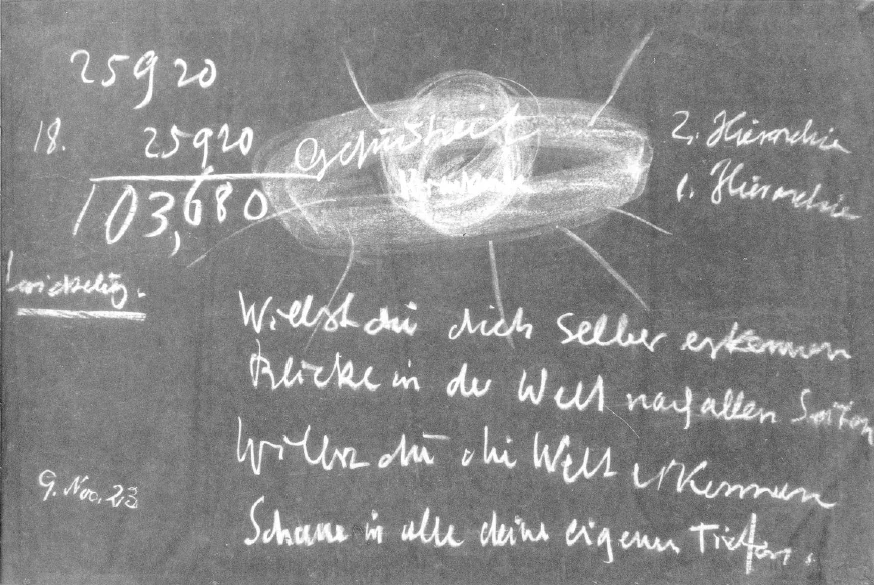
[ 15 ] Sie können es, ich möchte sagen, errechnen, wenn Sie es wollen. Bedenken Sie, was ich Ihnen gesagt habe: im Durchschnitt hat der Mensch achtzehn Atemzüge in der Minute. Das gibt in außerordentlich regelmäßiger Anpassung an den Kosmos während des Tages so viel Atemzüge, als der Zirkulationsrhythmus der Sonne beim Durchgehen durch das Sonnenjahr ausmacht. Da aber geht die Sonne in ihrem Frühlingsaufgangspunkt in 25920 Jahren durch das Ganze durch. Der Mensch hat in seinem mittleren Alter am Tage durchschnittlich 25 920 Atemzüge. Die Pulsschläge sind viermal mehr. Die andere Zirkulation, die mehr innerlich konzentrierte Zirkulation, ist beeinflußt von dem Stoffwechsel. Die Atmungszirkulation ist das, was dem äußeren Verkehre des Menschen mit der Außenwelt entspricht, was das Wechselverhältnis zur Außenwelt ist. Dieser Atmungsrhythmus muß fortwährend den Zirkulationsrhythmus bändigen, daß er bei seinen vieren bleibt, sonst kommt der Mensch mit seinem Zirkulationsrhythmus in einen ganz unregelmäßigen Rhythmus, nicht in die Zahl 103680 hinein. Das ist etwas, dem nichts im Kosmos entspricht. Da reißt sich der Mensch ganz aus dem Kosmos heraus. Sein Stoffwechsel reißt ihn aus dem Kosmos heraus, macht ihn fremd dem Kosmos, und der Atmungsrhythmus reißt fortwährend in den Kosmos hinein. In diesem Dividieren und in diesem Bändigen des Zirkulationsrhythmus durch den Atmungsrhythmus sehen Sie den Urheilungsprozeß, der fortwährend in dem Menschen ausgeführt wird. Aber in einer gewissen feineren Weise muß man mit jeder inneren Heilung dem Atmungsprozeß, der sich ja in einer gewissen Weise in den ganzen Körper hinein fortsetzt, so zu Hilfe kommen, daß er überall im Menschen den Zirkulationsprozeß bändigt, ihn zurückführt auf die allgemeinen Verhältnisse des Kosmos.
[ 15 ] You can, I would say, calculate it if you want to. Consider what I have told you: on average, a person takes eighteen breaths per minute. In an extraordinarily regular alignment with the cosmos throughout the day, this amounts to as many breaths as the sun’s cycle of circulation as it passes through the solar year. But the sun completes this entire cycle from its spring starting point in 25,920 years. A person in middle age takes an average of 25,920 breaths per day. The number of heartbeats is four times that. The other circulation—the more internally concentrated circulation—is influenced by metabolism. The respiratory circulation corresponds to a person’s external interaction with the outside world; it is the interrelationship with the outside world. This respiratory rhythm must constantly keep the circulatory rhythm in check so that it remains at its four beats; otherwise, a person’s circulatory rhythm falls into a completely irregular pattern, failing to align with the number 103,680. This is something to which nothing in the cosmos corresponds. In this way, the human being tears himself completely away from the cosmos. His metabolism tears him away from the cosmos, making him alien to the cosmos, while the respiratory rhythm continually draws him back into the cosmos. In this balancing and in this regulation of the circulatory rhythm by the respiratory rhythm, you see the primal healing process that is continually taking place within the human being. But in a certain more subtle way, with every inner healing, one must assist the respiratory process—which, after all, continues in a certain way throughout the entire body—in such a way that it regulates the circulatory process everywhere within the human being, bringing it back into harmony with the general conditions of the cosmos.
[ 16 ] So daß wir sagen können: Wir gehen von der Ernährung über in die Heilung, indem der Mensch von unten herauf immer eigentlich die Tendenz hat, krank zu werden, und in seinem mittleren Organismus, in dem Zirkulationsorganismus fortwährend die Tendenz entwickeln muß, gesund zu bleiben. Indem so in unserem mittleren Organismus fortwährend die Impulse der Gesundung entstehen, lassen sie etwas gerade nach dem Kopfnerven-Sinnessystem zurück; und wir kommen dann als Drittes zu dem Nerven-Sinnessystem. Was für Kräfte finden wir dann im Nerven-Sinnessystem? Wir finden im Nerven-Sinnessystem diejenigen Kräfte, die sozusagen der Arzt in uns zurückläßt. Er wirkt auf der einen Seite gesundend hinunter auf den Stoffwechselprozeß. Aber indem er gesundend auf den Stoffwechselprozeß wirkt, tut er ja etwas, was im ganzen Kosmos nun einer Beurteilung unterliegt. Und ich sage Ihnen nichts Phantastisches, sondern ich sage Ihnen etwas, was durchaus eine Realität ist: Es ruft dieser Vorgang, daß fortwährend in uns Gesundungsprozesse nach unten stattfinden, das Wohlgefallen der höheren Hierarchien hervor. Das ist die Freude der höheren Hierarchien an der Erdenwelt. Die schauen herunter und fühlen fortwährend das Aufsteigen der Krankheit aus demjenigen, was hinaufströmt in den Menschen vom Irdischen, was dableibt von den irdischen Eigenschaften der Stoffe. Sie sehen, wie die Impulse der aus dem Irdischen wirkenden Kräfte, die in der umkreisenden Luft und so weiter liegen, fortwährend Gesundungsprozesse sind. Das ruft das Wohlgefallen der höheren Hierarchien hervor.
[ 16 ] So we can say: We move from nutrition to healing, because the human being actually always has a tendency, from the bottom up, to become ill, and must continually develop the tendency to remain healthy in his middle organism—the circulatory system. As the impulses of healing continually arise in our middle organism, they leave something behind specifically for the cranial nerve-sensory system; and we then come, thirdly, to the nerve-sensory system. What kinds of forces do we find in the nerve-sensory system? In the nervous-sensory system, we find those forces that, so to speak, the “doctor” within us leaves behind. On the one hand, he exerts a healing influence downward on the metabolic process. But by exerting a healing influence on the metabolic process, he is doing something that is now subject to judgment throughout the cosmos. And I am not telling you something fantastical, but rather something that is very much a reality: this process—in which healing processes continually take place within us, flowing downward—evokes the delight of the higher hierarchies. This is the joy of the higher hierarchies in the earthly world. They look down and continually sense the rise of illness from that which flows upward into human beings from the earthly realm—that which remains of the earthly properties of matter. They see how the impulses of the forces acting from the earthly realm, which lie in the surrounding air and so on, are continually processes of healing. This evokes the delight of the higher hierarchies.
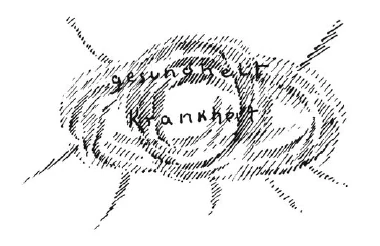
[ 17 ] Jetzt stellen Sie sich vor, was Sie studieren können an demjenigen Weltenkörper, der gewissermaßen als das würdigste geistige Studienobjekt an die Grenze unseres Planetensystems hingestellt worden ist. Da steht in der Mitte dasjenige, was in sich birgt die Kräfte, die, wenn wir sie auf Erden konzentriert denken, krankmachende Kräfte sind, und in der Umgebung zeigen sich die kreisenden Kräfte des Gesundmachens. Und wer für solche Sachen Empfänglichkeit hat, der sieht an den Saturnringen in einer solchen Ausprägung, wie man sie in dem, was die Erde umgibt, nicht wahrnehmen kann, weil man darinnen steht, das, was die kreisende Gesundheit ist. Dieser Saturnring ist noch etwas wesentlich anderes, als was die Astronomen von ihm sagen. Dieser Saturnring ist kreisende Gesundheit, und das Innere des Saturns ist das Kränkende, das Krankmachende, in reinster Konzentration gesehen.
[ 17 ] Now imagine what you can study in that celestial body which, in a sense, has been placed at the edge of our planetary system as the most worthy object of spiritual study. There, at the center, stands that which contains within itself the forces that—when we concentrate on them here on Earth—are disease-causing forces, while the surrounding area reveals the circling forces of healing. And anyone who is receptive to such things can see in the rings of Saturn—in a form that cannot be perceived in what surrounds the Earth, because we are immersed within it—what circulating health is. This ring of Saturn is something fundamentally different from what astronomers say about it. This ring of Saturn is circulating health, and the interior of Saturn is the ailing, the disease-causing force, seen in its purest concentration.
[ 18 ] Und so sieht man an dem Saturn, der an das äußerste Ende unseres Planetensystems hingestellt ist, den gleichen Prozeß sich abspielen, den wir fortwährend durch unseren Stoffwechsel und durch unseren Zirkulationsorganismus in uns tragen. Aber wir sehen auch, wenn wir auf das hinschauen, wie unser geistiger Blick hingelenkt wird auf die Welt namentlich der zweiten Hierarchie und der ersten Hierarchie; der zweiten Hierarchie: Kyriotetes, Dynamis, Exusiai; der ersten Hierarchie: Seraphim, Cherubim, Throne. Wenn wir aufmerksam sind mit dem geistigen Auge auf den Saturn und seinen Ring, werden wir hingelenkt auf diese oberen Hierarchien, wie sie, ich möchte sagen, wohlgefällig auf dieses Krankmachende und Gesundende hinblicken.
[ 18 ] And so, in Saturn—which is situated at the very outer edge of our planetary system—we see the same process unfolding that we constantly carry within ourselves through our metabolism and our circulatory system. But we also see, when we look at this, how our spiritual gaze is directed toward the world of, in particular, the second hierarchy and the first hierarchy; the second hierarchy: Kyriotetes, Dynamis, Exusiai; the first hierarchy: Seraphim, Cherubim, Thrones. If we observe Saturn and its ring attentively with the spiritual eye, we are drawn to these higher hierarchies, as they, I might say, look with benevolence upon that which causes illness and that which brings healing.
[ 19 ] Dieses Wohlgefallen, das ist nun eine Kraft im Weltenall. Dieses Wohlgefallen der höheren Hierarchien durchströmt dann unser Nerven-Sinnessystem und bildet darinnen die Kräfte der geistigen Entwickelung des Menschen. Das sind die Kräfte, die gewissermaßen hinausblühen aus der Heilung, die fortwährend im Menschen vor sich geht. So daß wir drittens die geistige Entwickelung haben.
[ 19 ] This delight is, in fact, a force in the universe. This delight of the higher hierarchies then flows through our nervous and sensory system and forms within it the forces of human spiritual development. These are the forces that, so to speak, blossom forth from the healing that is continually taking place within the human being. Thus, thirdly, we have spiritual development.
1. Stoffwechsel Ernährung
2. Zirkulation Heilung
3. Nerven-Sinnesorganisation Geistige Entwickelung
1. Metabolism and Nutrition
2. Circulation and Healing
3. Nervous and Sensory Systems, Mental Development
[ 20 ] Wenn wir jetzt den Menschen durch Saturn-, Sonnen- und Mondenzeit beschreiben, dann müssen wir sagen: Der Mensch ist zunächst aus dem Kosmos herausgeborener Geist, der in sich den Heiler entwickelt, der dadurch dann aufnehmen kann den kosmischen Patienten. Und durch die Zusammenwirkung von all diesem wird dann das hergestellt, was auf der Erde der in willkürlicher Bewegung befindliche Mensch ist.
[ 20 ] If we now describe the human being in terms of the Saturn, Sun, and Moon eras, we must say: The human being is, first and foremost, a spirit born from the cosmos who develops within himself the healer, who can thereby receive the cosmic patient. And through the interplay of all these factors, what is created is the human being on Earth who is in a state of arbitrary movement.
[ 21 ] Jedes einzelne Glied der Menschenerkenntnis muß, ich möchte sagen, in einer gewissen Weise inspiriert sein von demjenigen, was zugrunde liegt dem, was ich hier gesagt habe. Nehmen Sie an, es will jemand ein System der Heilkunde aufstellen, ein wirklich rationelles System der Heilkunde. Was wird denn das enthalten müssen? Natürlich in der Hauptsache die Heilungsprozesse. Aber die Heilungsprozesse, wovon werden die denn ausgehen müssen? Sie werden ausgehen müssen von den Stoffwechselvorgängen, und das andere kann höchstens Voraussetzung sein, wir werden darüber auch noch zu sprechen haben; das Anatomische, selbst das feiner Anatomische, das kann nur, weil es das Festgestaltete ist, der Ausgangspunkt sein. Das macht sich schon selbst menschlich. Aber die Stoffwechselvorgänge müssen zunächst von einem rationellen System der Medizin so studiert werden, daß man in ihnen immer die Tendenz wahrnimmt, wie sie zum Krankmachenden hingehen. So daß ein heutiges System der Medizin, das aufgestellt werden kann, durchaus mit dem Stoffwechselsystem, das heißt, zunächst mit den normalen Stoffwechselvorgängen zu beginnen hat, und daß von da aus geschöpft werden muß die Erkenntnis der Möglichkeit, wie nun innere Krankheiten aus dem Stoffwechsel heraus im weitesten Sinne entstehen können. Dann muß sich daraus durch eine intime Erkenntnis dessen, was die rhythmischen Prozesse machen, das ergeben, was die eigentliche Therapie ist. So daß bei einem heutigen System der Medizin begonnen werden muß mit dem Studium der Stoffwechselvorgänge, und dann von da aus der Übergang gemacht werden muß zu alldem, was im Bereich der rhythmischen Vorgänge im Menschen vorkommen kann. Und dann, möchte ich sagen, wird eine Art von Krönung des Ganzen erreicht werden, indem man zeigt, wie ein gesundes Entwickeln der geistigen Anlagen des Menschen voraussetzt die Erkenntnis desjenigen, was aus den heilenden Kräften kommt. Sie können heute gar keine Pädagogik, das heißt, keine Kunst der gesunden Entwickelung der Geistesnatur des Menschen finden, wenn Sie nicht ausgehen von den Heilungsprozessen; denn die Heilungsprozesse sind nichts anderes, als auf die Mittelnatur des Menschen das angewendet, was schon im reinen Denken verwendet werden muß bei der Ausbildung der geistigen Vorgänge des Menschen.
[ 21 ] Every single aspect of human knowledge must, I would say, be inspired in a certain way by what underlies what I have said here. Suppose someone wants to establish a system of medicine—a truly rational system of medicine. What will that have to include? Of course, primarily the healing processes. But what must these healing processes be based on? They must be based on metabolic processes, and everything else can at most be a prerequisite—we will have to discuss this further; anatomy, even the most detailed anatomy, can only serve as the starting point because it represents the solidified form. That is already evident in itself. But metabolic processes must first be studied by a rational system of medicine in such a way that one always perceives in them the tendency toward what causes disease. Thus, a modern system of medicine that can be established must certainly begin with the metabolic system—that is, first with normal metabolic processes—and from there we must derive an understanding of how internal diseases can arise from metabolism in the broadest sense. Then, through an intimate understanding of what the rhythmic processes do, the actual therapy must emerge from this. Thus, in a modern system of medicine, one must begin with the study of metabolic processes, and from there make the transition to everything that can occur in the realm of rhythmic processes in the human being. And then, I would say, a kind of culmination of the whole will be achieved by demonstrating how the healthy development of a person’s spiritual faculties presupposes an understanding of that which arises from the healing forces. Today, you cannot find any pedagogy—that is, any art of the healthy development of the human spiritual nature—unless you start from the healing processes; for the healing processes are nothing other than the application to the human physical nature of what must already be employed in pure thinking for the development of human spiritual processes.
[ 22 ] Der pädagogische Künstler muß auf geistige Art durchaus arbeiten mit den Kräften, die, ins Physische verdichtet, oder ins Ätherische verdichtet, Heilungsvorgänge sind. Tue ich irgend etwas an einem Kinde in pädagogischer Kunst, so ist das ein Vorgang, dem etwas Geistiges zugrunde liegt. Wenn ich mir diesen Vorgang übersetze, so daß ich das, was ich da im Geiste ausführe, jetzt dadurch ausführe, daß ich irgendein Stoffliches oder einen Prozeß anwende, so ist dieser Prozeß oder dieser Stoff ein Heilmittel. Man könnte auch sagen: Medizin ist die Metamorphosierung der geistigen Behandlung des Menschen hinunter ins Stoffliche. Wenn Sie sich erinnern, wie ich die Dinge angedeutet habe in dem Lehrerkursus, der dazumal für die englischen Besucher abgehalten wurde, so werden Sie sehen, wie ich überall darauf aufmerksam gemacht habe, wie in dem, was der Lehrer tut, mit einer Art allgemeiner menschlicher Therapie begonnen wird, wie diese oder jene pädagogische Maßnahme im späteren Lebensalter ungesunde Stoffwechselablagerungen oder Aufsaugen des unregelmäßigen Stoffwechsels verursachen kann. So daß das, was der Pädagoge tut, nach unten fortgesetzt, Therapie gibt. Und das Gegenbild der Therapie, das, was von unten nach oben strebt, das sind die Stoffwechselvorgänge.
[ 22 ] The educational artist must work in a spiritual way with the forces that, when condensed into the physical or into the etheric, are healing processes. When I do something for a child through the art of education, it is a process based on something spiritual. When I translate this process—so that what I am doing in the spirit, I now carry out by applying some material substance or process—then this process or substance is a remedy. One could also say: Medicine is the metamorphosis of the spiritual treatment of the human being down into the material realm. If you recall how I alluded to these things in the teachers’ course that was held at that time for the English visitors, you will see how I drew attention to this throughout—how what the teacher does begins with a kind of general human therapy, and how this or that pedagogical measure can, later in life, cause unhealthy metabolic deposits or the absorption of irregular metabolic processes. So that what the educator does, when continued downward, provides therapy. And the counterpart to therapy—that which strives from the bottom upward—is the metabolic processes.
[ 23 ] Sie sehen also auch, wie ein System der Medizin heute herausgeboren werden muß aus einer gesamten Menschenerkenntnis. Das kann es. Das fühlen manche. Aber etwas erreicht wird erst sein, wenn tatsächlich ein solches System der Medizin ausgebildet ist. Und es gehört in der Gegenwart schon zu dem Notwendigsten. Wenn Sie heute Handbücher der Heilkunde ansehen, so werden Sie sehen, daß in der Regel nicht mit dem Stoffwechselsystem oder wenigstens in den seltensten Fällen mit dem Stoffwechsel begonnen wird. Aber davon muß ausgegangen werden, sonst lernt man nicht erkennen, worin überhaupt die Natur der Krankheit besteht.
[ 23 ] So you can see, too, how a system of medicine today must emerge from a comprehensive understanding of the human being. It is possible. Some people sense this. But nothing will have been achieved until such a system of medicine has actually been developed. And in the present day, this is already among the most essential needs. If you look at medical textbooks today, you will see that, as a rule, they do not begin with the metabolic system—or at least do so only in the rarest of cases. But this must be the starting point; otherwise, one cannot learn to recognize what the very nature of disease consists of.
[ 24 ] Sehen Sie, diese ganze Sache ist wiederum so, daß tatsächlich Ernährungsvorgänge in Heilungsvorgänge, Heilungsvorgänge in geistige Vorgänge und wieder zurück geistige Vorgänge in Heilungsvorgänge übergehen können; oder wenn die geistigen Vorgänge direkt Stoffwechselstörungen bewirken, so gehen geistige Vorgänge auch wiederum in ein Stadium über, wo sie durch den mittleren Organismus des Menschen geheilt werden müssen. Alle diese Dinge gehen im Menschen ineinander über, und die ganze menschliche Organisation ist fortwährend eine wunderbare Metamorphose. Nehmen Sie zum Beispiel die Vorgänge, die in dieser ganzen wunderbaren Zirkulation des menschlichen Blutes liegen. Was sind denn das für Vorgänge?
[ 24 ] You see, this whole matter is such that nutritional processes can indeed transition into healing processes, healing processes into mental processes, and mental processes back into healing processes; or if mental processes directly cause metabolic disorders, then mental processes also transition into a stage where they must be healed by the human organism as a whole. All these things merge into one another within the human being, and the entire human organism is a continuous, wondrous metamorphosis. Take, for example, the processes involved in this entire wondrous circulation of human blood. What kind of processes are these?
[ 25 ] Nun, fassen Sie zunächst ganz abgesondert vom übrigen menschlichen Organismus das Blut auf, wie es durch die Adern strömt, fassen Sie auf die menschliche Gestalt, also sagen wir, das Adernsystem und das, was als Muskelsystem sich anschließt, Knochensystem und so weiter, also das, was feste Bildung ist, und das, was flüssig da durchströmt. Bleiben wir beim flüssigen Zustand, beim Blute, stehen; es sind ja auch andere Flüssigkeiten da, aber bleiben wir beim Blute stehen. In diesem strömenden Flüssigen, was geschehen denn da drinnen fortwährend für Prozesse? Es spielen sich fortwährend Prozesse ab. Dieselben Prozesse, die sich abspielen im flüssigen Blut, die können nun nach irgendwelchen Seiten hin das, was nur Wandung oder Gerüst oder irgend etwas Festgebildetes, Gestaltetes im Menschen sein kann, ergreifen, dann ist das, was ins Blut hineingehört, in der Gefäßwandung oder im Muskel oder irgendwo im Knochen drinnen oder in irgendeinem Umhüllungsorgan. Was wird es denn da? Da wird es der Impuls für Entzündungserscheinungen. Was wir als die Impulse von Entzündungserscheinungen da oder dort finden, wir finden es fortwährend im flüssigen Blute als die normalen Vorgänge. Was da an Entzündung erscheint, das sind an unrechte Stellen, das heißt, an die gestalteten festen Stellen hingedrängte Vorgänge, die fortwährend im fließenden Blute stattfinden müssen. Ein absolut normaler, gesunder Prozeß disloziert, an eine andere Stelle gestellt, wo er nicht hingehört, ist ein krankmachender Prozeß. Und gewisse Krankheiten des Nervensystems bestehen gerade darin, daß das Nervensystem, das polarisch entgegengesetzt ist in seiner ganzen Organisation dem Blutsystem, die Einwanderung der im Blute normalen Prozesse erfahren muß. Wenn diese Prozesse, die in den Blutbahnen normale Prozesse sind, sich hinüberdrängen in die Nervenbahnen, dann werden die Nervenbahnen, und das geschieht beim leisesten Eindringen, von Entzündungen ergriffen, die ganz im Anfange der Entzündlichkeit stehen, und wir bekommen die verschiedenen Formen des kranken Nervensystems heraus.
[ 25 ] Now, first of all, consider the blood—as it flows through the veins—completely apart from the rest of the human organism; consider the human form—that is, the venous system and what is connected to it as the muscular system, the skeletal system, and so on—in other words, what constitutes the solid structure, and what flows through it as a liquid. Let’s focus on the liquid state—the blood; there are, of course, other fluids as well, but let’s focus on the blood. In this flowing liquid, what processes are constantly taking place inside it? Processes are constantly unfolding. These same processes that take place in the liquid blood can now affect, in various ways, whatever in the human being consists solely of walls, a framework, or any solid, structured formation—whether in the blood vessel walls, the muscles, somewhere inside the bones, or in any enveloping organ. What happens there? There it becomes the impulse for inflammatory phenomena. What we find here and there as the impulses of inflammatory phenomena, we find continually in the liquid blood as normal processes. What appears there as inflammation consists of processes that have been forced into the wrong places—that is, into the solid, structured parts of the body—processes that must continually take place in the flowing blood. An absolutely normal, healthy process, when displaced to another location where it does not belong, becomes a disease-causing process. And certain diseases of the nervous system consist precisely in the fact that the nervous system—which is polar opposites to the blood system in its entire organization—must endure the intrusion of processes that are normal in the blood. When these processes—which are normal in the bloodstream—spill over into the nerve pathways, the nerve pathways—even at the slightest intrusion—become seized by inflammation that is in its very earliest stages, and we end up with the various forms of nervous system disorders.
[ 26 ] Ich sagte, in den Nerven sind ganz andere Vorgänge als im Blute, die entgegengesetzten Vorgänge. Im Blut sind nach dem Phosphorigen hindrängende Vorgänge, Vorgänge, die eben, wenn sie als phosphorige Vorgänge das das Blut Umgebende oder das dem Blute Benachbarte ergreifen, zu Entzündlichem führen. Wenn Sie die Vorgänge in den Nervenbahnen verfolgen und diese auswandern in die anderen benachbarten Organe oder auch ins Blut hinein, dann entstehen die Impulse für alle Geschwulstbildungen beim Menschen. Wenn das ins Blut hinübergetragen wird, so daß das Blut dann in ungesunder Weise die anderen Organe versorgt, dann entstehen die Geschwulstbildungen. So daß wir sagen können: Jede Geschwulstbildung ist ein metamorphosierter Nervenprozeß an unrechter Stelle im menschlichen Organismus.
[ 26 ] I said that the processes occurring in the nerves are entirely different from those in the blood—in fact, they are opposite processes. In the blood, there are processes that drive toward phosphorigenesis—processes which, when they affect the environment surrounding the blood or the tissues adjacent to it as phosphorigenic processes, lead to inflammation. If you trace the processes in the nerve pathways and observe how they migrate into other neighboring organs or even into the blood, then the impulses for all tumor formations in humans arise. When this is carried over into the blood, so that the blood then supplies the other organs in an unhealthy manner, neoplasms arise. Thus, we can say: Every neoplasm is a metamorphosed nervous process in the wrong place within the human organism.
[ 27 ] Sie sehen, was im Nerv läuft, muß im Nerv bleiben, was im Blute läuft, muß im Blute bleiben. Geht, was dem Blute angehört, hinüber in die Nachbarschaft, entstehen Entzündungen. Geht, was dem Nerv angehört, hinüber in die Nachbarschaft, so entstehen allerlei Bildungen, die man nur unter dem Trivialnamen Geschwulstbildung zusammenfassen kann. Aber es muß gerade zwischen den Vorgängen im Nervensystem und zwischen den Vorgängen im Blutsystem ein richtiger Rhythmus stattfinden.
[ 27 ] You see, what flows through the nerve must remain in the nerve; what flows through the blood must remain in the blood. If what belongs to the blood spills over into the surrounding area, inflammation occurs. If what belongs to the nerve spills over into the surrounding area, all sorts of growths arise that can only be summarized under the generic term “tumor formation.” But there must be a proper rhythm precisely between the processes in the nervous system and those in the circulatory system.
[ 28 ] Wir haben nicht nur im allgemeinen den Atmungsrhythmus in Kontrast mit dem Blutrhythmus, sondern wir haben im zirkulierenden Blute feine Vorgänge, die, wenn sie aus dem Blute herausgehen, Entzündungsvorgänge werden. Diese feinen Vorgänge müssen ebenso in einem gewissen rhythmischen Zusammenhange stehen mit dem, was im benachbarten Nerv vorgeht, wie die Atmung in einem Zusammenhange stehen muß mit der Blutzirkulation. Und in dem Augenblicke, wo das gestört ist zwischen dem Blutrhythmus und Nervenrhythmus, muß es wiederum hergestellt werden.
[ 28 ] Not only do we generally have the respiratory rhythm in contrast to the blood rhythm, but we also have subtle processes in the circulating blood that, when they emerge from the blood, become inflammatory processes. These subtle processes must be in a certain rhythmic relationship with what is happening in the adjacent nerve, just as respiration must be in a relationship with blood circulation. And the moment this relationship between the blood rhythm and the nerve rhythm is disrupted, it must be restored.
[ 29 ] Sie sehen, da kommen wir wieder hinein in ein Gebiet der Therapie, der Heilungsprozesse. Das alles zeigt Ihnen, wie im Menschen alles da sein muß: das am meisten Kranke muß da sein, damit es an anderer Stelle ein Gesundes sein kann; es ist nur durch einen unrechten Prozeß an eine falsche Stelle gekommen. Denn wäre es gar nicht da, könnte der Mensch nicht bestehen. Der Mensch könnte nicht bestehen, wenn er nicht Entzündungen kriegen könnte, denn die Entzündung erregenden Kräfte müssen fortwährend im Blute sein. So ist es gedacht gewesen, wenn ich oftmals gesagt habe: aus einer wirklichen Menschenerkenntnis heraus muß alles entstehen, was der Mensch eigentlich an Erkenntnis erwirbt. Sie sehen da, worin die Gründe liegen, warum eigentlich eine Pädagogik, ich möchte sagen, so obenauf, abstrakt getrieben, ein ziemlicher Unsinn ist. Eigentlich müßte man Pädagogik so treiben, daß man überall ausgeht von gewissen pathologischen Prozessen im Menschen und von der Möglichkeit ihrer Heilung.
[ 29 ] You see, this brings us back to the realm of therapy and healing processes. All of this shows you how everything must be present within a person: the most diseased part must be there so that there can be a healthy part elsewhere; it has simply ended up in the wrong place due to an improper process. For if it were not there at all, the human being could not survive. The human being could not survive if he could not develop inflammation, for the forces that induce inflammation must be constantly present in the blood. This is what I have meant when I have often said: everything that a human being actually acquires in terms of knowledge must arise from a genuine understanding of the human being. You can see here the reasons why a pedagogy—I would say—pursued in such a detached, abstract manner is, in fact, quite nonsensical. Actually, pedagogy should be pursued in such a way that one always proceeds from certain pathological processes in human beings and from the possibility of their healing.
[ 30 ] Wenn man eine Gehirnkrankheit und die Möglichkeit der Heilung der Gehirnkrankheit kennt, dann hat man im Groben - das ist wieder nach anderer Art fein, selbstverständlich, aber in bezug darauf, daß es ein physischer Vorgang ist, sage ich «grob» — in der Behandlung des Gehirns das, was genau just ausgeführt werden muß in der pädagogischen Kunst. Daher ist es so, daß eigentlich, wenn man einmal ein wirkliches pädagogisches Seminar einrichtet, man auf der einen Seite den Lehrern Pathologisch-Therapeutisches beibringen müßte: da würden sie ihr Denken schulen erst an Anschaulicherem, weil mehr im Stoffe Wurzelndem, für das, was sie nun begreifen sollen in der eigentlichen Pädagogik. Und wiederum ist nichts nützlicher für die Therapie, namentlich für die Therapie der inneren Krankheiten, als wenn man weiß, wie das oder jenes in der pädagogischen Kunstbehandlung wirkt. Denn findet man die Brücke hinüber zum Stofflichen, so findet man gerade an der Art und Weise, wie man im Pädagogischen behandeln soll, auch das Heilmittel.
[ 30 ] If one is familiar with a brain disorder and the possibility of curing it, then one has, in broad terms—which is, of course, subtle in a different way, but in reference to the fact that it is a physical process, I say “broad”—in the treatment of the brain, precisely what must be carried out in the art of education. That is why, in fact, once a genuine pedagogical seminar is established, one would have to teach teachers pathological-therapeutic principles on the one hand: there they would train their thinking first on more concrete examples—because these are more deeply rooted in the subject matter—in preparation for what they are now to grasp in pedagogy proper. And, in turn, nothing is more useful for therapy—particularly for the treatment of internal diseases—than knowing how this or that element works in the therapeutic application of pedagogy. For when one finds the bridge to the material realm, it is precisely in the manner in which one should treat students that one also finds the remedy.
[ 31 ] Wenn man zum Beispiel die richtigen pädagogischen Mittel findet, um gewissen Trägheitserscheinungen bei Kindern pädagogisch zu begegnen, die von Störungen im Verdauungssystem herrühren, dann bekommt man ganz merkwürdige innere Tendenzen; wenn man so wirklich drinnen lebt in der Pädagogik, natürlich nicht, wenn man so äußerlich lernt und eigentlich lieber, wenn die Schule aus ist, am Abend im «Gemeindestübel» sitzt und vergißt, was in der Schule vorgeht. Man bekommt von der Behandlungsweise, die man da angedeihen läßt einem solchen Kinde, die Tendenz, das ganze Wirken der Kopfvorgänge, den ganzen Zusammenhang der Kopfvorgänge und der Unterleibsvorgänge, ich möchte sagen, zu sehen. Und wenn man dann wiederum in der Mineralogie studiert zum Beispiel die Vorgänge, die in dem Kupfer vor sich gehen, indem das Kupfer im Erdreich dies oder jenes bildet: dann ist es fast so, daß in alledem, was das Kupfer ausführt, indem es zu dem oder jenem Kupfererze wird, daß in diesem Werden der Erze zu dem Kupfererz oder zu den anderen Erzen es einem dann so erscheint, daß man sagt: Da tut ja die Kupferkraft in der Erde dasjenige, was du als Pädagoge mit dem Knaben oder dem Mädchen tust! Man sieht förmlich ein Abbild von dem, was man selber tut, in den Kupferprozessen. Und es ist außerordentlich reizvoll, als Pädagoge sich eine intuitive, eine gefühls- und instinktmäßige Klarheit zu verschaffen über das, was man tut, um dann entzückt in die Natur hinauszugehen und zu sehen, wie eigentlich da draußen die Natur im Großen pädagogisch handelt; wie überall dort, wo durch irgendeinen Kalkprozeß etwas Schlimmes geschehen könnte, irgendwie ein Kupferprozeß da hineingefügt wird. Ja, in diesen Kupferprozessen, in diesen Erzbildungsprozessen innerhalb der übrigen Erdenprozesse liegen auch fortwährende Heilungen. Und es ist entzückend, wenn man irgendwo Pyriterze oder irgend etwas anderes findet, nun sich zu sagen: Das ist gerade so, wie wenn man in der richtigen Weise Menschen behandelt. Da behandeln die Geister der Natur von den Hierarchien herunter bis zu jenen Elementargeistern, von denen ich Ihnen gesprochen habe, als Heiler das, was auch eben im Leben als störende, krankmachende Prozesse auftreten könnte. Es ist eigentlich dann schon gar nicht mehr etwas anderes als ein Ablesen. Denn wenn man sieht, was da draußen geschieht, wenn man dann diesen oder jenen Stoff als Heilmittel anspricht oder ihn verarbeitet als Heilmittel, dann stellt man sich einfach hin und frägt sich: Wo erscheint das Eisen? Wo erscheint dieses oder jenes Metall in den Adern? studiert dann die Umgebung, und man findet dann immer, wenn irgendein Metallisches da oder dort erscheint in dieser oder jener Verarbeitung von der Natur: da drinnen ist ein Heilungsprozeß; nimm ihn nut, setze ihn fort, hinein in den menschlichen Organismus, dann schaffst du eine Therapie, die dir die Natur draußen vorgezeigt hat.
[ 31 ] For example, if one finds the right pedagogical methods to address certain signs of lethargy in children that stem from digestive system disorders, one develops some very peculiar inner tendencies; if one truly lives and breathes pedagogy—not, of course, if one merely learns it superficially and actually prefers, once school is out, to sit in the “community parlor” in the evening and forget what goes on at school. From the way one treats such a child, one develops a tendency to, I might say, see the entire workings of the mental processes, the entire interconnection between mental processes and abdominal processes. And when one then studies, for example, in mineralogy the processes taking place in copper—as the copper in the earth forms this or that—it is almost as if, in everything the copper does as it becomes this or that copper ore, in this process of the ores becoming copper ore or other ores, it then appears to one that one might say: “The power of copper in the earth is doing exactly what you, as an educator, do with the boy or the girl!” One literally sees a reflection of what one does oneself in the processes of copper. And it is extraordinarily fascinating, as a teacher, to gain an intuitive, emotional, and instinctive clarity about what one does, and then to go out into nature with delight and see how nature itself actually acts pedagogically on a grand scale; how, wherever something harmful might occur due to some calcification process, a copper process is somehow interwoven into it. Yes, in these copper processes, in these ore-formation processes within the broader earthly processes, there are also ongoing healing processes. And it is delightful when, upon finding pyrite ores or something else somewhere, one says to oneself: This is exactly like treating people in the right way. There, the spirits of nature—from the hierarchies down to those elemental spirits of which I have spoken to you—act as healers, addressing what might otherwise arise in life as disruptive, disease-causing processes. It is really nothing more than a form of observation. For when one sees what is happening out there, when one then uses this or that substance as a remedy or processes it as a remedy, one simply stands there and asks oneself: Where does iron appear? Where does this or that metal appear in the veins?” You then study the surroundings, and you always find that whenever any metallic element appears here or there in this or that form as processed by nature: there is a healing process taking place there; make use of it, carry it forward into the human organism, and you will create a therapy that nature has demonstrated to you out there.
[ 32 ] Ja, alles Gehen durch die Welt ist in Wirklichkeit ein richtiges Studieren des Ernährenden, des Heilenden, des Geistigen; denn in der Natur wird fortwährend krank gemacht und fortwährend geheilt. Da draußen sind sie, die großen kosmischen Heilungsprozesse. Wir müssen sie nur anwenden auf den Menschen. Das ist das wunderbare Zusammenwirken des Makrokosmos mit dem Mikrokosmos. Es ist in der Tat tief wahr, was ich zu manchen von Ihnen in dieser oder jener Form gesagt habe:
[ 32 ] Yes, every journey through the world is, in reality, a true study of what nourishes, what heals, and what is spiritual; for in nature, illness is constantly being caused and constantly being healed. Out there they are—the great cosmic healing processes. We need only apply them to human beings. This is the marvelous interaction of the macrocosm with the microcosm. It is indeed profoundly true what I have said to some of you in one form or another:
Willst du dich selber erkennen,
Blicke in der Welt nach allen Seiten.
Willst du die Welt erkennen,
Schaue in alle deine eigenen Tiefen.
If you want to know yourself,
Look in all directions throughout the world.
If you want to know the world,
Look into all the depths of your own being.
[ 33 ] Das können Sie aber auf alles anwenden: Willst du den Menschen heilen, blicke in die Welt nach allen Seiten, blicke hin darauf, wie die Welt nach allen Seiten Heilung entwickelt. Willst du die Geheimnisse der Welt als Krankheits- und Heilungsprozesse erkennen, so blickeinalle die Tiefen der menschlichen Natur hinunter. - Sie können das auf alles anwenden, was Menschenwesen ist. Aber Sie müssen den Blick hinausrichten auf die große Natur und den Menschen in lebendigem Zusammenhang sehen mit dieser großen Natur.
[ 33 ] But you can apply this to everything: If you want to heal people, look out into the world in all directions; observe how the world brings about healing in every way. If you want to recognize the mysteries of the world as processes of illness and healing, then look deep into all the depths of human nature. - You can apply this to everything that is human. But you must turn your gaze outward toward the great natural world and see human beings in a living connection with this great natural world.
[ 34 ] Man hat sich heute etwas anderes angewöhnt. Man geht weg von der Natur, so weit als möglich; man macht etwas, was einem selbst den Blick von der Natur abschließt, denn das, was man untersuchen will, das legt man unter ein Glas da unten auf ein kleines Tischchen; das Auge, das blickt nicht hinaus in die Natur, sondern blickt da hinein. Selbst der Blick noch ist abgeschnürt von der Natur. Man nennt das ein Mikroskop. Man könnte es ebensogut in einer gewissen Beziehung ein Nulloskop nennen, denn man schließt sich ab von der großen Natur. Und man weiß nicht, wenn man da unten das vergrößert hat, daß man in der Tat für die geistige Erkenntnis dasselbe hat, was geschehen würde, wenn der Vorgang in der Natur sich abspielte. Denken Sie doch nur einmal, wenn Sie irgendein kleines winziges Dingchen vom Menschen da drinnen vergrößern, damit Sie es beobachten können, so vollführen Sie ja mit diesem Winzigen des Menschen dasselbe, was Sie mit dem Menschen vollführen würden, wenn Sie ihn so weit auseinanderzerren und -reißen würden! Sie wären etwas viel Schrecklicheres noch als der Prokrustes, wenn Sie den Menschen so auseinanderzerren und -reißen würden, damit er so vergrößert ist, wie da dieses winzige Dingchen da unten unter dem Rohr vergrößert ist. Aber glauben Sie, daß Sie da den Menschen noch hätten? Es ist natürlich keine Rede davon, daß Sie den Menschen noch hätten. Ebensowenig haben Sie die Wahrheit da unten unter dem Mikroskop. Die vergrößerte Wahrheit ist nicht mehr die Wahrheit, ist ein Scheingebilde. Man darf nicht weggehen von der Natur und sich selbst noch den Blick einsperren. Gewiß, das alles kann für andere Dinge nützlich sein, aber für das, was eine wirkliche Menschenerkenntnis ist, ist es zunächst etwas, was ungeheuer von dieser wirklichen Menschenerkenntnis hinwegführt.
[ 34 ] People have gotten used to something different these days. People distance themselves from nature as much as possible; they do something that blocks their own view of nature, for what they wish to examine, they place under a glass down there on a small table; the eye does not look out into nature, but looks into it. Even the gaze itself is cut off from nature. This is called a microscope. In a certain sense, one might just as well call it a “nulloscope,” for one cuts oneself off from the great natural world. And when one has magnified something down there, one does not know whether, in terms of spiritual understanding, one is actually experiencing the same thing that would happen if the process were taking place in nature. Just think about it for a moment: when you magnify some tiny little thing from a human being in there so that you can observe it, you are doing to this tiny part of the human being exactly what you would do to the human being if you were to stretch and tear him apart to that extent! You would be even more terrible than Procrustes if you were to stretch and tear a human being apart like that, so that he is magnified just as that tiny little thing down there under the tube is magnified. But do you believe that you would still have a human being there? Of course, there’s no question that you’d still have a human being. Nor do you have the truth down there under the microscope. The magnified truth is no longer the truth; it is an illusion. One must not stray from nature and imprison one’s own vision. Certainly, all of this can be useful for other things, but as far as true understanding of humanity is concerned, it is, first and foremost, something that leads one far away from that true understanding of humanity.
[ 35 ] Die wirkliche Menschenerkenntnis muß so gesucht werden, wie wir es angedeutet haben. Sie muß führen von den Ernährungsvorgängen durch die Heilungsvorgänge zu den Vorgängen der Menschen- und Weltpädagogik im weitesten Sinne, wir können sagen, von der Ernährung durch die Heilung zu der Zivilisation und Kultur. Denn es ist alles wie eine untere Grundlage der physischen Vorgänge, die im Menschen in der Ernährung konzentriert sind; der Heilungsvorgänge, die aus dem, was immer umkreist, hervorgehen, was im Menschen in den rhythmischen Vorgängen konzentriert ist; und desjenigen, was von oben kommt, was im Menschen durch die Nerven-Sinnesprozesse konzentriert ist. Dreistufig richtet sich so die Welt auf.
[ 35 ] True understanding of humanity must be sought in the way we have indicated. It must lead from the processes of nutrition, through the processes of healing, to the processes of human and world education in the broadest sense—we might say, from nutrition through healing to civilization and culture. For it is all like a lower foundation of the physical processes concentrated in the human being in nutrition; the healing processes that arise from what constantly revolves around us, concentrated in the human being in the rhythmic processes; and that which comes from above, concentrated in the human being through the nervous-sensory processes. Thus the world is structured in three stages.
[ 36 ] Das wollte ich Ihnen zunächst als eine Art Grundlage geben. Wir wollen dann darauf weiter aufbauen. Wir wollen sehen, wie wir wirklich von solchen Ausgangspunkten hinaufkommen können in etwas, was sozusagen die Handhabung der Sache im praktischen Leben ist und was dann übergeführt werden kann zu dem, was Hierarchienerkenntnis ist.
[ 36 ] I wanted to give you that first as a kind of foundation. We will then build on that. We want to see how we can truly move from such starting points to something that is, so to speak, the practical application of this in everyday life—and which can then be transformed into what is known as knowledge of the Hierarchy.