Humanity as the Harmony of the creative, formative, and shaping Word of the WorldGA 230
9 November 1923, Dornach
Translated by Steiner Online Library
Tenth Lecture
[ 1 ] You will have noticed that in these lectures I have given recently, everything tends toward summarizing the phenomena of the world in such a way that, ultimately, a truly comprehensive understanding of human nature emerges. Everything we have considered points toward an understanding of human nature. Such an understanding will only be possible if it begins with the lowest forms of the phenomenal world—with everything that reveals itself to human beings as the material world. And what begins with the contemplation of what reveals itself as the material world must conclude with the contemplation of the world of hierarchies. From the lowest forms of material existence all the way up to the highest forms of spiritual existence, up to the world of the hierarchies, we must seek that which can then lead to a true understanding of human nature. We will now sketch out a kind of outline for such an understanding of human nature in the lectures I am about to present to you.
[ 2 ] We must be clear that what stands before us today as a human being is the result of that long cosmic evolution which I have always summarized as the Saturn, Sun, Moon, and Earth evolutions. The Earth evolution is not yet complete. But let us be clear about what humanity actually owes to the Earth evolution in the narrower sense—that is, the phase that followed the Moon evolution.
[ 3 ] You see, when you spread your arms and move them, when you move your fingers, when you perform any outward movement: everything within your organism that is necessary for you to move your arms and legs, your head, your lips, and so on—and the forces behind such human expressions do, after all, extend into the innermost parts of the human organism—all of this has been bestowed upon humankind through Earth’s evolution in the narrower sense. Look, on the other hand, into everything that constitutes metabolic development, into the space bounded by the outermost layer of human skin; look at everything that takes place within the physical, bodily inner being as metabolic development—then you will have a picture of what humanity owes to the lunar evolution. And you have a picture of what humanity owes to the ancient solar evolution when you look at everything within the human being that is in any way a rhythmic process. The processes of breathing and blood circulation are, after all, the most important rhythmic processes; humanity owes all these rhythmic processes to the ancient solar evolution. And everything pertaining to nervous and sensory development—which, in turn, is spread throughout the entire body of modern humans—humanity owes to the ancient Saturn evolution.
[ 4 ] But in all of this, you must bear in mind that the human being is a whole, and that the evolution of the worlds is a whole. When we refer today to the ancient Saturn evolution, as I did in my *Outline of Esoteric Science*, we mean the evolution that, in time immemorial, preceded the evolution of the Sun, the Moon, and the Earth. But this is, in essence, only the one Saturn evolution that made it all the way to the Earth. As the Earth evolves, a Saturn evolution also arises. This new Saturn evolution is contained within the Earth’s evolution; it is, so to speak, the most recent Saturn evolution. The one that reached the Earth’s evolution is the oldest. The one that was present as a Saturn evolution in the ancient Sun is the younger one; the one that was present in the Moon is even younger; and the Saturn that now fills the Earth—which essentially makes use of certain thermal structures of the Earth—is the youngest Saturn evolution. But we, as human beings, are embedded within this Saturn evolution.
[ 5 ] So we are immersed in cosmic evolution. But we are also immersed in what surrounds us physically on Earth. Take the mineral kingdom, for example. We interact with the mineral kingdom. We absorb minerals through food. We also absorb them in other ways, such as through breathing and so on. We process the mineral elements within ourselves.
[ 6 ] But all development, all worldly processes, are different within human beings than they are outside of them. I have already noted: it is sheer absurdity when we study chemical processes in the chemistry lab today and then imagine that these chemical processes simply continue inside the human being when he eats food. A human being is not merely a convergence of chemical effects; everything changes within the human being. And from a certain point of view, this change appears as follows.
[ 7 ] Suppose we ingest minerals. Everything we ingest in the form of minerals must be processed within the human body to such an extent that the following holds true. As you know, we possess our own internal heat; in a healthy person, our blood temperature is approximately thirty-seven degrees. Our blood temperature is, on average, slightly higher than the external temperature. However, everything we ingest in the form of minerals must be transformed—metamorphosed—within our organism in such a way that the portion of our blood temperature that exceeds the average temperature of the external environment—that is, the portion that is higher than the average temperature of the external environment—is able to readily absorb the mineral substances. When you savor a tiny crumb of table salt, this table salt must be absorbed by your own body heat—not by the heat you share with the external world, but by your own body heat—and must be readily absorbed. All mineral substances must be transformed into heat ether. And the moment a person has something in their organism that prevents a mineral from being transformed into heat ether, at that very moment they are ill.
[ 8 ] Let us move on to the plant realm, which human beings take in. Human beings take in the plant realm; they themselves belong to the world by developing the plant realm within themselves as well. Human beings contain the mineral realm, which, however, tends—and continually strives—to become warmth ether. The plant realm continually tends, within the human being, to become airy, to become gaseous. Thus, human beings have the plant realm within themselves as the airy realm. Everything that enters the human being from plants, or that he himself develops as an inner plant organization, must become airy; it must be able to take on an airy form within him. If it does not take on an airy form—if his constitution is such that it prevents everything within him that seeks to be plant-like from transforming into an airy form—then he is ill. Everything animal that a human being takes in, or that he himself develops within himself as animal, must, at least at some point, take on a liquid, watery form within him. A human being must not have anything animal within him—neither internally generated animal substance nor ingested animal substance—that does not undergo the process of becoming liquid within him at some point. If a human being is unable to transform their own animal nature or that of another into a liquid state, and then to transform it back into a solid state, then they are ill. Only that which gives rise to the purely human form within a human being—that which stems from the fact that they are an upright being, that they possess within themselves the impulses to speak and think— only that which makes him a true human being, that which elevates him above the animal—that alone may enter into the solid, earthly realm—and that constitutes at most ten percent of our entire organism—that alone may enter into the solid, into the solidly formed, into the form. If anything of the animal or plant realm enters into the human solid form, then the human being is ill.
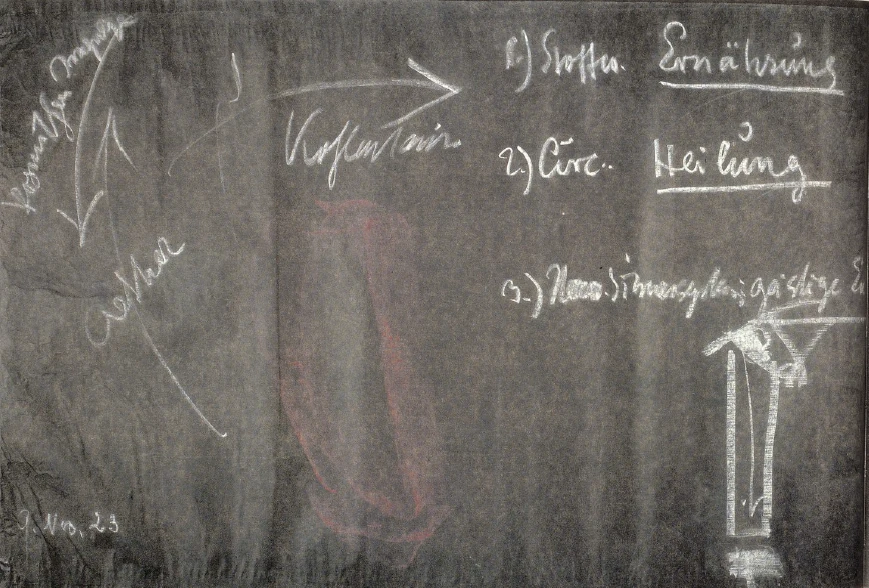
[ 9 ] Everything mineral must eventually become warmth-ether within the human being. Everything plant-like must pass through the transitional stage of the airy within the human being. Everything animal-like must pass through the transitional stage of the watery within the human being. Only that which is human may always retain its earthly, solid form within the human being. This is one of the mysteries of the human organism.
[ 10 ] Now, let us first set aside—the later discussion will address this in greater detail—what the human being derives from the Earth; let us consider what constitutes the human metabolic system, which the human being does indeed transform during the Earth phase, but which he possesses in its basic form from the ancient lunar era; let us take, then, what takes place as metabolism in the narrower sense within the human skin—and here we must certainly include excretions as part of the metabolism—and we see that this is, I would say, continually altered by the intake of nutrients. The nutrients, which are initially outside the human being, enter the human body and are first integrated into this metabolic system.
[ 11 ] This metabolic system transforms the human environment into something human. It begins to bring all that is mineral closer to the warmth-ether, all that is plant-like closer to the gaseous, airy, and fragrant, and it begins to bring all that is animal—namely, what is produced by animals themselves—closer to the aqueous, and, as an organized form, shapes what is truly human into the solid. All of this is inherent in the tendency of metabolism. And in this regard, metabolism is something that is extraordinarily interesting.
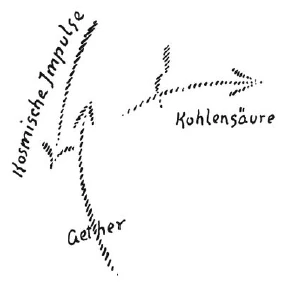
[ 12 ] If we trace the metabolic process back to respiration, we find that the human being produces carbon—which is found throughout the body—from within. It is combined with oxygen and transformed into carbon dioxide, which the human being then exhales. Carbon dioxide is the compound of carbon and oxygen. The oxygen inhaled through breathing acts upon the carbon, absorbing it; the human being exhales carbon dioxide, the compound that oxygen has formed with carbon. But before exhalation occurs, the carbon, so to speak, still becomes a benefactor to human nature. For this carbon, by combining with oxygen—by, so to speak, linking what the blood circulation brings about with what respiration then does with the blood circulation—this carbon becomes a benefactor to the human organism; for before it leaves the human organism, it spreads an outflow of ether throughout the entire human organism. Physical science merely states: carbon is exhaled as carbon dioxide. But that is only one side of the entire process. The human being exhales carbon dioxide, but throughout their entire organism, the carbon—which is utilized by oxygen—leaves behind ether as a result of exhalation. This ether penetrates the human etheric body. And this ether, which is constantly produced by carbon, is what makes the human organism capable of opening itself to spiritual influences—it is what receives the astral-etheric effects from the cosmos. This ether, left behind by carbon, attracts the cosmic impulses—those cosmic impulses that in turn have a formative effect on the human being, preparing, for example, the nervous system so that it can become the carrier of thoughts. This ether must continually permeate our senses—for example, our eyes—so that the eyes can see, so that the eyes can receive the outer light ether. We therefore owe it to carbon that we possess within us an etheric preparation capable of responding to the world.
[ 13 ] All of this is already prepared within the metabolic system. But the metabolic system, as a human system, is situated within the entire cosmos in such a way that it could not exist on its own. The metabolic system could not exist on its own. That is why it was formed as the third system in the human being. The first blueprint for the nervous-sensory system was formed during the ancient Saturn era, the second blueprint for the rhythmic system during the ancient Sun era, and only after these other systems were in place could the metabolic system be brought about in human beings, because the metabolic system could not exist on its own. If we set aside voluntary movements for the moment, the metabolic system is, in the cosmic context, designed for human nutrition. But this nutrition cannot exist on its own. Human beings need this nutrition, but it cannot exist on its own. For if one studies the metabolic system in human beings in isolation—you will see in the next lectures how essential it, in turn, is for the entire human organism—it is constantly permeated by all manner of tendencies to make people sick. We must always seek the origin of internal diseases—that is, those not caused by external injuries—in the metabolic system. Therefore, anyone who truly wishes to conduct a rational observation of disease must start with the metabolic system, and must essentially examine every single phenomenon within the metabolic system by asking: “What path are you following?” — If we consider all the processes—from the intake of food in the mouth, to the processing of food as we convert certain substances within us into starch, sugar, and so on; if we consider the coating of food in the mouth by ptyalin; if we proceed further to the action of pepsin in the stomach; if we proceed still further to the processing of metabolic products within the digestive system, as they pass into the lymphatic vessels, as they pass into the blood—then we must examine every single process, and there are countless processes to consider. The mixing of metabolic products with pancreatic secretions, which are then added, the mixing of substances with bile secretion, and so on—we must ask each individual process: What do you actually want? — And it will answer us: When I am alone, I am a process that always makes people sick. No metabolic process in human nature must be allowed to run its full course, for every metabolic process, when it runs its full course, makes a person sick. Human nature is healthy only when metabolic processes are halted at a certain stage.
[ 14 ] We will come to recognize this—which might at first appear to be the folly of the world order: that something begins within the human being which, if it were not halted halfway, would make the person ill—we will come to recognize this as one of the wisest things in the upcoming lectures. But for now, let us consider it from a factual perspective; let us take into account that the details of metabolic processes, when we study them inwardly in terms of their essence, would tell us: We are on the path to making the entire organism sick. Any metabolic process, if continued, makes the organism sick. If there is to be any metabolism in the human being at all, there must simply be other processes present that must first be developed in their potential, and these are the processes that are present in the circulation; these are the circulatory processes. The circulatory processes continuously contain healing processes. So that the human being can indeed be described in such a way that one says: During the ancient lunar evolution, the human being was born as a patient, and the physician was sent ahead of him within his own nature during the ancient solar evolution. During the ancient solar evolution, the human being was born as a physician in relation to his own nature. It was a very prudent arrangement in the evolution of the world that the physician arose before the patient, for during the ancient lunar evolution, the patient came into being within the human being himself. If one wishes to describe human beings correctly, one must move from metabolic processes to circulatory processes—and, of course, to everything that underlies these circulatory processes as impulses. One substance causes faster circulation, another slower circulation, in the broadest sense. We also have very small circulatory processes within us. Take any mineral substances—take gold, take copper—everything, when introduced into the human body in one way or another—internally, by injection, or in any other way—triggers a process whereby something in the circulation takes shape, changes, has a healing effect, and so on. And what one must know in order to gain insight into the actual healing processes of the human being is what each individual substance from the human environment triggers within the person in terms of changes in circulation. So that we can say: circulation is a continuous healing process.
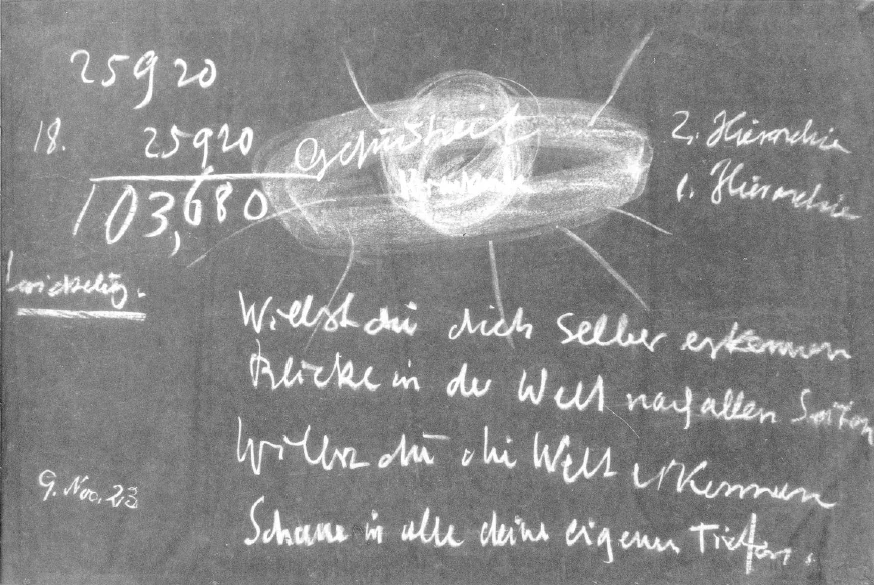
[ 15 ] You can, I would say, calculate it if you want to. Consider what I have told you: on average, a person takes eighteen breaths per minute. In an extraordinarily regular alignment with the cosmos throughout the day, this amounts to as many breaths as the sun’s cycle of circulation as it passes through the solar year. But the sun completes this entire cycle from its spring starting point in 25,920 years. A person in middle age takes an average of 25,920 breaths per day. The number of heartbeats is four times that. The other circulation—the more internally concentrated circulation—is influenced by metabolism. The respiratory circulation corresponds to a person’s external interaction with the outside world; it is the interrelationship with the outside world. This respiratory rhythm must constantly keep the circulatory rhythm in check so that it remains at its four beats; otherwise, a person’s circulatory rhythm falls into a completely irregular pattern, failing to align with the number 103,680. This is something to which nothing in the cosmos corresponds. In this way, the human being tears himself completely away from the cosmos. His metabolism tears him away from the cosmos, making him alien to the cosmos, while the respiratory rhythm continually draws him back into the cosmos. In this balancing and in this regulation of the circulatory rhythm by the respiratory rhythm, you see the primal healing process that is continually taking place within the human being. But in a certain more subtle way, with every inner healing, one must assist the respiratory process—which, after all, continues in a certain way throughout the entire body—in such a way that it regulates the circulatory process everywhere within the human being, bringing it back into harmony with the general conditions of the cosmos.
[ 16 ] So we can say: We move from nutrition to healing, because the human being actually always has a tendency, from the bottom up, to become ill, and must continually develop the tendency to remain healthy in his middle organism—the circulatory system. As the impulses of healing continually arise in our middle organism, they leave something behind specifically for the cranial nerve-sensory system; and we then come, thirdly, to the nerve-sensory system. What kinds of forces do we find in the nerve-sensory system? In the nervous-sensory system, we find those forces that, so to speak, the “doctor” within us leaves behind. On the one hand, he exerts a healing influence downward on the metabolic process. But by exerting a healing influence on the metabolic process, he is doing something that is now subject to judgment throughout the cosmos. And I am not telling you something fantastical, but rather something that is very much a reality: this process—in which healing processes continually take place within us, flowing downward—evokes the delight of the higher hierarchies. This is the joy of the higher hierarchies in the earthly world. They look down and continually sense the rise of illness from that which flows upward into human beings from the earthly realm—that which remains of the earthly properties of matter. They see how the impulses of the forces acting from the earthly realm, which lie in the surrounding air and so on, are continually processes of healing. This evokes the delight of the higher hierarchies.
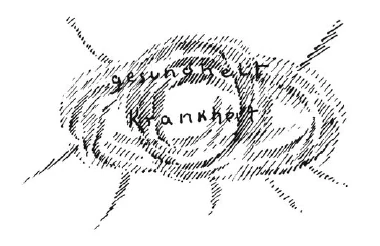
[ 17 ] Now imagine what you can study in that celestial body which, in a sense, has been placed at the edge of our planetary system as the most worthy object of spiritual study. There, at the center, stands that which contains within itself the forces that—when we concentrate on them here on Earth—are disease-causing forces, while the surrounding area reveals the circling forces of healing. And anyone who is receptive to such things can see in the rings of Saturn—in a form that cannot be perceived in what surrounds the Earth, because we are immersed within it—what circulating health is. This ring of Saturn is something fundamentally different from what astronomers say about it. This ring of Saturn is circulating health, and the interior of Saturn is the ailing, the disease-causing force, seen in its purest concentration.
[ 18 ] And so, in Saturn—which is situated at the very outer edge of our planetary system—we see the same process unfolding that we constantly carry within ourselves through our metabolism and our circulatory system. But we also see, when we look at this, how our spiritual gaze is directed toward the world of, in particular, the second hierarchy and the first hierarchy; the second hierarchy: Kyriotetes, Dynamis, Exusiai; the first hierarchy: Seraphim, Cherubim, Thrones. If we observe Saturn and its ring attentively with the spiritual eye, we are drawn to these higher hierarchies, as they, I might say, look with benevolence upon that which causes illness and that which brings healing.
[ 19 ] This delight is, in fact, a force in the universe. This delight of the higher hierarchies then flows through our nervous and sensory system and forms within it the forces of human spiritual development. These are the forces that, so to speak, blossom forth from the healing that is continually taking place within the human being. Thus, thirdly, we have spiritual development.
1. Metabolism and Nutrition
2. Circulation and Healing
3. Nervous and Sensory Systems, Mental Development
[ 20 ] If we now describe the human being in terms of the Saturn, Sun, and Moon eras, we must say: The human being is, first and foremost, a spirit born from the cosmos who develops within himself the healer, who can thereby receive the cosmic patient. And through the interplay of all these factors, what is created is the human being on Earth who is in a state of arbitrary movement.
[ 21 ] Every single aspect of human knowledge must, I would say, be inspired in a certain way by what underlies what I have said here. Suppose someone wants to establish a system of medicine—a truly rational system of medicine. What will that have to include? Of course, primarily the healing processes. But what must these healing processes be based on? They must be based on metabolic processes, and everything else can at most be a prerequisite—we will have to discuss this further; anatomy, even the most detailed anatomy, can only serve as the starting point because it represents the solidified form. That is already evident in itself. But metabolic processes must first be studied by a rational system of medicine in such a way that one always perceives in them the tendency toward what causes disease. Thus, a modern system of medicine that can be established must certainly begin with the metabolic system—that is, first with normal metabolic processes—and from there we must derive an understanding of how internal diseases can arise from metabolism in the broadest sense. Then, through an intimate understanding of what the rhythmic processes do, the actual therapy must emerge from this. Thus, in a modern system of medicine, one must begin with the study of metabolic processes, and from there make the transition to everything that can occur in the realm of rhythmic processes in the human being. And then, I would say, a kind of culmination of the whole will be achieved by demonstrating how the healthy development of a person’s spiritual faculties presupposes an understanding of that which arises from the healing forces. Today, you cannot find any pedagogy—that is, any art of the healthy development of the human spiritual nature—unless you start from the healing processes; for the healing processes are nothing other than the application to the human physical nature of what must already be employed in pure thinking for the development of human spiritual processes.
[ 22 ] The educational artist must work in a spiritual way with the forces that, when condensed into the physical or into the etheric, are healing processes. When I do something for a child through the art of education, it is a process based on something spiritual. When I translate this process—so that what I am doing in the spirit, I now carry out by applying some material substance or process—then this process or substance is a remedy. One could also say: Medicine is the metamorphosis of the spiritual treatment of the human being down into the material realm. If you recall how I alluded to these things in the teachers’ course that was held at that time for the English visitors, you will see how I drew attention to this throughout—how what the teacher does begins with a kind of general human therapy, and how this or that pedagogical measure can, later in life, cause unhealthy metabolic deposits or the absorption of irregular metabolic processes. So that what the educator does, when continued downward, provides therapy. And the counterpart to therapy—that which strives from the bottom upward—is the metabolic processes.
[ 23 ] So you can see, too, how a system of medicine today must emerge from a comprehensive understanding of the human being. It is possible. Some people sense this. But nothing will have been achieved until such a system of medicine has actually been developed. And in the present day, this is already among the most essential needs. If you look at medical textbooks today, you will see that, as a rule, they do not begin with the metabolic system—or at least do so only in the rarest of cases. But this must be the starting point; otherwise, one cannot learn to recognize what the very nature of disease consists of.
[ 24 ] You see, this whole matter is such that nutritional processes can indeed transition into healing processes, healing processes into mental processes, and mental processes back into healing processes; or if mental processes directly cause metabolic disorders, then mental processes also transition into a stage where they must be healed by the human organism as a whole. All these things merge into one another within the human being, and the entire human organism is a continuous, wondrous metamorphosis. Take, for example, the processes involved in this entire wondrous circulation of human blood. What kind of processes are these?
[ 25 ] Now, first of all, consider the blood—as it flows through the veins—completely apart from the rest of the human organism; consider the human form—that is, the venous system and what is connected to it as the muscular system, the skeletal system, and so on—in other words, what constitutes the solid structure, and what flows through it as a liquid. Let’s focus on the liquid state—the blood; there are, of course, other fluids as well, but let’s focus on the blood. In this flowing liquid, what processes are constantly taking place inside it? Processes are constantly unfolding. These same processes that take place in the liquid blood can now affect, in various ways, whatever in the human being consists solely of walls, a framework, or any solid, structured formation—whether in the blood vessel walls, the muscles, somewhere inside the bones, or in any enveloping organ. What happens there? There it becomes the impulse for inflammatory phenomena. What we find here and there as the impulses of inflammatory phenomena, we find continually in the liquid blood as normal processes. What appears there as inflammation consists of processes that have been forced into the wrong places—that is, into the solid, structured parts of the body—processes that must continually take place in the flowing blood. An absolutely normal, healthy process, when displaced to another location where it does not belong, becomes a disease-causing process. And certain diseases of the nervous system consist precisely in the fact that the nervous system—which is polar opposites to the blood system in its entire organization—must endure the intrusion of processes that are normal in the blood. When these processes—which are normal in the bloodstream—spill over into the nerve pathways, the nerve pathways—even at the slightest intrusion—become seized by inflammation that is in its very earliest stages, and we end up with the various forms of nervous system disorders.
[ 26 ] I said that the processes occurring in the nerves are entirely different from those in the blood—in fact, they are opposite processes. In the blood, there are processes that drive toward phosphorigenesis—processes which, when they affect the environment surrounding the blood or the tissues adjacent to it as phosphorigenic processes, lead to inflammation. If you trace the processes in the nerve pathways and observe how they migrate into other neighboring organs or even into the blood, then the impulses for all tumor formations in humans arise. When this is carried over into the blood, so that the blood then supplies the other organs in an unhealthy manner, neoplasms arise. Thus, we can say: Every neoplasm is a metamorphosed nervous process in the wrong place within the human organism.
[ 27 ] You see, what flows through the nerve must remain in the nerve; what flows through the blood must remain in the blood. If what belongs to the blood spills over into the surrounding area, inflammation occurs. If what belongs to the nerve spills over into the surrounding area, all sorts of growths arise that can only be summarized under the generic term “tumor formation.” But there must be a proper rhythm precisely between the processes in the nervous system and those in the circulatory system.
[ 28 ] Not only do we generally have the respiratory rhythm in contrast to the blood rhythm, but we also have subtle processes in the circulating blood that, when they emerge from the blood, become inflammatory processes. These subtle processes must be in a certain rhythmic relationship with what is happening in the adjacent nerve, just as respiration must be in a relationship with blood circulation. And the moment this relationship between the blood rhythm and the nerve rhythm is disrupted, it must be restored.
[ 29 ] You see, this brings us back to the realm of therapy and healing processes. All of this shows you how everything must be present within a person: the most diseased part must be there so that there can be a healthy part elsewhere; it has simply ended up in the wrong place due to an improper process. For if it were not there at all, the human being could not survive. The human being could not survive if he could not develop inflammation, for the forces that induce inflammation must be constantly present in the blood. This is what I have meant when I have often said: everything that a human being actually acquires in terms of knowledge must arise from a genuine understanding of the human being. You can see here the reasons why a pedagogy—I would say—pursued in such a detached, abstract manner is, in fact, quite nonsensical. Actually, pedagogy should be pursued in such a way that one always proceeds from certain pathological processes in human beings and from the possibility of their healing.
[ 30 ] If one is familiar with a brain disorder and the possibility of curing it, then one has, in broad terms—which is, of course, subtle in a different way, but in reference to the fact that it is a physical process, I say “broad”—in the treatment of the brain, precisely what must be carried out in the art of education. That is why, in fact, once a genuine pedagogical seminar is established, one would have to teach teachers pathological-therapeutic principles on the one hand: there they would train their thinking first on more concrete examples—because these are more deeply rooted in the subject matter—in preparation for what they are now to grasp in pedagogy proper. And, in turn, nothing is more useful for therapy—particularly for the treatment of internal diseases—than knowing how this or that element works in the therapeutic application of pedagogy. For when one finds the bridge to the material realm, it is precisely in the manner in which one should treat students that one also finds the remedy.
[ 31 ] For example, if one finds the right pedagogical methods to address certain signs of lethargy in children that stem from digestive system disorders, one develops some very peculiar inner tendencies; if one truly lives and breathes pedagogy—not, of course, if one merely learns it superficially and actually prefers, once school is out, to sit in the “community parlor” in the evening and forget what goes on at school. From the way one treats such a child, one develops a tendency to, I might say, see the entire workings of the mental processes, the entire interconnection between mental processes and abdominal processes. And when one then studies, for example, in mineralogy the processes taking place in copper—as the copper in the earth forms this or that—it is almost as if, in everything the copper does as it becomes this or that copper ore, in this process of the ores becoming copper ore or other ores, it then appears to one that one might say: “The power of copper in the earth is doing exactly what you, as an educator, do with the boy or the girl!” One literally sees a reflection of what one does oneself in the processes of copper. And it is extraordinarily fascinating, as a teacher, to gain an intuitive, emotional, and instinctive clarity about what one does, and then to go out into nature with delight and see how nature itself actually acts pedagogically on a grand scale; how, wherever something harmful might occur due to some calcification process, a copper process is somehow interwoven into it. Yes, in these copper processes, in these ore-formation processes within the broader earthly processes, there are also ongoing healing processes. And it is delightful when, upon finding pyrite ores or something else somewhere, one says to oneself: This is exactly like treating people in the right way. There, the spirits of nature—from the hierarchies down to those elemental spirits of which I have spoken to you—act as healers, addressing what might otherwise arise in life as disruptive, disease-causing processes. It is really nothing more than a form of observation. For when one sees what is happening out there, when one then uses this or that substance as a remedy or processes it as a remedy, one simply stands there and asks oneself: Where does iron appear? Where does this or that metal appear in the veins?” You then study the surroundings, and you always find that whenever any metallic element appears here or there in this or that form as processed by nature: there is a healing process taking place there; make use of it, carry it forward into the human organism, and you will create a therapy that nature has demonstrated to you out there.
[ 32 ] Yes, every journey through the world is, in reality, a true study of what nourishes, what heals, and what is spiritual; for in nature, illness is constantly being caused and constantly being healed. Out there they are—the great cosmic healing processes. We need only apply them to human beings. This is the marvelous interaction of the macrocosm with the microcosm. It is indeed profoundly true what I have said to some of you in one form or another:
If you want to know yourself,
Look in all directions throughout the world.
If you want to know the world,
Look into all the depths of your own being.
[ 33 ] But you can apply this to everything: If you want to heal people, look out into the world in all directions; observe how the world brings about healing in every way. If you want to recognize the mysteries of the world as processes of illness and healing, then look deep into all the depths of human nature. - You can apply this to everything that is human. But you must turn your gaze outward toward the great natural world and see human beings in a living connection with this great natural world.
[ 34 ] People have gotten used to something different these days. People distance themselves from nature as much as possible; they do something that blocks their own view of nature, for what they wish to examine, they place under a glass down there on a small table; the eye does not look out into nature, but looks into it. Even the gaze itself is cut off from nature. This is called a microscope. In a certain sense, one might just as well call it a “nulloscope,” for one cuts oneself off from the great natural world. And when one has magnified something down there, one does not know whether, in terms of spiritual understanding, one is actually experiencing the same thing that would happen if the process were taking place in nature. Just think about it for a moment: when you magnify some tiny little thing from a human being in there so that you can observe it, you are doing to this tiny part of the human being exactly what you would do to the human being if you were to stretch and tear him apart to that extent! You would be even more terrible than Procrustes if you were to stretch and tear a human being apart like that, so that he is magnified just as that tiny little thing down there under the tube is magnified. But do you believe that you would still have a human being there? Of course, there’s no question that you’d still have a human being. Nor do you have the truth down there under the microscope. The magnified truth is no longer the truth; it is an illusion. One must not stray from nature and imprison one’s own vision. Certainly, all of this can be useful for other things, but as far as true understanding of humanity is concerned, it is, first and foremost, something that leads one far away from that true understanding of humanity.
[ 35 ] True understanding of humanity must be sought in the way we have indicated. It must lead from the processes of nutrition, through the processes of healing, to the processes of human and world education in the broadest sense—we might say, from nutrition through healing to civilization and culture. For it is all like a lower foundation of the physical processes concentrated in the human being in nutrition; the healing processes that arise from what constantly revolves around us, concentrated in the human being in the rhythmic processes; and that which comes from above, concentrated in the human being through the nervous-sensory processes. Thus the world is structured in three stages.
[ 36 ] I wanted to give you that first as a kind of foundation. We will then build on that. We want to see how we can truly move from such starting points to something that is, so to speak, the practical application of this in everyday life—and which can then be transformed into what is known as knowledge of the Hierarchy.