Humanity as the Harmony of the creative, formative, and shaping Word of the WorldGA 230
21 October 1923, Dornach
Translated by Steiner Online Library
Third Lecture
[ 1 ] We have once again attempted to place human beings within the universe from a certain perspective. Today we would like to offer a reflection that can, I would say, summarize the whole. We live our physical lives on Earth, surrounded by the events and facts that arise from the physical matter of the Earth, which is shaped and formed in the most diverse ways into the beings of the natural kingdoms and into the human form itself. In all of this lies the physical substance of the Earth. Let us call this physical substance “the physical substance of the Earth” today, since we will soon have to speak of its opposite—that is, the physical substance of the Earth, which forms the material basis for the Earth’s various forms— and let us distinguish from it that which exists in the universe as the opposite of this physical substance—the spiritual substance that, for example, underlies our own soul, but which also underlies those forms in the universe that, as spiritual entities, are connected with physical forms.
[ 2 ] One cannot fully understand the matter if one speaks only of a physical material or a physical substance. You need only consider that we had to incorporate the beings of the higher hierarchies into the overall picture of our world. These beings of the higher hierarchies do not possess earthly substance, nor do they possess physical substance in what we would call their physical form. They possess spiritual substance. Thus, when we look at the earthly realm, we perceive physical substance; and when we look at the non-earthly realm, we perceive spiritual substance.
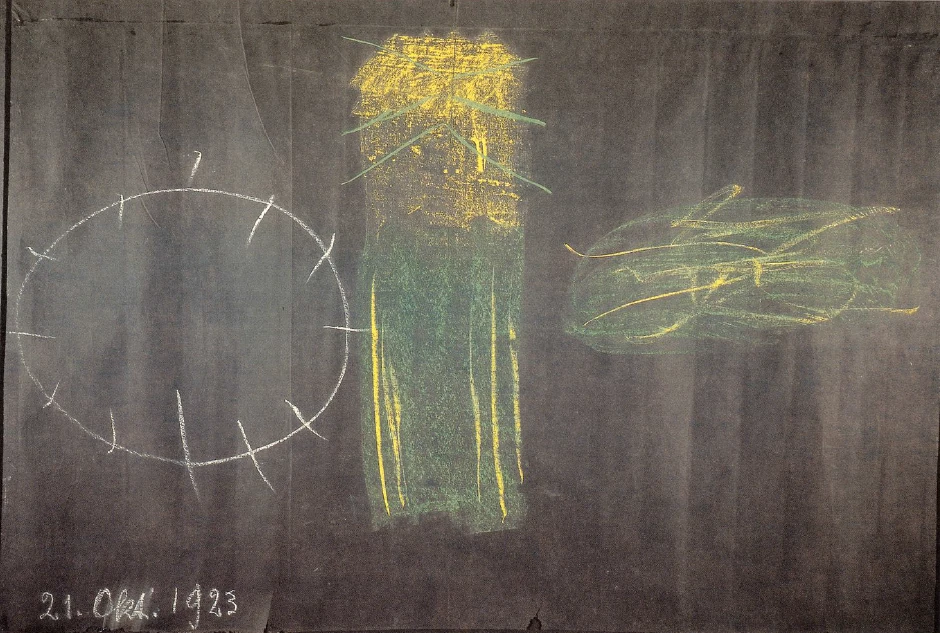
[ 3 ] Today, little is known about spiritual substance, and so even when speaking of the earthly being who belongs to both the physical and the spiritual worlds—that is, the human being—people speak of him as if he were composed solely of physical substance. But that is not the case. Human beings certainly possess both spiritual and physical substance within themselves, and they possess this spiritual and physical substance in such a unique way that it must at first come as a surprise to anyone who is not accustomed to paying attention to such things. For when we consider that aspect of the human being which specifically enables him to move—that is, the limbs—and what then continues inward from the limbs as metabolic activity, it is incorrect to speak primarily of physical substance in this context. You will see this more clearly shortly. We speak of the human being correctly only when we view their so-called lower nature in such a way that it is fundamentally based on a spiritual substance. Thus, if we wish to schematically depict the human being, we must do so in the following manner.
[ 4 ] We must say: The lower part of the human being actually presents us with a form made of spiritual substance, and the closer we get to the head, the more the human being is formed of physical substance. The head is essentially formed of physical substance. But the legs—and we must say this, even though it sounds grotesque—are essentially formed of spiritual substance; as I said, as grotesque as it sounds. So that, as we move toward the head, we must draw the human being (as it is drawn) in such a way that we allow the spiritual substance to merge into the physical substance; and in particular, the physical substance is contained within the human head. In contrast, the spiritual substance is particularly beautifully spread out, I would say, where the person extends his legs into space, or extends his arms into space. It is truly as if the main thing for the arms and legs were that this spiritual substance fills them, that it is their essence. It is truly the case that, for the arms and legs, the physical substance, so to speak, merely floats within the spiritual substance, whereas the head is, in fact, a compact formation of physical substance, so to speak. — But in a formation such as the human being, we must not only distinguish between the different substances but also distinguish the forces within its structure. Here, too, we must again distinguish between spiritual forces and earthly-physical forces.
[ 5 ] Now, with the forces, it is exactly the opposite. While the substance of the limbs and metabolism is spiritual, the forces within them—for example, gravity in the legs—are physical. And while the substance of the head is physical, the forces at work within it are spiritual. Spiritual forces work through the head, while physical forces work through the spiritual substance of the human being’s limbs and metabolism. Only in this way can the human being be fully understood: by distinguishing within him the upper regions—his head and also the upper chest regions, which are actually physical substance—through which spiritual forces work—I would say that the lowest spiritual forces work in the breathing—and we must regard the lower human being as a formation of spiritual substance within which physical forces are at work. Of course, we must be clear about how these things actually relate to the human being. For the human being extends the nature of his head throughout his entire organism, so that the head—which is, after all, physical substance permeated by spiritual forces—extends this very nature into the lower regions of the human being as well. What the human being is through his spiritual substance, in which physical forces are at work, is in turn reflected upward into the upper human being. What is at work within the human being permeates one another. But one can only understand the human being if one regards him in this way as a physical-spiritual entity—both substantial and dynamic, that is, as a being of forces.
[ 6 ] This is indeed of great significance. For if we look beyond outward appearances and focus on the inner essence, we see, for example, that no irregularity may occur in this distribution of the substantial and the energetic aspects within the human being.
[ 7 ] For example, when what is supposed to be pure substance— should be pure spiritual substance in human beings—that is, physical matter, physical substance—and, for example, if physical substance asserts itself too strongly in the metabolic system—which actually leads to the head—then, in a sense, the metabolism becomes too strongly permeated by the head’s essence, and the person becomes ill; specific types of illness then arise. And the task of healing then consists in paralyzing and expelling this physical substance formation that is spreading within the spiritual substance. On the other hand, when the human digestive system—in its unique way of being worked through by physical forces within the spiritual substance—sends this upward toward the head, the human head becomes, if I may put it that way, overly spiritualized; an excessive spiritualization of the head then occurs. In that case, because this constitutes a pathological condition, one must ensure that sufficient physical nourishing forces are sent to the head so that they arrive there in such a way that they are not spiritualized.
[ 8 ] Anyone who observes healthy and sick people will very quickly recognize the usefulness of this distinction, provided they are concerned with the truth itself and not merely with outward appearances. But there is something else, something fundamentally different, at play here. What is at play here—the way a person feels as a result of being the kind of being I have described—remains, for the time being, in the subconscious of ordinary modern consciousness. It is already present there. It manifests as a kind of mood, a human mood of life. But only spiritual insight brings it into full consciousness, and I can describe this spiritual insight to you only in this way: The one who, through modern initiatory science, knows this mystery of the human being—that the head is actually the most important, the most essential organ requiring physical substance so that it can work through this physical substance with the spiritual forces—and who further knows that in the metabolism of the limbs, the essential element is the spiritual substance that requires physical forces, the forces of gravity, the forces of equilibrium, and the other physical forces—in order to exist—anyone who spiritually comprehends this mystery of the human being in this way and then looks back on this human earthly existence actually comes to see himself, as a human being, as an immense debtor to the Earth. For on the one hand, he must tell himself that, in order to sustain his human being, he requires certain conditions; but through these conditions he actually becomes a debtor to the Earth. He is constantly drawing something away from the Earth. For he comes to realize that what he carries within himself as spiritual substance during his earthly existence is actually what the Earth needs. He should, in fact, leave this behind for the Earth when he passes through death, for the Earth constantly requires spiritual substance for its renewal. He cannot do so, for he would be unable to complete his human journey through the time after death. He must take this spiritual substance with him for the life between death and a new birth, because he needs it; for he would, so to speak, vanish after death if he did not take this spiritual substance with him through death.
[ 9 ] Only in this way can a person undergo the changes he must undergo—by carrying this spiritual substance of his physical, metabolic being through the gateway of death into the spiritual world. And so, human beings would not be subject to future incarnations if they were to give the Earth what they actually owe her—this spiritual substance. They cannot do so. They remain debtors. This is a situation that, for the time being, cannot be remedied in any way, as long as the Earth remains in its intermediate state. At the end of earthly existence, things will be different.
[ 10 ] It is true, my dear friends, that whoever views life through spiritual vision experiences not only the pains and sufferings—but also, for my sake, the happiness and joy—that ordinary life offers; rather, with this spiritual vision, cosmic feelings, cosmic sufferings, and cosmic joys arise. And initiation is inseparable from the occurrence of such cosmic sufferings—for example, the realization that simply by sustaining my human existence, I must make myself a debtor to the Earth. I cannot give the Earth what I would actually have to give her if I were completely righteous in a cosmic sense.
[ 11 ] Something similar applies to the substance of the head. Because spiritual forces are at work within the material substance of the head throughout the entire earthly life, this substance becomes alienated from the Earth. After all, human beings must draw the substance for their heads from the Earth. But in order to be human, he must also continually imbue this substance of his head with the spiritual forces of the non-earthly realm. And when a human being dies, it is extraordinarily disruptive for the Earth that it must now take back the human’s head matter, which has become so alien to it. When a human being has passed through the gate of death and surrenders the substance of his head to the Earth, this substance—which is actually thoroughly spiritualized and carries within it spiritual achievements—basically has a poisonous effect on the whole of earthly life; in fact, it disrupts this earthly life. When a person sees through these things, they must actually tell themselves: it would be right for them to take this substance with them right through the gate of death, because it would actually fit much better into the spiritual region that a person passes through between death and a new birth. But they cannot do this. For if a person were to take this spiritualized earthly substance with them, they would continually create an enemy for their entire development between death and a new birth. It would be the most terrible thing that could happen to a person if they were to take this spiritualized substance of the head with them. It would continually work toward the destruction of their spiritual development between death and a new birth.
[ 12 ] So one must tell oneself, when one sees through these things: One thereby also becomes a debtor to the earth; for something that one owes to her but has rendered useless to her, one must continually leave behind—one cannot take it with one. What one ought to leave to the earth, one takes away from it; what one ought to take with oneself—that which one has rendered useless to it—one hands over, along with one’s earthly dust, to this earth, which, in its collective life as a whole being, suffers immensely as a result.
[ 13 ] It is indeed true that, at first, something settles upon the human soul—precisely through spiritual vision—that feels like an immense, tragic sensation. And only when one looks at longer periods of time and surveys the development of entire systems does the prospect emerge that, for example, once the Earth has reached its end, this guilt will be, so to speak, balanced out and cast off in the later stages of human development—in the Jupiter, Venus, and Vulcan stages—
[ 14 ] Thus, it is not only by living a single earthly life that one creates karma; rather, one creates karma—world karma, cosmic karma—simply by being an earthly human being, by inhabiting the Earth, and by drawing one’s sustenance from the Earth.
[ 15 ] Then it becomes possible to look beyond human beings and turn one’s gaze to the rest of nature, and to see how, although human beings—I would say—must bear this guilt I have just described to you, a balance is nevertheless continually restored through the cosmic beings. There one penetrates into the wondrous mysteries of existence—mysteries which, in fact, when summarized, become what we perceive as the wisdom of the world.
[ 16 ] Let us turn our gaze away from human beings and toward something to which we have frequently turned our attention in recent days—let us turn our gaze to the world of birds, which has been represented to us in recent days by the eagle. We spoke of the eagle as the representative of the bird world, as the animal that, so to speak, embodies the qualities and powers of the bird world. And when we look at the eagle, we are actually looking at that which, within the cosmic context, pertains to the entire bird world. So in the future, I will simply speak of the eagle. — I have spoken to you about how the eagle actually corresponds to the human head, and how the forces that trigger thoughts in the human head trigger the plumage in the eagle. So that, in fact, the sun-permeated air forces, the light-permeated air forces, are at work in the eagle’s plumage. This shimmers in the eagle’s plumage: the air force permeated by light.
[ 17 ] Now, the eagle—to which one might indeed attribute many negative traits—does, after all, possess a remarkable characteristic in relation to its cosmic existence: in a sense, everything that these sun-infused air forces form within it remains outside its skin, in the structure of its plumage. One only realizes what is happening there, however, when the eagle dies.
[ 18 ] It is only when the eagle dies that one realizes what a peculiar—I would say superficial—digestive process the eagle has, compared to the thorough digestion of the cow through its rumination. The cow is truly the animal of digestion—again, as a representative of many within the animal kingdom. There, digestion is thorough. The eagle, like every bird, digests superficially. Everything is merely begun, so to speak; the process of digestion has only just begun. And I would say that, in the nature of the eagle, this digestion—when we look at the whole picture—is actually a secondary function of its existence; it is treated as a secondary function throughout the eagle’s being. In contrast, everything that goes into its plumage is processed thoroughly in the eagle. In other birds, this is even more pronounced. There, everything in the feathers is crafted with immense care. And such a bird feather is actually a marvelous structure. For it is there that what one might call earthly matter—which the eagle draws from the earth and which is spiritualized by the higher forces—comes into being most powerfully; yet in such a way that it is not appropriated by the eagle, for the eagle makes no claim to reincarnation. He therefore need not be concerned about what subsequently occurs as a result of the influence exerted by the higher spiritual forces upon the earthly matter in his plumage; nor need he be concerned about how this continues to have an effect in the spiritual world.
[ 19 ] Thus we see that when the eagle dies and its plumage also perishes—as I said, this applies to every bird—the spiritualized earthly matter departs into the spiritual realm and is transformed back into spiritual substance.
[ 20 ] As you can see, we share a curious kinship with the eagle in relation to our head. What we cannot do, the eagle can: The eagle continually carries away from the earth that which is spiritualized within the earth through spiritual forces from physical substance.
[ 21 ] That is also why we view the eagle in flight with such a strange sense of wonder. We perceive it as something otherworldly, as something that has more to do with the heavens than with the earth, even though it draws its sustenance from the earth. But how does it obtain it? It obtains it in such a way that, as far as earthly substance is concerned, it is nothing but a robber. I would say that the ordinary, mundane law of earthly existence does not provide for the eagle to receive anything at all. It steals its sustenance; it plunders its matter, just as the bird species in general often plunder their sustenance. But the eagle makes up for it. He seizes his substance, but he allows it to be spiritualized by the forces that exist as spiritual forces in the higher regions, and after his death he carries these spiritualized earthly forces—which he has seized—into the spirit realm. With the eagles, the spiritualized earthly substance journeys out into the spirit realm.
[ 22 ] The lives of animals do not end when they die. They have their significance in the universe. And when the eagle flies as a physical eagle, it is, in a sense, merely a symbol of its existence; thus it flies as a physical eagle. Oh, it continues to fly after its death! The spiritualized physical matter of the eagle’s nature flies out into the vastness to unite with the spiritual matter of the spirit realm.
[ 23 ] You see, when you understand these things, you discover wonderful mysteries in the universe. Only then do you ask yourself why these various animals and other forms of life on Earth actually exist. They all have their great, their immense significance in the entire universe.
[ 24 ] Let us now turn to the other extreme, which we have also been considering these past few days: the cow, so revered by Hindus. Here, indeed, we have the other extreme. Just as the eagle closely resembles the human head, the cow closely resembles the human metabolic system. It is the digestive animal. And, as strange as it may sound, this digestive animal essentially consists of spiritual substance, into which the physical matter that is consumed is merely woven and interspersed. There is the spiritual substance within the cow (it is illustrated), and the physical matter penetrates everywhere here and is absorbed and processed by the spiritual substance. To ensure this happens thoroughly, the cow’s digestive process is so extensive and thorough. It is the most thorough digestive process one can imagine, and in this respect, the cow truly embodies animal nature most thoroughly. The cow is thoroughly an animal. She actually brings animal nature—this animal egoism, this animal selfhood—down from the cosmos to Earth, into the realm of Earth’s gravity.
[ 25 ] No other animal has the same ratio of blood weight to total body weight as the cow; it either has less or more blood relative to its body weight than the cow; and weight has to do with heaviness, and blood with individuality. Not with the ego—which, after all, only humans possess—but with egoity, with individuality. Blood is also what makes an animal an animal, at least the higher animal. One might say: the cow has solved the riddle of the universe—how to maintain just the right balance between the weight of the blood and the weight of the entire body when one wants to be an animal as thoroughly as possible.
[ 26 ] You see, the ancients didn’t call the zodiac the “zodiac” for nothing. It consists of twelve parts, distributing, as it were, its entire being across twelve individual parts. These forces, which come from the cosmos, from the zodiac, manifest themselves precisely in the animals. But the other animals do not conform to this pattern quite so precisely. A cow’s blood weight is one-twelfth of its body weight. A cow’s blood weight is one-twelfth of its body weight, whereas for a donkey it is only one-twenty-third, and for a dog, one-tenth. All other animals have a different ratio. In humans, blood accounts for one-thirteenth of body weight.
[ 27 ] You see, the cow is intent on expressing the entirety of animal existence through its physical heaviness, on expressing the cosmic as thoroughly as possible. What I have been saying these past few days—that one can see in the cow’s astral body that she actually realizes the higher aspect within the physical-material realm—is expressed in the very fact that she maintains the twelvefold division within her own internal balance of weight. Therein lies her cosmic essence. Everything about the cow is such that the forces of the Earth are woven into its spiritual substance. Earthly gravity is compelled to distribute itself within the cow according to the zodiacal proportions. Earthly gravity must yield, allowing one-twelfth to be allocated to the ego. Everything compels the cow to bring its spiritual substance into alignment with earthly conditions. Thus, the cow lying in the pasture is, in fact, spiritual substance that takes in, absorbs, and assimilates earthly matter.
[ 28 ] When the cow dies, the spiritual substance that the cow carries within itself is capable of being absorbed by the earth’s matter for the benefit of all life on Earth. And one is right to feel toward the cow: You are the true sacrificial animal, for you are, in essence, continually giving the earth what it needs—without which it could not continue to exist, without which it would harden and wither. You continually give it spiritual substance and renew the earth’s inner vitality and liveliness.
[ 29 ] And when you look at the pasture with the cows on one side and the soaring eagle on the other, you see a curious contrast: the eagle, which—when it dies—carries the earthly matter that has become useless to the Earth—because this matter has been spiritualized—out into the vastness of the spirit realm; the cow, when she dies, gives the earth’s heavenly substance and thus renews the earth. The eagle takes from the earth what it can no longer use, what must return to the spirit realm. The cow brings into the earth what the earth continually needs in terms of renewing forces from the spirit realm.
[ 30 ] Here you can see something like the emergence of sensations arising from the science of initiation. For people usually believe that this science of initiation—well, you study it, but it really offers nothing but concepts, nothing but ideas. One fills one’s head with ideas about the supersensible, just as one otherwise fills one’s head with ideas about the sensible. But that is not the case. As one delves ever deeper into this science of initiation, one comes to draw up from the depths of the soul sensations of which one previously had no inkling, but which are nevertheless present unconsciously in every human being; one comes to perceive all beings differently than one did before. So I can describe to you a sensation that is precisely part of the living experience of spiritual science, of the science of initiation. It is this: one must say to oneself, “If only human beings were on Earth,” then, upon recognizing the true nature of the human being, one would actually despair that the Earth would ever receive what it needs—that spiritualized matter would be taken from it at the right time and spiritual matter given to it. One would actually have to feel such a contrast between human and earthly existence that it causes great, great pain—pain that is so intense precisely because one says to oneself: If human beings are to be truly human on Earth, then the Earth cannot be truly Earth through human beings. Human beings and the Earth need one another, yet human beings and the Earth cannot support one another! What one being needs is lost to the other; what the other needs is lost to the one. And there would be no assurance of the vital connection between humanity and the Earth if it were not for the emergence of the natural world, prompting us to say: What humanity is unable to accomplish in terms of guiding the spiritualized substance of the Earth into the spiritual realm, the bird world accomplishes. And what human beings are unable to give to the Earth in terms of spiritual substance, the ruminants accomplish—and, as their representative: the cow.
[ 31 ] You see, this is how the world comes together, so to speak, into a whole. If one looks only at human beings, a sense of uncertainty creeps into one’s perception of life on earth; if one looks at what surrounds human beings, one regains that sense of security.
[ 32 ] Now you will be even less surprised that a religious worldview as deeply spiritual as Hinduism venerates the cow; for she is the animal that continually spiritualizes the earth, continually giving the earth that spiritual substance which she herself draws from the cosmos. And one really ought to bring to life the image of how, beneath a grazing herd of cows, the earth lives in joyful excitement, with the elemental spirits down below rejoicing because they are assured of receiving their nourishment from the cosmos through the very existence of the beings grazing there. One should actually paint the dancing, jubilant circle of air elementals, swirling around the eagle. Then one would have painted spiritual realities once again, and one would see the physical within those spiritual realities; one would continually see the eagle within its aura, and flowing into that aura would be the jubilant cries of the elemental air spirits and fire spirits of the air.
[ 33 ] One would see this strange aura of the cow, which so greatly contradicts earthly existence because it is entirely cosmic, and one would see the excited cheerfulness of the senses of the earthly elemental spirits, who here behold what they have lost by having to eke out their existence in the darkness of the earth. For these spirits, what appears in the cows is indeed the sun. These elemental spirits dwelling in the earth cannot rejoice in the physical sun, but they can rejoice in the astral bodies of the ruminants.
[ 34 ] Yes, my dear friends, there is indeed another history of nature besides the one found in today’s books. And what, after all, is the final conclusion of the history of nature found in today’s books?
[ 35 ] The sequel to that book by Albert Schweitzer, which I reviewed some time ago, has just been published. You may recall my review of this little book on the current state of culture, which appeared some time ago in *Goetheanum*. The preface to this sequel is actually a rather sad chapter in contemporary intellectual output; for while the first little volume, which I reviewed at the time, at least possessed a certain strength and insight to acknowledge what our culture lacks, this preface is truly a rather sad chapter. For in it, Schweitzer boasts that he was the first to realize that, fundamentally speaking, knowledge can offer nothing at all, and that one must derive one’s worldview and ethics from somewhere other than knowledge.
[ 36 ] Well, first of all, there has been a great deal of talk about the limits of knowledge, and it takes a bit of—how shall I put it—short-sightedness to believe that one is the first to have spoken of the limits of knowledge. Natural scientists have done so in every possible way. So there’s no need to boast that one was the first to discover this colossal error.
[ 37 ] But if one sets that aside, it becomes precisely evident that even such an outstanding thinker as Schweitzer—for he is indeed an outstanding thinker, judging by this first little volume—goes so far as to say: If we want to have a worldview, if we want to have ethics, we must look entirely beyond knowledge and insight; for they give us nothing after all. Knowledge and insight, as they appear in books today and are officially recognized—these sciences and these insights—do not lead us to discover a meaning—as Schweitzer says—in the world. For when you really look at the world the way these figures do, the only conclusion you can reach is this: it is meaningless that eagles fly, apart from the fact that they can be used as heraldic animals; it is of practical use on earth that cows give milk, and so on. But since human beings, too, are merely physical beings, this has only a physical utility; it does not, after all, provide any meaning for the universe as a whole.
[ 38 ] However, if one is not willing to go any further, one does not reach the level where a meaning of the world can emerge. One must simply turn to what the spiritual realm—what the science of initiation—can tell us about the world; then one will indeed find this meaning of the world. Then one finds this meaning of the world even by discovering wondrous mysteries in all of existence—mysteries such as the one that unfolds with the dying eagle and the dying cow, between whom stands the dying lion, which, in turn, maintains such a balance between spiritual and physical substance within itself through the harmony of its respiratory and blood rhythms that it is now the one that, through its group soul, regulates how many eagles and how many cows are necessary to allow the proper process—upward and downward, as I have described to you—to take place.
[ 39 ] You see, the three animals—the eagle, the lion, and the bull or cow—were created precisely out of a wonderful, instinctive insight. Their kinship with human beings is palpable. For when a person truly understands these things, they should actually say to themselves: The eagle takes on for me the tasks that I cannot fulfill myself through my head; the cow takes on for me the tasks that I cannot fulfill myself through my metabolism, through my system of limbs; the lion takes on for me those tasks that I cannot fulfill myself through my rhythmic system. In this way, I and the three animals become a whole within the cosmic context.
[ 40 ] This is how one immerses oneself in the cosmic context. This is how one feels a deep kinship with the world and comes to recognize just how wise are the forces that govern the existence into which human beings are woven, and by which they, in turn, are surrounded and enveloped.
[ 41 ] As you can see, we have been able to summarize what we have encountered by exploring the relationship between human beings and the triune being we have been discussing over the past few weeks. The inner connection between world phenomena and world beings