Humanity as the Harmony of the creative, formative, and shaping Word of the WorldGA 230
26 October 1923, Dornach
Translated by Steiner Online Library
Fourth Lecture
[ 1 ] We have examined, in a certain way, the relationship between earthly conditions, cosmic conditions, and the animal kingdom in relation to human beings. In the coming days, we will continue with these very considerations; today, however, I would like to make the transition to other areas that we will need to address in the future. And here I would first like to point out that, as already described in my *Outline of Esoteric Science*, the development of the Earth within the cosmos has been presented in such a way that, when considering this earthly development, we must take as our starting point the ancient Saturn metamorphosis of the Earth. This Saturn metamorphosis is to be understood as containing within it everything that belongs to our planetary system. The individual planets of our solar system, from Saturn down to the Moon, were at that time still celestial bodies dissolved within the ancient Saturn—which, as you know, consisted solely of warmth-ether. Thus Saturn, which had not yet even attained airtightness but was simply warmth-ether, also contained, in an etherically dissolved state, everything that would later take on an independent form and become individualized in the individual planets.
[ 2 ] We then distinguish, as the second metamorphosis in the Earth’s development, what I collectively refer to as the Earth’s ancient solar metamorphosis. Here we are dealing with the process by which, gradually, the sphere of air—the Sun, a sphere of air permeated, illuminated, and glittering with light—emerges from the fiery sphere of Saturn.
[ 3 ] Then we have a third metamorphosis, in which—after the old states have been repeated—the solar aspect emerges on the one hand, which at that time still encompasses the Earth and the Moon, and that which is external—well, you have described it in *The Secret Science*—to which Saturn, in its separation, then belongs.
[ 4 ] But at the same time, during this lunar metamorphosis, we are dealing with the separation of the Sun and that which then constitutes the connection between the Earth and the Moon. And I have often described how the realms of nature that we know today did not exist back then, how, in particular, the Earth did not consist of a mineral mass, but—if I may put it this way—was horn-like, so that the solid components broke off in a horn-like manner; horn-like rocks, so to speak, protruded from the lunar mass, which had already become watery. Then, during the fourth metamorphosis, the conditions arose that correspond to our present-day earthly conditions.
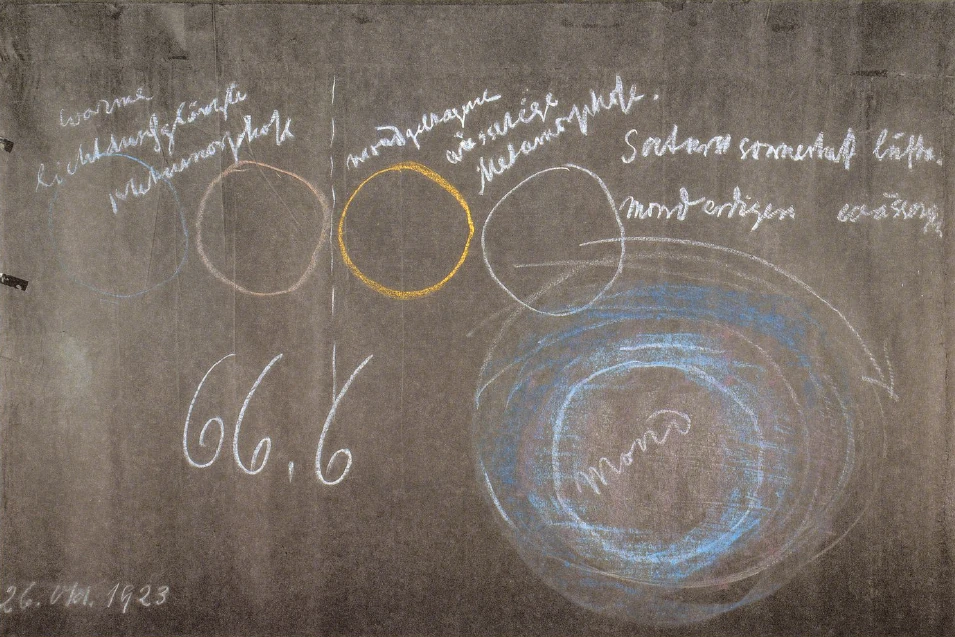
[ 5 ] Now, if we trace these four metamorphoses in sequence, we first have the Saturn metamorphosis—the body of heat that has already dissolved everything that will later be contained in our planetary system—followed by the Sun metamorphosis, the Moon metamorphosis, and the Earth metamorphosis. Within this quartet, we can distinguish between two different aspects. (A diagram is drawn.)
[ 6 ] Just consider, in the evolution from Saturn to the Sun, what we are dealing with—that which has advanced only as far as the air-like substance! Evolution originates from the fireball; the fireball undergoes metamorphosis and condenses into the airball, which is, however, already permeated by light and glistening with light. That is the first part of the development.
[ 7 ] Then we have this phase of development in which the Moon plays its first role. For the Moon plays precisely the role that enabled it to shape those horn-like rock formations. During the Earth’s metamorphosis, the Moon breaks away, becomes a satellite, and leaves the Earth with its inner forces. For example, the forces of gravity are certainly something that has been left behind by the Moon in a physical sense. The Earth would not develop the forces of gravity if the remnants of the old lunar inclusion had not been left behind; the Moon itself has departed. The Moon is that colony in outer space of which I have spoken to you from a spiritual perspective in recent days. It has a completely different substance than the Earth, but it has left behind on Earth what can be called, in a broader sense, Earth’s magnetism; the Earth’s forces—namely, the Earth’s gravitational forces, the effects known as the effects of weight—have been left behind by the Moon. So we can say: Here (two circles on the left) we have the Saturn and Sun states—essentially a warm, light-permeated metamorphosis when we consider the two together; here (two circles on the right) we have the lunar and terrestrial states—the moon-borne, watery metamorphosis, the watery element that forms during the lunar metamorphosis and then remains during the terrestrial metamorphosis; the solid is, after all, brought about precisely by the forces of gravity.
[ 8 ] These two metamorphoses actually differ considerably from one another, and one must be clear that everything that once was is contained within the later one. That which was the ancient fireball Saturn remained within all subsequent metamorphoses as a substance of warmth, and when we walk about within the Earth’s realm today and encounter warmth everywhere, the warmth we find everywhere is the remnant of the ancient Saturn evolution. Wherever we find air or merely air-like bodies, we have the remnants of the ancient Sun evolution. When we look out into the sun-dappled air, we should actually—by allowing ourselves to be imbued with a sense of this evolution—say to ourselves: In this sun-dappled air we have the remnants of the ancient solar evolution; for had this ancient solar evolution not taken place, there would be no connection between our air and the sunbeams that are now outside. Only because the Sun was once connected to the Earth—because the Sun’s light shone from within the Earth, which was still in a gaseous state—so that the Earth was a sphere of air radiating inner light out into space— only through this could the later metamorphosis take place—the present-day metamorphosis of the Earth, in which the Earth is enveloped by an atmosphere of air into which the sun’s rays fall from without. But these sunbeams have a deep inner kinship with the Earth’s atmosphere. These sunbeams do not strike—as today’s physicists crudely put it—like rays, as if small projectiles were passing through the gaseous atmosphere; rather, these sunbeams have a deep inner kinship with the atmosphere. And this connection is precisely the aftereffect of their former coexistence during the Sun’s metamorphosis. Thus, everything is interconnected in such a way that earlier states continually influence later states in manifold ways. But during the period when, broadly speaking, the Earth’s evolution proceeded as described in *The Secret Science* and as I have briefly outlined here, everything that exists on and around the Earth—as well as within the Earth—came into being.
[ 9 ] And now we can say that when we look at the Earth today, we find within it that which brings about the solid—the inner Moon, essentially anchored in the Earth’s magnetism; the inner Moon, which indeed causes the existence of the solid in the first place, ensuring that there is something that has weight, and it is the forces of weight that transform the liquid into the solid. Then we have the actual Earthly realm, the aqueous realm, which appears in the most varied ways—as groundwater, for example, but also as the water contained in the rising vapor masses, in the falling rain, and so on. Further out, we have the airy realm, and all of this is permeated by the fiery element—the remnants of the ancient Saturn. Thus, even in today’s Earth, we must acknowledge something that exists up above as Sun-Saturn or Saturn-Sun. We can always tell ourselves that everything contained in the warm air, which is suffused with light, is Saturn-Sun. And when we look up, we actually find our air permeated by what is the influence of Saturn, what is the influence of the Sun, and what has then developed over time into the actual atmospheric sphere—which, however, is also merely an aftereffect of the Sun’s metamorphosis. This is what we see, so to speak, when we turn our gaze upward. (A drawing is made.)
[ 10 ] If we turn our gaze downward, we see more of the continuation of what occurred during the last two metamorphoses. We have the heavy, the solid—or rather, that which acts with heaviness and becomes solid; we have the fluid; we have the Moon-Earth. We can strictly distinguish these two aspects, so to speak, of earthly existence from one another. If you reread *The Secret Science* with this in mind, you will see that the very stylization of the text creates a deep break at the point where the solar metamorphosis transitions into the lunar metamorphosis. Thus, even today, there remains a kind of sharp contrast between what is above—the Saturnian—and what is below—the Earthy-Lunar-Aquous. We can therefore quite clearly distinguish between the Saturnian-Solar-Airy and the Lunar-Earthy-Aquous. One is above, the other is below.
[ 11 ] Since, in the course of the Earth’s evolution, everything that belongs to the Earth has, on the whole, developed alongside it, the gaze of one who looks into these matters through the science of initiation is first drawn to the diversity of the insect world. One might think that even a mere sense of this fluttering, shimmering world of insects would have to place it in a certain connection with the higher realms—with that which is Saturn-like, solar, and airy. This is indeed the case. When we look at the butterfly: it flutters in the air—in the light-permeated, light-radiant air—with its iridescent colors. It is carried by the waves of the air. It scarcely touches what is lunar-earthy-aquatic. Its element is that which is above. When one then investigates the actual course of development, one finds, strangely enough, that this small insect traces back to the very early stages of the Earth’s metamorphosis. What shimmers today in the light-drenched air as a butterfly’s wing first took shape in embryonic form during the ancient Saturn era and continued to develop during the ancient Sun era. That is where what still enables the butterfly today to be, in essence, a creature of light and air, originated. The Sun owes the gift of spreading light to itself. The Sun owes the gift of its light—which evokes fiery, shimmering qualities in substances—to the influence of Saturn, Jupiter, and Mars. And in truth, anyone who seeks the nature of the butterfly on Earth does not understand it. We must seek the forces—the active forces—in the nature of the butterfly above, in the Sun, Mars, Jupiter, and Saturn. If we examine this wondrous development of the butterfly more closely—I have already described it here once in connection with the human being, in a sense as the cosmic embodiment of memory—but if we examine it more closely, we find: the butterfly first flutters, shimmering with light, carried by the air high above the earth. It lays its egg. Yes, the crassly materialistic person says: “The butterfly lays its egg”—because the most fundamental things are not studied at all under the influence of today’s unscientific mindset. The question is this: To whom does the butterfly actually entrust its egg when it lays it?
[ 12 ] Well, examine all the places where butterfly eggs are laid; you will find them everywhere: the butterfly egg is laid in such a way that it cannot be shielded from the sun’s influence. After all, the sun’s influence on the earth is not limited to when the sun shines directly on it. I have often pointed out how farmers plant their potatoes in the ground in winter and cover them with soil, because what reaches the earth as the sun’s heat and the power of sunlight during the summer is present inside the earth during the winter. Potatoes freeze on the surface of the earth. They do not freeze, but remain truly good potatoes, if you bury them in a pit and cover them with soil, because the sun’s influence remains within the earth throughout the winter. Throughout the winter, we must seek the sun’s influence from the summer beneath the earth. If, for example, we go to a certain depth in the earth in December, then in December we have the sun’s influence as it was in July. In July, the sun shines its light and warmth onto the earth’s surface. The warmth and light gradually penetrate deeper. If we want to find in December the same solar energy that we experience on the earth’s surface in July, then we must dig a pit; and at a certain depth, what was on the earth’s surface in July is found underground in December. There, the potato is embedded in the July sun. So the sun is not merely where one seeks it with a crude, materialistic mind, but the sun is actually present in many areas; it is just that this is strictly regulated according to the seasons in the cosmos.
[ 13 ] But the butterfly does not lay its egg anywhere where the egg cannot remain connected to the sun in some way. So it is inaccurate to say that the butterfly lays its egg in the earthly realm. It does not do that at all. It lays its egg in the realm of the sun. The butterfly does not descend all the way to Earth at all. Wherever there is sunlight on Earth, it seeks out those places to lay its eggs, so that this butterfly egg is entirely under the influence of the sun. It does not come under the influence of the Earth at all.
[ 14 ] Then you know that the caterpillar hatches from this butterfly egg. So the caterpillar emerges and remains under the influence of the sun, but is now also subject to another influence. The caterpillar would not be able to crawl if it were not also subject to this other influence. And that is the influence of Mars.
[ 15 ] If you imagine the Earth (a drawing is shown) with Mars orbiting it, the Mars currents are present everywhere above and remain there. It doesn’t matter where Mars is located; rather, we have the entire Mars sphere, and when the caterpillar crawls along, it crawls in accordance with the Mars sphere. Then the caterpillar pupates, forming a cocoon around itself. We end up with a cocoon. I have described to you how this is an act of surrender by the caterpillar to the sun, how the thread that is spun there is spun in the direction of the light beam. The caterpillar is exposed to the light, follows the rays of light, spins, stops when it is dark, and continues spinning. All of this is actually cosmic sunlight—sunlight permeated with matter. So, for example, when you have the silkworm’s cocoon, which is used to make your silk garments, what lies within the silk is indeed sunlight, with the silkworm’s matter spun into it. From within its own body, the silkworm spins its substance toward the direction of the sun’s rays, and in this way forms the cocoon around itself. But for this to happen, the influence of Jupiter is required. The sun’s rays must be modified by the influence of Jupiter.
[ 16 ] Then, as you know, the butterfly—that creature carried by light and radiant with it—emerges from the cocoon, from the pupa. It leaves the dark chamber, into which light could only enter in the same way as into the cromlechs—as I described to you regarding the cromlechs of the ancient Druids. There, the sun comes under the influence of Saturn, and only in conjunction with Saturn can the sun send light into the air in such a way that the butterfly can shine in the air in its many colors.
[ 17 ] So you see, when we look at that wonderful sea of flying butterflies in the atmosphere, we find something within it about which we must say: This is, in essence, not an earthly formation at all. It is born into the Earth from above. The butterfly, along with its egg, does not descend any further than to what comes from the Sun to the Earth. The cosmos bestows the sea of butterflies upon the Earth. Saturn provides the colors of the butterflies. The Sun provides the power of flight, brought about by the supporting power of light, and so on.
[ 18 ] So in the butterfly we actually see—I would say—the tiny beings that are, as it were, scattered onto the Earth by that which is the Sun and what lies above the Sun in our planetary system. Butterflies, insects in general, dragonflies, and other insects alike are truly gifts from Saturn, Jupiter, Mars, and the Sun. And the Earth could not produce a single insect—not even a flea—if the planets above the Sun, together with the Sun, did not bestow upon the Earth this gift of the insect world. In fact, the reason Saturn, Jupiter, and the others can be so generous as to allow the world of insects to flutter in is due to the first two metamorphoses that Earth’s evolution has undergone. (See illustration.)
[ 19 ] And now let’s look at how the last two metamorphoses—the lunar metamorphosis and the earthly metamorphosis—have contributed. Now, even if the butterfly egg is not entrusted to the Earth, it must be pointed out that at the time when the lunar metamorphosis—the third metamorphosis—was just beginning, butterflies were not yet as they are today. Nor was the Earth as dependent on the Sun. In fact, at the beginning of the third metamorphosis, the Sun was still united with the Earth; it was only then that they separated. Therefore, the butterflies were not yet so aloof that they would not have entrusted their seeds to the Earth at all. After all, by entrusting them to the Earth, they were simultaneously entrusting them to the Sun. Thus, a differentiation came about. Here, in the first two metamorphoses, we can speak only of the forefathers of the insect world. But entrusting them to the cosmos, the outer planets, and the Sun still meant, at that time, entrusting them to the Earth. Only when the Earth became dense, acquired water, and received the magnetic forces of the Moon did things change, and a differentiation took place.
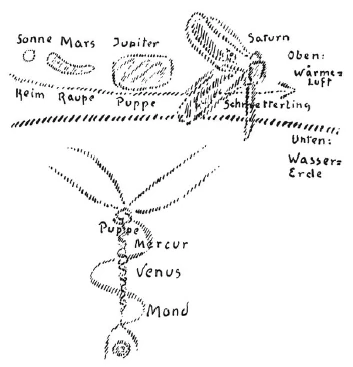
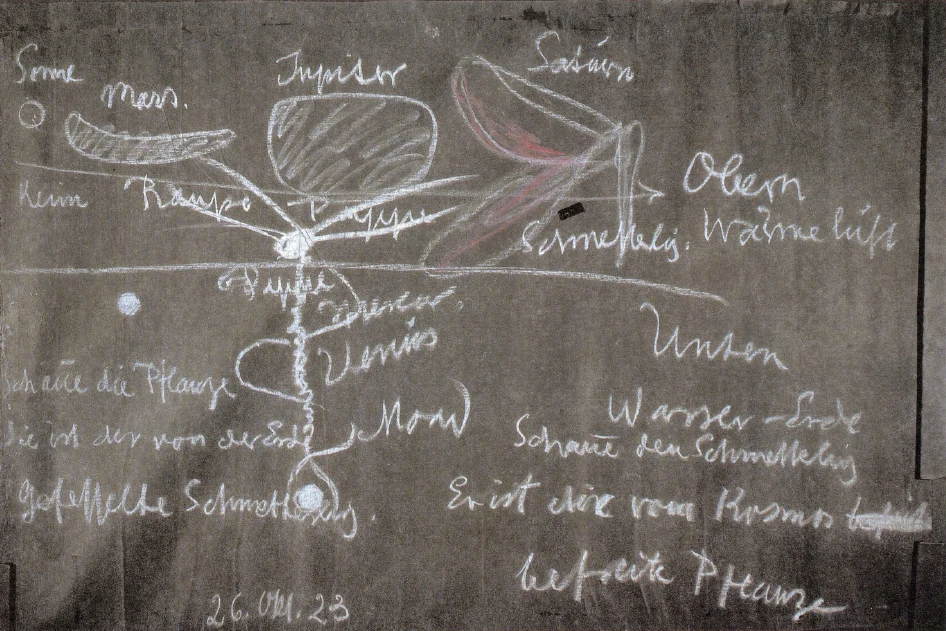
[ 20 ] Well, let’s assume that all of this belongs to the Upper Realm: heat and air; now let’s consider the Lower Realm: water and earth. Let us consider those seeds that were destined to be entrusted to the earth—Table 6, center—while others were withheld and entrusted not to the earth but only to the sun within the earthly realm.
[ 21 ] Let us now consider those seeds that were entrusted to the Earth at the time when the third metamorphosis—the lunar metamorphosis—came into being. You see, these seeds came under the influence of the Earth’s action—the watery Earth-Moon action—just as the insect seeds came solely under the influence of the Sun’s action and that which is above the Sun. And because these seeds entered the realm of the Earth-water actions, they became plant seeds. And those seeds that remained in the upper regions remained insect seeds. And when the third metamorphosis then began, the plant seeds within the third metamorphosis of Earth’s development arose through what was transformed at that time from the solar into the lunar-Earthly. What you now have here under the influence of the extraterrestrial cosmos—this entire development from seed through caterpillar, through chrysalis, to butterfly—you can now trace as follows: As the seed becomes earthly, it is not the butterfly that develops, but rather, as the seed becomes earthly and is entrusted to the earth—no longer to the sun—the plant root develops, the first thing to emerge from the seed. And instead of the caterpillar crawling under the forces emanating from Mars, the leaf emerges, spiraling upward. The leaf is the caterpillar that has come under the influence of the earth. Look at the crawling caterpillar, and you have what corresponds in the higher realm to the lower—the plant leaf that metamorphoses out of what has become a root through the seed that has been transferred from the solar realm into the earthly realm.
[ 22 ] As you move further up, the parts become increasingly compressed toward the top, where the calyx is—that is, what is known as the pupa. And finally, the butterfly emerges within the flower, which is just as colorful as the butterfly up in the sky. The cycle is complete. Just as the butterfly lays its egg, so too does the seed within the flower develop into the next generation. You see: we look up into the air at the butterfly; we understand it as the plant raised up into the air. The butterfly, from egg to adult, is—under the influence of the sun and the upper planets—the same as the plant is below under the influence of the earth. When it reaches the leaf stage (see drawing), we have the influence of the moon from the earth, then the influence of Venus, and the influence of Mercury. Then it returns to the influence of the earth. The seed is once again under the influence of the Earth.
[ 23 ] So you see, we can put forward two sentences that express a great mystery of nature:
Look at the plant
It is the butterfly
bound to the earth.Look at the butterfly
It is the plant
set free by the cosmos.
[ 24 ] The plant—the butterfly bound to the earth! The butterfly—the plant freed from the earth by the cosmos!
[ 25 ] If one looks at the butterfly—or indeed any insect—from the seed to the fluttering insect itself: it is the plant lifted up into the air and shaped there by the cosmos. If one looks at the plant: it is the butterfly bound to the earth below. The egg is claimed by the earth. The caterpillar is transformed into the leaf structures. What is contracted is transformed into the chrysalis. Then what unfolds in the butterfly develops in the flower of the plant. No wonder there is such an intimate relationship between the world of butterflies and insects in general and the plant world. For in truth, those spiritual beings that underlie the insects and butterflies must say to themselves: “Here below are our kin; we must stand by them, we must unite with them; we must, while enjoying their sap and so on, unite with them, for they are our brothers.” They are the brothers who have descended into the earthly realm, who are bound to the earth, who have attained this other existence.
[ 26 ] And again, the spirits that animate the plants might look up at the butterflies and say: “These are the heavenly kin of the earthly plant.”
[ 27 ] You see, one can certainly say: An understanding of the world cannot arise from abstractions, for abstractions are not sufficient for understanding. For that which is at work in the cosmos is, in itself, the greatest artist. The cosmos shapes everything according to laws that, in the deepest sense, also satisfy the artistic sensibility. No one can understand the butterfly buried in the earth except by transforming abstract thoughts into artistic form. No one can understand the essence of the plant blossoms—lifted into the air by light and cosmic forces—as embodied in the butterfly unless they, in turn, can transform these abstract thoughts into artistic movement. Yet there remains, at any rate, something immensely uplifting when we contemplate this deep inner kinship between the things and beings of nature.
[ 28 ] There is something quite unique about seeing the insect perched on the plant and, at the same time, observing how the astral realm reigns over the plant’s blossom. There, the plant reaches out beyond the earthly realm. The plant’s longing for the heavens reigns over the shimmering, colorful petals. The plant itself cannot satisfy this longing. Then, from the cosmos, that which is the butterfly beams toward it. In it, as it gazes upon the butterfly, the plant sees the fulfillment of its own desires. This is that wondrous connection within the earthly environment whereby the longings of the plant world are satisfied at the sight of insects, particularly the world of butterflies. What the flower’s color yearns for—as it radiates its color out into the cosmos—is fulfilled for it as a realization of its longing when the butterfly, with its shimmering colors, comes toward it. Radiant, warmth-radiating longing; fulfillment streaming down from heaven: this is the interaction between the world of flowering plants and the world of butterflies. This is what we are meant to see in the earthly environment.
[ 29 ] Now that the transition to the plant kingdom has been achieved, I will soon be able to expand upon the reflections that have ranged from human beings to animals. We can now include the plant world and will thus gradually arrive at the relationship between human beings and the entire Earth. But for this, it was necessary, so to speak, to build a bridge from the fluttering plant of the air—the butterfly—to the butterfly rooted in the Earth, to the plant itself. The Earth-bound plant is the rooted butterfly. The butterfly is the flying plant. Once we have recognized this connection between the earthbound plant and the butterfly set free in the heavens, only then have we truly built the bridge between the animal world and the plant world, and only then can we most certainly look down with a certain indifference upon all the trivialities that constantly repeat themselves, such as the theories of spontaneous generation and the like. These prosaic concepts do not take us into the realms of the universe that we must reach. One can only reach into those realms when one is able to transform these prosaic concepts into artistic ones and then arrive at the idea of how, from the butterfly egg that sprang from the heavens—entrusted solely to the sun—the plant comes into being only later, as this butterfly egg undergoes metamorphosis: whereas it was once entrusted only to the sun, it is now entrusted to the earth.