

Humanity as the Harmony of the creative, formative, and shaping Word of the WorldGA 230
27 October 1923, Dornach
Translated by Steiner Online Library
Fifth Lecture
[ 1 ] These lectures deal with the inner connection between world phenomena and world beings, and you have already seen that this reveals many things of which those who focus solely on the outer world of phenomena can initially have no inkling. We have seen how, fundamentally, every kind of being—as we have shown with a few examples—has its role within the overall context of cosmic existence. Today, as a sort of recapitulation, let us take another look at the kinds of beings we have already discussed; let us consider what I have said in recent days about the nature of the butterfly. I have just elaborated on this nature of the butterfly in contrast to the plant being, and we have been able to see how the butterfly is actually a being that belongs to the light—the light as it is modified by the forces of the outer planets: Mars, Jupiter, and Saturn. So, if we truly wish to understand the butterfly in its essence, we must look up into the higher regions of the cosmos and say to ourselves: these higher regions of the cosmos bestow upon the Earth, grace the Earth with the butterfly being.
[ 2 ] But now, I would say, this blessing of the earth actually runs much deeper. Let us recall, as we had to point out, that the butterfly does not actually participate in immediate earthly existence, but only indirectly, insofar as the sun, with its warmth and luminosity, is active precisely within earthly existence. The butterfly even lays its eggs where they do not leave the sphere of the sun’s influence, where they remain within that sphere, so that the butterfly does not entrust its egg to the earth, but actually only to the sun. Then the caterpillar emerges, which is under the influence of Mars; of course, the influence of the Sun remains present at all times. The chrysalis forms, which is under the influence of Jupiter. The butterfly emerges from the chrysalis, and in its iridescent colors it reflects, in the Earth’s surroundings, what the Sun’s luminous power—united with the power of Saturn—can be for the Earth.
[ 3 ] Thus, we actually see the influence of Saturn at work directly within earthly existence, in the context of earthly existence, in the manifold colors of our mortal existence. But let us remember that the substances relevant to worldly existence are of two kinds. We are dealing with the purely material substances of the Earth, and we are dealing with the spiritual substances; and I have told you that what is remarkable about this is that, with regard to the human organism of metabolism and limbs, the spiritual substance forms the foundation, whereas the physical substance forms the foundation of the head. In the lower nature of the human being, the spiritual substance is permeated by physical forces, by the force of gravity, and by other earthly forces. In the head, the earthly substance—which is carried up into the human head through the entire metabolic, circulatory, and nervous systems, and so on—is permeated by supersensible spiritual forces that are reflected in our thinking and our imagination. Thus, in the human head we have spiritualized physical matter, and in the metabolic-limb system we have—if I may coin the term—“earth-bound” spiritual-mental substance.
[ 4 ] Well, we find this spiritualized matter above all in the butterfly. Since the butterfly remains entirely within the realm of solar existence, it takes hold of earthly matter—I would say, though this is of course still a metaphor—only as if it were the finest dust. The butterfly appropriates earthly matter only as if it were the finest dust. It also obtains its nourishment from those substances of the earth that have been transformed by the sun. It unites with its own being only that which has been transformed by the sun; it extracts, so to speak, the very finest essence from all that is earthly and drives it to the most complete spiritualization. In fact, when one looks closely at a butterfly’s wing, one is essentially looking at the most spiritualized earthly matter. Because the matter of the butterfly’s wing is permeated with color, it is the most spiritualized earthly matter.
[ 5 ] The butterfly is, in fact, the being that lives entirely within spiritualized earthly matter. One can even perceive spiritually how the butterfly, in a certain sense, disregards its body—which lies amidst its colorful wings—because its entire attention, its entire group soul, actually rests in the joyful enjoyment of its wing colors.
[ 6 ] Just as one can follow the butterfly in admiration of its iridescent colors, one can follow it in admiration of the fluttering joy these colors bring. This is something that, fundamentally, should already be cultivated in children—this joy in the spirituality that flutters through the air, which is actually fluttering joy itself, joy in the play of colors. In this regard, the butterfly-like quality takes on wonderful nuances. And underlying all of this is something else.
[ 7 ] We could say of the bird, which we found represented in the eagle, that upon its death it can carry the spiritualized earthly substance into the spiritual world; that its purpose in cosmic existence is to spiritualize earthly matter as a bird and to do what human beings cannot do. Human beings have also spiritualized earthly matter to a certain degree within their heads, but they cannot take this earthly matter into the world they experience between death and a new birth, for he would have to endure an unspeakable, unbearable, and destructive pain if he were to carry this spiritualized earthly matter from his mind into the spiritual world.
[ 8 ] The bird world, represented by the eagle, is capable of this, so that a connection is indeed established between what is earthly and what is extraterrestrial. Earthly matter is first, so to speak, slowly transformed into spirit, and the bird kingdom has the task of handing this spiritualized earthly matter over to the universe. Once the Earth has reached the end of its existence, it will be possible to say: this earthly matter has been spiritualized, and the bird kingdom was present within the entire economy of earthly existence to carry the spiritualized earthly matter back to the realm of the spirits.
[ 9 ] There is something else to consider regarding butterflies. The butterfly spiritualizes earthly matter even more than the bird. After all, the bird is much closer to the earth than the butterfly. I will elaborate on this later. But because the butterfly never leaves the solar region, it is able to spiritualize its matter to such an extent that it releases continuously spiritualized matter into the Earth’s environment—into the cosmic environment surrounding the Earth—not only upon its death, as the bird does, but already during its lifetime.
[ 10 ] Just think how truly magnificent this is within the entire cosmic economy, if we can imagine it: the Earth, fluttered through by the world of butterflies in the most diverse ways, and spiritualized earthly matter continually streaming out into outer space—which the world of butterflies releases into the cosmos! So, through such an understanding, we can view this region of the butterfly world surrounding the Earth with entirely different feelings.
[ 11 ] We can look into this fluttering world and say to ourselves: You fluttering creatures, you radiate something even better than sunlight; you radiate spiritual light out into the cosmos! — After all, our materialistic science pays little attention to the spiritual realm. And so this materialistic science actually has no way of even beginning to address these things, which are part of the whole of the world economy. But they are there, just as the physical effects are there, and they are more essential than the physical effects. For what radiates out into the spiritual realm will continue to have an effect long after the Earth has perished; what the physicist and the chemist observe today will come to an end with earthly existence. So that if any observer were sitting out in the cosmos and had a long time to observe, he would see how something like a continuous radiation of spiritual matter into the spiritual realm—of matter that has become spiritual—takes place; how the Earth radiates its own essence out into outer space, into the cosmos, and how, like sparkling sparks—sparks that flash ceaselessly—that which causes the bird species, each bird after its death, to shine, now radiates outward into the universe in rays: a glimmer of butterfly spirit-light and a spray of bird spirit-light!
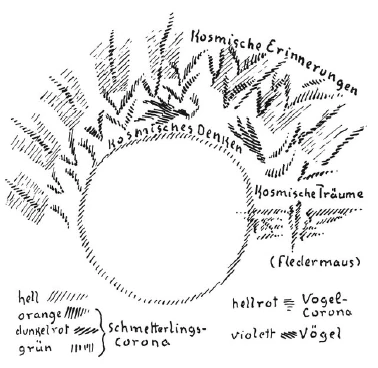
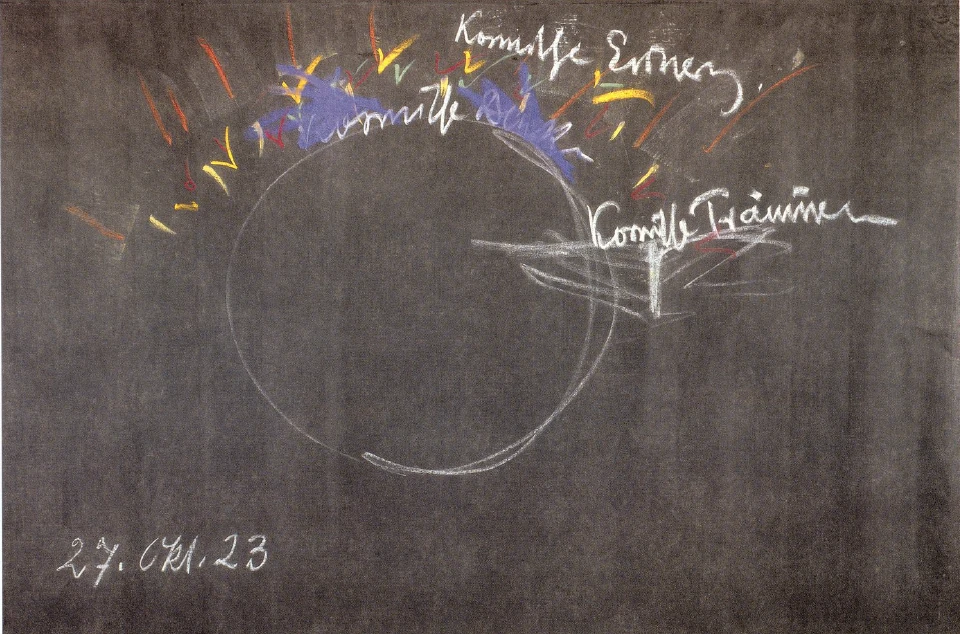
[ 12 ] These are the things that could, at the same time, draw our attention to the fact that when we look out toward the other stellar worlds, one should not believe that only what the spectroscope shows—or rather, what spectroscopists imagine into the spectroscope—is shining down there; rather, what shines down from the other starry worlds toward Earth is just as much the result of living beings in other worlds as what radiates out from Earth into outer space is the result of living beings. We look at a star and, along with today’s physicists, imagine something like an ignited inorganic flame—something like that. It is, of course, utter nonsense. For what is being observed there is indeed the result of living, animated, and spiritual beings.
[ 13 ] Let us now turn from this “butterfly belt,” if I may call it that, which encircles the Earth, back once more to the bird kingdom. If we consider what we already know, we have three contiguous regions. Above them are other regions, and below them yet other regions. We have the light ether, and we have the heat ether, which actually consists of two parts, two layers; one is the earthly heat layer, the other is the cosmic heat layer, and these are constantly interacting with one another. In fact, we do not have just one kind of heat, but two: the heat that is actually of earthly, telluric origin, and that which is of cosmic origin. These are constantly interacting with one another. Then, adjacent to the heat ether, we have air. Next come water and earth, and above them comes the chemical ether, the life ether.
[ 14 ] If we now consider the butterfly species, it belongs primarily to the light ether, and the light ether itself is the medium through which the luminous force draws the caterpillar from the butterfly egg; it is essentially the luminous force that brings it forth. This is not the case with the bird species. Birds lay their eggs. These must then be incubated by heat. The butterfly egg is simply left to the nature of the sun; the bird’s egg enters the realm of heat. The bird exists within the realm of the heat ether, and it actually overcomes what is mere air.
[ 15 ] The butterfly also flies through the air, but it is, in essence, a creature of light. And since the air is permeated by light, the butterfly, within this existence of light and air, chooses not the existence of air but that of light; the air is merely its medium. The air is the waves on which it, so to speak, floats about, but its element is light. The bird flies through the air, but its element is actually heat—the various temperature differences in the air—and to a certain degree it overcomes the air. The bird is, after all, an air being at its core. To a high degree, it is an air being. Take a look at the bones of mammals, the bones of humans: they are filled with marrow. We will speak more about why they are filled with marrow. Bird bones are hollow and filled only with air. So, insofar as what is inside our bones is concerned, we consist of marrow-like substance; the bird consists of air, and its marrow-like substance is pure air. If you examine a bird’s lungs, you will find within them a whole host of sacs extending from the lungs; these are air sacs. When the bird inhales, it does not merely breathe air into the lungs, but also into these air sacs, and from the air sacs the air flows into the hollow bones. So that if one could remove all the flesh and feathers from the bird and take away the bones, one would still be left with an animal consisting of air, which would have the shape of the internal lung structure and also the internal structure of all the bones. If one were to imagine it in this form, it would have the exact shape of the bird. Inside the eagle of flesh and bone sits an eagle of air. This is not merely because there is still an eagle of air inside, but because the bird breathes; through breathing, it generates heat. It imparts this heat to its air, which it then forces into all its limbs. This creates a temperature difference relative to the external environment. There is its internal heat, and there is the external heat. It is within this difference in temperature—between the external heat of the air and the heat it imparts to its own internal air—that is, within this difference in temperature within the heat element itself—that the bird actually lives. And if you were to ask the bird in an appropriate way how it is actually doing with its body, then it would answer you—if you understood the language of birds, you would already see that it does this—in such a way that you would recognize it is speaking of its solid, substantial bones and of what else it carries on itself, much as if you were laden on the left and right, on your back, and on your head with nothing but suitcases. You wouldn’t say then: “This is my body—the suitcase on the right, the suitcase on the left, and so on.” — Just as you do not speak of these things with which you are laden as if they were your body, but rather of how you carry them on yourself, so the bird, when it speaks of itself, speaks only of the air it warms, and of the other things as the baggage it carries with it in its earthly existence. These bones, which envelop this actual bird-air-body: that is its baggage. So we must certainly say: fundamentally, the bird lives entirely in the element of warmth, and the butterfly in the element of light. For the butterfly, everything that is physical substance—which it spiritualizes—is, before spiritualization, in fact even more so—one might say not even baggage, but rather household furnishings. It is even further removed from it.
[ 16 ] So as we ascend into this region, toward the beings in these regions, we encounter something that we must not judge in purely physical terms. If we were to judge it in a physical way, it would be something like trying to draw a person in such a way that we would depict his hair growing into whatever he’s wearing on his head, his suitcases fused with his arms, and his back fused with whatever he’s carrying as a backpack—so that we would make him completely hunched over, as if the backpack had grown out of his back. If we were to draw a person like that, it would correspond to the image that a materialist actually has of the bird. That is not the bird at all; that is the bird’s baggage. The bird actually feels as though it is struggling terribly under the weight of this baggage, for it would prefer to make its journey through the world free and unburdened, as a warm creature of the air. The other is a burden to him. And he pays tribute to his existence in this world by spiritualizing this burden and sending it off into the realm of spirits when he dies; the butterfly does so even during its lifetime.
[ 17 ] You see, the bird breathes and uses air in the way I have described to you. With the butterfly, it is different still. The butterfly does not breathe at all through structures such as those found in so-called higher animals; after all, these are merely the larger animals—they are not, in reality, the higher animals. The butterfly actually breathes only through tubes that extend inward from its outer covering and are slightly inflated, so that it can store air while flying, meaning it isn’t bothered by the fact that it doesn’t need to breathe constantly. It actually breathes only through tubes that lead into its interior. Because it breathes through tubes that lead into its interior, it is able to take in not only the air it inhales but also the light contained in the air throughout its entire body. There is also a major difference here.
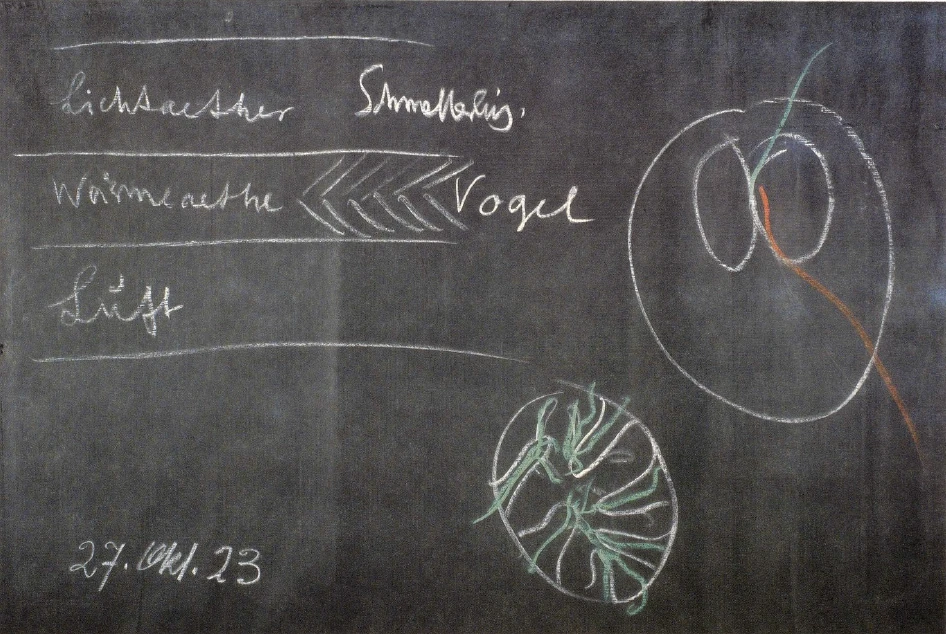
[ 18 ] To put it simply: Imagine a higher-order animal; it has lungs. Oxygen enters the lungs and mixes with the blood as it passes through the heart. The blood must flow into the heart and lungs to come into contact with the oxygen in these larger animals—and also in humans. With a butterfly, I have to draw it quite differently. I have to draw it like this: If this is the butterfly, the tubes enter everywhere; these tubes branch out further. And the oxygen now enters everywhere, branching out itself as well; the air penetrates the body everywhere.
[ 19 ] In us and in the so-called higher animals, air enters the lungs merely as air; in the butterfly, the external air, with its light-filled contents, spreads throughout its entire inner body. The bird spreads the air all the way into its hollow bones; the butterfly is not only an animal of light on the outside, but it also spreads the light carried by the air throughout its entire body, so that it is also light on the inside. If I were able to describe to you that the bird is actually internally warmed air, then the butterfly is actually entirely light. Its body, too, consists of light, and for the butterfly, warmth is actually a burden, baggage. It flutters entirely in the light and actually builds its body entirely from the light within. And when we see the butterfly fluttering in the air, we should actually be seeing mere beings of light fluttering—beings of light rejoicing in their colors and their play of colors. The rest is merely clothing and baggage. One must first realize what the beings of the earthly environment are actually made of, for outward appearances are deceptive.
[ 20 ] Those who have learned this or that so superficially today—let’s say from Eastern wisdom—speak of the world as Maya. But that really means nothing when one says, “The world is Maya.” One must see in the details how it is Maya. One understands Maya when one knows that, in its true nature, the bird does not actually look at all as it appears on the outside, but is rather a warm being of air. The butterfly does not look at all as it appears there, but is a being of light fluttering about, and whose very essence consists essentially of the joy of the play of colors—that play of colors that arises on the butterfly’s wing when the earthly dust-matter is permeated by color and thereby, at the first stage of spiritualization, extends out into the spiritual universe, into the spiritual cosmos.
[ 21 ] You see, there are, I would say, two levels: the butterfly, an inhabitant of the light ether in our earthly environment; and the bird, an inhabitant of the warmth ether in our earthly environment. And now the third type. When we descend into the air, we then encounter those beings who could not yet have existed during a certain period of our Earth’s evolution—for example, during the time when the Moon was still attached to the Earth, before the Moon had separated from the Earth. There we encounter beings who, although they are also air beings—that is, who live in the air—are in fact already quite strongly influenced by what is peculiar to the Earth, by Earthly gravity. The butterfly is not yet affected by Earthly gravity at all. The butterfly flutters joyfully in the light ether and perceives itself as a creature born out of the light ether. The bird overcomes gravity by warming the air within itself, thereby creating warm air, and warm air is carried by the cold air. It still overcomes the Earth’s gravity.
[ 22 ] Those animals which, although by virtue of their ancestry must still live in the air, cannot overcome the pull of gravity because they do not have hollow bones but rather bones filled with marrow, and because they do not have air sacs like birds—these animals are bats.
[ 23 ] Bats are a truly remarkable order of animals. Bats do not overcome the Earth’s gravity through the inner workings of their bodies. They are not as light as air as the butterfly is, nor are they as light as warmth as the bird is; they are subject to the Earth’s gravity and feel it in their very flesh and bones. That is why the element of which, for example, the butterfly is composed—the element in which the butterfly lives entirely, this element of light—is unpleasant to bats. They love twilight. They must use the air, but they prefer the air when it does not carry light. They surrender themselves to twilight. They are, in fact, creatures of twilight. Bats can only stay aloft because they have—I might say—those somewhat caricature-like bat wings, which are not real wings at all, but stretched-out membranes, membranes stretched between their elongated fingers, like parachutes. This is how they stay aloft. In this way, they overcome gravity by counterbalancing it with something that is itself connected to that very gravity. But as a result, they are completely bound up in the realm of earthly forces. You can never actually construct the flight of a butterfly—or that of a bird, for that matter—simply based on physical-mechanical designs. It will never be entirely accurate. You have to incorporate something that also includes other designs. But the flight of a bat—that you can certainly construct using earthly dynamics and mechanics.
[ 24 ] The bat does not love the light or the light-filled air, but at most the twilight air slightly tinged with light. The bat differs from the bird in that when the bird looks, it is actually always focused on what is in the air. Even the vulture, when it sees the lamb, perceives the lamb as something at the edge of the airspace; when it looks down from above, the lamb appears as if painted onto the earth. Moreover, it is not mere seeing; it is a desire that you will perceive if you truly observe the vulture’s flight as it heads toward the lamb—a flight that embodies a distinct dynamism of volition, will, and desire. j
[ 25 ] The butterfly sees everything on Earth as if in a mirror; for the butterfly, the Earth is a mirror. It sees what is in the cosmos. When you see the butterfly fluttering, you should actually imagine this: it pays no attention to the Earth—the Earth is a mirror. The Earth reflects to it what is in the cosmos. The bird does not see what is earthly, but it sees what is in the air. The bat is just beginning to perceive what it flies through or past. And since it does not like light, it is actually disturbed by everything it sees. One could certainly say that the butterfly and the bird see in a very spiritual way. The first animal, coming down from above, that must see in an earthly way, is disturbed by this seeing. The bat does not like to see, and therefore it has—I would say—a kind of embodied fear of what it sees and does not want to see. It wants to flit right past things: having to see and not wanting to see—it wants to squeeze past everything. That is why, because it wants to squeeze past everything, it wants to listen so intently to everything. The bat is, in fact, an animal that constantly listens to its own flight, to see if that flight is in any way endangered.
[ 26 ] Look at the bat’s ears. You can tell by looking at them that they are attuned to a fear of the world. That’s what they are—these bat ears. They are quite strange structures; they are truly attuned to creeping through the world, to a fear of the world. You can only understand all this when you view the bat in the context in which we are now placing it.
[ 27 ] We need to say a little more about this. The butterfly continually releases spiritualized matter into the cosmos, and it is the favorite of Saturn’s influences. Now, remember how I have explained here that Saturn is the great bearer of our planetary system’s memory. The butterfly is entirely connected to our planet’s capacity for memory. These are the thoughts of memory that live within the butterfly. The bird—as I have also explained to you—is, in its entirety, essentially a head, and in this warm air through which it flies through the cosmos, it is, in fact, the living, flying thought. What we have within us as thoughts—which is also connected to the warmth ether—is the bird-nature, the eagle-nature within us. The bird is the flying thought. The bat, however, is the flying dream, the flying dream image of the cosmos. So that you can say: The Earth is interwoven with butterflies—they are the cosmic memory; with the bird species—it is cosmic thinking; and with the bat—it is the cosmic dream, cosmic dreaming. Indeed, it is the flying dreams of the cosmos that whiz through space as bats. Just as the dream loves the twilight, so does the cosmos love the twilight, sending the bat through space. The enduring thoughts of memory—we see them embodied in the Earth’s butterfly belt; the thoughts living in the present, in the Earth’s bird belt; the dreams in the Earth’s surroundings fly about embodied as bats. Just feel, when we truly immerse ourselves in their form, how closely related this contemplation of a bat is to dreaming! One cannot look at a bat without the thought occurring to one: “You are dreaming, aren’t you?”; for it is, in fact, something that ought not to be there, something as far removed from the rest of nature’s creatures as a dream is from ordinary physical reality.
[ 28 ] We can therefore say: The butterfly sends the spiritualized substance into the spirit realm during its lifetime; the bird sends it out after its death. What, then, does the bat do? The bat secretes the spiritualized substance—especially that spiritualized substance which lives in the taut membranes between its individual fingers—during its lifetime, but does not release it into the cosmos; rather, it secretes it into the Earth’s atmosphere. As a result, “spiritual pearls,” so to speak, are continually formed in the Earth’s atmosphere. And so we have surrounded the Earth with this continuous glow of the butterfly’s emanating spiritual matter, spraying into it that which comes from the dying birds, but reflecting back toward the Earth the peculiar inclusions in the air—where the bats secrete what they have spiritualized. These are the spiritual forms one always sees when watching a bat fly. In fact, it always has something like a tail trailing behind it, much like a comet. It secretes spiritual matter, but does not send it away; rather, it pushes it back into the physical matter of the Earth. It pushes it back into the air. Just as one sees the physical bat fluttering with the physical eye, so too can one see these corresponding spiritual forms of the bats fluttering through the air; they whiz through the airspace. And while we know that the air consists of oxygen, nitrogen, and other components, that is not all; it also consists of the spiritual influence of the bats.
[ 29 ] As strange and paradoxical as it may sound: this dream-like species of bats sends little ghosts into the air, which then merge into a single mass. In geology, what lies beneath the earth—a mass of rock that is mushy—is called magma. One could speak of a “ghost magma” in the air, originating from the emissions of the bats.
[ 30 ] In ancient times, when instinctive clairvoyance existed, people were very sensitive to this spiritual magma, just as some people today are still sensitive to more material things, such as unpleasant odors; except that one might regard the latter as something—I would say—more plebeian, whereas in the ancient era of instinctive clairvoyance, people were sensitive to what remains of bats in the air.
[ 31 ] They protected themselves against this. And in some mysteries, there were very special formulas through which people sealed themselves off inwardly so that these bat remnants would have no power over them. For as human beings, we do not merely inhale oxygen and nitrogen with the air; we also inhale these bat remnants. However, people today are not interested in protecting themselves from these bat remnants; rather, while they may be quite sensitive to certain things—I mean, to smells—they are highly insensitive to bat remnants. They swallow them up, one might even say, without feeling the slightest bit of disgust. It is quite strange: people who are otherwise quite squeamish swallow up what I am talking about here to their heart’s content. But this then also enters into the human being. It does not enter the physical or etheric bodies, but it does enter the astral body.
[ 32 ] Yes, as you can see, we’re arriving at some strange connections here. Initiatory science leads us deep into the inner workings of these connections: these bat remains are the most coveted food of what I have described to you in these lectures as the dragon. But first, these bat remains must be inhaled into the human being. And the dragon finds its strongest footholds in human nature when a person allows these bat remains to permeate their instincts. They gnaw away inside. And the dragon devours them and thereby grows fat—spiritually speaking, of course—and gains power over the human being, gaining power in the most manifold ways. And so it is that modern human beings, too, must once again protect themselves. This protection is to come from what has been described here as the new form of Michael’s struggle with the dragon. The inner strength that a person gains by taking in the Michael impulse as described here protects them against the nourishment the dragon is meant to receive; thus, they protect themselves against the unjustified “bat remnants” within the atmosphere.
[ 33 ] One must not shy away from drawing out the truths from the inner context of the world if one truly wishes to penetrate this inner context. For the form of truth-seeking that is generally accepted today leads to nothing real at all, but mostly only to something not even dreamt of—namely, Maya. Reality must certainly be sought in the realm where one sees all physical existence played out through spiritual existence. There, one can only approach reality by viewing it as is done in these lectures.
[ 34 ] Beings that exist somewhere exist for some good or some evil. Everything is so interwoven within the fabric of the universe that one can see how it is connected to other beings. To the materialist, butterflies flutter, birds fly, and bats flutter about. But it is almost like what sometimes happens with a person who lacks an appreciation for art, when they hang their room full of all sorts of pictures that do not belong together, that have no inner connection. Thus, for the ordinary observer of the world, what flies through the world has no inner connection either, because he does not see one. But everything in the cosmos is in its proper place, because from that place it has an inner connection with the totality of the cosmos. Whether butterfly, bird, or bat, everything exists in the world with some kind of meaning.
[ 35 ] Let those who wish to mock such things today go ahead and mock them. People have done worse things when it comes to mockery. Famous academies have passed judgment: meteorites cannot exist because iron cannot fall from the sky, and so on. Why shouldn’t people also mock the functions of bats, which I have spoken about today? But none of this should deter us from truly permeating our civilization with an understanding of the spiritual.