Humanity as the Harmony of the creative, formative, and shaping Word of the WorldGA 230
28 October 1923, Dornach
Translated by Steiner Online Library
Sixth Lecture
[ 1 ] Before we now turn to considering the other animal, plant, and mineral beings connected to human beings in earthly existence, we must today take a look at the evolution of the human being itself and reflect on certain points that are already familiar from the various presentations I have given, both orally and in writing, but which must now be compiled here in a clear and concise manner.
[ 2 ] If we wish to learn from external science today, it is usually the case that we are told we must investigate how the higher, so-called higher beings—say, of the plant kingdom, then the animal kingdom, and the human kingdom—developed from inanimate, so-called inorganic substances or forces.
[ 3 ] A true understanding of evolution reveals something quite different. As you can already see from my *Outline of Esoteric Science*, it shows that human beings, as they stand before us today, are the beings that have undergone the longest evolution, an evolution that dates back to the ancient Saturn era. Thus, we must say: Human beings are the oldest creatures within the evolution of the Earth. It was not until the Sun era that the animal kingdom came into being, and during the Moon era that the plant kingdom emerged; and the mineral kingdom, as we know it today, is actually a product of the Earth itself, having come into being only during the Earth’s evolution.
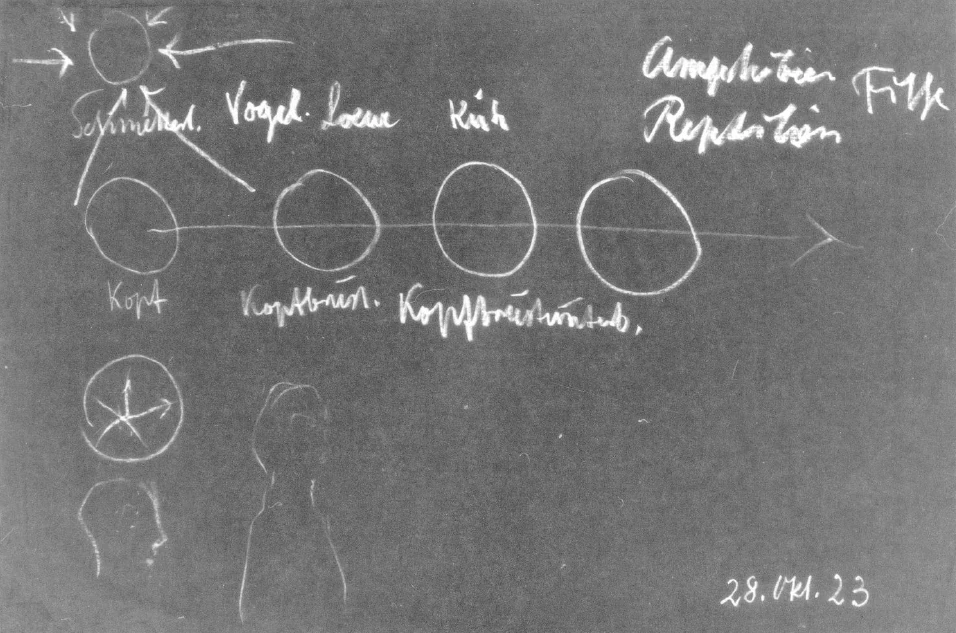
[ 4 ] Now let us take a look at human beings in their present form and ask ourselves: From an evolutionary perspective, what is the oldest part of the human being? It is the human head. This human head received its first rudiments during the time when the Earth was still in the Saturn metamorphosis. However, the Saturn metamorphosis consisted solely of heat substance, and the human head was actually surging, weaving, undulating warmth; it then took on an air-like form during the Sun era, assumed a liquid form—that is, it was a fluid, flowing entity—during the Moon era, and acquired its solid form with the inclusion of bones during the Earth era. Thus, we must say: A being—of which it is, however, difficult to form a conception today based on external observations—existed in the ancient Saturn era, a being whose descendant is the human head. Simultaneously with this formation of the human head—as you can gather from my recent explanations—and with this fundamental structure of the human head, the predispositions for the butterfly being arose during the ancient Saturn era. We will examine the other insect being in greater detail later; for now, let us focus on the butterfly being. Thus, we can trace the development from the ancient Saturn era to the present day, into earthly existence, and must then say: There, in a subtle, substantial form, the human head takes shape in its rudimentary form; there, everything that flits through the air as a butterfly being takes shape. — Both evolutions continue. The human being internalizes, so that he becomes more and more a being who expresses the revelation of a soul-life that flows from the inside out, schematically represented something like this: a being who develops radiantly from the inside out. The butterfly being, on the other hand, is a being onto whose outer surface the cosmos—I might say—unloads all its beauties. The butterfly is a being that, so to speak, has been imbued through its wing dust with all the beauty and majesty present in the cosmos in the manner I have described to you. We must therefore imagine the butterfly as, in a sense, a mirror image of the beauties of the higher cosmos. While the human being takes in and encloses within itself that which is the higher cosmos—which becomes inner and soulful, soulful like the concentration of the cosmos—and which then radiates outward and takes form in the human head, so that in the human head we have something formed from the inside out, in the butterfly we have that which is formed from the outside in. And for those who view these things through the eyes of a seer, it is indeed the case that they learn something truly immense when they proceed in the following manner, when they say: I want to fathom the mysteries—the most ancient mysteries, the Saturn mysteries—of the human head; I want to know what forces have actually been at work within the skull. — He must allow himself to be guided by what is visible everywhere on the outside, by what radiates outward from everywhere, and study the nature of the butterfly. To come to know the wonders of your own head, study the wonders of how the butterfly comes into being out in nature: that is, in a sense, the great lesson that the cosmos imparts through clairvoyant observation.
[ 5 ] As evolution then progresses from the Saturn era to the Sun era, a being emerges that undergoes further development—an aerial transformation, an aerial metamorphosis of the head; but it is integrated into a fine substance that later becomes the chest structures, the respiratory and cardiac structures of the human being. So here in the Saturn era—we still essentially have the metamorphosis that constitutes the human head. But that is, of course, the later form. As we move up to the Solar Age, we have the head-chest human; what is now the human chest begins to take shape. At the same time, however, already in the late Saturn Age and the early Solar Age, that which we now see represented by the eagle begins to emerge. The bird species emerge in the first Solar Age, and in the second Solar Age the first rudiments of those animal species emerge that are true thoracic animals, such as the lion, for example—the lion as a representative, but also other thoracic animals. Thus, the first rudiments of these animals date back to the ancient Solar Age.
[ 6 ] From this you can see what an enormous difference exists in the development of even the higher animals and humans. I will speak more about the transitional animals—which, of course, include the ape family—in the future, but today I simply want to provide a summary. You can see what an enormous difference there is between human development and the development of higher animals.
[ 7 ] In humans, the first thing to develop in the course of evolution is the head. The rest become accessory organs that, so to speak, attach themselves to the formation of the head. In cosmic evolution, the human being grows downward from the head. The lion, on the other hand—for example, during the Old Sun period, specifically the second half of the Old Sun period—is an animal that initially develops as a thoracic animal, a powerful respiratory animal with a head that is still very small and underdeveloped. Only when the Sun later separates from the Earth and begins to act from the outside does the head emerge from the chest. Thus, the lion develops by growing upward from the chest, while the human being develops by growing downward from the head. This is a tremendous difference in the overall course of evolution.
[ 8 ] As we proceed to the Earth’s lunar metamorphosis—since the Moon represents the water metamorphosis and is watery in nature, though it later becomes calloused—human beings require, from this point onward, a further continuation downward. The foundation of the digestive system is formed. During the ancient solar era, when there was only light-permeated, light-translucent, airy substance, human beings required for their sustenance only a respiratory system closed off at the bottom; the human being was a head and a respiratory organ. Now, during the lunar era, the digestive system is incorporated into the human form. With this, however, the human being comes to consist of head, chest, and abdomen. And since everything in the Moon is still a watery substance, during this Lunar period the human being has appendages that carry him floating through the water. One can speak of arms and legs only during the Earth period, when gravity takes effect and shapes what, above all, aligns itself with the directions of gravity—the limbs. This, then, belongs to the Earth period. During the Lunar period, however, the digestive system develops—still of a very different nature than it will be later—in such a way that this human digestive system does not yet need to process everything required for the free, voluntary mobility of the limbs. It is still a fundamentally different digestive system; it later transforms into the digestive system that is the Earth digestive system. But during the Lunar period, the human being develops this digestive system.
[ 9 ] Once again, it is the case that, in addition to the descendants of butterflies, birds, and those species of which the lion is a representative, there are now those animals that are primarily inclined toward digestion. So, in addition to these, during the lunar phase we have, for example, what we have represented by the cow.
[ 10 ] But how, in contrast to humans, does a cow grow? It is the case that during this old lunar phase, the cow primarily develops its digestive system; then, after the moon has separated, the mammary glands and the uniquely shaped head grow out of the digestive system. Whereas in humans, development begins with the head, followed by the chest and its metamorphoses, and then the digestive organs; whereas the lion begins with the chest organs, followed by the head, and develops the digestive organs simultaneously with the human during the lunar phase; in those animals represented by the cow, the digestive organs are the first to form, and then, growing out of them, the chest and head organs are formed. So you see, the human being grows from the head downward, the lion from the chest upward and downward; the cow grows from the digestive organs all the way into the chest and only then into the head—growing, so to speak, when we compare it to the human being, entirely upward, toward the heart and head. This provides an insight into human development.
[ 11 ] Now, of course, the question arises: Is it only the cow that joins in, like a comrade, in the evolution of humankind? — That is not merely the case; rather, whenever any such planetary metamorphosis occurs, the old beings continue to develop, but at the same time new ones emerge. The cow comes into being during the very first lunar metamorphosis. But then other animals join them, which receive their very first potential during the last lunar metamorphosis. They can no longer, for example, participate in the moon’s emergence, because it is already outside. Consequently, they cannot participate in what this emergence of the moon brings about—namely, that it, so to speak, draws the heart organs and the head organs out of the cow’s belly—but the beings that appear later remain at the stage that is fixed in humans through digestion. Thus, beings arise that essentially remain merely digestive animals, remaining at the stage that humans carry within their lower abdomen.
[ 12 ] Just as the eagle and the butterflies are associated with the head, just as the lion is associated with the chest, and the cow with the abdomen—but, I would say that just as the animal that, in later evolution, allows all the upper aspects to grow within itself at the same time, so too are amphibians and reptiles—that is, toads, frogs, snakes, lizards, and so on—assigned, if I may use the expression, solely to the human abdomen, the human digestive system. There, pure digestive systems are emerging as animals.
Butterfly, bird. Lion, cow. Reptiles, amphibians. Fish
Saturn: Sun: Moon: Head
Head-chest, head-chest-abdomen
[ 13 ] They also come into being during the second lunar period in a highly rudimentary form; they are essentially walking stomachs and intestines, walking stomachs and intestinal tracts. It is only later, during the Earth period, that they acquire their head parts—which, even then, do not look particularly refined. Just look at the frogs and toads, or the snakes! They do indeed emerge quite late as digestive animals, whereas human beings, so to speak, can only attach their digestive systems to what they already had before.
[ 14 ] During the Earth period, when humans develop their limbs under the influence of gravity and the Earth’s magnetism, the turtles—let’s take the turtle as an example—also extend their heads out from above their shells, more like a limb than a head. This helps us understand why, in amphibians and reptiles, the head is so rudimentary in form. It is actually designed in such a way that one really does have the feeling—and rightly so—that from the mouth one enters directly into the stomach. There is not much of a transition.
[ 15 ] So when one considers human beings and classifies their nature among the animal kingdom, one must attribute the human digestive process to that which is contained within reptiles and amphibians. And indeed, one can say: Just as human beings carry the products of their digestion around in their intestines, so the cosmos, by way of the Earth, carries toads, snakes, and frogs, as it were, around in the cosmic intestines that it forms within the watery-earthly element of the Earth. In contrast, that which is more closely connected with human reproduction—which first takes shape in its very earliest form during the very last Lunar Epoch and only emerges during the Earth metamorphosis—is related to the fish, the fish and even lower animals. Thus we must regard fish as latecomers in evolution—as beings that join the other animals in the evolutionary process only when, in humans, the reproductive organs join the digestive organs. The snake is essentially the mediator between the reproductive organs and the digestive organs. When we look deeply into human nature, what does the snake represent? The snake represents the so-called renal duct; it arose during the same period of world evolution in which the renal duct developed in humans.
[ 16 ] In this way, we can truly observe how human beings, beginning with their head, grow downward, how the earth draws out their limbs and puts them to work, so that these limbs become integrated into the earth’s equilibrium of gravity and magnetic forces. And simultaneously with this downward growth, the various classes of animals take shape.
[ 17 ] You see, this is how one gains a true picture of the Earth’s evolution and its creatures. In accordance with this evolution, these creatures have developed in such a way that they show us what exists today. When you look at butterflies and birds, they do indeed have earthly forms; but you know from the earlier description: the butterfly is actually a being of light, and earthly matter has merely clung to it. If it could tell you itself what it is, it would declare that it has a body of light, and that, as I have already said, it carries what has clung to it as earthly matter—like baggage, like something external—upon itself. Likewise, the bird is, one might say, a warm-air creature, for the true bird is the warm air that is spread out within the bird; the other is its baggage, which it drags through the world. These beings, which even today have preserved their nature of light and warmth only through an earthly covering, an earthly garment, and a watery garment—these entities arose earliest in the entire evolution of the Earth. These beings also have forms that remind those who can now look back into the time that human beings spend in the spiritual world before their descent into earthly life of what was experienced in the spiritual world. Certainly, they are earthly forms, for earthly matter has attached itself to them. But if you truly visualize the floating, fluttering beings of light that are the butterflies—if you set aside what has adhered to them from the earthly realm; if you set aside from the bird what has adhered to it from the earthly realm; if you conceive of this mass of energy that makes the bird a warm being of air, with what then constitutes its plumage, as nothing but luminous rays—if you imagine this, then these beings, who look the way they do solely because of their outer covering and possess their size only because of this outer covering, remind those who are also familiar with the human being before its descent to Earth of that human being’s descent to Earth. Then the one who looks into the spiritual world in this way says to himself: In butterflies and birds, we have something that reminds us of those spirit forms among which the human being lived before descending to Earth—the beings of the higher hierarchies. When viewed with understanding, butterflies and birds are a memory—transformed and reduced to a smaller scale—of those forms that surrounded us as spiritual forms before we had descended into earthly evolution. Because earthly matter is heavy and must be overcome, butterflies contract their gigantic form—which they actually possess—into a smaller one. If you could separate everything that is earthly matter from a butterfly, it would indeed be able to expand into the form of an archangel—as a spiritual being, as a being of light. Even in those animals that inhabit the air, we find earthly reflections of what exists in higher regions in a spiritual form. Therefore, during the era of instinctive clairvoyance, it was a natural artistic endeavor to create, from the forms of flying animals, the symbolic and pictorial forms of the spiritual beings of the higher hierarchies. This has its inner justification. Essentially, the physical forms of butterflies and birds are precisely the physical metamorphoses of spiritual beings. It is not the spiritual beings themselves that have undergone metamorphosis, but the metamorphosed images of them; these are, of course, different entities.
[ 18 ] You will therefore understand why, returning to something I have already mentioned, I would like to outline the following for you once more. I told you that the butterfly—which is actually a being of light—constantly sends out spiritualized earthly matter into the cosmos throughout its life. I would now like to call this spiritualized earthly matter, which is sent out into the cosmos, the “butterfly corona,” borrowing a common term from solar physics. Thus, the butterfly corona radiates continuously out into the cosmos. But radiating into this butterfly corona is what the bird kingdom releases into the cosmos every time a bird dies, so that the spiritualized matter of the bird kingdom radiates into it and out into the cosmos. From the outside, spiritually speaking, one then has the sight of a glowing corona emanating from the butterfly species—which, according to certain laws, persists even in winter—and, arranged in a more radiant pattern, what flows out from the birds.
[ 19 ] You see, when a human being prepares to descend from the spiritual world into the physical world, it is first and foremost the butterfly corona—this peculiar radiance of spiritualized earthly matter—that calls the human being into earthly existence. And the rays of the bird corona are perceived more as forces drawing one in. Now you can see an even higher significance in what lives in the air realm. One must simply seek the spiritual everywhere in what lives and weaves in reality. And when one seeks the spiritual, only then does one truly come to understand the significance of the individual realms of being. In a sense, the Earth lures human beings into reincarnation by sending out the luminous radiance of the butterfly corona and the radiance of the bird corona into the cosmos. These are the forces that, after a person has spent some time in the purely spiritual world between death and a new birth, call them back into a new earthly existence. It is therefore no wonder that human beings find it difficult to unravel the complex feeling they rightly experience when beholding the world of butterflies and birds. For what is truly there lies deep in the subconscious. What is truly there is the memory of the longing for a new earthly existence.
[ 20 ] And this, in turn, is connected to what I have often explained to you: that after a human being has departed from the earth through the gate of death, their head is actually dispersed, so that the rest of their organism—according to its forces, not its matter—is transformed into the head of their next earthly existence. So the human being actually strives toward the head as he descends. And the head is the first thing to develop in the human embryo in a form that already resembles the later human form. The fact that all this is so is connected to the fact that this development toward the head is intimately related to what acts and weaves in the world of flight, through which the human being is actually drawn from the supersensible into sensory existence.
[ 21 ] Then, once the human being has initially developed the head structure during its embryonic stage, the digestive system and so on form out of the earthly existence, situated within the mother’s body. Just as what is above—the formation of the head—is connected with the warmth-like, the air-like, and the warmth-light-like elements, so too is what is then a replica of what is later incorporated into the human being during evolution—and what is now newly incorporated during the embryonic period—connected with the earth-moist element. This earth-moist element, however, must first be prepared for the human being in a very special way—namely, within the mother’s body. If it were to form on its own, scattered outside in the telluric, in the earthly realm, it would develop into the lower animal forms—the amphibians and reptiles—and then into fish and even lower animals.
[ 22 ] While the butterfly rightly regards itself as a being of light and the bird as a being of warm air, the lower animals—the amphibians, reptiles, and fish—cannot do so. Let us first take a look at the fish. As they are today, they are left to develop externally, so to speak, subject to external formation, where forces acting upon them from the outside correspond to those that act upon human beings from within. Fish live primarily in the watery element. But water is not merely what hydrogen and oxygen are in their chemical composition to the chemist; rather, water is permeated by all manner of cosmic forces. The forces of the stars also make their presence felt in the water, and no fish would live in water if it were merely a homogeneous mixture of hydrogen and oxygen. But just as the butterfly feels itself to be a being of light, and the bird a being of warm air, so does the fish actually feel itself to be an earthly-aquatic being. It does not perceive the actual water it absorbs into itself as its essence.
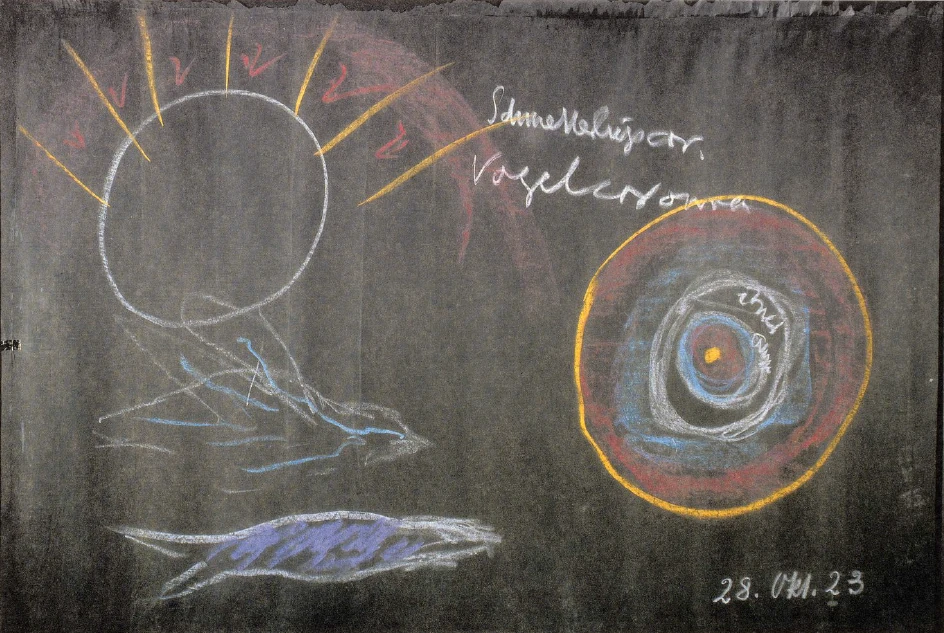
[ 23 ] The bird perceives the air it inhales as its very essence. Schematically speaking, the bird thus perceives what enters it as air—what spreads everywhere—as its very essence; this spreading air, warmed by the bird (see blue illustration), is its very essence. The fish has water within itself, but the fish does not feel itself to be the water; the fish feels itself to be that which encloses the water—it feels itself to be the environment of the water. It feels itself to be this glittering shell or covering of the water. But it feels the water as an element foreign to itself, which flows in and out of it, and in flowing in and out of it, simultaneously brings it the air it needs. Yet it perceives both air and water as something foreign. As a physical fish, it initially perceives them as something foreign. But the fish also has its etheric and astral bodies. This is precisely what is unique about the fish: because it actually perceives itself as the shell, and the water within it remains connected to the rest of the aqueous element, it perceives the ether as that in which it actually lives. He does not, then, perceive the astral as something that belongs to him. But the fish is the peculiar animal that is truly an etheric creature. In and of itself, it is the physical shell for the water. It perceives the water within itself as belonging to all the waters of the world. In a sense, moisture extends everywhere around it. Moisture is, after all, everywhere, and within this moisture it simultaneously perceives the ether (see purple illustration). Fish are, of course, mute in earthly life, but if they could speak and tell you how they feel, then the fish would say to you: “I am a shell, but the shell contains a water element that spreads everywhere, which is the bearer of the etheric element.” I actually swim in the ether.” — The fish would say: “The water is only Maya; reality is the ether, in which I actually swim.” — So the fish experiences its life as the life of the Earth. That is what is unique about the fish: it feels its life as the life of the Earth, and therefore it participates intimately in everything the Earth goes through in the course of the year—this outward flow of the etheric forces in summer, this withdrawal of the etheric forces in winter. So the fish feels something that breathes throughout the entire Earth. The fish perceives the ether as the Earth’s breath.
[ 24 ] Dr. Wachsmuth once spoke here about the Earth’s breathing. It was a very beautiful discussion. From his own experience, a fish could have presented this here, had he learned the art of public speaking; for he perceives everything that was presented there through his observation of the corresponding phenomena. The fish is the animal that participates in the Earth’s respiratory life throughout the course of the year in a truly extraordinary way, because for the fish, what matters most is precisely the etheric life element that ebbs and flows, and which carries along only that which also breathes.
[ 25 ] The situation is different with reptiles and amphibians—frogs, for example, which are exceptionally characteristic in this regard. They are less connected to the etheric element of the cosmos and more connected to the astral element of the cosmos. If you ask a fish, “How are things with you, actually?”—it will say, “Well, here on Earth I am a creature incarnated in the physical world, formed from the earthly, moist element; but my true life is the life of the entire Earth with its cosmic breathing.”—It is not like that with the frog; with the frog, it is fundamentally different. The frog participates in the universally pervading astral realm.
[ 26 ] I mentioned this to you in connection with plants, and I will speak further about how the astral nature of the cosmos above influences the flower. The frog is connected to this astral nature—to the astral body of the Earth, so to speak—in the same way that the fish is connected to the etheric body of the Earth. The fish has its astral nature more to itself. The frog actually has its etheric body very strongly to itself, much more so than the fish; but the frog lives within the general astral realm; so that it experiences, in particular, those astral processes that unfold over the course of the year, when the Earth allows its astral nature to play out in the evaporation of water and in the return of water to the surface. Of course, the materialistically minded person will say: Water evaporates due to this or that aerodynamic—or, if you will, aeromechanical—force; this causes the upward movement. Droplets form; when they become heavy enough, they fall back down. But that is roughly the same as if one were to propose a similar theory about the human circulatory system without taking into account that everything is alive within the bloodstream. Thus, the astral atmosphere of the Earth—the astral nature of the Earth—lives within the cycle of water rising and falling. I am not telling you something fantastical when I say: it is precisely the frogs—though this is also present in other amphibians, albeit to a lesser extent—that participate in this astral interplay, which manifests itself in weather conditions and meteorology. Not only are they, as you know, used in the familiar, simple way as weather prophets—because they experience this interplay wonderfully by being immersed, through their astral nature, in the Earth’s astral nature—but the frog does not say at all that it has a feeling; rather, the frog is merely a carrier of the feelings that the Earth has during rainy periods, dry periods, and so on. That is why, under certain weather conditions, you also have the more or less beautiful or ugly frog concerts. These are essentially the frogs’ expression of what they experience in the Earth’s astral body. They truly do not croak without having a reason for it originating from the entire cosmos; they live through the Earth’s astral reality.
[ 27 ] Thus we can say: Whatever lives in the earthy-moist element does, in fact, experience the earthly realm to a greater extent; that is, the earthly conditions of life in the case of the fish, the earthly sensory conditions in the case of the frog, and in general among the reptile and amphibian species. On the other hand, if one wishes to study the entire human digestive system, one must say: this digestive system, in turn, develops from the inside out according to this same pattern. But anyone who truly wishes to study how things function must turn to the amphibian and reptilian kingdoms, for they are shaped from the outside by the forces that humans channel through their digestive organs. With the very same forces by which humans digest, the outer cosmos—outer nature—forms snakes, toads, lizards, and frogs. And anyone who truly—forgive me, but in nature nothing is ugly; rather, everything must be discussed objectively—anyone who wishes to study the inner nature, let us say, of the human large intestine with its powers of secretion must study toads externally, for what affects the toad externally is what acts from the inside out in the human large intestine according to this pattern. It is not as beautiful in its description as what I had to describe regarding butterflies; but in nature, everything must simply be accepted with objective impartiality.
[ 28 ] You see, this gives you a picture of how the Earth, for its part, experiences cosmic life. For consider the Earth’s excretory organs, so to speak: the Earth not only excretes the short-lived human waste products, but it also excretes living beings, and its actual excretions are, for example, toads, through which the Earth rids itself of what it cannot use.
[ 29 ] From all this you can see how the outer aspect of nature corresponds everywhere to its inner aspect. Anyone who says, “No creative spirit penetrates into the inner being of nature,” simply does not realize that this inner aspect of nature is present everywhere in the outer world. We can study the whole human being in terms of his inner being if we understand what weaves and lives in the outer cosmos. We can study this human being, from head to limb, if we study what exists in the external world. The world and the human being are, after all, inextricably linked. And one could indeed say that a diagram could be drawn up that would look like this: There is the great circle; the great circle concentrates its power at a single point. The large circle creates a smaller one within itself; the point radiates the same energy outward. The smaller circle, in turn, forms yet another smaller circle; what is within radiates the same energy outward. This circle, in turn, forms such a circle; what is within the human being continues to radiate outward: and the outer aspect of the human being comes into contact with the inner aspect of the cosmos. Where our senses meet the world, that which has moved from the inside to the outside in the human being comes into contact with that which has moved from the outside to the inside in the cosmos. In this sense, the human being is a small world, a microcosm in relation to the macrocosm. But the human being contains all the wonders and mysteries of this macrocosm, only in the opposite direction of development.
[ 30 ] It would be very detrimental to the Earth’s continued development if things were only as I have described them so far; in that case, the Earth would weed out the toad-like beings, and one day it would have to perish just like the physical human being, without any continuation. However, we have so far considered only human beings in relation to animals, and in recent days we have built a small bridge toward the plant beings. We will have to delve further into the plant kingdom, and then into the mineral kingdom, and we will see how mineral beings came into being during the Earth’s history; how, for example, the rocks of our primeval mountains were deposited bit by bit by the plants, and how the limestone mountains were deposited bit by bit by the later animals. The mineral kingdom is a deposit of the plant and animal kingdoms, and essentially a deposit of the lowest animals. Toads do not yet contribute very much to the Earth’s mineral matter, nor do fish contribute much; but the lower animals and the plants contribute a great deal. The lower organisms with silica shells and calcareous shells—calcareous shells—deposit what they first form from their animal and plant nature, and the mineral substance then disintegrates. When the mineral substance disintegrates, it is precisely the products of this disintegration that are imbued with a supreme power and use them to build new worlds. The mineral substance in a particular place can, above all else, become of great importance.
[ 31 ] If we trace the evolution of the Earth—thermal metamorphosis, atmospheric metamorphosis, aquatic metamorphosis, mineral and terrestrial metamorphosis—the human head has undergone all of these metamorphoses, the mineral metamorphosis initially manifesting outwardly in the decaying skull, which is, in fact, still imbued with a certain vitality. But in an even more pronounced way, the human head has undergone the Earthly mineral metamorphosis. In the center of the human head, within the brain, there is a pyramid-shaped organ, the pineal gland. This pineal gland, located near the corpus quadrigonum and the optic thalami, secretes what is known as “brain sand”—lemon-yellow granules that lie in little piles at one end of the pineal gland and which truly constitute the mineral element within the human head. If they are not present—if a person does not carry this “brain sand,” this mineral substance, within them—then they become an idiot or a cretin. The pineal gland is relatively large in normal people. In cretins, pineal glands as small as a hemp seed have been found; these are unable to secrete “brain sand.”
[ 32 ] It is within this mineral inclusion that the spiritual human actually resides, since this already suggests that the living being cannot, in the first instance, harbor the spirit, but rather that the spirit, as the center of the human being, requires something non-living—that is, it must above all exist as an independent, living spirit.
[ 33 ] It has been a beautiful evolution that has taken us from butterfly-like head formation and bird-like head formation down to reptiles and fish. We will now ascend again to consider what can satisfy us just as much as the animal kingdom: the plant kingdom and the mineral kingdom. And just as we have been able to draw lessons about the past from the animal kingdom, so too will we be able to draw hope for the Earth’s future from the mineral kingdom. In doing so, we will of course still need to address the transitional animals in the most varied ways in the upcoming lectures, for in this overview I have been able to touch upon only the most important animals—those that appear, so to speak, at the junctures of evolution.