

Humanity as the Harmony of the creative, formative, and shaping Word of the WorldGA 230
2 November 1923, Dornach
Translated by Steiner Online Library
Seventh Lecture
[ 1 ] The outwardly perceptible, visible world includes the invisible world, which together with it forms a whole. This becomes strikingly clear when we turn our attention from animals to plants.
[ 2 ] The existence of plants, which initially delights human beings, sprouts and shoots up from the earth and actually provides the occasion for something that must be perceived as mysterious. In the case of animals, even though the animal’s will—its entire inner activity—is already something mysterious to the human being at first, the human can nevertheless say: This will is simply there, and the animal’s form and outward expressions are a consequence of this will. — But in the case of the plant, which appears in such a manifold form on the surface of the earth, which initially develops in such a mysterious way from the seed with the help of the earth and the atmosphere, human beings must sense that something else must exist so that this plant world can indeed appear to them in the form in which it does.
[ 3 ] When we look at the plant world, spiritual contemplation immediately leads us to a wealth of beings that were also known and recognized in the ancient times of instinctive human clairvoyance, but were later forgotten, and today are merely names used by poets—names to which modern humanity does not actually attribute any reality. But to the same extent that no reality is attributed to the beings that swarm around and weave themselves into the plant, we lose our understanding of the plant world; this understanding of the plant world—which, for example, would be so necessary for the art of healing—has, in fact, been completely lost to modern humanity.
[ 4 ] We have already recognized a very significant connection between the plant world and the world of butterflies; yet this connection will truly come to life for us only when we look even more deeply into the entire fabric of life and activity within the plant world.
[ 5 ] The plant extends its root into the soil. Anyone who can observe what the plant is actually extending into the soil—and this must be done with the spiritual gaze, for only such a gaze can truly penetrate the root—can at the same time observe how the plant’s root system is everywhere surrounded and interwoven by elemental spirits of nature. And these elemental spirits—which an ancient view referred to as gnomes, and which we can call root spirits—we can truly observe with an imaginative and inspired worldview, just as we observe human and animal life in the physical world. We can, so to speak, look into the soul-life of these elemental spirits, this world of root spirits.
[ 6 ] These root spirits are a very special race of earth beings, initially invisible to the naked eye, but all the more visible in their effects; for no root could form if these remarkable root spirits did not act as mediators between the root and the soil, setting the earth’s mineral substances in motion to bring them to the plant’s roots. Of course, I am referring here to the spiritual process underlying this.
[ 7 ] These root spirits, which are present everywhere in the earth, feel particularly at home within rocks and ores that are more or less transparent or even interlaced with metal; yet they feel most at home—because that is their true place—when it comes to conveying the mineral essence of the plant root—these root spirits are entirely filled with an inner spiritual quality that we can only compare to what we perceive in the inner spiritual nature of the human eye and the human ear. For in their spiritual nature, these root spirits are entirely sense. They are, in fact, nothing other than sense; they are entirely sense—and a sense that is at the same time intellect, which not only sees and not only hears, but which, in the very act of seeing and hearing, immediately understands what is seen and heard; which everywhere receives not merely impressions, but ideas. — Yes, we can also point to the way in which these root spirits receive their ideas. You see, there the plant sprouts from the earth (Plate 11, top left / drawing on p. 114). As I will show shortly, the plant comes into connection with the extraterrestrial cosmos, and at certain times of the year, spiritual currents (purple) flow, as it were, from above—from the flower and the fruit of the plant—all the way down to the root, flowing into the earth. And just as we turn our eyes toward the light and see, so do the root spirits turn their powers of perception toward what trickles down from above through the plants into the earth. What trickles down to them is what the light has sent into the blossoms, what the sun’s warmth has sent into the plants, what the air has wrought in the leaves—indeed, what distant stars have brought about in the formation of the plants. The plant gathers the mysteries of the universe, sinks them into the ground, and the gnomes absorb these mysteries of the universe from what trickles down to them spiritually through the plant. And as they carry—especially from autumn through winter—what has been poured into them through the plants on their wanderings through ore and rock, they thereby become the beings within the Earth who carry the ideas of the entire universe as they wander, flowing through the Earth. We look out into the vast world. The world is built from the world spirit, an embodiment of the world ideas, of the world spirit. Through the plants—which are to them what rays of light are to us—the gnomes absorb the ideas of the universe and carry them within the Earth, in full consciousness, from ore to ore, from stone to stone.
[ 8 ] We look down into the depths of the Earth, not to seek abstract ideas down there for some purely mechanical laws of nature, but rather we look down into the depths of the Earth and see the wandering and transforming gnomes, who are the luminous guardians of the world’s intellect within the Earth. Because these gnomes simultaneously know what they see, they possess a kind of knowledge that is, in a sense, similar to that of humans; they are beings of intellect par excellence—they are pure intellect. Everything about them is intellect, but an intellect that is universal, and which therefore actually looks down upon the human intellect as something imperfect. The world of the gnomes actually laughs at us and our stifled, struggling intellect, with which we sometimes grasp this or that, while the gnomes do not need to think at all. They see what is intelligible in the world, and they are particularly ironic when they notice that humans must struggle just to arrive at this or that. “How can one—” say the gnomes—“how can one even bother to think? After all, one knows everything one looks at. Humans are stupid—so say the gnomes—because they have to think first.”
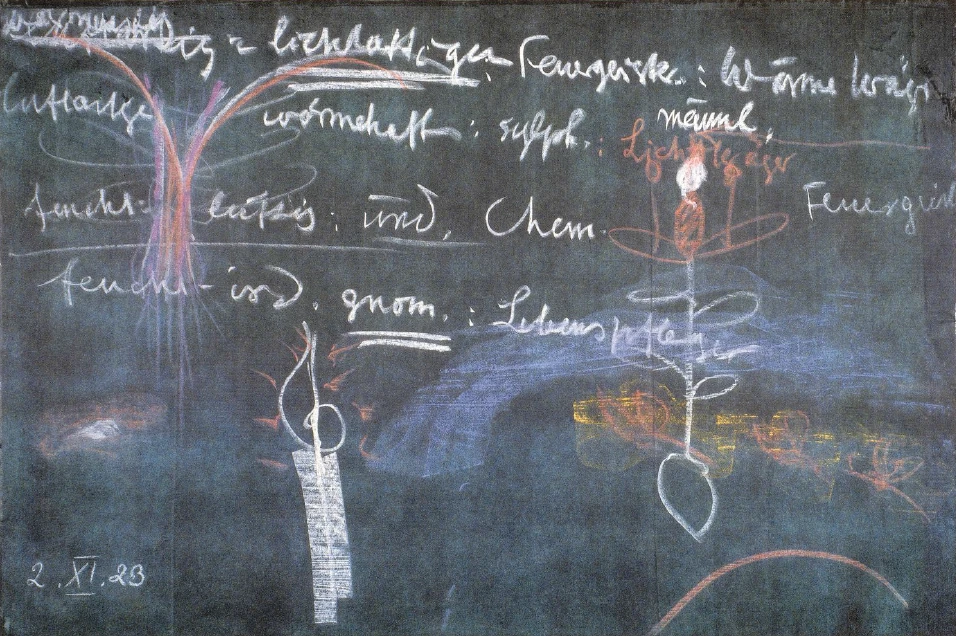
[ 9 ] And I’d like to say that the gnomes become downright rude—even to the point of rudeness—when you talk to them about logic. After all, why would anyone need such a superfluous thing as a guide to thinking? Thoughts are just there, after all. Ideas flow through the plants. Why don’t people stick their noses as deep into the earth as a plant’s roots go, and let what the sun says to the plants drip into their noses? Then they would know something! But with logic—say the gnomes—you can really only ever have very small bits of knowledge.
[ 10 ] Thus, within the Earth, the gnomes are actually the bearers of the ideas of the universe, of the cosmos. But they don’t like the Earth itself at all. They flit about inside the Earth with ideas of the cosmos, but they actually hate all things earthly. For them, it is something they would most like to escape. Nevertheless, they remain with these earthly things—you’ll see why in a moment— but they hate it, because the earthly realm poses a constant danger to the gnomes, namely because this earthly realm constantly threatens the gnomes with having to take on a certain form: namely, the forms of those beings I described to you here in the last lecture, specifically the forms of amphibians, frogs, and toads. And the gnomes’ feeling within the earth is actually this: If we become too closely intertwined with the earth, we take on the form of a frog or a toad. And they are constantly on the verge of avoiding becoming too closely intertwined with the earth, so as not to take on this form; they constantly resist this earthly form, which would threaten them precisely in the element in which they dwell. They dwell in the earthy-moist element; there, the amphibian form constantly threatens them. They constantly tear themselves away from it and fill themselves entirely with the ideas of the extraterrestrial universe. Within the Earth, they are actually that which represents the extraterrestrial, because they must constantly avoid merging with the earthly; otherwise, the individual beings would indeed take on the form of the amphibian world. And it is precisely from this—I would say—feeling of hatred, this feeling of antipathy toward the earthly realm, that the gnomes draw the strength to drive the plants out of the earth. They constantly repel the earthly realm with their fundamental force, and this repulsion determines the upward direction of the plants’ growth; they pull the plants along with them. It is the gnomes’ antipathy toward the earthly realm that allows plants to remain in the earth only with their roots, but then causes them to grow out of the earth, so that, in effect, the gnomes tear the plants from their very own earthly form and cause them to grow upward.
[ 11 ] Once the plant has grown upward, it has left the realm of the gnomes and crossed over from the realm of the moist-earthly into the realm of the moist-airy; then the plants develop what takes on its outer physical form in the leaves. But in all that is now at work within the leaf, other beings are active in turn—water spirits, elemental spirits of the watery element—which an older, instinctive form of clairvoyance, for example, called Undines. Just as we find the root surrounded and interwoven by gnomic beings, so too, near the ground—pleased to observe the upward striving that the gnomes have imparted—do we see these water beings, these elemental beings of water, these undine beings.
[ 12 ] These Undine beings differ in their inner nature from the gnomes. They cannot turn themselves outward toward the universe like a sensory organ—like a spiritual sensory organ. In fact, they can only surrender themselves to the weaving and unfolding of the entire cosmos within the airy-moist element, and because of this, they are not as luminous spirits as the gnomes. These undines are, in fact, constantly dreaming, but their dreaming is at the same time their own form. They do not hate the earth as strongly as the gnomes do, but they are sensitive to all that is earthly. They live in the ethereal element of water, swimming and floating through it. And they are very sensitive to everything that is fish-like, for they are threatened by the form of a fish, which they sometimes assume but immediately abandon to undergo another metamorphosis. They dream their own existence. And as they dream their own existence, they bind and unbind, bind and separate the substances of the air, which they mysteriously bring into the leaves and carry up to that which the gnomes have pushed upward. The gnomes push the plant being upward. (Plate 11, top left / drawing p. 114, light.) It would wither away here if the Undine beings did not, as it were, approach from all sides and now, in this dreamlike consciousness in which they flit about the plants, reveal themselves—one cannot say it any other way—as the World Chemist. The Undines dream of the binding and dissolving of substances. And this dream, in which the plants live, into which the plant grows as it leaves the ground and reaches upward—this Undine dream is the world chemist who brings about the mysterious combination and dissolution of substances within the plant, beginning at the leaf. So we can say that the Undines are the chemists of plant life. They dream of chemistry. There is within them an exceedingly delicate spirituality, a spirituality that actually finds its element where water and air meet. The Undines live entirely within the watery element; but they find their true inner delight when they come into contact with a surface anywhere—even if it is only the surface of a drop or any other body of water. For their entire striving consists in guarding themselves against taking on the form—the permanent form—of fish. They wish to remain in metamorphosis, in eternal, everlasting transformability. But in this mutability, in which they dream of stars and the sun, of light and warmth, they become the chemists who, starting from the leaf, now advance the plant in its formation—the plant that has been pushed upward by the power of the gnomes. And so the plant develops its leaf growth (Plate 11, top left / drawing on p. 114), and the mystery reveals itself as an Undine dream into which the plant grows.
[ 13 ] But to the same extent that the plant grows into the realm of the Undines, it now enters another realm above—the realm of those spirits who live in the airy-warm element, just as the Gnomes live in the moist-earthly element and the Undines in the moist-airy element. Thus, in the airy-warm element live those beings whom an older, instinctive art of clairvoyance has designated as the Sylphs. These Sylphs, who live in the airy-warm element, however, because the air is permeated everywhere by light, advance toward the light, become akin to light, and are particularly receptive to the finer but larger movements within the airy sphere.
[ 14 ] If, in spring or fall, you see a flock of swallows whose flight sets the air in vibration and creates a moving air current, this moving air current—which is present with every bird—is something audible to the sylphs. From it, the music of the worlds resounds to the sylphs. If you are traveling somewhere—say, on a ship—and the seagulls fly toward you, then what is stirred by the seagulls’ flight contains a spiritual resonance, a spiritual music that accompanies the ship.
[ 15 ] Once again, it is the sylphs that unfold and develop within these sounds and find their home in these agitated air currents. In the spiritually resonant, vibrating air element, they find their home and thereby absorb what the power of light sends into these air vibrations. As a result, however, these sylphs—which are, in essence, more or less dormant beings—feel most at home, most in their element, wherever a bird soars through the air. When a sylph is forced to flit through birdless air, it is as if she has lost herself. When she catches sight of a bird in the air, something very special comes over the sylph. I have often had to describe a certain process to people—the process that leads the human soul to say “I” to itself. I have always drawn attention to Jean Paul’s statement that when a human being first arrives at the concept of the “I,” it is as if they were looking into the most veiled Holy of Holies of the soul. The Sylph does not look into such a veiled Holy of Holies of her own soul, but rather she sees the bird, and the sense of “I” overwhelms her. In what the bird, flying through the air, stirs within her, the Sylph finds her “I.” And because this is so—because she kindles her “I” through the external world—the Sylph becomes the bearer of cosmic love through the air. At the same time, by living much like a human desire—yet having her “I” not within herself but in the world of birds—the Sylph is the bearer of loving desires throughout the universe.
[ 16 ] That is why we must observe the Sylph’s deepest affinity with the world of birds. Just as the Gnome hates the world of amphibians, and just as the Undine is sensitive and, in a sense, does not wish to approach fish—wishing to stay away from them and feeling a certain horror toward them—so the Sylph is drawn to birds, feeling at ease when she can carry the floating, resonant air toward their plumage. And if you were to ask the bird from whom it learned to sing, it would tell you that its inspiration comes from the Sylph. The Sylph takes delight in the form of the bird. But she is prevented by the cosmic order from becoming a bird, for she has a different task. Her task is to carry the light to the plants in love (Plate 11, top left / drawing on p. 114, light and red). Just as the Undine is to chemists, the Sylph is the bearer of light for the plant. She permeates the plant with light; she carries the light into the plant.
[ 17 ] The fact that the Sylph carries light into the plant creates something quite unique within the plant. You see, the Sylph continuously carries light into the plant. This light—that is, the Sylphic force within the plant—acts upon the chemical forces that the Undine introduces into the plant. This is where the interaction between Sylphic light and Undine chemistry takes place (Plate 11, top left / drawing on p. 114, red). This is a remarkable formative activity. Out of the light, the Sylphs weave an ideal plant form within the plant, with the aid of the substances that flow upward and are processed by the Undines. The Sylphs are actually weaving the primordial plant within the plant out of the light and out of the chemical work of the Undines. And when the plant withers toward fall and all that is physical matter disintegrates, these plant forms begin to drip down, and the gnomes now perceive them—they perceive what the world, the sun through the sylphs, and the air through the undines have wrought upon the plant. The gnomes perceive this. Thus, the gnomes are busy down below throughout the entire winter, perceiving what drips down from the plants into the earth. There they grasp the ideas of the world in the plant forms, which have been sculpted with the help of the sylphs and which enter the earth in their spiritual-ideational form.
[ 18 ] Of course, those who view the plant solely in material terms, as something physical, know nothing of this spiritual-ideal form. Therefore, in this context, the material view of the plant leads to what is nothing less than a colossal error, a terrible error. I would like to outline this error for you.
[ 19 ] You will find this described everywhere in materialistic science: the plant takes root in the soil, above which it unfurls its leaves, then its flower, within the flower the stamens, then the ovary, and then, as a rule, pollen is carried from the anthers—from the stamens—of another plant, and the ovary is fertilized, thereby producing the seed of the new plant. This is how it is described everywhere. In a sense, the ovary is regarded as the feminine and what comes from the stamens as the masculine; it cannot be viewed any other way as long as one remains stuck in materialism, for from that perspective this process truly looks like fertilization. But that is not how it is; rather, in order to understand fertilization—that is, the reproduction of plants—at all, we must be aware that the plant form—the ideal plant form—arises first from what the great chemists, the Undines, bring about in the plants, and from what the Sylphs bring about; this form sinks into the earth and is preserved by the Gnomes. There it is, down below—this plant form. There, deep within the earth, it is now guarded by the gnomes, after they have seen it and observed it. The earth becomes the womb of that which trickles down there. And this is something entirely different from what materialistic science describes.
[ 20 ] Up here (see illustration $121), after passing through the realm of the Sylphs, the plant enters the sphere of the elemental fire spirits. And the fire spirits—they are the inhabitants of the warm and luminous realm; when the earth’s heat has risen to its highest point or has become just right, they gather up the heat. Just as the sylphs have gathered up the light, so the fire spirits gather up the heat and carry it into the flowers of the plants.
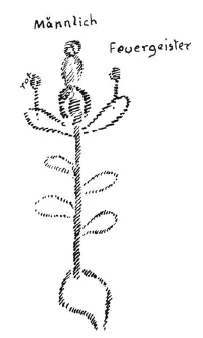
[ 21 ] Undines carry the effects of the chemical ether into the plants; sylphs carry the effects of the light ether into the plants; and the fire spirits carry the effects of the heat ether into the flowers of the plants. And the pollen is, so to speak, the little airship that the fire spirits use to carry the warmth into the seed. The warmth is gathered from all around with the help of the stamens and transmitted from the stamens to the seed within the ovary. And what is formed here in the ovary is, as a whole, the masculine principle that comes from the cosmos. It is not the ovary that is the feminine, and the anthers of the stamen that are the masculine! No fertilization takes place in the flower at all; rather, only the male seed is preformed there. What acts as fertilization is, in fact, that which is brought into the flower by the fire spirits—the world-masculine seed drawn from the warmth of the universe—which is united with the feminine principle that, as I have told you, has already dripped down earlier as an ideal from the plant’s formative process into the earth, where it rests. For plants, the earth is the mother, the sky the father. And everything that happens outside the earthly realm is not the plant’s womb. It is a colossal error to believe that the plant’s maternal principle lies in the ovary. That is precisely where the masculine principle, drawn from the universe with the help of the fire spirits, resides. The maternal principle is carried down from the plant’s cambium—which extends toward both the bark and the wood—as the ideal form within the plant. And what now arises from the interaction of the gnomes’ influence and the fire spirits’ influence is fertilization. Essentially, the gnomes are the spiritual midwives of plant reproduction. And fertilization takes place during the winter down in the earth, when the seed enters the earth and encounters the forms that the gnomes have received from the influences of the sylphs and undines and carry along, where these forms can come into contact with the fertilizing seed.
[ 22 ] As you can see, because people are unaware of the spiritual realm—because they do not know how gnomes, undines, sylphs, and fire spirits (what used to be called salamanders) interweave and live in harmony with plant growth—they are completely unclear about the process of fertilization in the plant world. So, outside the Earth, no fertilization takes place at all; rather, the Earth is the mother of the plant world, and the heavens are the father of the plant world. This is the case in the most literal sense. And the fertilization of plants occurs when the gnomes take from the fire spirits what the fire spirits have carried into the ovary on the tiny airships of pollen as concentrated cosmic warmth. Thus, the fire spirits are carriers of warmth.
[ 23 ] Now, of course, you will easily see how the entire process of plant growth actually comes about. First, with the help of what they receive from the fire spirits, the gnomes enliven the plant from below and propel it upward. They are the nurturers of life. They carry the life ether to the root; that life ether in which they themselves live, they carry it to the root. Furthermore, within the plant, the Undines nurture the chemical ether, the Sylphs the light ether, and the fire spirits the warmth ether. Then, in turn, the fruit of the warmth ether unites with what constitutes life below. And so one can only understand the plant by viewing it in connection with all that surrounds, envelops, and animates it. And one can only arrive at the correct interpretation of the most important process in the plant by delving into these things—delving into them in a spiritual way.
[ 24 ] Once this is recognized, it is interesting to revisit that passage in Goethe where, referring to another botanist, he is so terribly annoyed that people talk about “eternal weddings” up there among the plants. Goethe was annoyed that a meadow was supposed to be filled with nothing but weddings. It struck him as something unnatural. But that was an instinctively very certain feeling. Goethe simply could not yet know what it was actually about, but it was instinctively very certain. Based on his instinct, he could not comprehend that fertilization was supposed to take place up there in the flowers. He simply did not yet know what was going on down there, beneath the soil—that the earth is the womb for the plants. But the fact that what is up there is not what all botanists take it to be—that is something Goethe sensed instinctively. Now you, too, recognize the intimate connection between the plant and the earth on the one hand. But there is something else you must take into account.
[ 25 ] You see, when the fire spirits are flitting about up there—especially when they are conveying pollen—they have only one sensation. This is a heightened sensation compared to that of the sylphs. The sylphs perceive their self, their “I,” by watching the birds flit about. The fire spirits have heightened this sensation even further in relation to the world of butterflies and, indeed, the entire insect world. And it is these fire spirits who most readily follow the trail of insects in order to convey warmth to the ovary. In order to carry the concentrated warmth—which must enter the earth to unite there with the ideal form—the fire spirits feel deeply connected to the world of butterflies and, indeed, to the entire insect world. They follow the trails of insects everywhere as they flit from flower to flower. And so, when one observes these insects flitting from flower to flower, one actually has the feeling that each such insect has a very special aura that cannot really be explained by the insect alone. Bees in particular, with their bright, wonderfully luminous, shimmering, iridescent aura as they flit from plant to plant, are extraordinarily difficult to explain in terms of their aura. Why? Because the bee is accompanied everywhere by the fire spirit, which feels so closely connected to it that the bee is there, and to spiritual vision, the bee is everywhere enveloped in an aura that is, in fact, the fire spirit itself. When the bee flies through the air from plant to plant, from tree to tree, it flies with an aura that is actually bestowed upon it by the fire spirit. The fire spirit not only feels its own self in the presence of the insect, but also wishes to be completely united with the insect.
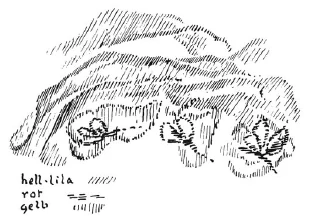
[ 26 ] But this also gives the insects that power I have spoken to you about, which manifests itself even as it radiates out into the cosmos. Through this, the insects gain the power to fully spiritualize the physical matter that unites with them and to allow the spiritualized physical matter to radiate out into outer space. But just as with a flame, where it is the heat that first causes the light to shine, so too on the surface of the Earth, when the insects let their light shine out into the cosmos, it is this that attracts human beings when they are to descend into physical embodiment: it is the insects (Plate 11, right / drawing, red and yellow)—those beings who are inspired to these deeds by the cosmos, by the fire spirits that swarm around them. And while the fire spirits work, on the one hand, to ensure that the fire-pervaded matter flows out into the cosmos, they work, on the other hand, to ensure that the concentrated fiery and warm forces flow into the interior of the Earth to awaken, with the help of the gnomes, the spiritual form that has been dripped down into the Earth by the sylphs and undines.
[ 27 ] You see, this is the spiritual process of plant growth. And because the human subconscious actually senses that there is something special about the flowering, sprouting plant, the plant world appears so mysterious. The mystery is not, of course, unraveled, for the wonderful mysteries are not stripped of their enchantment; but, I would say, what otherwise delights and uplifts people in the plant appears in an even greater wonder when it is not merely the physical plant that is present, but also this marvelous work taking place down below—the work of the gnome world, which is immediately intelligent and entirely intellect-forming, and which initially propels the plant’s life force upward. Just as, in a sense, the human mind is not subject to gravity—just as the head is supported without our feeling its weight—so the gnomes, with their light-filled intellect, overcome the earthly and propel the plant upward. They prepare life from below. But life would wither away if it were not kindled by chemistry. The Undines bring that about. And the light must flow through it.
[ 28 ] So we look up from below, I would say, in the bluish-black hue, the force of gravity (Plate 12 / Drawing p. 126), which is given upward momentum originating from the gnomes; and, swirling around the plant, indicated in the leaves, the undine force, which mixes and separates substances as the plant grows upward. From above, the Sylph spirits imprint light into the plant, which now forms a three-dimensional shape; this, in turn, descends in an idealized form and is absorbed by the Earth’s womb. And then, in turn, the plant is surrounded by the fire spirits, who concentrate the warmth of the world into the tiny seed points; this warmth is then passed down to the gnomes along with the seed’s power, so that the gnomes, with fire and life down below, can bring the plants into being.
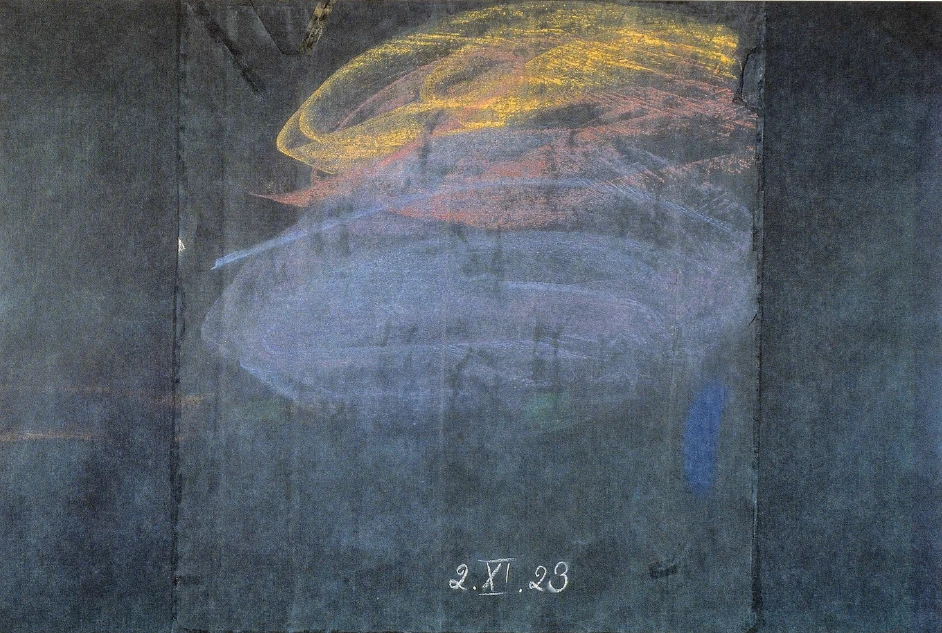
[ 29 ] Once again, you can see how the Earth owes its repulsive force—its density—essentially to the antipathy of the gnomes and undines toward amphibians and fish. If the Earth is dense, then this density is the very antipathy through which gnomes and undines maintain their form. When light and warmth descend upon the Earth, this is at the same time the expression of that force of sympathy—the sustaining, loving force of the Sylphs, carried through the air—and the sustaining, sacrificial force of the fire spirits, which brings about this descent. So that one can say: What constitutes earth’s density, earth’s magnetism, and earth’s gravity coalesces above the earth as it strives upward, together with the downward-striving force of love and sacrifice. And in this interplay between the downward-flowing power of love and sacrifice and the upward-flowing density, gravitational force, and magnetic force—in this interplay—the plant being develops above the earth’s surface, where the two meet; it is an outward expression of the interplay of world love, world sacrifice, world gravity, and world magnetism.
[ 30 ] You have now seen what is at work when we turn our gaze to the plant world that so delights, uplifts, and enchants us. We can only truly understand it when we are able to look beyond the physical and the sensory to the spiritual and the supersensible. This also makes it possible to correct the fundamental error of materialistic botany, which assumes that fertilization takes place up there. What is happening there is not fertilization, but the preparation of the plant’s male heavenly seed for what is being prepared for the plant in the womb of the Earth.