Humanity as the Harmony of the creative, formative, and shaping Word of the WorldGA 230
3 November 1923, Dornach
Translated by Steiner Online Library
Eighth Lecture
[ 1 ] Yesterday I spoke to you about the other side of natural existence—about the beings that, as supersensible and invisible entities, accompany the beings and processes of visible, sensory nature. An older, instinctive perception looked just as much toward these beings of the supersensible world—which lie behind natural existence—as it did toward the sensory ones. Today, these beings have, so to speak, withdrawn from human perception. However, the fact that this realm of gnomes, undines, sylphs, and fire beings cannot be perceived in the same way as the animals, plants, and so on of the physical-sensory world is due solely to the fact that, at the present stage of human development on Earth, human beings are not yet able to unfold their soul-spiritual nature without the aid of the physical and etheric bodies. In the current stage of Earth’s evolution, human beings are simply dependent on using the etheric body for the purposes of their soul and the physical body for the purposes of their spirit. The physical body, which provides the spirit with its tools—the sense organs—is simply not capable of connecting with the beings that underlie the physical world. Nor is the human etheric body, which the human being needs in order to unfold as a soul being. As a result, if I may put it this way, half of the human being’s earthly environment actually eludes him. Everything encompassed by those elemental beings I spoke of yesterday eludes them. Neither the physical body nor the etheric body can reach them. One gains an idea of what actually eludes modern human beings when one is clear about what such gnomes, undines, and so on actually are.
[ 2 ] You see, we have here the entire host of lower—currently lower—animals, those animals that consist, so to speak, only of a soft mass, that move about in the liquid element, that live in the liquid element, and that have no skeleton of any kind—in other words, nothing that provides them with internal support. These are beings that belong to the most recently evolved on Earth—beings that are actually only now carrying out, beneath the already developed Earth, what the oldest earthly being, the human being, accomplished with regard to the structure of the head during the ancient Saturn period. As a result, these beings do not develop within themselves those hardenings that can become skeletal support.
[ 3 ] Now, the gnomes are those beings who, in a sense, spiritually complement from the outside what is lacking in the world—from the very lowest animal kingdom all the way up to amphibians and fish themselves, which, after all, have only rudimentary skeletons—especially the fish—so that, in a sense, this lower animal kingdom only becomes a whole through the existence of the gnomes.
[ 4 ] And because the relationships among beings in the world are so varied, there is a certain dynamic at play between these lower beings and the gnomes—something I described yesterday as antipathy. The gnomes do not want to become like these lower beings. They always strive to guard against taking on the form of these lower beings. These gnomes are, as I have described to you, extraordinarily wise and intelligent beings. With their perception, they have already been endowed with intelligence; they are truly the antithesis of the lower animal world in every respect. And while they play the role in plant growth that I described yesterday, they truly serve as a complement to the lower animal kingdom. They add, so to speak, to the lower animal kingdom what that lower animal kingdom lacks. This lower animal kingdom has a dull consciousness; the gnomes, on the other hand, possess the brightest consciousness. This lower animal kingdom has no bony skeleton, no bony support; these gnomes, I might say, bind together everything that constitutes gravity and form their bodies out of this fleeting, invisible gravity—bodies which, incidentally, are constantly in danger of disintegrating and losing their substance. The gnomes must, so to speak, create themselves out of gravity again and again, because they are constantly in danger of losing their substance. As a result, in order to save their own existence, these gnomes are constantly attentive to what is happening around them. There are no beings more attentive to observing the earth than such a gnome. He keeps an eye on everything because he must know everything, must grasp everything, in order to save his life. He must always be alert; if he were to become drowsy, as humans often are, he would immediately die from his drowsiness.
[ 5 ] There is a German proverb—which actually dates back to very ancient times—that perfectly captures this characteristic of gnomes: always having to be alert. The saying goes: “Be as watchful as a gnome.” And gnomes are, of course, those little creatures. So if you want to urge someone to pay attention, you tell them: “Pay attention like a gnome.” — A gnome really is an attentive creature. If you could place a gnome in the front row of a classroom—so that everyone could see him—as a prime example, he would be an excellent model for all the students in the class to emulate.
[ 6 ] In addition to this trait, gnomes are also characterized by an almost invincible drive for freedom. They pay little attention to one another, so to speak, and devote their attention almost exclusively to the other world—the world around them. One gnome is of little interest to another. But everything else in this world—the world in which they live—that surrounds them is of particular interest to them.
[ 7 ] Well, I told you that the body actually acts as an obstacle to perceiving such beings. The moment the body no longer presents such an obstacle, these beings are there, just as other beings of nature are there for us to see. And anyone who has managed to experience the dream that occurs as one falls asleep with full consciousness knows these gnomes well. You need only recall what I just said about the dream at the “Goetheanum.” I said that the dream does not actually appear in its true form before ordinary consciousness, but rather wears a mask. The dream that occurs as one falls asleep also wears a mask. We do not immediately emerge from what we have experienced in ordinary daytime consciousness, or from whatever else we have experienced; reminiscences, images from life, or symbols—such as the heart as a furnace, the lungs as wings, and so on—manifest themselves symbolically. These are masks. If a person were to see the dream without masks, if they were to sleep through it and truly enter that world—without the beings there masking themselves—then, just as they fall asleep, they would see this entire army of little men; they would come to meet them.
[ 8 ] But for ordinary consciousness, human beings are, so to speak, protected from perceiving these things without warning, because they would be terrified by them. For in the form in which they appear to us, they are actually true reflections of everything within a person that functions as destructive forces. A person would perceive all at once, in their very essence, everything within them that functions as destructive forces, everything that is constantly breaking them down. And these gnomes, if perceived unprepared, would be nothing but symbols of death. A person would be terribly frightened by them if, for example, they had never heard anything about them in their ordinary understanding, and these gnomes were now to come toward them as they fell asleep and, so to speak, bury them—for that is how the situation appears: they would, so to speak, bury them over there in the astral world. For what takes place as one falls asleep—as seen from over there—is a kind of being buried by the gnomes.
[ 9 ] Well, that actually applies only to the moment of falling asleep. Another addition to the physical-sensory world are the Undines, the water beings—these constantly transforming beings that live in harmony with water, just as the Gnomes live in harmony with the earth. These Undines—we have already seen what role they play in plant growth; but they also relate, as complementary beings, to animals that are already on a somewhat higher level, to animals that have already taken on a more differentiated earthly body. These animals, which then develop into higher forms of fish or amphibians, need scales; they need some kind of hard shell. They need a hard outer shell. The world owes the forces that provide this external support—this external skeleton, so to speak—to certain animals, such as insects, to the activity of the Undines. The gnomes, so to speak, spiritually support those animals that are at a very low level of development. These animals, which now need external protection—which, for example, must be encased in a shell—owe their protective coverings to the activity of the undines. It is the undines, then, who add to these somewhat higher animals, in a primitive way, what we have in the top of our skulls. They, so to speak, turn them into a head. All these beings, who exist invisibly behind the visible world, have their great task within the entire context of existence, and you will see everywhere that whenever materialistic science is called upon to explain anything of the kind I have just described, it fails. For example, it is unable to explain how the lower beings—who are scarcely any harder than the element in which they live—manage to move about within it, because it does not know that this spiritual support is provided by the gnomes I have just described. On the other hand, the fact of becoming encased in armor will always pose a difficulty for a purely materialistic science, because it is not known how, in the process of becoming sensitive and in avoiding their own descent into a lower animal state, the Undines repel from themselves that which then comes over the somewhat higher animals as scales or other armor.
[ 10 ] And again, even for these beings, it is only the body—in relation to the ordinary consciousness of modern humans—that prevents us from perceiving them in the same way we perceive, for example, plant leaves or slightly higher animals.
[ 11 ] But when a person falls into a deep, dreamless sleep—and it is not that the sleep itself is dreamless, but rather that, through the gift of inspiration, this sleep can be penetrated—then, before the spiritual gaze, before the gaze of the spiritual human being, these beings of the Undines emerge from that sea of the astral realm into which, upon falling asleep, the gnomes have, so to speak, buried and hidden the person, and they become visible in deep sleep. Sleep extinguishes ordinary consciousness. The consciousness illuminated for sleep has as its content this wondrous world of the fluid in the making—the fluid that surges in every possible way toward the metamorphoses of the Undines. Just as we are surrounded by beings with fixed contours in our waking consciousness, the illuminated consciousness of the night would present these ever-changing beings—which themselves surge like a sea and then subside again. Deep sleep is actually filled with the presence of a turbulent sea of living beings surrounding the human being—a turbulent sea of Undines.
[ 12 ] The situation is different for the sylphs. For the sylphs, the situation is such that they, too, in a certain way, serve as a complement to certain animal beings—but now from the opposite direction. One might say: gnomes and undines add the head-like quality to those animals that lack a head. Birds, as I have described to you, are essentially pure head; they are entirely head-organization. The Sylphs add to the bird, in a spiritual way, what it lacks, so to speak, as the physical complement to its head-organization. They are thus the complement to the bird species in that area of organization which, in humans, corresponds to the metabolic-limb system. While birds fly through the air with atrophied legs, the Sylphs, by contrast, have powerfully developed limbs; and they represent in a spiritual sense—I would say in the air—what the cow represents down below in physical matter. That is why I was able to say yesterday that the Sylphs have their “I” in the bird kingdom—that which connects them to the Earth. Human beings acquire their “I” on Earth. What connects the Sylphs to the Earth is the bird kingdom. They owe their “I”—or at least the consciousness of their “I”—to the bird kingdom.
[ 13 ] When a person has slept through the night, having experienced the astral sea—which takes on the most varied forms of undines—and then wakes up and has the waking dream, he would, if this waking dream were not in turn masked by memories of life or by symbols of internal organs, if he were to see the unmasked dream, find himself face to face with the world of the sylphs. But these sylphs would take on a strange form for them. They would be as if the sun wanted to send something, but something that actually has a difficult effect on people, something that, in a certain way, lulls them into a spiritual slumber. We will hear shortly why this is the case. Nevertheless, if a person were to perceive the unmasked waking dream, they would see in it something like the fluttering—the essential fluttering—of light. They would find it unpleasant, in part because the limbs of these sylphs, as it were, entwine and envelop them. They would feel as if the light were attacking them from all sides, as if the light were something that assails one, to which one is extremely sensitive. Perhaps they might also perceive this here and there as a caress of light. But in all these things, I merely wish to hint to you how this sustaining, tentative light actually approaches in the form of a sylph.
[ 14 ] When we come to the fire beings, the situation with them is that they serve as a complement to the ephemeral nature of the butterfly. The butterfly, so to speak, develops as little as possible of its physical body—its actual physical body—keeping it as thin as possible; in contrast, it is a being of light. The fire beings turn out to be beings that complement the butterfly’s body, so that one might get the following impression. If, on the one hand, one sees a physical butterfly and imagines it enlarged accordingly, and on the other hand a fire being—these beings are rarely found together, only in the cases I mentioned to you yesterday—then one has the feeling that if one were to fuse them together, one would actually end up with something like a winged human, truly a winged human. One need only enlarge the butterfly accordingly and adjust the fire beings to human scale, and then one ends up with something like a winged human being.
[ 15 ] This, in turn, shows you how the fire beings are actually the counterpart to these animal beings, which are closest to the spiritual realm; they are, so to speak, the counterpart on the lower end. Gnomes and undines are the counterpart on the upper end, toward the head; sylphs and fire beings are the counterpart to birds and butterflies on the lower end. So the fire spirits must be associated with butterflies.
[ 16 ] In the same way that a person can, so to speak, penetrate the dream state while asleep, a person can also penetrate waking daily life. In doing so, however, the person makes use of their physical body in a very robust manner. I have also described this in essays published in *Goetheanum*. In that context, a person is completely unable to realize how they could actually see the fire beings continuously during waking life, for the fire beings are intrinsically connected to human thoughts, to everything that arises from the organization of the head. And when a person manages to be fully present in waking daytime consciousness and yet, in a certain sense, to be outside of themselves—that is, to be entirely rational, to stand firmly with both feet on the ground, and at the same time to be outside of themselves—that is, to be themselves and to be their counterpart, meaning to be able to regard themselves as a being of thought: then the human being perceives how the fire beings in the world constitute the element that, when we perceive it, makes our thoughts perceptible on the other side.
[ 17 ] Thus, the perception of the fire beings can lead human beings to see themselves as thinkers—not merely to be thinkers and to cook up thoughts, but to observe how thoughts unfold. Only then do thoughts cease to be bound to the human being; they then reveal themselves as world-thoughts; they act and weave as impulses in the world. One then realizes that the human head merely creates the illusion that thoughts are enclosed within this skull. They are only reflected there; their reflections are present. That which underlies the thoughts belongs to the sphere of the fire beings. When one enters this sphere of the fire beings, one sees in the thoughts not merely oneself, but the thought content of the world, which is in fact also an imaginative content. It is therefore the power to step outside of oneself that presents the thoughts to us as world thoughts. Yes, perhaps I may say: If one now views what can be seen on Earth not from the perspective of the human body but from the sphere of the fire beings—that is, in a sense, from the Saturn being that extends into the Earth—then one obtains precisely the picture I have described of Earth’s evolution in *An Outline of Esoteric Science*. This outline of a secret science is presented in such a way that thoughts appear as the thought-content of the world, as seen from the perspective of the fire beings.
[ 18 ] You see, these things do have a profoundly real significance. But they also have a profoundly real significance for human beings in other ways as well. Take the gnomes and undines; they exist, so to speak, in the world that borders on the world of human consciousness; they are already beyond the threshold. Ordinary consciousness is protected from seeing these beings because not all of them are benevolent. Benevolent beings are those I described yesterday—those who, for example, work in various ways to promote plant growth. But not all of them are benevolent beings. And the moment one enters the world where these beings are active, it is not only the benevolent ones that are present, but the malevolent ones as well. One must first form a conception of which of them are benevolent and which are malevolent. That is not entirely easy. You will see this from the way I must describe the malevolent ones to you. The malevolent beings differ from the benevolent ones primarily in that the benevolent ones remain more closely connected to the plant and mineral kingdoms; but the malevolent beings always seek to approach the animal and human kingdoms—and the most malevolent ones even the plant and mineral kingdoms as well. But one can already gain a quite respectable understanding of the malevolence that the beings of this realm can possess when one engages with those who seek to approach humans and animals and who, in humans, actually seek to accomplish what the higher hierarchies have assigned to the benevolent beings for the plant and mineral worlds.
[ 19 ] You see, there are indeed such malevolent entities from the realms of the gnomes and the undines who prey upon humans and animals and cause what is actually meant to be added to the lower animals to manifest physically in humans; in human beings it is already there anyway. In human beings it is meant to manifest physically, and in animals as well. As a result of the presence of these malevolent gnome and undine beings, lower animal or plant beings—parasites—then live within human beings and animals. And so these malevolent beings are the creators of parasites. But, I would like to say, the moment a human being crosses the threshold into the spiritual world, he immediately enters into the subtleties of that world. There are actually pitfalls everywhere, and one must first learn something from the gnomes, namely to be on guard. The spiritualists, for example, are never able to do that. There are pitfalls everywhere. Now someone might ask: What purpose do these malevolent gnome and undine beings serve at all, if they give rise to parasitic entities? Well, if these entities did not exist at all, then human beings would not be able to develop within themselves the power to form their brain matter. And this brings us to something that is extraordinarily significant,
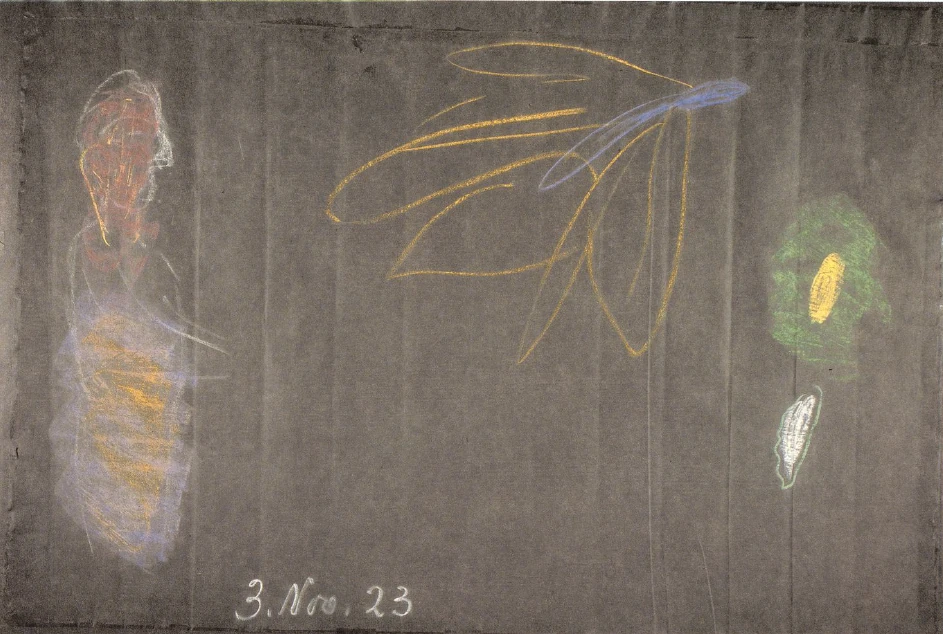
[ 20 ] I’d like to sketch this out for you schematically (Plate 13, left). If you think of the human being as a metabolic-limb being, as a chest being—that is, as a rhythmic being—and then as a head being, that is, as a nervous-sensory being, you must be absolutely clear about this: processes are taking place down here—let’s leave the rhythmic being aside for now—and processes are taking place up here as well. If you take into account the processes taking place down below, there is essentially one result that is usually overlooked in everyday life: these are the excretory processes—excretion through the intestines, excretion through the kidneys, and so on—all excretory processes that flow downward. These excretory processes are usually regarded simply as excretory processes. But that is nonsense. Excretion does not occur merely for the sake of excretion; rather, to the same extent that excretory products appear, something spiritual appears in the lower part of the human being that is analogous to the physical brain in the upper part. What happens in the lower part of the human being is a process that remains halfway in terms of its physical development. It is excreted because the substance passes into the spiritual realm. Up above, the process is completed. There, what is only spiritual down below takes physical form. Up above we have a physical brain; down below, a spiritual brain. And if what is excreted down below were subjected to a further process—if one were to continue transforming it—then the final metamorphosis would, for the time being, be the human brain.
[ 21 ] Human brain matter is a highly evolved waste product. This is something that is immensely important, for example, in a medical context, and something that doctors in the 16th and 17th centuries were still well aware of. Certainly, people today speak very disparagingly—and in some respects quite rightly so—of the old “filthy apothecary.” But this is because they do not know that within that filth lay the so-called mummies of the spirit. Of course, this is not meant to be a glorification of what has been referred to as the “filthy pharmacy” in recent centuries; rather, I am pointing out many truths that are as deeply interconnected as the one I have just described.
[ 22 ] The brain is, in fact, a higher form of metamorphosis of waste products. Hence the connection between brain diseases and intestinal diseases; hence, too, the connection between the healing of brain diseases and that of intestinal diseases.
[ 23 ] You see, since gnomes and undines exist—and since there is a world at all where gnomes and undines can live—the forces are present that can certainly cause parasites to develop in the lower human being, but which at the same time are the cause of the transformation of waste products into the brain in the higher human being. We could not possibly have a brain if the world were not arranged in such a way that gnomes and undines could exist.
[ 24 ] What applies to gnomes and undines with regard to the forces of destruction—destruction and decay, which, after all, originate in the brain—applies to sylphs and fire beings with regard to the forces of creation. Again, the benevolent sylphs and fire beings keep their distance from humans and animals and are concerned with plant growth in the manner I have indicated; but there are also malevolent ones. These malevolent beings, above all, carry down into the watery and earthly regions that which is meant to remain only in the higher regions—the regions of air and warmth.
[ 25 ] If you now wish to study what happens when these sylphic beings, for example, carry down from the higher regions to the lower regions of the watery and earthy elements that which belongs up above, then take a look at the belladonna. Belladonna is the plant that, in its bloom—if I may put it that way—has been kissed by the Sylph, and which, as a result, has transformed what might have been a benign sap into the poisonous sap of belladonna.
[ 26 ] There you have what might be called a shift in the sphere. Up above, it is right for the sylphs to develop their enveloping forces, as I described earlier, where one is literally touched by the light—for that is what the bird world needs. But when the sylph comes down and applies what it should be using above to the plant world below, a potent plant poison is produced. Parasitic beings are created by gnomes and undines; by sylphs, the poisons that are actually the heavenly elements that have flowed too deeply into the earth. When humans or certain animals eat belladonna, which looks like a cherry except that it is hidden inside the calyx—it is pressed down; you can still see this in the shape of the belladonna, as I have just described—when humans or certain animals eat belladonna, they die from it. But just look at thrushes and blackbirds: they perch on the belladonna and find in it the best food in the world. What is contained in the belladonna belongs to their realm.
[ 27 ] It is indeed a curious phenomenon that animals and humans, who are actually earthbound through their lower organs, absorb as poison that which is corrupted in the earth within the belladonna; whereas, on the other hand, such representative birds as thrushes and blackbirds—who, in a spiritual sense, through the sylphs, are meant to possess precisely that — and through the benevolent sylphs they do indeed possess it —, are able to tolerate it, even when what is up there in their region is carried down. What is food for them is poison for the beings more bound to the earth.
[ 28 ] This gives you an idea of how, on the one hand, parasitic forces rise from the earth to other beings through gnomes and undines, and how the poisons actually trickle down from above.
[ 29 ] If, on the other hand, the fire beings imbue themselves with those impulses that belong to the realm of butterflies—impulses that are very beneficial to the butterflies’ development—and carry them down into the fruits, then what arises, for example, are what we call poisonous almonds within a batch of almonds. This poison is carried into the almond fruit through the activity of the fire beings. And, in turn, the almond fruit could not come into being at all if these same fire beings did not, in a benevolent way, so to speak, “burn” what we eat in other fruits. Just take a look at the almond. In other fruits, you have the white kernel in the center and the flesh surrounding it. In the almond, you have the kernel right in the middle, and the flesh surrounding it is completely charred. That is the work of the fire beings. And if this activity gets out of hand—if what the fire beings do is not merely worked into the brown almond shell, where it can still be benign, but if only a small part of what is meant to form the shell penetrates inward into the white kernel of the almond—then the almond becomes poisonous (Plate 13, right).
[ 30 ] This gives you a picture of how these entities, which border on the world that lies immediately beyond the threshold, actually become—when they act on their impulses—carriers of the parasitic nature, the toxic nature, and thus carriers of disease. In this way, it becomes clear to what extent the human being, as a healthy being, stands apart from what can overtake him in illness. For this is connected to the unfolding of the evil aspect within these entities, which, on the other hand, must exist to make possible the entire structure of nature—its growth and sprouting, and, in turn, its destruction.
[ 31 ] These are the things that, fundamentally, stemmed from instinctive clairvoyance and underlay such intuitions as the Indian concepts of Brahma, Vishnu, and Shiva. Brahma represented the active being in the cosmic sphere that is permitted to approach human beings. Vishnu represented that cosmic sphere which is permitted to approach human beings only insofar as it must continually dismantle what has been built up, insofar as everything must continually undergo transformation. And Shiva represented everything connected with the forces of destruction. And in the earlier times of Indian high culture, it was said: Brahma is intimately connected with all that is of the nature of fire beings and sylphs; Vishnu with all that is of the nature of sylphs and undines; Shiva with all that is of the nature of gnomes and undines. In general, when one goes back to these older conceptions, one finds everywhere the pictorial expressions for what one must now once again seek as underlying the mysteries of nature.
[ 32 ] So you see: Yesterday we examined the relationship between this invisible people and the plant world; today we have added the relationship between this invisible people and the animal world. Everywhere, the beings on this side of the threshold interact with the beings on the other side of the threshold, and the beings on the other side of the threshold interact with the beings on this side of the threshold, and so on. And only when one understands the living interplay of these two kinds of beings does one truly comprehend how the visible world unfolds. For human beings, knowledge of the supersensible world is very, very necessary, for the moment they pass through the gate of death, they no longer have the sensory world around them; rather, the other world begins to be their world. At their present stage of development, human beings cannot enter this other world unless they have, so to speak, recognized in the physical manifestations the signs that point toward this other world; unless they have learned to read in the animals of the earth, in the animals of the water, in the animals of the air, and in the animals— I might say, of light—in the butterflies—that which points to the elemental beings who are our fellow inhabitants between death and a new birth. But what we see of these beings is, in fact, everywhere here between birth and death merely—I might say—the brutal, dense part. We only begin to recognize what belongs to the supersensible realm when we cross over with our insight and understanding into this supersensible world.