

World History from an Anthroposophical Perspective
and as the foundation of understanding the Spirit in Man
GA 233
24 December 1923, Dornach
Translated by Steiner Online Library
First Lecture
[ 1 ] During these evening hours of our Christmas gathering, I would like to provide you with an overview of humanity’s development on Earth that may help you to take in more intimately and intensely what it means to be human in this present age. Especially in these present times, when something so extraordinarily significant—one might even say—for all of civilized humanity is in the making, it should actually be natural for every deeply thinking person to raise the question: How has the current configuration, the current state of the human soul, emerged from a long process of development? — For it cannot be denied that the present becomes understandable when one attempts to grasp it in terms of its emergence from the past.
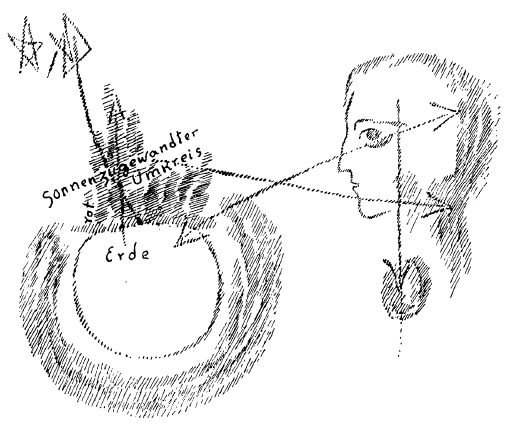
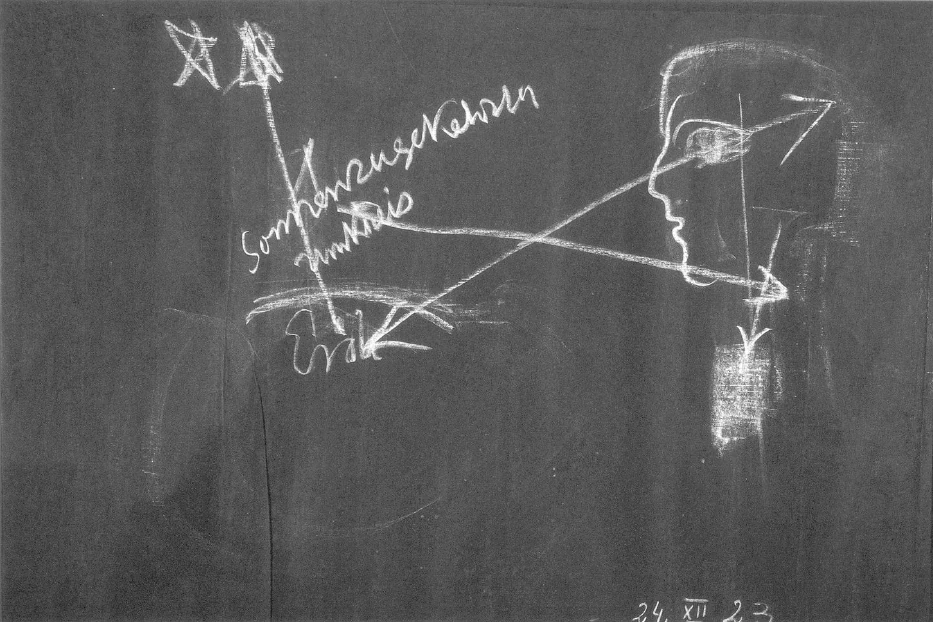
[ 2 ] Yet today, in particular, people are extremely constrained when it comes to the development of the individual and of humanity. To begin with, people imagine that, in terms of their soul-spiritual life, human beings have essentially remained as they are today throughout all of history. Certainly, from a strictly scientific perspective, people imagine that in ancient times human beings were childlike, believed in all sorts of fanciful notions, and that they have only recently become truly intelligent in the scientific sense. But if one sets aside what is strictly scientific, one then imagines that, in general, the state of mind that modern humans possess was also already possessed by the Greeks and the people of the East. Even if one imagines minor modifications in the life of the soul, on the whole one imagines that during historical times, everything was actually just as it is today. One then assumes that historical life flows into prehistory and says: “We don’t really know anything about that.” — But then one goes further back: there, human beings were still in their animal form. — So if one traces history back, one imagines the inner life to have remained more or less unchanged, then—fading into the mist—the image, and then the human being in animal imperfection, a sort of superior ape.
[ 3 ] That is, after all, more or less the common view today. It is based on an extraordinary bias, for by forming such a conception, people make a conscious effort not to recognize the profound differences that already exist in the constitution of the soul between people of the present and those of a time that is, relatively speaking, not so long ago—say, the 11th, 10th, 9th centuries A.D., or how great the difference is in the state of the soul between a person today and a contemporary of the Mystery of Golgotha, or even between a person today and a Greek. And if we then go back to the Eastern world—of which Greek civilization was, in a sense, a kind of colony, a late colony—we encounter states of mind that are entirely different from those of modern people. And I would like to show you right away, using examples—real cases—how a person who lived in the Orient, say, ten thousand or fifteen thousand years ago, was of a completely different nature than, for example, the Greeks and than we ourselves.
[ 4 ] Let us imagine our inner life as a picture before the eye of the soul. Let us take something from our own inner life. We have some kind of experience. From this experience—in which we are involved through our senses or in some other way through our personality—we form an idea, a concept, a mental image. We retain this mental image in our thinking, and after some time it can in turn rise from our thinking into our conscious inner life as a memory. Let’s say you have some kind of memory today that takes you back to experiences you had perhaps ten years ago. And now grasp exactly what that actually is. You experienced something ten years ago. Let’s say that ten years ago you attended a gathering of people; you formed an impression of each and every one of these people—their faces and so on. You experienced what these people said to you, what you did together with them, and so on. All of this can emerge as a mental image before you today. It is an inner soul image that exists within you from the event that took place perhaps ten years ago. And not only according to science, but also according to a general sense—which, admittedly, people experience only very faintly today, but which does exist—such a mental image of a memory, which in turn brings the experience to mind, is localized in the human head. One says to oneself: What exists in the head is the memory of an experience.
[ 5 ] Well, let’s now take a rather big leap back in human evolution and take a look at the populations of the Eastern regions, of whom the Chinese, Indians, and so on—whose histories we’ve described—are actually only the descendants. So let’s go back thousands of years. If we consider a person from those ancient times, he did not live in such a way that he would say: “I have in my mind the memory of something I have experienced or gone through in my external life.” — He did not have such an inner experience at all; it did not exist for him. He did not have thoughts or ideas filling his mind. The superficiality of modern people assumes: “Today we have ideas, concepts, and notions; people in historical times have always had these.” — But that is not the case.
[ 6 ] If we go back far enough with spiritual insight, we encounter people who had absolutely no ideas, concepts, or notions in their heads—people who did not experience such abstract content within their heads, but rather, as grotesque as it may seem to you, experienced their entire head; they simply felt their heads, simply sensed them. These people did not concern themselves with abstractions as we understand them. They simply did not know what it meant to experience ideas in their minds, but they did know what it meant to experience their own minds. And just as you, when you have a mental image of an experience, relate that image to the experience—just as there is a relationship between your mental image and the experience that took place out there—so these people related the experience of their head to the Earth, to the entire Earth. And they said: In the world there is the Earth; in the world there is me, and on me is my head. And my head, which I carry on my shoulders, is the cosmic memory of the Earth. The Earth existed first; my head came later. But the fact that I have a head—that is the memory, the cosmic memory of earthly existence. Earthly existence is still there, but the very configuration, the very form of the human head, stands in relation to the entire Earth. — And so such an ancient Oriental felt within his own head the very essence of the Earth itself. He said: The gods have created, have brought forth from the general cosmic existence, the Earth with its realms of nature, the Earth with its rivers and mountains. But I myself carry my head on my shoulders. This head is a faithful image of the Earth itself. This head, with the blood flowing within it, is a faithful image of the rivers and ocean currents flowing across the Earth. The configuration of the mountains on Earth is repeated in my own head in the configuration of my brain. I carry on my shoulders a reflection of the Earth that belongs to me. — Just as modern humans relate their mental images to their experiences, so did this person relate his entire head to the Earth. You see, that was a considerably different inner perspective of the human being.
[ 7 ] And furthermore, when a person perceives the Earth’s atmosphere and takes it in, this atmosphere—the airy substance surrounding the Earth—will appear to them as permeated by the Sun, its warmth, and its light; and in a certain sense, one can say that the Sun lives within the Earth’s atmosphere. The Earth opens itself to the universe by surrendering the forces it emits to the atmosphere and opening itself to the Sun’s influences. And in those ancient times, every person perceived the region of the Earth where they happened to live as particularly important, as particularly essential. And so, we might say, an ancient Oriental perceived a certain part of the Earth’s surface as his own—the Earth below, the sunlit sphere above. The rest of the Earth—to the left and right, and in front and behind—blurred into the more general whole (see drawing, left side).
[ 8 ] So, for example, if an ancient Oriental living on Indian soil felt that this Indian soil was particularly important to him, then everything else that existed on Earth—to the east, south, and west—generally faded from his awareness. He did not concern himself much with the way the Earth adjoins the rest of cosmic space. On the other hand, the ground on which he happened to be standing was particularly important to him (see illustration, left, red). The way the Earth extended into outer space in this region became particularly important to him. The way he was able to breathe on this particular ground—he experienced that as a particularly significant experience for himself. Today, people don’t ask themselves much: How does one breathe on a particular piece of ground? — They are, of course, subject to more favorable or less favorable breathing conditions, but this is not registered in their consciousness in that way. Such an ancient Oriental actually had a profound experience precisely in the way he was able to breathe, and likewise in other aspects related to how the Earth extends into outer space.
[ 9 ] What the entire Earth was, human beings perceived as that which lives within their heads. But the head is enclosed by solid bony walls—above, to the sides, and behind. Yet it has certain openings, a certain free opening downward toward the chest (see drawing, right). It was of very special importance for ancient humans to feel how the head opens toward the chest with a relative freedom. These people perceived the inner configuration of the head as a reflection of the earthly realm. When they had to relate the earth to their head, they had to relate the outer sphere—that which is above the earth—to that which now extends downward within them. This opening downward, this turning toward the heart, was perceived by the person as corresponding to the outer sphere—as an image, as the earth’s opening out into the cosmos. And it was a profound experience for the person when he said: “In my head I feel the whole earth. This head is a small earth.” But this entire earth opens up into my chest, which holds my heart. And what takes place there between my head and my chest—my heart—is the reflection of what occurs from my life out into the cosmos, out toward the sphere turned toward the sun. — And it was a significant, profound experience when the ancient person said: Here, in my head, the Earth lives within me. If I go deeper, the Earth turns toward the sun (see arrows), and the image of the sun is my heart.
[ 10 ] Humanity had reached what, in ancient times, corresponded to our emotional life. We still have an abstract emotional life, but we have no direct knowledge of our own heart. Through anatomy and physiology, we believe we know something about it. But what we know is about as much as what we know about a heart modeled in papier-mâché. Yet what we experience as an emotional perception of the world is something ancient humans did not have. Instead, they had their heart experience. And just as we extend our feelings to the world that lives with us—how we feel, whether we love a person, whether we feel antipathy toward someone, love this or that flower, or are averse to this or that—just as we relate our feelings to the world, but to a world that, one might say, has been torn out of the solid, firm cosmos into ethereal abstraction—in just the same way, the ancient Oriental related his heart to the cosmos, that is, to that which extended from the earth into the sphere surrounding it, toward the sun.
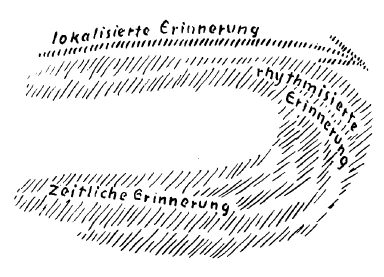
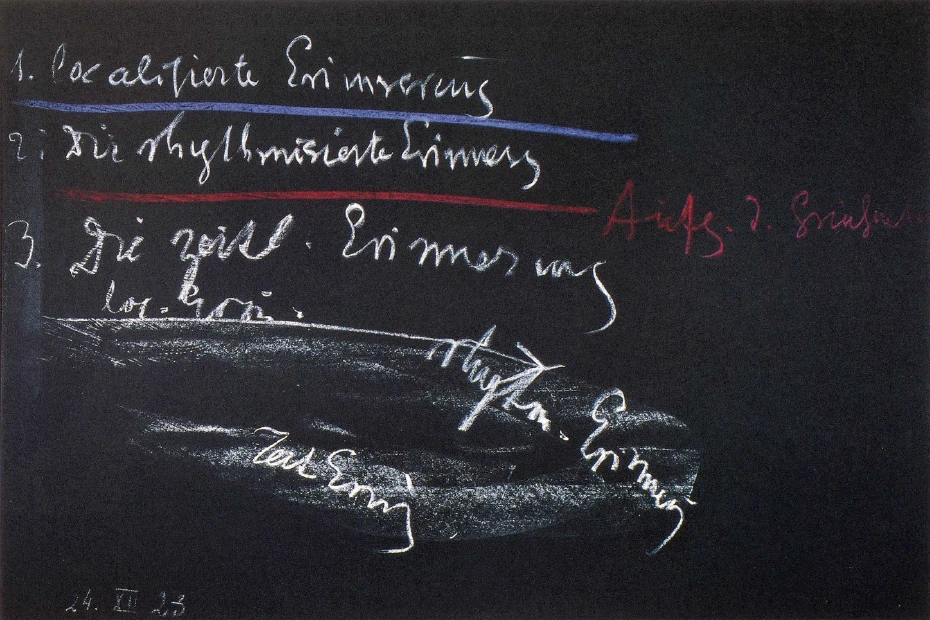
[ 11 ] And we, for example, say today when we walk: “We want to walk.” — We know that our will lives in our limbs. The people of the ancient Orient had a fundamentally different experience. They did not, after all, know what we today call “will.” It is a mere prejudice to assume that what we call thinking, feeling, and willing existed among the ancient peoples of the Orient. That was not the case at all. They had experiences in the head that were experiences of the earth; experiences in the chest or heart that were experiences of their immediate surroundings, extending as far as the sun. The sun corresponds to the experience of the heart. But they also experienced the stretching and extending into their limbs, the perception of their own humanity in the movement of their legs and feet, in the movement of their arms and hands. They were right in the midst of it. But in this inward expansion into their limbs, they did not merely perceive an image of the Earth’s surroundings; rather, they directly perceived an image of the connection between human beings and the worlds of the stars (see drawing on page 15). In my head I have an image of the Earth. In what stretches freely downward from my head into my chest toward my heart, I have an image of what lies within the Earth’s orbit. In what I perceive as the forces of my arms and hands, my feet and legs, I have that which reflects the relationship of the Earth to the celestial bodies living far out in the cosmic dance.
[ 12 ] So that the person who, in those ancient times, expressed the experiences he had as—what we would call today—a willing human being, did not say: “I am going.” — That was not even implied in the words. Nor did he say: “I sit down.” — If one were to examine the ancient languages for these subtle nuances, one would find everywhere that for the action we describe as “I walk,” the ancient Oriental languages used: “Mars impels me,” “Mars is at work within me.” — Moving forward was the sensation of Mars’s impulse in the legs. Grasping something, the sensation in the hands, was expressed by saying, “Venus is at work within me.” — Pointing at something, indicating a direction—even when a coarse person wanted to point something out to another by kicking him—all such pointing was expressed by saying that Mercury was at work within the person. Sitting down was the activity of Jupiter in a person. And lying down—whether to rest or out of laziness—was expressed by saying that one was surrendering to the impulses of Saturn. Thus, one felt in one’s limbs the vastness of the cosmos outside. Human beings knew: when they go from the Earth out into the vastness of the worlds, they move from the Earth into the orbit, into the sphere of the stars. When they move downward from their head, they undergo the same process within their own being. In their head they are in the Earth; in their chest and heart, in the orbit; and in their limbs, in the cosmic realm of the stars outside.
[ 13 ] I’d like to say—and from a certain point of view, one can certainly say this: “Oh, we poor people of the present—we’re caught up in abstract thoughts. What good are they, really? We’re very proud of them, but even the most clever abstract thought makes us forget our own minds. And our head is far richer in content than even our most brilliant thoughts. A single convolute of the brain—anatomists and physiologists, after all, know very little about the wondrous mystery of the brain’s convolutions—is something more magnificent, more powerful than the most brilliant abstract science of any human being. — And there was once a time on Earth when humans were conscious not merely of their meager thoughts, but of their heads; when they sensed their heads—let us say, for the sake of argument, the four-lobed body or the visual lobes—and perceived them as a reflection of a certain physical mountainous configuration of the Earth; where human beings did not merely relate the heart to the sun on the basis of some abstract doctrine, but where they sensed: Just as my head is to my chest, to my heart, so is the Earth in relation to the sun.
[ 14 ] It was a time when human beings, with their entire lives, had become one with the universe, with the cosmos. But this oneness was expressed in every aspect of their lives. It is precisely because we substitute our meager thinking for our head that we are, in fact, enabled to have mental memories. We form mental images of what we have experienced as abstract memories in our head. Those who did not have thoughts, but still felt their head, were unable to do this. They could not form memories. If one therefore traveled to those regions of the ancient Orient where people were still conscious of their heads but had no thoughts—and thus no memories—one would find, in a particularly developed form, something that we, in turn, are just beginning to need. For a long time, people had no need for it, and it is really just a minor lapse in our spiritual life that we now need it again. If, in the time I am speaking of, one traveled to the regions where people lived who were as conscious of their heads, their chests, their hearts, and their limbs as I have described, then one would see everywhere: here is some small peg driven into the ground with a mark on it; there is a mark made on some wall. All areas of life, all the places where people lived, were dotted with such markers, for they did not yet have a mental memory. Wherever something happened, they would, so to speak, erect a small monument, and when they returned, they would relive the event through the marker they had made. Human beings had, in a sense, grown together with the earth in their minds. Today they simply make a mental note—and as I’ve already said, we’re already starting again to make notes not only in our minds but in our notebooks and the like; but I also said that this is merely a sloppiness of the soul, yet we will need it more and more; but back then, making mental notes didn’t exist, because the thoughts and ideas simply weren’t there; everything was dotted with markers. And it was from this natural disposition of human beings that the tradition of monuments arose.
[ 15 ] Everything that has occurred in the history of human development is, after all, rooted in the very essence of human nature. We should simply be honest and admit to ourselves: Modern humans are completely unaware of the true, deeper foundation of the concept of monuments. They erect monuments out of habit. But these monuments are the remnants of those ancient landmarks from a time when people did not yet possess the kind of memory they have today, but rather had to place a landmark at the spot where they had experienced something, so that when they returned there, they could rekindle that memory in their minds—minds that bring to life everything connected in any way to the earth. We entrust to the earth what the mind has experienced—that was the principle in ancient times.
[ 16 ] And I would like to say: In the ancient Orient, we find an age as old as time itself—the age of localized memories—where virtually everything related to memory was tied to the placement of memorial markers on the earth. Memory was not internal; it was external—there were mnemonic notes and memorial stones everywhere. People placed mnemonic symbols on the earth. That was localized memory.
[ 17 ] For a person’s spiritual development today, it is still exceptionally beneficial to connect not with that capacity for memory located within the human being, but with the capacity for memory that actually unfolds and takes shape in the person’s interaction with the external earthly world; for example, when one says to oneself: I do not want to remember this or that, but rather I will make a mental note here or there—or: I want to develop inner spiritual feelings regarding certain things solely in accordance with these mental notes. I want to place a picture of the Madonna in a corner of my room, and I want, as the image of the Madonna comes before my soul, to experience what I can experience precisely by directing my soul toward the Madonna. — For there is a subtle connection to such objects as the image of the Madonna that we encounter in homes whenever we venture even a little toward the East. This is not only the case in Russia; it is already the case everywhere, even in Central Eastern Europe. All of these are, in essence, remnants from the time of localized memories. The memory clings externally to the place.
[ 18 ] But a second stage is the one in which a person transitions from localized memory to rhythmic memory. So, first, we have localized memory; second, rhythmic memory. Here, human beings had developed the need to live in rhythm—not out of some clever, conscious subtlety, but out of their inner nature. They had developed the need, whenever they heard something, to reproduce it within themselves in such a way that a rhythm emerged. When they experienced the cow—Moo—they did not call it simply “Moo,” but “Moo-moo” or, for that matter, even “Moo-moo-munh” in earlier times. That is, they stacked the perceived sounds on top of one another in such a way that a rhythm emerged. You can still trace this in some word formations today, for example, “Gaugauch” or “Kuckuck.” Or even when the word elements do not appear immediately one after the other, you can at least see how this need to form such repetitions still exists, as is evident in children. This is yet another legacy from the time when rhythmic memory took hold—a time when people did not remember things they had merely experienced, but only remembered what they had experienced through rhythm, that is, through repetition, through rhythmic repetition. And so there had to be at least some similarity between successive elements: “man and mouse,” “stick and stone.” This rhythmic structuring of experience is the last remnant of a profound longing to impose rhythm on everything, for whatever was not structured rhythmically during this second epoch—the era of localized memory—was not retained by human beings. And it was from this rhythmic memory that the entire body of early verse, indeed all verse-based poetry, actually emerged. And only as a third stage did that which we still know today take shape: temporal memory, where memory no longer has its point of reference spatially in the external world, where we are no longer dependent on rhythm, but where that which is placed within time can be recalled later. This entirely abstract memory of ours is only the third stage in the development of memory.
[ 19 ] And now take a close look at the precise moment in human development when rhythmic memory gives way to temporal memory—the moment when that which we, in our wretched abstractness as modern human beings, take for granted first appears: temporal memory, where we evoke in our minds’ eye exactly what we intend to evoke; where we no longer experience it as though we must have evoked something through rhythmic repetition in a semi- or fully unconscious process for it to resurface. Take this moment of transition from rhythmic memory to temporal memory, and you have the very moment when the ancient Orient began to colonize Greece—that moment described in history as the emergence of the colonies founded in Europe by settlers from Asia. What the Greeks recount about those heroes who came from Asia or Egypt and settled on Greek soil is actually the story that ought to be called: Once upon a time, the great heroes set out from the land where rhythmic memory existed and sought a climate where rhythmic memory could transition into temporal memory, into temporal recollection.
[ 20 ] We have thus precisely defined the time of the rise of Hellenism. For what stood out in the Orient as the motherland and cradle of Hellenism is, in essence, a human realm with a highly developed rhythmic memory. Rhythm lived there. And in truth, the ancient Orient is only truly understood by people when they conceive of it as the land of rhythm. And if Paradise is set back only as far as the Bible sets it back, then, if we were to relocate Paradise to Asia, we would have to imagine it as the region where the purest rhythms resounded through the cosmos and, in turn, stirred within human beings that which was their rhythmic memory—where human beings lived as experiencers of rhythm within a cosmos that was itself a generator of rhythm.
[ 21 ] Try to sense, even just a little, in the Bhagavad Gita what that magnificent experience of rhythm once was; sense it in the Vedic literature; sense it even in much of what constitutes West Asian poetry and West Asian literature—if we may use this modern term: there live on the echoes of the rhythm that once permeated all of Asia with majestic content, a rhythm that was reflected as the mystery of the Earth’s orbit within the human ribcage, within the human heart. And then we come to even earlier times, when rhythmic memory traces its way backward into localized memory—a time when people did not yet have rhythmic memories, when they were dependent on placing a marker at the very spot where they had experienced something. If they were not at that place, they did not need to do so; when they came to that place, they had to remember. But it was not they who remembered the marker; the Earth reminded them. Just as the Earth is, in general, that which has the human head as its image, so too did the marker in the Earth in turn bring forth its image in the localized memories within the heads of these people. Human beings live entirely with the Earth; their memory lies entirely in their connection to the Earth. The Gospel recalls this in only one passage, where it states that Christ writes something into the earth.
[ 22 ] And we have identified a point in time when localized memory transitions into rhythmic memory. This is the point in time when, during the downfall of ancient Atlantis, the ancient post-Atlantean peoples migrated from west to east, across to Asia. For when we move from Europe to Asia, we first have the migration from ancient Atlantis—which is, after all, now the bed of the Atlantic Ocean—across to Asia (see diagram), and then the return migration of culture back to Europe. With the migration of the Atlantean peoples to Asia, we see the transition from localized memory to rhythmic memory, which finds its fulfillment in Asian spiritual life. Then, with the colonization of Greece, we see the transition from rhythmic memory to temporal memory, which we still carry within us today.
[ 23 ] And in this shaping of memory lies the entire civilization spanning the time between the Atlantic catastrophe and the emergence of Greek civilization; it contains everything that has come down to us from ancient Asia—more in the form of legends and myths than as history. We do not come to know the development of humankind on Earth by focusing first and foremost on the external, by examining external documents, but rather by focusing on the development of what lives within the human being, by focusing on how something like the faculty of memory, the capacity to remember, has developed from the external to the internal.
[ 24 ] You all know what this ability to remember means for people today. You’ve probably heard of people who, in a pathological way, have suddenly erased some part of their lives that they were supposed to remember. A friend of mine suffered a terrible fate before his death: one day, he left his home, bought a ticket at the train station to a certain destination, got off, and bought another ticket—all while the memory of his life up to the moment he bought that ticket had been momentarily erased. He acted sensibly throughout; his intellect was fully intact; his memory was erased. And he eventually found himself again—as his memory reconnected with the past—in a homeless shelter in Berlin, where he had ended up. It was later determined that, in the meantime, he had traveled all over half of Europe without being able to connect this experience to his earlier ones. His memory only began to return after he had arrived at this Berlin shelter for the homeless in a way that was completely unknown to him. This is just one example of the numerous cases we encounter in life, where we see how the inner life of modern humans is simply not intact unless the thread of memory has remained unbroken up to a certain point after our birth.
[ 25 ] This was not the case for those people in whom localized memory had developed. They were completely unfamiliar with this thread of memory. But they would have been unhappy in their inner lives; they would have become like we do when something within us extinguishes the self—had they not been surrounded everywhere in their surroundings by mental markers that reminded them of what they themselves had experienced, by mental markers they themselves had erected everywhere, but also by mental markers that their fathers, their sisters, brothers, and so on had erected—which, in their configuration, resembled their own memorials and thus connected them to their kin. But what we inwardly perceive as the condition of our intact self was, for these people, an external matter.
[ 26 ] Only by allowing this transformation of the human soul to unfold before our inner eye can we grasp the full significance of this transformation in the historical development of humanity. It is only by contemplating such things that history is truly illuminated. And I would like to begin by illustrating, using a specific example, the nature of humanity’s spiritual history as it relates to the power of memory. In the coming days, we will then see how historical events reveal their true form only when we are able to illuminate them with the light drawn from the study of the human soul.