

World History from an Anthroposophical Perspective
and as the foundation of understanding the Spirit in Man
GA 233
25 December 1923, Dornach
Translated by Steiner Online Library
Second Lecture
[ 1 ] From yesterday’s explanations, it will have become clear to you that the only way to gain a proper understanding of the historical course of human development on Earth is by engaging with the distinctly different states of the soul that existed in the various ages. And yesterday I attempted to delineate the actual ancient Eastern, or Asian, development, and to point out that period in which the descendants of the Atlantean population, following the Atlantean catastrophe, found their way from the West to the East and gradually settled in Europe and Asia. What then unfolded among these peoples in Asia was entirely under the influence of a state of mind in these people that was accustomed to the rhythmic. In the beginning, we still have the echoes—the distinct echoes—of what was, after all, fully present in Atlantis: localized memory. Then, during Oriental development, this transitions into rhythmic memory. And I showed you how it was only with Greek development that the shift to temporal memory occurred.
[ 2 ] But this marks the true Asian development—for what history depicts are, after all, already states of decadence among people of a completely different nature than those of later times, and the external historical events of those ancient times were far more dependent on what lived in the human soul than they were later. What lived in the human mind in those earlier times lived, in fact, in the whole person. People did not experience such a separate life of the soul and thought as we do today. They did not know this kind of thinking that no longer feels any connection whatsoever to the inner processes of the human head. People did not know this abstract feeling that no longer recognizes any connection with the blood circulation; rather, they knew only a thinking that was experienced inwardly at the same time as a process of the head, and a feeling that was experienced in the rhythm of breathing and blood circulation, and so on. They experienced and sensed the whole human being in undivided unity.
[ 3 ] All of this, however, was connected to the fact that people experienced their relationship to the world, to the universe, to the cosmos, and to the spiritual and physical aspects of the cosmos in a completely different way than they do today. People today experience life on Earth more or less in the countryside or in cities. They are surrounded by what they perceive as forests, rivers, and mountains, or by the walls of cities. And when they speak of the cosmic-supernatural—well, where exactly is it? Modern people, so to speak, cannot point to any sphere where they are supposed to conceive of the cosmic-supernatural. It is not really tangible or comprehensible to him anywhere—I mean, not even in a soul-spiritual sense. This was not the case in that ancient Eastern development; rather, in that ancient Eastern development, the environment—which we would today call the physical environment—was actually only the lowest part of a world conceived as a unified whole. Surrounding human beings was that which is contained within the three natural kingdoms—that which is contained in rivers and mountains and so on—but at the same time, it was, if I may say so, permeated by spirit, flowed through by spirit, and interwoven with spirit. And human beings would say: I live with mountains, I live with rivers, but I also live with the elemental spirits of the mountains and rivers. I live in the physical realm, but this physical realm is the body of a spiritual realm. All around me is the spiritual world, the lowest spiritual world.
[ 4 ] There was this realm, which has now become the earthly realm for us, down below. Human beings lived within it. But they imagined—as shown in the illustration (see drawing)—that where this realm (light) ends toward the top, another begins (yellow-red), into which the lower one merges, and then yet another (blue), and finally the highest, which is yet to be attained (orange). And if we were to name these realms according to what has become customary among us in anthroposophical knowledge—in ancient Eastern traditions they had different names, but that is beside the point; we will name them as we do—then up there we would have the first hierarchy: Seraphim, Cherubim, Thrones; then the second hierarchy: Kyriotetes, Dynamis, Exusiai; and the third hierarchy: Archai, Archangeloi, Angeloi.
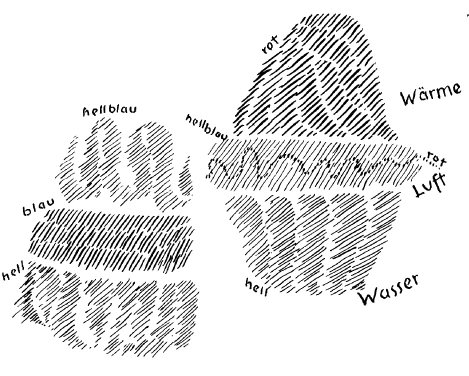
[ 5 ] And now came the Fourth Kingdom, where people live in a realm that, according to our current understanding, consists solely of natural objects and natural processes—a realm where these people felt these natural processes and objects interwoven with the elemental spirits of water and earth. And that was Asia (see illustration).
[ 6 ] Asia represented the lowest spiritual realm, one in which human beings still find themselves. However, the perspective that is common to us today—the one human beings hold in their ordinary consciousness—did not exist in those ancient Eastern times. It would be utterly absurd to think that in those ancient Eastern times people would have had any way of conceiving of spiritless matter anywhere. What we speak of today as oxygen and nitrogen would have been a sheer impossibility to conceive of in those ancient times. Oxygen was the spiritual force that had a life-giving, stimulating effect on what was already alive, accelerating the life of living beings. Nitrogen—which we today imagine to be contained in the air mixed with oxygen—was that spiritual element that interweaves the world and, by acting upon living organic matter, prepares it to absorb the soul within itself. That was the only way people understood oxygen and nitrogen, for example. And that was how they understood all natural processes as connected to the spiritual, because they did not at all share the view that the average person on the street holds today. A few individuals did, and these were precisely the initiates. Other people had a state of consciousness for ordinary, everyday life that was very similar to a waking dream—but precisely a dream state, such as we now experience only in abnormal situations. People went about their lives in this dreamlike state. In this dreamlike state, they approached the meadows, the trees, the rivers, and the clouds, and they saw everything in the same way that one can see and hear in this dream state.
[ 7 ] Just imagine for a moment what might happen there, for example, to a person today. The person has fallen asleep. Suddenly, the image—the dream image—of a blazing stove appears before them. They hear: “Furio!” Outside, the fire truck drives by on its way to put out a fire somewhere. — How vastly different is what dry human reason—as they say—and ordinary sensory perception perceive in this activity of the fire department from what a dream can present to a person. But everything that ancient Eastern humanity experienced was cast in such dreams. Everything that existed outside in the realms of nature was transformed into images. And in these images, people experienced the elemental spirits of water, earth, air, and fire. And that deep, unconscious sleep we have—I mean, the kind where you just lie there like a sack and are completely unaware of yourself—people in those days did not have that. Isn’t that right? That kind of sleep does exist today. But people in those days did not have it; instead, they retained a dim consciousness even during that sleep. While, on the one hand, they were—as we would say today—resting their bodies, the spiritual within them was active in the outer world. And in this activity, they perceived what constitutes the third hierarchy. Asia was perceived in the ordinary waking-dream state—that is, in the everyday consciousness of that time. The third hierarchy was perceived in sleep. And into this sleep would sometimes sink a still dim consciousness—but a consciousness that carved its experiences deep into the human soul. Thus, for these Eastern peoples, there existed this everyday consciousness in which everything was transformed into imaginings and images. They were not as real as those of earlier times—for example, the Atlantean or even the Lemurian era, or the Lunar era—but they were, after all, images that were still present even during this Eastern phase of development.
[ 8 ] So these people had these images. Then, in their states of sleep, they had what they could put into words: When we drift off from ordinary earthly existence, we enter the realm of the Angeloi, Archangeloi, and Archai, and live among them. The soul frees itself from the physical body and lives among the beings of the higher hierarchies.
[ 9 ] At the same time, it was clearly understood that, while living in Asia, one encountered gnomes, undines, sylphs, and salamanders—that is, with the elemental spirits of earth, water, air, and fire—one experienced, in the state of sleep in which the body rested, the beings of the third hierarchy, but at the same time experienced planetary existence, that which lives in the planetary system to which the Earth belongs. — But then, at times, a very special state would enter into the sleep consciousness—where one perceived the third hierarchy—in which the sleeper felt: A completely foreign realm is drawing near to me. Something is drawing me in; something is taking me away from earthly existence. This was not yet felt while one was immersed in the third hierarchy, but as this deeper state of sleep set in, one felt it. In fact, there was never a clear awareness of what happened during this third kind of sleep. But what was experienced from the second hierarchy penetrated deeply, deeply into the whole of human being. And upon waking, the person carried this in their heart, and they said: “I have been blessed by higher spirits who live a life above planetary existence.” — And so these people then spoke of that hierarchy which encompasses the Exusiai, the Kyriotetes, and the Dynamis. — And what I am now telling you was, so to speak, essentially the ordinary consciousness in ancient Asia. The two states of consciousness—waking-sleeping, sleeping-waking—and the sleep into which the third hierarchy penetrated were present in everyone from the very beginning. And some, by virtue of their particular constitutional disposition, experienced this penetration of a deeper sleep, in which the second hierarchy played a role in human consciousness. And the initiates into the Mysteries attained a further state of consciousness. Which one? That is precisely what transcends the ordinary. If one asks: “What state of consciousness did the initiates of that time attain?”—the answer is: the state of consciousness that you always have during the day today. — You develop it naturally during your second and third years of life. The ancient Oriental never arrived at it naturally, but had to cultivate it artificially. He had to cultivate it out of waking dreams and dreaming wakefulness. Whereas, when he went about in his state of waking dreams and dreaming wakefulness, he saw images everywhere that, in a more or less symbolic way, merely represented what we see today with sharp contours, the initiates of that time came to see things as people today see them every day with ordinary consciousness. And the initiates came to learn, through this newly developed consciousness, what every schoolboy and schoolgirl learns today in elementary school. And the difference did not lie in the content being different. Admittedly, those abstract letter forms we have today did not exist back then. The script possessed characteristics that were more intimately connected with the things and events of the world. Nevertheless, in those ancient times, only the initiates learned to write and read, because one can only learn to write and read in the intellectual state of consciousness that is natural today.
[ 10 ] So if you were to imagine that this ancient Oriental world—with people just as they were back then—were to reappear somewhere, and you were to walk among these people with the spiritual nature you possess today, you would all be initiates to those people of that time. The difference does not lie in the content itself. You would be initiates, but the moment you were recognized as such by the people of that time, they would drive you out of the country by any means necessary, because they would realize that, as an initiate, one is not permitted to know things the way people today do. For example—this was the view of that time, and I am characterizing it with this image—one was not allowed, in the opinion of the people of that time, to write the way people of today can write. If I were to put myself in the mindset of someone from that time and such a pseudo-initiate—that is, an ordinary person, an ordinarily intelligent person of the present—were to approach them, that person from that time would say: “He can write; he makes marks on paper that mean something, and he isn’t even aware of how infinitely diabolical it is to do such a thing without carrying within himself the awareness that one may do this only on behalf of the divine world-consciousness, that one may make marks on paper that mean something only if one is aware that: God works in the hands, in the fingers; God works in the soul, so that the soul expresses itself through these letter forms. — This—which does not lie in the diversity of content, but in the human conception of the matter—is precisely what the initiates of ancient times possessed in a completely different way than people today, who possess the same content. If you read my book *Christianity as a Mystical Fact*, which has now been republished, you will find it indicated right at the beginning that this is, in fact, the very essence of the initiate of ancient times. And this is actually always the case in the evolution of the world: What develops naturally within a person in a later era had to be attained through initiation in an earlier era.
[ 11 ] Precisely by describing such things, you will sense the fundamental difference between the state of mind of these ancient Eastern peoples of prehistoric development and the people who later entered civilization. It is indeed a different kind of humanity that called the lowest heaven “Asia” and understood it to mean their own land—the nature that surrounded them. They knew where the outermost heaven was. Compare this with today’s views: how little do people of the present regard what surrounds them as the outermost heaven. Most cannot regard it as such, after all, because they do not know the heavens that lie beyond it either.
[ 12 ] Well, we see, then, that the spiritual penetrated deeply into natural existence in those ancient times. And yet, we encounter something among these people that might seem infinitely barbaric to us in the present day—at least to many of us. To the people of that time, it would have seemed terribly barbaric if someone had been able to write with the kind of attitude that one can write with today. It would have seemed downright diabolical to them. To a large number of people today, however, it certainly seems barbaric in turn that, in that part of Asia, it was considered perfectly natural for a people migrating from west to east to often subjugate—with great cruelty—another people who were already settled, to conquer their land, and to enslave the population. That, in general terms, is the broader content of this Oriental history spanning all of Asia. While these people held a lofty spiritual outlook of the kind I have just described, their external history unfolded as a series of continuous conquests of foreign lands, whose populations were subjugated. This certainly seems barbaric to many people today. And even if wars of conquest still exist in some form today, even those who defend them do not have a completely clear conscience about them. You can already tell this from the justifications for wars of conquest: people do not have a completely clear conscience about them. In those days, people had the very clearest conscience precisely regarding wars of conquest, and they believed that such conquests were, in fact, God’s will. And what later spread across much of Asia as a yearning for peace is actually a late product of civilization. In contrast, the early product of civilization for Asia is the continuous conquest of lands and the subjugation of populations. The further back one looks into prehistoric times, the more one finds this conquest, of which what Xerxes and similar figures did is now merely a shadow.
[ 13 ] But this principle of conquest is, after all, based on something very specific. In those days, precisely because of the states of consciousness among people that I have described to you, human beings were in a completely different situation—both in relation to one another and to the world—than they are today. Certain differences among the world’s populations have now lost their fundamental significance. Back then, they existed in a completely different way than they do today. And so let us consider something that was often a reality as an example.
[ 14 ] Let’s assume that we have the European region here on the left (drawing on page 36) and the Asian region here on the right. A conquering population (red) could have crossed over—even from northern Asia—expanded across some region in Asia, and subjugated the population there (red surrounding yellow).
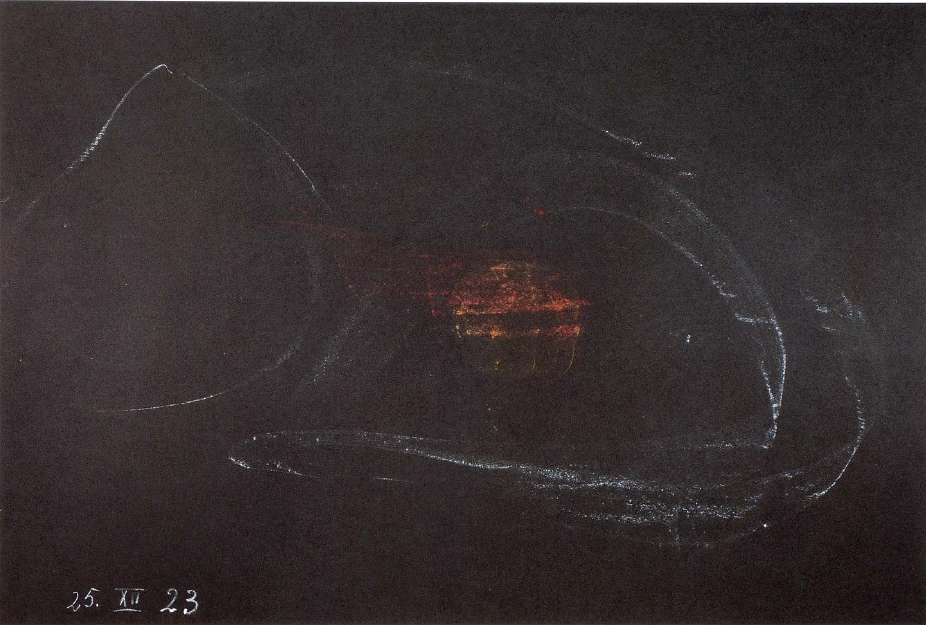
[ 15 ] What was actually going on there? In the cases described, which kept the actual historical development moving forward, the conquering population—whether as a people or a race—was always young—young, full of youthful vigor. Now, what does it mean today, among the people of the current stage of Earth’s development, to be young? Among human beings in the current stage of Earth’s development, being young means carrying within oneself, at every moment of life, enough forces of death to supply the soul forces required by the dying processes of the human being. We do indeed have the sprouting, budding life forces within us; but these do not make us level-headed—rather, they render us powerless and unconscious. The decomposing forces—the forces of death—which are also constantly at work within us, and which are only ever overcome by the life forces during sleep, so that we can only gather all these forces of death together at the end of life in that single moment of death—these forces of death must be constantly present within us. They are what bring about self-control and consciousness. But this is precisely a characteristic of present-day humanity. Such a young race, a young people, suffered from its excessively strong life forces. Whatever was human there constantly had the feeling: I am constantly pressing my blood against the walls of my body. I cannot bear it. My consciousness refuses to become level-headed. I cannot develop my full humanity because of my youth.
[ 16 ] That, however, was not how ordinary people spoke; rather, it was how the initiates into the mysteries spoke—those who at that time still guided and directed all these historical events. And so such a population had too much youth, too much vital energy, and too little of that inner quality that could provide prudence. Then it set out, conquered a territory where an older population lived—one that had already, in some way, absorbed forces of death because it had already fallen into decadence—and subjugated that population. There was no need for a blood relationship to develop between the conquerors and those made into slaves. What took place unconsciously in the soul between the conquerors and the enslaved people had a rejuvenating effect, and it worked toward prudence. And the conqueror, having established his estate where he now kept his slaves, needed only this influence on his consciousness. He need only direct his mind toward these slaves, and—I might say—his soul was tempered in its longing for powerlessness, and consciousness and prudence took hold.
[ 17 ] What we as individuals must achieve today was achieved back then through living together with other people. One needed, so to speak, a population around oneself that possessed greater life-giving forces than a population that was domineering but young and not yet fully mature. They struggled their way up to what they needed as human beings by overcoming another population. And so these ancient Eastern struggles—often so terrible and seeming so barbaric to us today—are nothing other than the very impulses of human development itself. They had to exist. They are the impulses of human development. Humanity could not have developed on Earth had it not been for these terrible struggles and wars, which seem barbaric to us today.
[ 18 ] Those initiated into the mysteries did, in fact, already see the world as it is seen today; they simply associated it with a different state of mind, a different outlook. For them, what they experienced in sharp contours—just as we today experience external things in sharp contours through our sensory perception—was, after all, that which came from the gods, including human consciousness itself. For how did this appear to an initiate of that time?
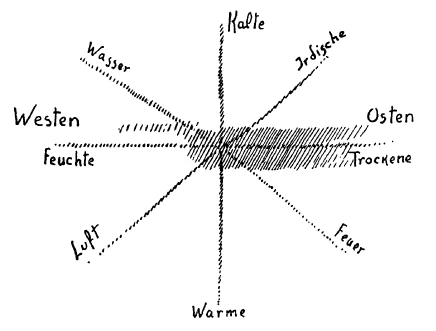
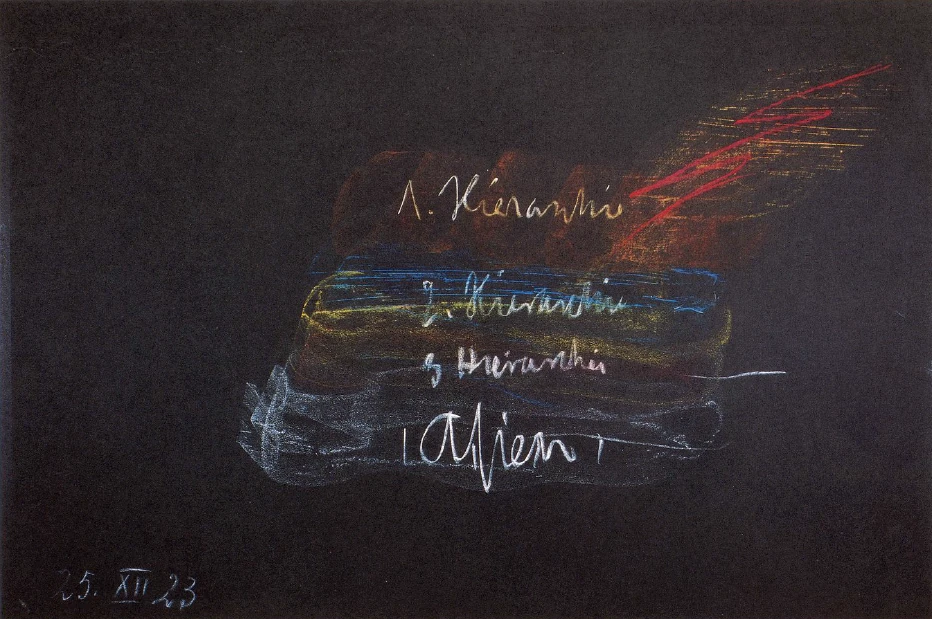
[ 19 ] You see, there might have been, let’s say, a flash of lightning. Let’s use a very vivid image. Well, as you know, people today see it exactly as one sees a flash of lightning (see drawing, above). But people in ancient times did not see it that way. They saw living, spiritual beings moving here (yellow), and the sharp contours of the lightning disappeared completely. It was a military procession or a procession of spiritual beings advancing through or within the cosmos. They did not see the lightning as such. They saw a procession of spirits floating through the cosmos. For the initiate, it was such that they, like other people, also saw this procession; but for their vision—which had been developed within them—as the image of the procession gradually faded and then disappeared, the lightning could emerge in the form that everyone sees today. The whole of nature, as everyone sees it today, had to be attained in ancient times through initiation. But how was this experienced? This, too, was by no means experienced with the indifference with which we regard knowledge or truths today. It was experienced with a distinctly moral dimension. And when we consider what happened to the disciples of the Mysteries, we must say the following: They were initiated into the very view of nature that later became the natural one, accessible to all. Only a few were led to this view of nature through rigorous inner trials and tests. But then they naturally had the following feeling: There is the human being with his ordinary consciousness. He sees this procession of elemental beings riding through the air. But because he has such a view, he is devoid of human free will. He is entirely devoted to the divine-spiritual world. — For in this waking dream, this dreaming wakefulness, the will did not exist as a free will, but as that which flowed into the human being as the divine will. And the initiate, who saw the flash of lightning emerge from these imaginations, felt this so deeply that he learned to say through his initiator: I must be a human being who is also permitted to move in the world without the gods, for whom the gods cast the contents of the world into the indeterminate. — For the initiates, it was, so to speak, that which they saw in sharp contours: the contents of the world cast out by the gods, which the initiate approached in order to become independent of the gods.
[ 20 ] You understand that it would have been an unbearable state of affairs if he had not had some kind of balancing factor. But he did have one. For while the initiate, on the one hand, came to experience Asia as forsaken by God and devoid of spirit, on the other hand he came to know a state of consciousness even deeper than that which extended to the second hierarchy. He came to know, in contrast to his deified world, the world of the Seraphim, Cherubim, and Thrones.
[ 21 ] At a certain stage in Asian development—roughly the middle stage, though we will discuss these periods in greater detail later—the state of consciousness of these people, these initiates, was such that they walked upon the earth and already had, to some extent, the same view of the earthly realms that modern human beings have; but they actually felt this in their limbs. They felt their limbs liberated from the gods within the deified earthly matter. But in return, they encountered in this godless land the high gods of the Seraphim, Cherubim, and Thrones. As an initiate, one no longer merely came to know those gray-green spirit beings who were the images of the forest, the images of the trees; rather, as an initiate, one came to know the forest as spiritless, but one had the compensating experience of encountering in the forest precisely the members of the first hierarchy—some being from the realm of the Seraphim, Cherubim, or Thrones.
[ 22 ] Viewed as a social configuration, all of this is precisely what is essential to the historical development of the ancient Orient. And the driving forces of further development are those that seek a balance between young races and old races, so that the young races can mature through the old ones—precisely through the subjugated souls. And as far as we look toward Asia, we find this everywhere: that young races, which cannot attain prudence on their own, seek that prudence through conquest. But when we turn our gaze from Asia toward Greece, we find that things are different there. Even in the most glorious periods of Greek development, there was a population that, while it understood the process of growing older, did not understand how to imbue that process with full spiritual depth. I have often had to draw attention to that characteristic saying of the wise Greek: “Better to be a beggar in the upper world than a king in the realm of shadows.” — The Greek could not come to terms with death outside and with death within the human being as well. But on the other hand, they carried this death within themselves. And so, for the Greeks, it was not a longing for prudence—which might have existed as an impulse within them—but rather a fear of death. The young Oriental peoples did not feel this fear of death, for they set out on conquests when, as a race, they were unable to experience death in the proper way.
[ 23 ] But the inner conflict that the Greeks experienced in relation to death led, as an inner impulse of humanity, to what is reported to us as the Trojan War. The Greeks did not need to seek death among a foreign people in order to attain composure; rather, precisely because of what they felt about death, the Greeks needed the inner, life-giving mystery of death. And this led to that conflict between the Greeks as such and the people from whom the Greeks had originated in Asia. The Trojan War is a war of anxiety; the Trojan War is a war of fear. We see how, in the Trojan War, the representatives of the Asia Minor priestly culture stand opposed to the Greeks, who already feel death within themselves but do not know what to do with it. The rest of the Oriental population, which set out on conquests, wanted death but did not have it; the Greeks had death but did not know what to do with it. They needed a completely different approach in order to come to terms with death. Achilles, Agamemnon—all these people carry death within themselves but do not know what to do with it. They look across to Asia. And over in Asia, they find a population that is in the opposite situation, one that suffers under the immediate impression of this contrasting state of mind. Over there are those people who do not feel death in such an intense way as the Greeks do, who feel death as something that is, at its core, defiant of life.
[ 24 ] Floszer actually expressed this in a wonderful way. Wherever the Trojans are set against the Greeks—just look at the iconic figures of Hector and Achilles—this contrast is present everywhere. And this contrast expresses what is happening at the border between Asia and Europe. In those ancient times, Asia had, so to speak, a surplus of life over death; it yearned for death. Europe, on Greek soil, had a surplus of death within the human being, which it did not know how to deal with. Thus, Europe and Asia stood opposed to one another from a second perspective: on the one hand, the transition from rhythmic memory to temporal memory; on the other hand, the entirely different experience of death within the human organism.
[ 25 ] Tomorrow we will examine this contrast—which I could only hint at at the end of today’s reflection—in greater detail, in order to gain an understanding of those transitions that have profoundly shaped human development, leading from Asia to Europe; without an understanding of these, it is essentially impossible to comprehend anything about the current development of humanity.