

World History from an Anthroposophical Perspective
and as the foundation of understanding the Spirit in Man
GA 233
26 December 1923, Dornach
Translated by Steiner Online Library
Third Lecture
[ 1 ] It is almost exactly thirteen years to the day that I spoke in Stuttgart as part of a lecture series—which I also gave between Christmas and New Year’s—on the same topic that this lecture series addresses. However, I will have to modify slightly the perspective that prevailed regarding the topic at that time.
[ 2 ] In the two introductory lectures, we have sought to help our souls understand just how profoundly the mental and spiritual constitution of humanity has changed in the course of historical development—and particularly during prehistoric development. This time, too—at least to begin with—we need not go back further than a few millennia. As you know, from the perspective of spiritual science, we regard the period commonly referred to as the time of the Earth’s glaciation—the Younger Ice Age—as the most significant context for historical and prehistoric events since the so-called Atlantean catastrophe that struck the Earth. At that time, however, the final act of the downfall of the Atlantic continent—which today forms the floor of the Atlantic Ocean—was also taking place. And following this Atlantic catastrophe, as has often been pointed out, we have had five successive major cultural epochs up to our own time, the first of which have been completely lost to historical tradition. For what is contained in the writings of the East—including the magnificent Vedas and the profound philosophy of Vedanta—are merely echoes of what must be described if one wishes to portray that cultural epoch of which I always speak as the primordial Indian and primordial Persian eras, as I do in my *Secret Science*.
[ 3 ] Well, we don’t want to go back that far today, but rather we want to focus on the period I have often referred to as the Chaldean-Egyptian cultural period, which preceded the Greek era. We have had to point out that during this time between the Atlantean catastrophe and the Greek era, major changes took place with regard to the capacity for recollection—human memory—and with regard to human coexistence. A memory such as we have today—one that allows us to recall the past—such a sense of time did not yet exist in this third post-Atlantean cultural period; rather, there was a memory bound up with rhythmic experience, as I have described. And this emerged from what was particularly strong during the Atlantean period: localized memory, in which human beings possessed only a consciousness of the present, but had markers—derived from all manner of things they either encountered in the external world or placed there themselves—through which they established a relationship not only with the past of their own personality but with the past of humanity as a whole.
[ 4 ] Landmarks, however, were not only those directly placed on the earth; rather, especially in ancient times, landmarks were also the constellations in the sky—particularly the planetary constellations—from whose repetition or varied repetition one could discern how things had been in times past. Thus, heaven and earth actually worked together to form the external, localized memory of an ancient humanity.
[ 5 ] But this earlier humanity was also, in its entire human constitution, of a different nature than later humanity or even than the humanity of our time. Humanity of our time carries within itself, in the waking state, the “I” and the astral body so imperceptibly within the physical body that most people do not actually notice how this physical body—which is a far more significant organization than the astral body itself—carries the astral body and the “I” organization within itself alongside the etheric body. You are, of course, familiar with these connections. An earlier humanity, however, perceived the reality of its own being quite differently. And we return to such a humanity when we look back to the earlier third post-Atlantean cultural period, the Egyptian-Chaldean period. At that time, human beings still experienced themselves as spirit and soul to a high degree outside their physical and etheric bodies, even while they were awake. They knew how to distinguish: This is what I have within me as my spirit and my soul—we call it the “I” and the astral body—and this is connected to my physical and etheric bodies. Human beings moved through the world as this duality. They did not call their physical body and their etheric body “I”; rather, they initially called only their spirit and soul “I”—that which was spiritual and which was connected downward in a certain way, but in a connection perceptible to them, with the physical and etheric bodies. And within this spirit-soul realm—within this “I” and astral body—human beings perceived the penetration of the divine-spiritual hierarchies, just as human beings today perceive the penetration of natural substances into their physical bodies.
[ 6 ] In this physical body, a human being experiences it in such a way that he knows he is taking in the substances of the outer natural realms through food and breathing. These substances are first outside him, then inside him. They act in such a way that they pass through him and become part of him. At that time, human beings—who sensed a certain separation between their spiritual-soul aspect and their physical-etheric aspect—knew that the angels, archangels, and all the way up to the highest hierarchies were spiritual-substantial beings that now also passed through their spiritual-soul aspect, becoming, if I may put it that way, components of them. So that human beings could say at every moment of their lives: “The gods live within me.” — And they did not conceive of their “I” as built up from below through physical and etheric substances, but rather as something bestowed upon them by grace, coming from above, from the hierarchies. And in a sense, he regarded his physical-etheric body as a burden, as a vehicle, as something he used—like a chariot of life—to move forward in the physical world. Unless one grasps this in the appropriate way with the eye of the soul, one does not truly understand the historical course of human development.
[ 7 ] Now we could trace this historical course of human development using various characteristic examples. Today, let us, so to speak, lay out a thread before us—a thread that I also touched upon thirteen years ago, when I drew upon that historical-mythological document which represents the earliest phase of the development I wish to discuss, namely, the Epic of Gilgamesh. But the Epic of Gilgamesh is, after all, partly legendary, and today I will present the process—which, as I said, I described thirteen years ago—in the way it arises directly from spiritual contemplation.
[ 8 ] There, in a city of the Near East—Uruk, as the Epic of Gilgamesh calls it—we find one of those conquering personalities I spoke of yesterday, who had truly emerged from those spiritual and social conditions of humanity that were characterized yesterday. The epic calls him Gilgamesh. So we are dealing here with a personality who, in the era we are now discussing, was just as I have described him—one who had retained many ancient human characteristics from earlier times. But just as it was clear to this personality at that time that he was, so to speak, the duality between the spiritual-soul aspect, into which the gods reach, and the physical-etheric realm, into which the substances of the Earth and the cosmos—the physical and etheric substances—extend, it is equally a fact that during the time in which this individual, of whom the Epic of Gilgamesh speaks, lived, precisely those characteristic human beings—the representative human beings—were already in a transitional epoch leading to later human development. And this transition consisted in the fact that the ego-consciousness, which relatively shortly before had been situated, so to speak, in the spiritual-soul realm, had descended into the physical-etheric realm, so that Gilgamesh was among those who were beginning to focus not on his spiritual-soul realm—in which the gods were sensed— but rather to that which was earthly-etheric in him. That was this new state of the soul.
[ 9 ] But within this state of the soul—which we can describe as the “I” drawn down from the spiritual-soul realm, the conscious “I” drawn down into the physical-etheric realm—this personality still retained those old habits: that old habit of experiencing—primarily through memory—only what had been experienced in rhythm, and there was that inner feeling that one must become acquainted with the forces of death, because in truth only the forces of death yield what brings a person to a state of composure. Now, precisely because this Gilgamesh personality involved a soul that had already passed through many earthly incarnations but had entered the new form of human existence—as I have just described it—precisely because of this, this personality was, I might say, in a physical existence that carried a certain uncertainty within it. The validity, so to speak, of the habits of the conqueror and of rhythmic memory began to no longer apply to the Earth. And so the experiences of this personality were indeed the experiences of a transitional epoch.
[ 10 ] Thus, when this figure, acting out of old habit, conquered and annexed the very city mentioned in the Epic of Gilgamesh as Uruk, conflicts arose in that city. At first, this individual was not welcome in the city; he was perceived as a stranger and would likely not have been able to cope on his own with all the difficulties that had arisen there. Then, because fate led him there, another individual appeared—the Epic of Gilgamesh calls him Enkidu—an individual who had descended to Earth relatively late from that planetary existence which, as I have described in my *Secret Science*, had guided Earth’s humanity for a time. As you know, during the Atlantean era, souls gradually descended—some earlier, others later—after having withdrawn from Earth into the cosmos and settled on various planets during the very early stages of Earth’s development.
[ 11 ] In Gilgamesh, we are dealing with a personality—an individual—who returned to Earth relatively early and had thus experienced many earthly incarnations during the period I am referring to. As for the other personality, who was also drawn to that city, we are dealing with one who had remained in planetary existence for a relatively long time and only returned to Earth later in life. This can be read from a somewhat different perspective in my lecture series, which was held thirteen years ago in Stuttgart, on “History from the Perspective of Spiritual Science.”
[ 12 ] This personality, then, became close friends with Gilgamesh, and together they were able to establish truly sustainable social conditions in the city of Uruk in the Near East. This was made possible in particular by the fact that this second individual had retained a relatively large amount of the knowledge that had been preserved through a few earthly incarnations from the cosmic sojourn outside Earth. As I already mentioned back then in Stuttgart, this individual possessed a kind of clairvoyance, clairaudience, and claircognizance. And from the convergence of what remained in one personality—the old habits of conquest and a memory attuned to rhythm—and the other personality’s insight into the mysteries of the worlds, the social order of that city in the Near East took shape, just as was usually the case in earlier times. Peace came to this city, happiness came to its inhabitants, and everything would have been in order at first, had it not been for a certain event that redirected the entire course of events in a different direction.
[ 13 ] There was a kind of mystery in that city—the mystery of a goddess—and this mystery held an extraordinary number of the world’s secrets. But in the spirit of the times, it was a kind of—I would say—synthetic mystery, that is, this mystery brought together the most diverse mystery revelations of Asia. And at various times, the contents of the mysteries were cultivated and taught there in a varied, transformed manner. At first, the figure known in the epic as Gilgamesh did not understand this; he accused this place of mystery of teaching contradictory doctrines. And because the accusation came from an authoritative source—for the two figures I am speaking of were, after all, the ones who actually provided the entire city with its order and administration— because the mystery was denounced by such an authoritative source, difficulties arose that ultimately led the mystery priests to turn to those powers to which one could turn in the ancient mysteries. You will not be surprised today to learn that in the ancient mysteries one could indeed turn to the spiritual beings of the higher hierarchies, since I told you yesterday: In ancient Oriental times, Asia was, in fact, merely the lowest heaven, and in this lowest heaven people knew the divine-spiritual beings to be present and communed with them. — This communion was cultivated especially within the Mysteries. And so the priesthood of the Ishtar Mysteries turned to those spiritual powers to which they had always turned when seeking enlightenment, and as a result, these spiritual powers imposed a certain punishment upon the city.
[ 14 ] At the time, this was expressed by saying: Something that is actually a higher spiritual force is at work in Uruk as an animalistic force, as a ghostly animalistic force. — All manner of afflictions befell the inhabitants—physical illnesses, but especially psychological upheavals. And the consequence of this was that the one personality who had allied himself with Gilgamesh—the one called Enkidu in the epic—died as a result of these difficulties, but in fact remained spiritually with this personality on earth even after death to continue the other personality’s mission. Thus, we must understand the later life and development of that personality who bears the name Gilgamesh in the epic as continuing to involve a collaboration between the two distinct personalities—but in such a way that inspirations, and insights received by Gilgamesh from Enkidu in the subsequent period, so that Gilgamesh alone continued to act not only out of his own will, but out of the will of both, out of the convergence of their two wills.
[ 15 ] With this, I have once again presented you with something that was certainly a possibility in those ancient times. The human mind was not as clear-cut in those ancient times as it is today. Therefore, the experience of freedom, as we understand it today, could not exist in that sense back then. It was certainly possible either for a spiritual being who had never incarnated on Earth to act through the will of an earthly personality, or—as was indeed the case with Gilgamesh—for a personality who had already passed through death and was leading a postmortem life to speak and act through the will of a personality on Earth. And so it was with Gilgamesh. And from what arose in this way from the convergence of the two wills, a rather clear realization emerged in Gilgamesh, above all else, of the historical situation in which he actually found himself. Precisely through the influence of the spirit inspiring him, he began to realize that the “I” had descended into the mortal physical body and the etheric body, and the problem of immortality began to play an intensely significant role for Gilgamesh. All his longing was directed toward somehow getting to the bottom of this problem of immortality. The mysteries, which preserved what could be said about immortality on Earth at that time, did not initially reveal themselves to Gilgamesh. These mysteries still held the tradition—and, to a large extent, the living knowledge derived from those traditions—that had existed while primordial wisdom reigned on Earth during the ancient Atlantean era.
[ 16 ] But the bearers of this primordial wisdom, who once walked the Earth as spiritual beings, had long since withdrawn and founded the cosmic colony on the Moon. For it is sheer childishness to believe that the Moon is the lifeless, frozen body that modern physics describes it as being. The Moon is, above all, the cosmic abode of those spiritual beings who were the first great teachers of humanity on Earth, who once brought primordial wisdom to humanity, and who, shortly after the Moon—as a physical celestial body—left the Earth and took its own place in the planetary system, withdrew to this Moon. Those who today, through imaginative insight, have the opportunity to truly come to know the Moon also encounter, within this cosmic colony, those spiritual beings who were once the teachers of humanity’s primordial wisdom on Earth. The mysteries preserved not only what these beings had once taught, but also those impulses through which one can, in a certain sense, come into contact with this primordial wisdom. However, there was no true connection between these mysteries of the Near East, for example, and the figure known as Gilgamesh in the epic. But through the supersensible influence of the friend who was united with Gilgamesh in the postmortem state, an inner urge arose within Gilgamesh to seek out paths in the world through which he might be able to learn something about the immortality of the soul.
[ 17 ] In the Middle Ages, it became customary, when one wished to learn about the spiritual world, to immerse oneself in the inner world of the human being. In more recent times, I would say, an even more inward process has become common. But in those earlier times I am speaking of now, people knew quite precisely: The Earth is not that lump of rock as described, for example, by modern geology, but rather the Earth is a living, animated, spiritual being. — And just as, for example, a small animal, when it runs over a human being, can get to know that person by running over their nose, over their forehead, through their hair, and acquiring knowledge through this journey—so it was in those days that the human being, by setting out on a journey across the Earth, came to know the Earth in its various configurations in different places and thereby gained insights into the spiritual world. They gained these insights, whether or not they were granted access to the mysteries; they gained them nonetheless. And it is by no means a mere coincidence that stories are told of Pythagoras and others like him who undertook great journeys precisely to acquire their knowledge. People traveled the Earth to take in, through the diversity of its configurations, what could be observed in the various forms of the spiritual, soul, and physical Earth at different locations on this planet. Today, people can travel to Africa or Australia, yet—with the exception of the superficialities they gaze at—they experience little that is different from what they experience at home. For human receptivity to the radical differences that exist between various parts of the Earth has simply died out. In the time I am now speaking of, it had not yet died out. And so the very urge to gain something through a journey across the Earth—for the solution to the problem of immortality—was something very significant for Gilgamesh.
[ 18 ] And so he set out on this journey. For him, this journey was, after all, a very, very significant success. He arrived in a region that lies roughly in the same area that has been much discussed in recent times, but which, of course, has changed greatly in terms of its social conditions; he arrived in the region of the so-called Burgenland, over which there had been disputes as to whether it should belong to Zisleithania or to Hungary—in a region of the Burgenland, that is, an ancient mystery. The high priest of this mystery is named Xisuthros in the Epic of Gilgamesh. He encountered an ancient mystery that was a genuine reincarnation of the ancient Atlantean mysteries—naturally in a transformed form, as was to be expected at such a late period.
[ 18 ] And so he set out on this journey. For him, this journey was, after all, a very, very significant success. He arrived in a region that lies roughly in the same area that has been much discussed in recent times, but which, of course, has changed greatly in terms of its social conditions; he arrived in the region of the so-called Burgenland, over which there had been disputes as to whether it should belong to Zisleithania or to Hungary—in a region of the Burgenland, that is, an ancient mystery. The high priest of this mystery is named Xisuthros in the Epic of Gilgamesh. He encountered an ancient mystery that was a genuine reincarnation of the ancient Atlantean mysteries—naturally in a transformed form, as was to be expected at such a late period.
[ 20 ] He wandered along the Danube, southward along the Danube, and then back to his hometown—his chosen hometown. But before he arrived at this home town, he succumbed—because he had received his initiation into the post-Atlantean mystery not in the other way I have described, but in that somewhat difficult way—he succumbed to the first temptation: a terrible outburst of anger over an event that had befallen him, actually something he had heard about what was happening in the city. He heard about it before he arrived in the city. A terrible surge of anger overwhelmed him, and this surge of anger almost completely obscured his enlightenment, so that he arrived without it.
[ 21 ] Nevertheless—and this is what makes this individual so unique—the possibility remained of gaining a glimpse into the spiritual world in connection with the deceased friend, with the spirit of the deceased friend, or at least of receiving messages from the spiritual world. However, it is quite another matter to look directly into the spiritual world through an initiation or to receive messages from a person who is in the postmortem state. Yet one can say that Gilgamesh retained some insight into the nature of immortality. — And I will now set aside what is experienced after death; these events that are experienced there do not yet play a very strong role in the consciousness of subsequent incarnations, whether today or in the past: in the consciousness! Certainly they have a very strong influence on life and on the inner constitution, but not on the consciousness.
[ 22 ] You see, I have described to you two personalities who, together, embody the human state of mind in the third post-Atlantean cultural epoch, roughly at its midpoint; they still lived in such a way that the nature of their lives clearly revealed how human beings consist of a duality. For one of them, Gilgamesh, was indeed aware of this duality, even though he was one of the first to have experienced the descent of the “I”-consciousness—the descent of the “I” into the physical-etheric realm. The other, because he had undergone only a few incarnations on Earth, possessed a clairvoyant insight through which he came to understand that matter, substance, does not exist at all, that everything is spiritual, and that the so-called material realm is merely another form of the spiritual.
[ 23 ] You can imagine: with such a constitution of his being, a person could naturally not think or feel all the things that people think and feel today. His entire way of thinking and feeling was simply different. And what could reach such personalities was, of course, not our modern school system—neither something resembling today’s elementary school system nor the higher school system—but rather, everything that reached people intellectually, culturally, and in terms of civilization flowed from the Mysteries and was communicated in one way or another through all manner of channels to the broadest masses of people. But the true custodians were the priest-sages of the Mysteries.
[ 24 ] Now, what was peculiar about both of the personalities I am speaking of was that, in the incarnation I have just described, their particular nature of soul prevented them from being close to the mysteries—specifically, the mysteries of their surroundings. The one called Enkidu in the Epic of Gilgamesh was close to the mysteries through his stays on other planets; the one called Gilgamesh experienced a kind of initiation into a post-Atlantean mystery, but it bore only partial fruit within him. But all of this had the effect that, within the very being of these personalities, something was felt that made them similar to humanity’s earthly prehistory. Both could ask themselves: How did we come to be? What have we actually experienced in the course of Earth’s evolution? We have become who we are precisely through Earth’s evolution. What have we actually experienced there?
[ 25 ] The question of immortality—which tormented Gilgamesh and with which he wrestled—was, after all, closely intertwined at that time with what lay within the human soul, along with essential insights into prehistoric earthly development. And one could not really think or feel about the immortality of the soul in the sense of that time unless one simultaneously had a certain understanding of how human souls—which were already present even during the Earth’s most ancient phases of development, during the lunar and solar states and so on—had witnessed what later became earthly drawing near to them. One felt that one belonged to the Earth; in order to know oneself, one must understand one’s connection to the Earth.
[ 26 ] Now, the mysteries practiced in all Asian mystery traditions were, first and foremost, cosmic mysteries, whose teachings and wisdom centered specifically on the course of the Earth’s development in relation to the cosmos. In these mysteries, a vivid picture was presented—one that could take root as ideas within people—offering them an overview of how the Earth has developed and how, amid the ebb and flow of the Earth’s substances and forces through the solar, lunar, and terrestrial eras, humanity has evolved alongside all these substances. This was demonstrated with great vitality.
[ 27 ] One of the mystery cults in which such rituals were performed had survived until very late times. It is the mystery sanctuary of Ephesus, the sanctuary of Artemis of Ephesus. This mystery sanctuary of Ephesus was such that it had the image of the goddess Artemis at its center. When someone today looks at the replicas of the goddess Artemis of Ephesus, they are left with only the grotesque impression of a female figure with prominent breasts, because they have no idea how such things were experienced in ancient times. It was the experience of these things that mattered in ancient times. The initiates of the mysteries had to undergo preparations that led them to the very center of the mysteries. The center of these Ephesian Mysteries was this image of Artemis. When they were led to this center, they became one with such an image. Standing before this image, the person ceased to have the awareness that he was something inside his own skin. He gained the awareness that he was what the image was. He identified with the image. And this identification in consciousness with the divine image at Ephesus had the effect that one no longer looked upon the earthly realms surrounding one—stones, trees, rivers, clouds, and so on—but by feeling one’s way into the image of Artemis, one gained an inner perception of one’s connection with the etheric worlds. One felt at one with the world of the stars, with the processes taking place in the world of the stars. One did not feel the earthly materiality within one’s human skin; one felt one’s cosmic existence. One felt oneself to be in the etheric.
[ 28 ] And through this sense of being in the etheric realm, it became clear what the earlier states of human experience on Earth—and of earthly experience itself—had been. Today we view the Earth as, as I said, a kind of rocky mass that carries water over a large part of its surface, surrounded by an atmosphere containing oxygen, nitrogen, and other substances—above all, what human beings need to breathe, and so on. And when people today begin to speculate, observe, and interpret their observations within the framework of current scientific knowledge—then something true does emerge! For what preceded these present-day conditions in the most ancient times can only be attained through spiritual insight. But such spiritual insight into the primordial states of the Earth and humanity dawned on the disciples of Ephesus when they identified with the image of the gods, and they came to recognize how what is now the Earth’s atmosphere was not always as it is today, but rather—in the Earth’s environment where the atmosphere now exists—was an extraordinarily fine, liquid, and volatile protein substance. So that everything that lived on Earth required, for its formation, the forces of this protein substance—which was a volatile liquid spreading over the Earth—and also lived within it. And one observed how that which was already present in this protein substance in a certain sense—finely dispersed, yet with a definite tendency to crystallize everywhere (see drawing, reddish)—which existed in a finely dispersed state as silicic acid, constituted a kind of sensory organ of the Earth that absorbed within itself the imaginations and influences coming from all over the cosmos. Thus, within the silica content of the Earth’s protein-like atmosphere, there were everywhere real, externally existing imaginations.
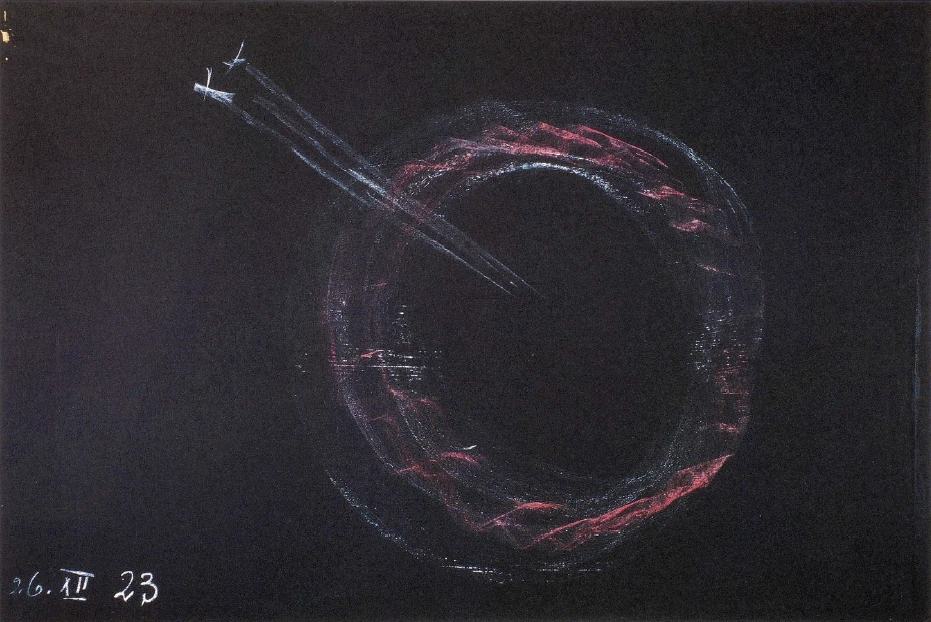
[ 29 ] These imaginations took the form of gigantic plant organisms, and from what appeared to the earthly realm as imaginations, the plant kingdom later developed through the absorption of atmospheric substance, initially in a volatile, liquid form in the Earth’s vicinity. Only later did it sink into the ground and become what would later be the plant kingdom. And in addition to the silica-containing matter, finely dispersed calcareous material was embedded in this albuminous atmosphere. From the calcareous material, in turn, the animal kingdom arose under the influence of the coagulation of this protein. And human beings felt themselves to be part of all of this. Human beings felt that in primeval times they were one with the entire Earth. They lived within what took shape in the Earth as plants through imagination; they lived within what took shape in the earthly realm as the animal kingdom, just as I have just described. Every human being essentially perceived himself as extending across the entire Earth, as one with the Earth. Thus, as I have described in relation to the human capacity for ideas in my book *Christianity as a Mystical Fact* with regard to the Platonic teaching, human beings were intertwined.
[ 30 ] You see, fate decreed that those two individuals I spoke of back then in Stuttgart—and of whom I am speaking again now—were once more embodied as participants in the Ephesian Mystery, and that they took what I have now outlined deeply into their souls. In a certain sense, this led to an inner consolidation of their souls. Through the Mystery, they now absorbed as earthly wisdom what had previously been accessible to them only through experience—and largely through unconscious experience. Thus, the experience of the human condition was distributed across two separate incarnations for these individuals. As a result, however, they carried within themselves a strong awareness of humanity’s connection to the higher, spiritual world, yet at the same time a strong, intense sensitivity to all that is earthly.
[ 31 ] For you see, when these two things are always intertwined—when one cannot distinguish between them—then they blur into one another; but when they are clearly distinct, then one can judge each by the other. And so these two personalities were able, on the one hand, to assess the spiritual aspect of the higher world that arose from life—which lived within them as an echo of their earlier incarnations. And now that the matter had been handed down to them in the mystery, in the Ephesian mystery under the influence of the goddess Artemis, they were now able to assess how things on Earth came into being apart from human beings, how the non-human on Earth gradually developed out of an original substantial reality that encompassed human beings as well. As a result, the lives of these very personalities—which partly still fell within the period when Heraclitus lived in Ephesus, but then extended into a later era—became lives of particular inner richness, lives deeply permeated by the mysteries of the world. And a strong awareness also arose of how human beings, in their soul life, can be connected not merely to what extends horizontally across the earth, but to what extends upward when human beings stretch their being upward. And this inner soul configuration—which these two personalities, who had worked together during the earlier Egyptian-Chaldean period and who then lived together during the time of Heraclitus, so to speak, though somewhat later, in connection with the Ephesian Mystery—allowed this collaboration to continue. The soul configuration that had developed in both of them then passed through death, passed through the spiritual world, and prepared itself for an earthly life in which, fundamentally speaking, many things were bound to become problems—in various ways, of course. And it is precisely in the way these two personalities had to position themselves within the historical course of Earth’s development that one sees how, through the souls’ experiences from earlier times—which then continue karmically into later Earth lives—things are prepared that later appear in entirely different metamorphoses of incorporation into the development of Earth humanity.
[ 32 ] And I cite this example for the reason that these two figures appeared during an extraordinarily important epoch of historical development, which I also pointed out at the time in Stuttgart. For in fact, I had already discussed all these matters from a certain perspective thirteen years ago. These figures, who had thus passed through a vast world life during the Egyptian-Chaldean epoch and who subsequently deepened this world life inwardly—so that their souls had, in a certain sense, become consolidated—these figures were reborn in later incarnations as Aristotle and Alexander the Great. And only when one takes these underlying currents in the souls of Aristotle and Alexander the Great into account can one—as I have already outlined in Stuttgart in that historical chapter—understand what actually constituted that which, at that time, manifested in such a problematic way in these personalities during the decadence of Greek civilization at the dawn of Roman -Roman rule—and what subsequently worked through these figures. We will continue to discuss this tomorrow in the next lecture.